5G Private Networks for Industrial IoT Deployment Corporate Training Program
Edstellar's instructor-led 5G Private Networks training equips professionals to plan, deploy, and manage private 5G networks for industrial IoT environments. Participants gain expertise in network architecture, edge computing, slice management, security, and operational technology integration.
(Virtual / On-site / Off-site)
Available Languages
English, Español, 普通话, Deutsch, العربية, Português, हिंदी, Français, 日本語 and Italiano
Drive Team Excellence with 5G Private Networks for Industrial IoT Deployment Corporate Training
Empower your teams with expert-led on-site, off-site, and virtual 5G Private Networks for Industrial IoT Deployment Training through Edstellar, a premier corporate training provider for organizations globally. Designed to meet your specific training needs, this group training program ensures your team is primed to drive your business goals. Help your employees build lasting capabilities that translate into real performance gains.
5G Private Networks for Industrial IoT Deployment addresses the growing demand for dedicated, low-latency wireless infrastructure in manufacturing, logistics, energy, and smart industry environments. Private 5G networks provide organizations with full control over spectrum, coverage, security, and quality of service, enabling reliable connectivity for autonomous robots, machine vision systems, remote monitoring, and real-time process automation. This training covers the full spectrum of 5G private network planning, architecture, deployment, integration with operational technology, and operational management for industrial IoT use cases.
Edstellar's 5G Private Networks for Industrial IoT Deployment Instructor-led course offers virtual/onsite training options to meet professionals' diverse needs. This flexibility ensures that professionals and teams can engage in learning experiences that best suit their logistical and learning preferences. What sets the Edstellar course apart is its emphasis on practical experience, with hands-on labs and real-world industrial deployment scenarios that prepare participants to confidently design and operate private 5G networks in demanding industrial environments.

Key Skills Employees Gain from Instructor-led 5G Private Networks for Industrial IoT Deployment Training
5G Private Networks for Industrial IoT Deployment skills corporate training will enable teams to effectively apply their learnings at work.
- 5G Private Network Architecture Design
- Industrial IoT Network Planning
- Network Slicing and QoS Management
- Edge Computing Integration
- OT/IT Network Convergence
- 5G Network Security Implementation
- Industrial IoT Device Management
Key Learning Outcomes of 5G Private Networks for Industrial IoT Deployment Training Workshop
Upon completing Edstellar’s 5G Private Networks for Industrial IoT Deployment workshop, employees will gain valuable, job-relevant insights and develop the confidence to apply their learning effectively in the professional environment.
- Master 5G private network architecture principles, including standalone and non-standalone deployment models, spectrum options, and radio access network design for industrial IoT environments.
- Gain expertise in network slicing and quality of service management by configuring dedicated virtual network resources to meet latency, reliability, and bandwidth requirements of industrial applications.
- Develop proficiency in edge computing integration, deploying MEC nodes to process industrial IoT data locally and enable real-time decision-making for time-critical automation systems.
- Learn OT/IT convergence strategies for connecting 5G private networks to SCADA, PLC, and industrial protocol environments while maintaining operational continuity and security.
- Build comprehensive 5G network security skills, implementing authentication, encryption, network isolation, and threat detection tailored to industrial operational environments.
- Apply industrial IoT device management practices, covering onboarding, provisioning, monitoring, and lifecycle management for large-scale device deployments on private 5G networks.
Key Benefits of the 5G Private Networks for Industrial IoT Deployment Group Training
Attending our 5G Private Networks for Industrial IoT Deployment group training classes provides your team with a powerful opportunity to build skills, boost confidence, and develop a deeper understanding of the concepts that matter most. The collaborative learning environment fosters knowledge sharing and enables employees to translate insights into actionable work outcomes.
- Understand 5G private network fundamentals by learning standalone and non-standalone architectures, spectrum options, and deployment models suited for industrial environments.
- Plan industrial IoT network topologies by mapping device densities, coverage requirements, and latency targets to 5G private network design parameters.
- Configure network slicing to allocate dedicated virtual network resources for specific industrial applications such as robotics, AGVs, and machine vision systems.
- Deploy multi-access edge computing (MEC) nodes to process industrial IoT data locally, reducing latency and bandwidth consumption for time-critical applications.
- Integrate 5G private networks with operational technology (OT) systems including SCADA, PLCs, and industrial protocols such as PROFINET and OPC-UA.
- Implement end-to-end 5G network security frameworks covering authentication, encryption, network isolation, and threat detection for industrial environments.
- Manage industrial IoT device onboarding, provisioning, and lifecycle management within private 5G network environments at scale.
- Monitor 5G private network performance using KPIs including throughput, latency, packet loss, and availability tailored to industrial SLA requirements.
- Apply spectrum management strategies using licensed, shared, and unlicensed bands to optimize 5G private network capacity and interference management.
- Design resilient and redundant 5G private network architectures to ensure high availability and failover capabilities for mission-critical industrial operations.
Topics and Outline of 5G Private Networks for Industrial IoT Deployment Training
Our virtual and on-premise 5G Private Networks for Industrial IoT Deployment training curriculum is structured into focused modules developed by industry experts. This training for organizations provides an interactive learning experience that addresses the evolving demands of the workplace, making it both relevant and practical.
-
5G Technology Overview
- Evolution from 4G LTE to 5G
- 5G NR key features and capabilities
- 5G frequency bands and spectrum
- Standalone vs non-standalone architecture
-
Private Network Concepts
- What is a private 5G network
- Public vs private network comparison
- Deployment models overview
- Business drivers for private 5G
-
Industrial IoT Requirements
- IIoT use case categories
- Latency and reliability requirements
- Device density and coverage needs
- Mission-critical application demands
-
5G for Industrial Applications
- Manufacturing automation use cases
- Logistics and warehousing applications
- Energy sector IoT deployments
- Smart infrastructure use cases
-
Regulatory and Spectrum Framework
- Licensed spectrum options
- Shared spectrum frameworks (CBRS, DECT)
- Unlicensed band options
- Regional regulatory considerations
-
Private 5G Ecosystem
- Key vendors and solution providers
- Hyperscaler 5G offerings
- Open RAN ecosystem
- Industry partnerships and standards
-
Core Network Architecture
- 5G core (5GC) components
- Control plane and user plane separation
- Network function virtualization
- On-premise vs cloud-hosted core
-
Radio Access Network Design
- Small cell and macro cell planning
- Antenna selection for industrial environments
- Indoor and outdoor coverage design
- Interference management strategies
-
Deployment Model Selection
- Fully on-premise private network
- Hybrid on-premise and cloud model
- Network slicing from public operator
- Criteria for deployment model choice
-
Transport and Backhaul Design
- Fronthaul and midhaul architecture
- Fiber and microwave backhaul options
- Latency budget planning
- Redundancy and failover design
-
Capacity and Coverage Planning
- Traffic modeling for IIoT
- Cell planning tools and methods
- RF propagation modeling
- Coverage validation techniques
-
Architecture Documentation
- Network architecture diagram standards
- Bill of materials development
- Design review process
- Vendor architecture alignment
-
Network Slicing Fundamentals
- What is network slicing
- Slice types for industrial use cases
- Slice lifecycle management
- Multi-slice resource orchestration
-
QoS Framework Design
- 5G QoS identifier (5QI) parameters
- Guaranteed bit rate flows
- Non-GBR QoS management
- QoS policy enforcement
-
Slice Configuration for IIoT
- URLLC slice for critical control
- eMBB slice for high-bandwidth video
- mMTC slice for sensor networks
- Slice-specific SLA definitions
-
Traffic Prioritization
- Scheduling algorithms in 5G
- Pre-emptive scheduling for critical traffic
- Traffic classification methods
- Congestion management strategies
-
SLA Monitoring for Slices
- Per-slice KPI tracking
- SLA breach detection
- Automated slice resource adjustment
- SLA reporting to stakeholders
-
Slice Optimization
- Dynamic resource reallocation
- AI-driven slice optimization
- Load balancing across slices
- Slice performance benchmarking
-
Multi-Access Edge Computing Fundamentals
- MEC architecture and principles
- MEC use cases in industrial IoT
- ETSI MEC standards overview
- MEC vs cloud processing trade-offs
-
MEC Platform Deployment
- MEC host hardware selection
- Containerized application deployment
- MEC orchestration platforms
- Integration with 5G core
-
Edge Application Design
- Latency-sensitive application patterns
- Data preprocessing at the edge
- AI/ML inference at the edge
- Edge-to-cloud data flow management
-
Industrial IoT Edge Use Cases
- Real-time machine vision processing
- Predictive maintenance at the edge
- AGV and robotics control
- Energy consumption optimization
-
Edge Security
- Securing edge compute nodes
- Application isolation and sandboxing
- Data protection at the edge
- Edge node authentication
-
Edge Performance Monitoring
- MEC performance KPIs
- Latency measurement techniques
- Resource utilization monitoring
- Edge node health management
-
OT/IT Convergence Fundamentals
- Understanding OT and IT environments
- Convergence drivers and challenges
- Purdue model and ISA-95 reference
- 5G as convergence enabler
-
Industrial Protocol Landscape
- PROFINET and PROFIBUS overview
- OPC-UA for industrial communication
- Modbus and EtherNet/IP protocols
- Time Sensitive Networking (TSN)
-
Protocol Integration Strategies
- Protocol gateway and translation
- OPC-UA over 5G connectivity
- Industrial data broker design
- Integration testing methodologies
-
SCADA and PLC Connectivity
- Connecting SCADA systems over 5G
- PLC remote access via private 5G
- Control loop latency requirements
- Failover and redundancy for control
-
Industrial Network Segmentation
- Network segmentation for OT safety
- Demilitarized zone (DMZ) design
- Micro-segmentation strategies
- Segment access control policies
-
Change Management for OT Teams
- OT team readiness assessment
- Training and upskilling OT engineers
- Managing OT/IT cultural differences
- Governance for converged networks
-
5G Security Architecture
- 5G security principles and standards
- 3GPP security specifications
- Security domains in 5G networks
- Security for industrial environments
-
Authentication and Access Control
- 5G authentication frameworks
- SIM and eSIM management
- Device identity management
- Role-based network access
-
Data Encryption and Protection
- Over-the-air encryption standards
- User plane integrity protection
- Signaling plane security
- End-to-end data protection
-
Network Isolation and Segmentation
- Private network isolation controls
- Slice security boundaries
- Firewall and IDS integration
- Zero trust principles for 5G
-
Threat Detection and Response
- Industrial IoT threat landscape
- Anomaly detection for network traffic
- SIEM integration for 5G events
- Incident response for network attacks
-
Security Compliance and Auditing
- IEC 62443 for industrial security
- NIST cybersecurity framework alignment
- Security audit methodologies
- Compliance documentation practices
-
IIoT Device Landscape
- Types of industrial IoT devices
- 5G-capable device categories
- Device hardware selection criteria
- Device certification requirements
-
Device Onboarding and Provisioning
- Zero-touch provisioning for IIoT
- SIM and eSIM profile management
- Device registration and enrollment
- Bulk onboarding workflows
-
Device Lifecycle Management
- Firmware and software update management
- Remote configuration management
- Device health monitoring
- End-of-life and decommissioning
-
Connectivity Management
- Device attach and detach procedures
- Mobility and handover management
- Power class optimization
- Connectivity troubleshooting
-
IoT Data Collection and Management
- Sensor data collection strategies
- Data buffering and local storage
- MQTT and AMQP protocol use
- Time-series data management
-
Scalability for Large Deployments
- Scaling to thousands of devices
- Group-based device management
- Automation in device operations
- Capacity planning for device growth
-
Deployment Planning and Preparation
- Site survey and assessment
- Deployment timeline and milestones
- Permits and regulatory approvals
- Logistics and equipment staging
-
Radio Network Installation
- Base station installation procedures
- Antenna mounting and alignment
- Cable management and power
- Installation safety protocols
-
Core Network Setup
- Core network software installation
- Network function configuration
- Subscriber profile management setup
- Core-to-RAN interface commissioning
-
Network Testing and Validation
- RF performance testing
- End-to-end connectivity testing
- KPI benchmark validation
- Industrial application acceptance testing
-
Integration Testing with OT Systems
- OT system connectivity testing
- Protocol integration validation
- Control loop performance testing
- Failover and redundancy testing
-
Go-Live and Handover
- Go-live checklist and criteria
- Operational team handover
- Documentation and knowledge transfer
- Warranty and support setup
-
Network Operations Center Setup
- NOC architecture for private 5G
- Monitoring tool selection
- Alarm management framework
- Shift and on-call procedures
-
Performance Monitoring
- Key 5G network performance indicators
- Industrial SLA KPI tracking
- Throughput and latency dashboards
- Availability and reliability metrics
-
Fault Management
- Fault detection and classification
- Root cause analysis workflows
- Escalation and resolution procedures
- MTTR tracking and improvement
-
Capacity Management
- Capacity utilization monitoring
- Forecasting for growth
- Spectrum management operations
- Hardware and software upgrade planning
-
Configuration Management
- Configuration baseline management
- Change management procedures
- Software version control
- Configuration audit and compliance
-
Automation in Network Operations
- Self-optimizing network (SON) features
- AI-driven network analytics
- Automated troubleshooting workflows
- Zero-touch network operations
-
Smart Factory Applications
- Connected production line control
- Collaborative robot (cobot) connectivity
- Digital twin connectivity
- Remote expert assistance
-
Autonomous Logistics
- Automated guided vehicle (AGV) management
- Drone fleet coordination
- Real-time location systems (RTLS)
- Warehouse automation integration
-
Critical Infrastructure Monitoring
- Energy grid sensor networks
- Water and utility monitoring
- Pipeline and asset monitoring
- Emergency response communications
-
5G Advanced and 6G Outlook
- 5G Advanced (Release 18+) features
- RedCap for IoT optimization
- 6G research directions
- Preparing for next-generation networks
-
Open RAN for Private Networks
- O-RAN architecture overview
- Open RAN vendor ecosystem
- Disaggregated deployment benefits
- Open RAN deployment considerations
-
ROI and Business Case for Private 5G
- Total cost of ownership analysis
- Productivity and efficiency metrics
- Safety and compliance value
- Building the executive business case
Who Can Take the 5G Private Networks for Industrial IoT Deployment Training Course
The 5G Private Networks for Industrial IoT Deployment training program can also be taken by professionals at various levels in the organization.
- Network Engineer
- IoT Solutions Architect
- Telecommunications Engineer
- Industrial Automation Engineer
- IT Infrastructure Manager
- OT Systems Engineer
Prerequisites for 5G Private Networks for Industrial IoT Deployment Training
Professionals should have a solid understanding of telecommunications fundamentals, networking protocols, and IoT architecture concepts, along with familiarity with industrial environments or operational technology systems, to take the 5G Private Networks for Industrial IoT Deployment training course.
Corporate Group Training Delivery Modes
for 5G Private Networks for Industrial IoT Deployment Training
At Edstellar, we understand the importance of impactful and engaging training for employees. As a leading 5G Private Networks for Industrial IoT Deployment training provider, we ensure the training is more interactive by offering Face-to-Face onsite/in-house or virtual/online sessions for companies. This approach has proven to be effective, outcome-oriented, and produces a well-rounded training experience for your teams.


.webp)
Edstellar's 5G Private Networks for Industrial IoT Deployment virtual/online training sessions bring expert-led, high-quality training to your teams anywhere, ensuring consistency and seamless integration into their schedules.
.webp)
Edstellar's 5G Private Networks for Industrial IoT Deployment inhouse face to face instructor-led training delivers immersive and insightful learning experiences right in the comfort of your office.
.webp)
Edstellar's 5G Private Networks for Industrial IoT Deployment offsite face-to-face instructor-led group training offer a unique opportunity for teams to immerse themselves in focused and dynamic learning environments away from their usual workplace distractions.
Explore Our Customized Pricing Package
for
5G Private Networks for Industrial IoT Deployment Corporate Training
Looking for pricing details for onsite, offsite, or virtual instructor-led 5G Private Networks for Industrial IoT Deployment training? Get a customized proposal tailored to your team’s specific needs.
64 hours of group training (includes VILT/In-person On-site)
Tailored for SMBs
Tailor-Made Trainee Licenses with Our Exclusive Training Packages!
160 hours of group training (includes VILT/In-person On-site)
Ideal for growing SMBs
Tailor-Made Trainee Licenses with Our Exclusive Training Packages!
400 hours of group training (includes VILT/In-person On-site)
Designed for large corporations
Tailor-Made Trainee Licenses with Our Exclusive Training Packages!
Unlimited duration
Designed for large corporations
Edstellar: Your Go-to 5G Private Networks for Industrial IoT Deployment Training Company
Experienced Trainers
Our trainers bring years of industry expertise to ensure the training is practical and impactful.
Quality Training
With a strong track record of delivering training worldwide, Edstellar maintains its reputation for its quality and training engagement.
Industry-Relevant Curriculum
Our course is designed by experts and is tailored to meet the demands of the current industry.
Customizable Training
Our course can be customized to meet the unique needs and goals of your organization.
Comprehensive Support
We provide pre and post training support to your organization to ensure a complete learning experience.
Multilingual Training Capabilities
We offer training in multiple languages to cater to diverse and global teams.
What Our Clients Say
We pride ourselves on delivering exceptional training solutions. Here's what our clients have to say about their experiences with Edstellar.
"Edstellar's virtual 5G Private Networks training gave our telecom and IoT teams a clear roadmap for deploying private 5G in our factories. Twelve network engineers and IoT architects completed the three-week program, gaining in-depth knowledge of network slicing, edge computing, and OT/IT integration. We successfully piloted a private 5G network that reduced machine downtime by 32% through real-time predictive monitoring."
Stefan Holz
Head of Industrial Networks,
A Global Manufacturing Company
"The onsite 5G Private Networks training by Edstellar was exactly the technical depth our team required. Twenty network engineers and OT specialists attended a four-day workshop covering 5G architecture, security, and industrial protocol integration. We deployed a private 5G network across two production sites, enabling AGV automation that improved throughput by 25% and reduced logistics errors by 40%."
Yuki Tanaka
Director of Smart Factory Initiatives,
A Global Electronics Manufacturer
"Edstellar's off-site 5G IIoT training was transformative for our infrastructure team. Over five intensive days, fifteen engineers and architects covered private 5G design, MEC deployment, network slicing, and security for industrial environments. We launched a private 5G deployment for our oil and gas monitoring operations, achieving 99.99% connectivity uptime and enabling real-time sensor analytics that reduced inspection costs by 35%."
Carlos Mendoza
VP of Digital Infrastructure,
A Global Energy Company
"Edstellar's IT & Technical training programs have been instrumental in strengthening our engineering teams and building future-ready capabilities. The hands-on approach, practical cloud scenarios, and expert guidance helped our teams improve technical depth, problem-solving skills, and execution across multiple projects. We're excited to extend more of these impactful programs to other business units."
Aditi Rao
L&D Head,
A Global Technology Company
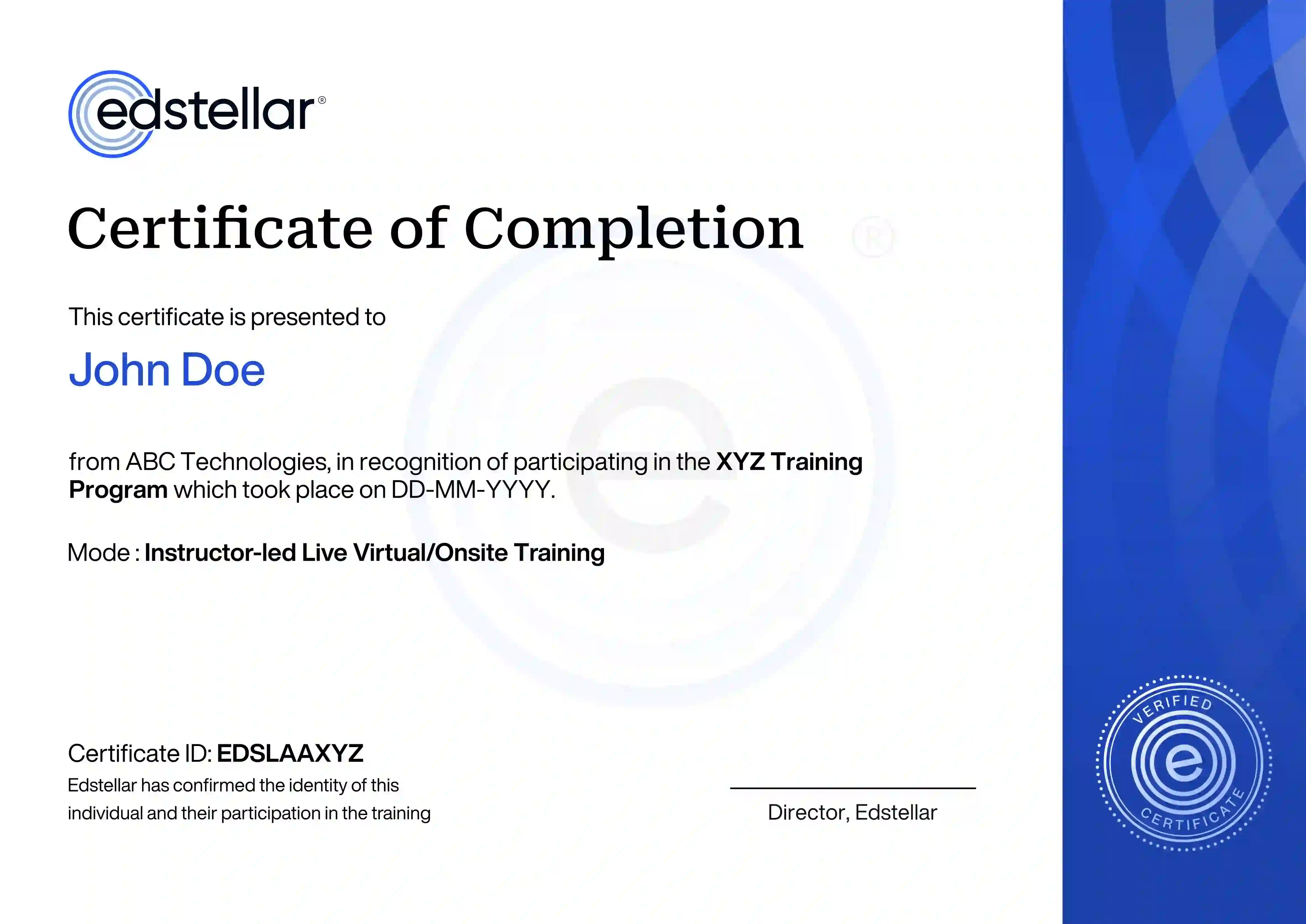
Get Your Team Members Recognized with Edstellar’s Course Certificate
Upon successful completion of the training course offered by Edstellar, employees receive a course completion certificate, symbolizing their dedication to ongoing learning and professional development.
This certificate validates the employee's acquired skills and is a powerful motivator, inspiring them to enhance their expertise further and contribute effectively to organizational success.


Other Related Corporate Training Courses
Edstellar is a one-stop instructor-led corporate training and coaching solution that addresses organizational upskilling and talent transformation needs globally.
Marketing Excellence
Operational Excellence
Finance Excellence
HR Excellence
IT Excellence
Customer Service
Leadership Excellence
Quality Management
Software
How it WorksFAQ'sCorporate Training
CatalogStellar AI
Skill MatrixHRMS Integration
Who we ServeCEO RetreatsPricingTraining DeliveryPartner with Edstellar
CareersContact us