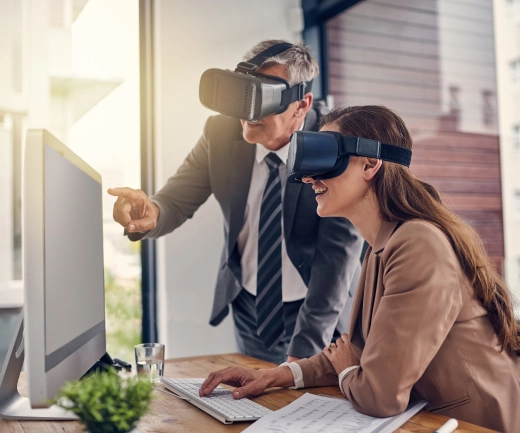
















Assess
We analyze the training need, audience, risk profile, and organizational readiness. The output is a modality selection recommendation backed by a cost-benefit analysis and technology readiness assessment.
Your people can't learn to lead, operate, sell, or make critical decisions from a PowerPoint deck. As a leading simulation training consulting firm, Edstellar designs and deploys immersive VR/AR experiences, digital business simulations, scenario-based role-plays, and custom case studies that put learners inside the situation, where they practice, fail safely, and build the judgment that only experience creates. We're modality-agnostic: we match the right experiential format to the right use case, so you invest where immersive training delivers real impact.


Lectures and slides transfer knowledge but can't develop the decision-making reflexes, situational awareness, and procedural muscle memory that complex roles demand. Surgeons, leaders, plant operators, and sales professionals need to practice, not just listen.
You can't let new hires practice emergency response on live production floors, clinicians rehearse rare procedures on patients, or leaders navigate a restructuring on real teams. Without safe practice environments, learners face their first critical moment unprepared.
Standard eLearning modules produce passive engagement, learners click "next" until the completion certificate appears. There is no meaningful practice, no consequence for wrong decisions, and no behavioral change. The content is forgotten within days.
Organizations adopt VR because it's innovative, not because it's the right fit. Without a modality strategy, they spend $200K on a VR experience where a $30K desktop simulation would deliver the same result, or worse, use a cheap eLearning module where immersive VR is actually essential.
Finance, strategy, and operational decision-making are taught through spreadsheets and case presentations, not through simulated business environments where decisions have visible P&L consequences. Leaders manage real budgets without ever practicing in a safe simulation.
Off-the-shelf case studies from business school libraries don't reflect your industry, your competitive landscape, or your strategic challenges. Learners disengage because the scenarios feel abstract and irrelevant to their daily decisions.
Experiential learning isn't one format, it's a spectrum. From the visceral realism of virtual reality to the strategic depth of a decision-point case study, Edstellar's experiential learning design consultants select the right experiential format for every skill your organization needs to build.
Digital and board-based simulations that recreate business scenarios, operational processes, and interpersonal situations. Learners make decisions, see consequences, and build competence through repeated practice, on desktop, mobile, or in person. No VR headset required.
Virtual reality immerses learners in fully digital environments for high-risk, high-stakes, or hard-to-replicate training. Augmented reality overlays digital guidance onto physical workspaces for on-the-job performance support. Together, they make the impossible practicable.
Custom case studies and experiential learning exercises built from real organizational scenarios, not generic textbook cases. Harvard-method decision cases, competitive team exercises, and facilitated simulations that develop strategic thinking, business judgment, and cross-functional leadership.
Assess which training needs are best served by VR, AR, desktop simulation, business simulation, or case study. We build the modality selection framework, develop the business case, and create the implementation roadmap, before a single simulation is designed.
Modality-fit assessment
Business case development
Technology readiness audit
Implementation roadmap

Custom virtual reality and augmented reality training experiences for high-risk, high-stakes, or hard-to-replicate scenarios. From scenario design and 3D environment creation through user testing, pilot deployment, and enterprise-wide rollout.
VR scenario design
3D environment development
AR overlay creation
Multi-hardware deployment

Digital and board-based business simulations that teach financial acumen, strategic thinking, leadership decision-making, sales strategy, and cross-functional collaboration through competitive, consequence-driven gameplay.
Business acumen games
Leadership simulations
P&L decision engines
Competitive team formats

Branching-scenario digital experiences, AI-powered conversational role-plays, software system simulations, and interactive decision-point exercises. All desktop and browser-based, deployable at scale without VR hardware.
Branching scenarios
AI role-play engines
Software simulations
Dynamic data systems

Harvard-method business case studies, industry-specific decision cases, and facilitated experiential exercises built from your organization's real challenges, strategy, and competitive landscape, not off-the-shelf generic cases.
Custom decision cases
Industry scenario writing
Facilitator guides
Assessment rubrics

Points, leaderboards, badges, competitive mechanics, and full game-based learning experiences integrated into simulation programs to drive engagement, completion, and knowledge retention across any modality.
Engagement mechanics design
Leaderboard systems
Badge/reward frameworks
Full game development

.webp)
.webp)


.webp)
10-20 page structured case documents written from the perspective of a real decision-maker facing a genuine business challenge. Each case follows the Harvard Business School methodology refined over 100+ years.
Multi-team experiential exercises where groups represent competing companies, departments, or stakeholder groups. Teams make parallel decisions, negotiate across groups, and see how collective choices shape outcomes.
Focused case exercises (3-8 pages) built around industry challenges: regulatory dilemmas, market disruptions, operational crises, and technology adoption decisions. Designed for 45-90 minute workshop settings.
.webp)
Strategic integration of game mechanics into existing training programs: leaderboards, badge systems, progress bars, streak counters, and team challenges. Every mechanic mapped to a specific learning behavior.
Complete learning games, digital or physical, where the game IS the learning. Business simulation board games, competitive quiz tournaments, escape-room-style compliance challenges, and narrative-driven adventure games.
Digital platforms enabling organization-wide learning competitions: department vs. department, region vs. region. Live leaderboards, real-time scoring, and prize structures that drive participation.
We analyze the training need, audience, risk profile, and organizational readiness. The output is a modality selection recommendation backed by a cost-benefit analysis and technology readiness assessment.
We design the experiential learning architecture: scenarios, branching logic, decision points, assessment criteria, and feedback mechanisms. For VR/AR, this includes environment concepts and interaction models.
Full production of experiential learning assets: 3D environment creation for VR/AR, simulation coding, case study writing and facilitator guide development, gamification mechanics integration.
Beta deployment with representative learner groups. Facilitator training for case studies and business simulations. Structured feedback collection, usability testing, and rapid iteration.
Enterprise-wide deployment: LMS integration, device management for VR/AR, analytics activation, and facilitator network expansion. Continuous optimization based on learner performance data.
Every engagement produces tangible, deployable assets, not just strategy decks. These are the experiential learning products your organization uses, measures, and refines independently.
A complete modality selection framework mapping every training program to its optimal experiential format, VR, AR, desktop simulation, business game, or case study. Includes cost modeling, technology requirements, and phased implementation plan.
Use case x modality decision matrix
Cost-per-learner modeling by format
Technology readiness assessment
Phased implementation roadmap
Production-ready VR and/or AR training experiences: 3D environments, interactive scenarios, multi-hardware deployment packages, analytics integration, and device management architecture. Ready for enterprise-wide rollout.
Custom 3D environments and interactive scenarios
Multi-hardware deployment packages
Analytics integration and device management
A portfolio of branching-scenario eLearning modules, AI role-play experiences, and software system simulations, SCORM/xAPI compliant, LMS-ready, and designed for repeated practice with dynamic data variation.
Branching-scenario eLearning modules
AI role-play experiences
SCORM/xAPI compliance and LMS integration
Complete business simulation packages: digital platform, physical game materials, facilitator guides, scoring systems, debrief frameworks, and participant workbooks. Ready for internal facilitators to run independently.
Digital simulation platform with P&L engine
Facilitator guides and debrief frameworks
Scoring systems and participant workbooks
A library of custom-written case studies built around your organization's real challenges, complete with facilitator guides, discussion questions, teaching notes, assessment rubrics, and digital/print-ready formatting.
Harvard-method decision cases
Facilitator guides and teaching notes
Assessment rubrics and scoring frameworks
A gamification design system: mechanics, rules, badge taxonomy, leaderboard structure, and integration specifications. Ready for your development team or LMS vendor to implement across any learning program.
Engagement mechanics and reward logic
Badge taxonomy and progression systems
Integration specs for LMS and HR platforms
Surgical procedure VR simulations, clinical decision scenario training, patient communication role-plays, pharmaceutical regulatory compliance cases, and medical device AR assembly guidance. High-stakes training where VR's safe-practice advantage is most effective.
Surgical procedure VR simulations
Clinical decision scenario training
Patient communication AI role-plays
Medical device AR assembly guidance
Safety procedure VR training, equipment operation simulations, assembly line AR guidance, quality control decision scenarios, and supply chain disruption business simulations.
Safety procedure VR training
Equipment operation simulations
Assembly line AR guidance
Supply chain business simulations
Regulatory compliance branching scenarios, fraud detection decision cases, customer advisory role-play simulations, risk management business games, and financial acumen simulations for relationship managers.
Compliance branching scenarios
Fraud detection decision cases
Customer advisory role-plays
Financial acumen simulations
Hazardous environment VR safety training, field technician AR maintenance guidance, emergency response simulations, regulatory compliance scenarios, and operational decision-making business cases.
Hazardous environment VR training
Field technician AR guidance
Emergency response simulations
Operational business cases
Software system simulations for product training, sales call AI role-plays, customer success scenario training, product launch business simulations, and technical onboarding VR walkthroughs.
Software system simulations
Sales call AI role-plays
Product launch business simulations
Technical onboarding VR
Customer service role-play simulations, store operations VR onboarding, loss prevention scenario training, visual merchandising AR guidance, and retail management business simulations.
Customer service role-plays
Store operations VR onboarding
Retail management simulations
Loss prevention scenarios
We manage mission-critical training operations for aerospace and defense organizations, ensuring compliance with stringent industry standards, security protocols, and technical certification requirements.
Mission-critical training management
Security clearance training coordination
Technical certification programs
Standards compliance administration
Emergency response VR training, policy implementation case studies, citizen service role-play simulations, crisis management business games, and regulatory decision-making scenarios.
Emergency response VR training
Policy implementation case studies
Crisis management business games
Regulatory decision scenarios
Client engagement role-play simulations, consulting case study methodology, project management business simulations, negotiation skills AI role-plays, and business development scenario training.
Client engagement role-plays
Consulting case study methodology
Negotiation AI role-plays
Business development scenarios
What separates us from VR vendors, simulation companies, and eLearning studios.
Competitors are locked into one format. Edstellar spans the full experiential learning spectrum and recommends the format that fits the skill, not the technology we happen to sell.

Edstellar is the only experiential learning consulting firm spanning VR, AR, desktop simulation, business games, case studies, and gamification, and recommends the format that fits the skill.
We start with your training need, audience, and business outcome, not with a VR headset. Our modality selection framework ensures every simulation investment is justified by evidence, not hype.
No VR company, simulation vendor, or eLearning studio offers custom Harvard-method case study development as a service. Edstellar uniquely combines immersive technology design with the oldest and most proven experiential learning format, because VR can't teach everything, and case studies teach things VR can't.
One engagement, one team, one design system. You don't need a VR vendor, a simulation company, a case study writer, and a gamification consultant. Edstellar designs, develops, and deploys all formats within a single engagement.
Every simulation includes assessment criteria, analytics hooks, and measurement frameworks. We build experiential learning that proves behavior change at Kirkpatrick Level 3-4, connected to Edstellar's Learning Governance, Analytics & ROI practice.
AI-powered conversational role-plays, adaptive branching scenarios, and generative AI-assisted content creation accelerate development timelines and create richer, more personalized learning experiences.
Leading organizations across industries trust Edstellar for training simulation design, VR/AR development, and custom case study creation. Our experiential learning programs operate inside Fortune 500 enterprises, healthcare systems, and global manufacturing companies worldwide.
Organizations trust Edstellar to design simulations, VR/AR experiences, and case studies that build real capability.
Everything you need to know about simulation, VR/AR, and case study consulting with Edstellar
The modality should match the skill and risk profile. Use VR when physical fidelity matters and the real environment is dangerous, expensive, or impossible to replicate. Use AR when workers need real-time guidance in the physical world. Use desktop/browser simulations when you need scalable practice without VR hardware costs. Use business simulations for leadership, finance, and strategic decision-making. Use case studies for deep strategic analysis and executive education. Many programs benefit from a blended approach.
Costs vary by complexity. A 360-degree video experience typically costs $15,000-$50,000. A basic interactive VR simulation ranges from $50,000-$150,000. A complex multi-scenario VR program ranges from $150,000-$500,000+. For comparison, desktop branching simulations cost $20,000-$80,000, business simulations $30,000-$120,000, and custom case studies $8,000-$25,000. A simulation training consulting firm like Edstellar ensures you don't overspend where a simpler format would work.
The most common enterprise VR hardware is Meta Quest (standalone, no PC required). Apple Vision Pro offers premium mixed-reality for specialized use cases. HTC Vive and Pico serve enterprise deployments with specific requirements. For AR, standard smartphones and tablets work for most applications; dedicated AR glasses are used for hands-free industrial applications. Edstellar designs all VR content with a 2D browser-based fallback so non-VR users can still access the training.
We apply rigorous measurement at every level. Level 1: learner engagement and satisfaction. Level 2: pre/post assessments and in-simulation performance scores. Level 3: manager assessments and on-the-job observations at 60-90 days. Level 4: business impact metrics like safety incident reduction, error rates, and sales performance. Level 5 (ROI): financial return comparing benefits against total costs. For high-stakes programs, we conduct full ROI impact studies with isolation techniques.
Yes. All desktop-based simulations are built to SCORM 1.2/2004 and xAPI standards for seamless LMS integration. Completion status, assessment scores, and branching path data flow directly into your LMS reporting. For VR/AR experiences, we integrate analytics via xAPI to the LMS or a Learning Record Store (LRS). Business simulations and case studies can be tracked through LMS-integrated assessment rubrics.
Timeline depends on modality and complexity. Custom case studies take 4-8 weeks. Branching-scenario eLearning takes 6-10 weeks. Business simulations take 8-14 weeks. Desktop software simulations take 6-12 weeks. 360-degree video VR takes 6-10 weeks. Fully interactive VR takes 12-20 weeks depending on complexity. Edstellar's AI-enhanced design tools can accelerate scenario writing and branching logic development by 30-40%.
Traditional training teaches knowledge. Simulations build capability. Edstellar's simulation and immersive learning consulting services design VR/AR experiences, business simulations, and custom case studies that put your people inside the situation, where practice, failure, and mastery happen before the stakes are real.
Deep dive into industry trends, expert insights, success stories and innovative training practices
.webp)
Share a few details about your simulation and experiential learning goals. An Edstellar simulation design consulting specialist will review your submission and schedule a discovery call.
What happens next? An Edstellar simulation design consulting specialist will review your submission and schedule a 30-minute discovery call within 2 business days to discuss your experiential learning goals, current technology landscape, and the best modality for your training needs.