Home
Corporate Training Courses
IT & Technical
DevOps Training
Building Internal Developer Platforms (IDP) Training

Drive Team Excellence with Building Internal Developer Platforms (IDP) Corporate Training

Empower your teams with expert-led on-site, off-site, and virtual Building Internal Developer Platforms (IDP) Training through Edstellar, a premier corporate training provider for organizations globally. Designed to meet your specific training needs, this group training program ensures your team is primed to drive your business goals. Help your employees build lasting capabilities that translate into real performance gains.

An Internal Developer Platform (IDP) is a curated set of self-service tools, workflows, and infrastructure capabilities that engineering teams use to build, deploy, and operate software without depending on platform or operations teams for every request. IDPs reduce cognitive load, accelerate developer onboarding, and improve delivery performance by surfacing standardized paths for provisioning, deployment, and observability. This training covers IDP architecture, service catalog design, toolchain integration with Backstage and Port, CI/CD integration, secrets management, and developer adoption strategies, equipping teams to build and scale production-grade internal platforms.

Edstellar's Building Internal Developer Platforms (IDP) Instructor-led course offers virtual/onsite training options to meet professionals' diverse needs. This flexibility ensures that professionals and teams can engage in learning experiences that best suit their logistical and learning preferences. What sets the Edstellar course apart is its emphasis on practical experience, with hands-on labs building real IDP components and integrating industry-standard toolchains. Edstellar equips professionals with the confidence to design, launch, and continuously improve internal developer platforms that measurably accelerate engineering delivery and developer satisfaction.

Get Customized Expert-led Training for Your Teams
Customized Training Delivery
Scale Your Training: Small to Large Teams
In-person Onsite, Live Virtual or Hybrid Training Modes
Plan from 2000+ Industry-ready Training Programs
Experience Hands-On Learning from Industry Experts
Delivery Capability Across 100+ Countries & 10+ Languages
""""

Key Skills Employees Gain from Instructor-led Building Internal Developer Platforms (IDP) Training

Building Internal Developer Platforms (IDP) skills corporate training will enable teams to effectively apply their learnings at work.

  • IDP Architecture and Component Design
  • Service Catalog Development
  • Infrastructure Self-Service Provisioning
  • IDP Toolchain Integration (Backstage/Port)
  • CI/CD Pipeline Integration for IDPs
  • IDP Security and Secrets Management
  • IDP Adoption and Developer Experience

Key Learning Outcomes of Building Internal Developer Platforms (IDP) Training Workshop

Upon completing Edstellar’s Building Internal Developer Platforms (IDP) workshop, employees will gain valuable, job-relevant insights and develop the confidence to apply their learning effectively in the professional environment.

  • Master IDP architecture fundamentals by designing core platform components including developer portals, service catalogs, infrastructure backends, and CI/CD integration layers.
  • Gain expertise in service catalog development using Backstage and Port, covering component registration, software templates, API docs, and ownership lifecycle management.
  • Develop proficiency in infrastructure self-service provisioning by building workflows that let developers create and manage environments without platform team intervention.
  • Learn to integrate IDP toolchains including Backstage, Port, and Cortex with cloud providers, CI/CD systems, and internal APIs for a unified developer experience.
  • Build skills in IDP security and secrets management using Vault, external secrets operators, and RBAC to enforce least-privilege access across platform services.
  • Apply IDP adoption and measurement strategies using self-service rate tracking, developer satisfaction scores, and delivery metrics to drive continuous platform improvement.

Key Benefits of the Building Internal Developer Platforms (IDP) Group Training

Attending our Building Internal Developer Platforms (IDP) group training classes provides your team with a powerful opportunity to build skills, boost confidence, and develop a deeper understanding of the concepts that matter most. The collaborative learning environment fosters knowledge sharing and enables employees to translate insights into actionable work outcomes.

  • Understand internal developer platform concepts by exploring IDP architecture models, platform capability layers, and the role of IDPs in reducing developer cognitive load across engineering organizations.
  • Design IDP architecture by defining core components including developer portals, service catalogs, infrastructure backends, CI/CD integrations, and observability layers for a cohesive platform.
  • Build and manage a service catalog using Backstage or Port, including software templates, component registration, ownership mapping, and API documentation integration.
  • Implement infrastructure self-service provisioning workflows that allow developers to create environments, deploy services, and manage resources without platform team intervention.
  • Integrate IDP toolchains including Backstage, Port, and Cortex with existing CI/CD systems, cloud providers, and internal APIs to create a unified developer experience.
  • Configure CI/CD pipeline integration within IDPs to provide developers with standardized, policy-compliant deployment workflows and automated quality gates.
  • Apply secrets management and IDP security practices using Vault, external secrets operators, and RBAC to protect platform resources and developer workloads.
  • Integrate observability and monitoring into the IDP so developers gain unified access to metrics, logs, and traces for their services through the platform portal.
  • Design developer onboarding programs within the IDP that automate environment setup, surface relevant documentation, and accelerate time-to-first-deployment for new engineers.
  • Measure IDP success using adoption metrics, developer satisfaction scores, self-service rates, and delivery performance indicators to guide continuous platform improvement.

Topics and Outline of Building Internal Developer Platforms (IDP) Training

Our virtual and on-premise Building Internal Developer Platforms (IDP) training curriculum is structured into focused modules developed by industry experts. This training for organizations provides an interactive learning experience that addresses the evolving demands of the workplace, making it both relevant and practical.

  1. What Is an Internal Developer Platform?
    • IDP definition, scope, and purpose
    • IDP vs DevOps toolchain vs platform engineering distinction
    • Core IDP capability layers and components
    • Business case for building an IDP
  2. Developer Cognitive Load and the IDP Value Proposition
    • Sources of cognitive load in modern engineering teams
    • How IDPs reduce toil and context switching
    • Developer productivity metrics and IDP correlation
    • Organizational outcomes from successful IDP adoption
  3. IDP Architecture Overview
    • Layered IDP architecture model
    • Developer portal as the IDP front end
    • Infrastructure backend and API abstractions
    • Integration layer connecting toolchains and services
  4. IDP Ecosystem and Tooling Landscape
    • Open-source IDP tools: Backstage, Port, Cortex overview
    • Commercial IDP platforms and their trade-offs
    • Build vs buy decision framework for IDPs
    • IDP community resources and CNCF landscape context
  5. IDP Adoption Patterns and Challenges
    • Common IDP adoption failure modes
    • Team readiness assessment for IDP initiatives
    • Phased adoption strategies from pilot to org-wide
    • Managing cultural change during IDP rollout
  6. IDP Governance and Ownership Models
    • Platform team ownership and responsibility scope
    • Product management practices for IDPs
    • Governance structures for IDP standards and policies
    • Stakeholder alignment and executive sponsorship
  1. IDP Component Design Principles
    • Separation of concerns in IDP architecture
    • API-first design for IDP services
    • Modularity and extensibility patterns
    • Loose coupling between IDP components
  2. Developer Portal Architecture
    • Frontend architecture for developer portals
    • Plugin and extension systems for portals
    • Authentication and SSO integration patterns
    • Search and discoverability features in portals
  3. Infrastructure Backend Design
    • Infrastructure abstraction layer for self-service
    • Resource provisioning API design patterns
    • State management for provisioned resources
    • Quota enforcement and resource governance backends
  4. Integration Layer Architecture
    • API gateway patterns for IDP integrations
    • Event-driven integration using webhooks and message queues
    • Adapter pattern for third-party toolchain connectors
    • Integration testing and contract validation strategies
  5. Data and Metadata Architecture
    • Catalog data model design for software entities
    • Entity relationships: services, teams, APIs, resources
    • Metadata ingestion and synchronization pipelines
    • Data freshness and consistency management
  6. IDP Reliability and Scalability Design
    • High availability architecture for critical IDP services
    • Horizontal scaling patterns for IDP components
    • Graceful degradation when backend services are unavailable
    • Load testing and capacity planning for IDP workloads
  1. Service Catalog Fundamentals
    • Purpose and structure of a software service catalog
    • Entity types: components, APIs, systems, domains
    • Ownership and team mapping in the catalog
    • Catalog-driven developer discoverability
  2. Backstage Catalog Configuration
    • catalog-info.yaml schema and entity definitions
    • Catalog ingestion from source code repositories
    • Entity processors and custom entity kinds
    • Catalog search, filtering, and tagging strategies
  3. Software Templates and Scaffolding
    • Template design for new service creation
    • Cookiecutter and Nunjucks templating in Backstage
    • Repository scaffolding with CI/CD and IaC bootstrapping
    • Template versioning and governance workflows
  4. API Documentation Integration
    • OpenAPI spec registration in the catalog
    • AsyncAPI and gRPC documentation integration
    • API explorer and interactive documentation features
    • API lifecycle tracking from draft to deprecated
  5. Catalog Quality and Completeness
    • Catalog completeness scoring frameworks
    • Automated catalog validation and linting
    • Stale entity detection and remediation workflows
    • Catalog adoption campaigns and team engagement
  6. Port and Cortex as Alternative Catalog Tools
    • Port data model and entity blueprint configuration
    • Cortex service catalog and scorecard features
    • Comparison of Backstage, Port, and Cortex capabilities
    • Migration strategies between catalog tooling
  1. Self-Service Provisioning Principles
    • Self-service provisioning workflow design patterns
    • Request-driven vs policy-driven provisioning models
    • Guardrails and approval gates for self-service actions
    • Developer experience for provisioning interfaces
  2. Terraform Integration for Self-Service
    • Terraform module registry design for IDP consumption
    • Terraform Cloud and Atlantis integration patterns
    • State management and workspace isolation per team
    • Policy enforcement with Sentinel and OPA in Terraform
  3. Crossplane for Kubernetes-Native Provisioning
    • Crossplane architecture and composite resource design
    • Provider configuration for AWS, GCP, and Azure resources
    • Composition layers exposed as developer-friendly APIs
    • Integrating Crossplane with Backstage software templates
  4. Workflow Engine Integration
    • Temporal and Argo Workflows for multi-step provisioning
    • Workflow orchestration for complex resource dependencies
    • Error handling and compensation patterns in workflows
    • Audit logging for all provisioning workflow events
  5. Environment Management
    • Ephemeral environment creation patterns
    • Environment lifecycle management and auto-teardown
    • Environment parity between dev, staging, and production
    • Cost controls for developer-created environments
  6. Resource Governance and Quota Management
    • Resource quota policy design per team and project
    • Automated quota enforcement in the IDP backend
    • Cost attribution for self-service provisioned resources
    • Resource cleanup and reclamation automation
  1. Backstage Setup and Configuration
    • Backstage installation and deployment options
    • App-config.yaml structure and environment management
    • Plugin architecture and plugin registry overview
    • Backstage authentication providers and SSO configuration
  2. Backstage Plugin Development
    • Frontend and backend plugin architecture in Backstage
    • Creating custom plugins for internal tooling integration
    • Plugin API contracts and extension points
    • Publishing and versioning internal Backstage plugins
  3. Port Platform Configuration
    • Port entity blueprints and data model design
    • Port actions and self-service workflow automation
    • Port integrations with GitHub, GitLab, and Jira
    • Port scorecards and developer maturity tracking
  4. Cortex for Service Maturity and Governance
    • Cortex service catalog setup and entity ingestion
    • Scorecard definition for service quality standards
    • Cortex initiatives and team-level improvement tracking
    • Integrating Cortex with CI/CD and incident management tools
  5. Cloud Provider Integrations
    • AWS, Azure, and GCP plugin integration patterns
    • IAM and credential management for cloud integrations
    • Cloud resource visibility and cost surfacing in the portal
    • Cross-cloud resource aggregation in IDP dashboards
  6. Third-Party Tool Integrations
    • PagerDuty and incident management integration
    • Jira and project tracking integration for IDP workflows
    • SonarQube and code quality surfacing in the portal
    • Datadog and Grafana observability plugin integration
  1. CI/CD Architecture within the IDP
    • Centralizing CI/CD configuration through the IDP
    • Pipeline-as-code and template library design
    • CI/CD system integration: GitHub Actions, GitLab CI, Jenkins
    • Surfacing pipeline status within the developer portal
  2. Golden Path CI/CD Templates
    • Standardized pipeline templates for common service types
    • Template parameterization and team-level customization
    • Automated quality gates within golden path pipelines
    • Template governance and backward-compatible upgrades
  3. Deployment Workflow Integration
    • ArgoCD and Flux GitOps integration with the IDP
    • Deployment approval and promotion workflows in the portal
    • Progressive delivery configuration via IDP self-service
    • Rollback and incident response hooks through the IDP
  4. Artifact Management Integration
    • Container image registry integration with the IDP catalog
    • Artifact version tracking and promotion workflows
    • Image scanning and signing surfaced in the portal
    • Dependency and SBOM tracking within IDP metadata
  5. Environment Promotion Pipelines
    • Dev-to-staging-to-production promotion patterns
    • Change management integration for production deployments
    • Environment-specific configuration and secrets injection
    • Automated smoke tests and validation after promotion
  6. CI/CD Observability in the IDP
    • Pipeline metrics aggregation across teams
    • Deployment frequency and change failure rate dashboards
    • DORA metrics surfacing within the developer portal
    • Pipeline failure alerting and root cause analysis integration
  1. IDP Security Architecture
    • Zero trust principles applied to IDP access
    • Threat modeling for IDP components and integrations
    • Security boundary definition for multi-tenant IDPs
    • Defense-in-depth layering across the IDP stack
  2. Identity and Access Management for IDPs
    • RBAC implementation for developer portal access
    • SSO and OIDC integration for IDP authentication
    • Service account and workload identity management
    • Least-privilege access design for IDP self-service actions
  3. Secrets Management with HashiCorp Vault
    • Vault architecture and secret engine configuration
    • Dynamic secrets for database and cloud credentials
    • Vault agent sidecar injection in Kubernetes workloads
    • Secret lease renewal and revocation automation
  4. Kubernetes Secrets Management
    • External Secrets Operator (ESO) configuration
    • Sealed Secrets for GitOps-compatible secret storage
    • Secret rotation automation and lifecycle policies
    • Audit logging for all secret access and modification events
  5. Policy-as-Code for IDP Governance
    • OPA and Gatekeeper policies for IDP access control
    • Policy lifecycle management and version control
    • Automated compliance checks in self-service workflows
    • Evidence collection for regulatory audit requirements
  6. Supply Chain and Runtime Security
    • SBOM generation and artifact provenance tracking
    • Container image signing with Cosign integrated in the IDP
    • Runtime security monitoring for IDP-deployed workloads
    • Vulnerability scanning surfaced through the portal catalog
  1. Observability Integration Strategy for IDPs
    • Surfacing observability data within the developer portal
    • Unified observability access for developers via IDP
    • Choosing observability backends for IDP integration
    • Observability-as-a-service delivery model through IDPs
  2. Metrics and Dashboard Integration
    • Grafana and Datadog plugin integration in Backstage/Port
    • Service-level dashboard surfacing per catalog entity
    • Custom metric panels linked to IDP service components
    • Golden signal dashboards for IDP-managed services
  3. Distributed Tracing Integration
    • OpenTelemetry instrumentation standards for IDP services
    • Jaeger and Tempo integration with the developer portal
    • Trace-to-log correlation surfaced in the IDP
    • Sampling configuration for high-throughput IDP workloads
  4. Logging Integration
    • Centralized log access per service in the catalog
    • Loki and Elasticsearch integration with portal plugins
    • Structured logging standards enforced via IDP templates
    • Log-based alerting linked to catalog entity ownership
  5. SLO and Reliability Tracking
    • SLO definition and tracking per catalog service
    • Error budget dashboards surfaced in the IDP portal
    • SLO burn rate alerting with ownership routing
    • Reliability scorecards per team in Cortex or Port
  6. Incident Management Integration
    • PagerDuty and Opsgenie integration with catalog entities
    • Incident lifecycle tracking surfaced in the portal
    • On-call schedule visibility per service owner in the IDP
    • Post-incident review links attached to catalog components
  1. Developer Onboarding via the IDP
    • Automated day-one environment setup through IDP self-service
    • Onboarding journey design within the developer portal
    • Guided tutorials and sandbox environments in the IDP
    • Time-to-first-deployment tracking for new hires
  2. IDP Adoption Strategy
    • Phased adoption model from pilot team to org-wide rollout
    • Identifying early adopters and internal champions
    • Incentive structures to drive self-service adoption
    • Migration playbooks from legacy toolchains to the IDP
  3. Documentation and Knowledge Management
    • Docs-as-code workflows integrated into the catalog
    • TechDocs and mkdocs configuration in Backstage
    • Runbook and architectural decision record standards
    • Documentation discoverability and search optimization
  4. Developer Community and Support Programs
    • Internal IDP office hours and support channel design
    • Developer champion and ambassador program structure
    • Feedback collection and triage from portal users
    • Community showcase events for IDP feature wins
  5. IDP Communication and Change Management
    • Internal product launch strategies for new IDP features
    • Release notes and changelog communication cadence
    • IDP roadmap transparency with engineering stakeholders
    • Managing resistance to IDP-driven workflow changes
  6. Onboarding Measurement and Optimization
    • Onboarding funnel analytics within the IDP
    • Time-to-productivity benchmarks for new developers
    • Self-service adoption rate tracking per workflow type
    • Iterative onboarding improvement based on feedback data
  1. IDP Success Metrics Framework
    • Developer-facing metrics: onboarding time, self-service rate
    • Delivery metrics: deployment frequency, change failure rate
    • Platform health metrics: uptime, API latency, error rates
    • Business outcome metrics tied to IDP adoption
  2. Developer Satisfaction Measurement
    • Developer satisfaction (DevSat) survey design
    • Net Promoter Score (NPS) for the internal platform
    • Qualitative feedback collection through portal feedback widgets
    • Correlating satisfaction scores with platform usage data
  3. DORA Metrics and Platform Contribution
    • Deployment frequency tracking before and after IDP adoption
    • Lead time for changes measurement methodology
    • Mean time to restore (MTTR) tracking via IDP incident data
    • Change failure rate reduction attribution to IDP controls
  4. IDP Roadmap and Prioritization
    • OKR-based IDP roadmap development
    • Impact vs effort prioritization for platform features
    • Stakeholder input collection for roadmap decisions
    • Communicating platform strategy to engineering leadership
  5. Continuous Improvement Practices
    • Platform retrospective cadence and improvement cycles
    • A/B testing for new IDP feature rollouts
    • Incident-driven improvement tracking for platform reliability
    • Data-driven platform optimization using usage analytics
  6. IDP Cost Management and ROI
    • Total cost of ownership modeling for the IDP
    • FinOps practices applied to IDP infrastructure spend
    • Developer time savings quantification as platform ROI
    • Executive reporting on IDP business value and outcomes

Who Can Take the Building Internal Developer Platforms (IDP) Training Course

The Building Internal Developer Platforms (IDP) training program can also be taken by professionals at various levels in the organization.

  • Platform Engineers
  • DevOps Engineers
  • Cloud Infrastructure Architects
  • Engineering Managers
  • Internal Tooling Developers
  • SREs

Prerequisites for Building Internal Developer Platforms (IDP) Training

Professionals should have foundational knowledge of cloud infrastructure, containerization with Docker and Kubernetes, CI/CD pipeline concepts, and version control with Git, along with basic familiarity with API design and infrastructure-as-code tools, to take the Building Internal Developer Platforms (IDP) training course.

Request a Quote for your Corporate Training Requirements

Valid number

Delivering Training for Organizations across 100 Countries and 10+ Languages

Corporate Group Training Delivery Modes
for Building Internal Developer Platforms (IDP) Training

At Edstellar, we understand the importance of impactful and engaging training for employees. As a leading Building Internal Developer Platforms (IDP) training provider, we ensure the training is more interactive by offering Face-to-Face onsite/in-house or virtual/online sessions for companies. This approach has proven to be effective, outcome-oriented, and produces a well-rounded training experience for your teams.

Virtual Building Internal Developer Platforms (IDP) Training

Edstellar's Building Internal Developer Platforms (IDP) virtual/online training sessions bring expert-led, high-quality training to your teams anywhere, ensuring consistency and seamless integration into their schedules.

With global reach, your employees can get trained from various locations
The consistent training quality ensures uniform learning outcomes
Participants can attend training in their own space without the need for traveling
Organizations can scale learning by accommodating large groups of participants
Interactive tools can be used to enhance learning engagement
On-site Building Internal Developer Platforms (IDP) Training

Edstellar's Building Internal Developer Platforms (IDP) inhouse face to face instructor-led training delivers immersive and insightful learning experiences right in the comfort of your office.

Higher engagement and better learning experience through face-to-face interaction
Workplace environment can be tailored to learning requirements
Team collaboration and knowledge sharing improves training effectiveness
Demonstration of processes for hands-on learning and better understanding
Participants can get their doubts clarified and gain valuable insights through direct interaction
Off-site Building Internal Developer Platforms (IDP) Training

Edstellar's Building Internal Developer Platforms (IDP) offsite face-to-face instructor-led group training offer a unique opportunity for teams to immerse themselves in focused and dynamic learning environments away from their usual workplace distractions.

Distraction-free environment improves learning engagement
Team bonding can be improved through activities
Dedicated schedule for training away from office set up can improve learning effectiveness
Boosts employee morale and reflects organization's commitment to employee development

Explore Our Customized Pricing Package
for
Building Internal Developer Platforms (IDP) Corporate Training

Looking for pricing details for onsite, offsite, or virtual instructor-led Building Internal Developer Platforms (IDP) training? Get a customized proposal tailored to your team’s specific needs.

Request a Group Training Quote
""
How Many Team Members Need Training?
Please select an option or fill in the custom field.
"'

Is Your Corporate Training Requirement Only for Building Internal Developer Platforms (IDP)?

Please select at least one course.
""
Add the List of Training Workshops
search icon

      Please select the course

      No. of Courses selected: 0

      Clear

      Upload a CSV

      Send us your Training Requirements in 3 Easy steps

      1. 1
      2. 2
        Add the required training workshops
      3. 3
        Upload to get a quick quote or email it to contact@edstellar.com

      ""

      Looking for a Complete Package?

      Looking for a one-time pricing option for all your annual training requirements?

      View Corporate Training Packages
      ""
      Select the Option that Best Describes Your Corporate Training Requirement

      Please select an option or choose from the recurring options.
      ""
      Verify and Submit Your Request

      Review Your Corporate Training Selection Summary

      Training Program: Building Internal Developer Platforms (IDP) Training

      1. No of Team Members

      2. Selected Training Preference

      3. Selected Recurring Sessions

      1

      Review your Requirements

      Training Workshops Selected :


        Excel
        File has been
        successfully uploaded.
        Fill the form to submit
 your details
        Submit Your Professional Contact Information
        Valid number
        We've received your enquiry. Our team will be in touch soon.
        Oops! Something went wrong while submitting the form.
        Starter
        120 licences

        Tailor-Made Trainee Licenses with Our Exclusive Training Packages!

        View Package

        64 hours of group training (includes VILT/In-person On-site)

        Tailored for SMBs

        Growth
        320 licences

        Tailor-Made Trainee Licenses with Our Exclusive Training Packages!

        View Package

        160 hours of group training (includes VILT/In-person On-site)

        Ideal for growing SMBs

        Enterprise
        800 licences

        Tailor-Made Trainee Licenses with Our Exclusive Training Packages!

        View Package

        400 hours of group training (includes VILT/In-person On-site)

        Designed for large corporations

        Custom
        Unlimited licenses

        Tailor-Made Trainee Licenses with Our Exclusive Training Packages!

        View Package

        Unlimited duration

        Designed for large corporations

        Edstellar: Your Go-to Building Internal Developer Platforms (IDP) Training Company

        Experienced Trainers

        Our trainers bring years of industry expertise to ensure the training is practical and impactful.

        Quality Training

        With a strong track record of delivering training worldwide, Edstellar maintains its reputation for its quality and training engagement.

        Industry-Relevant Curriculum

        Our course is designed by experts and is tailored to meet the demands of the current industry.

        Customizable Training

        Our course can be customized to meet the unique needs and goals of your organization.

        Comprehensive Support

        We provide pre and post training support to your organization to ensure a complete learning experience.

        Multilingual Training Capabilities

        We offer training in multiple languages to cater to diverse and global teams.

        Testimonials

        What Our Clients Say

        We pride ourselves on delivering exceptional training solutions. Here's what our clients have to say about their experiences with Edstellar.

        "Edstellar's virtual IDP training was a turning point for our platform team. Within eight weeks of completing the program, we cut time-to-first-deployment for new developers by 68% and saw self-service adoption climb to 74% across all provisioning workflows. The modules on Backstage catalog setup, software templates, and CI/CD integration were directly applicable to what we were building. Highly recommended."

        Priya Venkatesh

        Head of Internal Tooling,

        A Global Technology Company

        "The onsite IDP training from Edstellar gave our team the foundation to roll out Backstage org-wide in under three months. Developer support tickets related to environment setup and infrastructure access dropped by 52% within six weeks of launch. The hands-on labs covering service catalog configuration, software templates, and plugin development were exactly what our team needed to build confidence and momentum."

        James Okonkwo

        Director of Engineering,

        A Mid-Market SaaS Company

        "After a five-day intensive IDP training with Edstellar, our team delivered a production-ready internal developer platform with a full self-service catalog, CI/CD integration, and secrets management in just ten weeks. We onboarded 90 engineers in the first month, with a 60% reduction in environment provisioning time and a 45% drop in platform-related support requests. The off-site format allowed deep focus that accelerated our entire rollout."

        Lisa Hartmann

        VP of Engineering,

        A High-Growth Cloud Platform Company

        "Edstellar's IT & Technical training programs have been instrumental in strengthening our engineering teams and building future-ready capabilities. The hands-on approach, practical cloud scenarios, and expert guidance helped our teams improve technical depth, problem-solving skills, and execution across multiple projects. We're excited to extend more of these impactful programs to other business units."

        Aditi Rao

        L&D Head,

        A Global Technology Company

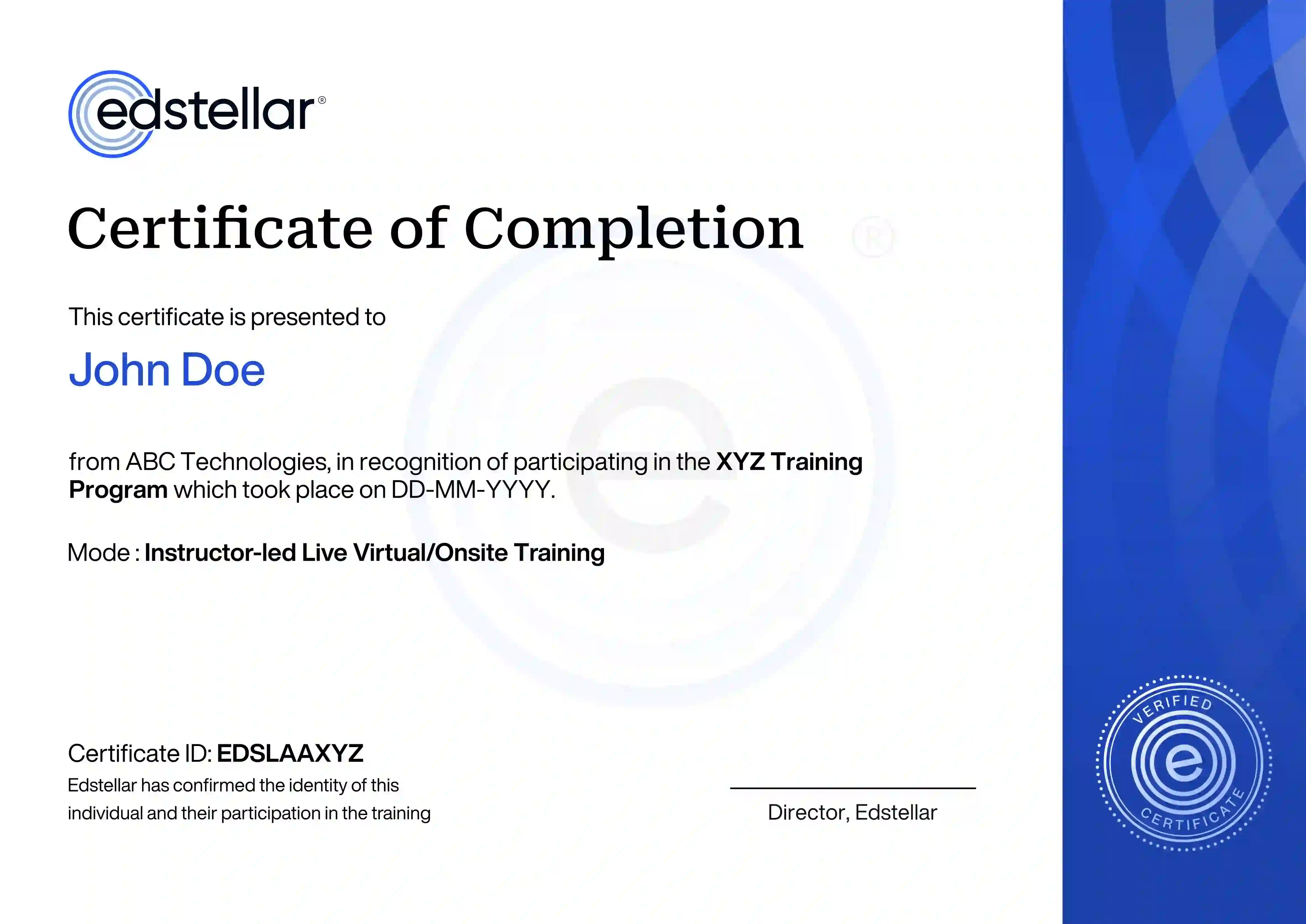
        Get Your Team Members Recognized with Edstellar’s Course Certificate

        Upon successful completion of the training course offered by Edstellar, employees receive a course completion certificate, symbolizing their dedication to ongoing learning and professional development.

        This certificate validates the employee's acquired skills and is a powerful motivator, inspiring them to enhance their expertise further and contribute effectively to organizational success.

        Certificate of Excellence