Home
Corporate Training Courses
IT & Technical
Software Development Training
Cloud-Native Java Performance Engineering Training

Drive Team Excellence with Cloud-Native Java Performance Engineering Corporate Training

Empower your teams with expert-led on-site, off-site, and virtual Cloud-Native Java Performance Engineering Training through Edstellar, a premier corporate training provider for organizations globally. Designed to meet your specific training needs, this group training program ensures your team is primed to drive your business goals. Help your employees build lasting capabilities that translate into real performance gains.

Cloud-Native Java Performance Engineering is the discipline of designing, profiling, and tuning Java applications to meet strict latency, throughput, and resource efficiency targets in containerized and distributed cloud environments. It covers JVM internals, GraalVM native compilation, reactive frameworks, Kubernetes resource management, and distributed observability, equipping engineers to identify root causes of performance degradation and apply targeted optimizations across the full application stack.

Edstellar's Cloud-Native Java Performance Engineering Instructor-led course offers virtual/onsite training options to meet professionals' diverse needs. This flexibility ensures that professionals and teams can engage in learning experiences that best suit their logistical and learning preferences. What sets the Edstellar course apart is its emphasis on practical experience, with hands-on profiling exercises, live benchmarking labs, and real-world cloud scenarios that translate performance engineering concepts into measurable production gains.

Get Customized Expert-led Training for Your Teams
Customized Training Delivery
Scale Your Training: Small to Large Teams
In-person Onsite, Live Virtual or Hybrid Training Modes
Plan from 2000+ Industry-ready Training Programs
Experience Hands-On Learning from Industry Experts
Delivery Capability Across 100+ Countries & 10+ Languages
""""

Key Skills Employees Gain from Instructor-led Cloud-Native Java Performance Engineering Training

Cloud-Native Java Performance Engineering skills corporate training will enable teams to effectively apply their learnings at work.

  • JVM Performance Tuning and Memory Management
  • Java Application Profiling and Benchmarking
  • GraalVM Native Image Optimization
  • Cloud-Native Java Framework Performance Tuning
  • Reactive and Non-Blocking Java Programming
  • Kubernetes Java Resource Optimization
  • Distributed Performance Monitoring

Key Learning Outcomes of Cloud-Native Java Performance Engineering Training Workshop

Upon completing Edstellar’s Cloud-Native Java Performance Engineering workshop, employees will gain valuable, job-relevant insights and develop the confidence to apply their learning effectively in the professional environment.

  • Master JVM tuning, garbage collection configuration, and heap management to eliminate bottlenecks and latency spikes in cloud-native Java services.
  • Gain proficiency in Java profiling and benchmarking using async-profiler, JFR, and JMH to identify and resolve performance regressions.
  • Build and optimize GraalVM native images, achieving sub-second startup times and reduced container memory footprints for microservices.
  • Develop expertise tuning Quarkus, Micronaut, and Spring Boot for maximum throughput by configuring thread pools and framework-level settings.
  • Apply reactive and non-blocking programming patterns using Project Reactor to sustain high concurrency in cloud-native Java deployments.
  • Integrate automated performance tests into CI/CD pipelines with Gatling and k6 to enforce SLA benchmarks on every release.

Key Benefits of the Cloud-Native Java Performance Engineering Group Training

Attending our Cloud-Native Java Performance Engineering group training classes provides your team with a powerful opportunity to build skills, boost confidence, and develop a deeper understanding of the concepts that matter most. The collaborative learning environment fosters knowledge sharing and enables employees to translate insights into actionable work outcomes.

  • Master JVM internals including garbage collection algorithms, heap sizing, and thread management to eliminate latency spikes in cloud-native Java applications.
  • Profile Java applications using tools such as async-profiler, JFR, and VisualVM to identify CPU hotspots, memory leaks, and lock contention issues.
  • Benchmark Java services with JMH to produce statistically reliable throughput and latency measurements for performance regression detection.
  • Build and optimize GraalVM native images to achieve sub-second startup times and reduced memory footprints for containerized microservices.
  • Tune Quarkus, Micronaut, and Spring Boot applications for peak throughput by configuring thread pools, connection pools, and framework-specific settings.
  • Implement reactive and non-blocking I/O patterns using Project Reactor and Vert.x to maximise concurrency under high-load cloud conditions.
  • Optimize database and persistence layers by tuning Hibernate, connection pooling, and query execution plans to reduce response latency.
  • Configure Kubernetes resource requests, limits, vertical pod autoscaling, and JVM flags to right-size Java workloads in container environments.
  • Instrument Java services with OpenTelemetry to collect distributed traces, metrics, and logs for end-to-end observability across microservices.
  • Integrate performance tests and load tests into CI/CD pipelines using Gatling and k6 to enforce SLA thresholds on every code change.

Topics and Outline of Cloud-Native Java Performance Engineering Training

Our virtual and on-premise Cloud-Native Java Performance Engineering training curriculum is structured into focused modules developed by industry experts. This training for organizations provides an interactive learning experience that addresses the evolving demands of the workplace, making it both relevant and practical.

  1. Performance Engineering Fundamentals
    • Defining performance goals and SLAs
    • Latency, throughput, and resource efficiency metrics
    • Performance engineering lifecycle overview
    • Common cloud-native Java performance anti-patterns
  2. Cloud-Native Java Ecosystem Overview
    • Java runtime options for cloud environments
    • Comparing JVM-based and native-image deployments
    • Key cloud-native frameworks: Quarkus, Micronaut, Spring Boot
    • Container and Kubernetes constraints on Java performance
  3. Toolchain Setup and Benchmarking Baselines
    • Installing and configuring profiling tools
    • Setting up JMH benchmarking projects
    • Establishing baseline performance measurements
    • Version control for benchmark results
  4. Observability Foundations
    • Metrics, traces, and logs in cloud-native Java
    • Instrumentation strategies for microservices
    • Introduction to OpenTelemetry for Java
    • Correlating observability signals with performance issues
  5. Performance Testing Concepts
    • Load testing vs stress testing vs soak testing
    • Designing representative workload models
    • Interpreting throughput and latency percentiles
    • Avoiding common benchmarking pitfalls
  6. Cost and Resource Efficiency in Cloud Java
    • Right-sizing containers for Java workloads
    • CPU and memory cost implications in cloud billing
    • Efficiency vs performance trade-off analysis
    • Sustainability considerations in cloud resource usage
  1. JVM Architecture Deep Dive
    • Class loading and bytecode execution
    • JIT compilation and tiered compilation
    • Interpreter vs compiled code performance
    • JVM intrinsics and runtime optimizations
  2. Heap and Off-Heap Memory
    • Young generation and old generation layout
    • Metaspace and class data sharing
    • Off-heap memory with ByteBuffer and unsafe APIs
    • Memory pressure detection and diagnosis
  3. Garbage Collection Algorithms
    • G1GC configuration and region sizing
    • ZGC and Shenandoah for low-latency workloads
    • Parallel and serial GC use cases
    • GC pause analysis and tuning strategies
  4. JVM Flags and Tuning Parameters
    • Key heap sizing flags for containers
    • GC logging and diagnostic flags
    • Container-aware JVM settings (UseContainerSupport)
    • JVM ergonomics and automatic tuning behavior
  5. Thread Management and Concurrency
    • Thread pool sizing and configuration
    • Lock contention and deadlock detection
    • Virtual threads (Project Loom) overview
    • Thread dump analysis techniques
  6. Memory Leak Detection and Resolution
    • Heap dump capture and analysis
    • Identifying retained object graphs
    • Common memory leak patterns in Java
    • Automated memory leak detection in CI
  1. Java Flight Recorder and Mission Control
    • Enabling and configuring JFR recordings
    • Analyzing CPU, memory, and I/O events
    • JFR streaming for continuous profiling
    • Custom JFR events for application metrics
  2. async-profiler and Flame Graphs
    • CPU profiling with async-profiler in Linux
    • Wall-clock and allocation profiling modes
    • Generating and reading flame graphs
    • Profiling in containerized environments
  3. JMH Microbenchmarking
    • JMH project structure and annotations
    • Warm-up and measurement iteration design
    • Avoiding dead code elimination and constant folding
    • Comparing benchmark results across versions
  4. Allocation and GC Profiling
    • Identifying high-allocation hot paths
    • Object creation rate analysis
    • Escape analysis and stack allocation
    • Reducing allocation pressure in tight loops
  5. Continuous Profiling in Production
    • Low-overhead always-on profiling strategies
    • Pyroscope and Grafana Phlare integration
    • Correlating profiles with distributed traces
    • Alerting on profiling regressions
  6. Performance Regression Detection
    • Statistical comparison of benchmark results
    • Integrating JMH into CI pipelines
    • Tracking performance trends over releases
    • Automated regression reporting
  1. GraalVM Architecture Overview
    • GraalVM JIT vs AOT compilation modes
    • Substrate VM and native image internals
    • Polyglot capabilities and use cases
    • GraalVM Community vs Enterprise editions
  2. Building Native Images
    • Native image build configuration and flags
    • Reflection, resource, and proxy configuration
    • Build-time vs run-time initialization
    • Multi-stage Docker builds for native images
  3. Native Image Performance Characteristics
    • Startup time and memory footprint benchmarks
    • Peak throughput trade-offs vs JVM mode
    • Profile-guided optimization for native images
    • Closed-world assumption and its implications
  4. Compatibility and Limitation Management
    • Handling reflection-heavy libraries
    • Dynamic class loading restrictions
    • Serialization compatibility strategies
    • Third-party library compatibility checks
  5. Native Image Testing and Validation
    • Unit and integration testing native binaries
    • Functional parity verification with JVM mode
    • Performance regression testing for native builds
    • Native image CI/CD pipeline integration
  6. Production Deployment of Native Images
    • Container sizing for native Java services
    • Kubernetes deployment manifests for native images
    • Health check and readiness probe configuration
    • Monitoring and observability for native services
  1. Quarkus Performance Tuning
    • Quarkus dev mode and hot reload performance
    • Extension configuration for optimal throughput
    • Quarkus native image build and deployment
    • RESTEasy Reactive and Vert.x integration
  2. Micronaut Performance Optimization
    • Compile-time dependency injection advantages
    • Micronaut HTTP client and server tuning
    • GraalVM native image with Micronaut
    • Micronaut data and repository optimization
  3. Spring Boot Performance Tuning
    • Spring Boot startup time optimization
    • WebFlux reactive stack configuration
    • Spring Boot native with GraalVM
    • Actuator metrics and health endpoint tuning
  4. HTTP Server and Thread Pool Configuration
    • Netty and Undertow event loop sizing
    • Worker thread pool configuration
    • Keep-alive and connection reuse settings
    • HTTP/2 and gRPC performance considerations
  5. Serialization and Deserialization Performance
    • Jackson vs Jsonb vs custom serialization benchmarks
    • Reducing serialization overhead in hot paths
    • Protobuf and Avro for high-throughput services
    • Schema caching and reuse strategies
  6. Framework Comparison and Selection
    • Benchmarking Quarkus vs Micronaut vs Spring Boot
    • Memory and CPU usage comparison under load
    • Startup time and first-request latency comparison
    • Selecting the right framework for workload characteristics
  1. Reactive Programming Principles
    • Reactive manifesto and core concepts
    • Backpressure and flow control mechanisms
    • Publisher/Subscriber patterns in Java
    • Comparing blocking vs non-blocking I/O models
  2. Project Reactor (Mono and Flux)
    • Creating and composing Mono and Flux pipelines
    • Schedulers and threading in Reactor
    • Error handling and retry strategies
    • Context propagation in reactive chains
  3. RxJava and Mutiny
    • RxJava 3 observables and operators
    • Mutiny reactive API for Quarkus
    • Converting between reactive libraries
    • Testing reactive streams with StepVerifier
  4. Non-Blocking HTTP and Messaging
    • Reactive REST clients with WebClient
    • Reactive Kafka and messaging consumers
    • Server-sent events and WebSocket performance
    • Back-pressure propagation across service boundaries
  5. Reactive Database Access
    • R2DBC reactive database drivers
    • Reactive MongoDB and Redis clients
    • Connection pool tuning for reactive drivers
    • Avoiding blocking calls in reactive pipelines
  6. Debugging and Profiling Reactive Code
    • Reactor debug agent and checkpoint operators
    • Tracing reactive pipeline execution paths
    • Thread starvation and scheduling stall detection
    • Profiling reactive applications with async-profiler
  1. JDBC and Connection Pool Tuning
    • HikariCP configuration for high throughput
    • Connection pool sizing calculations
    • Pool monitoring and leak detection
    • Connection validation and timeout settings
  2. Hibernate and JPA Optimization
    • N+1 query detection and resolution
    • Batch inserts and updates configuration
    • Second-level cache with Caffeine and Infinispan
    • Lazy vs eager loading performance trade-offs
  3. Query Optimization Strategies
    • Execution plan analysis for slow queries
    • Index design for high-read workloads
    • Pagination and cursor-based result streaming
    • Native queries vs JPQL performance comparison
  4. Caching for Persistence Performance
    • Application-level caching with Caffeine
    • Distributed caching with Redis for Java services
    • Cache invalidation strategies
    • Read-through and write-through cache patterns
  5. NoSQL and Time-Series Optimization
    • MongoDB aggregation pipeline performance
    • Cassandra partition and clustering key design
    • Redis data structure selection for performance
    • Time-series data access patterns in Java
  6. Database Observability and Slow Query Analysis
    • Slow query log analysis and alerting
    • JDBC-level tracing with P6Spy and Datasource Proxy
    • Database connection metrics in Prometheus
    • Correlating database latency with application traces
  1. Container-Aware JVM Configuration
    • UseContainerSupport and MaxRAMPercentage flags
    • CPU quota and JVM active processor detection
    • GC algorithm selection for constrained containers
    • JVM flags in Kubernetes deployment manifests
  2. Resource Requests and Limits
    • CPU requests, limits, and throttling behavior
    • Memory requests, limits, and OOMKill prevention
    • Quality of Service classes for Java pods
    • Resource quota management for Java namespaces
  3. Horizontal and Vertical Pod Autoscaling
    • HPA configuration for Java microservices
    • Custom metrics autoscaling with KEDA
    • VPA for right-sizing Java workloads
    • Scale-to-zero strategies with Knative
  4. Pod Scheduling and Affinity
    • Node affinity for performance-sensitive Java pods
    • Pod anti-affinity for high-availability deployments
    • Topology spread constraints for even load distribution
    • Priority classes for critical Java services
  5. Network Performance in Kubernetes
    • Service mesh overhead and sidecar proxies
    • eBPF-based networking for lower latency
    • Java service-to-service communication optimization
    • Ingress and load balancer tuning for Java APIs
  6. Startup Optimization and Readiness
    • JVM class data sharing (AppCDS) in containers
    • Readiness and liveness probe configuration
    • Graceful shutdown handling in Java pods
    • Pre-warming techniques for JIT-compiled services
  1. OpenTelemetry for Java
    • OTel SDK auto-instrumentation setup
    • Manual span creation and context propagation
    • Exporting traces to Jaeger, Zipkin, and OTLP
    • Sampling strategies for high-throughput services
  2. Metrics Collection with Micrometer
    • Micrometer registry configuration for Prometheus
    • Custom application metrics and timers
    • JVM metrics exposure via Micrometer
    • Grafana dashboard creation for Java services
  3. Distributed Log Aggregation
    • Structured JSON logging with Logback and Log4j2
    • Trace ID injection into log records
    • Log aggregation with Loki and Elasticsearch
    • Correlating logs, metrics, and traces
  4. Alerting and SLA Enforcement
    • Defining SLOs and error budgets for Java services
    • Prometheus alerting rules for latency and error rates
    • PagerDuty and OpsGenie alert routing
    • Runbook integration with alerts
  5. Service Mesh Observability
    • Istio telemetry for Java microservices
    • Envoy proxy metrics and access logs
    • Kiali service graph for dependency analysis
    • Identifying latency hotspots in service graphs
  6. Performance Dashboards and Reporting
    • Designing Grafana dashboards for Java performance KPIs
    • Golden signals monitoring (latency, traffic, errors, saturation)
    • Automated performance reporting for stakeholders
    • Trend analysis for capacity planning
  1. Load Testing with Gatling
    • Gatling simulation design and scenario scripting
    • Ramp-up profiles and constant throughput injection
    • Assertions and SLA validation in Gatling
    • Gatling HTML report interpretation
  2. k6 for API and Microservice Load Testing
    • k6 script structure and virtual user modeling
    • Thresholds and checks for SLA enforcement
    • k6 cloud and distributed load generation
    • Real-time k6 metrics in Grafana
  3. Chaos Engineering for Java Services
    • Chaos Monkey and LitmusChaos experiments
    • Injecting latency and resource contention
    • Verifying graceful degradation under failure
    • Measuring recovery time and blast radius
  4. CI/CD Performance Gates
    • Integrating JMH benchmarks into GitHub Actions
    • Failing builds on performance regression thresholds
    • Storing and comparing benchmark artifacts
    • Performance gate configuration in Jenkins pipelines
  5. Capacity Planning and Scalability Testing
    • Finding throughput saturation points
    • Modeling resource requirements for projected growth
    • Soak testing for memory and resource leak detection
    • Scalability testing with incremental user ramps
  6. Performance Test Reporting and Governance
    • Standardized performance test report templates
    • Tracking performance KPIs across releases
    • Communicating performance results to stakeholders
    • Performance governance processes in engineering teams

Who Can Take the Cloud-Native Java Performance Engineering Training Course

The Cloud-Native Java Performance Engineering training program can also be taken by professionals at various levels in the organization.

  • Senior Java Developers
  • Software Architects
  • Cloud-Native Engineers
  • Site Reliability Engineers (SREs)
  • Performance Engineers
  • Tech Leads

Prerequisites for Cloud-Native Java Performance Engineering Training

Professionals should have solid experience writing Java applications and a working understanding of cloud deployment fundamentals, containerization with Docker, and basic Kubernetes concepts to take the Cloud-Native Java Performance Engineering training course.

Request a Quote for your Corporate Training Requirements

Valid number

Delivering Training for Organizations across 100 Countries and 10+ Languages

Corporate Group Training Delivery Modes
for Cloud-Native Java Performance Engineering Training

At Edstellar, we understand the importance of impactful and engaging training for employees. As a leading Cloud-Native Java Performance Engineering training provider, we ensure the training is more interactive by offering Face-to-Face onsite/in-house or virtual/online sessions for companies. This approach has proven to be effective, outcome-oriented, and produces a well-rounded training experience for your teams.

Virtual Cloud-Native Java Performance Engineering Training

Edstellar's Cloud-Native Java Performance Engineering virtual/online training sessions bring expert-led, high-quality training to your teams anywhere, ensuring consistency and seamless integration into their schedules.

With global reach, your employees can get trained from various locations
The consistent training quality ensures uniform learning outcomes
Participants can attend training in their own space without the need for traveling
Organizations can scale learning by accommodating large groups of participants
Interactive tools can be used to enhance learning engagement
On-site Cloud-Native Java Performance Engineering Training

Edstellar's Cloud-Native Java Performance Engineering inhouse face to face instructor-led training delivers immersive and insightful learning experiences right in the comfort of your office.

Higher engagement and better learning experience through face-to-face interaction
Workplace environment can be tailored to learning requirements
Team collaboration and knowledge sharing improves training effectiveness
Demonstration of processes for hands-on learning and better understanding
Participants can get their doubts clarified and gain valuable insights through direct interaction
Off-site Cloud-Native Java Performance Engineering Training

Edstellar's Cloud-Native Java Performance Engineering offsite face-to-face instructor-led group training offer a unique opportunity for teams to immerse themselves in focused and dynamic learning environments away from their usual workplace distractions.

Distraction-free environment improves learning engagement
Team bonding can be improved through activities
Dedicated schedule for training away from office set up can improve learning effectiveness
Boosts employee morale and reflects organization's commitment to employee development

Explore Our Customized Pricing Package
for
Cloud-Native Java Performance Engineering Corporate Training

Looking for pricing details for onsite, offsite, or virtual instructor-led Cloud-Native Java Performance Engineering training? Get a customized proposal tailored to your team’s specific needs.

Request a Group Training Quote
""
How Many Team Members Need Training?
Please select an option or fill in the custom field.
"'

Is Your Corporate Training Requirement Only for Cloud-Native Java Performance Engineering?

Please select at least one course.
""
Add the List of Training Workshops
search icon

      Please select the course

      No. of Courses selected: 0

      Clear

      Upload a CSV

      Send us your Training Requirements in 3 Easy steps

      1. 1
      2. 2
        Add the required training workshops
      3. 3
        Upload to get a quick quote or email it to contact@edstellar.com

      ""

      Looking for a Complete Package?

      Looking for a one-time pricing option for all your annual training requirements?

      View Corporate Training Packages
      ""
      Select the Option that Best Describes Your Corporate Training Requirement

      Please select an option or choose from the recurring options.
      ""
      Verify and Submit Your Request

      Review Your Corporate Training Selection Summary

      Training Program: Cloud-Native Java Performance Engineering Training

      1. No of Team Members

      2. Selected Training Preference

      3. Selected Recurring Sessions

      1

      Review your Requirements

      Training Workshops Selected :


        Excel
        File has been
        successfully uploaded.
        Fill the form to submit
 your details
        Submit Your Professional Contact Information
        Valid number
        We've received your enquiry. Our team will be in touch soon.
        Oops! Something went wrong while submitting the form.
        Starter
        120 licences

        Tailor-Made Trainee Licenses with Our Exclusive Training Packages!

        View Package

        64 hours of group training (includes VILT/In-person On-site)

        Tailored for SMBs

        Growth
        320 licences

        Tailor-Made Trainee Licenses with Our Exclusive Training Packages!

        View Package

        160 hours of group training (includes VILT/In-person On-site)

        Ideal for growing SMBs

        Enterprise
        800 licences

        Tailor-Made Trainee Licenses with Our Exclusive Training Packages!

        View Package

        400 hours of group training (includes VILT/In-person On-site)

        Designed for large corporations

        Custom
        Unlimited licenses

        Tailor-Made Trainee Licenses with Our Exclusive Training Packages!

        View Package

        Unlimited duration

        Designed for large corporations

        Edstellar: Your Go-to Cloud-Native Java Performance Engineering Training Company

        Experienced Trainers

        Our trainers bring years of industry expertise to ensure the training is practical and impactful.

        Quality Training

        With a strong track record of delivering training worldwide, Edstellar maintains its reputation for its quality and training engagement.

        Industry-Relevant Curriculum

        Our course is designed by experts and is tailored to meet the demands of the current industry.

        Customizable Training

        Our course can be customized to meet the unique needs and goals of your organization.

        Comprehensive Support

        We provide pre and post training support to your organization to ensure a complete learning experience.

        Multilingual Training Capabilities

        We offer training in multiple languages to cater to diverse and global teams.

        Testimonials

        What Our Clients Say

        We pride ourselves on delivering exceptional training solutions. Here's what our clients have to say about their experiences with Edstellar.

        "The virtual Cloud-Native Java Performance Engineering training from Edstellar transformed how our team approaches performance. Within four weeks, our senior developers reduced average application response latency by 52% and improved API throughput by 38% by applying JVM tuning and reactive programming techniques from the course. The expert-led sessions were practical, immediately applicable, and exactly what our cloud engineering team needed."

        Arjun Mehta

        Head of Software Engineering,

        A Global FinTech Platform

        "Edstellar's onsite Cloud-Native Java Performance Engineering training gave our team the expertise to migrate 12 core microservices to GraalVM native images. Container startup time dropped from 8 seconds to under 400 milliseconds, and memory footprint decreased by 60%. The hands-on labs and real production scenarios made the transition smooth and confident. An outstanding investment for any Java engineering organisation targeting cloud-native efficiency."

        Sandra Okonkwo

        Engineering Director,

        A Global Cloud Services Company

        "After Edstellar's intensive off-site Cloud-Native Java Performance Engineering program, our team achieved p99 latency targets of under 50ms across all 18 cloud-native Java services - a 70% improvement from baseline. The five-day deep-dive covering JVM internals, Kubernetes resource tuning, and distributed tracing gave our architects the frameworks to deliver on SLA commitments we previously considered out of reach."

        Ravi Krishnamurthy

        Chief Technology Officer,

        A Global Enterprise Software Group

        "Edstellar's IT & Technical training programs have been instrumental in strengthening our engineering teams and building future-ready capabilities. The hands-on approach, practical cloud scenarios, and expert guidance helped our teams improve technical depth, problem-solving skills, and execution across multiple projects. We're excited to extend more of these impactful programs to other business units."

        Aditi Rao

        L&D Head,

        A Global Technology Company

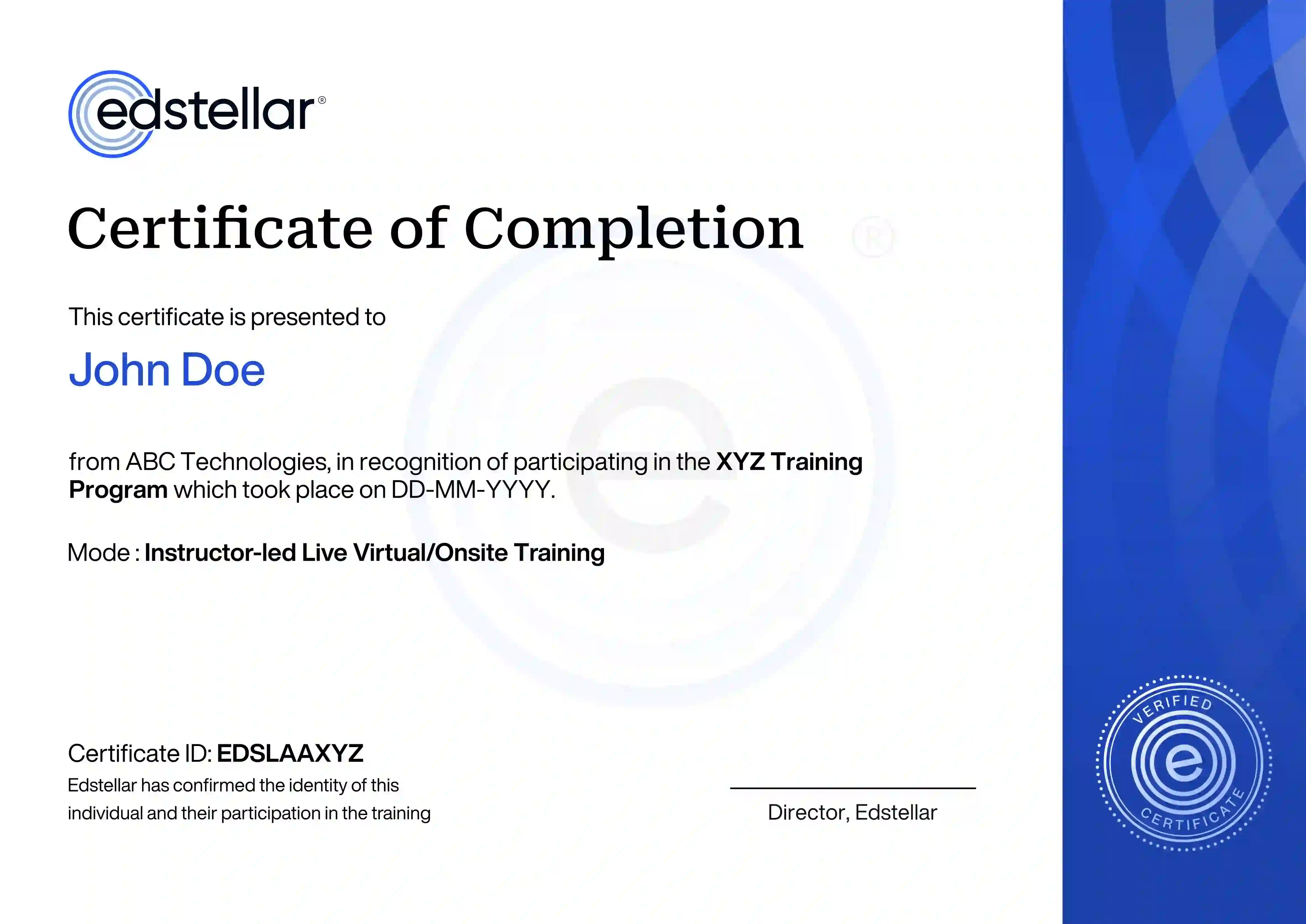
        Get Your Team Members Recognized with Edstellar’s Course Certificate

        Upon successful completion of the training course offered by Edstellar, employees receive a course completion certificate, symbolizing their dedication to ongoing learning and professional development.

        This certificate validates the employee's acquired skills and is a powerful motivator, inspiring them to enhance their expertise further and contribute effectively to organizational success.

        Certificate of Excellence