Drive Team Excellence with Decision-Making in a Crisis Corporate Training

Empower your teams with expert-led on-site, off-site, and virtual Decision-Making in a Crisis Training through Edstellar, a premier corporate training provider for organizations globally. Designed to meet your specific training needs, this group training program ensures your team is primed to drive your business goals. Help your employees build lasting capabilities that translate into real performance gains.

Crisis decision-making is a critical competency for leaders who must navigate high-stakes, time-sensitive situations with limited information. This training covers decision frameworks, cognitive bias mitigation, risk assessment, stakeholder communication, and team coordination strategies that enable professionals to lead confidently when it matters most.

Edstellar's Decision-Making in a Crisis Instructor-led course offers virtual/onsite training options tailored for teams across industries. Participants engage in immersive crisis simulations, structured scenario analyses, and collaborative exercises that build practical decision-making skills and long-term organizational resilience.

Get Customized Expert-led Training for Your Teams
Customized Training Delivery
Scale Your Training: Small to Large Teams
In-person Onsite, Live Virtual or Hybrid Training Modes
Plan from 2000+ Industry-ready Training Programs
Experience Hands-On Learning from Industry Experts
Delivery Capability Across 100+ Countries & 10+ Languages
""""

Key Skills Employees Gain from Instructor-led Decision-Making in a Crisis Training

Decision-Making in a Crisis skills corporate training will enable teams to effectively apply their learnings at work.

  • Crisis Situation Assessment
  • Rapid Decision Frameworks
  • Stakeholder Communication Under Pressure
  • Risk Identification and Prioritization
  • Cognitive Bias Recognition
  • Team Coordination in Emergencies
  • Post-Crisis Evaluation and Learning

Key Learning Outcomes of Decision-Making in a Crisis Training Workshop

Upon completing Edstellar’s Decision-Making in a Crisis workshop, employees will gain valuable, job-relevant insights and develop the confidence to apply their learning effectively in the professional environment.

  • Master structured decision-making frameworks designed for high-pressure, time-critical crisis situations
  • Develop rapid situation assessment skills to prioritize actions and resources effectively during a crisis
  • Build cognitive bias awareness to ensure clarity and sound judgment when making decisions under stress
  • Apply crisis communication strategies to coordinate stakeholders and maintain trust during emergencies
  • Gain practical experience through crisis simulations that strengthen decision confidence and team coordination
  • Learn post-crisis evaluation techniques to capture lessons and build lasting organizational resilience

Key Benefits of the Decision-Making in a Crisis Group Training

Attending our Decision-Making in a Crisis group training classes provides your team with a powerful opportunity to build skills, boost confidence, and develop a deeper understanding of the concepts that matter most. The collaborative learning environment fosters knowledge sharing and enables employees to translate insights into actionable work outcomes.

  • Instructor-led Decision-Making in a Crisis training delivered onsite or virtually for corporate teams
  • Covers structured decision frameworks including the OODA Loop and Recognition-Primed Decision model
  • Practical modules on cognitive bias recognition and mitigation under high-pressure conditions
  • Hands-on crisis simulations and scenario-based exercises for real-world decision practice
  • Risk assessment techniques tailored to dynamic and time-critical crisis environments
  • Crisis communication strategies for internal and external stakeholder management
  • Team coordination and leadership techniques for maintaining effectiveness in emergencies
  • Post-crisis review processes to extract lessons and prevent recurrence
  • Organizational resilience frameworks for sustained crisis readiness
  • Flexible scheduling with dedicated Edstellar support throughout the training engagement

Topics and Outline of Decision-Making in a Crisis Training

Our virtual and on-premise Decision-Making in a Crisis training curriculum is structured into focused modules developed by industry experts. This training for organizations provides an interactive learning experience that addresses the evolving demands of the workplace, making it both relevant and practical.

  1. Defining Crisis and High-Stakes Decision Environments
    • Characteristics of crisis situations in organizational contexts
    • Differences between routine and crisis decision-making processes
    • The role of leadership in managing organizational crises effectively
    • Common types of crises faced by modern organizations
  2. The Psychology of Decision-Making Under Pressure
    • How stress and time pressure affect cognitive processing and judgment
    • The fight-or-flight response and its impact on leader decisions
    • Emotional regulation techniques for high-stakes crisis scenarios
    • Building mental resilience for sustained decision performance
  3. Core Principles of Effective Crisis Decision-Making
    • Speed versus accuracy trade-offs in high-stakes decision situations
    • The importance of situational awareness in crisis management
    • Ethical considerations when making rapid decisions under pressure
    • Frameworks for balancing short-term and long-term crisis outcomes
  4. Crisis Leadership Styles and Their Impact
    • Overview of authoritative, participative, and adaptive leadership styles
    • Matching leadership style to crisis type and organizational severity
    • Building trust and credibility as a crisis decision-making leader
    • Case studies of effective and ineffective crisis leadership decisions
  5. Introduction to Crisis Decision Frameworks
    • The OODA Loop framework for rapid decision cycles in crises
    • The Recognition-Primed Decision model for experienced crisis leaders
    • Structured Analytic Techniques for crisis situation analysis
    • Selecting the appropriate decision framework for a given crisis
  6. Situational Assessment in Crisis Environments
    • Techniques for rapid environmental scanning during active crises
    • Gathering and validating information under time and resource constraints
    • Establishing a shared situational picture across crisis response teams
    • Using situational assessment to prioritize crisis response actions
  1. Overview of Cognitive Biases in Crisis Decisions
    • Definition and categories of cognitive biases in decision-making
    • How biases are amplified under crisis and time pressure conditions
    • Impact of cognitive biases on the quality of crisis outcomes
    • Common biases observed in real-world organizational crisis scenarios
  2. Confirmation Bias and Tunnel Vision
    • How confirmation bias narrows information gathering during crises
    • Strategies for actively seeking disconfirming evidence under pressure
    • Techniques to break tunnel vision when time is limited
    • Team practices that counteract individual confirmation bias
  3. Anchoring, Availability, and Representativeness Biases
    • How anchoring distorts initial crisis situation assessments
    • The availability heuristic and its role in crisis risk perception
    • Representativeness errors in emergency pattern matching
    • De-biasing techniques for rapid decision environments
  4. Groupthink and Social Pressure in Crisis Teams
    • How groupthink emerges in high-stress team decision settings
    • The role of authority gradients in suppressing dissent
    • Structured techniques to elicit independent team perspectives
    • Building psychologically safe crisis response teams
  5. Overconfidence and Optimism Bias
    • How overconfidence leads to underestimation of crisis severity
    • Calibration techniques for confidence in uncertain situations
    • The planning fallacy and its impact on crisis resource allocation
    • Using pre-mortem analysis to challenge overconfident crisis decisions
  6. Tools and Techniques for Cognitive Bias Mitigation
    • Checklists and structured decision protocols to reduce cognitive bias
    • Devil's advocate and red team approaches in crisis settings
    • Real-time feedback mechanisms for bias awareness during crises
    • Building personal and team habits for bias-resistant decision-making
  1. Principles of Effective Crisis Communication
    • Key principles of crisis communication: clarity, transparency, and timeliness
    • Adapting communication style to crisis severity and target audience
    • The role of communication in maintaining trust and organizational control
    • Common communication failures observed during organizational crises
  2. Internal Communication During a Crisis
    • Establishing clear communication chains and escalation paths
    • Keeping teams informed and aligned under conditions of uncertainty
    • Managing rumor and misinformation within the organization
    • Using communication technology effectively in emergency situations
  3. External Stakeholder Communication
    • Identifying and prioritizing external stakeholders during a crisis
    • Crafting appropriate messages for customers, regulators, and the public
    • Media relations and managing press communication during crises
    • Legal and compliance considerations in external crisis messaging
  4. Crisis Communication Planning and Protocols
    • Developing a crisis communication plan before events occur
    • Roles and responsibilities within a crisis communication team
    • Pre-approved messaging templates for common crisis event types
    • Testing and updating crisis communication protocols regularly
  5. Managing Difficult Conversations Under Pressure
    • Delivering bad news with clarity, honesty, and empathy
    • Managing emotionally charged interactions during an active crisis
    • Negotiation and persuasion techniques in high-stakes discussions
    • Conflict resolution strategies for crisis-driven disagreements
  6. Post-Crisis Communication and Reputation Recovery
    • Transitioning from crisis communication to recovery messaging
    • Acknowledging mistakes and rebuilding stakeholder trust
    • Sharing lessons learned with internal and external audiences
    • Monitoring stakeholder sentiment throughout the post-crisis period
  1. Foundations of Crisis Risk Assessment
    • Defining risk in the context of crisis and emergency management
    • Differentiating between proactive and reactive risk assessment approaches
    • The role of risk assessment in crisis decision-making frameworks
    • Common risk assessment models applied in crisis environments
  2. Rapid Risk Identification and Categorization
    • Techniques for quickly identifying risks during an active crisis
    • Categorizing risks by severity, likelihood, and urgency
    • Using SWOT and PESTLE analysis for crisis risk identification
    • Building a rapid risk register during emergency situations
  3. Quantitative and Qualitative Risk Analysis
    • Applying qualitative risk analysis methods under time pressure
    • Using quantitative data and models for crisis risk evaluation
    • Risk scoring and prioritization in dynamic crisis environments
    • Balancing data-driven and intuitive approaches to risk assessment
  4. Cascading and Interdependent Risks in Crises
    • How risks compound and cascade in complex crisis situations
    • Mapping interdependencies between risk factors in emergencies
    • Scenario analysis techniques for cascading failure identification
    • Strategies for managing interconnected and compounding risk chains
  5. Risk-Based Decision Prioritization
    • Using risk assessment outputs to prioritize crisis response actions
    • Resource allocation strategies based on assessed risk severity
    • Trade-off analysis for competing crisis priorities and objectives
    • Communicating risk-based decisions to leadership and response teams
  6. Dynamic Risk Monitoring During a Crisis
    • Establishing real-time monitoring systems for evolving crisis risks
    • Defining trigger points and escalation criteria for risk response
    • Adapting risk response plans as the crisis situation changes
    • Tools and dashboards for dynamic crisis risk tracking and reporting
  1. The Cynefin Framework for Crisis Context Analysis
    • The four Cynefin domains: Simple, Complicated, Complex, and Chaotic
    • Applying Cynefin to categorize crisis situations accurately
    • Decision strategies appropriate to each Cynefin domain
    • Moving from chaotic to complex domains during crisis resolution
  2. The OODA Loop and FORDEC Decision Models
    • The Observe-Orient-Decide-Act loop for rapid crisis decision cycles
    • Applying the FORDEC model from aviation crisis management
    • Key differences between OODA and FORDEC in practice
    • Selecting the right model for different crisis decision contexts
  3. Naturalistic Decision Making in Crisis Situations
    • How experienced decision-makers use pattern recognition in crises
    • The Recognition-Primed Decision model applied to real crisis scenarios
    • Building expertise-based intuition for high-stakes crisis environments
    • Limitations of naturalistic decision making under novel threats
  4. Scenario-Based Decision Making and War Gaming
    • Designing realistic crisis scenarios for decision-making practice
    • Running war gaming exercises to test and refine decision frameworks
    • Evaluating decision quality and outcomes in simulated crisis settings
    • Incorporating war gaming insights into organizational crisis planning
  5. Multi-Criteria Decision Analysis Under Pressure
    • Applying MCDA techniques in time-constrained crisis settings
    • Weighting criteria for rapid trade-off evaluation in emergencies
    • Using simplified scoring matrices for high-stakes crisis decisions
    • Integrating stakeholder perspectives into MCDA during active crises
  6. Adaptive Decision-Making in Dynamic Environments
    • The importance of flexibility and iteration in crisis decision-making
    • Agile decision-making principles applied to crisis response
    • Establishing decision review loops during ongoing crisis events
    • Balancing commitment to a course of action with adaptive flexibility
  1. Building High-Performing Crisis Response Teams
    • Characteristics of effective crisis response teams
    • Role clarity and accountability structures in emergency team settings
    • Assembling cross-functional crisis teams quickly and effectively
    • Team composition considerations for different crisis types
  2. Crisis Command Structures and Incident Command Systems
    • Incident command system principles and organizational structure
    • Establishing command hierarchy and escalation protocols
    • Unified command models for multi-agency crisis response
    • Applying incident command principles to corporate crisis environments
  3. Team Communication and Coordination Under Pressure
    • Communication protocols and standards for crisis response teams
    • Managing information flow between team members during crises
    • Tools and technologies for team coordination in emergencies
    • Avoiding communication breakdowns in high-stress team environments
  4. Psychological Safety and Trust in Crisis Teams
    • The role of psychological safety in effective crisis response
    • Building trust among team members before and during a crisis
    • Addressing fear, anxiety, and stress within crisis response teams
    • Leadership behaviors that reinforce team confidence under pressure
  5. Decision Delegation and Empowerment in Crisis Response
    • When and how to delegate decisions during an active crisis
    • Empowering team members to act decisively within defined boundaries
    • Managing autonomy and accountability in crisis delegation
    • Feedback and communication loops for delegated crisis decisions
  6. Post-Crisis Team Debrief and Recovery
    • Structuring effective post-crisis debriefs for team learning
    • Addressing team stress, fatigue, and psychological impact post-crisis
    • Capturing team insights and converting them into process improvements
    • Rebuilding team cohesion and morale after a significant crisis event
  1. Information Needs in Crisis Decision-Making
    • Types of information critical to effective crisis decision-making
    • Prioritizing information needs when time and resources are limited
    • The role of intelligence and real-time data in crisis response
    • Building information requirements into crisis response plans
  2. Gathering and Validating Information Under Uncertainty
    • Techniques for rapid information collection during active crises
    • Validating information accuracy and reliability in real time
    • Managing conflicting information from multiple crisis sources
    • Using structured analytical techniques to assess information quality
  3. Information Overload and Filtering Strategies
    • How information overload impairs crisis decision-making quality
    • Techniques for filtering and prioritizing incoming crisis information
    • Building decision support systems that highlight critical data
    • Training teams to synthesize large information volumes effectively
  4. Rumor Control and Misinformation Management
    • Sources and spread of rumors during organizational crisis events
    • Protocols for identifying and correcting misinformation quickly
    • Communication strategies to prevent escalation of rumors
    • The role of leadership in maintaining information credibility
  5. Technology for Crisis Information Management
    • Overview of crisis management information systems and platforms
    • Using digital dashboards and real-time data feeds during crises
    • Social media monitoring for crisis situational awareness
    • Cybersecurity considerations for crisis information systems
  6. Building a Crisis Information Architecture
    • Designing information flows for crisis response organizations
    • Establishing data repositories and access controls for emergencies
    • Pre-crisis information gathering and baseline data establishment
    • Integrating information management into crisis preparedness plans
  1. Introduction to Crisis Simulation Methods
    • Types of crisis simulations: tabletop, functional, and full-scale exercises
    • Objectives and benefits of crisis simulation training programs
    • Designing effective crisis simulation scenarios for leadership teams
    • Evaluating decision quality and team performance in simulations
  2. Tabletop Exercises for Crisis Decision Practice
    • Structure and facilitation of tabletop crisis decision exercises
    • Developing realistic inject sequences for tabletop scenarios
    • Engaging leadership teams in tabletop crisis decision discussions
    • Documenting and debriefing tabletop exercise outcomes effectively
  3. Scenario Planning for Crisis Preparedness
    • Principles of scenario planning applied to crisis management
    • Identifying plausible crisis scenarios through environmental scanning
    • Developing detailed scenario narratives and decision trigger points
    • Integrating scenario plans into organizational crisis frameworks
  4. Stress Testing Through Red Team Analysis
    • The purpose and process of red team analysis in crisis planning
    • Identifying decision vulnerabilities through adversarial challenges
    • Using red team findings to strengthen crisis response strategies
    • Building a red team culture within organizational crisis programs
  5. After-Action Reviews and Simulation Debriefs
    • Structure and objectives of after-action review processes
    • Facilitating constructive debriefs after crisis simulation exercises
    • Identifying gaps in decision-making and response effectiveness
    • Converting simulation insights into actionable improvement plans
  6. Building Organizational Crisis Simulation Programs
    • Establishing a recurring crisis simulation program for organizations
    • Scaling simulations from team-level to enterprise-wide exercises
    • Integrating simulations with real incident response and continuity plans
    • Measuring simulation outcomes and decision capability improvement
  1. The Importance of Post-Crisis Review
    • Why post-crisis analysis is essential for organizational improvement
    • Common barriers to effective post-crisis learning in organizations
    • Establishing a culture of honest reflection and accountability after crises
    • Linking post-crisis reviews to broader organizational strategy
  2. Root Cause Analysis for Crisis Events
    • Applying root cause analysis methods to crisis investigations
    • Tools: 5 Whys, Fishbone Diagram, and Fault Tree Analysis
    • Identifying systemic versus symptomatic causes of a crisis event
    • Using root cause analysis findings to prevent recurrence
  3. Lessons Learned Documentation and Knowledge Management
    • Capturing and documenting crisis lessons in accessible formats
    • Building organizational knowledge repositories for crisis insights
    • Sharing lessons learned across teams, departments, and locations
    • Updating crisis plans and procedures based on documented learnings
  4. Decision Quality Assessment Post-Crisis
    • Frameworks for evaluating the quality of crisis decisions made
    • Separating decision process quality from decision outcome quality
    • Identifying decision-making errors and their contributing factors
    • Using post-crisis reviews to develop individual decision capabilities
  5. Communicating Lessons to Stakeholders
    • Reporting post-crisis findings to leadership and the board
    • Communicating process improvements to affected stakeholders
    • Balancing transparency with legal and reputational considerations
    • Building stakeholder confidence through visible improvement actions
  6. Embedding Learning into Organizational Culture
    • Integrating crisis lessons into ongoing training and onboarding
    • Rewarding learning behaviors and near-miss reporting
    • Building feedback loops between crisis response and organizational policy
    • Measuring the impact of lessons learned on future crisis performance
  1. Defining Organizational Resilience in Crisis Contexts
    • What organizational resilience means and why it matters
    • The relationship between crisis decision-making and resilience
    • Key resilience dimensions: adaptive capacity, robustness, and recovery
    • Frameworks for assessing current organizational resilience levels
  2. Resilience Planning and Business Continuity Management
    • Linking crisis decision-making capability to business continuity planning
    • Developing resilience strategies across business-critical functions
    • Business continuity frameworks: ISO 22301 and NIST guidelines
    • Testing and validating resilience plans through simulation exercises
  3. Building Crisis-Ready Culture and Leadership
    • Cultural attributes of highly resilient organizations
    • Leadership behaviors that promote crisis readiness across all teams
    • Integrating crisis preparedness into everyday management practice
    • Reward systems and recognition programs for crisis-ready behaviors
  4. Resilient Communication and Decision Systems
    • Designing communication systems that function effectively during crises
    • Redundant decision channels and backup command structures
    • Technology resilience for maintaining operational decision capability
    • Human factors in maintaining resilient decision processes
  5. Cross-Functional Resilience and Collaboration
    • Building cross-departmental resilience through shared planning
    • Collaborative crisis response across departments and functions
    • External partnerships and mutual aid agreements for resilience
    • Resilience integration with supply chain and partner networks
  6. Measuring and Continuously Improving Resilience
    • Key performance indicators for organizational crisis resilience
    • Resilience audits and capability assessments
    • Using crisis data and near-misses to drive continuous improvement
    • Benchmarking resilience against industry standards and best practices

Who Can Take the Decision-Making in a Crisis Training Course

The Decision-Making in a Crisis training program can also be taken by professionals at various levels in the organization.

  • Senior Managers and Executives
  • Operations and Business Continuity Managers
  • Crisis Response and Emergency Management Professionals
  • Team Leaders and Supervisors
  • Risk Management and Compliance Officers
  • HR and Organizational Development Professionals

Prerequisites for Decision-Making in a Crisis Training

Professionals should have basic management experience and familiarity with organizational operations to take the Decision-Making in a Crisis training course.

Request a Quote for your Corporate Training Requirements

Valid number

Delivering Training for Organizations across 100 Countries and 10+ Languages

Corporate Group Training Delivery Modes
for Decision-Making in a Crisis Training

At Edstellar, we understand the importance of impactful and engaging training for employees. As a leading Decision-Making in a Crisis training provider, we ensure the training is more interactive by offering Face-to-Face onsite/in-house or virtual/online sessions for companies. This approach has proven to be effective, outcome-oriented, and produces a well-rounded training experience for your teams.

Virtual Decision-Making in a Crisis Training

Edstellar's Decision-Making in a Crisis virtual/online training sessions bring expert-led, high-quality training to your teams anywhere, ensuring consistency and seamless integration into their schedules.

With global reach, your employees can get trained from various locations
The consistent training quality ensures uniform learning outcomes
Participants can attend training in their own space without the need for traveling
Organizations can scale learning by accommodating large groups of participants
Interactive tools can be used to enhance learning engagement
On-site Decision-Making in a Crisis Training

Edstellar's Decision-Making in a Crisis inhouse face to face instructor-led training delivers immersive and insightful learning experiences right in the comfort of your office.

Higher engagement and better learning experience through face-to-face interaction
Workplace environment can be tailored to learning requirements
Team collaboration and knowledge sharing improves training effectiveness
Demonstration of processes for hands-on learning and better understanding
Participants can get their doubts clarified and gain valuable insights through direct interaction
Off-site Decision-Making in a Crisis Training

Edstellar's Decision-Making in a Crisis offsite face-to-face instructor-led group training offer a unique opportunity for teams to immerse themselves in focused and dynamic learning environments away from their usual workplace distractions.

Distraction-free environment improves learning engagement
Team bonding can be improved through activities
Dedicated schedule for training away from office set up can improve learning effectiveness
Boosts employee morale and reflects organization's commitment to employee development

Explore Our Customized Pricing Package
for
Decision-Making in a Crisis Corporate Training

Looking for pricing details for onsite, offsite, or virtual instructor-led Decision-Making in a Crisis training? Get a customized proposal tailored to your team’s specific needs.

Request a Group Training Quote
""
How Many Team Members Need Training?
Please select an option or fill in the custom field.
"'

Is Your Corporate Training Requirement Only for Decision-Making in a Crisis?

Please select at least one course.
""
Add the List of Training Workshops
search icon

      Please select the course

      No. of Courses selected: 0

      Clear

      Upload a CSV

      Send us your Training Requirements in 3 Easy steps

      1. 1
      2. 2
        Add the required training workshops
      3. 3
        Upload to get a quick quote or email it to contact@edstellar.com

      ""

      Looking for a Complete Package?

      Looking for a one-time pricing option for all your annual training requirements?

      View Corporate Training Packages
      ""
      Select the Option that Best Describes Your Corporate Training Requirement

      Please select an option or choose from the recurring options.
      ""
      Verify and Submit Your Request

      Review Your Corporate Training Selection Summary

      Training Program: Decision-Making in a Crisis Training

      1. No of Team Members

      2. Selected Training Preference

      3. Selected Recurring Sessions

      1

      Review your Requirements

      Training Workshops Selected :


        Excel
        File has been
        successfully uploaded.
        Fill the form to submit
 your details
        Submit Your Professional Contact Information
        Valid number
        We've received your enquiry. Our team will be in touch soon.
        Oops! Something went wrong while submitting the form.
        Starter
        120 licences

        Tailor-Made Trainee Licenses with Our Exclusive Training Packages!

        View Package

        64 hours of group training (includes VILT/In-person On-site)

        Tailored for SMBs

        Growth
        320 licences

        Tailor-Made Trainee Licenses with Our Exclusive Training Packages!

        View Package

        160 hours of group training (includes VILT/In-person On-site)

        Ideal for growing SMBs

        Enterprise
        800 licences

        Tailor-Made Trainee Licenses with Our Exclusive Training Packages!

        View Package

        400 hours of group training (includes VILT/In-person On-site)

        Designed for large corporations

        Custom
        Unlimited licenses

        Tailor-Made Trainee Licenses with Our Exclusive Training Packages!

        View Package

        Unlimited duration

        Designed for large corporations

        Edstellar: Your Go-to Decision-Making in a Crisis Training Company

        Experienced Trainers

        Our trainers bring years of industry expertise to ensure the training is practical and impactful.

        Quality Training

        With a strong track record of delivering training worldwide, Edstellar maintains its reputation for its quality and training engagement.

        Industry-Relevant Curriculum

        Our course is designed by experts and is tailored to meet the demands of the current industry.

        Customizable Training

        Our course can be customized to meet the unique needs and goals of your organization.

        Comprehensive Support

        We provide pre and post training support to your organization to ensure a complete learning experience.

        Multilingual Training Capabilities

        We offer training in multiple languages to cater to diverse and global teams.

        Testimonials

        What Our Clients Say

        We pride ourselves on delivering exceptional training solutions. Here's what our clients have to say about their experiences with Edstellar.

        "Edstellar's virtual Decision-Making in a Crisis training transformed how our leadership team responds under pressure. After completing the program, our incident response time improved by 45% and our crisis decision accuracy, as measured in post-event reviews, increased significantly. The OODA Loop and cognitive bias modules were immediately actionable and directly applicable to our operations."

        Arvind Nair

        VP of Operations,

        A Leading Global Infrastructure Company

        "The onsite Decision-Making in a Crisis training by Edstellar was exactly what our senior management team needed. The trainers facilitated highly realistic crisis simulations and guided our team through structured decision frameworks. Following the program, we redesigned our crisis response protocols, reducing escalation delays by 35% and improving cross-functional coordination."

        Preethi Subramaniam

        Head of Business Continuity,

        A Multinational Financial Services Group

        "We sent our entire crisis response leadership through Edstellar's intensive Decision-Making in a Crisis program and saw measurable results within one quarter. The off-site immersive format allowed our teams to practice under realistic pressure, and post-training assessments showed a 50% improvement in structured decision speed and a marked reduction in groupthink patterns across our response teams."

        Deepak Menon

        Chief Risk Officer,

        A Global Energy Enterprise

        "Edstellar's Leadership training programs have significantly strengthened our management team's strategic thinking, adaptability, and decision-making capabilities. The sessions blend real-world business scenarios with actionable leadership frameworks, enabling leaders to navigate change, guide their teams with clarity and confidence, and drive a long-term vision aligned with organizational goals."

        Shalini Menon

        Chief People Officer,

        A Global Technology Enterprise

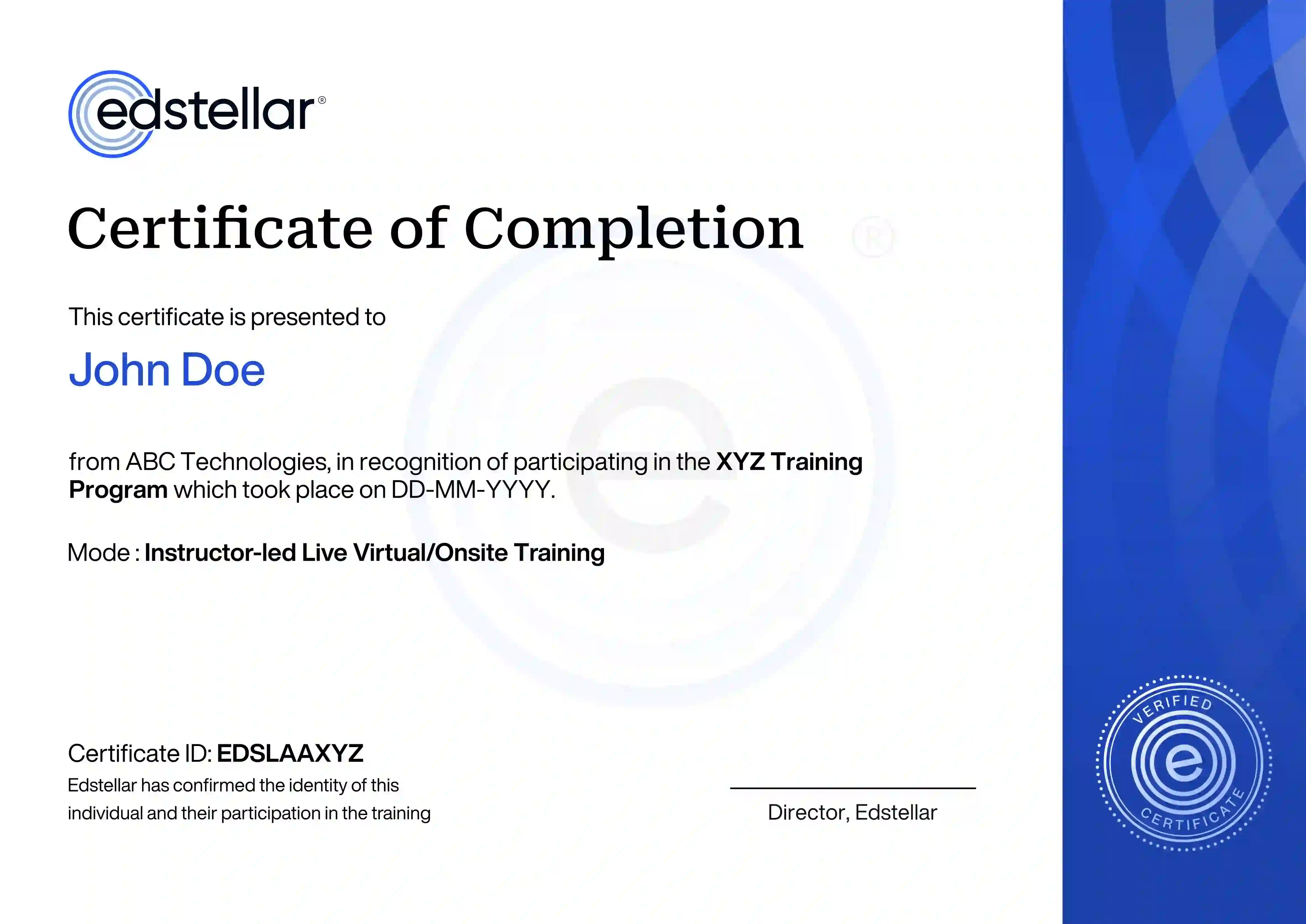
        Get Your Team Members Recognized with Edstellar’s Course Certificate

        Upon successful completion of the training course offered by Edstellar, employees receive a course completion certificate, symbolizing their dedication to ongoing learning and professional development.

        This certificate validates the employee's acquired skills and is a powerful motivator, inspiring them to enhance their expertise further and contribute effectively to organizational success.

        Certificate of Excellence