Environmental Management and Sustainability Reporting Integration Corporate Training Program
Edstellar's instructor-led Environmental Management and Sustainability Reporting training equips professionals to design EMS frameworks, collect and analyze environmental data, and produce integrated sustainability reports aligned with GRI, TCFD, and ESG disclosure standards.
(Virtual / On-site / Off-site)
Available Languages
English, Español, 普通话, Deutsch, العربية, Português, हिंदी, Français, 日本語 and Italiano
Drive Team Excellence with Environmental Management and Sustainability Reporting Integration Corporate Training
Empower your teams with expert-led on-site, off-site, and virtual Environmental Management and Sustainability Reporting Integration Training through Edstellar, a premier corporate training provider for organizations globally. Designed to meet your specific training needs, this group training program ensures your team is primed to drive your business goals. Help your employees build lasting capabilities that translate into real performance gains.
Environmental Management and Sustainability Reporting Integration equips organizations to systematically manage their environmental impacts and communicate sustainability performance to investors, regulators, and stakeholders. This field encompasses the design and operation of Environmental Management Systems (EMS) aligned with ISO 14001, the application of globally recognized reporting frameworks including GRI Standards, TCFD, and integrated reporting, and the integration of environmental data into financial and governance disclosures. With increasing regulatory pressure and investor demand for ESG transparency, organizations must build robust systems for measuring, managing, and reporting their environmental footprint.
Edstellar's Environmental Management and Sustainability Reporting Integration Instructor-led course offers virtual/onsite training options to meet professionals' diverse needs. This flexibility ensures that professionals and teams can engage in learning experiences that best suit their logistical and learning preferences. What sets the Edstellar course apart is its emphasis on practical experience, with hands-on exercises covering real-world EMS implementation, materiality assessments, and sustainability report construction that prepare participants to lead environmental reporting with confidence.

Key Skills Employees Gain from Instructor-led Environmental Management and Sustainability Reporting Integration Training
Environmental Management and Sustainability Reporting Integration skills corporate training will enable teams to effectively apply their learnings at work.
- Environmental Management System Design
- Sustainability Reporting Framework Application
- ESG Data Collection and Analysis
- GRI and TCFD Disclosure Alignment
- Carbon Footprint Measurement
- Environmental KPI Development
- Integrated Reporting Communication
Key Learning Outcomes of Environmental Management and Sustainability Reporting Integration Training Workshop
Upon completing Edstellar’s Environmental Management and Sustainability Reporting Integration workshop, employees will gain valuable, job-relevant insights and develop the confidence to apply their learning effectively in the professional environment.
- Master environmental management system design and implementation, applying ISO 14001 principles to assess environmental aspects, establish objectives, and build a compliant EMS framework.
- Gain expertise in sustainability reporting frameworks, including GRI Standards, TCFD recommendations, and integrated reporting principles, to produce credible, decision-useful ESG disclosures.
- Develop proficiency in carbon footprint measurement using GHG Protocol Scope 1, 2, and 3 methodologies to quantify emissions, set reduction targets, and track progress.
- Learn ESG data governance and management strategies, covering data collection design, quality assurance, audit readiness, and multi-framework reporting integration.
- Build stakeholder engagement and materiality assessment skills to prioritize sustainability topics that are most relevant to investors, regulators, employees, and communities.
- Apply integrated sustainability communication strategies by combining financial and non-financial performance data into cohesive reports that demonstrate long-term organizational value.
Key Benefits of the Environmental Management and Sustainability Reporting Integration Group Training
Attending our Environmental Management and Sustainability Reporting Integration group training classes provides your team with a powerful opportunity to build skills, boost confidence, and develop a deeper understanding of the concepts that matter most. The collaborative learning environment fosters knowledge sharing and enables employees to translate insights into actionable work outcomes.
- Understand environmental management system fundamentals by learning ISO 14001 principles, environmental aspects and impacts assessment, and EMS certification pathways for organizations.
- Design environmental monitoring programs by identifying key performance indicators, data collection methods, and measurement systems for tracking organizational environmental impacts.
- Apply GRI Standards for sustainability disclosure by mapping material topics, selecting applicable GRI disclosures, and structuring credible, stakeholder-relevant sustainability reports.
- Implement TCFD recommendations by assessing physical and transition climate risks, developing scenario analysis, and integrating climate disclosures into financial reporting.
- Measure and manage carbon footprints using Greenhouse Gas Protocol Scopes 1, 2, and 3 methodologies to support emission reduction targets and net zero commitments.
- Integrate sustainability reporting with financial reporting using integrated reporting frameworks to communicate how environmental strategy drives long-term organizational value.
- Build ESG data management systems by designing data collection pipelines, quality controls, and audit-ready documentation for multi-framework sustainability disclosure.
- Engage stakeholders through materiality assessments and sustainability communication strategies that align reporting priorities with investor, regulator, and community expectations.
- Develop environmental compliance programs by identifying applicable regulations, managing permit obligations, and building internal audit and corrective action processes.
- Communicate sustainability performance to boards, investors, and external stakeholders using narrative reporting, data visualization, and assurance-ready disclosure documentation.
Topics and Outline of Environmental Management and Sustainability Reporting Integration Training
Our virtual and on-premise Environmental Management and Sustainability Reporting Integration training curriculum is structured into focused modules developed by industry experts. This training for organizations provides an interactive learning experience that addresses the evolving demands of the workplace, making it both relevant and practical.
-
Environmental Management Overview
- What is environmental management
- Evolution of corporate environmental responsibility
- Environmental management drivers
- Business case for environmental management
-
Environmental Aspects and Impacts
- Identifying environmental aspects
- Assessing significance of impacts
- Lifecycle perspective on impacts
- Prioritizing environmental risks
-
Environmental Regulatory Landscape
- International environmental treaties
- National and regional regulations
- Industry-specific environmental obligations
- Compliance obligation management
-
Environmental Policy Development
- Environmental policy principles
- Policy drafting and approval
- Policy communication and implementation
- Policy review and update cycles
-
Environmental Objectives and Targets
- Setting SMART environmental objectives
- Aligning targets with business strategy
- Baseline data establishment
- Target monitoring and review
-
Environmental Leadership and Culture
- Leadership commitment to sustainability
- Building environmental awareness
- Cross-functional environmental teams
- Embedding environmental culture
-
ISO 14001 Standard Overview
- ISO 14001 structure and requirements
- Plan-Do-Check-Act cycle in EMS
- Relationship to other ISO standards
- Certification process overview
-
Context of the Organization
- Internal and external issues analysis
- Interested parties and requirements
- EMS scope determination
- Organizational context documentation
-
EMS Planning
- Risk and opportunity identification
- Legal compliance planning
- Environmental objectives planning
- Action plans for environmental targets
-
EMS Support and Operational Control
- Resource and competence management
- Environmental training programs
- Operational control procedures
- Emergency preparedness and response
-
EMS Performance Evaluation
- Monitoring and measurement systems
- Internal audit procedures
- Management review process
- Corrective action management
-
EMS Continual Improvement
- Nonconformity and corrective action
- Continual improvement planning
- Lessons learned integration
- EMS maturity progression
-
GHG Protocol Fundamentals
- GHG Protocol standards and scope
- Scope 1 direct emissions
- Scope 2 energy indirect emissions
- Scope 3 value chain emissions
-
Emissions Inventory Development
- Organizational boundary setting
- Activity data collection
- Emission factor selection
- Inventory calculation methods
-
Scope 3 Emissions Management
- Scope 3 category identification
- Supply chain emissions assessment
- Supplier engagement strategies
- Scope 3 reduction approaches
-
Net Zero and Science-Based Targets
- Science-Based Targets initiative (SBTi)
- Net zero target setting principles
- Interim target milestones
- Target monitoring and reporting
-
Carbon Reduction Strategies
- Energy efficiency opportunities
- Renewable energy transition
- Carbon capture and removal
- Carbon offset frameworks and quality
-
GHG Verification and Assurance
- Third-party verification process
- Assurance standards overview
- Preparing for verification engagements
- Disclosure of verified emissions data
-
GRI Standards Overview
- GRI Universal Standards structure
- Topic-specific standards for environment
- GRI-referenced vs GRI-aligned reporting
- GRI report index construction
-
Materiality Assessment
- Double materiality concept
- Stakeholder identification and engagement
- Topic prioritization methods
- Materiality matrix development
-
Environmental GRI Disclosures
- Energy consumption disclosures (GRI 302)
- Emissions disclosures (GRI 305)
- Water and effluents (GRI 303)
- Biodiversity disclosures (GRI 304)
-
SASB Standards Application
- SASB industry-specific standards
- Selecting applicable SASB topics
- SASB and GRI alignment
- SASB disclosure preparation
-
CSRD and ESRS Requirements
- EU Corporate Sustainability Reporting Directive
- European Sustainability Reporting Standards
- ESRS environmental standards
- CSRD readiness assessment
-
Sustainability Report Structure
- Sustainability report components
- Narrative and data presentation
- Assurance and verification integration
- Multi-year comparability
-
TCFD Framework Overview
- TCFD four-pillar structure
- Governance recommendations
- Strategy recommendations
- Risk management recommendations
-
Physical and Transition Climate Risks
- Physical risk categories and examples
- Transition risk categories
- Climate risk identification methods
- Risk materiality assessment
-
Climate Scenario Analysis
- Scenario analysis methodology
- IPCC and IEA scenario frameworks
- Qualitative vs quantitative scenarios
- Scenario output interpretation
-
Climate Metrics and Targets
- Climate-related financial metrics
- Internal carbon pricing
- Climate target disclosure
- Linking climate metrics to strategy
-
TCFD Disclosure Preparation
- TCFD disclosure document structure
- Board and management oversight disclosure
- Risk management integration disclosure
- Annual TCFD report review
-
ISSB and IFRS S2 Climate Standards
- ISSB IFRS S2 structure and requirements
- Transition from TCFD to ISSB
- IFRS S2 disclosure requirements
- Preparing for mandatory ISSB adoption
-
ESG Data Architecture
- ESG data collection sources
- Centralized vs decentralized data models
- ESG data platforms and tools
- Integration with financial systems
-
Data Collection and Aggregation
- Primary data collection methods
- Supplier and value chain data collection
- Estimation and extrapolation methods
- Data aggregation and consolidation
-
Data Quality Controls
- Data validation rules
- Completeness and accuracy checks
- Outlier detection and investigation
- Data correction procedures
-
ESG Data Governance
- ESG data ownership and accountability
- Data governance policies
- Metadata management for ESG
- Audit trail and version control
-
Technology for ESG Reporting
- ESG reporting software evaluation
- Automation in data collection
- AI-assisted ESG data management
- API integration with reporting platforms
-
Assurance Readiness
- Preparing ESG data for third-party assurance
- Internal controls documentation
- Evidence gathering and retention
- Working with assurance providers
-
Integrated Reporting Framework
- IIRC Integrated Reporting Framework
- Six capitals model
- Value creation story development
- Connectivity of financial and non-financial data
-
Linking EMS to Financial Reporting
- Environmental liabilities and provisions
- Stranded asset risk disclosure
- Carbon cost in financial planning
- Environmental risk in audit committees
-
Annual Report Integration
- Embedding ESG in annual reports
- Sustainability highlights in executive letters
- Board sustainability governance disclosure
- Investor relations and ESG messaging
-
ESG Ratings and Indices
- Major ESG rating agencies overview
- Improving ESG ratings
- Responding to ESG questionnaires
- ESG index inclusion criteria
-
Stakeholder Communication
- Investor ESG communication strategies
- Regulator reporting and engagement
- Customer and supplier communication
- Community and NGO engagement
-
Reporting Credibility and Transparency
- Avoiding greenwashing
- Balanced reporting principles
- Third-party verification value
- Continuous reporting improvement
-
Environmental Compliance Program Design
- Compliance obligation identification
- Compliance calendar and register
- Compliance roles and responsibilities
- Compliance technology tools
-
Permit and License Management
- Environmental permit types
- Permit application processes
- Permit condition compliance
- Permit renewal management
-
Environmental Risk Assessment
- Environmental risk identification
- Impact and likelihood assessment
- Risk mitigation controls
- Environmental risk register
-
Environmental Incident Management
- Incident classification and reporting
- Emergency response procedures
- Regulatory notification requirements
- Post-incident review and prevention
-
Environmental Auditing
- Internal environmental audit design
- Audit scope and criteria
- Findings classification and reporting
- Corrective action tracking
-
Supply Chain Environmental Management
- Supplier environmental assessment
- Environmental requirements in contracts
- Supplier engagement programs
- Supply chain risk monitoring
-
Circular Economy Principles
- Linear vs circular economy models
- Circular design principles
- Business models for circularity
- Circular economy benefits and barriers
-
Waste Management and Reduction
- Waste hierarchy application
- Waste data collection and reporting
- Zero waste to landfill strategies
- Hazardous waste management
-
Water Stewardship
- Water risk assessment
- Water consumption reduction programs
- Wastewater management
- Water stewardship frameworks
-
Energy Management
- ISO 50001 energy management
- Energy audit methodologies
- Energy efficiency measures
- Renewable energy procurement
-
Biodiversity and Land Management
- Biodiversity impact assessment
- Nature-based solutions
- Biodiversity net gain frameworks
- TNFD disclosure framework overview
-
Resource Efficiency Reporting
- Resource efficiency KPIs
- Circular economy metrics
- Material flow accounting
- Reporting on waste and water
-
Corporate Sustainability Strategy
- Developing a sustainability vision
- Setting long-term sustainability commitments
- Aligning sustainability with business strategy
- Sustainability governance structures
-
Just Transition and Social Dimensions
- Just transition principles
- Social impacts of environmental action
- Community engagement in sustainability
- Environmental justice considerations
-
Emerging Regulatory Requirements
- Evolving EU sustainability regulation
- SEC climate disclosure rules
- Global regulatory convergence trends
- Preparing for mandatory disclosure
-
AI and Digital Tools in Sustainability
- AI for environmental data analysis
- Digital twin for environmental modeling
- Blockchain for supply chain transparency
- Predictive analytics for environmental risk
-
Sustainability Reporting Maturity
- Assessing reporting maturity levels
- Moving from compliance to strategic reporting
- Benchmarking against peers
- Best practice reporting examples
-
Building Internal Sustainability Capability
- Sustainability team structure
- Internal training and awareness programs
- Cross-functional sustainability networks
- Long-term sustainability capability roadmap
Who Can Take the Environmental Management and Sustainability Reporting Integration Training Course
The Environmental Management and Sustainability Reporting Integration training program can also be taken by professionals at various levels in the organization.
- Sustainability Manager
- Environmental Compliance Officer
- ESG Analyst
- Corporate Reporting Manager
- Chief Sustainability Officer
- Risk and Governance Manager
Prerequisites for Environmental Management and Sustainability Reporting Integration Training
Professionals should have a general understanding of corporate sustainability principles, familiarity with environmental regulations or business reporting processes, and basic data analysis skills to take the Environmental Management and Sustainability Reporting Integration training course.
Corporate Group Training Delivery Modes
for Environmental Management and Sustainability Reporting Integration Training
At Edstellar, we understand the importance of impactful and engaging training for employees. As a leading Environmental Management and Sustainability Reporting Integration training provider, we ensure the training is more interactive by offering Face-to-Face onsite/in-house or virtual/online sessions for companies. This approach has proven to be effective, outcome-oriented, and produces a well-rounded training experience for your teams.


.webp)
Edstellar's Environmental Management and Sustainability Reporting Integration virtual/online training sessions bring expert-led, high-quality training to your teams anywhere, ensuring consistency and seamless integration into their schedules.
.webp)
Edstellar's Environmental Management and Sustainability Reporting Integration inhouse face to face instructor-led training delivers immersive and insightful learning experiences right in the comfort of your office.
.webp)
Edstellar's Environmental Management and Sustainability Reporting Integration offsite face-to-face instructor-led group training offer a unique opportunity for teams to immerse themselves in focused and dynamic learning environments away from their usual workplace distractions.
Explore Our Customized Pricing Package
for
Environmental Management and Sustainability Reporting Integration Corporate Training
Looking for pricing details for onsite, offsite, or virtual instructor-led Environmental Management and Sustainability Reporting Integration training? Get a customized proposal tailored to your team’s specific needs.
64 hours of group training (includes VILT/In-person On-site)
Tailored for SMBs
Tailor-Made Trainee Licenses with Our Exclusive Training Packages!
160 hours of group training (includes VILT/In-person On-site)
Ideal for growing SMBs
Tailor-Made Trainee Licenses with Our Exclusive Training Packages!
400 hours of group training (includes VILT/In-person On-site)
Designed for large corporations
Tailor-Made Trainee Licenses with Our Exclusive Training Packages!
Unlimited duration
Designed for large corporations
Edstellar: Your Go-to Environmental Management and Sustainability Reporting Integration Training Company
Experienced Trainers
Our trainers bring years of industry expertise to ensure the training is practical and impactful.
Quality Training
With a strong track record of delivering training worldwide, Edstellar maintains its reputation for its quality and training engagement.
Industry-Relevant Curriculum
Our course is designed by experts and is tailored to meet the demands of the current industry.
Customizable Training
Our course can be customized to meet the unique needs and goals of your organization.
Comprehensive Support
We provide pre and post training support to your organization to ensure a complete learning experience.
Multilingual Training Capabilities
We offer training in multiple languages to cater to diverse and global teams.
What Our Clients Say
We pride ourselves on delivering exceptional training solutions. Here's what our clients have to say about their experiences with Edstellar.
"Edstellar's virtual Environmental Management and Sustainability Reporting training equipped our sustainability team with the frameworks needed to produce credible GRI and TCFD disclosures. Fourteen sustainability managers and ESG analysts completed the program. We published our first integrated sustainability report, which improved our ESG rating by two tiers and strengthened investor confidence significantly."
Amara Osei
Head of Sustainability Reporting,
A Global Consumer Goods Company
"The onsite Environmental Management training by Edstellar transformed how our operations and compliance teams approach environmental governance. Eighteen environmental officers and facility managers attended a three-day workshop on ISO 14001 implementation, carbon footprint measurement, and compliance auditing. We achieved ISO 14001 certification six months after training and reduced our Scope 1 emissions by 22% in the first year."
Elena Vasquez
Environmental Compliance Director,
A Global Manufacturing Group
"Edstellar's off-site Sustainability Reporting training brought together our finance, sustainability, and legal teams for a five-day intensive program on integrated reporting, TCFD disclosures, and ESG data governance. We redesigned our reporting architecture, improved data quality controls, and aligned our climate disclosures with ISSB requirements, resulting in a 30% reduction in audit queries on our sustainability data."
Thomas Bergmann
Chief Sustainability Officer,
A Global Infrastructure Company
"Edstellar's Social Impact training programs have helped our organization strengthen its commitment to responsible practices, sustainability, and community well-being. The sessions offer actionable insights, structured sustainability frameworks, and real-world case studies that empower teams to embed ethical practices, create measurable social value, and drive meaningful, long-term impact across business operations."
Leena Thomas
Head of Sustainability & CSR,
A Global Industrial Group
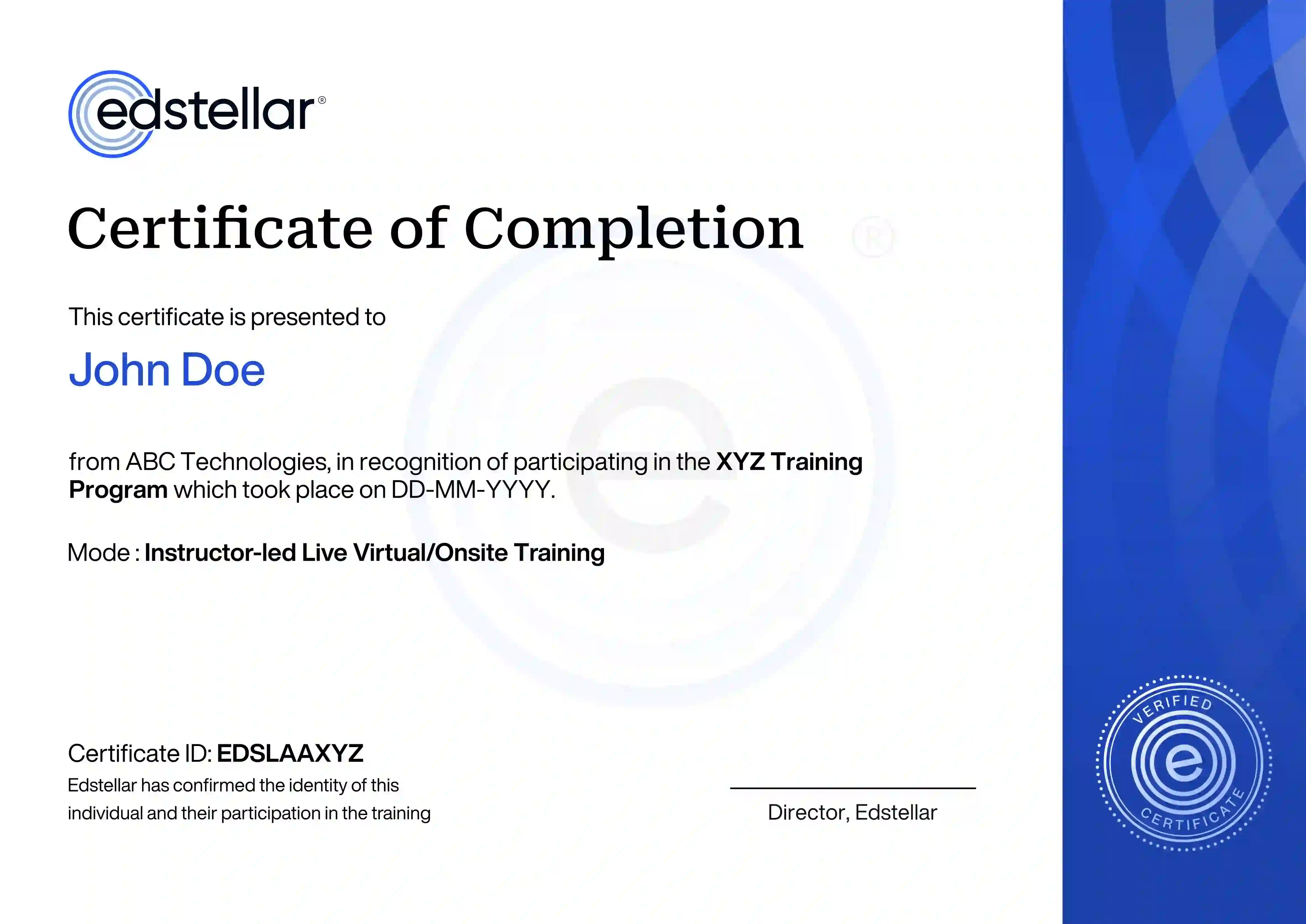
Get Your Team Members Recognized with Edstellar’s Course Certificate
Upon successful completion of the training course offered by Edstellar, employees receive a course completion certificate, symbolizing their dedication to ongoing learning and professional development.
This certificate validates the employee's acquired skills and is a powerful motivator, inspiring them to enhance their expertise further and contribute effectively to organizational success.


Edstellar is a one-stop instructor-led corporate training and coaching solution that addresses organizational upskilling and talent transformation needs globally.
Marketing Excellence
Operational Excellence
Finance Excellence
HR Excellence
IT Excellence
Customer Service
Leadership Excellence
Quality Management
Software
How it WorksFAQ'sCorporate Training
CatalogStellar AI
Skill MatrixHRMS Integration
Who we ServeCEO RetreatsPricingTraining DeliveryPartner with Edstellar
CareersContact us