.webp)
ESG Data Assurance and Reporting Corporate Training Program
ESG Data Assurance and Reporting training equips sustainability and finance professionals with the frameworks, internal controls, and assurance standards needed to produce accurate, verifiable ESG disclosures that satisfy investors, regulators, and multi-framework reporting requirements.
(Virtual / On-site / Off-site)
Available Languages
English, Español, 普通话, Deutsch, العربية, Português, हिंदी, Français, 日本語 and Italiano
Drive Team Excellence with ESG Data Assurance and Reporting Corporate Training
ESG Data Assurance and Reporting has become a critical capability for organizations navigating growing demands from investors, regulators, and stakeholders for credible, auditable sustainability disclosures. As ESG reporting standards evolve rapidly and assurance expectations rise, organizations that lack robust data governance and quality controls face reputational, regulatory, and financial risk. This training provides the technical knowledge and practical tools needed to build investor-grade ESG reporting systems backed by credible internal and external assurance processes.
Edstellar's ESG Data Assurance and Reporting Instructor-led course offers virtual/onsite training options, enabling sustainability managers, finance professionals, ESG analysts, and compliance officers to design ESG data governance systems, apply international assurance standards, navigate multi-framework reporting requirements, and communicate ESG performance with the transparency and rigor that today's stakeholders demand.

Skills Your Employees Will Gain
These are the core, hands-on capabilities your team builds during the program.
- ESG Data Governance
- Internal ESG Controls
- Third-Party ESG Assurance
- ISAE 3000 Application
- Multi-Framework ESG Reporting
- ESG Data Quality Management
- Stakeholder ESG Communication
What Your Team Will Achieve After This Training
- Master ESG data governance frameworks and design internal controls that ensure data integrity across the full reporting cycle
- Gain hands-on capability to apply the ISAE 3000 standard for managing limited and reasonable assurance engagements
- Develop proficiency in aligning ESG disclosures across GRI, TCFD, and ISSB/IFRS S1 and S2 reporting frameworks
- Learn to produce investor-grade ESG reports that satisfy institutional investors, rating agencies, and regulatory requirements
- Build stakeholder communication strategies that present ESG data and assurance outcomes with transparency and confidence
- Apply continuous improvement practices to elevate ESG data quality and assurance readiness across successive reporting cycles
Topics & Program Outline
The curriculum is organized into focused modules built by industry experts and delivered virtually or on-premise. Interactive sessions reflect the evolving demands of the workplace, keeping the learning both relevant and practical.
-
The ESG Assurance Landscape
- Drivers of growing ESG assurance demand from investors and regulators
- Regulatory developments requiring mandatory ESG assurance globally
- The difference between ESG reporting and ESG assurance
- Consequences of ESG data inaccuracy for organizational reputation and risk
-
ESG Data Fundamentals
- Categories of ESG data: environmental, social, and governance metrics
- Quantitative versus qualitative ESG data types and their treatment
- Defining ESG data boundaries, scope, and organizational consolidation
- Common ESG data challenges including gaps, estimates, and inconsistency
-
ESG Reporting Ecosystem Overview
- Overview of major ESG reporting frameworks and their primary audiences
- How GRI, TCFD, and ISSB relate to and differ from one another
- Mandatory versus voluntary disclosure regimes across key jurisdictions
- Understanding how frameworks interconnect for integrated reporting
-
Stakeholder Expectations for ESG Assurance
- What institutional investors look for in assured ESG disclosures
- Rating agency methodologies and their reliance on ESG data quality
- Regulatory expectations for ESG assurance in key markets
- Board and audit committee responsibilities for ESG data oversight
-
Assurance Readiness Assessment
- Diagnosing current ESG data maturity using readiness assessment tools
- Identifying gaps in data collection, controls, and documentation
- Prioritizing assurance readiness improvements across reporting cycles
- Building an internal roadmap to achieve limited and then reasonable assurance
-
Building the Business Case for ESG Assurance
- Quantifying the cost of ESG data errors and assurance failures
- Presenting ESG assurance ROI through investor confidence and capital access
- Aligning ESG assurance investment with corporate strategy and values
- Engaging executive leadership and the board in ESG assurance commitments
-
ESG Data Governance Frameworks
- Defining ESG data governance and its role in reporting credibility
- Key components of an ESG data governance framework
- Assigning data ownership and accountability across the organization
- Benchmarking governance maturity against leading organizational practices
-
ESG Data Policies and Standards
- Developing ESG data collection policies aligned to reporting frameworks
- Setting internal data quality standards for accuracy and completeness
- Establishing data retention and documentation requirements for assurance
- Communicating data policies across business units and subsidiaries
-
Data Ownership and Stewardship
- Defining roles of data owners, stewards, and custodians in ESG reporting
- Building cross-functional ESG data teams with clear responsibilities
- Training data stewards on ESG definitions and measurement protocols
- Establishing escalation pathways for data quality issues and disputes
-
ESG Data Taxonomy and Definitions
- Standardizing ESG metric definitions across business units globally
- Aligning internal taxonomy with GRI, TCFD, and ISSB disclosure requirements
- Managing changes to ESG definitions and their impact on trend data
- Documenting methodology notes for all significant ESG data metrics
-
ESG Data Lifecycle Management
- Mapping the end-to-end ESG data lifecycle from source to disclosure
- Managing data handoffs and transformation steps with audit trail integrity
- Archiving ESG data in formats suited to multi-year trend analysis
- Reviewing and updating governance protocols annually for continuous improvement
-
Governance of ESG Data in Mergers and Acquisitions
- Due diligence considerations for ESG data in acquisition target assessment
- Integrating acquired entity ESG data into existing governance frameworks
- Managing boundary changes in ESG disclosures following M and A activity
- Communicating data boundary changes transparently in ESG reports
-
ESG Data Sources and Collection Methods
- Identifying primary and secondary data sources across ESG categories
- Collecting environmental data from metering, invoices, and operational records
- Gathering social and governance data from HR systems and board records
- Managing supplier and value chain data collection for Scope 3 reporting
-
ESG Data Management Systems
- Evaluating ESG software platforms for data collection and reporting needs
- Configuring ESG systems to support multiple framework outputs simultaneously
- Integrating ESG platforms with ERP, HR, and operational data systems
- Ensuring system-level audit trails meet external assurance provider requirements
-
Data Collection Templates and Tools
- Designing standardized data collection templates for business unit use
- Building validation rules into collection tools to prevent data entry errors
- Training data contributors on template use and metric definitions
- Automating data collection where feasible to reduce manual error risk
-
Managing Estimates and Proxies in ESG Data
- When and how to use estimation methodologies for missing ESG data
- Selecting credible proxy data sources and documenting assumptions clearly
- Reducing reliance on estimates through improved data collection infrastructure
- Disclosing estimation approaches transparently in ESG reports and assurance
-
Data Validation and Cleansing Processes
- Building data validation workflows to catch errors before reporting deadlines
- Conducting outlier analysis and reasonableness checks on submitted data
- Resolving data discrepancies through structured escalation and review
- Documenting validation outcomes as evidence for external assurance providers
-
Continuous Improvement of Data Collection Systems
- Reviewing collection system performance after each annual reporting cycle
- Incorporating assurance provider feedback into system improvement plans
- Piloting new data collection tools before organization-wide deployment
- Tracking data quality improvement metrics across successive reporting cycles
-
Principles of Internal Control in ESG Reporting
- Adapting financial reporting internal control frameworks to ESG contexts
- COSO framework application to ESG data risk and control environments
- Mapping ESG data risks to specific control objectives and activities
- Building a control environment that supports external assurance readiness
-
Control Design for ESG Data Processes
- Designing preventive and detective controls for high-risk ESG data points
- Segregation of duties in ESG data preparation and review processes
- Authorization controls for data submission, adjustment, and sign-off
- Documenting control procedures for each significant ESG metric
-
Control Testing and Effectiveness Evaluation
- Designing internal control testing plans for ESG data processes
- Sampling approaches for testing ESG data control effectiveness
- Documenting control test results and remediation actions taken
- Reporting internal control findings to management and audit committees
-
Reconciliation and Review Controls
- Building reconciliation processes to verify ESG data consistency across systems
- Conducting management review controls over reported ESG metrics
- Peer review mechanisms for high-materiality ESG data calculations
- Maintaining evidence of review and approval for assurance provider access
-
IT Controls Supporting ESG Reporting
- Access management controls for ESG data systems and reporting tools
- Change management controls over ESG system configurations and formulas
- Data backup and recovery controls for ESG data and documentation
- IT general controls assessment as part of ESG assurance preparation
-
Internal Audit and ESG Controls
- Engaging internal audit in reviewing ESG data controls and processes
- Developing ESG-specific internal audit programs and testing protocols
- Coordinating internal and external assurance work to avoid duplication
- Using internal audit findings to build assurance readiness year on year
-
Overview of Third-Party ESG Assurance
- Why third-party assurance increases ESG disclosure credibility
- Types of ESG assurance providers including audit firms and specialist verifiers
- Selecting the right assurance provider for your organization and scope
- Comparing assurance provider approaches, methodologies, and competencies
-
Assurance Standards and Frameworks
- Overview of ISAE 3000 as the primary ESG assurance standard
- AA1000 Assurance Standard and its application in sustainability reporting
- Comparing ISAE 3000 and AA1000 for organizational reporting contexts
- Emerging standards and regulatory assurance requirements by jurisdiction
-
Scoping the Assurance Engagement
- Defining the subject matter, boundary, and period for assurance engagements
- Selecting which ESG metrics to include in limited or reasonable assurance scope
- Materiality considerations in determining assurance scope priorities
- Aligning assurance scope with investor and regulatory expectations
-
Preparing for Assurance Engagements
- Building an assurance-ready documentation pack for provider review
- Coordinating internal teams and data owners during assurance fieldwork
- Managing assurance provider queries and evidence requests efficiently
- Common assurance findings and how to prevent them in advance
-
Assurance Opinions and Statements
- Understanding limited versus reasonable assurance opinion language
- What assurance statements communicate to investors and stakeholders
- Handling qualified or modified assurance opinions and remediation
- Publishing assurance statements effectively in ESG and annual reports
-
Continuous Improvement Through Assurance Cycles
- Using assurance findings to strengthen internal controls and data quality
- Tracking improvement in assurance readiness metrics across reporting cycles
- Progressing from limited to reasonable assurance over a defined timeline
- Building assurance provider relationships that deliver ongoing value
-
ISAE 3000 Standard in Depth
- Structure and requirements of the ISAE 3000 standard for non-financial information
- Responsibilities of the responsible party and the assurance practitioner
- Criteria for selecting and applying suitable reporting criteria under ISAE 3000
- How ISAE 3000 applies to both quantitative and qualitative ESG disclosures
-
Limited Assurance Engagements
- Defining the nature, scope, and output of limited assurance engagements
- Procedures typically performed in a limited assurance engagement
- Understanding the negative form of conclusion in limited assurance opinions
- Organizational prerequisites for achieving limited assurance outcomes
-
Reasonable Assurance Engagements
- How reasonable assurance differs from limited assurance in depth and procedures
- Evidence requirements for reasonable assurance on ESG metrics
- Building internal control maturity required to support reasonable assurance
- Understanding the positive form of conclusion in reasonable assurance opinions
-
Evidence and Documentation Requirements
- Types of evidence accepted by assurance providers under ISAE 3000
- Structuring documentation packages to support efficient assurance fieldwork
- Maintaining audit trails that satisfy ISAE 3000 evidence requirements
- Managing documentation version control during active assurance engagements
-
Criteria and Materiality in ISAE 3000
- Selecting suitable criteria for ESG disclosure under ISAE 3000
- Applying quantitative and qualitative materiality thresholds in assurance
- How materiality judgments affect assurance scope and procedures
- Communicating materiality decisions to assurance providers and stakeholders
-
Progressing the Assurance Journey
- Planning a multi-year roadmap from limited to reasonable assurance coverage
- Expanding the scope of assured metrics progressively across reporting cycles
- Addressing assurance provider findings to accelerate assurance maturity
- Communicating assurance progress milestones to board and investor audiences
-
GRI Standards in Depth
- Structure and application of the GRI Universal Standards 2021
- Topic standards selection based on materiality assessment outcomes
- GRI disclosure requirements for environmental, social, and governance topics
- GRI content index preparation and verification for published reports
-
TCFD Framework and Climate Disclosure
- TCFD recommendations across governance, strategy, risk, and metrics pillars
- Physical and transition climate risk assessment and disclosure approaches
- Scenario analysis methodologies for TCFD strategy disclosures
- Aligning TCFD disclosures with ISSB IFRS S2 climate requirements
-
ISSB and IFRS S1 and S2
- Overview of ISSB and the purpose of IFRS S1 and IFRS S2 standards
- IFRS S1 requirements for general sustainability-related financial disclosures
- IFRS S2 requirements for climate-related financial disclosures
- Jurisdictional adoption timelines and mandatory application requirements
-
Aligning Disclosures Across Multiple Frameworks
- Mapping common data requirements across GRI, TCFD, and ISSB frameworks
- Building a single data collection process that serves multiple framework outputs
- Managing differences in scope, boundary, and definition across frameworks
- Using cross-reference tables to demonstrate alignment in published reports
-
Materiality Assessment for Multi-Framework Reporting
- Double materiality assessment under GRI and European CSRD requirements
- Financial materiality assessment for ISSB and investor-focused disclosures
- Stakeholder engagement processes to inform robust materiality assessments
- Documenting and communicating materiality assessment methodology and outcomes
-
Framework Evolution and Regulatory Convergence
- Tracking ongoing updates to GRI, TCFD, ISSB, and CSRD requirements
- Understanding regulatory convergence trends across major global jurisdictions
- Building reporting processes that can adapt to evolving framework requirements
- Engaging with framework bodies and industry groups to stay ahead of changes
-
What Makes ESG Reporting Investor-Grade
- Defining investor-grade ESG data quality, completeness, and auditability
- Understanding how institutional investors use ESG data in decision-making
- Key investor expectations for ESG report structure and content
- Common ESG report weaknesses that reduce investor confidence
-
ESG Rating Agencies and Indices
- Overview of major ESG rating methodologies including MSCI and Sustainalytics
- How ESG ratings are calculated from disclosed and estimated data
- Strategies to improve ESG ratings through better disclosure quality
- Managing ESG rating agency data requests and verification processes
-
Quantitative ESG Data Presentation
- Selecting the right metrics to present for investor-grade ESG reporting
- Presenting multi-year trend data that demonstrates performance trajectory
- Normalizing ESG data by revenue, headcount, or production for comparability
- Visualizing ESG data in formats that aid investor interpretation
-
Narrative and Qualitative ESG Disclosure
- Writing qualitative ESG disclosures that complement quantitative data
- Communicating ESG strategy, targets, and progress credibly to investors
- Avoiding greenwashing risks in narrative ESG disclosures
- Connecting ESG narrative to financial strategy and value creation
-
Peer Benchmarking and Competitive Positioning
- Benchmarking ESG performance and disclosure quality against industry peers
- Using peer analysis to identify disclosure gaps and improvement priorities
- Positioning ESG disclosure leadership as a competitive differentiator
- Communicating peer benchmarking insights to board and investor audiences
-
Integrated Reporting and Financial-ESG Linkage
- Principles of integrated reporting and their application to ESG disclosure
- Demonstrating links between ESG performance and financial value creation
- Incorporating ESG data into annual reports, proxy statements, and filings
- Meeting investor expectations for ESG connectivity in annual reporting cycles
-
ESG Stakeholder Mapping and Engagement
- Identifying and prioritizing ESG stakeholder groups and their information needs
- Designing stakeholder engagement processes that inform ESG reporting
- Managing stakeholder expectations around ESG disclosure scope and timing
- Building ongoing stakeholder dialogue mechanisms for ESG feedback
-
Communicating ESG Data to Investors
- Tailoring ESG data presentations for institutional and retail investor audiences
- Conducting effective ESG investor roadshows and briefing sessions
- Responding to investor ESG data requests and questionnaires accurately
- Communicating material ESG developments through timely investor disclosures
-
Board and Executive ESG Communication
- Presenting ESG data and assurance outcomes to the board in accessible formats
- Building board oversight of ESG reporting through audit and risk committees
- Designing executive dashboards that track ESG data quality and assurance progress
- Linking ESG reporting outcomes to executive remuneration and accountability
-
Regulatory Communication and Compliance Reporting
- Meeting mandatory ESG disclosure requirements for key regulatory bodies
- Managing regulatory inquiries and data verification requests efficiently
- Documenting regulatory ESG submissions with audit-ready evidence packs
- Monitoring evolving regulatory requirements and adapting reporting proactively
-
ESG Communication During Controversies
- Managing stakeholder communication when ESG data errors are identified
- Issuing corrections and restatements transparently while maintaining trust
- Communicating remediation plans following ESG assurance qualifications
- Building crisis communication protocols specific to ESG disclosure failures
-
Digital and Multi-Channel ESG Communication
- Designing ESG microsites and digital reports for stakeholder accessibility
- Using data visualization tools to present complex ESG metrics clearly
- Managing ESG social media communication aligned with reported disclosures
- Measuring stakeholder engagement and comprehension of ESG communications
-
ESG Assurance Maturity Model
- Defining levels of ESG assurance maturity from initial to optimized
- Assessing current organizational position on the ESG maturity spectrum
- Identifying the key capability gaps that limit assurance maturity progression
- Building a phased improvement roadmap anchored to maturity model milestones
-
Post-Assurance Review Process
- Conducting structured reviews after each assurance cycle to capture insights
- Documenting assurance provider findings and root causes systematically
- Assigning ownership and deadlines for all post-assurance improvement actions
- Tracking closure of post-assurance actions before the next reporting cycle begins
-
ESG Data Quality Metrics and KPIs
- Defining KPIs to track ESG data quality improvements over time
- Measuring error rates, restatement frequency, and assurance finding counts
- Benchmarking data quality KPIs against peer organizations and best practice
- Reporting data quality improvement progress to board and audit committees
-
Technology and Innovation in ESG Assurance
- Emerging technologies that improve ESG data collection accuracy and traceability
- Blockchain and distributed ledger applications for ESG data verification
- AI and machine learning tools for ESG data anomaly detection and quality control
- Evaluating and piloting technology innovations in ESG assurance processes
-
Building Internal ESG Assurance Capability
- Developing internal ESG reporting and assurance expertise across the team
- Designing training programs that upskill ESG data owners and stewards
- Building internal audit ESG competency through targeted skill development
- Retaining and growing ESG assurance talent within the organization
-
Future-Proofing ESG Assurance Programs
- Monitoring regulatory and framework developments that affect assurance requirements
- Scenario planning for mandatory reasonable assurance adoption timelines
- Building organizational agility to adapt assurance programs to emerging standards
- Engaging external networks and industry bodies to stay ahead of ESG assurance trends
Who Should Attend?
This program suits professionals at many levels across the organization, including:
- Sustainability Managers
- ESG Analysts and Reporting Teams
- Finance and Audit Professionals
- Risk and Compliance Officers
- Investor Relations Managers
- Board and Committee Members
What are the Prerequisites?
Professionals should have a foundational understanding of ESG principles and corporate reporting processes, along with exposure to sustainability or financial disclosure practices, to take the ESG Data Assurance and Reporting training course.
Choose the Format That Fits Your Team
We design training your teams actually engage with, and deliver it the way that suits you best. Through a vetted global trainer network, Edstellar runs sessions in 10+ languages with consistent quality anywhere.


.webp)
Virtual / online: expert-led live sessions delivered anywhere, with consistency and easy scheduling.
.webp)
On-site (in-house): immersive, instructor-led learning at your office.
.webp)
Off-site: focused, instructor-led group learning away from everyday workplace distractions.
Get a Proposal Shaped to Your Needs
Need pricing for onsite, offsite, or virtual delivery? Get a proposal tailored to your team's needs.
64 hours of group training (includes VILT/In-person On-site)
Tailored for SMBs
Tailor-Made Trainee Licenses with Our Exclusive Training Packages!
160 hours of group training (includes VILT/In-person On-site)
Ideal for growing SMBs
Tailor-Made Trainee Licenses with Our Exclusive Training Packages!
400 hours of group training (includes VILT/In-person On-site)
Designed for large corporations
Tailor-Made Trainee Licenses with Our Exclusive Training Packages!
Unlimited duration
Designed for large corporations
What Sets Edstellar Apart
Experienced Trainers
Our trainers are drawn from a vetted global network and bring years of industry expertise, keeping every session practical and impactful.
Proven Quality
With a strong global track record, Edstellar is known for quality and engaging delivery.
Industry-Relevant Curriculum
Our programs are built by experts to match the demands of today's industry.
Fully Customizable
Every program can be tailored to your organization's goals.
Comprehensive Support
We provide pre- and post-session support for a complete learning experience.
Global Multi-Location & Multilingual Training Delivery
We deliver in multiple languages to support diverse global teams.
Hear from Organizations We've Trained
"Edstellar's virtual ESG Data Assurance and Reporting training gave our sustainability team the technical depth we had been missing. Within one reporting cycle, our assurance provider finding count dropped by 60% and our data restatement rate fell to zero. The ISAE 3000 module alone transformed how we prepare our evidence packs."
Priya Ramachandran
Head of ESG Reporting,
A Global Financial Institution
"The onsite ESG Data Assurance training Edstellar delivered across our finance and sustainability teams created a shared language and process discipline we previously lacked. Our internal control scores improved by 34% in our subsequent internal audit review, and our external assurance provider upgraded us from limited to reasonable assurance within 18 months."
Marcus Lindqvist
Director of Sustainability Finance,
A Nordic Industrial Conglomerate
"We brought our ESG reporting and investor relations teams together for an intensive off-site program through Edstellar focused on ESG Data Assurance and Reporting. The multi-framework alignment sessions were outstanding. Our GRI, TCFD, and ISSB disclosures are now produced from a single data set, saving us 120 hours per reporting cycle and improving investor feedback scores by 45%."
Amara Osei-Bonsu
VP Sustainability and Investor Relations,
A Pan-African Listed Group
"Edstellar's Social Impact training programs have helped our organization strengthen its commitment to responsible practices, sustainability, and community well-being. The sessions offer actionable insights, structured sustainability frameworks, and real-world case studies that empower teams to embed ethical practices, create measurable social value, and drive meaningful, long-term impact across business operations."
Leena Thomas
Head of Sustainability & CSR,
A Global Industrial Group
Recognition That Motivates Your Team
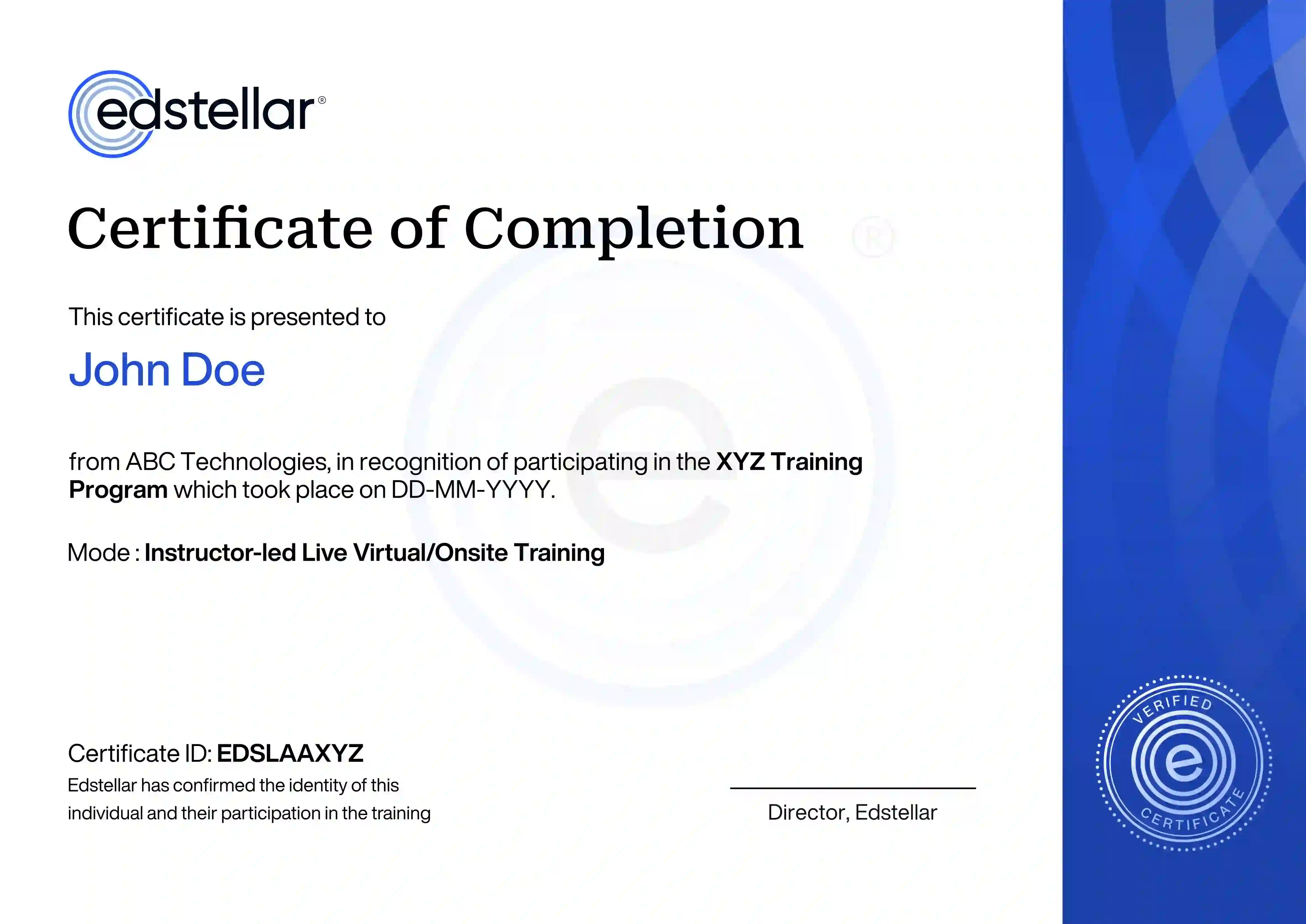
Upon successful completion of the training course offered by Edstellar, employees receive a course completion certificate, symbolizing their dedication to ongoing learning and professional development.
This certificate validates the employee's acquired skills and is a powerful motivator, inspiring them to enhance their expertise further and contribute effectively to organizational success.


Edstellar is a one-stop instructor-led corporate training and coaching solution that addresses organizational upskilling and talent transformation needs globally.
Marketing Excellence
Operational Excellence
Finance Excellence
HR Excellence
IT Excellence
Customer Service
Leadership Excellence
Quality Management
Software
How it WorksFAQ'sCorporate Training
CatalogStellar AI
Skill MatrixHRMS Integration
Who we ServeCEO RetreatsPricingTraining DeliveryPartner with Edstellar
CareersContact us