Drive Team Excellence with IoT for Fleet Management Corporate Training

Empower your teams with expert-led on-site, off-site, and virtual IoT for Fleet Management Training through Edstellar, a premier corporate training provider for organizations globally. Designed to meet your specific training needs, this group training program ensures your team is primed to drive your business goals. Help your employees build lasting capabilities that translate into real performance gains.

IoT for Fleet Management is the application of connected sensors, telematics devices, and cloud analytics platforms to monitor, manage, and optimize vehicle fleets in real time. It enables organizations to track asset locations, automate maintenance scheduling, monitor driver behavior, and reduce fuel costs through data-driven decision-making. The training covers IoT hardware selection, connectivity protocols, predictive maintenance models, driver safety analytics, platform integration, and security practices for enterprise fleet deployments.

Edstellar's IoT for Fleet Management Instructor-led course offers virtual/onsite training options to meet professionals' diverse needs. This flexibility ensures that fleet managers, telematics engineers, and logistics teams can engage in learning experiences that best suit their operational schedules. What sets the Edstellar course apart is its emphasis on practical experience, with hands-on labs using real IoT sensor data, GPS platforms, and analytics dashboards that bring fleet IoT concepts to life in working environments.

Get Customized Expert-led Training for Your Teams
Customized Training Delivery
Scale Your Training: Small to Large Teams
In-person Onsite, Live Virtual or Hybrid Training Modes
Plan from 2000+ Industry-ready Training Programs
Experience Hands-On Learning from Industry Experts
Delivery Capability Across 100+ Countries & 10+ Languages
""""

Key Skills Employees Gain from Instructor-led IoT for Fleet Management Training

IoT for Fleet Management skills corporate training will enable teams to effectively apply their learnings at work.

  • IoT Sensor Integration for Fleet Systems
  • Real-Time Fleet Tracking and Telematics
  • Predictive Maintenance Implementation
  • Fleet IoT Data Analytics
  • Driver Behavior Monitoring
  • Fleet IoT Platform Configuration
  • Fleet IoT Security Management

Key Learning Outcomes of IoT for Fleet Management Training Workshop

Upon completing Edstellar’s IoT for Fleet Management workshop, employees will gain valuable, job-relevant insights and develop the confidence to apply their learning effectively in the professional environment.

  • Master IoT architecture principles for fleet systems, connecting sensors, gateways, and cloud platforms to enable real-time vehicle monitoring and data-driven operations.
  • Gain hands-on expertise in GPS and telematics integration, configuring tracking hardware and communication protocols for accurate and reliable fleet location data.
  • Develop proficiency in predictive maintenance using IoT sensor streams and analytics models to reduce vehicle downtime and extend asset lifespan.
  • Learn to build driver behavior monitoring systems that capture safety events and generate actionable insights to improve fleet safety performance.
  • Build practical skills in fleet IoT data analytics and dashboard design to visualize KPIs, fuel efficiency, and route optimization opportunities in real time.
  • Apply IoT security frameworks and platform integration techniques to protect fleet systems and connect IoT data with enterprise business applications.

Key Benefits of the IoT for Fleet Management Group Training

Attending our IoT for Fleet Management group training classes provides your team with a powerful opportunity to build skills, boost confidence, and develop a deeper understanding of the concepts that matter most. The collaborative learning environment fosters knowledge sharing and enables employees to translate insights into actionable work outcomes.

  • Understand core IoT architecture for fleet systems by learning how sensors, gateways, and cloud platforms connect to deliver real-time vehicle data and operational insights.
  • Configure and deploy GPS and telematics hardware, including OBD-II devices and asset trackers, to enable accurate real-time fleet location monitoring.
  • Implement fleet connectivity protocols including MQTT, CAN bus, and 4G/5G cellular networks to ensure reliable and low-latency data transmission from vehicles.
  • Build predictive maintenance pipelines using IoT sensor data and machine learning models to forecast component failures and reduce unplanned vehicle downtime.
  • Develop driver behavior monitoring systems that capture speeding, harsh braking, and idling events to improve safety scores and reduce fuel consumption.
  • Design and use fleet IoT dashboards and analytics tools to visualize route efficiency, fuel usage, asset utilization, and maintenance trends in real time.
  • Integrate IoT fleet platforms with ERP, TMS, and dispatch systems using REST APIs and webhooks to automate workflows and streamline fleet operations.
  • Apply geofencing and zone alert configurations to enforce operational boundaries, trigger automated alerts, and improve cargo security across the fleet.
  • Implement IoT security frameworks including device authentication, encrypted communications, and firmware update management to protect fleet data and systems.
  • Plan and execute scaling strategies for IoT-enabled fleets, including edge computing deployment and multi-vendor platform management for large vehicle networks.

Topics and Outline of IoT for Fleet Management Training

Our virtual and on-premise IoT for Fleet Management training curriculum is structured into focused modules developed by industry experts. This training for organizations provides an interactive learning experience that addresses the evolving demands of the workplace, making it both relevant and practical.

  1. Overview of Fleet Management Challenges
    • Common operational pain points in fleet management
    • Cost drivers including fuel, maintenance, and downtime
    • How IoT addresses visibility and efficiency gaps
    • Business case for IoT adoption in fleet operations
  2. Fundamentals of IoT Technology
    • Definition and core components of IoT systems
    • IoT architecture layers: perception, network, and application
    • Edge computing vs cloud computing in IoT
    • Real-world IoT deployment examples in transportation
  3. Fleet IoT Ecosystem Overview
    • Key stakeholders and roles in a fleet IoT project
    • Popular fleet IoT platforms and vendors
    • Open-source vs proprietary fleet management tools
    • Integration landscape: ERP, TMS, and dispatching systems
  4. IoT Data Flows in Fleet Operations
    • How sensor data travels from vehicle to dashboard
    • Data ingestion pipelines for fleet telemetry
    • Latency considerations in real-time fleet monitoring
    • Data volume and storage planning for large fleets
  5. Regulatory and Compliance Context
    • Electronic logging device (ELD) mandates and compliance
    • Data privacy regulations affecting fleet IoT data
    • Vehicle safety regulations and telematics standards
    • Environmental and emissions reporting requirements
  6. IoT ROI and KPIs for Fleet Operations
    • Key performance indicators for fleet IoT programs
    • Calculating return on investment for IoT deployment
    • Benchmarking fleet performance before and after IoT
    • Communicating IoT value to executive stakeholders
  1. Vehicle Sensor Types and Applications
    • OBD-II port sensors for engine diagnostics and fuel data
    • Accelerometers and gyroscopes for driver behavior capture
    • Temperature and cargo condition monitoring sensors
    • Tire pressure monitoring systems (TPMS) integration
  2. GPS and GNSS Hardware Selection
    • GPS module types and accuracy specifications
    • Comparison of GNSS constellations: GPS, GLONASS, Galileo
    • Asset tracker vs hardwired GPS unit selection criteria
    • Antenna placement and signal quality optimization
  3. Telematics Control Units (TCU)
    • TCU architecture and onboard processing capabilities
    • CAN bus interface and vehicle data extraction methods
    • Power management for always-on TCU installations
    • Firmware update and remote configuration of TCUs
  4. Edge Computing Devices for Fleet
    • Onboard edge gateways for local data processing
    • Edge AI for real-time event detection in vehicles
    • Reducing cloud data transfer with edge pre-processing
    • Hardware selection criteria for rugged fleet environments
  5. Camera and Vision Systems
    • Dashcam integration for incident recording and review
    • AI-enabled cameras for driver drowsiness and distraction detection
    • Rear-facing and surround-view camera system configuration
    • Video storage, retrieval, and privacy compliance
  6. Hardware Installation and Maintenance
    • Device installation best practices and vehicle compatibility
    • Wiring and power supply considerations for fleet hardware
    • Preventive maintenance schedules for IoT devices
    • Troubleshooting common hardware faults in the field
  1. Cellular Connectivity for Fleet IoT
    • 4G LTE and 5G network capabilities for mobile assets
    • SIM management and multi-carrier failover strategies
    • Data plan optimization for high-volume telemetry streams
    • Coverage mapping and dead-zone mitigation approaches
  2. MQTT Protocol for Fleet Telemetry
    • MQTT architecture: brokers, publishers, and subscribers
    • Topic design for fleet data streams
    • QoS levels and their impact on fleet data reliability
    • Securing MQTT with TLS and certificate-based authentication
  3. CAN Bus and Vehicle Data Protocols
    • CAN bus fundamentals and frame structure
    • OBD-II PID decoding for engine and fuel parameters
    • J1939 protocol for heavy-duty commercial vehicles
    • Parsing and normalizing CAN data for analytics platforms
  4. Short-Range Wireless Protocols
    • Bluetooth Low Energy for driver ID and cargo scanning
    • Wi-Fi depot connectivity for bulk data offload
    • RFID for yard management and asset gate tracking
    • Zigbee and LoRa for low-power sensor applications
  5. Cloud Connectivity and Data Ingestion
    • Fleet data ingestion using AWS IoT Core and Azure IoT Hub
    • Message queue design for high-throughput telemetry
    • Device shadow and twin concepts for offline fleet assets
    • Data compression and binary encoding for bandwidth savings
  6. Network Resilience and Failover
    • Designing redundant connectivity paths for critical fleet data
    • Store-and-forward buffering during connectivity gaps
    • Automatic network switching between cellular carriers
    • Monitoring connectivity health across the fleet in real time
  1. Live Vehicle Location Tracking
    • Configuring GPS polling intervals for real-time accuracy
    • Map rendering and vehicle icon display on fleet dashboards
    • Multi-vehicle tracking at scale with performance optimization
    • Historical replay and breadcrumb trail visualization
  2. Geofencing Configuration and Alerts
    • Creating polygon and circular geofence zones
    • Entry, exit, and dwell-time alert configuration
    • Geofence-triggered workflow automation
    • Geofence compliance reporting for route adherence
  3. Route Optimization and Navigation
    • Dynamic route calculation using traffic and delivery data
    • Multi-stop optimization algorithms for delivery efficiency
    • Turn-by-turn navigation integration with driver mobile apps
    • Actual vs planned route deviation analysis
  4. ETA Prediction and Dispatching
    • Machine learning models for accurate ETA estimation
    • Real-time ETA updates pushed to customer notification systems
    • Dispatcher console design for live fleet management
    • Automated job assignment based on proximity and availability
  5. Asset and Cargo Tracking
    • Tracking trailers, containers, and detached assets independently
    • Cargo seal and tamper-detection event integration
    • Cold-chain monitoring with temperature sensor correlation
    • Proof-of-delivery event capture with GPS timestamp
  6. Fleet Tracking Reporting and Dashboards
    • Designing fleet KPI dashboards for operations managers
    • On-time performance and route efficiency reporting
    • Automated scheduled reports for fleet utilization
    • Exporting tracking data for regulatory and audit use
  1. Maintenance Strategy Overview
    • Comparing reactive, preventive, and predictive maintenance models
    • Cost impact of unplanned vehicle downtime on operations
    • IoT data sources enabling condition-based maintenance
    • Building a business case for predictive maintenance programs
  2. Sensor Data Collection for Maintenance
    • Engine temperature, oil pressure, and vibration sensor setup
    • OBD-II fault code monitoring and DTC interpretation
    • Battery health and charging cycle tracking for EVs
    • Brake wear and transmission health sensor integration
  3. Predictive Analytics and Machine Learning
    • Feature engineering from raw sensor telemetry data
    • Anomaly detection models for early fault identification
    • Remaining useful life (RUL) estimation techniques
    • Model training, validation, and continuous retraining workflows
  4. Maintenance Workflow Automation
    • Automated work order generation triggered by sensor thresholds
    • Integration with fleet maintenance management systems (FMMS)
    • Technician notification and parts pre-ordering workflows
    • Maintenance scheduling optimization to minimize service downtime
  5. Fleet Health Monitoring Dashboards
    • Designing vehicle health scorecards for fleet managers
    • Alerting thresholds and escalation rules for critical faults
    • Fleet-wide maintenance trend analysis and reporting
    • Tracking maintenance cost savings and downtime reduction metrics
  6. EV and Alternative Fuel Fleet Maintenance
    • Battery management system (BMS) data integration
    • Charging infrastructure health monitoring
    • Range prediction modeling using battery and route data
    • Transitioning maintenance programs from ICE to EV fleets
  1. Fleet Data Architecture Design
    • Data lake and warehouse design for fleet telemetry
    • Time-series database selection for high-frequency sensor data
    • Data partitioning and retention policies for fleet records
    • Batch vs streaming processing architecture trade-offs
  2. Real-Time Stream Processing
    • Apache Kafka for fleet telemetry ingestion pipelines
    • Stream analytics using AWS Kinesis or Azure Stream Analytics
    • Complex event processing for multi-sensor alert rules
    • Windowing functions for aggregated real-time fleet metrics
  3. Fleet Analytics and Reporting
    • Fuel efficiency analysis and idle-time reporting
    • Route performance and delivery SLA analytics
    • Driver performance leaderboards and trend analysis
    • Asset utilization and vehicle lifecycle reporting
  4. Data Quality and Governance
    • Handling missing, duplicate, and out-of-sequence sensor data
    • Data validation pipelines for GPS and telemetry accuracy
    • Master data management for vehicle and driver records
    • Data lineage and audit trail management for fleet systems
  5. Business Intelligence Integration
    • Connecting fleet data to Power BI and Tableau dashboards
    • Designing executive KPI views for fleet performance
    • Self-service analytics for operations teams
    • Automated report scheduling and distribution workflows
  6. Predictive and Prescriptive Analytics
    • Demand forecasting for fleet capacity planning
    • Route optimization using historical performance data
    • Prescriptive recommendations for fuel and driver cost reduction
    • AI-driven insights for continuous fleet improvement
  1. Driver Behavior Data Collection
    • Accelerometer-based detection of harsh braking and acceleration
    • Cornering and lane-change event capture from gyroscope data
    • Speeding event detection and speed limit correlation
    • Idle time and engine-on without movement tracking
  2. Driver Scoring Models
    • Designing composite driver safety score algorithms
    • Weighting and normalizing driver behavior event data
    • Benchmarking individual driver scores against fleet averages
    • Score trend analysis and improvement tracking over time
  3. Fatigue and Distraction Detection
    • Camera-based fatigue and drowsiness detection systems
    • Hours-of-service (HOS) compliance monitoring and alerts
    • Mobile phone usage detection during driving events
    • Real-time alert delivery to drivers and fleet managers
  4. Driver Coaching and Feedback
    • In-cab audio and visual alert systems for real-time coaching
    • Driver mobile app features for self-monitoring and improvement
    • Gamification and incentive programs tied to safety scores
    • Manager-led coaching workflows using telematics evidence
  5. Safety Incident Management
    • Automated collision detection and first notice of loss (FNOL)
    • Event video retrieval for incident investigation
    • Near-miss event logging and analysis for proactive risk reduction
    • Integrating safety data with insurance and claims management
  6. Fleet Safety Reporting and Compliance
    • DOT and FMCSA safety compliance reporting requirements
    • Fleet-wide safety trend dashboards for leadership review
    • Driver qualification and certification tracking in the platform
    • Benchmarking fleet safety against industry standards
  1. Fleet IoT Platform Overview
    • Leading fleet IoT platforms: Samsara, Geotab, Trimble, Verizon Connect
    • Platform selection criteria for enterprise fleet operations
    • Multi-vendor platform management for heterogeneous fleets
    • Cloud-native vs on-premise fleet platform deployment options
  2. REST API Integration Fundamentals
    • Fleet platform REST API authentication and authorization
    • Designing API call workflows for vehicle and event data retrieval
    • Rate limiting and pagination handling in API integrations
    • Webhooks for real-time event push from fleet platforms
  3. ERP and TMS Integration
    • Bidirectional data sync between fleet IoT and ERP systems
    • Transportation management system (TMS) job and dispatch integration
    • Automated invoicing triggered by GPS proof-of-delivery events
    • Fuel card system integration for fuel cost reconciliation
  4. Maintenance System Integration
    • Connecting IoT fault data to CMMS and maintenance platforms
    • Work order status synchronization and technician assignment
    • Parts inventory integration triggered by predictive maintenance alerts
    • Warranty and service contract data linking with IoT fault codes
  5. Data Streaming and Middleware
    • Using Apache Kafka or RabbitMQ as fleet data message brokers
    • ETL pipeline design for cross-system fleet data consolidation
    • Data transformation and schema mapping between platforms
    • Middleware patterns for decoupling IoT data producers and consumers
  6. Custom Application Development
    • Building custom fleet dashboards using platform APIs and SDKs
    • Mobile app development for driver and supervisor interfaces
    • Embedding fleet map and analytics widgets in internal portals
    • Version management and backward compatibility in API-driven apps
  1. IoT Device Security Fundamentals
    • Device identity management and unique certificate provisioning
    • Secure boot and firmware integrity verification
    • Over-the-air (OTA) update security and rollback controls
    • Physical tamper detection and device hardening practices
  2. Data Encryption and Transmission Security
    • TLS encryption for all vehicle-to-cloud data channels
    • End-to-end encryption for sensitive driver and location data
    • Key management and certificate rotation strategies
    • Protecting data at rest in fleet cloud storage systems
  3. Access Control and Identity Management
    • Role-based access control (RBAC) for fleet platform users
    • Multi-factor authentication for fleet manager and driver accounts
    • API key management and token-based authorization
    • Audit logging of all access events across the platform
  4. Cyber Threat Detection for Fleet Systems
    • Monitoring for anomalous GPS data or device spoofing attempts
    • Intrusion detection for fleet cloud infrastructure
    • Incident response playbooks for fleet IoT security breaches
    • Penetration testing approaches for telematics systems
  5. Driver Data Privacy and Compliance
    • GDPR and CCPA obligations for driver monitoring data
    • Employee consent and data use disclosure requirements
    • Data minimization and retention policy implementation
    • Cross-border data transfer compliance for international fleets
  6. Regulatory Compliance for Fleet IoT
    • ELD mandate compliance and certified device requirements
    • FMCSA and DOT data reporting obligations
    • ISO 27001 controls applicable to fleet data systems
    • Audit readiness and evidence collection for fleet compliance reviews
  1. Fleet IoT Scaling Architecture
    • Scaling from pilot fleet to enterprise-wide IoT deployment
    • Cloud auto-scaling for high-volume telemetry ingestion
    • Multi-region deployment for geographically distributed fleets
    • Database sharding and partitioning for large-scale fleet data
  2. Edge Computing Optimization
    • Deploying edge nodes at depots for local processing
    • Offloading real-time analytics from cloud to edge devices
    • Edge-cloud synchronization strategies for hybrid architectures
    • Managing edge device fleets with remote orchestration tools
  3. Fleet IoT Cost Optimization
    • Cellular data cost reduction using efficient message compression
    • Cloud infrastructure rightsizing for fleet workloads
    • Reserved and spot instance strategies for batch analytics
    • Total cost of ownership modeling for fleet IoT programs
  4. Performance Monitoring and SLA Management
    • Defining and monitoring SLAs for fleet IoT data pipelines
    • End-to-end latency measurement from sensor to dashboard
    • Capacity planning for peak-demand fleet operations
    • Incident management and mean-time-to-recovery (MTTR) tracking
  5. Continuous Improvement and Innovation
    • Running controlled pilots to test new IoT features and sensors
    • Establishing a fleet IoT center of excellence
    • Evaluating emerging technologies: 5G, V2X, and autonomous vehicles
    • Feedback loops between operations, IT, and data science teams
  6. Change Management and Adoption
    • Developing a fleet IoT rollout and communication plan
    • Training drivers and dispatchers on new IoT-enabled workflows
    • Measuring adoption rates and addressing resistance to change
    • Building a culture of data-driven decision-making in fleet teams

Who Can Take the IoT for Fleet Management Training Course

The IoT for Fleet Management training program can also be taken by professionals at various levels in the organization.

  • Fleet Managers
  • IoT Solutions Architects
  • Telematics Engineers
  • Logistics Operations Managers
  • Transport Technology Specialists
  • Data Analysts (Fleet)

Prerequisites for IoT for Fleet Management Training

Professionals should have a foundational understanding of networking concepts, basic data analysis, and familiarity with fleet or logistics operations to take the IoT for Fleet Management training course.

Request a Quote for your Corporate Training Requirements

Valid number

Delivering Training for Organizations across 100 Countries and 10+ Languages

Corporate Group Training Delivery Modes
for IoT for Fleet Management Training

At Edstellar, we understand the importance of impactful and engaging training for employees. As a leading IoT for Fleet Management training provider, we ensure the training is more interactive by offering Face-to-Face onsite/in-house or virtual/online sessions for companies. This approach has proven to be effective, outcome-oriented, and produces a well-rounded training experience for your teams.

Virtual IoT for Fleet Management Training

Edstellar's IoT for Fleet Management virtual/online training sessions bring expert-led, high-quality training to your teams anywhere, ensuring consistency and seamless integration into their schedules.

With global reach, your employees can get trained from various locations
The consistent training quality ensures uniform learning outcomes
Participants can attend training in their own space without the need for traveling
Organizations can scale learning by accommodating large groups of participants
Interactive tools can be used to enhance learning engagement
On-site IoT for Fleet Management Training

Edstellar's IoT for Fleet Management inhouse face to face instructor-led training delivers immersive and insightful learning experiences right in the comfort of your office.

Higher engagement and better learning experience through face-to-face interaction
Workplace environment can be tailored to learning requirements
Team collaboration and knowledge sharing improves training effectiveness
Demonstration of processes for hands-on learning and better understanding
Participants can get their doubts clarified and gain valuable insights through direct interaction
Off-site IoT for Fleet Management Training

Edstellar's IoT for Fleet Management offsite face-to-face instructor-led group training offer a unique opportunity for teams to immerse themselves in focused and dynamic learning environments away from their usual workplace distractions.

Distraction-free environment improves learning engagement
Team bonding can be improved through activities
Dedicated schedule for training away from office set up can improve learning effectiveness
Boosts employee morale and reflects organization's commitment to employee development

Explore Our Customized Pricing Package
for
IoT for Fleet Management Corporate Training

Looking for pricing details for onsite, offsite, or virtual instructor-led IoT for Fleet Management training? Get a customized proposal tailored to your team’s specific needs.

Request a Group Training Quote
""
How Many Team Members Need Training?
Please select an option or fill in the custom field.
"'

Is Your Corporate Training Requirement Only for IoT for Fleet Management?

Please select at least one course.
""
Add the List of Training Workshops
search icon

      Please select the course

      No. of Courses selected: 0

      Clear

      Upload a CSV

      Send us your Training Requirements in 3 Easy steps

      1. 1
      2. 2
        Add the required training workshops
      3. 3
        Upload to get a quick quote or email it to contact@edstellar.com

      ""

      Looking for a Complete Package?

      Looking for a one-time pricing option for all your annual training requirements?

      View Corporate Training Packages
      ""
      Select the Option that Best Describes Your Corporate Training Requirement

      Please select an option or choose from the recurring options.
      ""
      Verify and Submit Your Request

      Review Your Corporate Training Selection Summary

      Training Program: IoT for Fleet Management Training

      1. No of Team Members

      2. Selected Training Preference

      3. Selected Recurring Sessions

      1

      Review your Requirements

      Training Workshops Selected :


        Excel
        File has been
        successfully uploaded.
        Fill the form to submit
 your details
        Submit Your Professional Contact Information
        Valid number
        We've received your enquiry. Our team will be in touch soon.
        Oops! Something went wrong while submitting the form.
        Starter
        120 licences

        Tailor-Made Trainee Licenses with Our Exclusive Training Packages!

        View Package

        64 hours of group training (includes VILT/In-person On-site)

        Tailored for SMBs

        Growth
        320 licences

        Tailor-Made Trainee Licenses with Our Exclusive Training Packages!

        View Package

        160 hours of group training (includes VILT/In-person On-site)

        Ideal for growing SMBs

        Enterprise
        800 licences

        Tailor-Made Trainee Licenses with Our Exclusive Training Packages!

        View Package

        400 hours of group training (includes VILT/In-person On-site)

        Designed for large corporations

        Custom
        Unlimited licenses

        Tailor-Made Trainee Licenses with Our Exclusive Training Packages!

        View Package

        Unlimited duration

        Designed for large corporations

        Edstellar: Your Go-to IoT for Fleet Management Training Company

        Experienced Trainers

        Our trainers bring years of industry expertise to ensure the training is practical and impactful.

        Quality Training

        With a strong track record of delivering training worldwide, Edstellar maintains its reputation for its quality and training engagement.

        Industry-Relevant Curriculum

        Our course is designed by experts and is tailored to meet the demands of the current industry.

        Customizable Training

        Our course can be customized to meet the unique needs and goals of your organization.

        Comprehensive Support

        We provide pre and post training support to your organization to ensure a complete learning experience.

        Multilingual Training Capabilities

        We offer training in multiple languages to cater to diverse and global teams.

        Testimonials

        What Our Clients Say

        We pride ourselves on delivering exceptional training solutions. Here's what our clients have to say about their experiences with Edstellar.

        "Edstellar's virtual IoT for Fleet Management training transformed how our team manages our 500-vehicle fleet. Within six weeks of completing the program, we reduced fuel costs by 18% through improved driver coaching and route optimization, and cut unplanned vehicle downtime by 32% using predictive maintenance models our engineers built during the course. The live labs with real telematics data made the learning immediately applicable."

        Sarah Whitfield

        Fleet Operations Director,

        A National Logistics and Distribution Company

        "The onsite IoT for Fleet Management training delivered by Edstellar was a game-changer for our operations. Our telematics and logistics teams completed a four-day intensive workshop using our own fleet data, and within three months we saw on-time delivery improve by 22% and maintenance costs drop by 27%. The hands-on platform integration exercises gave our engineers the confidence to deploy solutions independently."

        Rajiv Nair

        Head of Logistics,

        A Regional Transport and Supply Chain Group

        "Edstellar's off-site IoT Fleet Management intensive was exactly what our technology team needed. In five days, our engineers went from concept to a fully deployed live IoT fleet monitoring system covering 120 vehicles. We achieved a 40% reduction in manual tracking effort and a 15% improvement in fleet utilization within the first 60 days post-training. The depth of content on security, APIs, and analytics was exceptional."

        Marcus Leal

        Head of Fleet Technology,

        A Global Industrial Equipment Company

        "Edstellar's IT & Technical training programs have been instrumental in strengthening our engineering teams and building future-ready capabilities. The hands-on approach, practical cloud scenarios, and expert guidance helped our teams improve technical depth, problem-solving skills, and execution across multiple projects. We're excited to extend more of these impactful programs to other business units."

        Aditi Rao

        L&D Head,

        A Global Technology Company

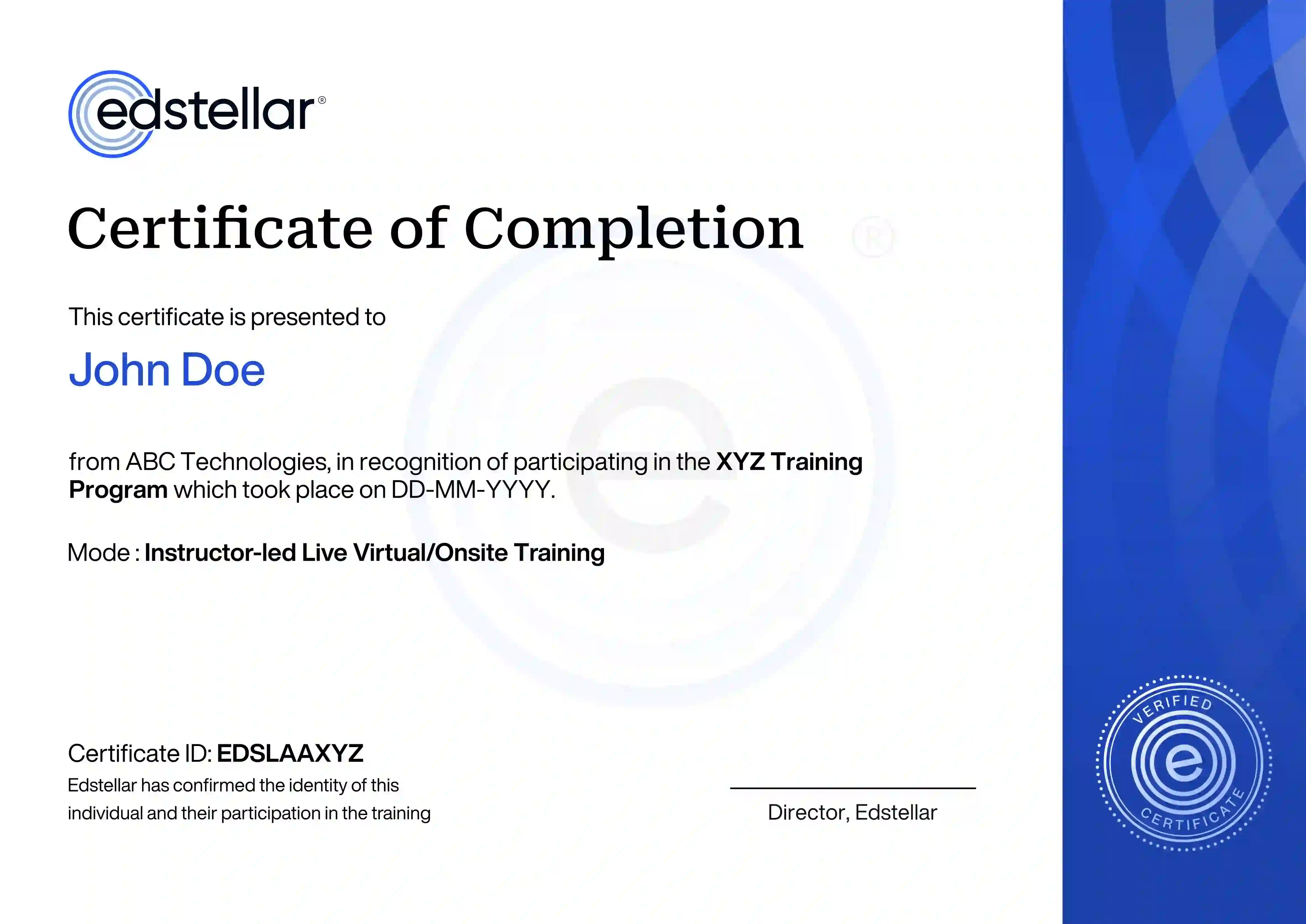
        Get Your Team Members Recognized with Edstellar’s Course Certificate

        Upon successful completion of the training course offered by Edstellar, employees receive a course completion certificate, symbolizing their dedication to ongoing learning and professional development.

        This certificate validates the employee's acquired skills and is a powerful motivator, inspiring them to enhance their expertise further and contribute effectively to organizational success.

        Certificate of Excellence