Drive Team Excellence with Micro-Frontends Architecture Corporate Training

Empower your teams with expert-led on-site, off-site, and virtual Micro-Frontends Architecture Training through Edstellar, a premier corporate training provider for organizations globally. Designed to meet your specific training needs, this group training program ensures your team is primed to drive your business goals. Help your employees build lasting capabilities that translate into real performance gains.

Micro-Frontends Architecture is an approach to frontend development that extends microservices principles to the browser layer, enabling large engineering organizations to decompose monolithic web applications into independently developed, tested, and deployed frontend modules. It addresses cross-team coordination challenges by assigning clear ownership boundaries, supports technology diversity, and allows teams to release features at their own cadence without requiring synchronized deployments across the entire application.

Edstellar's Micro-Frontends Architecture Instructor-led course offers virtual/onsite training options to meet professionals' diverse needs. This flexibility ensures that professionals and teams can engage in learning experiences that best suit their logistical and learning preferences. What sets the Edstellar course apart is its emphasis on practical experience, with hands-on Module Federation labs, integration pattern exercises, and real-world deployment scenarios that equip teams to design and operate micro-frontend systems confidently in production.

Get Customized Expert-led Training for Your Teams
Customized Training Delivery
Scale Your Training: Small to Large Teams
In-person Onsite, Live Virtual or Hybrid Training Modes
Plan from 2000+ Industry-ready Training Programs
Experience Hands-On Learning from Industry Experts
Delivery Capability Across 100+ Countries & 10+ Languages
""""

Key Skills Employees Gain from Instructor-led Micro-Frontends Architecture Training

Micro-Frontends Architecture skills corporate training will enable teams to effectively apply their learnings at work.

  • Micro-Frontend Decomposition and Design
  • Module Federation Configuration
  • Runtime Integration Pattern Implementation
  • Cross-Micro-Frontend State Management
  • Design System Integration for Micro-Frontends
  • Micro-Frontend Testing Strategies
  • Micro-Frontend Production Deployment

Key Learning Outcomes of Micro-Frontends Architecture Training Workshop

Upon completing Edstellar’s Micro-Frontends Architecture workshop, employees will gain valuable, job-relevant insights and develop the confidence to apply their learning effectively in the professional environment.

  • Master micro-frontend decomposition principles to split monolithic UIs into independently deployable applications owned by autonomous cross-functional teams.
  • Gain proficiency configuring Webpack 5 Module Federation for runtime code sharing, enabling teams to expose and consume remote modules without tight coupling.
  • Build runtime integration solutions using Web Components, single-spa, and iframes to compose coherent user experiences from independent micro-frontends.
  • Develop shared state and cross-micro-frontend communication patterns using event buses and backend-for-frontend APIs to maintain data consistency.
  • Apply design system integration techniques to enforce UI consistency and shared component reuse across multiple independently deployed micro-frontends.
  • Deploy micro-frontend applications to production with independent CI/CD pipelines, CDN hosting, and real-user monitoring for operational reliability.

Key Benefits of the Micro-Frontends Architecture Group Training

Attending our Micro-Frontends Architecture group training classes provides your team with a powerful opportunity to build skills, boost confidence, and develop a deeper understanding of the concepts that matter most. The collaborative learning environment fosters knowledge sharing and enables employees to translate insights into actionable work outcomes.

  • Apply micro-frontend decomposition principles to break monolithic UIs into independently developed, tested, and deployed frontend applications owned by separate teams.
  • Configure Webpack 5 Module Federation to share components, utilities, and state across multiple micro-frontend applications at runtime without code duplication.
  • Implement runtime integration patterns including iframes, Web Components, and Module Federation to compose micro-frontends into a unified user experience.
  • Design client-side routing strategies that coordinate navigation across multiple micro-frontend applications using single-spa and custom shell approaches.
  • Establish shared state management patterns using event buses, shared libraries, and backend-for-frontend APIs to enable communication between micro-frontends.
  • Integrate a consistent design system across micro-frontend teams using shared component libraries, design tokens, and CSS custom properties.
  • Write unit, integration, and end-to-end tests for micro-frontend applications, covering contract testing and cross-micro-frontend interaction scenarios.
  • Optimize micro-frontend performance by managing bundle sizes, lazy loading remote modules, and applying caching strategies for shared dependencies.
  • Configure independent CI/CD pipelines for each micro-frontend and deploy to production using CDN-backed static hosting and container-based strategies.
  • Monitor and operate micro-frontend applications in production using distributed tracing, error tracking, and real-user monitoring across application boundaries.

Topics and Outline of Micro-Frontends Architecture Training

Our virtual and on-premise Micro-Frontends Architecture training curriculum is structured into focused modules developed by industry experts. This training for organizations provides an interactive learning experience that addresses the evolving demands of the workplace, making it both relevant and practical.

  1. What Are Micro-Frontends
    • Definition and core architectural principles
    • Evolution from monolithic frontends to micro-frontends
    • Comparison with traditional SPA architectures
    • Industry adoption and real-world examples
  2. Benefits and Trade-Offs
    • Independent deployment and team autonomy benefits
    • Technology diversity and incremental migration advantages
    • Operational complexity and coordination overhead
    • When micro-frontends are and are not appropriate
  3. Micro-Frontend vs Microservices Alignment
    • Mapping backend microservices to frontend modules
    • Vertical vs horizontal decomposition strategies
    • Domain-driven design applied to frontend boundaries
    • Team topology models for micro-frontend organizations
  4. Integration Approaches Overview
    • Build-time integration patterns
    • Server-side composition approaches
    • Runtime client-side composition patterns
    • Edge-side composition and CDN-level stitching
  5. Ecosystem and Tooling Overview
    • Module Federation, single-spa, and Bit overview
    • Shell application and orchestration layer concepts
    • CDN and static hosting considerations
    • Developer experience tooling for micro-frontends
  6. Organizational Readiness
    • Conway's Law and frontend team structure
    • Cross-team API contracts and communication norms
    • Shared ownership of design system and infrastructure
    • Governance models for micro-frontend standards
  1. Domain-Based Decomposition
    • Identifying bounded contexts in the UI
    • Mapping user journeys to micro-frontend ownership
    • Domain modeling for frontend feature slices
    • Avoiding chatty cross-micro-frontend dependencies
  2. Page-Based vs Widget-Based Decomposition
    • Full-page ownership patterns
    • Widget and component-level granularity
    • Trade-offs between page and widget decomposition
    • Composing pages from multiple widget micro-frontends
  3. Vertical Slice Architecture
    • End-to-end feature ownership from UI to API
    • Reducing cross-team dependencies with vertical slices
    • Database and backend alignment with vertical teams
    • Implementing vertical slices in brownfield applications
  4. Migration Strategies from Monolithic Frontends
    • Strangler Fig pattern applied to frontends
    • Incremental extraction of micro-frontend modules
    • Running legacy and micro-frontend code in parallel
    • Rollback and fallback strategies during migration
  5. Shared vs Isolated Dependencies
    • Identifying shared infrastructure vs application dependencies
    • Dependency version alignment strategies
    • Avoiding duplicate framework instances
    • Singleton pattern enforcement across micro-frontends
  6. Decomposition Anti-Patterns
    • Too-fine-grained decomposition pitfalls
    • Shared state leakage across boundaries
    • Tight coupling through shared global objects
    • Recognizing and refactoring poor decomposition choices
  1. Webpack 5 Module Federation Fundamentals
    • Module Federation plugin architecture
    • Host and remote application concepts
    • Exposing and consuming remote modules
    • Shared dependency configuration and singleton enforcement
  2. Configuring Hosts and Remotes
    • webpack.config.js ModuleFederationPlugin setup
    • Dynamic remote loading at runtime
    • Fallback and error handling for unavailable remotes
    • Type-safe remote module contracts with TypeScript
  3. Sharing Libraries and Singletons
    • React, Angular, and Vue singleton sharing
    • Version negotiation and eager consumption settings
    • Avoiding multiple React instance errors
    • Shared context and provider patterns
  4. Build-Time Integration Alternatives
    • npm package-based component sharing
    • Mono-repo build-time composition with Nx and Turborepo
    • Bit component sharing platform overview
    • Comparing build-time vs runtime integration trade-offs
  5. Module Federation with Multiple Frameworks
    • React and Angular interoperability via Module Federation
    • Framework-agnostic module exposure strategies
    • Wrapping Angular components for React consumption
    • Version coexistence strategies for mixed-framework apps
  6. Vite and Rspack Module Federation
    • vite-plugin-federation for Vite-based micro-frontends
    • Rspack Module Federation for faster builds
    • Migrating Webpack Module Federation to Vite
    • Build tool selection for micro-frontend projects
  1. iframe-Based Integration
    • iframe isolation benefits and security model
    • Cross-origin communication with postMessage
    • Resizing and layout challenges with iframes
    • When to choose iframe isolation over other patterns
  2. Web Components for Micro-Frontend Integration
    • Custom Elements API and Shadow DOM
    • Wrapping React and Angular apps as Web Components
    • Attribute and event-based communication
    • Browser compatibility and polyfill considerations
  3. single-spa Orchestration Framework
    • single-spa root config and lifecycle methods
    • Registering and mounting micro-frontend applications
    • Parcel and utility module patterns in single-spa
    • Cross-application event handling with single-spa
  4. Server-Side Composition with Edge Side Includes
    • Edge Side Includes (ESI) for fragment composition
    • Server-side includes and SSI techniques
    • Tailor and Podium micro-frontend composition tools
    • CDN-level composition for performance gains
  5. Shell Application Design
    • Responsibilities of the application shell
    • Authentication and global layout in the shell
    • Dynamic micro-frontend registration and discovery
    • Shell versioning and backward compatibility
  6. Choosing the Right Integration Pattern
    • Decision matrix for integration pattern selection
    • Isolation requirements vs integration complexity trade-offs
    • Performance and user experience implications by pattern
    • Mixing integration patterns in a single application
  1. Client-Side Routing Architecture
    • Routing ownership in shell vs micro-frontends
    • URL-based micro-frontend activation
    • History API coordination across micro-frontends
    • Hash-based vs history-based routing strategies
  2. Cross-Micro-Frontend Navigation
    • Navigating between micro-frontend-owned routes
    • Avoiding tight router coupling between teams
    • Deep linking and shareable URL strategies
    • Route prefetching for seamless transitions
  3. Router Framework Integration
    • React Router in micro-frontend contexts
    • Angular Router integration with Module Federation
    • Vue Router configuration for micro-frontends
    • Framework-agnostic routing with single-spa
  4. 404 and Error Route Handling
    • Centralized error boundary for navigation failures
    • Fallback UI for unavailable micro-frontends
    • Graceful degradation on route resolution errors
    • User-friendly error states across micro-frontend boundaries
  5. Authentication and Route Guards
    • Centralizing authentication in the shell application
    • Token propagation to micro-frontend route guards
    • Role-based route access control patterns
    • SSO integration and session management across micro-frontends
  6. SEO and Server-Side Rendering Considerations
    • SSR challenges in micro-frontend architectures
    • Next.js and Nuxt micro-frontend integration patterns
    • Meta tag management across micro-frontend routes
    • Pre-rendering and static generation strategies
  1. State Management Principles for Micro-Frontends
    • Minimizing shared state across micro-frontend boundaries
    • Local state vs global state ownership models
    • State synchronization challenges and patterns
    • Consistency vs autonomy trade-offs in state design
  2. Event Bus Communication
    • Custom event bus implementation with browser events
    • Pub/Sub pattern for decoupled micro-frontend messaging
    • Event schema contracts and versioning
    • Debugging event-driven micro-frontend communication
  3. Shared State Libraries
    • Sharing Redux or Zustand store via Module Federation
    • RxJS-based observable state for cross-team use
    • Jotai and Recoil atoms in micro-frontend contexts
    • State library version compatibility across micro-frontends
  4. Backend-for-Frontend (BFF) Pattern
    • BFF design for aggregating micro-frontend data needs
    • Reducing direct cross-micro-frontend API calls
    • GraphQL federation for unified data access
    • BFF caching and performance optimization
  5. URL and Query String as Shared State
    • Encoding state in URL parameters for shareability
    • Coordinating URL state changes across micro-frontends
    • Deep link preservation and restoration
    • Avoiding URL parameter conflicts between teams
  6. Cross-Micro-Frontend Authentication State
    • Token storage and sharing strategies
    • Session expiry propagation across micro-frontends
    • Logout broadcast and state cleanup
    • Secure token handling in shared contexts
  1. Design System Architecture
    • Design token definition and distribution
    • Component library versioning for multiple consumers
    • Storybook as a shared component documentation hub
    • Design system governance across autonomous teams
  2. Sharing Component Libraries via Module Federation
    • Exposing design system components as Module Federation remotes
    • Consuming shared UI components without duplication
    • Version pinning vs floating version strategies
    • Breaking change communication and migration paths
  3. CSS Strategy for Micro-Frontends
    • CSS isolation with Shadow DOM and CSS Modules
    • CSS-in-JS libraries in micro-frontend contexts
    • Global CSS variables and design token propagation
    • Avoiding CSS conflicts across independently deployed apps
  4. Typography and Icon Consistency
    • Centralized font loading strategies
    • Icon library distribution across micro-frontends
    • Variable font usage and performance
    • Enforcing typography scale in distributed teams
  5. Theming and Branding Across Micro-Frontends
    • CSS custom property-based theming
    • Dark mode propagation across micro-frontend boundaries
    • White-labeling and multi-brand micro-frontend support
    • Runtime theme switching without full page reload
  6. Accessibility Consistency
    • ARIA landmark regions across micro-frontend boundaries
    • Focus management during micro-frontend transitions
    • Keyboard navigation continuity across app boundaries
    • Shared accessibility testing tools and standards
  1. Unit Testing Micro-Frontend Components
    • Jest and Vitest configuration for micro-frontends
    • Mocking Module Federation remotes in unit tests
    • Testing shared utility modules in isolation
    • Code coverage targets for micro-frontend modules
  2. Integration Testing Strategies
    • Testing host and remote integration with Testing Library
    • Mocking remote modules for integration tests
    • Integration test environment setup for micro-frontends
    • Shared test utilities across micro-frontend teams
  3. Contract Testing with Pact
    • Consumer-driven contract testing principles
    • Pact framework setup for micro-frontend APIs
    • Publishing and verifying pacts in CI pipelines
    • Preventing breaking changes with contract tests
  4. End-to-End Testing with Cypress and Playwright
    • E2E test architecture for composed micro-frontend apps
    • Testing cross-micro-frontend user journeys
    • Stubbing and intercepting micro-frontend dependencies
    • Visual regression testing across micro-frontend boundaries
  5. Component Testing with Storybook
    • Storybook interaction testing for shared components
    • Chromatic visual testing integration
    • Accessibility checks in Storybook stories
    • Cross-team component review workflows
  6. Test Orchestration in CI Pipelines
    • Running micro-frontend tests independently per team
    • Parallel test execution for faster feedback
    • Test environment composition for integration testing
    • Reporting and aggregating test results across micro-frontends
  1. Bundle Size Management
    • Analyzing bundle sizes with webpack-bundle-analyzer
    • Tree shaking shared dependencies in Module Federation
    • Code splitting within individual micro-frontends
    • Setting bundle size budgets in CI pipelines
  2. Lazy Loading Remote Modules
    • Dynamic import strategies for Module Federation remotes
    • Prefetching remote modules for critical paths
    • Loading state and skeleton UI patterns
    • Error boundaries for failed remote module loads
  3. Shared Dependency Caching
    • Long-term caching for shared library chunks
    • Content hash-based cache busting strategies
    • CDN caching configuration for micro-frontend assets
    • Service worker caching for offline micro-frontend support
  4. Initial Load Performance
    • Critical rendering path optimization for composed apps
    • Shell app minimization for fast first paint
    • Preloading critical micro-frontend modules
    • Measuring Core Web Vitals across micro-frontend pages
  5. Runtime Performance Optimization
    • Avoiding unnecessary re-renders across micro-frontend boundaries
    • Web Worker usage for compute-intensive micro-frontends
    • Virtualization for large list rendering in micro-frontends
    • Memory leak prevention in long-running composed apps
  6. Performance Monitoring and Alerting
    • Real-user monitoring (RUM) across micro-frontend apps
    • Synthetic performance tests for each micro-frontend
    • Lighthouse CI integration for performance budgets
    • Alerting on Core Web Vitals regressions in production
  1. Independent CI/CD Pipelines
    • Pipeline design for autonomous micro-frontend teams
    • Build, test, and deploy stages per micro-frontend
    • Artifact versioning and promotion strategies
    • Triggering downstream integration tests on deployment
  2. Static Hosting and CDN Deployment
    • Deploying micro-frontends to S3, GCS, and Azure Blob
    • CloudFront, Cloudflare, and Fastly CDN configuration
    • Cache invalidation strategies on deployment
    • Custom domain and CORS configuration for remote modules
  3. Container-Based Micro-Frontend Deployment
    • Dockerizing micro-frontend applications
    • Nginx configuration for serving micro-frontend assets
    • Kubernetes ingress routing for micro-frontend services
    • Horizontal scaling for high-traffic micro-frontends
  4. Feature Flags and Progressive Rollouts
    • Feature flag integration for micro-frontend releases
    • Canary deployments for individual micro-frontends
    • A/B testing micro-frontend variants in production
    • Instant rollback using feature flags without redeployment
  5. Error Tracking and Observability
    • Sentry error tracking per micro-frontend application
    • Correlating errors across micro-frontend boundaries
    • Distributed tracing for cross-micro-frontend user sessions
    • Log aggregation and search across micro-frontend services
  6. Production Operations and Incident Management
    • Runbooks for common micro-frontend production incidents
    • On-call ownership models for micro-frontend teams
    • SLA and error budget tracking per micro-frontend
    • Post-incident review processes for distributed frontend systems

Who Can Take the Micro-Frontends Architecture Training Course

The Micro-Frontends Architecture training program can also be taken by professionals at various levels in the organization.

  • Frontend Developers
  • Software Architects
  • Full-Stack Engineers
  • Engineering Managers
  • UI/UX Engineers
  • Tech Leads

Prerequisites for Micro-Frontends Architecture Training

Professionals should have solid experience building frontend applications with a modern JavaScript framework such as React, Angular, or Vue, along with a working knowledge of Webpack, npm, and REST APIs, to take the Micro-Frontends Architecture training course.

Request a Quote for your Corporate Training Requirements

Valid number

Delivering Training for Organizations across 100 Countries and 10+ Languages

Corporate Group Training Delivery Modes
for Micro-Frontends Architecture Training

At Edstellar, we understand the importance of impactful and engaging training for employees. As a leading Micro-Frontends Architecture training provider, we ensure the training is more interactive by offering Face-to-Face onsite/in-house or virtual/online sessions for companies. This approach has proven to be effective, outcome-oriented, and produces a well-rounded training experience for your teams.

Virtual Micro-Frontends Architecture Training

Edstellar's Micro-Frontends Architecture virtual/online training sessions bring expert-led, high-quality training to your teams anywhere, ensuring consistency and seamless integration into their schedules.

With global reach, your employees can get trained from various locations
The consistent training quality ensures uniform learning outcomes
Participants can attend training in their own space without the need for traveling
Organizations can scale learning by accommodating large groups of participants
Interactive tools can be used to enhance learning engagement
On-site Micro-Frontends Architecture Training

Edstellar's Micro-Frontends Architecture inhouse face to face instructor-led training delivers immersive and insightful learning experiences right in the comfort of your office.

Higher engagement and better learning experience through face-to-face interaction
Workplace environment can be tailored to learning requirements
Team collaboration and knowledge sharing improves training effectiveness
Demonstration of processes for hands-on learning and better understanding
Participants can get their doubts clarified and gain valuable insights through direct interaction
Off-site Micro-Frontends Architecture Training

Edstellar's Micro-Frontends Architecture offsite face-to-face instructor-led group training offer a unique opportunity for teams to immerse themselves in focused and dynamic learning environments away from their usual workplace distractions.

Distraction-free environment improves learning engagement
Team bonding can be improved through activities
Dedicated schedule for training away from office set up can improve learning effectiveness
Boosts employee morale and reflects organization's commitment to employee development

Explore Our Customized Pricing Package
for
Micro-Frontends Architecture Corporate Training

Looking for pricing details for onsite, offsite, or virtual instructor-led Micro-Frontends Architecture training? Get a customized proposal tailored to your team’s specific needs.

Request a Group Training Quote
""
How Many Team Members Need Training?
Please select an option or fill in the custom field.
"'

Is Your Corporate Training Requirement Only for Micro-Frontends Architecture?

Please select at least one course.
""
Add the List of Training Workshops
search icon

      Please select the course

      No. of Courses selected: 0

      Clear

      Upload a CSV

      Send us your Training Requirements in 3 Easy steps

      1. 1
      2. 2
        Add the required training workshops
      3. 3
        Upload to get a quick quote or email it to contact@edstellar.com

      ""

      Looking for a Complete Package?

      Looking for a one-time pricing option for all your annual training requirements?

      View Corporate Training Packages
      ""
      Select the Option that Best Describes Your Corporate Training Requirement

      Please select an option or choose from the recurring options.
      ""
      Verify and Submit Your Request

      Review Your Corporate Training Selection Summary

      Training Program: Micro-Frontends Architecture Training

      1. No of Team Members

      2. Selected Training Preference

      3. Selected Recurring Sessions

      1

      Review your Requirements

      Training Workshops Selected :


        Excel
        File has been
        successfully uploaded.
        Fill the form to submit
 your details
        Submit Your Professional Contact Information
        Valid number
        We've received your enquiry. Our team will be in touch soon.
        Oops! Something went wrong while submitting the form.
        Starter
        120 licences

        Tailor-Made Trainee Licenses with Our Exclusive Training Packages!

        View Package

        64 hours of group training (includes VILT/In-person On-site)

        Tailored for SMBs

        Growth
        320 licences

        Tailor-Made Trainee Licenses with Our Exclusive Training Packages!

        View Package

        160 hours of group training (includes VILT/In-person On-site)

        Ideal for growing SMBs

        Enterprise
        800 licences

        Tailor-Made Trainee Licenses with Our Exclusive Training Packages!

        View Package

        400 hours of group training (includes VILT/In-person On-site)

        Designed for large corporations

        Custom
        Unlimited licenses

        Tailor-Made Trainee Licenses with Our Exclusive Training Packages!

        View Package

        Unlimited duration

        Designed for large corporations

        Edstellar: Your Go-to Micro-Frontends Architecture Training Company

        Experienced Trainers

        Our trainers bring years of industry expertise to ensure the training is practical and impactful.

        Quality Training

        With a strong track record of delivering training worldwide, Edstellar maintains its reputation for its quality and training engagement.

        Industry-Relevant Curriculum

        Our course is designed by experts and is tailored to meet the demands of the current industry.

        Customizable Training

        Our course can be customized to meet the unique needs and goals of your organization.

        Comprehensive Support

        We provide pre and post training support to your organization to ensure a complete learning experience.

        Multilingual Training Capabilities

        We offer training in multiple languages to cater to diverse and global teams.

        Testimonials

        What Our Clients Say

        We pride ourselves on delivering exceptional training solutions. Here's what our clients have to say about their experiences with Edstellar.

        "Edstellar's virtual Micro-Frontends Architecture training completely changed how our cross-functional teams collaborate on the frontend. Within six weeks of completing the program, we reduced cross-team deployment conflicts by 74% and improved feature delivery speed by 45%. The Module Federation labs and practical decomposition exercises gave our developers skills they applied to production immediately."

        Claire Beaumont

        Head of Frontend Engineering,

        A Global Digital Commerce Company

        "After Edstellar's onsite Micro-Frontends Architecture training, our team successfully migrated our 200,000-line monolithic frontend to a micro-frontend architecture in under five months. Build times dropped from 18 minutes to under 3 minutes per team, and each of our six product squads now deploys independently up to four times per day without coordination overhead. The hands-on migration workshops were directly applicable to our brownfield codebase."

        Thomas Eriksson

        Engineering Director,

        A Global SaaS Platform Company

        "The intensive off-site Micro-Frontends Architecture program from Edstellar gave our team the architectural confidence to deliver our first production micro-frontend application in eight weeks. We established four independent deployment pipelines, achieved zero-downtime releases for each team, and reduced our time-to-production for new features by 55%. The depth of coverage on Module Federation, design system integration, and contract testing was exceptional."

        Nadia Volkov

        Chief Technology Officer,

        A Global Digital Transformation Group

        "Edstellar's IT & Technical training programs have been instrumental in strengthening our engineering teams and building future-ready capabilities. The hands-on approach, practical cloud scenarios, and expert guidance helped our teams improve technical depth, problem-solving skills, and execution across multiple projects. We're excited to extend more of these impactful programs to other business units."

        Aditi Rao

        L&D Head,

        A Global Technology Company

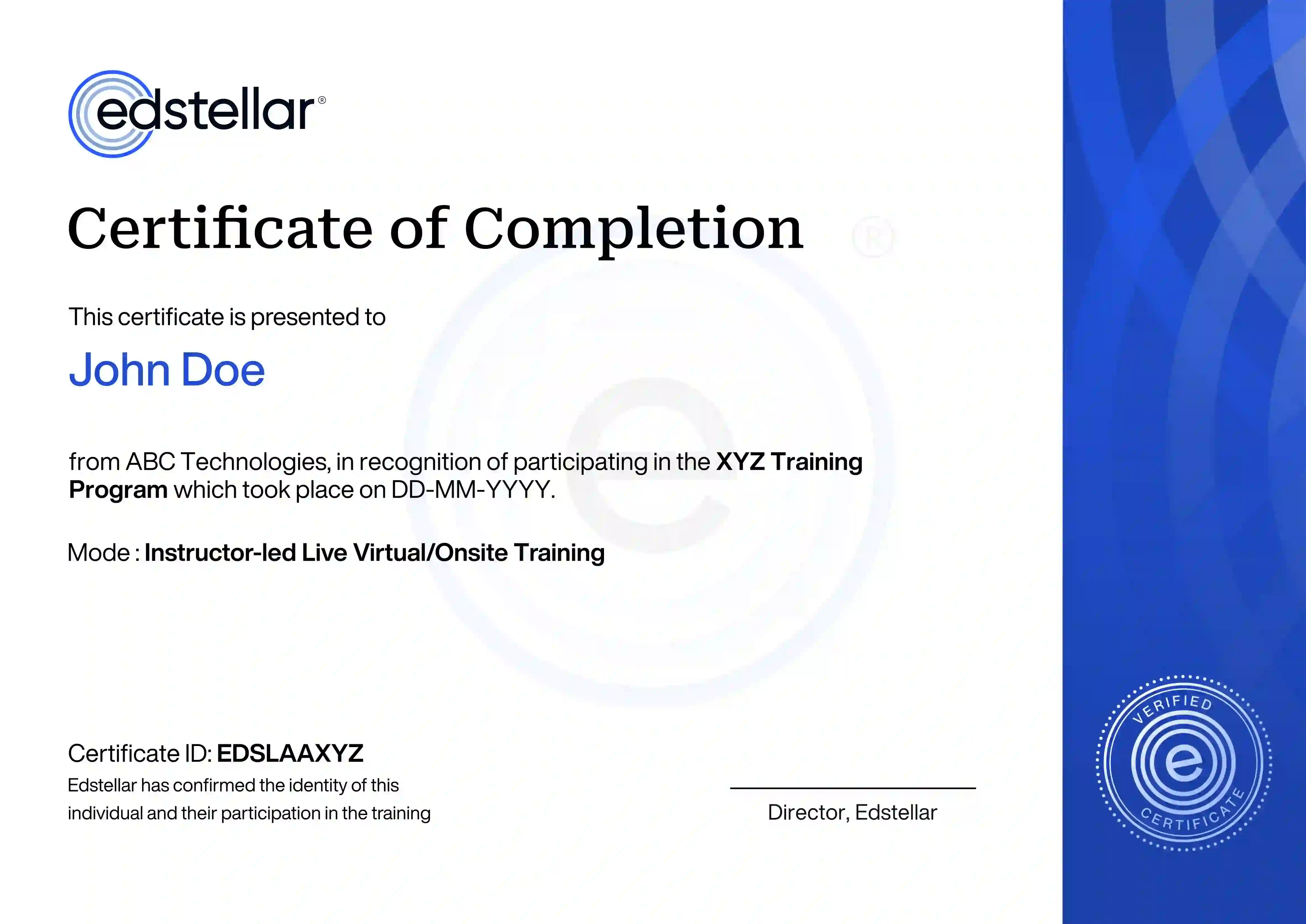
        Get Your Team Members Recognized with Edstellar’s Course Certificate

        Upon successful completion of the training course offered by Edstellar, employees receive a course completion certificate, symbolizing their dedication to ongoing learning and professional development.

        This certificate validates the employee's acquired skills and is a powerful motivator, inspiring them to enhance their expertise further and contribute effectively to organizational success.

        Certificate of Excellence