.svg "edstellar")

Microsoft Purview: Data Protection & DLP Corporate Training Program
This training equips IT and compliance professionals with the skills to implement and manage Microsoft Purview's data protection and DLP capabilities. Participants learn to configure sensitivity labels, create DLP policies, protect sensitive information, and monitor compliance across Microsoft 365.
(Virtual / On-site / Off-site)
.svg)
Drive Team Excellence with Microsoft Purview: Data Protection & DLP Corporate Training
Microsoft Purview provides organizations with a unified platform for data security, compliance, and governance across Microsoft 365 and beyond. As enterprises manage increasing volumes of sensitive information across cloud, on-premises, and hybrid environments, the ability to classify data, enforce data loss prevention policies, and meet regulatory compliance obligations has become a critical IT and compliance capability. This training gives professionals a deep, practical understanding of Microsoft Purview's full suite of data protection and DLP tools.
Edstellar's Microsoft Purview: Data Protection & DLP Instructor-led course offers virtual/onsite training options for Microsoft 365 administrators, IT security teams, and compliance professionals. Through hands-on lab exercises, policy configuration walkthroughs, and real-world compliance scenarios, participants build the technical and strategic skills needed to fully leverage Microsoft Purview to protect their organization's data and demonstrate regulatory compliance.
.svg)

Skills Your Employees Will Gain
These are the core, hands-on capabilities your team builds during the program.
- Sensitivity label configuration
- DLP policy creation
- Information protection management
- Insider risk identification
- Communication compliance monitoring
- eDiscovery and audit management
- Purview compliance portal navigation
What Your Team Will Achieve After This Training
- Master Microsoft Purview's core capabilities for data protection, information governance, and DLP across Microsoft 365 environments.
- Develop skills to design and configure sensitivity labels that classify and protect sensitive information across files, emails, and collaboration sites.
- Learn to build and deploy DLP policies that prevent unauthorized sharing of sensitive data across Microsoft 365 workloads and endpoints.
- Build expertise in managing insider risk, communication compliance, and audit capabilities within the Microsoft Purview compliance portal.
- Apply Purview's information protection framework to support GDPR, CCPA, and other data protection regulatory compliance requirements.
- Gain the skills to deploy, manage, and optimize Microsoft Purview at scale across an enterprise Microsoft 365 environment.
Topics & Program Outline
The curriculum is organized into focused modules built by industry experts and delivered virtually or on-premise. Interactive sessions reflect the evolving demands of the workplace, keeping the learning both relevant and practical.
-
Overview of Microsoft Purview
- What Microsoft Purview is and how it unifies data security, compliance, and governance
- Evolution of Microsoft Purview from Azure Purview and Microsoft 365 Compliance Center
- Key Purview solution areas: information protection, DLP, governance, risk, and compliance
- How Microsoft Purview fits into the broader Microsoft security and compliance ecosystem
-
Microsoft Purview Licensing and Editions
- Microsoft 365 licensing tiers that include Purview capabilities
- Difference between E3 and E5 Purview feature availability
- Add-on licensing options for advanced Purview compliance features
- Planning Purview licensing aligned to organizational compliance requirements
-
The Microsoft Purview Compliance Portal
- Overview of the Purview Compliance Portal layout and navigation
- Key portal sections: information protection, DLP, insider risk, and eDiscovery
- Role-based access control for the Purview Compliance Portal
- Using Compliance Manager and Compliance Score to track regulatory posture
-
Data Governance with Microsoft Purview
- Purview Data Map: scanning and cataloging data assets across environments
- Data lineage and classification capabilities in the Purview governance experience
- Connecting Purview governance to information protection and DLP policies
- Using Purview Data Catalog for enterprise data discovery and stewardship
-
Purview and Regulatory Compliance Frameworks
- How Purview Compliance Manager maps controls to GDPR, HIPAA, ISO 27001, and NIST
- Using regulatory assessment templates to evaluate compliance gaps
- Automating evidence collection for regulatory compliance with Purview
- Reporting on compliance posture to stakeholders using Compliance Manager dashboards
-
Purview Architecture and Deployment Planning
- Key architectural components of a Microsoft Purview deployment
- Integration points between Purview and Microsoft 365, Azure, and hybrid environments
- Planning a phased Purview deployment aligned to organizational compliance priorities
- Common Purview deployment challenges and how to address them
-
Information Protection Fundamentals
- What information protection means in the context of Microsoft Purview
- The know-protect-prevent-monitor framework for data protection in Purview
- Key information protection capabilities: classification, labeling, encryption, and rights management
- How Purview information protection integrates with Microsoft 365 workloads
-
Data Classification in Microsoft Purview
- Sensitive information types: built-in and custom definitions for detecting sensitive data
- Trainable classifiers: machine learning-based classification for complex content
- Content explorer and activity explorer for monitoring classified data
- Creating custom sensitive information types for organization-specific data patterns
-
Azure Information Protection (AIP) and Purview
- How AIP capabilities are integrated into the Microsoft Purview platform
- AIP scanner for classifying and protecting on-premises files
- Unified labeling and migration from classic AIP labels to Purview sensitivity labels
- Planning the transition from AIP to Purview information protection
-
Microsoft Information Protection (MIP) SDK
- Overview of the MIP SDK and its role in extending Purview to third-party applications
- Use cases for MIP SDK integration in custom and partner applications
- MIP SDK labeling and protection capabilities for developers
- MIP SDK deployment considerations in enterprise environments
-
Protecting Data in Microsoft 365 Workloads
- Applying information protection policies to Exchange, SharePoint, OneDrive, and Teams
- Protecting data in Microsoft 365 apps: Word, Excel, PowerPoint, and Outlook
- Information protection for Power BI reports and dashboards
- Extending Purview information protection to third-party and non-Microsoft workloads
-
Information Protection Monitoring and Reporting
- Using content explorer to discover and review classified data across the organization
- Activity explorer for tracking labeling activity, changes, and policy matches
- Information protection reports in the Microsoft Purview Compliance Portal
- Setting up alerts for critical information protection events and policy violations
-
Understanding Sensitivity Labels
- What sensitivity labels are and how they classify and protect data in Microsoft 365
- Sensitivity label scope: files, emails, meetings, and Microsoft 365 Groups and Sites
- Label hierarchy and sublabels for organizing classification schemes
- How sensitivity labels persist with content as it moves across systems
-
Designing a Sensitivity Label Taxonomy
- Principles for designing an effective sensitivity label taxonomy
- Aligning label taxonomy to organizational data classification policies
- Mapping sensitivity labels to regulatory classification requirements
- Stakeholder engagement in sensitivity label taxonomy design and approval
-
Creating and Configuring Sensitivity Labels
- Step-by-step creation of sensitivity labels in the Purview Compliance Portal
- Configuring label protection settings: encryption, content marking, and access restrictions
- Setting label priority and configuring default labels for workloads
- Publishing sensitivity labels to users through label policies
-
Auto-Labeling Policies
- Client-side vs. service-side auto-labeling and when to use each approach
- Configuring auto-labeling policies using sensitive information types and trainable classifiers
- Simulation mode for testing auto-labeling policy behavior before enforcement
- Monitoring auto-labeling policy performance and fine-tuning classification accuracy
-
Label Encryption and Rights Management
- How sensitivity label encryption uses Azure Rights Management Service
- Configuring user and group access permissions within label encryption settings
- Let users assign permissions encryption options for flexible label use
- Double Key Encryption for highly sensitive data requiring on-premises key control
-
Managing and Governing Sensitivity Labels
- Reviewing and auditing sensitivity label usage with activity explorer
- Managing label changes, version control, and deprecation in production environments
- Troubleshooting common sensitivity label configuration and publishing issues
- Communicating label taxonomy and usage guidance to the workforce
-
DLP Fundamentals in Microsoft Purview
- What DLP is and how Microsoft Purview DLP detects and protects sensitive information
- DLP coverage in Purview: Exchange, SharePoint, OneDrive, Teams, and endpoints
- How DLP policies use sensitive information types and trainable classifiers as conditions
- DLP policy lifecycle: create, test, enforce, and monitor
-
Designing DLP Policies
- Identifying the sensitive data types and scenarios that require DLP coverage
- Choosing DLP policy scope: location, users, groups, and workloads
- Configuring DLP policy conditions: content type, context, and sensitivity labels
- Defining DLP actions: notify, block, restrict, and encrypt
-
Creating and Deploying DLP Policies
- Step-by-step DLP policy creation in the Microsoft Purview Compliance Portal
- Using policy templates for common regulatory requirements: GDPR, HIPAA, PCI DSS
- Policy test mode for validating DLP behavior before full enforcement
- Staged enforcement strategies to minimize business disruption during rollout
-
User Notifications and Policy Tips
- Configuring DLP policy tips to alert users at the time of a potential violation
- Customizing policy tip messages for different violation scenarios
- Allowing users to override DLP blocks with business justification
- Designing policy tips that educate without creating excessive friction
-
DLP Incident Management
- Reviewing DLP alerts and incident reports in the Purview Compliance Portal
- Triaging and investigating DLP incidents to determine risk and intent
- Configuring alert severity, routing, and notification for DLP incidents
- Integrating DLP alerts with Microsoft Sentinel and other SIEM platforms
-
DLP Policy Tuning and Optimization
- Identifying and reducing false positive DLP alerts through condition refinement
- Using DLP reports and activity explorer to analyze policy effectiveness
- Tuning sensitive information type confidence levels to improve accuracy
- Iterative policy improvement based on incident trends and business feedback
-
Introduction to Endpoint DLP
- What Endpoint DLP is and how it extends DLP controls to Windows and macOS devices
- Device onboarding requirements for Endpoint DLP: Microsoft Intune and Defender
- Endpoint DLP activity types monitored: copy, print, upload, and transfer
- Difference between Endpoint DLP and cloud workload DLP policies
-
Onboarding Devices for Endpoint DLP
- Device onboarding methods: Intune, Group Policy, Configuration Manager, and script
- Verifying successful device onboarding in the Purview Compliance Portal
- Managing device onboarding at scale in enterprise environments
- Troubleshooting common device onboarding issues for Endpoint DLP
-
Configuring Endpoint DLP Policies
- Creating DLP policies with endpoint locations and device-specific conditions
- Configuring restricted app groups and unallowed app lists for endpoint protection
- Setting up network share, USB, and Bluetooth transfer restrictions
- Configuring browser and cloud upload restrictions for sensitive data
-
Endpoint DLP Evidence Collection
- Configuring evidence collection to capture file content for DLP investigations
- Storage requirements and security considerations for endpoint DLP evidence
- Using evidence in DLP incident investigations to assess intent and risk
- Retention and access controls for endpoint DLP evidence files
-
On-Premises Scanner for DLP
- How the Microsoft Purview on-premises scanner extends DLP to file shares and SharePoint Server
- Installing and configuring the on-premises scanner agent
- Running discovery and enforcement scans on on-premises repositories
- Managing scan results and remediating on-premises DLP violations
-
Endpoint DLP Monitoring and Reporting
- Reviewing endpoint DLP alerts and activity in the Purview Compliance Portal
- Using activity explorer to analyze endpoint data handling behaviors
- Identifying high-risk users and devices based on endpoint DLP activity data
- Building endpoint DLP dashboards for security operations and compliance teams
-
Navigating the Compliance Portal
- Layout and navigation of the Microsoft Purview Compliance Portal
- Key portal cards: Compliance Manager, information protection, DLP, and records management
- Customizing the portal dashboard for role-specific compliance views
- Using the unified search and filter capabilities across the compliance portal
-
Compliance Manager and Compliance Score
- What Compliance Manager is and how it maps controls to regulatory frameworks
- Using Compliance Score to track and communicate regulatory compliance posture
- Working with improvement actions to increase Compliance Score
- Assigning improvement action ownership and tracking completion status
-
Regulatory Assessment Templates
- Using built-in assessment templates for GDPR, HIPAA, ISO 27001, and other frameworks
- Creating custom assessments for organization-specific compliance requirements
- Managing multiple regulatory assessments simultaneously in Compliance Manager
- Exporting compliance reports from Compliance Manager for stakeholder review
-
Records Management in Microsoft Purview
- What records management is and how Purview supports regulatory retention obligations
- Configuring retention labels and retention policies for Microsoft 365 content
- Marking content as records and managing record review and disposition
- Using file plan manager to organize and govern retention labels at scale
-
Role-Based Access for Compliance Administration
- Purview compliance role groups and their scope of access
- Assigning compliance roles aligned to least privilege access principles
- Managing compliance role assignments for distributed compliance teams
- Auditing compliance portal access and administrative activity
-
Compliance Portal Alerts and Notifications
- Setting up compliance alerts for DLP, insider risk, and communication compliance events
- Configuring alert severity, routing, and escalation in the compliance portal
- Integrating compliance alerts with Microsoft Sentinel and ticketing systems
- Managing alert fatigue through intelligent alert tuning and consolidation
-
Introduction to Insider Risk Management
- What insider risk is and why it is a growing organizational concern
- Types of insider risk: malicious, negligent, and accidental data exposure
- How Microsoft Purview Insider Risk Management detects and responds to insider threats
- Privacy by design principles in Purview Insider Risk Management
-
Insider Risk Policy Templates
- Built-in policy templates: data theft by departing users, data leaks, and security violations
- Selecting the right policy template for specific insider risk scenarios
- Configuring policy indicators and scoring thresholds for risk detection
- Enabling HR connector to incorporate employee lifecycle signals into risk policies
-
Configuring Insider Risk Policies
- Step-by-step creation of an insider risk policy in the Purview Compliance Portal
- Scoping policies to users, groups, and priority user populations
- Configuring triggering events and cumulative exfiltration detection
- Setting alert volume and sensitivity levels to balance detection and noise
-
Investigating Insider Risk Alerts
- Reviewing insider risk alerts and user activity timelines in the portal
- Triaging alerts using risk scores, activity summaries, and forensic evidence
- Creating and managing insider risk cases for deeper investigation
- Collaborating with HR, legal, and security teams during insider risk investigations
-
Adaptive Protection and Integration
- What Adaptive Protection is and how it dynamically adjusts DLP controls based on risk level
- Enabling Adaptive Protection to connect insider risk signals to DLP enforcement
- Configuring risk level definitions and corresponding DLP policy assignments
- Monitoring Adaptive Protection effectiveness through risk level and DLP activity reports
-
Privacy and Governance in Insider Risk Management
- Anonymization features that protect user identities during initial alert triage
- Role-based access controls that limit insider risk data to authorized reviewers
- Audit logging of all insider risk management actions for governance accountability
- Building an insider risk management program governance framework
-
Introduction to Communication Compliance
- What Communication Compliance is and the regulatory drivers behind it
- Communication channels covered: Teams, Exchange, Viva Engage, and third-party platforms
- How Communication Compliance differs from eDiscovery and content search
- Privacy and legal considerations in deploying Communication Compliance policies
-
Communication Compliance Policy Templates
- Built-in templates: offensive language, regulatory compliance, conflict of interest, and custom
- Using machine learning classifiers for detecting policy violations in communications
- Configuring keyword conditions and sensitive information types for detection
- Scoping policies to specific users, groups, and communication directions
-
Creating Communication Compliance Policies
- Step-by-step communication compliance policy creation in the Purview portal
- Setting review percentage sampling for large communication volumes
- Assigning reviewers and configuring escalation paths for policy matches
- Testing policy configurations before enforcing them across the organization
-
Reviewing and Remediating Communication Violations
- Navigating the communication compliance review workspace in the Purview portal
- Classifying alerts: compliant, non-compliant, resolved, and false positive
- Escalating serious violations to HR, legal, or management for action
- Documenting remediation actions and case outcomes for compliance records
-
Communication Compliance for Regulated Industries
- Using Communication Compliance to meet FINRA, MiFID II, and SEC supervision requirements
- Configuring financial services policies for broker-dealer communication monitoring
- Managing communication compliance in healthcare environments under HIPAA
- Adapting Communication Compliance policies to multi-jurisdiction regulatory requirements
-
Communication Compliance Governance and Reporting
- Communication compliance reports and dashboards in the Purview portal
- Tracking policy match trends and reviewer activity over time
- Audit logs for communication compliance actions and case management
- Communicating communication compliance program outcomes to stakeholders
-
Introduction to eDiscovery in Microsoft Purview
- What eDiscovery is and why it is a critical compliance and legal capability
- Purview eDiscovery tiers: Content Search, eDiscovery Standard, and eDiscovery Premium
- Differences between eDiscovery Standard and eDiscovery Premium features
- Licensing requirements for eDiscovery Standard and Premium in Microsoft 365
-
Content Search and eDiscovery Standard
- Using Content Search to find content across Exchange, SharePoint, OneDrive, and Teams
- Building effective keyword queries using KQL in Content Search
- Creating and managing eDiscovery Standard cases for legal investigations
- Placing content on hold to preserve evidence in eDiscovery Standard cases
-
eDiscovery Premium: Advanced Features
- Custodian management and data source mapping in eDiscovery Premium
- Using review sets to organize, analyze, and tag collected evidence
- Near-duplicate detection and email threading to streamline document review
- Relevance and predictive coding for large-scale document review prioritization
-
Legal Hold Management
- Placing mailboxes, sites, and Teams data on hold for litigation or investigation
- Query-based holds to preserve targeted content subsets
- Notifying custodians of their hold obligations through hold notification workflows
- Managing hold release and data preservation timelines
-
Microsoft Purview Audit
- Overview of Microsoft Purview Audit Standard and Audit Premium capabilities
- Searching audit logs for user and administrative activity across Microsoft 365
- Audit Premium: intelligent insights, longer retention, and high-bandwidth API access
- Exporting audit log data for SIEM integration and compliance reporting
-
eDiscovery and Audit Governance
- Role-based access controls for eDiscovery and audit in the Purview portal
- Governing eDiscovery case access to protect investigation confidentiality
- Maintaining chain of custody for eDiscovery evidence collections
- Building an eDiscovery readiness program within the compliance function
-
Enterprise Purview Deployment Planning
- Assessing current data protection and compliance maturity before deployment
- Defining a phased Purview deployment roadmap aligned to business priorities
- Stakeholder engagement and change management for enterprise Purview adoption
- Establishing governance structures for ongoing Purview program management
-
PowerShell and API Management for Purview
- Using Security and Compliance PowerShell to manage Purview policies at scale
- Automating sensitivity label and DLP policy creation with PowerShell scripts
- Microsoft Graph API for Purview: capabilities and use cases
- Building automation workflows to streamline Purview policy management
-
Multi-Geo and Multi-Tenant Purview Considerations
- Managing Microsoft Purview in Microsoft 365 Multi-Geo environments
- Data residency implications for Purview information protection and DLP policies
- Managing Purview across multiple Microsoft 365 tenants in enterprise settings
- Cross-tenant collaboration and data protection considerations for Purview
-
Integrating Purview with the Microsoft Security Stack
- Connecting Microsoft Purview DLP alerts to Microsoft Sentinel for SIEM response
- Integrating Purview with Microsoft Defender for Cloud Apps for shadow IT protection
- Using Microsoft Defender for Endpoint alongside Endpoint DLP for device protection
- Building an integrated Microsoft security and compliance operations workflow
-
Performance Monitoring and Program Health
- Key metrics for monitoring Microsoft Purview program health and effectiveness
- Building Purview dashboards for compliance, DLP, and information protection KPIs
- Tracking policy match trends and using data to drive continuous improvement
- Reporting Purview program outcomes to CISO, compliance, and executive stakeholders
-
Keeping Purview Current with Microsoft Updates
- How Microsoft Purview features evolve with Microsoft 365 release cycles
- Tracking Purview product updates through the Microsoft 365 roadmap and Message Center
- Testing and validating new Purview features before enterprise rollout
- Building a change management process for Purview product updates and feature additions
Who Should Attend?
This program suits professionals at many levels across the organization, including:
- IT Security Professionals
- Microsoft 365 Administrators
- Compliance and Data Protection Officers
- Information Security Engineers
- Legal and eDiscovery Teams
- Risk and Governance Analysts
What are the Prerequisites?
Professionals should have a working knowledge of Microsoft 365 administration and a basic understanding of data protection and compliance concepts to take the Microsoft Purview: Data Protection & DLP training course.
Choose the Format That Fits Your Team
We design training your teams actually engage with, and deliver it the way that suits you best. Through a vetted global trainer network, Edstellar runs sessions in 10+ languages with consistent quality anywhere.


.webp "Virtual Microsoft Purview: Data Protection & DLP Training")
Virtual / online: expert-led live sessions delivered anywhere, with consistency and easy scheduling.
.webp "On-site Microsoft Purview: Data Protection & DLP Training")
On-site (in-house): immersive, instructor-led learning at your office.
.webp "Off-site Microsoft Purview: Data Protection & DLP Training")
Off-site: focused, instructor-led group learning away from everyday workplace distractions.
Get a Proposal Shaped to Your Needs
Need pricing for onsite, offsite, or virtual delivery? Get a proposal tailored to your team's needs.
64 hours of group training (includes VILT/In-person On-site)
Tailored for SMBs
Tailor-Made Trainee Licenses with Our Exclusive Training Packages!
160 hours of group training (includes VILT/In-person On-site)
Ideal for growing SMBs
Tailor-Made Trainee Licenses with Our Exclusive Training Packages!
400 hours of group training (includes VILT/In-person On-site)
Designed for large corporations
Tailor-Made Trainee Licenses with Our Exclusive Training Packages!
Unlimited duration
Designed for large corporations
What Sets Edstellar Apart
Experienced Trainers
Our trainers are drawn from a vetted global network and bring years of industry expertise, keeping every session practical and impactful.
Proven Quality
With a strong global track record, Edstellar is known for quality and engaging delivery.
Industry-Relevant Curriculum
Our programs are built by experts to match the demands of today's industry.
Fully Customizable
Every program can be tailored to your organization's goals.
Comprehensive Support
We provide pre- and post-session support for a complete learning experience.
Global Multi-Location & Multilingual Training Delivery
We deliver in multiple languages to support diverse global teams.
Recognition That Motivates Your Team
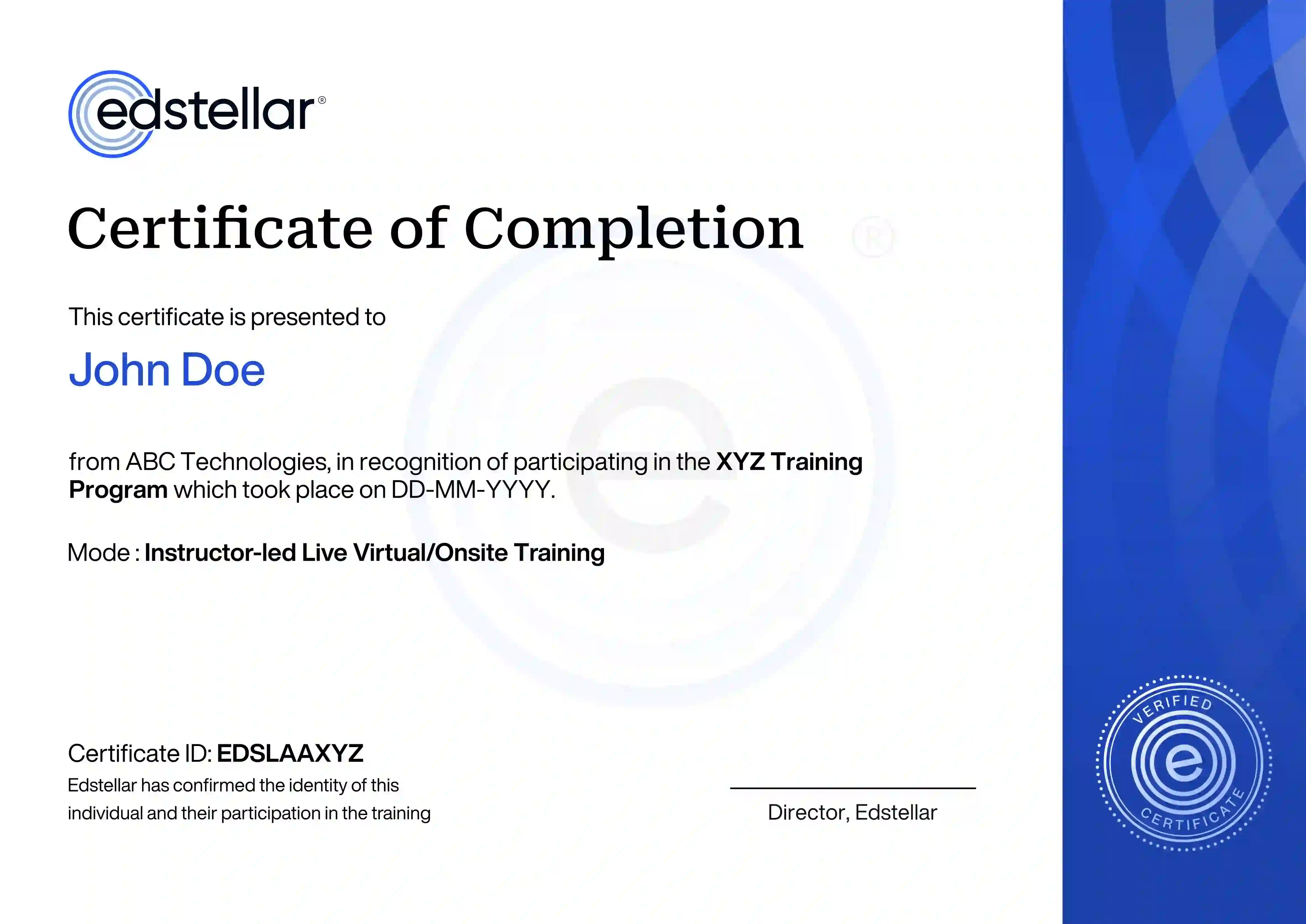
Upon successful completion of the Microsoft Purview: Data Protection & DLP training course offered by Edstellar, employees receive a course completion certificate, symbolizing their dedication to ongoing learning and professional development.
This certificate validates the employee's acquired skills and is a powerful motivator, inspiring them to enhance their expertise further and contribute effectively to organizational success.



Edstellar is a one-stop instructor-led corporate training and coaching solution that addresses organizational upskilling and talent transformation needs globally.
.svg)
.svg)
.svg)

.svg)
Learning Technology
Learning Content Design and Development
Learning Governance, Analytics & ROI
Digital Learning Ecosystem
Training Simulations, AR/VR & Case Studies
Employee Performance Support
Leadership Pipeline & Succession PlanningStrategic Workforce Planning for EnterprisesTransformation & Risk Advisory for EnterprisesDEI Consulting for EnterprisesEmployee Engagement Consulting for Enterprises
Cultural Transformation