.svg "edstellar")

NIST AI RMF Compliance Corporate Training Program
Edstellar's NIST AI RMF Compliance training equips professionals to apply the Govern, Map, Measure, and Manage functions, identify AI risks, and build trustworthy, accountable AI systems aligned with federal standards.
(Virtual / On-site / Off-site)
.svg)
Drive Team Excellence with NIST AI RMF Compliance Corporate Training
The NIST AI Risk Management Framework (AI RMF) is a voluntary, use-case-agnostic framework developed by the National Institute of Standards and Technology to help organizations identify, assess, and manage AI-related risks throughout the AI lifecycle. Built around four core functions - Govern, Map, Measure, and Manage - the framework provides practical guidance for building trustworthy AI systems that are safe, secure, fair, explainable, and accountable. This training covers AI risk categorization, trustworthiness evaluation, governance design, bias auditing, and integration of AI RMF with enterprise risk and compliance programs.
Edstellar's NIST AI RMF Compliance Instructor-led course offers virtual/onsite training options to meet professionals' diverse needs. This flexibility ensures that professionals and teams can engage in learning experiences that best suit their logistical and learning preferences. What sets the Edstellar course apart is its emphasis on practical experience, with hands-on workshops, real-world case studies, and structured exercises that bring AI RMF concepts to life and prepare teams for immediate implementation and audit readiness.
.svg)

Skills Your Employees Will Gain
These are the core, hands-on capabilities your team builds during the program.
- NIST AI RMF Implementation
- AI Risk Assessment and Categorization
- AI Trustworthiness Evaluation
- AI Governance Framework Design
- Bias and Fairness Auditing
- AI Lifecycle Risk Management
- AI Regulatory Compliance
What Your Team Will Achieve After This Training
- Master the NIST AI RMF structure and apply Govern, Map, Measure, and Manage functions to build a complete organizational AI risk management program.
- Gain proficiency in AI risk identification and categorization techniques to assess impact, likelihood, and contextual exposure across AI system deployments.
- Develop skills to evaluate AI trustworthiness across safety, security, fairness, explainability, and accountability dimensions using structured assessment tools.
- Learn to design and implement AI governance frameworks that establish clear ownership, accountability policies, and risk culture across the organization.
- Build expertise in bias and fairness auditing by applying systematic evaluation methods to detect, document, and remediate discriminatory AI behavior.
- Apply AI lifecycle risk management practices to integrate RMF controls into design, development, deployment, monitoring, and decommissioning phases.
Topics & Program Outline
The curriculum is organized into focused modules built by industry experts and delivered virtually or on-premise. Interactive sessions reflect the evolving demands of the workplace, keeping the learning both relevant and practical.
-
Overview of AI Risk and the Need for a Framework
- Defining AI risk in organizational contexts
- Types of AI harms: technical, societal, and operational
- Why traditional risk frameworks fall short for AI
- The role of standards bodies in AI governance
-
NIST AI RMF Structure and Purpose
- Framework origins and development process
- Relationship to NIST CSF and other NIST publications
- Voluntary vs. mandatory application contexts
- How the framework supports regulatory alignment
-
The Four Core Functions: Govern, Map, Measure, Manage
- Function definitions and interdependencies
- How functions interact across the AI lifecycle
- Mapping functions to organizational roles
- Iterative and adaptive use of functions
-
AI Trustworthiness Properties
- The seven trustworthiness characteristics
- Relationships between properties and risk categories
- Measuring trustworthiness in practice
- Trade-offs between competing trustworthy AI properties
-
AI Lifecycle and Risk Entry Points
- Stages of the AI lifecycle: design to decommission
- Risk entry points at each lifecycle stage
- Roles and responsibilities across the lifecycle
- Feedback loops and continuous improvement
-
Regulatory and Compliance Landscape for AI
- Key global AI regulations and executive orders
- NIST AI RMF alignment with the EU AI Act
- Federal agency adoption and guidance
- Compliance documentation and audit readiness
-
Establishing AI Risk Governance Policies
- Policy development lifecycle for AI governance
- Defining scope, objectives, and risk appetite
- Linking AI policy to enterprise risk policy
- Policy communication and enforcement strategies
-
Organizational Roles and Accountability Structures
- Assigning AI risk ownership across leadership
- Chief AI Officer and AI Ethics Board functions
- Cross-functional AI governance committees
- Third-party and vendor accountability frameworks
-
Building an AI Risk Culture
- Defining ethical AI values and organizational norms
- Training and awareness programs for AI risk
- Embedding accountability in team behaviors
- Incentives aligned with responsible AI practices
-
AI Risk Appetite and Tolerance Frameworks
- Defining quantitative and qualitative risk thresholds
- Translating risk appetite into operational controls
- Reviewing and adjusting risk tolerance over time
- Communicating risk appetite to stakeholders
-
Stakeholder Engagement and Transparency Obligations
- Identifying internal and external AI stakeholders
- Transparency requirements for AI system disclosure
- Engaging affected communities in AI decisions
- Documenting stakeholder feedback and responses
-
Governance Documentation and Recordkeeping
- Maintaining AI governance registers and logs
- Documentation standards for audit trails
- Version control for AI governance artifacts
- Retention schedules and compliance evidence
-
Contextualizing AI Use Cases
- Defining the AI system's intended purpose and context
- Identifying deployment environments and conditions
- Understanding user populations and affected parties
- Documenting assumptions and constraints
-
AI Risk Identification Methods
- Structured risk identification workshops
- Failure mode and effects analysis for AI
- Red-teaming and adversarial risk discovery
- Using AI incident databases as reference inputs
-
Categorizing AI Risks by Type and Severity
- Technical risk categories: robustness, security, performance
- Societal risks: bias, fairness, privacy, autonomy
- Operational risks: deployment failures and data drift
- Severity scoring and prioritization criteria
-
Impact and Likelihood Assessment
- Estimating probability of risk occurrence
- Assessing magnitude of potential harm
- Considering cascading and indirect effects
- Documenting assessment rationale
-
AI System Inventory and Mapping
- Building a comprehensive AI asset inventory
- Mapping data flows and system dependencies
- Identifying integration points and third-party components
- Maintaining current and accurate system maps
-
Risk Contextualization for Specific Sectors
- Healthcare AI risk considerations
- Financial services AI risk mapping
- Government and critical infrastructure contexts
- Adapting risk maps to sector-specific regulations
-
Defining AI Risk Metrics and KPIs
- Selecting quantitative metrics for AI risk measurement
- Qualitative assessment scales and rubrics
- Aligning metrics to trustworthiness properties
- Setting measurement baselines and targets
-
Performance and Reliability Testing
- Accuracy, precision, and recall benchmarking
- Robustness testing under distribution shift
- Stress testing and edge case analysis
- Consistency and stability measurement over time
-
Fairness and Bias Measurement
- Selecting appropriate fairness metrics for context
- Demographic parity and equalized odds analysis
- Intersectional bias detection approaches
- Interpreting bias measurements for decision-making
-
Security and Privacy Assessment
- Adversarial attack surface evaluation
- Data minimization and privacy risk metrics
- Differential privacy application and measurement
- Model inversion and membership inference risks
-
Explainability and Transparency Metrics
- Local vs. global explainability evaluation
- Fidelity and comprehensibility of explanations
- Human-understandable output assessment
- Explainability tools: SHAP, LIME, and alternatives
-
Continuous Monitoring and Measurement Programs
- Setting up automated monitoring pipelines
- Detecting model drift and performance degradation
- Frequency and triggers for re-evaluation
- Reporting measurement results to governance bodies
-
Risk Prioritization and Treatment Planning
- Ranking risks by severity and organizational priority
- Selecting treatment options: accept, mitigate, transfer, avoid
- Developing risk treatment action plans
- Assigning ownership and timelines for treatment
-
Implementing AI Risk Controls
- Technical controls: input validation, output filters, guardrails
- Process controls: human oversight and review gates
- Organizational controls: policy enforcement and training
- Testing control effectiveness and coverage
-
AI Incident Response Planning
- Defining AI incidents and harm thresholds
- Incident detection, triage, and escalation workflows
- Root cause analysis for AI failures
- Post-incident review and lessons learned integration
-
Residual Risk Acceptance and Documentation
- Assessing residual risk after controls are applied
- Formal acceptance criteria and approval processes
- Documenting accepted risks for audit purposes
- Communicating residual risks to stakeholders
-
Vendor and Third-Party AI Risk Management
- Evaluating third-party AI systems using RMF criteria
- Contractual requirements for AI risk obligations
- Ongoing vendor monitoring and reassessment
- Supply chain AI risk considerations
-
Continuous Improvement and RMF Updates
- Reviewing and updating risk treatments periodically
- Incorporating new NIST guidance and amendments
- Feeding lessons learned into Govern function updates
- Benchmarking against industry RMF maturity models
-
Risk Assessment Methodologies for AI
- Quantitative vs. qualitative risk assessment approaches
- Scenario-based risk analysis for AI systems
- Bayesian and probabilistic risk modeling
- Adapting traditional risk tools to AI contexts
-
AI Risk Taxonomy and Classification
- NIST AI RMF risk taxonomy overview
- Classifying risks by impact domain
- Distinguishing systemic from isolated risks
- Cross-referencing with sector-specific taxonomies
-
High-Risk AI System Identification
- Criteria for designating high-risk AI applications
- EU AI Act high-risk categories as reference
- Applying heightened scrutiny to high-risk systems
- Documentation requirements for high-risk designations
-
Data Risk Assessment
- Evaluating training data quality and representativeness
- Data poisoning and integrity risks
- Sensitive attribute exposure in datasets
- Data lineage and provenance assessment
-
Model Risk Assessment
- Overfitting, underfitting, and generalization risks
- Model staleness and concept drift risks
- Adversarial vulnerability assessment
- Model card development for risk communication
-
Risk Communication and Reporting
- Structuring risk reports for executive audiences
- Visualizing risk heat maps and dashboards
- Communicating uncertainty in risk assessments
- Regulatory reporting formats and standards
-
Defining and Evaluating AI Trustworthiness
- NIST AI RMF trustworthiness characteristics framework
- Operationalizing trust evaluation in practice
- Trade-off analysis between trustworthiness properties
- Stakeholder perspectives on AI trust
-
Safety and Reliability Assessment
- Defining safe AI behavior in operational contexts
- Reliability testing across diverse conditions
- Fail-safe design principles for AI systems
- Human override and intervention mechanisms
-
Security Trustworthiness Evaluation
- Adversarial robustness testing methodologies
- Model hardening techniques and defenses
- Secure AI development lifecycle practices
- Monitoring for adversarial attacks in production
-
Transparency and Explainability Practices
- Levels of AI transparency: system, process, output
- Communicating AI decision logic to non-technical users
- Explainability documentation and model cards
- Regulatory requirements for explainable AI
-
Privacy-Enhancing Practices in AI
- Privacy-by-design principles for AI systems
- Federated learning and on-device AI for privacy
- Anonymization and pseudonymization in AI pipelines
- Balancing model utility with privacy protection
-
Accountability Mechanisms for AI Systems
- Establishing clear lines of AI decision accountability
- Audit log design for AI decision traceability
- Human-in-the-loop accountability structures
- External audits and third-party accountability reviews
-
Sources of Bias in AI Systems
- Historical bias from training data
- Representation bias and minority group undersampling
- Measurement and label bias in datasets
- Feedback loops amplifying existing bias
-
Fairness Definitions and Frameworks
- Group fairness: demographic parity and equalized odds
- Individual fairness and counterfactual fairness
- Impossibility theorems and fairness trade-offs
- Selecting appropriate fairness criteria by use case
-
Bias Detection and Audit Methods
- Disparate impact analysis techniques
- Slicing and subgroup performance evaluation
- Statistical testing for bias detection
- Automated bias audit toolkits and frameworks
-
Bias Mitigation Strategies
- Pre-processing: resampling and re-weighting data
- In-processing: fairness constraints in model training
- Post-processing: threshold adjustment and calibration
- Validating mitigation effectiveness after intervention
-
Explainability Methods and Tools
- SHAP values for feature importance attribution
- LIME for local model-agnostic explanations
- Counterfactual explanations for decision review
- Choosing explainability methods by model type
-
Documenting Fairness and Explainability Decisions
- Model cards and datasheets for datasets
- Audit trails for fairness interventions
- Communicating fairness findings to regulators
- Ongoing fairness monitoring and reassessment schedules
-
Mapping AI RMF to Enterprise Risk Frameworks
- Aligning AI RMF with ISO 31000 principles
- Integration touchpoints with NIST CSF
- Connecting AI risk to COSO ERM structures
- Avoiding duplication across overlapping frameworks
-
AI RMF and Regulatory Compliance Integration
- Mapping RMF controls to EU AI Act obligations
- Aligning with NIST SP 800-53 security controls
- Supporting SOC 2 and ISO 27001 audits with RMF evidence
- Building a unified compliance control library
-
AI Procurement and Vendor Risk Integration
- Embedding RMF criteria in AI procurement processes
- Vendor AI risk questionnaires and scorecards
- Contractual AI risk obligations and SLAs
- Third-party AI audit rights and transparency requirements
-
Board and Executive Reporting on AI Risk
- Translating technical AI risks for board audiences
- AI risk dashboards for executive oversight
- Integrating AI risk into enterprise risk reports
- Board-level AI governance committee structures
-
Cross-Functional Collaboration for AI Risk
- Legal, compliance, and AI team collaboration models
- Embedding risk professionals in AI development teams
- Shared risk registers across business units
- Escalation paths from technical to governance levels
-
AI Risk Maturity Models
- Assessing current AI risk management maturity
- Defining maturity levels from ad hoc to optimized
- Building a roadmap to higher maturity states
- Benchmarking against industry AI governance peers
-
Embedding RMF into the AI Development Lifecycle
- Risk gates at each development phase
- Pre-deployment risk review checklists
- Integrating RMF into Agile and MLOps workflows
- Automating risk checks in CI/CD pipelines
-
AI RMF Tooling and Technology Enablers
- GRC platforms supporting AI risk workflows
- AI risk assessment tools and open-source libraries
- Model monitoring and observability platforms
- Automated bias and fairness testing integrations
-
Training and Capability Building for AI RMF
- Role-based AI risk training programs
- Building internal AI ethics and risk communities
- Certifications and professional development paths
- Sustaining RMF knowledge through change management
-
Audit Readiness and Evidence Management
- Building an AI compliance evidence repository
- Preparing for internal and external AI audits
- Documentation standards for RMF artifacts
- Responding to regulator inquiries about AI risks
-
Sustaining AI RMF Through Organizational Change
- Managing RMF continuity during leadership transitions
- Adapting the RMF to new AI use cases and deployments
- Embedding RMF into change management processes
- Sustaining stakeholder engagement over time
-
Measuring and Demonstrating AI RMF Value
- KPIs for AI risk program effectiveness
- Cost-benefit analysis of AI risk management investments
- Reporting AI RMF outcomes to executive leadership
- Linking AI risk management to business resilience metrics
Who Should Attend?
This program suits professionals at many levels across the organization, including:
- AI Risk Officers
- Compliance Managers
- AI/ML Engineers
- Chief AI Officers
- IT Governance Professionals
- Data Scientists
What are the Prerequisites?
Professionals should have a foundational understanding of AI/ML concepts, organizational risk management principles, and basic regulatory compliance frameworks to take the NIST AI RMF Compliance training course.
Choose the Format That Fits Your Team
We design training your teams actually engage with, and deliver it the way that suits you best. Through a vetted global trainer network, Edstellar runs sessions in 10+ languages with consistent quality anywhere.


.webp "Virtual NIST AI RMF Compliance Training")
Virtual / online: expert-led live sessions delivered anywhere, with consistency and easy scheduling.
.webp "On-site NIST AI RMF Compliance Training")
On-site (in-house): immersive, instructor-led learning at your office.
.webp "Off-site NIST AI RMF Compliance Training")
Off-site: focused, instructor-led group learning away from everyday workplace distractions.
Get a Proposal Shaped to Your Needs
Need pricing for onsite, offsite, or virtual delivery? Get a proposal tailored to your team's needs.
64 hours of group training (includes VILT/In-person On-site)
Tailored for SMBs
Tailor-Made Trainee Licenses with Our Exclusive Training Packages!
160 hours of group training (includes VILT/In-person On-site)
Ideal for growing SMBs
Tailor-Made Trainee Licenses with Our Exclusive Training Packages!
400 hours of group training (includes VILT/In-person On-site)
Designed for large corporations
Tailor-Made Trainee Licenses with Our Exclusive Training Packages!
Unlimited duration
Designed for large corporations
What Sets Edstellar Apart
Experienced Trainers
Our trainers are drawn from a vetted global network and bring years of industry expertise, keeping every session practical and impactful.
Proven Quality
With a strong global track record, Edstellar is known for quality and engaging delivery.
Industry-Relevant Curriculum
Our programs are built by experts to match the demands of today's industry.
Fully Customizable
Every program can be tailored to your organization's goals.
Comprehensive Support
We provide pre- and post-session support for a complete learning experience.
Global Multi-Location & Multilingual Training Delivery
We deliver in multiple languages to support diverse global teams.
Recognition That Motivates Your Team
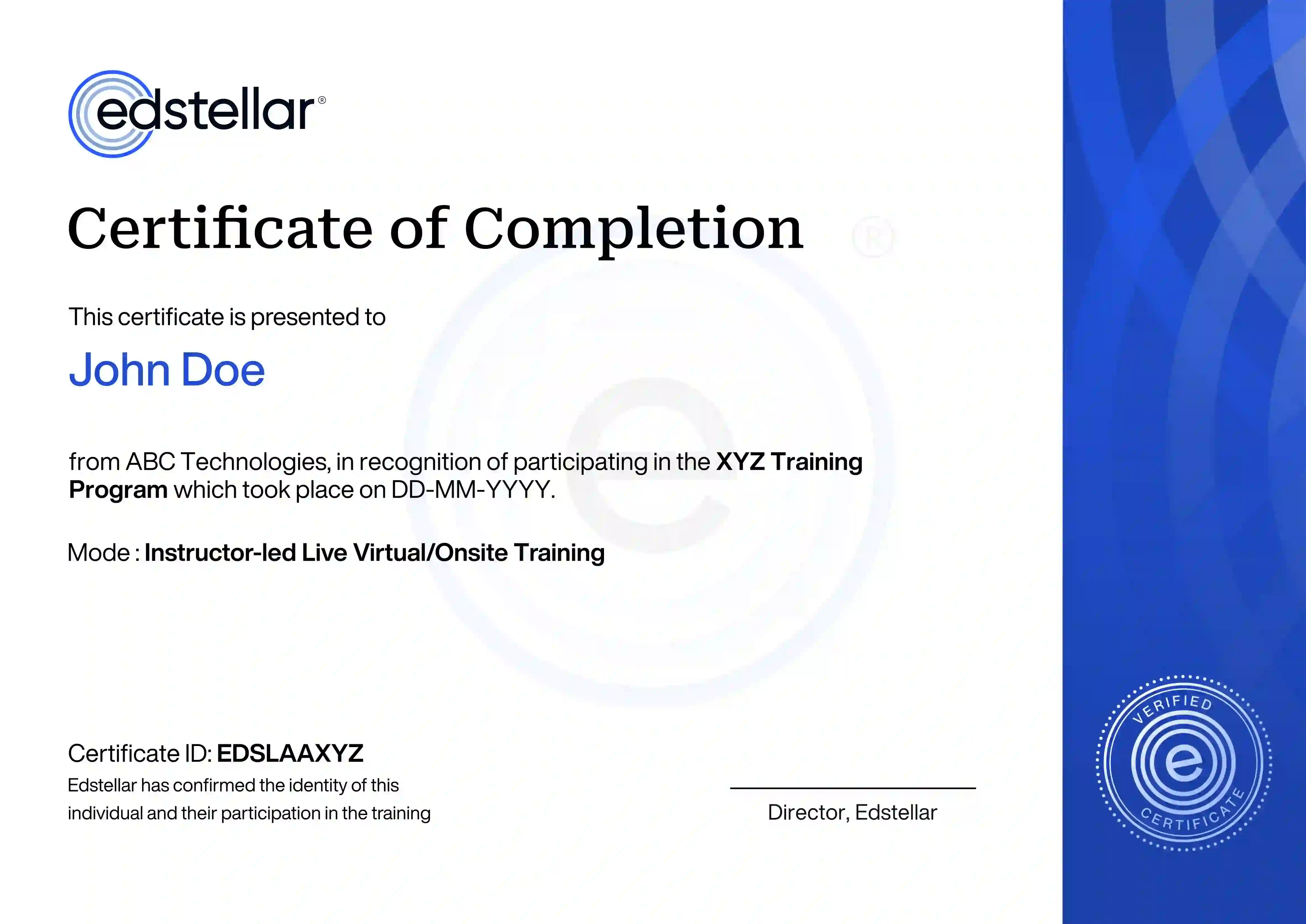
Upon successful completion of the NIST AI RMF Compliance training course offered by Edstellar, employees receive a course completion certificate, symbolizing their dedication to ongoing learning and professional development.
This certificate validates the employee's acquired skills and is a powerful motivator, inspiring them to enhance their expertise further and contribute effectively to organizational success.



Edstellar is a one-stop instructor-led corporate training and coaching solution that addresses organizational upskilling and talent transformation needs globally.
.svg)
.svg)
.svg)

.svg)
Learning Technology
Learning Content Design and Development
Learning Governance, Analytics & ROI
Digital Learning Ecosystem
Training Simulations, AR/VR & Case Studies
Employee Performance Support
Leadership Pipeline & Succession PlanningStrategic Workforce Planning for EnterprisesTransformation & Risk Advisory for EnterprisesDEI Consulting for EnterprisesEmployee Engagement Consulting for Enterprises
Cultural Transformation