Drive Team Excellence with Real-Time Feature Engineering Corporate Training

Empower your teams with expert-led on-site, off-site, and virtual Real-Time Feature Engineering Training through Edstellar, a premier corporate training provider for organizations globally. Designed to meet your specific training needs, this group training program ensures your team is primed to drive your business goals. Help your employees build lasting capabilities that translate into real performance gains.

Real-time feature engineering is a foundational capability for organizations deploying machine learning models that require low-latency, high-quality feature data in production. This training covers the full spectrum of real-time feature engineering, from stream processing architecture and feature extraction techniques to feature stores, automated engineering tools, drift monitoring, and production pipeline deployment, enabling data engineering and ML teams to build robust and scalable feature infrastructure.

Edstellar's Real-Time Feature Engineering Instructor-led course offers virtual/onsite training options designed for advanced ML engineering and data teams. Through intensive hands-on labs, streaming pipeline projects, and case-driven exercises, participants develop the deep technical skills needed to architect and operate world-class real-time feature engineering systems in production environments.

Get Customized Expert-led Training for Your Teams
Customized Training Delivery
Scale Your Training: Small to Large Teams
In-person Onsite, Live Virtual or Hybrid Training Modes
Plan from 2000+ Industry-ready Training Programs
Experience Hands-On Learning from Industry Experts
Delivery Capability Across 100+ Countries & 10+ Languages
""""

Key Skills Employees Gain from Instructor-led Real-Time Feature Engineering Training

Real-Time Feature Engineering skills corporate training will enable teams to effectively apply their learnings at work.

  • Streaming Data Pipeline Design
  • Real-Time Feature Extraction
  • Feature Store Implementation
  • Time-Series Feature Engineering
  • Feature Drift Detection
  • Automated Feature Engineering
  • Production Feature Pipeline Deployment

Key Learning Outcomes of Real-Time Feature Engineering Training Workshop

Upon completing Edstellar’s Real-Time Feature Engineering workshop, employees will gain valuable, job-relevant insights and develop the confidence to apply their learning effectively in the professional environment.

  • Master real-time feature extraction and transformation techniques for production ML systems
  • Develop streaming data pipeline skills using Apache Kafka and Flink for low-latency feature serving
  • Build and manage feature stores with online and offline serving capabilities for ML teams
  • Apply time-series and domain-specific feature engineering methods to specialized ML problems
  • Gain expertise in detecting and responding to feature drift in production data pipelines
  • Learn MLOps practices for deploying, monitoring, and maintaining real-time feature pipelines at scale

Key Benefits of the Real-Time Feature Engineering Group Training

Attending our Real-Time Feature Engineering group training classes provides your team with a powerful opportunity to build skills, boost confidence, and develop a deeper understanding of the concepts that matter most. The collaborative learning environment fosters knowledge sharing and enables employees to translate insights into actionable work outcomes.

  • Instructor-led Real-Time Feature Engineering training delivered onsite or virtually for data teams
  • End-to-end coverage of real-time feature pipeline design, development, and deployment
  • Hands-on labs building streaming pipelines with Apache Kafka and Apache Flink
  • Practical modules on time-series feature engineering for temporal ML use cases
  • Feature store architecture, implementation, and online/offline serving strategies
  • Automated feature engineering tools and libraries for accelerated development
  • Feature drift detection and data quality monitoring for production reliability
  • Domain-specific feature engineering for NLP, computer vision, and fraud detection
  • MLOps integration for production feature pipeline CI/CD and orchestration
  • Flexible scheduling with dedicated Edstellar support throughout the training engagement

Topics and Outline of Real-Time Feature Engineering Training

Our virtual and on-premise Real-Time Feature Engineering training curriculum is structured into focused modules developed by industry experts. This training for organizations provides an interactive learning experience that addresses the evolving demands of the workplace, making it both relevant and practical.

  1. Introduction to Feature Engineering
    • Definition and importance of feature engineering in machine learning
    • How feature quality impacts model accuracy and generalization
    • Feature engineering in the ML development lifecycle
    • Batch versus real-time feature engineering: key differences
  2. Feature Types and Representations
    • Numerical, categorical, temporal, and text feature types
    • Feature representation strategies for different ML algorithms
    • Encoding techniques: one-hot, ordinal, target, and hash encoding
    • Handling high-cardinality categorical features in real-time pipelines
  3. Common Feature Transformation Techniques
    • Normalization and standardization for numerical features
    • Log, power, and Box-Cox transformations for skewed distributions
    • Binning and discretization of continuous features
    • Interaction and polynomial feature creation
  4. Missing Value and Outlier Handling
    • Missing value patterns: MCAR, MAR, and MNAR in real-time data
    • Imputation strategies for streaming and real-time feature pipelines
    • Outlier detection and treatment in feature engineering
    • Impact of imputation and outlier treatment on model performance
  5. Feature Engineering Best Practices
    • Avoiding target leakage in feature design
    • Reproducibility and versioning in feature engineering workflows
    • Documentation standards for engineered features
    • Cross-validation strategies that respect feature engineering boundaries
  6. Tools and Libraries for Feature Engineering
    • Overview of scikit-learn Pipelines for feature preprocessing
    • Feature engineering with Pandas and NumPy for batch processing
    • Introduction to Featuretools and automated feature generation
    • Comparing feature engineering tool ecosystems for ML teams
  1. Streaming Data Fundamentals
    • Event-driven architectures and their role in real-time ML
    • Streams versus batches: processing semantics and trade-offs
    • Event time versus processing time in streaming feature engineering
    • Common streaming data sources: clickstreams, sensors, and transactions
  2. Apache Kafka for Real-Time Feature Pipelines
    • Kafka architecture: brokers, topics, partitions, and consumer groups
    • Producing and consuming feature events with Kafka
    • Kafka Streams for stateful real-time feature computations
    • Kafka schema registry and Avro for feature data contracts
  3. Apache Flink for Stream Processing
    • Flink architecture: jobs, task managers, and state backends
    • Flink DataStream API for real-time feature transformations
    • Windowing in Flink: tumbling, sliding, and session windows
    • Exactly-once processing semantics in Flink feature pipelines
  4. Watermarks and Late-Arriving Data Handling
    • Watermark strategies for managing event time in streaming pipelines
    • Allowed lateness and its impact on feature freshness
    • Handling out-of-order events in real-time feature computation
    • Side outputs for late data management in streaming feature jobs
  5. Stateful Computations and Aggregations
    • Stateful stream processing patterns for feature aggregation
    • Keyed state management in Flink for entity-level features
    • Rolling window aggregations: counts, sums, and moving averages
    • State size management and TTL configuration for feature pipelines
  6. Cloud Streaming Services for Feature Engineering
    • AWS Kinesis and MSK for real-time feature pipeline infrastructure
    • Google Cloud Dataflow for unified batch and streaming feature processing
    • Azure Event Hubs and Stream Analytics in feature engineering workflows
    • Comparing cloud streaming services for ML feature engineering use cases
  1. Time-Series Data Fundamentals for ML
    • Properties of time-series data relevant to feature engineering
    • Stationarity, trend, and seasonality in time-series features
    • Handling irregular time-series in real-time feature pipelines
    • Time-series cross-validation to prevent temporal leakage
  2. Lag and Rolling Window Features
    • Lag feature creation for capturing temporal dependencies
    • Rolling mean, sum, max, and min feature computation
    • Exponentially weighted moving average features
    • Selecting optimal lag and window sizes for target relationships
  3. Calendar and Temporal Features
    • Extracting hour, day, week, month, and quarter features
    • Holiday, weekend, and business-day indicator features
    • Cyclic encoding of time features using sine and cosine transformations
    • Time-since-event features for recency in customer and transaction data
  4. Frequency Domain Features
    • Fast Fourier Transform features for periodic signal detection
    • Spectral density features for identifying dominant frequencies
    • Wavelet transform features for multi-scale signal analysis
    • Applications: IoT sensor data and financial time-series feature engineering
  5. Statistical and Distribution Features
    • Rolling statistical features: skewness, kurtosis, and percentiles
    • Autocorrelation and partial autocorrelation features
    • Change detection features for anomaly and shift identification
    • Entropy and complexity measures as time-series features
  6. Real-Time Time-Series Feature Computation
    • Incremental algorithms for computing time-series features in real time
    • Online statistics: Welford's algorithm for mean and variance
    • Memory-efficient data structures for real-time aggregations
    • Validating real-time time-series features against offline gold standards
  1. Introduction to Automated Feature Engineering
    • Motivation and scope of automated feature engineering (AutoFE)
    • AutoFE versus manual feature engineering: trade-offs and use cases
    • Overview of AutoFE tools and libraries in the ML ecosystem
    • Integrating AutoFE into production ML pipelines
  2. Deep Feature Synthesis with Featuretools
    • Featuretools architecture: entities, relationships, and feature primitives
    • Generating deep features from relational data using DFS
    • Customizing primitives for domain-specific feature creation
    • Scaling Featuretools for large datasets and distributed environments
  3. AutoML Frameworks and Feature Automation
    • AutoML tools with integrated feature engineering: AutoGluon and H2O
    • TPOT and genetic programming for automated feature pipeline optimization
    • AutoKeras and neural architecture search for feature learning
    • Evaluating AutoML feature outputs for production suitability
  4. Neural Feature Learning and Representation
    • Autoencoders for unsupervised feature learning
    • Entity embeddings for high-cardinality categorical features
    • Pre-trained model embeddings for text and image features
    • Fine-tuning learned representations for downstream ML tasks
  5. Feature Selection Automation
    • Automated feature selection: recursive elimination and SHAP-based selection
    • Boruta algorithm for robust automated feature selection
    • Stability selection for reliable feature importance estimation
    • Integrating automated selection into real-time feature pipelines
  6. Evaluation and Governance of AutoFE Outputs
    • Evaluating the predictive and business relevance of generated features
    • Detecting spurious correlations in AutoFE outputs
    • Documentation and explainability requirements for automated features
    • Governance frameworks for approving AutoFE features in production
  1. Feature Store Fundamentals
    • What a feature store is and why organizations need one
    • Feature store architecture: online store, offline store, and registry
    • The training-serving skew problem and how feature stores solve it
    • Feature store adoption patterns in enterprise ML organizations
  2. Feature Store Platforms and Tools
    • Open-source feature stores: Feast, Hopsworks, and Tecton
    • Cloud-native feature stores: AWS SageMaker, GCP Vertex AI, and Azure ML
    • Evaluating feature store platforms for team size and use case
    • Migrating from ad-hoc feature pipelines to a centralized feature store
  3. Online and Offline Feature Serving
    • Online store design for low-latency real-time feature retrieval
    • Offline store design for high-throughput batch training data generation
    • Point-in-time correct feature retrieval for training dataset generation
    • Consistency guarantees between online and offline feature serving
  4. Feature Registry and Metadata Management
    • Defining and registering feature definitions in the feature registry
    • Feature lineage tracking from raw data to serving
    • Feature tagging, ownership, and documentation standards
    • Feature discovery and reuse across ML teams
  5. Feature Store Ingestion Pipelines
    • Batch ingestion pipelines from data warehouses into the feature store
    • Real-time streaming ingestion into the online feature store
    • Incremental versus full refresh ingestion strategies
    • Managing backfills for historical feature data in the offline store
  6. Feature Store Operations and Governance
    • Access control and permissions management in feature stores
    • Feature versioning and deprecation workflows
    • Monitoring feature store freshness and serving health
    • Cost management and storage optimization for feature stores
  1. Understanding Feature and Data Drift
    • Types of drift: data drift, concept drift, and feature drift
    • How feature drift degrades model performance in production
    • Root causes of feature drift: upstream data changes and behavioral shifts
    • Impact of feature drift on real-time versus batch ML systems
  2. Statistical Methods for Drift Detection
    • Population Stability Index (PSI) for feature distribution monitoring
    • Kolmogorov-Smirnov and Jensen-Shannon divergence tests
    • Maximum Mean Discrepancy for high-dimensional feature drift
    • Choosing the right drift detection method for different feature types
  3. Data Quality Checks for Feature Pipelines
    • Defining data quality rules for real-time feature pipelines
    • Schema validation and contract enforcement in streaming features
    • Statistical expectation checks: null rates, ranges, and cardinality
    • Implementing data quality checks with Great Expectations and similar tools
  4. Monitoring Infrastructure for Feature Pipelines
    • Instrumentation of real-time feature pipelines for observability
    • Metrics collection and visualization for feature pipeline health
    • Alerting rules and escalation protocols for feature drift events
    • Integrating feature monitoring into MLOps observability stacks
  5. Responding to Feature Drift in Production
    • Triage workflow for investigating detected feature drift
    • Automated versus manual responses to drift events
    • Retraining strategies triggered by feature drift detection
    • Communication protocols for drift incidents affecting production models
  6. Continuous Feature Quality Improvement
    • Building a drift monitoring culture within ML engineering teams
    • Post-drift reviews and retrospectives for pipeline improvement
    • Proactive feature hardening strategies to reduce drift sensitivity
    • Benchmarking feature quality over time using historical drift data
  1. End-to-End Streaming Feature Pipeline Architecture
    • Architecture of a complete Kafka plus Flink feature pipeline
    • Data flow from event source to feature store via streaming
    • Partitioning strategies for scalable streaming feature computation
    • Fault tolerance and recovery in streaming feature pipelines
  2. Advanced Kafka Patterns for Feature Engineering
    • Kafka topic design for feature engineering event streams
    • Consumer group management for parallel feature computation
    • Kafka Connect for integrating external data sources into feature pipelines
    • Compacted topics for stateful entity feature management
  3. Advanced Flink Patterns for Feature Computation
    • Broadcast state patterns for joining streaming features with lookup tables
    • AsyncIO for enriching feature streams with external data lookups
    • Flink Table API and SQL for declarative streaming feature definitions
    • Custom windowing functions for complex feature aggregation patterns
  4. Joining Streams for Cross-Entity Features
    • Stream-to-stream join patterns for cross-entity feature computation
    • Interval joins for time-bounded cross-stream feature enrichment
    • Stream-to-table joins using Flink and Kafka for real-time lookups
    • Managing join state size and TTL in production feature pipelines
  5. Pipeline Deployment and Operations
    • Containerizing Flink jobs for Kubernetes deployment
    • CI/CD for streaming feature pipeline updates and deployments
    • Monitoring Flink job health: backpressure, checkpoints, and throughput
    • Zero-downtime upgrades for production streaming feature pipelines
  6. Performance Tuning for Real-Time Feature Pipelines
    • Parallelism configuration for optimal Flink feature job throughput
    • RocksDB state backend tuning for high-state Flink feature jobs
    • Kafka consumer lag management for feature pipeline latency control
    • Profiling and optimizing hot paths in streaming feature computations
  1. Feature Engineering for Fraud Detection
    • Velocity features: transaction counts and amounts over time windows
    • Behavioral deviation features for anomaly detection in real time
    • Graph-based features for network fraud pattern detection
    • Real-time feature requirements for millisecond fraud scoring
  2. Feature Engineering for Natural Language Processing
    • Text preprocessing and tokenization pipelines for NLP features
    • TF-IDF and BM25 features for text relevance and search
    • Sentence and document embedding features using transformer models
    • Real-time NLP feature extraction for online classification systems
  3. Feature Engineering for Computer Vision
    • Pixel normalization, augmentation, and preprocessing pipelines
    • Convolutional feature extraction from pre-trained models
    • Object detection and segmentation features for downstream models
    • Streaming video feature engineering for real-time vision applications
  4. Feature Engineering for Recommendation Systems
    • User interaction history features: clicks, views, and purchases
    • Item popularity, recency, and novelty features for recommendations
    • Collaborative filtering features from real-time user sessions
    • Cold-start feature strategies for new users and items
  5. Feature Engineering for IoT and Sensor Data
    • Sensor signal preprocessing: filtering, resampling, and normalization
    • Statistical and frequency-domain features from sensor streams
    • Fault detection features from equipment sensor time series
    • Real-time feature pipelines for edge and cloud IoT ML systems
  6. Feature Engineering for Financial Risk Models
    • Credit risk features: payment history, utilization, and delinquency
    • Market features: price returns, volatility, and momentum indicators
    • Macro-economic feature integration into credit and risk models
    • Real-time risk feature updating for dynamic credit decisioning systems
  1. MLOps Principles Applied to Feature Engineering
    • The role of feature pipelines in the MLOps lifecycle
    • Feature pipeline versioning and reproducibility in MLOps
    • Connecting feature pipelines to model training and serving workflows
    • MLOps maturity levels and feature engineering capabilities
  2. CI/CD for Feature Pipelines
    • Automated testing for feature transformation correctness
    • Integration testing for feature pipeline end-to-end validation
    • CI/CD pipeline design for feature code and configuration changes
    • Feature pipeline blue-green and canary deployment patterns
  3. Feature Pipeline Orchestration
    • Orchestrating feature pipelines with Apache Airflow and Prefect
    • Dependency management between feature pipeline tasks and DAGs
    • Scheduling and triggering strategies for feature pipeline runs
    • Error handling and retry logic in feature pipeline orchestration
  4. Data Lineage and Feature Traceability
    • Tracking data lineage from source to model predictions
    • Tools for lineage tracking: OpenLineage, Marquez, and Amundsen
    • Impact analysis for upstream data changes on downstream features
    • Regulatory and audit requirements for feature lineage documentation
  5. Feature Pipeline Testing Strategies
    • Unit testing individual feature transformation functions
    • Property-based testing for feature pipeline correctness
    • Comparing real-time features against batch gold standards
    • Chaos testing for feature pipeline fault tolerance validation
  6. Feature Engineering Governance and Compliance
    • Data governance frameworks for feature data management
    • PII detection and anonymization in real-time feature pipelines
    • Feature access control and audit logging requirements
    • Regulatory compliance considerations for financial and healthcare features
  1. Production Readiness for Feature Pipelines
    • Production readiness checklist for real-time feature pipelines
    • Latency SLA definition and measurement for feature serving
    • Throughput capacity planning for production feature workloads
    • Documentation and runbook requirements for production pipelines
  2. Containerization and Orchestration
    • Containerizing feature pipeline components with Docker
    • Kubernetes deployment patterns for scalable feature infrastructure
    • Helm charts for managing feature pipeline deployments
    • Resource allocation and autoscaling for feature pipeline pods
  3. High Availability and Fault Tolerance
    • Redundancy design for mission-critical real-time feature pipelines
    • Failover strategies for feature store and streaming infrastructure
    • Checkpoint and recovery mechanisms for stateful streaming jobs
    • Disaster recovery planning for feature engineering infrastructure
  4. Feature Pipeline Performance Optimization
    • Profiling and identifying bottlenecks in production feature pipelines
    • Caching strategies for frequently accessed feature computations
    • Compute optimization: vectorization and parallelism in feature code
    • Network and I/O optimization for low-latency feature retrieval
  5. Feature Pipeline Incident Management
    • Defining incident severity for feature pipeline failures
    • On-call runbooks for common feature pipeline failure scenarios
    • Root cause analysis for feature staleness and data quality incidents
    • Post-incident reviews and pipeline hardening actions
  6. Capstone: Building and Deploying a Production Feature Pipeline
    • End-to-end project: design a real-time feature pipeline from scratch
    • Implementing feature extraction, storage, and serving components
    • Deploying the pipeline to a cloud environment with monitoring
    • Presenting pipeline design decisions and performance benchmarks

Who Can Take the Real-Time Feature Engineering Training Course

The Real-Time Feature Engineering training program can also be taken by professionals at various levels in the organization.

  • Data Scientists and ML Engineers
  • Data Engineers and Platform Engineers
  • MLOps Engineers
  • AI/ML Product Teams
  • Backend Engineers Working on ML-Powered Products
  • Analytics Engineers and Data Architects

Prerequisites for Real-Time Feature Engineering Training

Professionals should have solid experience in Python, machine learning fundamentals, and data pipeline development to take the Real-Time Feature Engineering training course.

Request a Quote for your Corporate Training Requirements

Valid number

Delivering Training for Organizations across 100 Countries and 10+ Languages

Corporate Group Training Delivery Modes
for Real-Time Feature Engineering Training

At Edstellar, we understand the importance of impactful and engaging training for employees. As a leading Real-Time Feature Engineering training provider, we ensure the training is more interactive by offering Face-to-Face onsite/in-house or virtual/online sessions for companies. This approach has proven to be effective, outcome-oriented, and produces a well-rounded training experience for your teams.

Virtual Real-Time Feature Engineering Training

Edstellar's Real-Time Feature Engineering virtual/online training sessions bring expert-led, high-quality training to your teams anywhere, ensuring consistency and seamless integration into their schedules.

With global reach, your employees can get trained from various locations
The consistent training quality ensures uniform learning outcomes
Participants can attend training in their own space without the need for traveling
Organizations can scale learning by accommodating large groups of participants
Interactive tools can be used to enhance learning engagement
On-site Real-Time Feature Engineering Training

Edstellar's Real-Time Feature Engineering inhouse face to face instructor-led training delivers immersive and insightful learning experiences right in the comfort of your office.

Higher engagement and better learning experience through face-to-face interaction
Workplace environment can be tailored to learning requirements
Team collaboration and knowledge sharing improves training effectiveness
Demonstration of processes for hands-on learning and better understanding
Participants can get their doubts clarified and gain valuable insights through direct interaction
Off-site Real-Time Feature Engineering Training

Edstellar's Real-Time Feature Engineering offsite face-to-face instructor-led group training offer a unique opportunity for teams to immerse themselves in focused and dynamic learning environments away from their usual workplace distractions.

Distraction-free environment improves learning engagement
Team bonding can be improved through activities
Dedicated schedule for training away from office set up can improve learning effectiveness
Boosts employee morale and reflects organization's commitment to employee development

Explore Our Customized Pricing Package
for
Real-Time Feature Engineering Corporate Training

Looking for pricing details for onsite, offsite, or virtual instructor-led Real-Time Feature Engineering training? Get a customized proposal tailored to your team’s specific needs.

Request a Group Training Quote
""
How Many Team Members Need Training?
Please select an option or fill in the custom field.
"'

Is Your Corporate Training Requirement Only for Real-Time Feature Engineering?

Please select at least one course.
""
Add the List of Training Workshops
search icon

      Please select the course

      No. of Courses selected: 0

      Clear

      Upload a CSV

      Send us your Training Requirements in 3 Easy steps

      1. 1
      2. 2
        Add the required training workshops
      3. 3
        Upload to get a quick quote or email it to contact@edstellar.com

      ""

      Looking for a Complete Package?

      Looking for a one-time pricing option for all your annual training requirements?

      View Corporate Training Packages
      ""
      Select the Option that Best Describes Your Corporate Training Requirement

      Please select an option or choose from the recurring options.
      ""
      Verify and Submit Your Request

      Review Your Corporate Training Selection Summary

      Training Program: Real-Time Feature Engineering Training

      1. No of Team Members

      2. Selected Training Preference

      3. Selected Recurring Sessions

      1

      Review your Requirements

      Training Workshops Selected :


        Excel
        File has been
        successfully uploaded.
        Fill the form to submit
 your details
        Submit Your Professional Contact Information
        Valid number
        We've received your enquiry. Our team will be in touch soon.
        Oops! Something went wrong while submitting the form.
        Starter
        120 licences

        Tailor-Made Trainee Licenses with Our Exclusive Training Packages!

        View Package

        64 hours of group training (includes VILT/In-person On-site)

        Tailored for SMBs

        Growth
        320 licences

        Tailor-Made Trainee Licenses with Our Exclusive Training Packages!

        View Package

        160 hours of group training (includes VILT/In-person On-site)

        Ideal for growing SMBs

        Enterprise
        800 licences

        Tailor-Made Trainee Licenses with Our Exclusive Training Packages!

        View Package

        400 hours of group training (includes VILT/In-person On-site)

        Designed for large corporations

        Custom
        Unlimited licenses

        Tailor-Made Trainee Licenses with Our Exclusive Training Packages!

        View Package

        Unlimited duration

        Designed for large corporations

        Edstellar: Your Go-to Real-Time Feature Engineering Training Company

        Experienced Trainers

        Our trainers bring years of industry expertise to ensure the training is practical and impactful.

        Quality Training

        With a strong track record of delivering training worldwide, Edstellar maintains its reputation for its quality and training engagement.

        Industry-Relevant Curriculum

        Our course is designed by experts and is tailored to meet the demands of the current industry.

        Customizable Training

        Our course can be customized to meet the unique needs and goals of your organization.

        Comprehensive Support

        We provide pre and post training support to your organization to ensure a complete learning experience.

        Multilingual Training Capabilities

        We offer training in multiple languages to cater to diverse and global teams.

        Testimonials

        What Our Clients Say

        We pride ourselves on delivering exceptional training solutions. Here's what our clients have to say about their experiences with Edstellar.

        "Edstellar's virtual Real-Time Feature Engineering training gave our ML platform team a complete framework for building production-grade feature pipelines. Within two months, we migrated from ad-hoc feature scripts to a centralized feature store, reducing training pipeline failures by 65% and cutting feature development time per model by 40%. The Kafka and Flink modules were exceptionally practical."

        Rajan Nair

        ML Platform Lead,

        A Global E-Commerce Technology Company

        "The onsite Real-Time Feature Engineering training by Edstellar was exactly the depth our data engineering team needed. The trainers covered streaming pipelines, feature stores, and drift monitoring with hands-on labs that directly mirrored our production environment. Post-training, we reduced feature serving latency by 55% and eliminated training-serving skew issues that had been causing model degradation."

        Divya Krishnaswamy

        Head of Data Engineering,

        A Leading Fintech Platform

        "We ran our ML and data engineering teams through Edstellar's intensive Real-Time Feature Engineering program at an off-site location. The comprehensive coverage from time-series features to production deployment gave our teams a shared architecture vision. Post-program, we launched a company-wide feature store that enabled 30% faster model development and a 50% reduction in feature-related production incidents."

        Arun Venkataraman

        Chief Data Officer,

        A Multinational Insurance Technology Group

        "Edstellar's IT & Technical training programs have been instrumental in strengthening our engineering teams and building future-ready capabilities. The hands-on approach, practical cloud scenarios, and expert guidance helped our teams improve technical depth, problem-solving skills, and execution across multiple projects. We're excited to extend more of these impactful programs to other business units."

        Aditi Rao

        L&D Head,

        A Global Technology Company

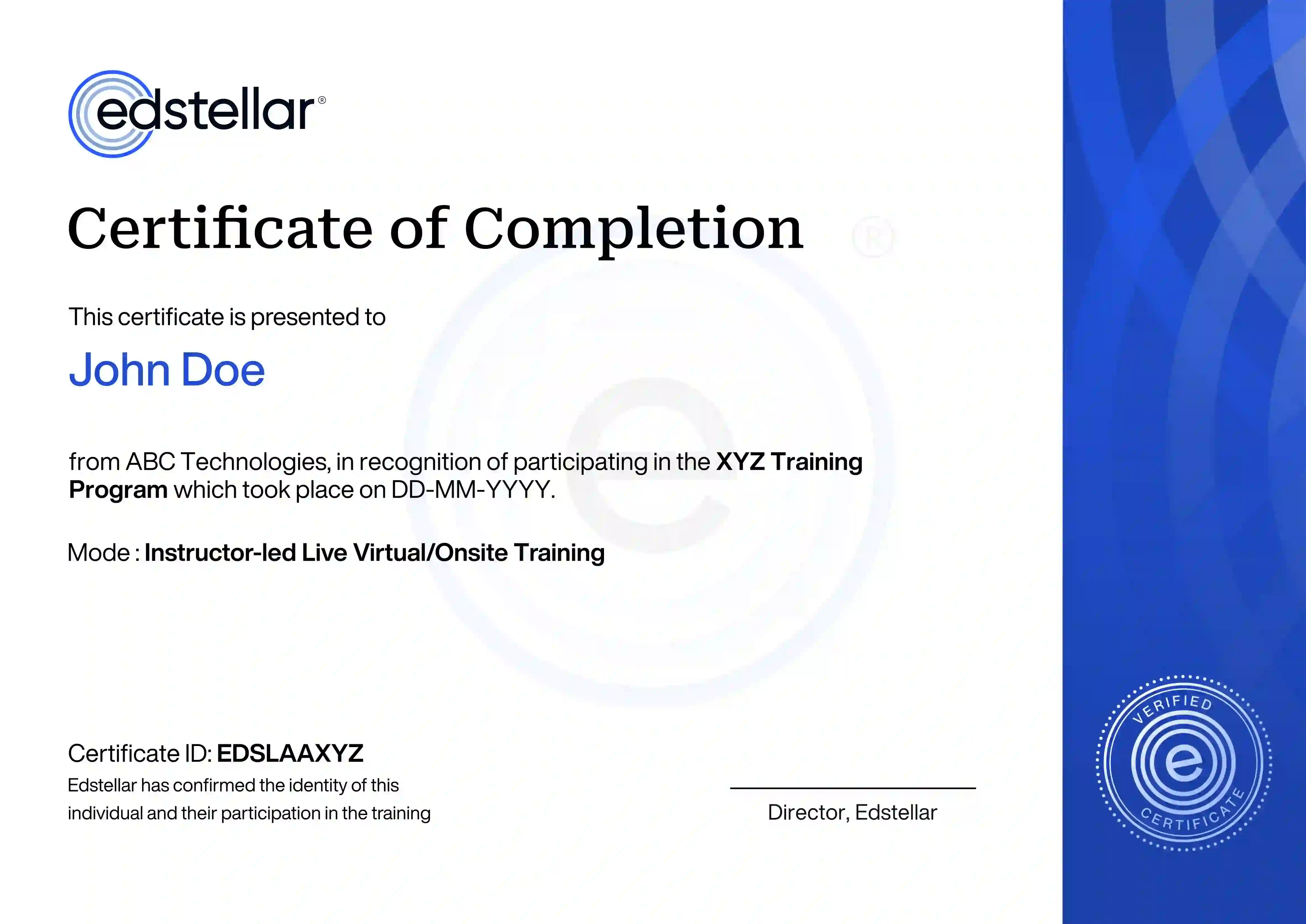
        Get Your Team Members Recognized with Edstellar’s Course Certificate

        Upon successful completion of the training course offered by Edstellar, employees receive a course completion certificate, symbolizing their dedication to ongoing learning and professional development.

        This certificate validates the employee's acquired skills and is a powerful motivator, inspiring them to enhance their expertise further and contribute effectively to organizational success.

        Certificate of Excellence