Drive Team Excellence with Streaming Data Mesh Corporate Training

Empower your teams with expert-led on-site, off-site, and virtual Streaming Data Mesh Training through Edstellar, a premier corporate training provider for organizations globally. Designed to meet your specific training needs, this group training program ensures your team is primed to drive your business goals. Help your employees build lasting capabilities that translate into real performance gains.

Streaming Data Mesh is an advanced architectural paradigm that unifies the scalability of real-time streaming platforms with the organizational principles of data mesh, enabling enterprises to decentralize data ownership, accelerate analytics, and maintain governance across distributed domains. As organizations grow in data complexity, this approach empowers individual domain teams to own, publish, and consume high-quality streaming data products without centralized bottlenecks.

Edstellar's Streaming Data Mesh Instructor-led course offers virtual/onsite training options tailored for engineering and data leadership teams. Participants gain practical expertise in streaming technologies, domain-driven design, federated governance, and organizational change management - equipping them to architect and operate production-grade streaming data mesh platforms confidently.

Get Customized Expert-led Training for Your Teams
Customized Training Delivery
Scale Your Training: Small to Large Teams
In-person Onsite, Live Virtual or Hybrid Training Modes
Plan from 2000+ Industry-ready Training Programs
Experience Hands-On Learning from Industry Experts
Delivery Capability Across 100+ Countries & 10+ Languages
""""

Key Skills Employees Gain from Instructor-led Streaming Data Mesh Training

Streaming Data Mesh skills corporate training will enable teams to effectively apply their learnings at work.

  • Streaming pipeline design with Kafka, Kinesis, and Pulsar
  • Domain-oriented data product ownership and governance
  • Event-driven architecture and schema management
  • Self-serve data infrastructure for real-time workloads
  • Data contracts and cross-domain interoperability
  • Stream processing with Apache Flink and Spark Streaming
  • Observability, SLA management, and data quality assurance

Key Learning Outcomes of Streaming Data Mesh Training Workshop

Upon completing Edstellar’s Streaming Data Mesh workshop, employees will gain valuable, job-relevant insights and develop the confidence to apply their learning effectively in the professional environment.

  • Design domain-oriented streaming data products aligned with data mesh principles and decentralized ownership models
  • Build and manage real-time pipelines using Apache Kafka, Kinesis, Pulsar, Flink, and Spark Streaming
  • Apply federated computational governance policies to enforce data quality and compliance across streaming domains
  • Implement data contracts and interoperability standards to enable reliable cross-domain data exchange
  • Configure self-serve data infrastructure to empower domain teams with autonomous pipeline management
  • Establish observability frameworks, SLA tracking, and data quality monitoring for production streaming meshes

Key Benefits of the Streaming Data Mesh Group Training

Attending our Streaming Data Mesh group training classes provides your team with a powerful opportunity to build skills, boost confidence, and develop a deeper understanding of the concepts that matter most. The collaborative learning environment fosters knowledge sharing and enables employees to translate insights into actionable work outcomes.

  • Instructor-led Streaming Data Mesh training delivered onsite or virtually to suit your team's schedule
  • Covers end-to-end data mesh principles applied to real-time streaming architectures
  • Hands-on labs using Apache Kafka, Flink, Pulsar, and Spark Streaming
  • Explores domain-oriented data product design and self-serve infrastructure patterns
  • Addresses federated computational governance and policy enforcement at scale
  • Teaches data contract design and cross-domain interoperability strategies
  • Includes observability frameworks, SLA definition, and data quality monitoring
  • Covers event-driven architecture patterns and schema evolution best practices
  • Provides migration and organizational change strategies for data mesh adoption
  • Customizable curriculum aligned to your organization's data engineering maturity

Topics and Outline of Streaming Data Mesh Training

Our virtual and on-premise Streaming Data Mesh training curriculum is structured into focused modules developed by industry experts. This training for organizations provides an interactive learning experience that addresses the evolving demands of the workplace, making it both relevant and practical.

  1. Introduction to Data Mesh Philosophy
    • Origins and motivations behind the data mesh paradigm
    • Limitations of centralized data lakes and warehouses
    • Core principles: domain ownership, data as a product, self-serve infrastructure, federated governance
    • Business case for adopting data mesh in large-scale organizations
  2. Domain-Oriented Ownership
    • Defining domain boundaries aligned with business capabilities
    • Assigning data ownership responsibilities to domain teams
    • Mapping organizational structure to data architecture
    • Common pitfalls when transitioning to decentralized ownership
  3. Data as a Product Mindset
    • Applying product thinking to data: discoverability, usability, and reliability
    • Defining data product interfaces and SLAs
    • Building internal data product catalogs
    • Measuring data product quality and consumer satisfaction
  4. Comparing Centralized vs. Decentralized Data Architectures
    • Architectural trade-offs between monolithic and mesh approaches
    • When data mesh is the right choice for an organization
    • Hybrid architectures: combining mesh with centralized components
    • Real-world case studies of data mesh adoption
  5. Organizational Readiness for Data Mesh
    • Assessing current data culture and maturity
    • Identifying domain champions and data product owners
    • Defining success metrics for a data mesh transformation
    • Building cross-functional teams around data domains
  6. Governance Foundations in a Mesh World
    • Role of federated governance in enabling decentralization
    • Balancing autonomy with global policy enforcement
    • Establishing a data governance council for mesh oversight
    • Tooling and automation support for distributed governance
  1. Apache Kafka Architecture and Core Concepts
    • Kafka brokers, topics, partitions, and consumer groups
    • Producer and consumer APIs: configuration and tuning
    • Kafka Connect for source and sink integrations
    • Kafka Schema Registry and Avro serialization
  2. Kafka Streams and ksqlDB
    • Stream processing fundamentals with Kafka Streams API
    • Stateful vs. stateless stream operations
    • Building real-time analytics with ksqlDB
    • Windowing, joins, and aggregations in Kafka Streams
  3. Amazon Kinesis for Cloud-Native Streaming
    • Kinesis Data Streams: shards, retention, and throughput
    • Kinesis Data Firehose for managed delivery pipelines
    • Kinesis Data Analytics for real-time SQL processing
    • Integrating Kinesis with AWS Lambda and S3
  4. Apache Pulsar Architecture
    • Pulsar's layered architecture: brokers, BookKeeper, and ZooKeeper
    • Multi-tenancy and namespace management in Pulsar
    • Pulsar Functions for lightweight stream processing
    • Comparing Pulsar and Kafka for data mesh use cases
  5. Choosing the Right Streaming Platform
    • Evaluation criteria: throughput, latency, ecosystem, and cost
    • Multi-platform streaming architectures and federation
    • Managed streaming services vs. self-hosted deployments
    • Migration paths between streaming platforms
  6. Operational Best Practices for Streaming Platforms
    • Monitoring cluster health with Prometheus and Grafana
    • Capacity planning and partition rebalancing strategies
    • Securing streaming clusters with TLS and ACLs
    • Disaster recovery and replication across regions
  1. Defining Streaming Data Products
    • Characteristics of a well-defined streaming data product
    • Identifying domain events and event streams as products
    • Packaging streams with metadata, schemas, and documentation
    • Versioning and lifecycle management for streaming data products
  2. Domain Event Modeling
    • Event storming techniques for identifying domain events
    • Distinguishing commands, events, and queries in event-driven domains
    • Designing event schemas for long-term compatibility
    • Documenting event models with AsyncAPI specifications
  3. Publishing Streaming Data Products
    • Exposing Kafka topics and Pulsar namespaces as domain products
    • Access control and subscription management for consumers
    • Registering streaming products in a data catalog
    • Communicating product changes to downstream consumers
  4. Consuming Streaming Data Products Across Domains
    • Consumer group design and offset management patterns
    • Handling schema evolution without breaking consumers
    • Chaining domain products into cross-domain pipelines
    • Monitoring consumer lag and alerting on SLA breaches
  5. Data Product Ownership and Accountability
    • Roles and responsibilities of a streaming data product owner
    • Establishing SLAs for availability, latency, and correctness
    • Incident response and root cause analysis for streaming products
    • Tracking data product usage and consumer feedback
  6. Streaming Data Product Patterns
    • Source-aligned, aggregate, and consumer-aligned data product patterns
    • Event sourcing and CQRS in data product design
    • Materialized views and read models for streaming consumers
    • Anti-patterns to avoid in streaming data product design
  1. Principles of Self-Serve Infrastructure
    • Why self-serve infrastructure is a core data mesh pillar
    • Reducing platform team dependency for domain teams
    • Designing internal developer platforms for streaming workloads
    • Platform as a product: aligning infrastructure to domain team needs
  2. Infrastructure as Code for Streaming Platforms
    • Provisioning Kafka clusters with Terraform and Ansible
    • Automating topic creation, ACLs, and connector deployments
    • GitOps workflows for streaming infrastructure changes
    • Environment management: dev, staging, and production parity
  3. Containerization and Orchestration for Streaming
    • Running Kafka and Flink workloads on Kubernetes
    • Helm charts and operators for stateful streaming applications
    • Auto-scaling stream processing jobs based on consumer lag
    • Resource isolation between domain team workloads
  4. Pipeline Templates and Golden Paths
    • Building reusable pipeline templates for domain teams
    • Standardizing ingestion, transformation, and output patterns
    • Self-service pipeline scaffolding with CLI tools
    • Documentation and onboarding for platform consumers
  5. Data Catalog and Discovery for Streaming Assets
    • Integrating streaming schemas with Apache Atlas or DataHub
    • Auto-registering topics and schemas in the data catalog
    • Enabling search and lineage tracking for streaming data products
    • Tagging and classifying streaming assets for governance
  6. Cost Management and Resource Optimization
    • Monitoring Kafka and Flink resource consumption per domain
    • Chargeback and showback models for self-serve platforms
    • Rightsizing partitions, replicas, and processing resources
    • Automating cost alerts and budget controls for domain teams
  1. Event-Driven Architecture Fundamentals
    • Core concepts: events, producers, consumers, and brokers
    • Event notification vs. event-carried state transfer patterns
    • Choreography vs. orchestration in event-driven systems
    • Benefits and trade-offs of event-driven architectures
  2. Designing Robust Event Schemas
    • Schema design principles: clarity, completeness, and extensibility
    • Choosing between Avro, Protobuf, and JSON Schema formats
    • Namespacing and versioning conventions for event schemas
    • Documenting event schemas with business context metadata
  3. Schema Registry Operations
    • Confluent Schema Registry architecture and API
    • Registering, retrieving, and evolving schemas programmatically
    • Compatibility modes: backward, forward, and full compatibility
    • Automating schema validation in CI/CD pipelines
  4. Schema Evolution Strategies
    • Identifying breaking vs. non-breaking schema changes
    • Coordinating schema migrations across producer and consumer teams
    • Dual-write patterns for zero-downtime schema changes
    • Deprecation workflows and consumer migration timelines
  5. AsyncAPI for Streaming Documentation
    • AsyncAPI specification structure and key components
    • Documenting Kafka and Pulsar topics with AsyncAPI
    • Generating developer portals from AsyncAPI definitions
    • Integrating AsyncAPI with data mesh data catalogs
  6. Event Routing and Filtering Patterns
    • Content-based routing using stream processors
    • Topic partitioning strategies for event routing efficiency
    • Fan-out patterns for multi-consumer event distribution
    • Dead letter queues and error handling for malformed events
  1. Introduction to Data Contracts
    • What are data contracts and why they matter in a data mesh
    • Components of a data contract: schema, SLA, quality rules, and ownership
    • Producer-driven vs. consumer-driven contract approaches
    • Data contracts as the foundation of domain interoperability
  2. Designing and Authoring Data Contracts
    • Structuring contracts using YAML, JSON, or OpenDataContract standard
    • Defining quality expectations: completeness, freshness, and accuracy
    • Including SLA commitments: latency, throughput, and uptime
    • Versioning and change management for data contracts
  3. Enforcing Data Contracts in Streaming Pipelines
    • Integrating contract validation at producer publish time
    • Consumer-side contract verification during ingestion
    • Automated contract testing with Pact and schema registries
    • Alerting and escalation when contract violations occur
  4. Cross-Domain Interoperability Standards
    • Establishing common data standards and canonical data models
    • Domain-specific vs. enterprise-wide schema governance
    • Semantic versioning and backward compatibility policies
    • Managing data product dependencies across domain boundaries
  5. API-First Approaches for Streaming Data Products
    • Exposing streaming data products via REST and GraphQL APIs
    • Websocket and SSE patterns for real-time data consumption
    • API gateway integration for streaming data product access control
    • Documenting streaming APIs with OpenAPI and AsyncAPI
  6. Data Contract Governance and Lifecycle
    • Reviewing and approving contract changes through governance workflows
    • Contract registry tools: Atlan, DataHub, and custom solutions
    • Tracking contract compliance metrics across domains
    • Deprecating and retiring outdated data contracts safely
  1. Principles of Federated Governance
    • Balancing domain autonomy with global policy compliance
    • Defining global vs. local governance responsibilities
    • Establishing a federated governance council and decision framework
    • Incentive structures that promote compliance in decentralized teams
  2. Policy as Code for Streaming Platforms
    • Encoding governance rules as machine-executable policies
    • Open Policy Agent (OPA) integration with streaming infrastructure
    • Automated policy enforcement at topic creation and schema registration
    • Auditing policy decisions and generating compliance reports
  3. Data Access Control and Privacy in Streaming Meshes
    • Role-based and attribute-based access control for streaming topics
    • Encrypting sensitive fields within event streams
    • Implementing data masking and tokenization in pipelines
    • GDPR and CCPA compliance in real-time data processing
  4. Data Lineage and Auditability
    • Capturing end-to-end lineage for streaming data products
    • Integrating Apache Atlas and OpenLineage with Kafka and Flink
    • Using lineage data for impact analysis and root cause investigation
    • Presenting lineage information to auditors and regulators
  5. Regulatory Compliance for Real-Time Data
    • Applying data retention and deletion policies to streaming topics
    • Handling data subject access requests in event-driven systems
    • Cross-border data transfer restrictions in streaming architectures
    • Documenting data flows for regulatory reporting
  6. Governance Automation and Tooling
    • Automating governance checks in CI/CD pipelines
    • Using DataHub and Collibra for federated metadata governance
    • Dashboards for governance KPIs across domains
    • Continuous improvement loops for governance policy refinement
  1. Apache Flink Architecture and Core APIs
    • Flink runtime: JobManager, TaskManager, and checkpointing
    • DataStream API for unbounded stream processing
    • Table API and SQL for declarative stream analytics
    • Flink state backends: RocksDB and heap-based options
  2. Windowing and Time Semantics in Flink
    • Event time vs. processing time: choosing the right semantic
    • Tumbling, sliding, session, and global window types
    • Watermarks and late data handling strategies
    • Allowed lateness and side output patterns
  3. Stateful Stream Processing
    • Keyed state vs. operator state in Flink applications
    • Querying live application state with queryable state API
    • Exactly-once processing guarantees with Flink checkpoints
    • State migration and versioning across application upgrades
  4. Apache Spark Structured Streaming
    • Spark Structured Streaming programming model and triggers
    • Reading from Kafka sources with Spark Streaming
    • Stateful aggregations with watermarking in Spark
    • Output modes: append, update, and complete
  5. Comparing Flink and Spark Streaming
    • Latency, throughput, and fault tolerance trade-offs
    • Use case fit: low-latency processing vs. micro-batch analytics
    • Ecosystem integrations and connector availability
    • Operational complexity and team skill requirements
  6. Deploying and Tuning Stream Processing Jobs
    • Deploying Flink jobs on Kubernetes with Flink Operator
    • Parallelism and resource configuration for throughput optimization
    • Monitoring job performance with Flink and Spark UIs
    • Debugging and troubleshooting common streaming job failures
  1. Observability Pillars for Streaming Systems
    • Metrics, logs, and traces in streaming data infrastructure
    • Key streaming metrics: consumer lag, throughput, and error rates
    • Distributed tracing across event-driven pipelines
    • Building observability dashboards with Prometheus and Grafana
  2. Defining and Managing Streaming SLAs
    • Establishing latency, availability, and freshness SLAs for data products
    • SLA measurement methodologies for streaming pipelines
    • Alerting on SLA breaches with PagerDuty and OpsGenie
    • SLA reporting and accountability across domain teams
  3. Data Quality Dimensions for Streaming Data
    • Completeness, accuracy, consistency, timeliness, and validity in streams
    • Implementing quality checks at ingestion and transformation stages
    • Statistical anomaly detection for streaming data quality monitoring
    • Quarantining and reprocessing low-quality events
  4. Data Quality Frameworks and Tools
    • Great Expectations integration with streaming pipelines
    • Soda Core for real-time data quality scanning
    • Monte Carlo and Acceldata for streaming data observability
    • Custom quality rule engines built on Flink or Spark
  5. Incident Management for Streaming Pipelines
    • Classifying streaming incidents by severity and business impact
    • On-call runbooks for common streaming failures
    • Post-incident reviews and blameless retrospectives
    • Communicating incidents to data product consumers
  6. Continuous Quality Improvement
    • Tracking quality trends over time with data quality scorecards
    • Feedback loops between consumers and data product owners
    • Automating regression testing for streaming pipeline changes
    • Using quality metrics to prioritize platform investments
  1. Assessing the Current Data Architecture
    • Conducting a data architecture audit: pipelines, systems, and ownership
    • Identifying bottlenecks in centralized data platforms
    • Mapping existing data flows to potential domain boundaries
    • Evaluating technical debt and migration complexity
  2. Defining the Migration Roadmap
    • Phased migration strategies: strangler fig and parallel-run approaches
    • Prioritizing domains for early migration based on value and risk
    • Setting milestones and success criteria for each migration phase
    • Resource planning and budget allocation for migration initiatives
  3. Migrating Streaming Workloads to the Mesh
    • Replatforming batch pipelines as streaming data products
    • Migrating from monolithic Kafka topics to domain-owned streams
    • Zero-downtime cutover strategies for production streaming pipelines
    • Validating migrated pipelines against baseline quality benchmarks
  4. Change Management and Organizational Alignment
    • Communicating the data mesh vision to engineering and business stakeholders
    • Identifying and empowering data mesh champions within domains
    • Managing resistance to change in data team restructuring
    • Aligning incentives and performance metrics with mesh goals
  5. Building Data Mesh Competencies
    • Skills gap analysis for transitioning teams to data mesh roles
    • Training domain engineers in data product ownership responsibilities
    • Establishing communities of practice for streaming and mesh topics
    • Partnering with platform teams to accelerate domain team enablement
  6. Measuring Data Mesh Success
    • Defining KPIs: data product adoption, time-to-insight, and pipeline reliability
    • Tracking organizational maturity along the data mesh journey
    • Executive reporting on data mesh ROI and business outcomes
    • Iterating on the mesh strategy based on lessons learned

Who Can Take the Streaming Data Mesh Training Course

The Streaming Data Mesh training program can also be taken by professionals at various levels in the organization.

  • Data Engineers
  • Data Architects
  • Platform Engineers
  • Senior Software Engineers
  • Data Product Managers
  • Chief Data Officers

Prerequisites for Streaming Data Mesh Training

Professionals should have experience with distributed systems and data engineering concepts to take the Streaming Data Mesh training course.

Request a Quote for your Corporate Training Requirements

Valid number

Delivering Training for Organizations across 100 Countries and 10+ Languages

Corporate Group Training Delivery Modes
for Streaming Data Mesh Training

At Edstellar, we understand the importance of impactful and engaging training for employees. As a leading Streaming Data Mesh training provider, we ensure the training is more interactive by offering Face-to-Face onsite/in-house or virtual/online sessions for companies. This approach has proven to be effective, outcome-oriented, and produces a well-rounded training experience for your teams.

Virtual Streaming Data Mesh Training

Edstellar's Streaming Data Mesh virtual/online training sessions bring expert-led, high-quality training to your teams anywhere, ensuring consistency and seamless integration into their schedules.

With global reach, your employees can get trained from various locations
The consistent training quality ensures uniform learning outcomes
Participants can attend training in their own space without the need for traveling
Organizations can scale learning by accommodating large groups of participants
Interactive tools can be used to enhance learning engagement
On-site Streaming Data Mesh Training

Edstellar's Streaming Data Mesh inhouse face to face instructor-led training delivers immersive and insightful learning experiences right in the comfort of your office.

Higher engagement and better learning experience through face-to-face interaction
Workplace environment can be tailored to learning requirements
Team collaboration and knowledge sharing improves training effectiveness
Demonstration of processes for hands-on learning and better understanding
Participants can get their doubts clarified and gain valuable insights through direct interaction
Off-site Streaming Data Mesh Training

Edstellar's Streaming Data Mesh offsite face-to-face instructor-led group training offer a unique opportunity for teams to immerse themselves in focused and dynamic learning environments away from their usual workplace distractions.

Distraction-free environment improves learning engagement
Team bonding can be improved through activities
Dedicated schedule for training away from office set up can improve learning effectiveness
Boosts employee morale and reflects organization's commitment to employee development

Explore Our Customized Pricing Package
for
Streaming Data Mesh Corporate Training

Looking for pricing details for onsite, offsite, or virtual instructor-led Streaming Data Mesh training? Get a customized proposal tailored to your team’s specific needs.

Request a Group Training Quote
""
How Many Team Members Need Training?
Please select an option or fill in the custom field.
"'

Is Your Corporate Training Requirement Only for Streaming Data Mesh?

Please select at least one course.
""
Add the List of Training Workshops
search icon

      Please select the course

      No. of Courses selected: 0

      Clear

      Upload a CSV

      Send us your Training Requirements in 3 Easy steps

      1. 1
      2. 2
        Add the required training workshops
      3. 3
        Upload to get a quick quote or email it to contact@edstellar.com

      ""

      Looking for a Complete Package?

      Looking for a one-time pricing option for all your annual training requirements?

      View Corporate Training Packages
      ""
      Select the Option that Best Describes Your Corporate Training Requirement

      Please select an option or choose from the recurring options.
      ""
      Verify and Submit Your Request

      Review Your Corporate Training Selection Summary

      Training Program: Streaming Data Mesh Training

      1. No of Team Members

      2. Selected Training Preference

      3. Selected Recurring Sessions

      1

      Review your Requirements

      Training Workshops Selected :


        Excel
        File has been
        successfully uploaded.
        Fill the form to submit
 your details
        Submit Your Professional Contact Information
        Valid number
        We've received your enquiry. Our team will be in touch soon.
        Oops! Something went wrong while submitting the form.
        Starter
        120 licences

        Tailor-Made Trainee Licenses with Our Exclusive Training Packages!

        View Package

        64 hours of group training (includes VILT/In-person On-site)

        Tailored for SMBs

        Growth
        320 licences

        Tailor-Made Trainee Licenses with Our Exclusive Training Packages!

        View Package

        160 hours of group training (includes VILT/In-person On-site)

        Ideal for growing SMBs

        Enterprise
        800 licences

        Tailor-Made Trainee Licenses with Our Exclusive Training Packages!

        View Package

        400 hours of group training (includes VILT/In-person On-site)

        Designed for large corporations

        Custom
        Unlimited licenses

        Tailor-Made Trainee Licenses with Our Exclusive Training Packages!

        View Package

        Unlimited duration

        Designed for large corporations

        Edstellar: Your Go-to Streaming Data Mesh Training Company

        Experienced Trainers

        Our trainers bring years of industry expertise to ensure the training is practical and impactful.

        Quality Training

        With a strong track record of delivering training worldwide, Edstellar maintains its reputation for its quality and training engagement.

        Industry-Relevant Curriculum

        Our course is designed by experts and is tailored to meet the demands of the current industry.

        Customizable Training

        Our course can be customized to meet the unique needs and goals of your organization.

        Comprehensive Support

        We provide pre and post training support to your organization to ensure a complete learning experience.

        Multilingual Training Capabilities

        We offer training in multiple languages to cater to diverse and global teams.

        Testimonials

        What Our Clients Say

        We pride ourselves on delivering exceptional training solutions. Here's what our clients have to say about their experiences with Edstellar.

        "Edstellar's virtual Streaming Data Mesh training delivered outstanding results for our data engineering teams. Within weeks of completing the program, our engineers successfully redesigned three critical pipelines as domain-owned data products, reducing time-to-insight by 40% and eliminating cross-team bottlenecks that had persisted for over a year."

        Rohan Mehta

        VP of Data Engineering,

        A Leading Financial Services Firm

        "The onsite Streaming Data Mesh workshop by Edstellar was a game-changer for our platform team. The hands-on Kafka and Flink labs, combined with real-world governance frameworks, helped our team cut pipeline incident response time by 35% and establish clear data contracts across six business domains."

        Priya Sundaram

        Head of Data Platform,

        A Global E-Commerce Enterprise

        "The intensive off-site Streaming Data Mesh program Edstellar delivered for our architects and senior engineers was exactly what we needed. The deep dives into federated governance, schema management, and Spark Streaming enabled our teams to launch our first production data mesh in under three months, with measurable improvements in data quality scores."

        James Whitfield

        Chief Architect,

        A Multinational Telecommunications Company

        "Edstellar's IT & Technical training programs have been instrumental in strengthening our engineering teams and building future-ready capabilities. The hands-on approach, practical cloud scenarios, and expert guidance helped our teams improve technical depth, problem-solving skills, and execution across multiple projects. We're excited to extend more of these impactful programs to other business units."

        Aditi Rao

        L&D Head,

        A Global Technology Company

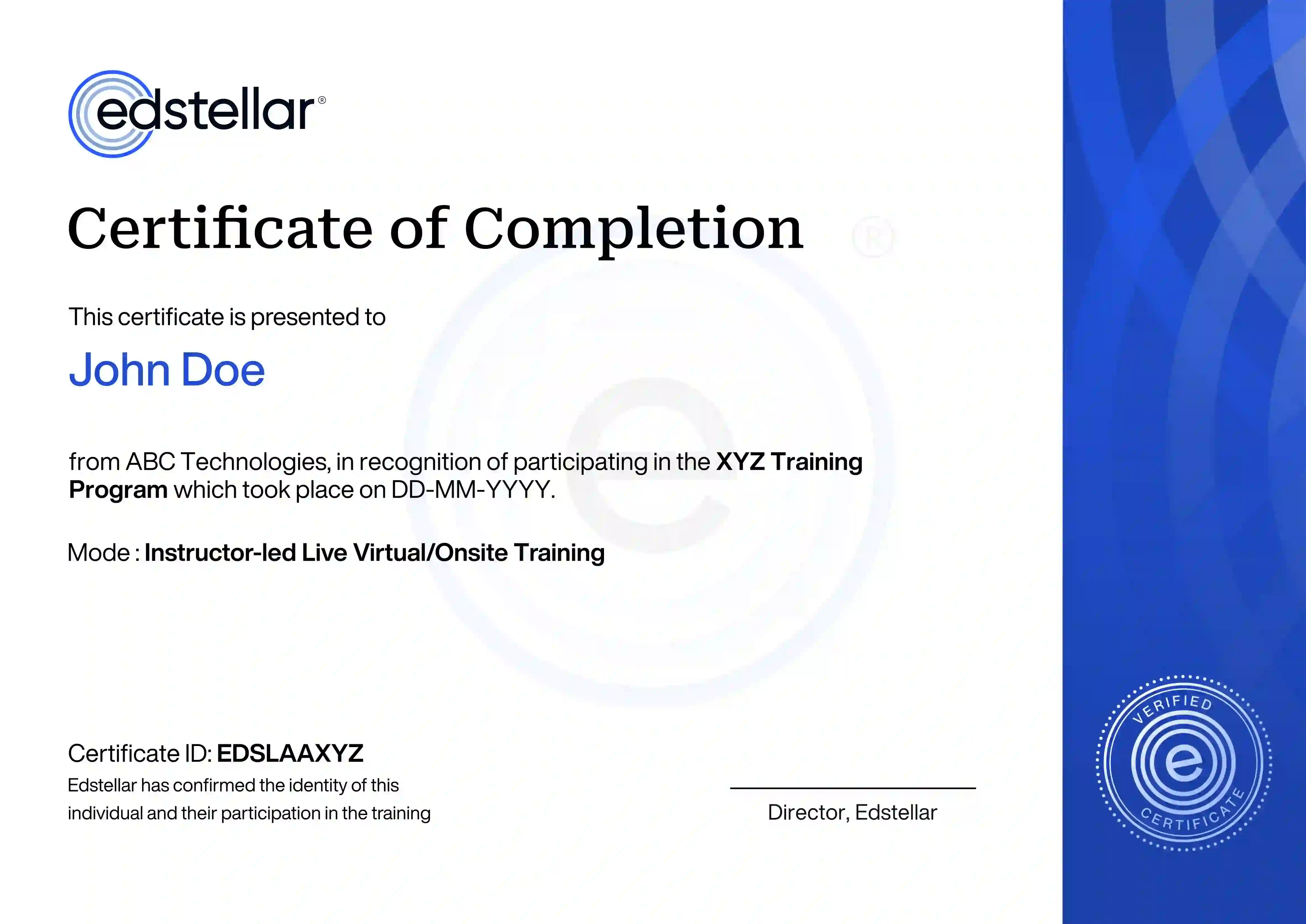
        Get Your Team Members Recognized with Edstellar’s Course Certificate

        Upon successful completion of the training course offered by Edstellar, employees receive a course completion certificate, symbolizing their dedication to ongoing learning and professional development.

        This certificate validates the employee's acquired skills and is a powerful motivator, inspiring them to enhance their expertise further and contribute effectively to organizational success.

        Certificate of Excellence