Drive Team Excellence with Windows Server 2025 Migration and Hybrid Cloud Integration Corporate Training

Empower your teams with expert-led on-site, off-site, and virtual Windows Server 2025 Migration & Hybrid Cloud Integration Training through Edstellar, a premier corporate training provider for organizations globally. Designed to meet your specific training needs, this group training program ensures your team is primed to drive your business goals. Help your employees build lasting capabilities that translate into real performance gains.

Windows Server 2025 Migration and Hybrid Cloud Integration addresses the growing enterprise need to modernize on-premises server infrastructure while extending capabilities into Azure cloud environments. This training covers migration planning, hybrid architecture design, identity federation, security configuration, and operational governance across on-premises and cloud workloads.

Edstellar's Windows Server 2025 Migration and Hybrid Cloud Integration Instructor-led course offers virtual/onsite training options, providing hands-on labs for migration scenarios, Azure hybrid service configuration, and governance framework implementation to prepare teams for real-world deployment challenges.

Get Customized Expert-led Training for Your Teams
Customized Training Delivery
Scale Your Training: Small to Large Teams
In-person Onsite, Live Virtual or Hybrid Training Modes
Plan from 2000+ Industry-ready Training Programs
Experience Hands-On Learning from Industry Experts
Delivery Capability Across 100+ Countries & 10+ Languages
""""

Key Skills Employees Gain from Instructor-led Windows Server 2025 Migration & Hybrid Cloud Integration Training

Windows Server 2025 Migration & Hybrid Cloud Integration skills corporate training will enable teams to effectively apply their learnings at work.

  • Windows Server 2025 migration planning and execution
  • Hybrid cloud architecture design and deployment
  • Azure AD and Active Directory identity integration
  • Network configuration and DNS management in hybrid environments
  • Storage migration and data replication strategies
  • Security hardening and compliance in hybrid cloud
  • Monitoring and automation of hybrid workloads

Key Learning Outcomes of Windows Server 2025 Migration & Hybrid Cloud Integration Training Workshop

Upon completing Edstellar’s Windows Server 2025 Migration & Hybrid Cloud Integration workshop, employees will gain valuable, job-relevant insights and develop the confidence to apply their learning effectively in the professional environment.

  • Master Windows Server 2025 migration planning, execution, and post-migration validation for enterprise environments
  • Design hybrid cloud architectures that seamlessly connect on-premises Windows Server infrastructure with Azure
  • Configure Azure Arc and Azure Stack HCI for extended hybrid management and governance capabilities
  • Implement robust identity integration using Active Directory and Azure Active Directory
  • Apply security hardening, compliance frameworks, and monitoring solutions across hybrid workloads
  • Develop automation strategies using PowerShell and Azure tools to streamline hybrid operations

Key Benefits of the Windows Server 2025 Migration & Hybrid Cloud Integration Group Training

Attending our Windows Server 2025 Migration & Hybrid Cloud Integration group training classes provides your team with a powerful opportunity to build skills, boost confidence, and develop a deeper understanding of the concepts that matter most. The collaborative learning environment fosters knowledge sharing and enables employees to translate insights into actionable work outcomes.

  • Learn Windows Server 2025 new features and migration readiness assessment techniques
  • Plan and execute seamless migration from legacy Windows Server to 2025 environments
  • Design and deploy hybrid cloud architectures integrating on-premises and Azure resources
  • Configure Azure Arc, Azure Stack HCI, and hybrid connectivity solutions effectively
  • Integrate Active Directory with Azure AD for unified identity and access management
  • Apply security hardening, patch management, and compliance controls in hybrid environments
  • Implement storage migration, backup, and disaster recovery for hybrid workloads
  • Monitor hybrid infrastructure performance using Azure Monitor and Windows Admin Center
  • Automate deployment and management tasks with PowerShell and Azure Automation tools
  • Develop governance frameworks for cost, resource, and policy management in hybrid cloud

Topics and Outline of Windows Server 2025 Migration & Hybrid Cloud Integration Training

Our virtual and on-premise Windows Server 2025 Migration & Hybrid Cloud Integration training curriculum is structured into focused modules developed by industry experts. This training for organizations provides an interactive learning experience that addresses the evolving demands of the workplace, making it both relevant and practical.

  1. Overview of Windows Server 2025 New Features
    • Hotpatching capabilities and improved security baselines
    • Enhanced Hyper-V and SMB compression improvements
    • Storage Spaces Direct enhancements and performance gains
    • Native integration with Azure hybrid services and management tools
  2. Hybrid Cloud Concepts and Architecture Patterns
    • Definition and business benefits of hybrid cloud deployment models
    • Common hybrid topologies including hub-and-spoke and multi-site designs
    • On-premises vs. cloud resource management trade-offs
    • Overview of key Azure hybrid services including Arc and Stack HCI
  3. Azure Services for Hybrid Integration Overview
    • Azure Arc for extending management to on-premises and multi-cloud environments
    • Azure Stack HCI for hyper-converged infrastructure at the edge
    • Azure Migrate for server discovery, assessment, and migration planning
    • Azure Site Recovery for business continuity and disaster recovery
  4. Migration Drivers and Business Case Development
    • Assessing technical debt and end-of-life legacy infrastructure risks
    • Cost-benefit analysis for server migration and cloud adoption
    • Regulatory compliance and data sovereignty requirements
    • Communicating migration value to business stakeholders
  5. Hybrid Cloud Governance Fundamentals
    • Resource tagging strategies and naming conventions for hybrid environments
    • Budget controls and cost management frameworks in Azure
    • Compliance monitoring using Azure Policy and initiative assignments
    • Organizational readiness and change management planning
  6. Lab Environment Setup and Prerequisites
    • Installing and configuring Windows Server 2025 evaluation environment
    • Setting up Azure subscription and hybrid connectivity for labs
    • Configuring Azure Arc connected machine agent on lab servers
    • Validating network and firewall prerequisites for hybrid scenarios
  1. Discovery and Inventory of Existing Infrastructure
    • Using Azure Migrate discovery agent to collect server data
    • Documenting server roles, dependencies, and workload profiles
    • Identifying application-to-server relationships and dependencies
    • Assessing network topology, bandwidth, and latency constraints
  2. Migration Strategy Selection
    • Rehost, refactor, rearchitect, and replace migration approaches
    • Lift-and-shift vs. modernization trade-offs for server workloads
    • Phased migration planning and workload sequencing strategies
    • Risk assessment frameworks and mitigation planning
  3. Compatibility Assessment and Validation
    • Running Windows Server 2025 upgrade readiness assessments
    • Evaluating application compatibility with newer OS versions
    • Identifying deprecated features and planning workarounds
    • Hardware and driver compatibility verification procedures
  4. Migration Timeline and Resource Planning
    • Creating project milestones and deliverable schedules
    • Estimating maintenance windows and planning rollback procedures
    • Allocating team resources and defining roles for migration
    • Developing communication plans for business stakeholders
  5. Pre-Migration Testing and Validation
    • Setting up test environments for migration simulations
    • Validating application functionality in migrated environments
    • Performance benchmarking before and after migration testing
    • Security posture assessment and gap analysis procedures
  6. Documentation and Change Management
    • Updating CMDB and asset inventory with migration records
    • Creating operational runbooks for migration procedures
    • Developing rollback and contingency response plans
    • Training operational teams on new environment procedures
  1. Installation Options and Deployment Methods
    • Server Core vs. Desktop Experience installation considerations
    • Automated deployment using Windows Deployment Services
    • Unattended installation with answer files and sysprep
    • Container base image and Nano Server deployment scenarios
  2. Core Server Configuration and Role Deployment
    • Configuring server roles and features via PowerShell and GUI
    • DNS, DHCP, and file server role configuration best practices
    • Remote Desktop Services and Web Server IIS setup
    • Hyper-V host configuration and virtual switch management
  3. Storage Configuration and Spaces Direct
    • Configuring Storage Spaces Direct for hyper-converged workloads
    • Setting up tiered storage with NVMe and SSD caching layers
    • Storage replica configuration for synchronous data replication
    • Managing volumes, deduplication, and compression policies
  4. Networking Configuration and Optimization
    • Configuring NIC teaming and RDMA for high-performance networking
    • Setting up Software Defined Networking components
    • Configuring Windows Firewall with advanced security policies
    • Network performance tuning and QoS policy configuration
  5. Server Core Administration and Remote Management
    • Administering Server Core via Windows Admin Center
    • PowerShell remoting and Just Enough Administration setup
    • Configuring Windows Remote Management WinRM endpoints
    • Event log monitoring and audit policy configuration
  6. Post-Deployment Validation and Baseline Configuration
    • Running health checks and Server Manager validation reports
    • Applying Windows Update and cumulative patch management
    • Configuring Windows Defender and endpoint protection policies
    • Establishing performance baseline metrics for monitoring
  1. Hybrid Cloud Reference Architectures
    • Hub-and-spoke network topology in Azure for hybrid workloads
    • Multi-site hybrid connectivity patterns and design trade-offs
    • Landing zone design principles for hybrid cloud environments
    • Decision frameworks for workload placement in hybrid cloud
  2. Azure Virtual Network Design for Hybrid Scenarios
    • Designing VNet address spaces, subnets, and peering configurations
    • Network Security Group rules and application security groups
    • User-defined routes and traffic flow management strategies
    • Private endpoints and service endpoints configuration
  3. Hybrid Connectivity Options and Selection
    • VPN Gateway configurations and SKU selection criteria
    • ExpressRoute circuits and private peering configurations
    • Azure Virtual WAN for branch and multi-site connectivity
    • SD-WAN integration with Azure network services
  4. Load Balancing and Traffic Management
    • Azure Load Balancer for internal and external hybrid traffic
    • Azure Application Gateway and Web Application Firewall setup
    • Azure Front Door for global traffic distribution
    • Traffic Manager DNS-based load balancing configuration
  5. High Availability and Fault Tolerance Design
    • Availability zones and region pair selection for resilience
    • Designing N+1 redundancy in hybrid environments
    • Failover clustering in Windows Server 2025 configurations
    • Business continuity planning frameworks for hybrid workloads
  6. Cost Optimization Strategies for Hybrid Cloud
    • Azure Reserved Instances and Hybrid Benefit licensing options
    • Right-sizing on-premises and cloud resources effectively
    • Cost allocation and chargeback models for hybrid environments
    • Autoscaling and resource decommissioning strategies
  1. Azure Arc Overview and Architecture
    • Extending Azure management to on-premises and multi-cloud servers
    • Azure Arc-enabled servers vs. Arc-enabled Kubernetes use cases
    • Supported operating systems and deployment prerequisites
    • Azure Arc connectivity requirements and architecture overview
  2. Deploying and Managing Azure Arc-Enabled Servers
    • Installing the Connected Machine agent at scale across environments
    • Onboarding servers using service principals and automation scripts
    • Validating Arc connectivity and monitoring agent health
    • Managing Arc-connected servers from the Azure portal
  3. Applying Azure Policies and Guest Configuration
    • Creating and assigning policy definitions for Arc-enabled servers
    • Guest Configuration for compliance auditing on hybrid servers
    • Remediation tasks and compliance reporting dashboards
    • Role-based access control configuration for Arc resources
  4. Azure Stack HCI Deployment and Configuration
    • Hardware requirements and cluster validation procedures
    • Deploying Azure Stack HCI using Windows Admin Center
    • Configuring Cluster Shared Volumes and storage pools
    • Integrating Azure Stack HCI with Azure management services
  5. Azure Stack HCI Workload Management
    • Deploying and managing virtual machines on Azure Stack HCI
    • Configuring Azure Kubernetes Service on Azure Stack HCI
    • Using Azure Arc for HCI workload governance and policy
    • Monitoring HCI cluster health and performance metrics
  6. Advanced Arc and HCI Administration
    • Configuring Microsoft Defender for Cloud on Arc-connected servers
    • Enabling Log Analytics workspace for hybrid infrastructure monitoring
    • Update Management and Change Tracking for Arc-enabled servers
    • Automating Arc server onboarding and management with scripts
  1. Active Directory Domain Services Review
    • Active Directory forest and domain design for hybrid environments
    • Domain controller placement and site topology optimization
    • FSMO roles management and transfer procedures
    • Active Directory replication topology monitoring and tuning
  2. Azure Active Directory and Hybrid Identity Models
    • Azure AD tenant architecture and licensing tier comparison
    • Hybrid identity models: synchronized, federated, and pass-through
    • Azure AD Connect configuration options and filtering rules
    • Password hash synchronization vs. pass-through authentication
  3. Azure AD Connect Configuration and Management
    • Installing and configuring Azure AD Connect for hybrid sync
    • Configuring attribute synchronization rules and filters
    • Setting up seamless single sign-on for domain-joined users
    • Monitoring sync health and troubleshooting sync errors
  4. Multi-Factor Authentication and Conditional Access
    • Enabling Azure AD Multi-Factor Authentication for hybrid users
    • Designing conditional access policies for hybrid environments
    • Configuring named locations and trusted IP ranges
    • Deploying Microsoft Authenticator and FIDO2 security keys
  5. Privileged Identity Management and Just-In-Time Access
    • Configuring Azure AD Privileged Identity Management
    • Defining eligible roles and time-bound access assignments
    • Conducting access reviews for privileged and guest accounts
    • Audit logging and reporting for privileged operations
  6. Identity Governance and Zero Trust Implementation
    • Entitlement management and access packages configuration
    • Identity Protection risk policies and automated remediation
    • Applying zero trust principles to hybrid identity architecture
    • Compliance reporting and identity governance audit trails
  1. VPN Gateway Configuration and Site-to-Site Connectivity
    • Creating and configuring VPN gateways in Azure portal
    • Configuring local network gateways for on-premises sites
    • IKEv2 and IPsec configuration parameters and policies
    • Monitoring VPN tunnel health and troubleshooting connectivity
  2. ExpressRoute Design and Implementation
    • ExpressRoute circuit provisioning and peering setup
    • Private peering vs. Microsoft peering configuration
    • ExpressRoute Global Reach for inter-site connectivity
    • ExpressRoute FastPath configuration for high-throughput scenarios
  3. DNS Architecture for Hybrid Environments
    • Azure Private DNS zones and virtual network link configuration
    • Conditional forwarding for on-premises DNS resolution
    • DNS resolution flows and split-brain DNS for hybrid workloads
    • Diagnosing and resolving DNS issues in hybrid environments
  4. Network Security in Hybrid Cloud
    • Network Security Groups and application security group design
    • Azure Firewall deployment and policy management
    • DDoS Protection Standard configuration and monitoring
    • Integrating network security events with SIEM solutions
  5. Network Monitoring and Diagnostics
    • Azure Network Watcher capabilities and diagnostic tools
    • Connection Monitor for end-to-end hybrid connectivity testing
    • Traffic Analytics for network flow visualization
    • Packet capture and NSG flow log analysis
  6. SD-WAN and Branch Office Connectivity
    • Azure Virtual WAN hub configuration for branch offices
    • Integrating third-party SD-WAN solutions with Azure
    • Branch office routing optimization techniques
    • QoS policy configuration for hybrid application traffic
  1. Storage Migration Service for Windows Server
    • Planning and executing storage migration using Storage Migration Service
    • Inventory and transfer phases of the migration process
    • Cutover configuration and DNS update management
    • Validating data integrity after storage migration
  2. Azure File Sync and Hybrid File Services
    • Deploying Azure File Sync topology and server endpoints
    • Configuring cloud tiering policies for local cache management
    • Managing sync groups and resolving namespace conflicts
    • Monitoring File Sync health and resolving sync errors
  3. Azure Backup for On-Premises Workloads
    • Configuring MARS agent for file and folder backup
    • Azure Backup Server for application-consistent workload protection
    • Backup policy design and retention configuration options
    • Restore operations and recovery time objective validation
  4. Azure Site Recovery for Disaster Recovery
    • Configuring replication for on-premises Hyper-V virtual machines
    • Designing recovery plans with workload dependency mapping
    • Running test failovers and validation procedures
    • Executing planned and unplanned failovers to Azure
  5. Data Replication and High Availability Storage
    • Storage Replica for server-to-server and cluster-to-cluster replication
    • Stretch clusters for metropolitan area high availability
    • DFS Replication for distributed file share redundancy
    • Monitoring replication health and managing replication lag
  6. Business Continuity Planning and Testing
    • Defining RTO and RPO objectives for critical workloads
    • Creating and documenting disaster recovery runbooks
    • Conducting business impact analysis for hybrid systems
    • Scheduling, executing, and documenting DR test outcomes
  1. Security Baselines and Hardening for Windows Server 2025
    • Applying Microsoft Security Baseline configurations
    • Windows Defender Credential Guard and Device Guard features
    • Secured-core server capabilities in Windows Server 2025
    • Attack surface reduction rules and application control policies
  2. Microsoft Defender for Cloud in Hybrid Environments
    • Enabling Defender for Cloud for Arc-connected servers
    • Secure Score interpretation and remediation prioritization
    • Threat detection alerts and incident response workflows
    • Vulnerability assessment and just-in-time VM access configuration
  3. Azure Policy and Compliance Management
    • Creating custom policy definitions and compliance initiatives
    • Assigning policies to management groups and subscriptions
    • Compliance dashboard monitoring and status reporting
    • Automated remediation tasks for non-compliant resources
  4. Data Protection and Encryption in Hybrid Cloud
    • Azure Key Vault for key, secret, and certificate management
    • Configuring disk encryption with BitLocker and Azure integration
    • Transport layer encryption for hybrid data flows
    • Data classification and sensitivity labeling strategies
  5. Identity and Access Security Controls
    • Implementing principle of least privilege across hybrid resources
    • Privileged Access Workstations for administrative task isolation
    • Audit policy configuration and security log retention
    • Integrating hybrid security events with SIEM platforms
  6. Regulatory Compliance Frameworks and Auditing
    • Mapping controls to GDPR, ISO 27001, and NIST frameworks
    • Using Microsoft Compliance Manager for control assessments
    • Evidence collection and audit trail management
    • Continuous compliance monitoring and remediation workflows
  1. Azure Monitor for Hybrid Infrastructure
    • Log Analytics workspace design and data source configuration
    • Configuring Azure Monitor agents on hybrid servers
    • Creating custom workbooks and dashboards for visibility
    • Setting up metric alerts and action group notifications
  2. Windows Admin Center for Hybrid Management
    • Deploying Windows Admin Center in gateway mode
    • Managing Hyper-V, Storage, and networking from WAC
    • Integrating WAC with Azure hybrid services
    • Customizing and extending WAC with third-party extensions
  3. PowerShell Automation for Hybrid Operations
    • Automating Windows Server configuration using PowerShell DSC
    • PowerShell remoting across on-premises and Azure workloads
    • Scripting Azure resource management with the Az PowerShell module
    • Scheduling and orchestrating automation runbooks
  4. Azure Automation and Update Management
    • Creating Automation accounts and PowerShell runbooks
    • Configuring Update Management for hybrid server patch compliance
    • Inventory and Change Tracking for configuration management
    • Scheduling patch deployments and generating compliance reports
  5. Performance Monitoring and Capacity Planning
    • Identifying performance bottlenecks with Performance Monitor
    • Azure Monitor VM Insights for workload analysis
    • Capacity planning models for hybrid infrastructure growth
    • Cost optimization reviews and resource rightsizing recommendations
  6. Operational Excellence and Continuous Improvement
    • Implementing DevOps practices for infrastructure lifecycle management
    • Infrastructure as Code with Bicep and ARM templates
    • GitOps workflows for configuration and state management
    • Conducting operational reviews and improving runbook quality

Who Can Take the Windows Server 2025 Migration & Hybrid Cloud Integration Training Course

The Windows Server 2025 Migration & Hybrid Cloud Integration training program can also be taken by professionals at various levels in the organization.

  • IT Infrastructure Engineers
  • Systems Administrators
  • Cloud Architects
  • Network Engineers
  • DevOps Engineers
  • IT Managers and Technical Leads

Prerequisites for Windows Server 2025 Migration & Hybrid Cloud Integration Training

Professionals should have foundational knowledge of Windows Server administration, networking, and basic cloud concepts to take the Windows Server 2025 Migration and Hybrid Cloud Integration training course.

Request a Quote for your Corporate Training Requirements

Valid number

Delivering Training for Organizations across 100 Countries and 10+ Languages

Corporate Group Training Delivery Modes
for Windows Server 2025 Migration & Hybrid Cloud Integration Training

At Edstellar, we understand the importance of impactful and engaging training for employees. As a leading Windows Server 2025 Migration & Hybrid Cloud Integration training provider, we ensure the training is more interactive by offering Face-to-Face onsite/in-house or virtual/online sessions for companies. This approach has proven to be effective, outcome-oriented, and produces a well-rounded training experience for your teams.

Virtual Windows Server 2025 Migration & Hybrid Cloud Training

Edstellar's Windows Server 2025 Migration & Hybrid Cloud Integration virtual/online training sessions bring expert-led, high-quality training to your teams anywhere, ensuring consistency and seamless integration into their schedules.

With global reach, your employees can get trained from various locations
The consistent training quality ensures uniform learning outcomes
Participants can attend training in their own space without the need for traveling
Organizations can scale learning by accommodating large groups of participants
Interactive tools can be used to enhance learning engagement
On-site Windows Server 2025 Migration & Hybrid Cloud Training

Edstellar's Windows Server 2025 Migration & Hybrid Cloud Integration inhouse face to face instructor-led training delivers immersive and insightful learning experiences right in the comfort of your office.

Higher engagement and better learning experience through face-to-face interaction
Workplace environment can be tailored to learning requirements
Team collaboration and knowledge sharing improves training effectiveness
Demonstration of processes for hands-on learning and better understanding
Participants can get their doubts clarified and gain valuable insights through direct interaction
Off-site Windows Server 2025 Migration & Hybrid Cloud Training

Edstellar's Windows Server 2025 Migration & Hybrid Cloud Integration offsite face-to-face instructor-led group training offer a unique opportunity for teams to immerse themselves in focused and dynamic learning environments away from their usual workplace distractions.

Distraction-free environment improves learning engagement
Team bonding can be improved through activities
Dedicated schedule for training away from office set up can improve learning effectiveness
Boosts employee morale and reflects organization's commitment to employee development

Explore Our Customized Pricing Package
for
Windows Server 2025 Migration & Hybrid Cloud Integration Corporate Training

Looking for pricing details for onsite, offsite, or virtual instructor-led Windows Server 2025 Migration & Hybrid Cloud Integration training? Get a customized proposal tailored to your team’s specific needs.

Request a Group Training Quote
""
How Many Team Members Need Training?
Please select an option or fill in the custom field.
"'

Is Your Corporate Training Requirement Only for Windows Server 2025 Migration & Hybrid Cloud Integration?

Please select at least one course.
""
Add the List of Training Workshops
search icon

      Please select the course

      No. of Courses selected: 0

      Clear

      Upload a CSV

      Send us your Training Requirements in 3 Easy steps

      1. 1
      2. 2
        Add the required training workshops
      3. 3
        Upload to get a quick quote or email it to contact@edstellar.com

      ""

      Looking for a Complete Package?

      Looking for a one-time pricing option for all your annual training requirements?

      View Corporate Training Packages
      ""
      Select the Option that Best Describes Your Corporate Training Requirement

      Please select an option or choose from the recurring options.
      ""
      Verify and Submit Your Request

      Review Your Corporate Training Selection Summary

      Training Program: Windows Server 2025 Migration & Hybrid Cloud Training

      1. No of Team Members

      2. Selected Training Preference

      3. Selected Recurring Sessions

      1

      Review your Requirements

      Training Workshops Selected :


        Excel
        File has been
        successfully uploaded.
        Fill the form to submit
 your details
        Submit Your Professional Contact Information
        Valid number
        We've received your enquiry. Our team will be in touch soon.
        Oops! Something went wrong while submitting the form.
        Starter
        120 licences

        Tailor-Made Trainee Licenses with Our Exclusive Training Packages!

        View Package

        64 hours of group training (includes VILT/In-person On-site)

        Tailored for SMBs

        Growth
        320 licences

        Tailor-Made Trainee Licenses with Our Exclusive Training Packages!

        View Package

        160 hours of group training (includes VILT/In-person On-site)

        Ideal for growing SMBs

        Enterprise
        800 licences

        Tailor-Made Trainee Licenses with Our Exclusive Training Packages!

        View Package

        400 hours of group training (includes VILT/In-person On-site)

        Designed for large corporations

        Custom
        Unlimited licenses

        Tailor-Made Trainee Licenses with Our Exclusive Training Packages!

        View Package

        Unlimited duration

        Designed for large corporations

        Edstellar: Your Go-to Windows Server 2025 Migration & Hybrid Cloud Integration Training Company

        Experienced Trainers

        Our trainers bring years of industry expertise to ensure the training is practical and impactful.

        Quality Training

        With a strong track record of delivering training worldwide, Edstellar maintains its reputation for its quality and training engagement.

        Industry-Relevant Curriculum

        Our course is designed by experts and is tailored to meet the demands of the current industry.

        Customizable Training

        Our course can be customized to meet the unique needs and goals of your organization.

        Comprehensive Support

        We provide pre and post training support to your organization to ensure a complete learning experience.

        Multilingual Training Capabilities

        We offer training in multiple languages to cater to diverse and global teams.

        Testimonials

        What Our Clients Say

        We pride ourselves on delivering exceptional training solutions. Here's what our clients have to say about their experiences with Edstellar.

        "Edstellar's virtual Windows Server 2025 migration and hybrid cloud training transformed our IT team's capabilities. We reduced our migration timeline by 40% and achieved a 25% reduction in infrastructure costs within the first quarter of deployment."

        Rajesh Nair

        Head of IT Infrastructure,

        A Global Financial Services Firm

        "The onsite Windows Server 2025 hybrid cloud training gave our engineers hands-on experience with real migration scenarios. Within 3 months, we migrated 200 servers to a hybrid architecture with zero downtime and improved system performance by 30%."

        Priya Sharma

        Cloud Operations Manager,

        A Global Manufacturing Company

        "Edstellar's intensive hybrid cloud migration bootcamp equipped our architects to lead our digital transformation confidently. We achieved a 45% reduction in on-premises footprint and improved disaster recovery RTO by 60% within six months."

        Arjun Mehta

        VP of Technology,

        A Global Retail Enterprise

        "Edstellar's IT & Technical training programs have been instrumental in strengthening our engineering teams and building future-ready capabilities. The hands-on approach, practical cloud scenarios, and expert guidance helped our teams improve technical depth, problem-solving skills, and execution across multiple projects. We're excited to extend more of these impactful programs to other business units."

        Aditi Rao

        L&D Head,

        A Global Technology Company

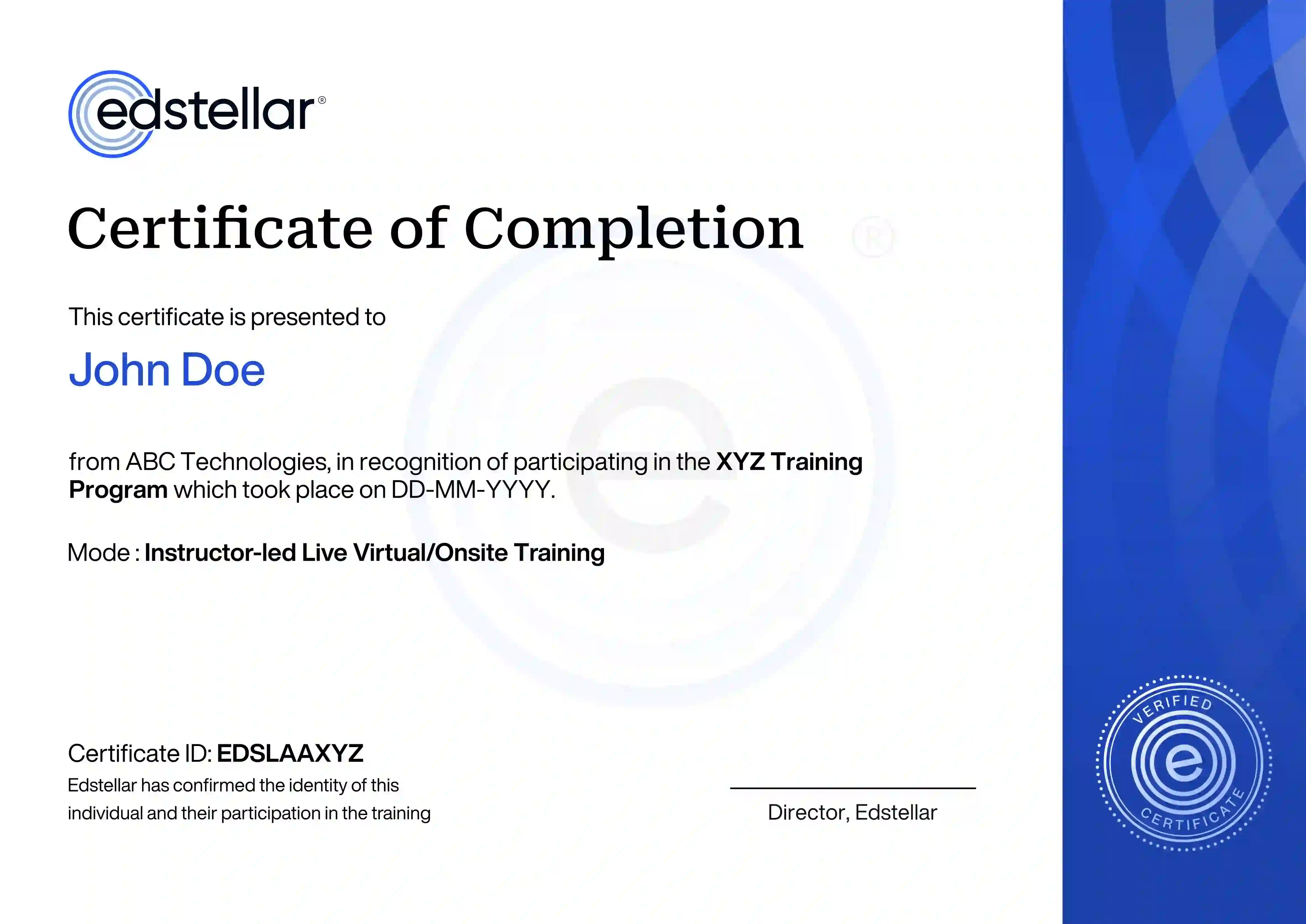
        Get Your Team Members Recognized with Edstellar’s Course Certificate

        Upon successful completion of the training course offered by Edstellar, employees receive a course completion certificate, symbolizing their dedication to ongoing learning and professional development.

        This certificate validates the employee's acquired skills and is a powerful motivator, inspiring them to enhance their expertise further and contribute effectively to organizational success.

        Certificate of Excellence

        Other Related Corporate Training Courses