.svg "edstellar")

5G and mmWave Antenna Engineering Corporate Training Program for Employees
Equip your RF and telecom engineers to design, optimize, and test the antennas behind 5G and millimeter-wave networks through Edstellar's instructor-led, fully customized 5G and mmWave Antenna Engineering training, delivered onsite or online worldwide.
(Virtual / On-site / Off-site)
.svg)
Build a 5G-Ready Antenna Engineering Team
5G and mmWave antenna engineering is the discipline of designing, building, and testing the high-frequency antennas and antenna arrays that make 5G and millimeter-wave networks work, covering beamforming, MIMO, RF front-end integration, and performance testing. As operators and equipment makers race to densify 5G and roll out millimeter-wave coverage, the engineers who can design efficient mmWave antennas directly determine network speed, coverage, and reliability.
As telecom operators and device makers accelerate 5G and mmWave rollouts, this program helps your engineering teams design and optimize antenna systems for real high-frequency networks. Empower your people with expert-led on-site, off-site, and virtual sessions delivered by Edstellar, a premier corporate training provider serving organizations worldwide in-person and virtually across popular languages. Fully customized to your goals, the program turns 5G and mmWave antenna engineering skills into lasting capabilities that lift performance across your RF, hardware, and network engineering teams.
By the end of the program, your team can design mmWave antenna arrays, apply beamforming and MIMO techniques, integrate RF front-end components, and validate performance through structured testing. The result is faster, more reliable 5G deployments, fewer costly design iterations, and an engineering workforce that keeps your organization competitive as networks move into higher frequency bands.
.svg)

- Design and develop efficient mmWave antenna systems for 5G networks.
- Apply MIMO and beamforming techniques to build multiple-antenna systems for high-frequency bands.
- Optimize antenna array configurations for coverage, gain, and overall performance.
- Integrate RF front-end devices and components into complete 5G antenna systems.
- Troubleshoot complex propagation and design challenges specific to mmWave technology.
- Test and validate antenna performance against key engineering metrics.
- 5G and mmWave Foundations
- Fundamentals of 5G and the millimeter-wave spectrum
- Why high-frequency bands matter for 5G capacity and speed
- The role of antennas in 5G network performance
- Key engineering challenges in moving to mmWave
- Antenna Principles
- Core principles of antenna operation: gain, radiation pattern, bandwidth
- Impedance matching and efficiency at high frequencies
- Propagation, path loss, and blockage in mmWave bands
- Design challenges unique to 5G antennas
- Types and Materials
- Patch, dipole, horn, and phased-array antenna types
- Key materials and substrates for mmWave designs
- Components and feed structures in 5G antennas
- Selecting the right antenna type for a use case
- MIMO and Beamforming
- MIMO fundamentals and spatial multiplexing
- Beamforming and beam-steering techniques
- Massive MIMO architectures for 5G
- System architecture, layout, and integration
- Array Design and Optimization
- Designing and configuring antenna arrays
- Element spacing, mutual coupling, and grating lobes
- Performance optimization for gain and coverage
- Trade-offs in size, power, and beam control
- RF Front-end Engineering
- Components of the RF front-end: amplifiers, filters, mixers
- Integration of the front-end with the antenna system
- Linearity, noise, and power efficiency considerations
- End-to-end signal-chain functionality
- Testing and Troubleshooting
- Methods for measuring and testing antenna performance
- Over-the-air (OTA) and chamber testing approaches
- Evaluating key performance metrics
- Troubleshooting and iterating on designs
- RF Engineers
- Telecom Engineers
- Network Planners
- System Engineers
- Antenna Designers
- Wireless Communication Engineers
- Hardware Engineers
- Research Scientists
- Consultants
- Test Engineers
- Field Engineers
- Managers
Participants should have a basic understanding of electromagnetic theory, antenna fundamentals, and wireless communication concepts before joining the 5G and mmWave Antenna Engineering training. The program suits RF, telecom, hardware, and network engineers, as well as research and test engineers. Teams without this background can request a tailored primer so every participant starts on solid footing.


.webp "Virtual 5G and mmWave Antenna Engineering Training")
.webp "On-site 5G and mmWave Antenna Engineering Training")
.webp "Off-site 5G and mmWave Antenna Engineering Training")
64 hours of group training (includes VILT/In-person On-site)
Tailored for SMBs
160 hours of group training (includes VILT/In-person On-site)
Ideal for growing SMBs
Tailor-Made Trainee Licenses with Our Exclusive Training Packages!
400 hours of group training (includes VILT/In-person On-site)
Designed for large corporations
Tailor-Made Trainee Licenses with Our Exclusive Training Packages!
Unlimited duration
Designed for large corporations
Experienced Trainers
Our trainers are drawn from a vetted global network and bring years of industry expertise, keeping every session practical and impactful.
Proven Quality
With a strong global track record, Edstellar is known for quality and engaging delivery.
Industry-Relevant Curriculum
Our programs are built by experts to match the demands of today's industry.
Fully Customizable
Every program can be tailored to your organization's goals.
Comprehensive Support
We provide pre- and post-session support for a complete learning experience.
Global Multi-Location & Multilingual Training Delivery
We deliver in multiple languages to support diverse global teams.
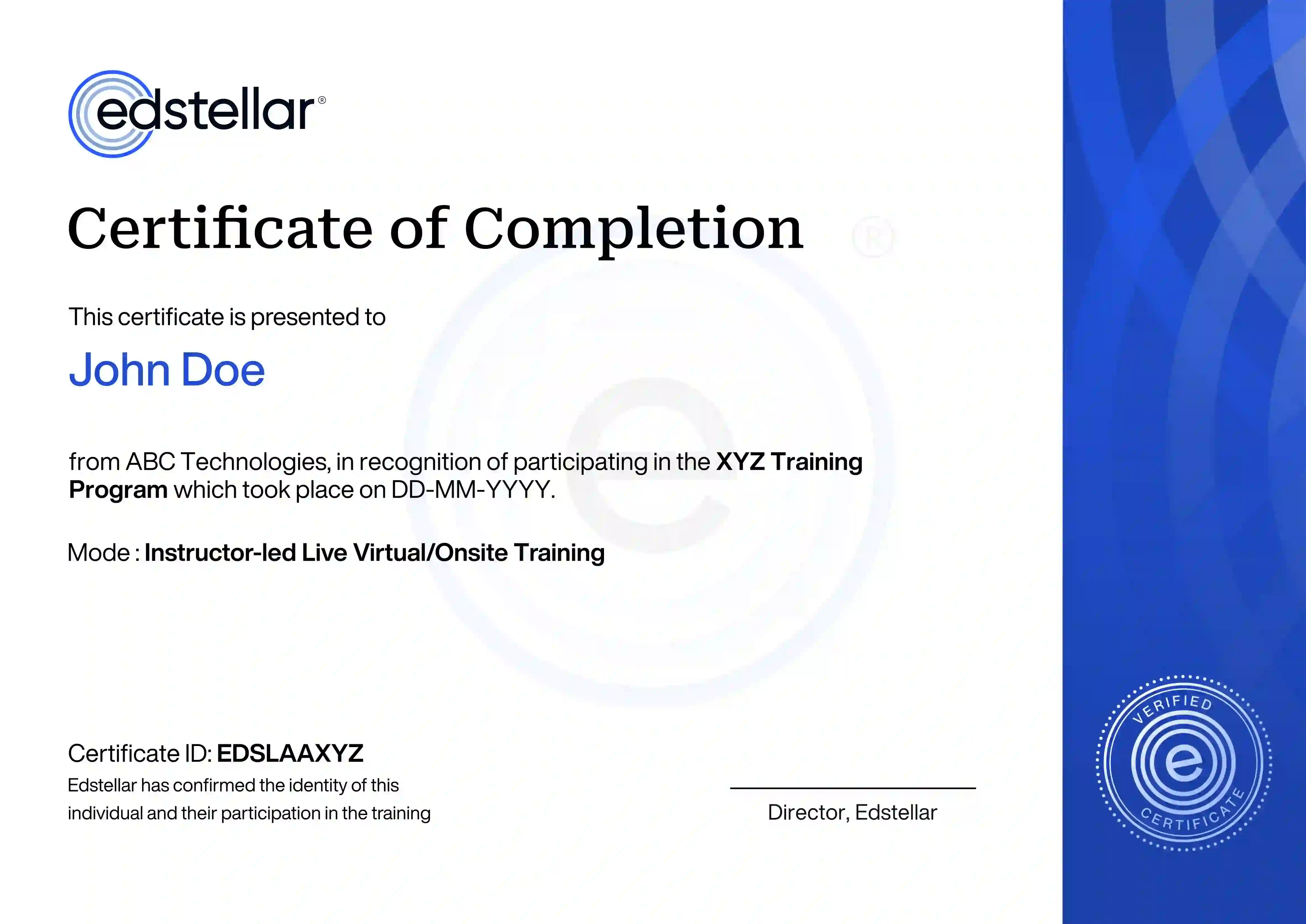
Recognition That Motivates Your Team

Frequently Asked Questions
Other Related Corporate Training Courses


Explore More Courses


.svg)
.svg)
.svg)

.svg)