.svg "edstellar")

AI Security and Risk Management Corporate Training Program for Employees
Equip your security, risk, and engineering teams to secure AI and machine learning systems, defend against adversarial and LLM threats, and govern AI risk with Edstellar's instructor-led, fully customized AI Security and Risk Management training, delivered onsite or online worldwide.
(Virtual / On-site / Off-site)
.svg)
AI Security and Risk Management is the practice of protecting artificial intelligence and machine learning systems from attack and misuse, and of identifying, measuring, and controlling the new risks AI introduces across an organization. It covers securing models, data, and pipelines against adversarial attacks, data poisoning, model theft, and prompt injection, alongside governing AI risk through frameworks such as the NIST AI Risk Management Framework, ISO/IEC 42001, and the EU AI Act. AI Security and Risk Management training gives your teams the practical methods to threat-model AI systems, set guardrails for generative AI and large language models, and build an AI risk program that keeps innovation safe, compliant, and trusted.
As organizations embed AI into products, decisions, and customer-facing workflows, this program helps your security, risk, and engineering teams adopt AI safely and within clear governance guardrails. Empower your people with expert-led on-site, off-site, and virtual sessions delivered by Edstellar, a premier corporate training provider serving organizations worldwide in-person and virtually across popular languages. Built around your goals, the program turns AI Security and Risk Management skills into lasting capabilities that lift performance across security, risk, compliance, and data teams.
By the end of the program, your teams can map the AI attack surface, secure machine learning and generative AI systems against real-world threats, apply recognized AI risk and governance frameworks, and stand up monitoring and incident response built for AI. The outcome is fewer AI-related breaches and failures, faster and more confident AI adoption, stronger regulatory readiness, and a security and risk function that treats AI as a governed, trusted capability rather than an unmanaged exposure.
.svg)

- Map the AI attack surface and threat-model machine learning and generative AI systems across their lifecycle.
- Defend AI and ML models against adversarial attacks, data poisoning, model theft, and inference threats.
- Secure generative AI and large language models against prompt injection, data leakage, and unsafe outputs.
- Apply recognized AI risk and governance frameworks, including the NIST AI RMF, ISO/IEC 42001, and the EU AI Act.
- Assess third-party, supply chain, and data privacy risk introduced by AI tools and vendors.
- Stand up AI-specific monitoring, incident response, and an organization-wide AI security and risk program.
- Understanding AI security and AI risk
- Define AI security, AI risk, and how they differ from traditional IT security
- Distinguish securing AI systems from using AI to manage business risk
- Recognize where AI creates new exposure across products, data, and decisions
- Business and governance alignment
- Connect AI security initiatives with organizational risk appetite and goals
- Clarify ownership across security, risk, compliance, data, and engineering
- Set program objectives, scope, and participant expectations
- Mapping the AI attack surface
- Identify threats across data, models, pipelines, and AI applications
- Map the AI/ML lifecycle from data collection to deployment and monitoring
- Threat modeling for AI systems
- Apply structured threat modeling to machine learning and AI workflows
- Prioritize AI threats by likelihood, impact, and business exposure
- Adversarial and data-centric attacks
- Defend against adversarial examples, evasion, and model inversion attacks
- Detect and mitigate data poisoning and training-data integrity risks
- Protecting models and pipelines
- Guard against model theft, extraction, and intellectual property loss
- Secure MLOps pipelines, model registries, and the AI software supply chain
- LLM-specific threats
- Mitigate prompt injection, jailbreaks, and insecure output handling
- Prevent sensitive data leakage and training-data exposure in LLM apps
- Guardrails for generative AI
- Apply input/output filtering, retrieval guardrails, and access controls
- Reference OWASP Top 10 for LLM applications and MITRE ATLAS techniques
- Applying recognized frameworks
- Operationalize the NIST AI Risk Management Framework across the AI lifecycle
- Align AI governance with ISO/IEC 42001 and the EU AI Act risk tiers
- Building AI governance
- Define AI policies, model risk management, and accountability structures
- Establish AI risk registers, controls, and review and approval gates
- Privacy and data protection
- Address data privacy, consent, and minimization in AI systems
- Align AI data handling with GDPR and organizational privacy obligations
- Ethics, fairness, and transparency
- Assess bias, fairness, and explainability risks in AI models
- Set responsible-AI guardrails for transparent, accountable deployment
- Vendor and third-party AI risk
- Evaluate security and risk of third-party AI tools, APIs, and foundation models
- Build AI vendor due-diligence, contracting, and assurance practices
- Operational resilience
- Manage shadow AI, unsanctioned tools, and uncontrolled AI usage
- Plan for AI service availability, dependency, and failure scenarios
- AI-specific monitoring and response
- Monitor models for drift, abuse, and security anomalies in production
- Build AI incident response and recovery playbooks for AI failures and attacks
- Scaling a sustainable program
- Develop a roadmap to embed AI security and risk across the organization
- Build awareness, training, and a culture of secure, governed AI adoption
- Cybersecurity Specialists
- Security Analysts
- Network Engineers
- Risk Analysts
- IT Auditors
- Threat Intelligence Analysts
- Systems Administrators
- Ethical Hackers
- Data Privacy Officers
- Security Architects
No advanced data science or programming background is required. Security engineers and architects, risk and compliance officers, AI and ML engineers, data and privacy leads, and IT and governance managers with a working understanding of their organization's security or risk processes will benefit most, and basic familiarity with AI or machine learning concepts is helpful but not mandatory. The program suits teams across security, risk, compliance, data, and engineering, and Edstellar tailors the depth, examples, and case studies to your organization, your AI use cases and tools, and the regulatory frameworks you operate under.


.webp "Virtual AI Security and Risk Management Training")
.webp "On-site AI Security and Risk Management Training")
.webp "Off-site AI Security and Risk Management Training")
64 hours of group training (includes VILT/In-person On-site)
Tailored for SMBs
160 hours of group training (includes VILT/In-person On-site)
Ideal for growing SMBs
Tailor-Made Trainee Licenses with Our Exclusive Training Packages!
400 hours of group training (includes VILT/In-person On-site)
Designed for large corporations
Tailor-Made Trainee Licenses with Our Exclusive Training Packages!
Unlimited duration
Designed for large corporations
Experienced Trainers
Our trainers are drawn from a vetted global network and bring years of industry expertise, keeping every session practical and impactful.
Proven Quality
With a strong global track record, Edstellar is known for quality and engaging delivery.
Industry-Relevant Curriculum
Our programs are built by experts to match the demands of today's industry.
Fully Customizable
Every program can be tailored to your organization's goals.
Comprehensive Support
We provide pre- and post-session support for a complete learning experience.
Global Multi-Location & Multilingual Training Delivery
We deliver in multiple languages to support diverse global teams.
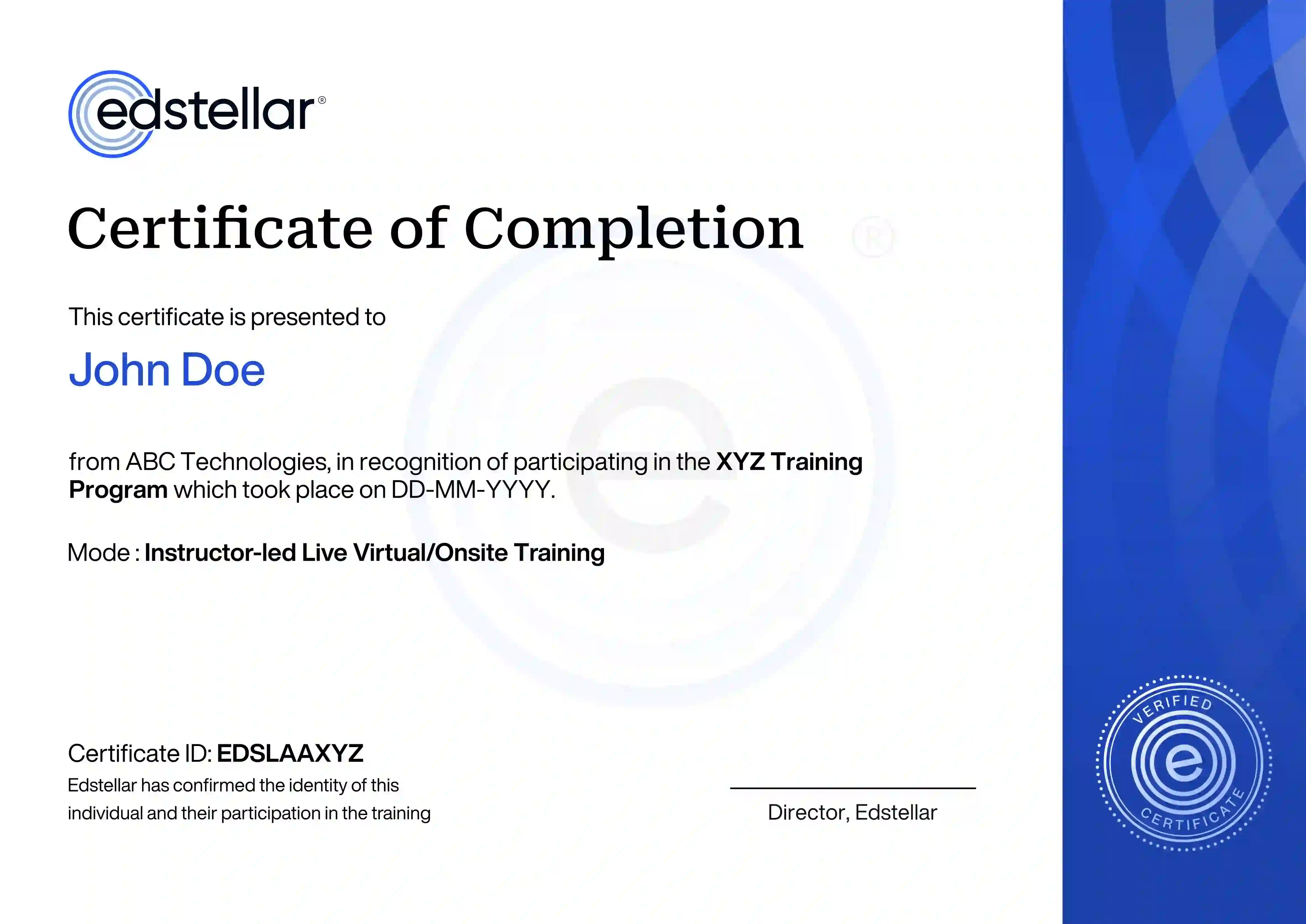
Recognition That Motivates Your Team

Frequently Asked Questions
Explore More Courses


.svg)
.svg)
.svg)

.svg)