.svg "edstellar")
%20Governance%20Course.webp)
Artificial Intelligence (AI) Governance Corporate Training Program
This training equips professionals with the skills and frameworks needed to govern AI systems responsibly and ethically. Participants learn to navigate AI regulations, manage AI risks, ensure model transparency, and implement governance structures that align with global AI compliance standards.
(Virtual / On-site / Off-site)
.svg)
Drive Team Excellence with Artificial Intelligence (AI) Governance Corporate Training
Organizations deploying artificial intelligence systems face growing responsibilities to govern those systems responsibly across regulatory, ethical, technical, and operational dimensions. From the EU AI Act and NIST AI RMF to ISO 42001 and emerging national frameworks, the global AI governance landscape is rapidly evolving and demanding that organizations establish structured programs to manage AI risk, ensure fairness and transparency, and demonstrate accountability to regulators and stakeholders.
Edstellar's Artificial Intelligence (AI) Governance Instructor-led course offers virtual/onsite training options designed for AI practitioners, compliance professionals, risk managers, and technology leaders. Through practical framework application, case study analysis, and governance program design exercises, participants gain the skills to build and operationalize effective AI governance programs that support responsible AI innovation while managing the full spectrum of AI-related risks.
.svg)

Skills Your Employees Will Gain
These are the core, hands-on capabilities your team builds during the program.
- AI risk management
- Regulatory compliance for AI
- AI ethics and responsible AI
- AI model governance
- AI transparency and explainability
- Data governance for AI
- AI bias and fairness assessment
What Your Team Will Achieve After This Training
- Understand the landscape of AI governance regulations and compliance frameworks, including the EU AI Act, NIST AI RMF, and ISO 42001, and their obligations for organizations.
- Apply responsible AI principles and ethical frameworks to evaluate AI systems for fairness, transparency, accountability, and alignment with human rights standards.
- Assess and manage AI-specific risks using structured risk management approaches aligned with enterprise risk frameworks and AI governance standards.
- Govern the full AI model lifecycle from development and validation through deployment, ongoing monitoring, and responsible decommissioning.
- Implement AI transparency and explainability practices that meet regulatory requirements and build stakeholder trust in organizational AI systems.
- Design and operationalize an AI governance program with appropriate policies, roles, tools, and metrics that support continuous governance improvement.
Topics & Program Outline
The curriculum is organized into focused modules built by industry experts and delivered virtually or on-premise. Interactive sessions reflect the evolving demands of the workplace, keeping the learning both relevant and practical.
-
What is AI Governance
- Definition of AI governance and its scope across organizational and societal dimensions
- The relationship between AI governance, AI ethics, and AI regulation
- Why AI governance is distinct from traditional IT and data governance
- Core components of an effective AI governance program
-
Why AI Governance Matters for Organizations
- Business risks arising from ungoverned AI: reputational, regulatory, and operational
- How AI governance failures have led to real-world organizational harms and regulatory penalties
- The strategic value of governance in enabling responsible AI innovation at scale
- Regulatory enforcement trends and the cost of non-compliance in AI deployment
-
The Global AI Governance Landscape
- Overview of major AI governance frameworks: EU AI Act, NIST AI RMF, and ISO 42001
- How different jurisdictions and regions are approaching AI governance regulation
- The role of international standards bodies in shaping AI governance norms and requirements
- Understanding the patchwork of global AI governance requirements for multi-jurisdictional organizations
-
AI Governance Stakeholders and Roles
- Key organizational roles in AI governance: CIO, CDO, legal, compliance, and data science teams
- The role of the board and senior leadership in AI governance oversight and accountability
- How cross-functional AI governance committees structure accountability and decision-making
- External stakeholders in AI governance: regulators, auditors, affected communities, and civil society
-
Key AI Governance Concepts and Terminology
- Defining AI, machine learning, and related terms relevant to governance professionals
- Governance concepts: accountability, transparency, explainability, and fairness in AI
- High-risk AI, prohibited AI, and minimal-risk AI categorization under major regulatory frameworks
- How to build a shared AI governance vocabulary across technical and non-technical organizational teams
-
AI Governance Maturity and Assessment
- AI governance maturity models: from ad hoc and reactive to optimized and embedded governance
- How to conduct an AI governance maturity assessment across people, processes, and technology
- Benchmarking AI governance maturity against industry peers and regulatory expectations
- Using maturity assessment results to build a prioritized AI governance improvement roadmap
-
The EU Artificial Intelligence Act
- Scope and applicability of the EU AI Act to organizations operating in or serving the European Union
- The EU AI Act's risk-based classification: prohibited, high-risk, limited-risk, and minimal-risk AI
- Compliance obligations for high-risk AI systems under the EU AI Act
- Conformity assessment, CE marking, and registration in the EU AI database for regulated systems
-
US AI Policy and Regulatory Frameworks
- The Executive Order on AI and its policy implications for organizations operating in the US
- NIST AI RMF and its adoption as a voluntary US AI governance and risk management standard
- Sector-specific US AI regulatory guidance in banking, healthcare, and critical infrastructure
- Emerging US federal and state-level AI legislation and its compliance implications
-
Global and Regional AI Regulatory Developments
- China's AI regulations: algorithm recommendations, deep synthesis, and generative AI rules
- UK, Canada, Brazil, and India AI governance frameworks and regulatory initiatives
- How organizations with global operations manage multi-jurisdictional AI compliance obligations
- Horizon scanning for emerging AI regulatory developments across major global markets
-
Sector-Specific AI Compliance Requirements
- Financial services AI compliance: explainability, fairness, and model risk management requirements
- Healthcare AI compliance: FDA guidance, HIPAA implications, and clinical decision support rules
- Employment and hiring AI regulations: bias audits and algorithmic transparency requirements
- Critical infrastructure and defense AI compliance considerations and governance obligations
-
AI Regulatory Compliance Planning and Gap Assessment
- How to conduct an AI system inventory and regulatory applicability assessment
- Gap analysis methodology: comparing current AI practices to regulatory requirements
- Prioritizing compliance initiatives based on risk, regulatory timelines, and organizational impact
- Building a regulatory compliance roadmap for AI systems across the organization
-
Managing Regulatory Risk in AI Deployment
- How to establish regulatory monitoring processes for evolving AI laws and standards
- Documentation and record-keeping requirements to demonstrate AI regulatory compliance
- Regulatory engagement strategies: proactive communication with AI regulators and supervisory bodies
- Building a culture of compliance awareness within AI development and operations teams
-
Core Principles of Responsible AI
- The foundational principles of responsible AI: fairness, accountability, transparency, and reliability
- How responsible AI principles translate into organizational policies and development practices
- The relationship between responsible AI and corporate social responsibility
- Why responsible AI principles vary across cultural, legal, and organizational contexts
-
Major AI Ethics Frameworks and Standards
- The OECD Principles on AI and their influence on national AI governance frameworks worldwide
- UNESCO Recommendation on the Ethics of AI and its global governance implications
- IEEE Ethically Aligned Design and its practical guidance for AI practitioners and organizations
- Industry-led responsible AI frameworks from major technology organizations and their governance relevance
-
Human Rights, Dignity, and AI Systems
- How AI systems can affect fundamental human rights including privacy, equality, and freedom of expression
- The concept of human dignity in AI design and its practical governance implications
- International human rights instruments and their applicability to organizational AI governance
- Conducting human rights impact assessments for high-risk AI systems and deployment contexts
-
Accountability and Governance in Responsible AI
- What accountability means in AI governance: who is responsible for AI decisions and resulting harms
- Mechanisms for establishing and enforcing AI accountability within organizations
- How to create traceable AI decision chains that support accountability and audit requirements
- Board and leadership accountability for organizational AI governance outcomes and failures
-
Privacy, Consent, and Data Ethics in AI
- How AI systems raise distinct privacy risks beyond traditional data processing and storage
- Consent requirements and their limitations in AI-driven data collection and processing
- Applying privacy by design principles to AI system development and deployment workflows
- Balancing AI innovation with data minimization and purpose limitation principles
-
Applying Responsible AI in Real-World Contexts
- Translating responsible AI principles into practical development and deployment decisions
- Case studies: how organizations have operationalized responsible AI frameworks across industries
- Common challenges in responsible AI implementation and how to overcome organizational resistance
- Building a responsible AI culture that spans technical, commercial, and governance teams
-
Understanding AI-Specific Risks
- How AI risks differ from traditional technology and operational risks in organizations
- Categories of AI risk: technical, ethical, regulatory, reputational, and operational
- The interconnected nature of AI risks and how they cascade across organizational systems
- Why AI risk management requires a dedicated and specialized governance approach
-
NIST AI Risk Management Framework (AI RMF)
- Overview of the NIST AI RMF core functions: Govern, Map, Measure, and Manage
- How the AI RMF provides a voluntary governance and risk management standard for organizations
- Applying the AI RMF to real-world AI system risk assessment and risk treatment planning
- Integrating the NIST AI RMF with existing enterprise risk management and compliance programs
-
ISO 42001 and AI Management Systems
- Overview of ISO 42001: the international standard for AI management systems
- Key requirements of ISO 42001 and how they map to AI governance program obligations
- Building an AI management system aligned with ISO 42001 requirements and audit expectations
- Certification, third-party audit, and continuous improvement under the ISO 42001 standard
-
AI Risk Assessment and Prioritization
- Structured approaches to identifying and assessing risks in AI systems before and after deployment
- Risk scoring methodologies for AI: probability, impact, and risk category weighting
- How to prioritize AI risks for treatment based on organizational risk appetite and capacity
- Documenting AI risk assessments to support governance, audit, and regulatory requirements
-
Monitoring and Controlling AI Risks
- How to establish ongoing monitoring for AI risks across the post-deployment lifecycle
- Key risk indicators for AI systems: performance degradation, model drift, and output anomalies
- Escalation and incident response processes for AI risk events and governance breaches
- Periodic AI risk review cycles and how to update risk assessments as systems evolve
-
Integrating AI Risk into Enterprise Risk Management
- How AI risk relates to strategic, operational, financial, and reputational organizational risk
- Embedding AI risk in the enterprise risk management framework and board-level reporting
- Board and senior leadership reporting on AI risk at the enterprise and portfolio level
- Building cross-functional AI risk governance that spans IT, legal, compliance, and business units
-
Phases of the AI Model Lifecycle
- Overview of the AI model lifecycle: from problem definition and data preparation to decommissioning
- Governance gates and decision checkpoints required at each lifecycle phase
- The importance of lifecycle documentation for auditability, compliance, and reproducibility
- How model lifecycle governance differs for machine learning, deep learning, and generative AI systems
-
Governance of Model Development and Training
- Requirements for defining AI model objectives, scope, and measurable success criteria
- Governance of training data selection, preparation, and quality validation before model training
- Documentation standards for model development decisions, methodologies, and design choices
- Ethical and regulatory review requirements at the model development and training stage
-
Model Validation, Testing, and Approval
- The purpose and scope of model validation in AI governance frameworks
- Independent model review: who should validate AI models and how validation independence is maintained
- Testing methodologies for AI: unit testing, integration testing, and adversarial robustness testing
- Approval processes and governance sign-off requirements before model deployment to production
-
Model Deployment Controls and Change Management
- Governance requirements for moving AI models from development environments to production systems
- Change management processes for AI model updates, retraining cycles, and version control
- Rollback procedures and contingency controls for AI systems that underperform in production
- Monitoring deployment environments for AI performance stability and unexpected behavior
-
Ongoing Model Monitoring and Performance Review
- Why AI models require continuous monitoring after deployment and the risks of neglecting this
- Key metrics for AI model monitoring: accuracy, data drift, concept drift, and fairness over time
- Establishing monitoring thresholds and alerts for AI performance degradation and anomalies
- Structured model review cycles and escalation processes when performance standards are breached
-
Model Decommissioning and Documentation Standards
- Criteria and processes for decommissioning AI models safely and with appropriate governance oversight
- Data retention and deletion obligations when retiring AI systems and their associated datasets
- Documentation requirements for decommissioned models to maintain audit trails and regulatory records
- Lessons learned reviews and how to apply model lifecycle insights to improve future AI programs
-
The Role of Data in AI Outcomes and Governance
- Why data quality is foundational to responsible, accurate, and effective AI systems
- How poor data governance creates AI risks: bias, inaccuracy, and regulatory non-compliance
- The intersection of data governance and AI governance frameworks in organizational programs
- Establishing data governance ownership and accountability for AI system inputs and outputs
-
Training Data Quality, Integrity, and Provenance
- What training data quality means and why it directly shapes AI model behavior and outcomes
- Provenance tracking: understanding where training data comes from and how it was collected
- Data integrity controls to detect and remediate errors, duplicates, and anomalies in datasets
- Governance processes for approving and validating training datasets before model development begins
-
Data Lineage and Data Cataloging for AI
- What data lineage is and why it is essential for AI transparency, auditability, and reproducibility
- Building and maintaining data lineage documentation for AI systems across the lifecycle
- The role of data catalogs in AI governance, regulatory compliance, and stakeholder transparency
- Using data lineage tools to trace AI decision inputs and explain model outputs
-
Data Privacy Compliance in AI Systems
- GDPR, CCPA, and other data privacy regulations and their application to AI data processing
- How AI systems can conflict with data minimization, purpose limitation, and consent requirements
- Privacy impact assessments for AI: when they are required and how to conduct them effectively
- Privacy-preserving AI techniques: federated learning, differential privacy, and data anonymization
-
Aligning Data Governance and AI Governance Programs
- How to integrate data governance and AI governance without creating redundant policies and processes
- Shared roles and responsibilities between data governance and AI governance teams
- Data governance policies that need to be adapted or extended to support AI system requirements
- Building a unified governance framework that effectively covers both data and AI assets
-
Data Governance Challenges in AI at Scale
- Challenges in governing training data across large, distributed, and multi-team AI programs
- Managing third-party, open-source, and synthetic data used in AI training and model fine-tuning
- Data versioning and reproducibility requirements for AI model governance and audit readiness
- Scaling data governance practices to support enterprise-wide AI deployment and innovation
-
Defining AI Transparency and Explainability
- What AI transparency means and how it differs from explainability in governance practice
- Types of explainability: global model explanations vs. local instance-level explanations
- Why transparency and explainability are central to trustworthy and accountable AI governance
- The relationship between explainability, accountability, and regulatory compliance obligations
-
Explainability Techniques: LIME, SHAP, and Model Cards
- Overview of LIME (Local Interpretable Model-agnostic Explanations) and its governance applications
- Overview of SHAP (SHapley Additive exPlanations) and the interpretability insights it provides
- How model cards document AI system characteristics, intended use cases, and known limitations
- Choosing the right explainability technique based on model type, audience, and governance requirements
-
Explainability for Different Stakeholder Audiences
- How to tailor AI explanations for technical users, business stakeholders, regulators, and auditors
- Explaining AI decisions to affected individuals: plain-language transparency and rights obligations
- Board and executive-level AI explainability reporting and governance dashboard design
- Designing explainability outputs that meet both technical accuracy and regulatory communication standards
-
Regulatory Requirements for AI Explainability
- GDPR right to explanation and its implications for automated decision-making systems
- EU AI Act requirements for transparency and explainability in high-risk AI system deployment
- Sector-specific explainability obligations in financial services, healthcare, and employment decisions
- Building regulatory documentation packages to demonstrate AI explainability compliance
-
Transparent AI in High-Stakes Decision-Making
- Why explainability is most critical in AI decisions affecting individuals' rights and livelihoods
- High-stakes AI use cases: lending, hiring, healthcare, criminal justice, and government benefits
- Human-in-the-loop models and when human oversight is required to maintain AI transparency
- Designing AI systems that preserve human understanding and meaningful decision-making authority
-
Implementing AI Documentation and Transparency Standards
- Datasheets for datasets: documenting training data for transparency, accountability, and reproducibility
- System cards and transparency notes for communicating AI system capabilities and limitations
- Audit trail and logging requirements for AI system decisions, inputs, and outputs
- Building a library of AI documentation standards that meets regulatory and governance requirements
-
Understanding Bias in AI Systems
- What algorithmic bias is and why it arises in AI systems and their training data
- The consequences of AI bias: harm to individuals, groups, and organizational reputation
- How AI bias intersects with protected characteristics and anti-discrimination law
- Why bias is not just a technical problem but a governance, legal, and ethical challenge
-
Sources and Types of AI Bias
- Historical bias: how past discrimination and inequality is encoded in training datasets
- Representation bias: the risks of underrepresented groups in training and evaluation data
- Measurement bias: how flawed data collection methodologies introduce systematic errors
- Aggregation and evaluation bias: how model design and metric choices create disparate outcomes
-
Fairness Metrics and Measurement Approaches
- Overview of key AI fairness metrics: demographic parity, equalized odds, and calibration
- Why different fairness definitions can conflict and how to navigate these trade-offs
- Selecting appropriate fairness metrics based on context, use case, and regulatory requirements
- How to interpret and communicate fairness metrics to non-technical governance stakeholders
-
Bias Detection and Testing Methodologies
- Pre-deployment bias auditing: testing AI models for discriminatory outcomes before release
- Disparate impact analysis: identifying whether AI systems produce statistically discriminatory outcomes
- Red-teaming and adversarial testing to uncover AI bias vulnerabilities and edge cases
- Third-party bias audits: when to engage external auditors and how to manage the process
-
Bias Mitigation Techniques and Strategies
- Pre-processing techniques: improving training data to reduce bias at the source
- In-processing techniques: building fairness constraints directly into the model training process
- Post-processing techniques: adjusting model outputs to reduce discriminatory impacts
- Combining bias mitigation strategies and monitoring residual bias after deployment
-
AI Fairness in High-Stakes Applications: Case Studies
- Case study: AI bias in credit scoring and its regulatory and reputational consequences
- Case study: facial recognition bias and the governance failures that allowed widespread harm
- Case study: AI hiring tools and the ongoing challenge of achieving fairness in recruitment
- Lessons learned and governance improvements derived from real-world AI bias incidents
-
AI Governance Framework Design and Architecture
- Core components of an AI governance framework: principles, policies, processes, and controls
- Designing governance structures that scale with organizational AI maturity and deployment volume
- Selecting the right AI governance model: centralized, federated, or hybrid organizational structures
- Aligning the AI governance framework with enterprise governance, risk, and compliance programs
-
AI Governance Policies, Standards, and Procedures
- Types of AI governance policies: acceptable use, model development, deployment, and monitoring standards
- How to develop AI governance policies that are practical, enforceable, and measurable
- Mapping governance policies to regulatory obligations and organizational risk appetite
- Governance procedures for AI incident reporting, escalation, investigation, and remediation
-
Building an AI Governance Committee and Team Structure
- Roles and responsibilities within an AI governance committee or AI center of excellence
- How to establish an AI review board with the right stakeholder representation and authority
- Integrating AI governance into existing governance committees and oversight structures
- Building AI governance capacity across data science, legal, compliance, and business teams
-
AI Governance Tools, Platforms, and Technology
- Overview of AI governance platforms and their capabilities for risk assessment, bias testing, and monitoring
- Using model management and MLOps tools to support AI governance and lifecycle management requirements
- Data governance tools that extend to support AI-specific documentation, lineage, and cataloging
- Evaluating and selecting AI governance technology to meet organizational governance needs
-
Operationalizing AI Governance Across the Organization
- Embedding AI governance requirements into the AI development and deployment workflow
- Training and awareness programs to build AI governance literacy across technical and business teams
- Incentive structures and accountability mechanisms that reinforce AI governance behaviors
- Managing resistance to AI governance requirements from development and commercial teams
-
Measuring and Improving AI Governance Effectiveness
- KPIs and metrics for evaluating AI governance program performance and maturity
- Governance audit and review cycles: internal and external AI governance assessments
- Using AI incident data and near-miss events to identify governance gaps and drive improvement
- Building an AI governance improvement roadmap aligned with organizational AI strategy and growth
-
Governing Generative AI and Large Language Models
- Unique governance challenges posed by generative AI and large language model deployment
- Hallucination, misinformation, and content safety risks in generative AI governance programs
- Intellectual property, copyright, and training data governance obligations for generative AI
- Regulatory and policy developments specifically targeting generative AI systems and their operators
-
Agentic AI and Autonomous System Governance
- What agentic AI is and why autonomous AI systems create distinct governance and accountability challenges
- Governance of AI agents with access to tools, APIs, external data sources, and action capabilities
- Accountability and control frameworks for AI systems that take autonomous actions and decisions
- Emerging standards and governance thinking for agentic AI oversight and risk management
-
AI Governance in Cloud and Multi-Cloud Environments
- Governance considerations when AI systems are deployed in cloud and serverless infrastructure
- Managing AI risk across multi-cloud and hybrid cloud deployment environments
- Cloud provider AI governance tools, shared responsibility models, and contractual obligations
- Data residency, sovereignty, and regulatory compliance implications for cloud-based AI systems
-
AI Safety, Alignment, and Long-Term Risk Governance
- What AI safety means and how it differs from traditional AI risk management frameworks
- AI alignment: ensuring AI systems pursue intended organizational and societal goals and values
- Governance approaches to managing catastrophic, systemic, and long-term AI risks
- How organizations can engage with AI safety research and emerging governance standards
-
The Future of Global AI Regulation and Standards
- Anticipated developments in EU AI Act implementation, enforcement timelines, and guidance
- The trajectory of US AI regulation and potential federal AI legislation developments
- Convergence and divergence of global AI regulatory frameworks and international standards
- How organizations should build governance programs that are resilient to regulatory uncertainty
-
Building an AI Governance-Ready Organization
- Creating a culture of responsible AI that supports effective governance at organizational scale
- Integrating AI governance into organizational strategy, innovation, and product development processes
- Continuous learning and professional capability building for AI governance practitioners
- Capstone: developing a personal and organizational AI governance action plan for post-training implementation
Who Should Attend?
This program suits professionals at many levels across the organization, including:
- AI and Data Science Teams
- Compliance and Legal Officers
- Chief Data Officers
- IT and Technology Leaders
- Risk Management Professionals
- Product Managers for AI Products
What are the Prerequisites?
Professionals should have a basic understanding of data concepts and business operations and familiarity with digital technology to take the Artificial Intelligence (AI) Governance training course.
Choose the Format That Fits Your Team
We design training your teams actually engage with, and deliver it the way that suits you best. Through a vetted global trainer network, Edstellar runs sessions in 10+ languages with consistent quality anywhere.


.webp "Virtual Artificial Intelligence (AI) Governance Training")
Virtual / online: expert-led live sessions delivered anywhere, with consistency and easy scheduling.
.webp "On-site Artificial Intelligence (AI) Governance Training")
On-site (in-house): immersive, instructor-led learning at your office.
.webp "Off-site Artificial Intelligence (AI) Governance Training")
Off-site: focused, instructor-led group learning away from everyday workplace distractions.
Get a Proposal Shaped to Your Needs
Need pricing for onsite, offsite, or virtual delivery? Get a proposal tailored to your team's needs.
64 hours of group training (includes VILT/In-person On-site)
Tailored for SMBs
Tailor-Made Trainee Licenses with Our Exclusive Training Packages!
160 hours of group training (includes VILT/In-person On-site)
Ideal for growing SMBs
Tailor-Made Trainee Licenses with Our Exclusive Training Packages!
400 hours of group training (includes VILT/In-person On-site)
Designed for large corporations
Tailor-Made Trainee Licenses with Our Exclusive Training Packages!
Unlimited duration
Designed for large corporations
What Sets Edstellar Apart
Experienced Trainers
Our trainers are drawn from a vetted global network and bring years of industry expertise, keeping every session practical and impactful.
Proven Quality
With a strong global track record, Edstellar is known for quality and engaging delivery.
Industry-Relevant Curriculum
Our programs are built by experts to match the demands of today's industry.
Fully Customizable
Every program can be tailored to your organization's goals.
Comprehensive Support
We provide pre- and post-session support for a complete learning experience.
Global Multi-Location & Multilingual Training Delivery
We deliver in multiple languages to support diverse global teams.
Recognition That Motivates Your Team
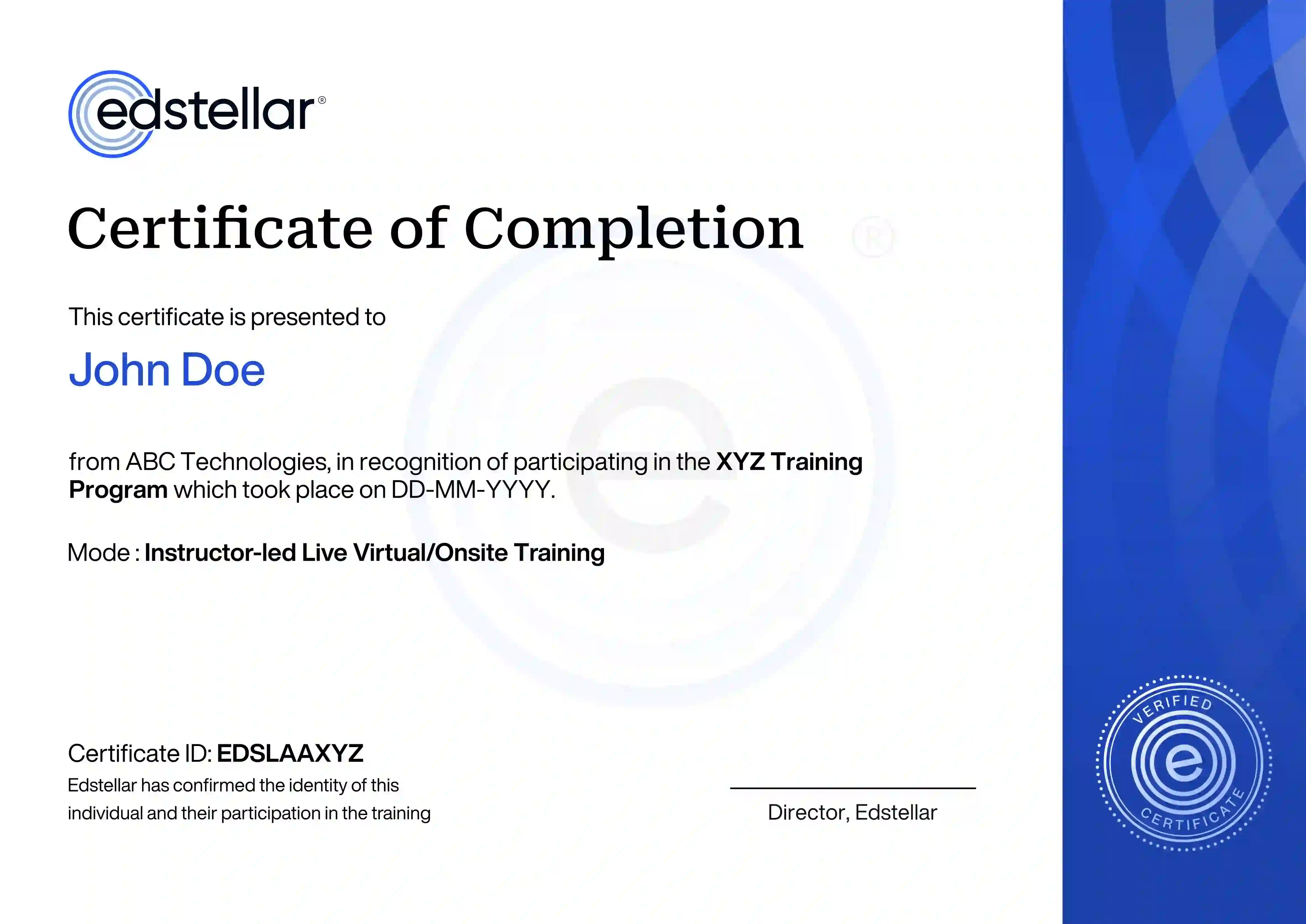
Upon successful completion of the Artificial Intelligence (AI) Governance training course offered by Edstellar, employees receive a course completion certificate, symbolizing their dedication to ongoing learning and professional development.
This certificate validates the employee's acquired skills and is a powerful motivator, inspiring them to enhance their expertise further and contribute effectively to organizational success.



Edstellar is a one-stop instructor-led corporate training and coaching solution that addresses organizational upskilling and talent transformation needs globally.
.svg)
.svg)
.svg)

.svg)
Learning Technology
Learning Content Design and Development
Learning Governance, Analytics & ROI
Digital Learning Ecosystem
Training Simulations, AR/VR & Case Studies
Employee Performance Support
Leadership Pipeline & Succession PlanningStrategic Workforce Planning for EnterprisesTransformation & Risk Advisory for EnterprisesDEI Consulting for EnterprisesEmployee Engagement Consulting for Enterprises
Cultural Transformation