.svg "edstellar")

Board-Level Risk Oversight & Governance Corporate Training Program
This training equips board members, directors, and senior executives with the skills and frameworks to fulfill their risk oversight and governance responsibilities. Participants learn to evaluate enterprise risks, set risk appetite, and strengthen board governance structures.
(Virtual / On-site / Off-site)
.svg)
Drive Team Excellence with Board-Level Risk Oversight & Governance Corporate Training
Boards of directors are increasingly expected to provide active, informed, and effective oversight of organizational risk across all dimensions: financial, operational, cyber, regulatory, ESG, and strategic. As regulatory scrutiny of board governance intensifies and the risk landscape grows more complex, directors and senior executives must develop the governance frameworks, risk vocabulary, and oversight skills to fulfill their responsibilities with confidence and accountability.
Edstellar's Board-Level Risk Oversight & Governance Instructor-led course offers virtual/onsite training options designed for board directors, non-executive directors, C-suite executives, and senior governance professionals. Through board simulation exercises, risk scenario analysis, and governance framework application, participants build the skills and judgment needed to strengthen board-level risk oversight and lead effective governance in a rapidly evolving risk environment.
.svg)

Skills Your Employees Will Gain
These are the core, hands-on capabilities your team builds during the program.
- Enterprise risk oversight
- Risk appetite framework design
- Cybersecurity governance
- Board-level risk reporting
- Crisis governance leadership
- ESG risk oversight
- Regulatory compliance governance
What Your Team Will Achieve After This Training
- Master the board's legal, fiduciary, and regulatory responsibilities for risk oversight and understand the governance obligations of directors.
- Develop skills to evaluate enterprise risk management frameworks and assess organizational risk posture from a board governance perspective.
- Learn to set, communicate, and monitor risk appetite and risk tolerance aligned to organizational strategy and stakeholder expectations.
- Build expertise in overseeing cybersecurity, financial, operational, ESG, and regulatory risks at the board and committee level.
- Apply effective board reporting and risk communication practices to receive timely, accurate, and actionable risk information from management.
- Gain confidence to lead board-level crisis response and ensure governance structures support organizational resilience and long-term recovery.
Topics & Program Outline
The curriculum is organized into focused modules built by industry experts and delivered virtually or on-premise. Interactive sessions reflect the evolving demands of the workplace, keeping the learning both relevant and practical.
-
Legal and Fiduciary Duties of Directors
- Directors' duties of care, loyalty, and obedience in risk oversight
- How regulatory frameworks define board accountability for organizational risk
- Personal liability of directors for governance and risk oversight failures
- Evolving regulatory expectations for board risk competence and engagement
-
Risk Oversight vs. Risk Management
- The distinction between board risk oversight and management's risk management role
- How boards challenge, validate, and approve management's risk activities
- Common governance failures when boards confuse oversight with management
- Building productive board-management relationships around risk governance
-
Board Risk Governance Structures
- Full board vs. board committee models for risk oversight
- Risk committee structure, mandate, and reporting lines
- Audit committee, compensation committee, and their risk oversight intersections
- Coordinating risk oversight across multiple board committees
-
The Three Lines of Defense Model
- Overview of the three lines of defense model and its governance implications
- Board oversight of the first, second, and third lines of defense
- How boards evaluate the effectiveness of each line of defense
- Common weaknesses in three-lines implementation and board remediation approaches
-
Board Risk Competency Requirements
- What risk literacy means for board directors in a complex risk environment
- Assessing board composition for risk governance skills and experience
- Director development programs for building risk oversight competence
- Using external advisors and consultants to supplement board risk expertise
-
High-Profile Board Governance Case Studies
- Analysis of major organizational failures linked to board risk oversight gaps
- Lessons from financial, cyber, and operational risk governance failures
- How board governance best practices emerged from landmark failure investigations
- Applying case study lessons to strengthen current board risk governance practice
-
Overview of Enterprise Risk Management
- What ERM is and how it provides a comprehensive view of organizational risk
- Key ERM frameworks: COSO ERM 2017, ISO 31000, and NIST RMF
- How ERM integrates with organizational strategy, planning, and governance
- Board responsibilities for approving and overseeing the ERM framework
-
Risk Identification and Risk Universe
- What a risk universe is and how organizations identify and categorize risks
- Board-level review of the completeness and quality of the organizational risk universe
- Emerging risk identification and how boards should challenge management on horizon risks
- Interconnected risks and the importance of portfolio-level risk thinking
-
Risk Assessment and Prioritization
- How organizations assess likelihood and impact to prioritize risks
- Risk heat maps and risk registers as board-level reporting tools
- Board challenges: how to probe management's risk assessment assumptions
- Scenario analysis and stress testing as board-level risk assessment tools
-
Key Risk Indicators (KRIs)
- What KRIs are and how they provide early warning signals to the board
- Evaluating whether KRIs are leading or lagging indicators
- Questioning whether management's KRIs are well-designed and appropriately calibrated
- Linking KRI thresholds to risk appetite and escalation triggers
-
ERM Program Effectiveness Assessment
- How boards assess whether the ERM program is effective and fit for purpose
- Questions boards should ask the CRO and risk team about ERM quality
- Using internal audit findings to assess ERM effectiveness
- Benchmarking ERM maturity against industry peers and regulatory expectations
-
Integrating ERM with Board Strategy
- Connecting enterprise risk management to strategic planning and capital allocation
- Board oversight of strategic risks arising from major decisions and transformations
- Using risk insights to stress test strategic plans and investment decisions
- Building risk considerations into board decision-making processes
-
Understanding Risk Appetite
- Definition of risk appetite and how it differs from risk tolerance and risk capacity
- Why a clearly defined risk appetite is essential for board-level governance
- How risk appetite connects organizational values, strategy, and risk-taking behavior
- Examples of risk appetite statements across different industries
-
Board's Role in Setting Risk Appetite
- How boards develop, approve, and maintain the organizational risk appetite framework
- Balancing strategic ambition with risk tolerance in appetite-setting discussions
- Engaging management, shareholders, and stakeholders in appetite-setting processes
- Common pitfalls in risk appetite setting and how boards avoid them
-
Communicating Risk Appetite Across the Organization
- How boards ensure risk appetite is translated into operational decision-making
- Communicating risk appetite to the executive team, managers, and front-line staff
- Embedding risk appetite into policies, procedures, and performance frameworks
- Measuring whether risk-taking behavior is aligned with stated appetite
-
Monitoring Risk Against Appetite
- Board oversight of whether the organization is operating within its risk appetite
- Receiving management reporting on risk appetite adherence and breaches
- Board escalation and intervention when appetite limits are exceeded
- Documenting board risk appetite decisions and monitoring actions
-
Reviewing and Updating Risk Appetite
- Triggers for reviewing the risk appetite framework: strategy changes, incidents, and market shifts
- Annual board review process for risk appetite statements and parameters
- Managing changes to risk appetite without creating operational uncertainty
- Communicating risk appetite changes to the organization and external stakeholders
-
Risk Appetite in Practice: Board Exercises
- Reviewing and critiquing sample risk appetite statements from the board's perspective
- Board scenario exercise: responding to a risk appetite breach
- Drafting risk appetite language for different organizational risk categories
- Peer discussion: how risk appetite differs across sectors and organizational contexts
-
Why Cybersecurity is a Board-Level Governance Issue
- Regulatory and legal drivers making boards accountable for cybersecurity oversight
- The business impact of major cyber incidents on shareholder value and reputation
- How boards are now scrutinized by regulators for cybersecurity governance quality
- SEC, FCA, and other regulatory requirements for board-level cyber risk disclosure
-
Understanding Cyber Risk Without Technical Expertise
- Key cybersecurity concepts every board director should understand
- How to interpret cyber risk briefings presented by the CISO or security team
- Questions boards should ask to probe the quality of the cybersecurity program
- Understanding cyber risk metrics and their limitations as oversight tools
-
Board Oversight of the Cybersecurity Program
- Evaluating the organizational cybersecurity strategy and investment adequacy
- Oversight of security frameworks: NIST CSF, ISO 27001, and CIS Controls
- Reviewing penetration test results and vulnerability assessments at board level
- Benchmarking the cybersecurity program against industry peers and regulatory standards
-
Third-Party Cyber Risk Oversight
- Why supply chain and vendor cyber risk is a board-level governance concern
- Oversight of the third-party risk management program from the board's perspective
- Board questions on vendor concentration risk and critical dependency oversight
- Regulatory expectations for board oversight of third-party cyber risk
-
Technology Risk and Digital Transformation Oversight
- Board oversight of technology risk arising from digital transformation programs
- AI and emerging technology risk: governance considerations for the board
- Cloud migration risk and the board's oversight responsibilities
- Ensuring IT resilience and operational technology security are on the board agenda
-
Cyber Incident Governance
- The board's role during and after a major cybersecurity incident
- Board decision-making authority during cyber crisis scenarios
- Post-incident board review: lessons learned and governance improvements
- Regulatory notification and disclosure obligations arising from cyber incidents
-
Financial Risk Oversight Responsibilities
- Board and audit committee responsibilities for financial risk oversight
- Key financial risks on the board agenda: liquidity, credit, market, and capital adequacy
- How boards evaluate management's financial risk controls and reporting quality
- Challenging financial assumptions in strategic plans and investment proposals
-
Internal Controls and the Audit Committee
- Audit committee oversight of the internal control environment
- Reviewing internal audit findings and management responses at board level
- Evaluating internal audit independence, quality, and resource adequacy
- Board response to significant internal control deficiencies
-
External Audit Oversight
- Board responsibilities for oversight of the external audit relationship
- Evaluating auditor independence, quality, and effectiveness
- Challenging management on audit findings and proposed accounting treatments
- Managing external auditor rotation and transition at the board level
-
Operational Risk Oversight
- What operational risk is and how it manifests across organizational processes and systems
- Board oversight of operational resilience: people, process, systems, and external events
- Evaluating business continuity and disaster recovery program adequacy
- Supply chain and third-party operational risk on the board risk agenda
-
Fraud Risk Governance
- Board responsibilities for anti-fraud governance and oversight
- Evaluating the adequacy of management's fraud detection and prevention controls
- Whistleblower programs and board oversight of speak-up culture
- Board response to significant fraud discoveries or compliance failures
-
Financial Reporting Integrity
- Board oversight of financial reporting quality and integrity
- Evaluating management's judgment and estimates in financial statements
- Critical accounting policies and their risk implications for the board
- Non-GAAP financial measures and the board's responsibility for investor transparency
-
Board Oversight of the Compliance Function
- Board responsibilities for overseeing organizational regulatory compliance
- How boards evaluate the independence, quality, and effectiveness of the compliance function
- Reviewing compliance program adequacy and resource sufficiency at board level
- Board response to significant compliance failures and regulatory sanctions
-
Regulatory Engagement and Relationship Management
- The board's role in managing relationships with key regulatory bodies
- How boards oversee management's engagement with regulators during investigations
- Board responsibilities when regulatory action or enforcement proceedings are initiated
- Proactive regulatory horizon scanning and emerging compliance risk oversight
-
Legal Risk and Litigation Oversight
- Board oversight of organizational legal risk and litigation exposure
- Evaluating legal risk provisioning and disclosure in financial reporting
- Managing conflicts of interest between directors and organizational legal matters
- Board oversight of class action litigation, regulatory settlements, and remediation
-
Data Privacy and Cybersecurity Regulatory Compliance
- Board oversight of GDPR, CCPA, DPDP Act, and other data protection regulatory obligations
- Reviewing data breach regulatory notification and reporting at board level
- Board oversight of the data protection officer function and privacy compliance program
- Regulatory expectations for board-level data protection governance
-
Ethics and Code of Conduct Governance
- Board responsibilities for setting the organizational tone on ethics and conduct
- Governing the code of conduct and its effective implementation across the workforce
- Board oversight of ethics investigations and disciplinary processes
- Linking executive compensation to ethics and compliance performance
-
Anti-Bribery, Corruption, and Sanctions Oversight
- Board oversight of anti-bribery and corruption programs and policies
- Sanctions compliance governance and the board's oversight responsibilities
- International operations and the complexity of multi-jurisdiction compliance oversight
- Board response to FCPA, UK Bribery Act, and other anti-corruption investigation risks
-
ESG Risk on the Board Agenda
- What ESG risk is and why it has become a priority for board-level governance
- Investor, regulatory, and stakeholder expectations for board ESG oversight
- Integrating ESG into the board's risk oversight framework and committee structure
- ESG risk disclosure obligations: TCFD, ISSB, SEC climate rules, and other frameworks
-
Climate and Environmental Risk Oversight
- Physical and transition climate risks and their implications for organizational strategy
- Board oversight of the organizational climate risk assessment and scenario analysis
- Reviewing climate-related financial disclosure under TCFD and ISSB frameworks
- Net-zero commitments and the board's oversight of sustainability strategy execution
-
Social and Governance Risk Oversight
- Human rights and labor risk in the supply chain: board oversight obligations
- Diversity, equity, and inclusion risk on the board agenda
- Board oversight of workforce safety, well-being, and talent retention risk
- Governance risk: board composition, independence, and succession planning
-
Strategic Risk Oversight
- What strategic risk is and how boards oversee risks arising from strategic decisions
- Board oversight of M&A risk: due diligence, integration, and value realization
- Disruption risk: how boards oversee risks from market, technology, and competitor shifts
- Geopolitical risk and its implications for organizational strategy oversight
-
Reputational Risk Governance
- What reputational risk is and how it interconnects with other risk categories
- Board oversight of brand, public relations, and social media risk
- Managing reputational risk during product recalls, regulatory action, and misconduct events
- Rebuilding reputation following a major organizational crisis
-
ESG and Strategic Risk in Practice
- Reviewing sample ESG risk disclosures from a board governance perspective
- Board scenario exercise: responding to a major climate-related regulatory development
- Evaluating strategic risk in a sample acquisition proposal from the board's perspective
- Peer discussion: how ESG risk governance is evolving across sectors
-
What Boards Need from Risk Reporting
- Principles of effective board risk reporting: concise, timely, and decision-relevant
- The difference between good and poor board risk reporting and its governance implications
- How boards should define their management information requirements
- Using risk reporting frameworks and templates to standardize board information quality
-
Risk Dashboard Design for Boards
- Key elements of an effective board risk dashboard
- Selecting the right risk metrics, KRIs, and trend indicators for the board
- Visualizing risk data clearly for non-technical board members
- Evaluating and improving existing board risk dashboards
-
Challenging Management Information
- How boards develop the skills to challenge rather than simply receive risk information
- Questions directors should ask when reviewing risk reports
- Identifying when management information may be incomplete, optimistic, or misleading
- Using independent sources of risk insight to supplement management reporting
-
Information Quality and Data Governance
- Board oversight of management information quality and data governance
- How data quality failures create governance risks and misinformed board decisions
- Evaluating management's approach to data integrity and reporting accuracy
- Building board-level data governance awareness as part of risk oversight
-
External Risk Reporting and Disclosure
- Board responsibilities for external risk disclosure in annual reports and regulatory filings
- Evaluating the quality and completeness of risk factor disclosures
- Managing the tension between disclosure transparency and competitive sensitivity
- Director liability for misleading or incomplete external risk disclosures
-
Risk Reporting Improvement Exercises
- Reviewing and critiquing sample board risk reports from a governance perspective
- Identifying gaps and improvements in sample risk dashboards
- Drafting management information requirements for a board risk committee
- Peer discussion: what good risk reporting looks like in different organizational contexts
-
The Board's Role in Crisis Response
- What constitutes a crisis that requires board-level governance activation
- The board's decision-making authority during a major organizational crisis
- Distinguishing board crisis governance from management crisis management
- Pre-crisis board governance: planning, protocols, and readiness
-
Crisis Communication and Stakeholder Management
- Board responsibilities for crisis communication strategy and approval
- Managing media, investor, regulator, and employee communication during a crisis
- The board chair's leadership role in external crisis communication
- Regulatory disclosure obligations arising from major organizational crises
-
Board Decision-Making Under Pressure
- How to make sound governance decisions in high-pressure, time-constrained crisis scenarios
- Managing information scarcity and uncertainty in board crisis decision-making
- Avoiding groupthink and overconfidence in crisis governance situations
- Documenting crisis decisions for governance accountability and legal defensibility
-
Crisis Scenarios: Tabletop Governance Exercises
- Tabletop exercise: board response to a major cyber incident
- Tabletop exercise: board governance during a major product liability or recall crisis
- Tabletop exercise: board decision-making during a significant financial fraud discovery
- Debrief and governance lessons from crisis tabletop exercises
-
Post-Crisis Governance Review
- Board-led post-crisis governance review: what worked and what failed
- Assessing management performance during the crisis from a board perspective
- Translating post-crisis lessons into governance improvements and policy updates
- Rebuilding stakeholder trust and confidence after a major organizational crisis
-
Business Continuity and Organizational Resilience
- Board oversight of organizational resilience and business continuity planning
- Evaluating the adequacy of business continuity plans and crisis response protocols
- Reviewing and approving BCP testing results and remediation plans
- Integrating resilience thinking into board strategic planning and risk oversight
-
What is Board Risk Culture
- Defining risk culture and its importance for effective board governance
- How board behaviors and attitudes shape organizational risk culture from the top
- Indicators of a strong board risk culture vs. a risk-blind or risk-avoidant board
- Regulatory expectations for board risk culture and its role in governance failures
-
Assessing Organizational Risk Culture
- How boards assess whether the organizational risk culture supports good risk management
- Tools and frameworks for evaluating risk culture: surveys, interviews, and observation
- Using speak-up culture metrics and whistleblower data as culture indicators
- Challenging management on culture assessment methodology and data quality
-
Board Effectiveness in Risk Oversight
- Evaluating whether the board's risk oversight processes are working effectively
- Board effectiveness reviews: scope, methodology, and independence
- Common board risk oversight weaknesses and how to address them
- Using external facilitation to strengthen board risk governance quality
-
Diversity and Cognitive Diversity in Board Risk Governance
- How diverse board composition strengthens risk oversight quality
- Cognitive diversity and its importance for avoiding risk blind spots
- Linking board diversity strategy to risk governance effectiveness
- Measuring the impact of board diversity on risk discussion quality
-
Continuous Improvement of Board Risk Governance
- Building a continuous improvement mindset into board risk governance practice
- Using regulatory feedback, peer benchmarking, and governance reviews to improve
- Updating board governance structures in response to evolving risk landscapes
- Developing a multi-year board risk governance improvement roadmap
-
Capstone: Board Risk Governance Self-Assessment
- Structured self-assessment of personal board risk governance knowledge and skills
- Identifying priority areas for individual director development post-training
- Group assessment of the board's collective risk governance strengths and gaps
- Building a personal and board-level action plan for risk governance improvement
Who Should Attend?
This program suits professionals at many levels across the organization, including:
- Non-Executive Directors
- Chief Executive Officers
- Chief Risk Officers
- Chief Financial Officers
- General Counsels and Company Secretaries
- Senior Independent Directors
What are the Prerequisites?
Professionals should have experience in organizational leadership or board directorship and a general understanding of business governance principles to take the Board-Level Risk Oversight & Governance training course.
Choose the Format That Fits Your Team
We design training your teams actually engage with, and deliver it the way that suits you best. Through a vetted global trainer network, Edstellar runs sessions in 10+ languages with consistent quality anywhere.


.webp "Virtual Board-Level Risk Oversight & Governance Training")
Virtual / online: expert-led live sessions delivered anywhere, with consistency and easy scheduling.
.webp "On-site Board-Level Risk Oversight & Governance Training")
On-site (in-house): immersive, instructor-led learning at your office.
.webp "Off-site Board-Level Risk Oversight & Governance Training")
Off-site: focused, instructor-led group learning away from everyday workplace distractions.
Get a Proposal Shaped to Your Needs
Need pricing for onsite, offsite, or virtual delivery? Get a proposal tailored to your team's needs.
64 hours of group training (includes VILT/In-person On-site)
Tailored for SMBs
Tailor-Made Trainee Licenses with Our Exclusive Training Packages!
160 hours of group training (includes VILT/In-person On-site)
Ideal for growing SMBs
Tailor-Made Trainee Licenses with Our Exclusive Training Packages!
400 hours of group training (includes VILT/In-person On-site)
Designed for large corporations
Tailor-Made Trainee Licenses with Our Exclusive Training Packages!
Unlimited duration
Designed for large corporations
What Sets Edstellar Apart
Experienced Trainers
Our trainers are drawn from a vetted global network and bring years of industry expertise, keeping every session practical and impactful.
Proven Quality
With a strong global track record, Edstellar is known for quality and engaging delivery.
Industry-Relevant Curriculum
Our programs are built by experts to match the demands of today's industry.
Fully Customizable
Every program can be tailored to your organization's goals.
Comprehensive Support
We provide pre- and post-session support for a complete learning experience.
Global Multi-Location & Multilingual Training Delivery
We deliver in multiple languages to support diverse global teams.
Recognition That Motivates Your Team
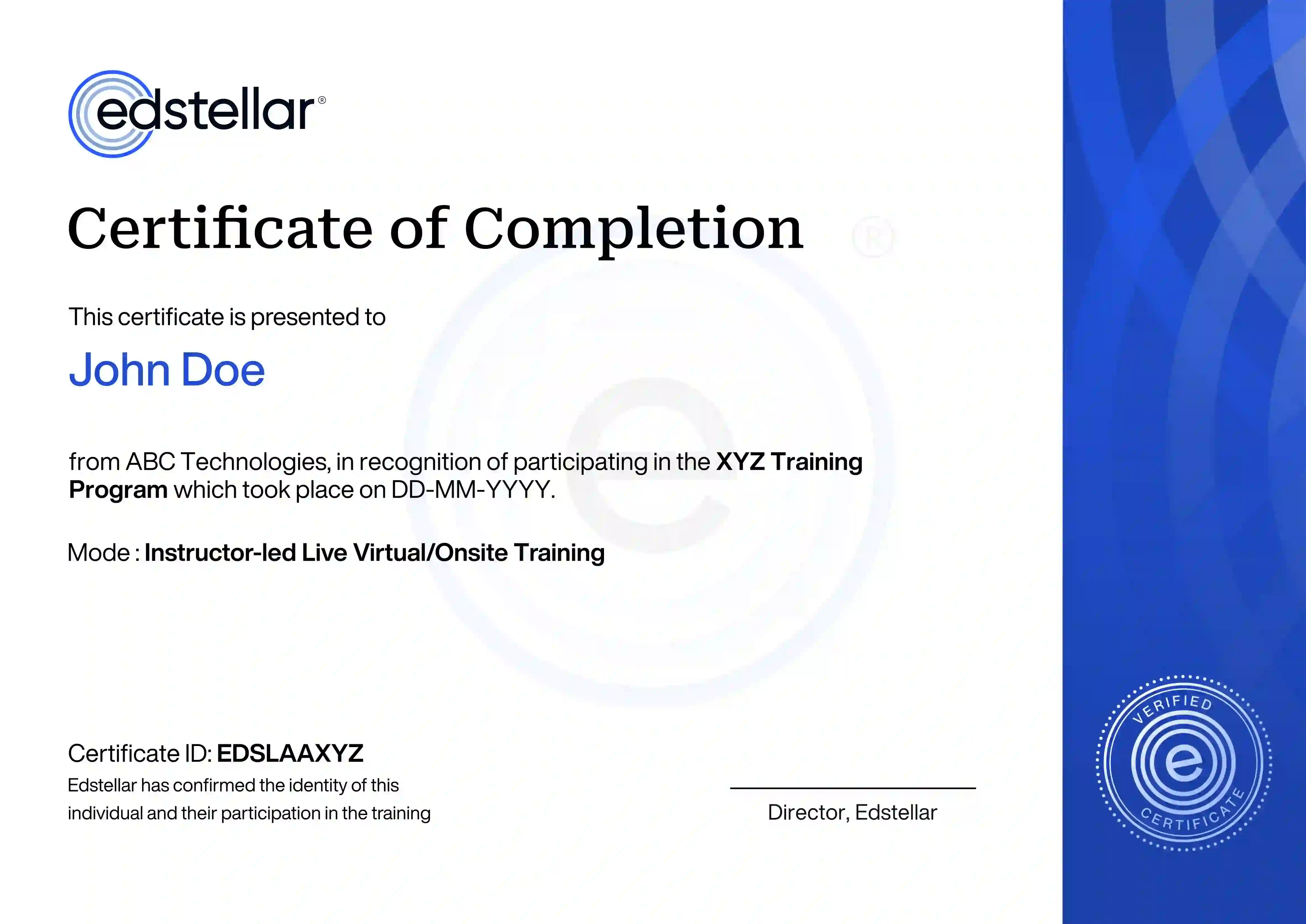
Upon successful completion of the Board-Level Risk Oversight & Governance training course offered by Edstellar, employees receive a course completion certificate, symbolizing their dedication to ongoing learning and professional development.
This certificate validates the employee's acquired skills and is a powerful motivator, inspiring them to enhance their expertise further and contribute effectively to organizational success.



Edstellar is a one-stop instructor-led corporate training and coaching solution that addresses organizational upskilling and talent transformation needs globally.
.svg)
.svg)
.svg)

.svg)
Learning Technology
Learning Content Design and Development
Learning Governance, Analytics & ROI
Digital Learning Ecosystem
Training Simulations, AR/VR & Case Studies
Employee Performance Support
Leadership Pipeline & Succession PlanningStrategic Workforce Planning for EnterprisesTransformation & Risk Advisory for EnterprisesDEI Consulting for EnterprisesEmployee Engagement Consulting for Enterprises
Cultural Transformation