.svg "edstellar")

CCPA Compliance Corporate Training Program
This training equips participants with practical CCPA compliance knowledge covering consumer rights, business obligations, data mapping, privacy notices, opt-out mechanisms, enforcement, and CPRA updates.
(Virtual / On-site / Off-site)
.svg)
Drive Team Excellence with CCPA Compliance Corporate Training
The California Consumer Privacy Act (CCPA), as amended by the California Privacy Rights Act (CPRA), represents one of the most significant data privacy regulations in the United States, imposing extensive obligations on businesses that collect or process California residents' personal information. This training covers every dimension of CCPA compliance, from consumer rights and opt-out mechanisms to data mapping, service provider obligations, enforcement risk, and program design.
Edstellar's CCPA Compliance Instructor-led course offers virtual/onsite training options so teams can learn in the format that suits them best. The curriculum combines regulatory analysis with practical compliance exercises, real enforcement case studies, and actionable templates, enabling legal, compliance, IT, and operational teams to confidently build and maintain a CCPA-compliant privacy program.
.svg)

Skills Your Employees Will Gain
These are the core, hands-on capabilities your team builds during the program.
- Consumer Rights Request Handling
- Privacy Notice Drafting
- Data Inventory and Mapping
- Opt-Out Mechanism Implementation
- Service Provider Contract Review
- CCPA Enforcement Awareness
- CPRA Compliance Readiness
What Your Team Will Achieve After This Training
- Master the scope, thresholds, and key definitions of CCPA and CPRA to determine organizational compliance obligations.
- Gain hands-on skills to implement consumer rights request workflows for access, deletion, and opt-out requirements.
- Develop compliant privacy notices, at-collection disclosures, and opt-out mechanisms for digital and offline channels.
- Learn to conduct data inventory and mapping exercises to identify personal information flows and compliance gaps.
- Build service provider and contractor contract review skills to ensure downstream CCPA compliance obligations are met.
- Apply a CCPA compliance program framework to assess, remediate, and maintain organizational privacy readiness.
Topics & Program Outline
The curriculum is organized into focused modules built by industry experts and delivered virtually or on-premise. Interactive sessions reflect the evolving demands of the workplace, keeping the learning both relevant and practical.
-
Overview of US Privacy Regulation
- How the US privacy regulatory landscape differs from the GDPR-based European framework
- Federal vs state-level privacy law: the patchwork of US consumer privacy protections
- Sector-specific federal privacy laws: HIPAA, COPPA, GLBA, and their relationship to CCPA
- The trend toward comprehensive state privacy laws and what it means for national compliance programs
-
CCPA Origins and Legislative Purpose
- How the 2018 ballot initiative and legislative compromise produced the original CCPA
- The consumer harms and data economy practices that CCPA was designed to address
- The CPRA 2020 ballot initiative and its significant amendments to the original CCPA framework
- Effective dates and enforcement timelines for CCPA and CPRA requirements
-
Businesses Subject to CCPA
- The three qualifying thresholds that trigger CCPA compliance obligations for a business
- Revenue threshold: $25 million in annual gross revenue and how to calculate it
- Data volume threshold: buying, selling, or sharing 100,000 or more consumer records annually
- Deriving 50% or more of annual revenue from selling or sharing personal information
-
Key CCPA Definitions
- Consumer: California residents and the broad scope of who qualifies for CCPA protections
- Business, service provider, contractor, and third party defined and distinguished under CCPA
- Sell, share, and disclose: understanding the three key data transfer concepts in CCPA
- Household: how CCPA treats data linked to a household rather than an individual consumer
-
CCPA vs GDPR: Key Similarities and Differences
- Comparing the legal basis frameworks: opt-in consent under GDPR vs opt-out under CCPA
- Data subject rights compared: access, deletion, portability, and correction across both laws
- Territorial scope differences and how multinational organizations manage dual compliance
- Practical compliance strategy for organizations subject to both GDPR and CCPA simultaneously
-
CPRA Amendments Overview
- New consumer rights introduced by CPRA: correction and limit use of sensitive personal information
- The sensitive personal information category and its specific compliance requirements under CPRA
- The California Privacy Protection Agency (CPPA): its structure, authority, and rulemaking role
- Data retention limitations and purpose limitation requirements introduced by the CPRA framework
-
What Constitutes Personal Information
- CCPA's broad definition of personal information and how it differs from traditional PII concepts
- The reasonably linkable standard: when information becomes personal under CCPA
- Publicly available information exclusion: what qualifies and how to apply it correctly
- Aggregated vs individual-level data: how CCPA treats statistical and population-level information
-
The Eleven Categories of Personal Information
- Identifiers: names, aliases, IP addresses, email addresses, and account names
- Commercial information: purchase records, transaction history, and consumer preferences
- Biometric, geolocation, internet activity, and inferences data categories explained
- Employment, education, and audio-visual information as personal information under CCPA
-
Sensitive Personal Information Under CPRA
- The CPRA-defined categories of sensitive personal information and their enhanced protections
- Social security numbers, financial account data, and precise geolocation as sensitive categories
- Racial or ethnic origin, religious beliefs, and health or sex life data under CPRA rules
- Consumer communications, genetic data, and biometric processing as sensitive information
-
Deidentified and Aggregate Information
- The CCPA definition of deidentified information and the technical standards required for qualification
- Public commitment, contractual prohibition, and technical safeguard requirements for deidentification
- Aggregate consumer information: what it means and when it falls outside CCPA's scope
- Risk of re-identification and the obligations that arise if deidentified data can be re-linked
-
Data Outside CCPA Scope
- Employee and job applicant data exemptions: current scope, limitations, and CPRA changes
- Business-to-business information exemption and its current status under CPRA
- Data already regulated by HIPAA, GLBA, and the FCRA and how exemptions apply
- Clinical trial and consumer reporting data: exemptions and the conditions that govern them
-
Data Covered Across Business Functions
- Marketing data: website visitors, email subscribers, and behavioral tracking under CCPA
- HR data: employee personal information and its evolving CCPA and CPRA treatment
- Customer relationship data: CRM, loyalty programs, and purchase history compliance obligations
- Third-party data: data purchased or received from data brokers and its CCPA implications
-
The Right to Know and Access
- What consumers can request: categories of personal information and specific pieces of data
- The 12-month lookback period for access requests and CPRA's removal of the lookback limitation
- Business response requirements: what must be disclosed and in what format
- Frequency limits for access requests and how to handle repeat or excessive consumer requests
-
The Right to Delete
- Scope of the deletion right: what personal information must be deleted upon consumer request
- The nine CCPA exceptions to deletion and how to evaluate and document each correctly
- Deletion obligations flowing downstream to service providers, contractors, and third parties
- Practical deletion implementation: technical approaches for complete and verifiable data removal
-
The Right to Correct (CPRA)
- The new CPRA correction right: what consumers can request to be changed in their data
- Business balancing rights: when to reject a correction request and how to document the decision
- Notifying service providers and contractors of corrections and cascading the changes downstream
- Building correction request workflows that are efficient, documented, and auditable
-
The Right to Opt-Out of Sale and Sharing
- Defining sale and sharing under CCPA and CPRA and why both concepts require opt-out mechanisms
- The Do Not Sell or Share My Personal Information link: placement, format, and functionality requirements
- Global Privacy Control (GPC) recognition: when and how businesses must honor browser-level signals
- Re-engagement rules: when and how businesses may invite consumers to opt back in after opting out
-
The Right to Limit Sensitive Personal Information Use
- The CPRA right to limit sensitive personal information use and the permitted purpose exceptions
- Implementing the Limit the Use of My Sensitive Personal Information link or combined opt-out
- Permitted purposes for sensitive personal information use without consumer restriction
- Service provider and contractor obligations when a consumer exercises the limitation right
-
The Right to Non-Discrimination and Data Portability
- CCPA's prohibition on discriminating against consumers who exercise their privacy rights
- Financial incentive programs: how to structure loyalty programs that comply with CCPA
- Bona fide business reason exception: when differential treatment is permissible under CCPA
- Data portability requirements: format, scope, and timing of consumer data transfer responses
-
Why Data Mapping is the CCPA Compliance Foundation
- How data mapping underpins every CCPA obligation from notices to rights response to vendor contracts
- The compliance gap cost of operating without a complete and current data inventory
- Data mapping as a continuous compliance discipline, not a one-time project
- Aligning data mapping with broader privacy program governance and risk management
-
Conducting a Data Inventory
- Designing the data inventory questionnaire for business unit and system owners
- Key attributes to capture: data category, source, purpose, retention, and sharing relationships
- Interview techniques for extracting accurate information from non-privacy technical teams
- Validating inventory accuracy through system log review and vendor contract analysis
-
Data Flow Mapping
- Tracing personal information from collection point through processing and onward to deletion
- Visualizing data flows using swim lane diagrams and data flow mapping tools
- Identifying unauthorized data flows that create CCPA disclosure and sale compliance risks
- Documenting data flows at a level of detail sufficient for regulators and internal auditors
-
Third-Party and Vendor Data Mapping
- Mapping personal information shared with service providers, contractors, and third parties
- Identifying which vendor relationships constitute a sale or sharing under CCPA definitions
- Vendor data practice questionnaires for assessing downstream compliance posture
- Integrating vendor data mapping into the procurement and contract management process
-
Maintaining and Updating the Data Map
- Triggers for data map updates: new systems, new vendors, product changes, and regulatory amendments
- Assigning data map ownership and accountability across business functions
- Technology tools for maintaining dynamic data inventories in large enterprise environments
- Annual data map review and certification process for compliance governance reporting
-
Using Data Mapping for Compliance Gap Analysis
- Comparing data map findings to CCPA notice, opt-out, and contract requirements to identify gaps
- Prioritizing remediation based on risk level, data sensitivity, and regulatory enforcement focus
- Documenting gap analysis findings for privacy counsel review and compliance reporting
- Building a remediation roadmap with assigned owners, timelines, and compliance milestones
-
At-Collection Privacy Notices
- The CCPA at-collection notice requirement: when, where, and what must be disclosed to consumers
- Categories of personal information and purpose of collection disclosure requirements
- Sensitive personal information collection notice requirements under CPRA
- Offline collection scenarios: point-of-sale, phone, and in-person notice requirements
-
The CCPA-Compliant Privacy Policy
- Required content elements of a CCPA privacy policy: categories, rights, contacts, and updates
- The 12-month look-back disclosure requirement for categories collected and shared
- Consumer rights notice requirements embedded within the privacy policy
- Annual privacy policy update obligations and version control best practices
-
Financial Incentive Program Notices
- When a loyalty, rewards, or discount program triggers financial incentive notice requirements
- Required notice elements: material terms, opt-in process, and withdrawal rights
- Bona fide business reason valuation methodology for financial incentive programs
- Practical examples of compliant and non-compliant financial incentive program designs
-
Notice to Employees and Job Applicants
- CCPA and CPRA notice requirements for California employees and job applicants
- Categories of employee personal information collected and the purpose of collection
- Monitoring and surveillance disclosure obligations for remote and on-site employees
- Integrating CCPA employee notices into onboarding, handbooks, and HR workflows
-
Notice Format, Placement, and Accessibility
- Readability and plain language requirements for CCPA privacy notices
- Notice placement requirements on websites: footer links, pop-ups, and form-level disclosures
- Mobile app privacy notice requirements and in-app disclosure placement standards
- Accessibility requirements: ensuring privacy notices are available in accessible formats
-
Notice Maintenance and Update Obligations
- Material change notification requirements when privacy practices change significantly
- Retroactive notice obligations when new categories of personal information are collected
- Version control and archival requirements for privacy policy updates and amendments
- Cross-functional notice review process involving legal, marketing, IT, and product teams
-
Building a Consumer Request Response Program
- Designing an end-to-end consumer rights request workflow from intake to response and documentation
- Required intake channels: web form, toll-free number, and email as minimum methods
- Assigning ownership and accountability for consumer rights request processing across the organization
- Technology solutions for intake, tracking, and response management at scale
-
Identity Verification Requirements
- The CCPA reasonable verification standard: matching the sensitivity of data to verification rigor
- Verification methods for online and offline consumers without creating undue burden
- When identity cannot be verified: how to respond without disclosing data to an unverified requestor
- Authorized agent verification: requirements for third parties making requests on behalf of consumers
-
Processing Right to Know and Access Requests
- The 45-day response timeline and the 45-day extension conditions and notice requirements
- Searching systems of record to identify all personal information responsive to an access request
- Format and delivery requirements for access request responses under CCPA
- Excluding third-party personal information from access responses to protect other individuals
-
Processing Deletion Requests
- Evaluating deletion requests against each of the nine statutory exceptions before deleting
- Technical deletion vs de-identification: when each approach satisfies the CCPA deletion obligation
- Notifying downstream service providers and contractors of confirmed deletion obligations
- Documenting deletion decisions and retaining records for regulatory and litigation purposes
-
Processing Opt-Out and Correction Requests
- Implementing opt-out requests across all data processing systems and downstream vendor relationships
- GPC signal recognition: technical implementation for browser-based opt-out signal compliance
- Processing correction requests: verification, implementation, and downstream notification workflow
- Denial of requests: when and how to deny a consumer request with proper documentation
-
Recordkeeping and Metrics Obligations
- CPRA recordkeeping requirements: maintaining metrics on consumer requests for prior 24 months
- Required metrics: number of requests received, median days to respond, and denial rates
- Annual metrics disclosure obligations for businesses that meet the disclosure threshold
- Internal audit of consumer request handling for compliance quality assurance and improvement
-
What Constitutes a Sale Under CCPA
- The broad CCPA definition of sale and why it extends well beyond traditional commercial transactions
- Valuable consideration: how non-monetary benefit can trigger the sale definition
- Common digital advertising and data sharing practices that may constitute a sale
- Exemptions from the sale definition: service provider disclosures, consumer direction, and mergers
-
Sharing Under CPRA
- How CPRA introduced sharing as a distinct concept targeting behavioral advertising data transfers
- Cross-context behavioral advertising: when it constitutes sharing and triggers opt-out obligations
- How sharing obligations apply to analytics, retargeting, and social media pixel integrations
- Evaluating your digital marketing stack for CCPA and CPRA sale and sharing compliance exposure
-
Service Providers, Contractors, and Third Parties
- Distinguishing service providers, contractors, and third parties and why classification matters
- Service provider definition: receiving data solely to perform services on the business's behalf
- Contractor classification under CPRA and the contractual requirements for contractor relationships
- Third-party transfers that constitute a sale or sharing and the obligations they trigger
-
Service Provider and Contractor Contract Requirements
- Required contract clauses for service provider agreements under CCPA and CPRA
- Prohibited processing limitations: what service providers and contractors cannot do with the data
- Consumer rights assistance obligations for service providers upon receiving a request
- Subprocessor and subcontractor flow-down requirements in CPRA-compliant agreements
-
Opt-Out of Sale and Sharing Implementation
- Technical implementation of the opt-out of sale mechanism across website and app environments
- Downstream opt-out propagation: communicating consumer opt-outs to all data recipients
- Opt-out signal recognition through GPC and cookie consent management platforms
- Testing and auditing opt-out functionality to ensure regulatory and technical compliance
-
Vendor Due Diligence and Downstream Compliance
- Conducting CCPA due diligence on existing and prospective data vendors and processors
- Risk-tiering vendors based on data volume, sensitivity, and processing activity profile
- Vendor audit rights and monitoring provisions for ongoing downstream compliance assurance
- Responding to vendor non-compliance: remediation, contract enforcement, and termination decisions
-
California Attorney General Enforcement
- The California AG's enforcement authority under CCPA and the scope of investigative powers
- The cure period: original 30-day cure right under CCPA and its modification under CPRA
- AG enforcement priorities and the types of violations that have drawn regulatory scrutiny
- Responding to an AG inquiry or civil investigative demand from a compliance posture
-
The California Privacy Protection Agency
- CPPA's structure, independence, and authority to investigate and enforce CPRA requirements
- CPPA rulemaking authority and the ongoing regulatory guidance program under CPRA
- How CPPA enforcement differs from AG enforcement and the implications for compliance programs
- Engaging with CPPA rulemaking through comment periods and industry association participation
-
Civil Penalties and Fines
- Standard civil penalty structure: up to $2,500 per unintentional violation and $7,500 per intentional
- CPRA's higher penalties for violations involving minors' personal information
- How penalties are calculated when violations involve large volumes of consumer records
- Factors that influence penalty amount: cooperation, remediation, and compliance program maturity
-
The Private Right of Action for Data Breaches
- Scope of the CCPA private right of action: limited to data breach claims, not general rights violations
- Statutory damages range: $100 to $750 per consumer per incident or actual damages if greater
- The reasonable security obligation that underlies the private right of action for breach claims
- Class action exposure under CCPA and litigation risk management strategies for businesses
-
Enforcement Case Studies and Lessons
- Analysis of California AG enforcement actions: settlement terms, remediation requirements, and fines
- Common violation patterns: opt-out failures, missing notices, and inadequate consumer request processes
- The Sephora settlement: implications for digital advertising data flows and opt-out compliance
- Applying enforcement case study lessons to proactive compliance program risk assessment
-
Regulatory Investigations and Audit Readiness
- How CCPA and CPRA regulatory investigations typically commence and progress
- Documentation and recordkeeping practices that support regulatory audit readiness
- Preserving privilege when engaging outside counsel in regulatory investigation response
- Voluntary disclosure considerations when self-identifying a material CCPA compliance gap
-
CCPA Compliance Program Architecture
- The five pillars of a defensible CCPA compliance program: notice, rights, contracts, security, governance
- Conducting an initial CCPA gap assessment against current organizational data practices
- Prioritizing remediation workstreams based on enforcement risk, consumer impact, and feasibility
- Building a compliance implementation roadmap with milestones, owners, and success metrics
-
Privacy Governance and Accountability
- Defining CCPA ownership across legal, IT, marketing, operations, and HR functions
- Privacy governance committee structure for cross-functional CCPA oversight and decision-making
- CPRA's explicit accountability and training obligations for businesses subject to the law
- Board and executive reporting on CCPA compliance program status and risk exposure
-
Privacy by Design for CCPA
- Embedding CCPA compliance requirements into product, system, and process design from inception
- Privacy impact assessments for new projects involving significant personal information processing
- Data minimization as a CCPA compliance strategy: collecting only what is necessary for the purpose
- Integrating privacy review checkpoints into the software development lifecycle and product roadmap
-
Employee Training and Awareness
- CCPA training obligations and recommended training content for different employee roles
- Role-specific training: legal, IT, marketing, customer service, and HR function requirements
- Training delivery formats: e-learning, instructor-led, and just-in-time process guidance
- Training completion tracking and recordkeeping for regulatory accountability purposes
-
Incident Response and Breach Notification
- CCPA's reasonable security obligation and what it requires of organizational security programs
- Breach response planning for CCPA private right of action exposure mitigation
- California breach notification law requirements and their intersection with CCPA obligations
- Post-breach remediation and consumer communication requirements under California law
-
Ongoing Compliance Monitoring and Maintenance
- Designing a CCPA compliance monitoring program with regular review cycles and audit checkpoints
- Tracking regulatory developments, CPPA rulemaking, and AG guidance for timely program updates
- Annual CCPA compliance assessment methodology and executive reporting framework
- Continuous improvement culture: embedding privacy compliance into organizational operations
-
CPRA Key Changes and Compliance Impact
- Comprehensive review of CPRA amendments to CCPA and their compliance implementation requirements
- New consumer rights: correction and limit use of sensitive personal information in practice
- New business obligations: purpose limitation, data retention, and risk assessment requirements
- CPRA contractor classification and the enhanced contractual requirements it introduces
-
CPPA Rulemaking and Regulatory Guidance
- Tracking CPPA rulemaking activity and the compliance implications of finalized regulations
- Cybersecurity audit and risk assessment regulations: scope and timing considerations
- Automated decision-making and profiling regulations and their impact on AI and marketing compliance
- How to monitor CPPA guidance and update compliance programs in response to new rules
-
Other US State Privacy Laws
- Overview of comprehensive state privacy laws: Virginia CDPA, Colorado CPA, Connecticut CTDPA
- Texas, Nevada, Oregon, and other states with active privacy legislation and enforcement
- Key differences between CCPA and other state laws: opt-in vs opt-out, thresholds, and rights
- Designing a multi-state privacy compliance program that addresses the full US regulatory patchwork
-
Federal Privacy Legislation Landscape
- Status of federal comprehensive privacy legislation and the prospects for federal preemption
- How a federal privacy law would interact with existing CCPA and state privacy frameworks
- Industry advocacy and the role of business organizations in shaping US federal privacy policy
- Planning for federal privacy compliance while maintaining state law compliance programs
-
Emerging Privacy Compliance Challenges
- AI and machine learning: privacy compliance obligations for automated profiling and decision-making
- Advertising technology compliance: the evolving cookie, pixel, and consent signal landscape
- Children's privacy: COPPA, CCPA minor protections, and emerging age-appropriate design requirements
- Biometric data regulation: state biometric laws and their intersection with CCPA sensitive data rules
-
Future-Proofing Your Privacy Compliance Program
- Building adaptive compliance infrastructure that accommodates regulatory change without full rebuilds
- Privacy technology investment: consent management, DSAR automation, and data mapping platforms
- Privacy as a competitive advantage: how strong compliance programs build consumer trust and brand value
- Staying current through continuous learning, regulatory engagement, and professional privacy community participation
Who Should Attend?
This program suits professionals at many levels across the organization, including:
- Privacy and Compliance Officers
- Legal Counsel
- IT Security Managers
- Marketing and Data Teams
- HR Professionals
- Product Managers
What are the Prerequisites?
Professionals should have a basic understanding of data privacy concepts and familiarity with business data handling practices to take the CCPA Compliance training course.
Choose the Format That Fits Your Team
We design training your teams actually engage with, and deliver it the way that suits you best. Through a vetted global trainer network, Edstellar runs sessions in 10+ languages with consistent quality anywhere.


.webp "Virtual CCPA Compliance Training")
Virtual / online: expert-led live sessions delivered anywhere, with consistency and easy scheduling.
.webp "On-site CCPA Compliance Training")
On-site (in-house): immersive, instructor-led learning at your office.
.webp "Off-site CCPA Compliance Training")
Off-site: focused, instructor-led group learning away from everyday workplace distractions.
Get a Proposal Shaped to Your Needs
Need pricing for onsite, offsite, or virtual delivery? Get a proposal tailored to your team's needs.
64 hours of group training (includes VILT/In-person On-site)
Tailored for SMBs
Tailor-Made Trainee Licenses with Our Exclusive Training Packages!
160 hours of group training (includes VILT/In-person On-site)
Ideal for growing SMBs
Tailor-Made Trainee Licenses with Our Exclusive Training Packages!
400 hours of group training (includes VILT/In-person On-site)
Designed for large corporations
Tailor-Made Trainee Licenses with Our Exclusive Training Packages!
Unlimited duration
Designed for large corporations
What Sets Edstellar Apart
Experienced Trainers
Our trainers are drawn from a vetted global network and bring years of industry expertise, keeping every session practical and impactful.
Proven Quality
With a strong global track record, Edstellar is known for quality and engaging delivery.
Industry-Relevant Curriculum
Our programs are built by experts to match the demands of today's industry.
Fully Customizable
Every program can be tailored to your organization's goals.
Comprehensive Support
We provide pre- and post-session support for a complete learning experience.
Global Multi-Location & Multilingual Training Delivery
We deliver in multiple languages to support diverse global teams.
Recognition That Motivates Your Team
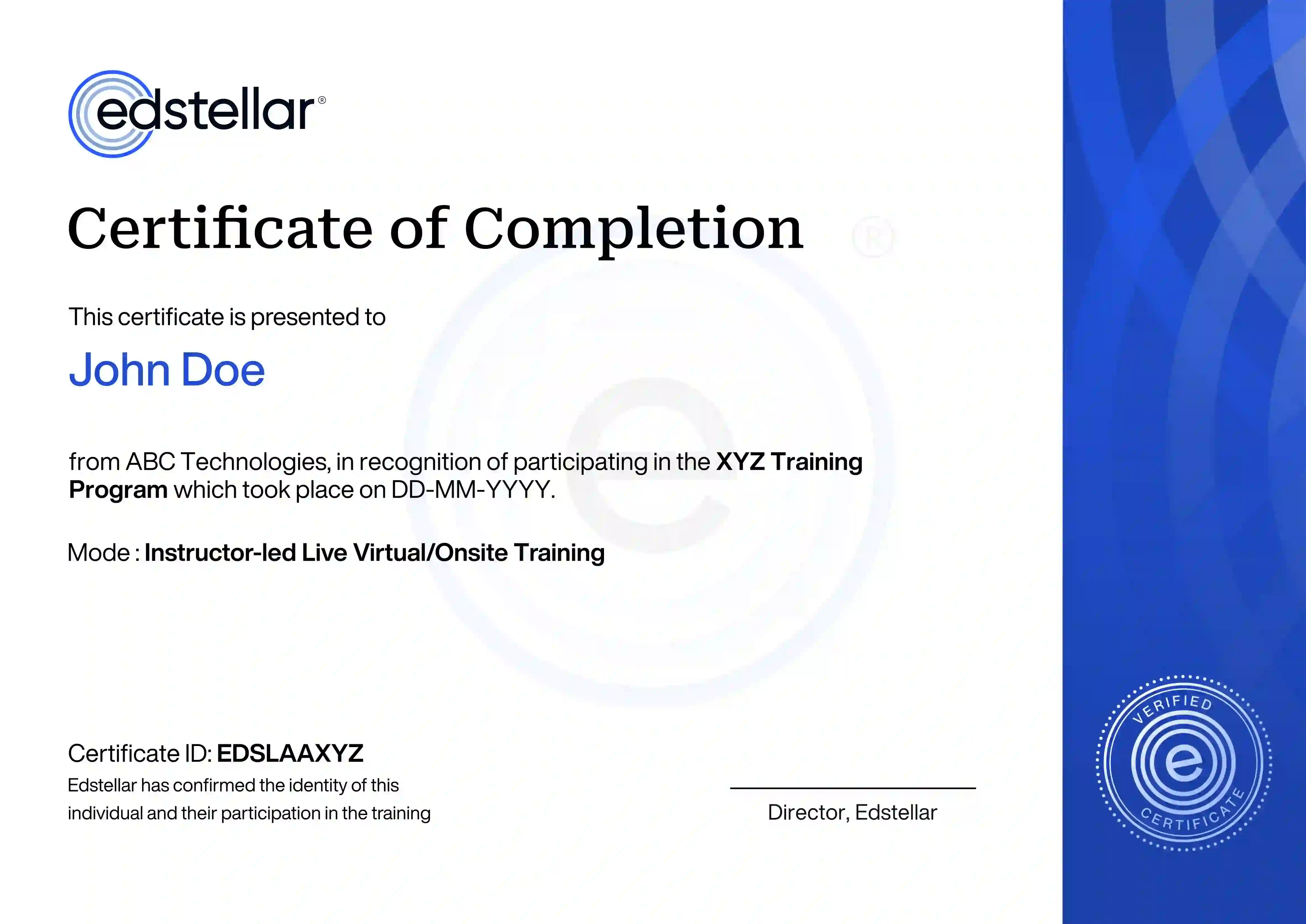
Upon successful completion of the CCPA Compliance training course offered by Edstellar, employees receive a course completion certificate, symbolizing their dedication to ongoing learning and professional development.
This certificate validates the employee's acquired skills and is a powerful motivator, inspiring them to enhance their expertise further and contribute effectively to organizational success.

Explore More Courses


Edstellar is a one-stop instructor-led corporate training and coaching solution that addresses organizational upskilling and talent transformation needs globally.
.svg)
.svg)
.svg)

.svg)
Learning Technology
Learning Content Design and Development
Learning Governance, Analytics & ROI
Digital Learning Ecosystem
Training Simulations, AR/VR & Case Studies
Employee Performance Support
Leadership Pipeline & Succession PlanningStrategic Workforce Planning for EnterprisesTransformation & Risk Advisory for EnterprisesDEI Consulting for EnterprisesEmployee Engagement Consulting for Enterprises
Cultural Transformation