.svg "edstellar")

Cross-Chain Interoperability Corporate Training Program for Employees
Edstellar's instructor-led Cross-Chain Interoperability training equips professionals to design and build multi-chain applications. Participants master bridges, messaging protocols (LayerZero, CCIP, Wormhole, Axelar, IBC), proof systems, liquidity aggregation, security models, and cross-chain dApp architectures for Ethereum, Cosmos, Solana, and emerging ecosystems.
(Virtual / On-site / Off-site)
.svg)
Drive Team Excellence with Cross-Chain Interoperability Corporate Training
Cross-Chain Interoperability is the discipline of connecting isolated blockchains to enable asset transfers, message passing, and composable applications across ecosystems. As the blockchain landscape fragments into hundreds of chains and rollups, interoperability is foundational for liquidity, user experience, and application reach. The training provides comprehensive knowledge of bridge architectures, messaging protocols, proof systems, token standards, security models, and multi-chain development patterns across EVM and non-EVM ecosystems including Ethereum, Cosmos, Solana, Bitcoin, and emerging L1s and L2s.
Edstellar's Cross-Chain Interoperability Instructor-led course offers virtual/onsite training options to meet professionals' diverse needs. This flexibility ensures that professionals and teams can engage in learning experiences that best suit their logistical and learning preferences. What sets the Edstellar course apart is its emphasis on practical experience, with hands-on protocol integrations, testnet cross-chain deployments, and real-world architecture case studies that bring interoperability concepts to life. Edstellar equips professionals with the skills and confidence to design, secure, and ship cross-chain applications in production environments.
.svg)

- Cross-Chain Messaging Protocols
- Bridge Architecture Design
- Proof Systems and Light Clients
- Token and Asset Standards
- Cross-Chain Security Modeling
- Multi-Chain dApp Development
- Interoperability Risk Assessment
- Master cross-chain interoperability fundamentals by understanding consensus isolation, message verification, and trust models, enabling architects to select appropriate interoperability primitives for their use case and risk tolerance.
- Gain expertise in major messaging protocols including LayerZero, Chainlink CCIP, Wormhole, Axelar, Hyperlane, and IBC, emphasizing protocol internals, integration patterns, and delivery guarantees for production applications.
- Develop proficiency in bridge architectures, proof systems, and cross-chain token standards, ensuring engineers can evaluate and implement lock-mint, burn-mint, liquidity network, and trust-minimized designs with appropriate security properties.
- Learn comprehensive security frameworks for cross-chain systems, emphasizing attack vectors, incident case studies, rate limits, circuit breakers, and monitoring that protect against exploits and reduce blast radius.
- Build practical skills in multi-chain dApp development including Solidity integrations, Cosmos SDK modules, non-EVM bridging, intent-based routing, and cross-chain UX patterns for seamless user experiences.
- Master cross-chain product design and operations, including chain selection, liquidity strategy, governance across chains, and emerging trends like shared sequencing, ZK interoperability, and chain abstraction.
- The Blockchain Isolation Problem
- Consensus and state isolation
- Why chains cannot read each other
- Fragmentation of liquidity and users
- Drivers for interoperability
- Trust Models Overview
- Trusted (custodial)
- Bonded validator sets
- Optimistic verification
- Trust-minimized light clients
- Message Verification Approaches
- Header relay and finality proofs
- Signature attestations
- ZK proofs of state
- Economic security staking
- Categories of Interoperability
- Asset bridges
- Generalized messaging
- Shared security (restaking)
- Modular rollup frameworks
- Finality and Latency
- Probabilistic vs deterministic finality
- Soft vs hard finality
- Re-org risk handling
- UX impact of latency
- Interoperability Trilemma
- Trustlessness, extensibility, generalizability
- Trade-offs in protocol design
- Case study comparisons
- Matching design to use case
- Lock-and-Mint Bridges
- Custodial locking mechanics
- Wrapped asset minting
- Unlock and burn flow
- Reserve management
- Burn-and-Mint Bridges
- Native burn on source
- Canonical mint on destination
- Unified supply models
- USDC CCTP example
- Liquidity Network Bridges
- Pool-based swaps (Across, Hop)
- Relayer economics
- Slippage and fee models
- Liquidity rebalancing
- Atomic Swap Designs
- HTLC basics
- Submarine swaps
- Trust assumptions
- Use case limitations
- Native Rollup Bridges
- Optimistic 7-day withdrawals
- ZK rollup fast proofs
- Canonical L1-L2 messaging
- Third-party fast bridges
- Centralized vs Decentralized Bridges
- Security implications
- Regulatory considerations
- Cost and performance trade-offs
- Hybrid approaches
- LayerZero Architecture
- Ultra light nodes (ULNs)
- DVN and executor model
- OApp and OFT standards
- V2 configurable security
- Chainlink CCIP
- Router and on-ramp architecture
- DON committee security
- Active Risk Management Network
- Token and data transfers
- Wormhole
- Guardian network
- VAA (Verifiable Action Approval)
- NTT and Native Token Transfers
- Non-EVM support
- Axelar Network
- PoS validator set
- General Message Passing (GMP)
- Interchain Token Service
- Cosmos SDK foundation
- Hyperlane Modular Security
- Interchain Security Modules (ISMs)
- Permissionless deployment
- Sovereign consensus
- Warp Route tokens
- Other Messaging Protocols
- Connext and xCall
- Polymer Labs
- deBridge
- Protocol comparison matrix
- Light Client Fundamentals
- Header chain verification
- Sync committees
- Merkle proof verification
- Storage proof patterns
- ZK-Based Interoperability
- ZK light clients
- Succinct Labs Telepathy
- Polymer and zk-IBC
- ZK bridges on Ethereum
- Optimistic Verification
- Fraud proof windows
- Nomad and Connext designs
- Challenger economics
- Cost and security trade-offs
- Attestation Networks
- Validator committees
- Threshold signatures
- MPC-based signing
- Restaking-backed validation
- Proof Aggregation
- Batched message verification
- Rollup-style amortization
- Cost reduction techniques
- Latency trade-offs
- Finality and Re-org Handling
- Waiting for source finality
- Re-org detection
- Message invalidation
- UX and refund flows
- IBC Protocol Overview
- Inter-Blockchain Communication basics
- Tendermint consensus foundation
- ICS standards and modules
- Channels and connections
- Packet Lifecycle
- Packet creation and commitment
- Relay and verification
- Acknowledgement and timeout
- Error handling
- Relayers and Incentives
- Relayer software options
- Economic incentivization
- Multi-hop routing
- Monitoring and alerting
- Fungible Token Transfer
- ICS-20 standard
- Denomination tracing
- Unwrap and recover patterns
- IBC token canonicalization
- Interchain Accounts and Queries
- ICA (ICS-27)
- Interchain Queries (ICQ)
- Cross-chain staking use cases
- DeFi coordination patterns
- IBC Beyond Cosmos
- IBC on Ethereum and L2s
- Polymer Labs rollup IBC
- Composable Finance
- Future expansion
- Ethereum L2 Landscape
- Optimistic rollups (OP Stack, Arbitrum)
- ZK rollups (zkSync, Starknet, Scroll)
- Validiums and volitions
- Super chains and stacks
- Canonical Bridges
- L1-L2 deposits and withdrawals
- 7-day challenge windows
- ZK proof verification
- Native messaging channels
- Third-Party and Fast Bridges
- Across, Hop, Synapse
- Instant withdrawal economics
- Solver and relayer networks
- Cost and speed comparisons
- L2-to-L2 Interop
- Superchain inter-rollup messaging
- Shared sequencer proposals
- OP Stack interop roadmap
- Cross-rollup atomicity
- Shared Sequencing and Proving
- Espresso and Astria
- Benefits for interoperability
- Challenges and trade-offs
- Ecosystem adoption
- Account Abstraction and Chain Abstraction
- ERC-4337 basics
- Cross-chain smart accounts
- Unified balances and intents
- UX improvements
- Solana Interoperability
- Wormhole Solana integration
- Portal token bridge
- Native Solana program patterns
- Performance considerations
- Aptos and Sui Move Chains
- Move language bridge support
- LayerZero and Wormhole support
- Token design differences
- Emerging ecosystem patterns
- NEAR Rainbow Bridge
- Light client design
- Aurora EVM compatibility
- Chain signatures
- Use cases
- Bitcoin Interoperability
- WBTC and renBTC historic designs
- tBTC federated minting
- Babylon Bitcoin staking
- Ordinals and runes bridges
- Polkadot and XCM
- XCM messaging format
- Parachains and relay chain
- Cross-consensus transfers
- Bridges to external ecosystems
- Cross-Ecosystem Messaging
- EVM to non-EVM patterns
- Data and payload formats
- Serialization differences
- Error handling across VMs
- Token Design Options
- Canonical vs wrapped tokens
- Native multi-chain tokens
- Lockbox and adapter patterns
- Supply invariants
- LayerZero OFT
- Omnichain Fungible Token standard
- OFT V2 features
- Adapter OFT for existing tokens
- Migration strategies
- Wormhole NTT
- Native Token Transfers architecture
- Rate limiting and pausability
- Accountant contract
- Customization options
- CCIP Token Pools
- Burn-mint and lock-release pools
- Rate limiter configuration
- Token admin controls
- CCTP for USDC
- xERC20 Standard
- Connext-led design
- Issuer-controlled minting rights
- Bridge-agnostic approach
- Implementation patterns
- Cross-Chain Liquidity Aggregation
- Solver networks and intents
- LI.FI and Jumper aggregation
- Socket and Bungee
- Optimal routing algorithms
- Bridge Attack Vectors
- Signature and key compromise
- Validator collusion
- Replay attacks
- Smart contract bugs
- Historical Bridge Incidents
- Ronin, Wormhole, Nomad hacks
- Root causes and impact
- Post-incident responses
- Lessons for designers
- Defensive Architecture Patterns
- Rate limits and throttling
- Circuit breakers and pauses
- Multi-bridge aggregation
- Dual-governance safeguards
- Monitoring and Alerting
- On-chain anomaly detection
- Message flow monitoring
- Supply invariant checks
- Incident response playbooks
- Audits and Formal Verification
- Pre-deployment audit scope
- Ongoing review cadence
- Formal methods in bridges
- Bug bounty programs
- Operational and Governance Risk
- Upgrade processes
- Key and multisig management
- Governance capture scenarios
- Decentralization pathways
- Chain Selection Strategy
- Target audience and liquidity
- Gas and performance
- Ecosystem maturity
- Regulatory considerations
- Integrating Messaging Protocols
- Integration patterns in Solidity
- Event handling and callbacks
- Error handling and retries
- Testing with testnets
- Intent-Based and Solver Architectures
- CoW Swap and UniswapX models
- Cross-chain intents (Across)
- Solver competition dynamics
- UX improvements
- Multi-Chain DeFi Use Cases
- Cross-chain lending
- Multi-chain DEXs
- Unified yield aggregators
- Cross-chain derivatives
- Cross-Chain Governance
- Message-based voting
- Token and treasury coordination
- Branded gateways
- Case studies (Uniswap, Aave)
- Future of Interoperability
- ZK proofs standardization
- Modular and shared security
- Chain abstraction UX
- Long-term consolidation vs proliferation
- Blockchain Developer
- Smart Contract Engineer
- Protocol Architect
- Security Engineer
- DeFi Product Manager
- Solutions Architect
Professionals should have a working understanding of Ethereum and smart contract development in Solidity, familiarity with Layer 2 networks and wallets, and general knowledge of cryptography basics and distributed systems, to take the Cross-Chain Interoperability training course.


.webp "Virtual Cross-Chain Interoperability Training")
.webp "On-site Cross-Chain Interoperability Training")
.webp "Off-site Cross-Chain Interoperability Training")
64 hours of group training (includes VILT/In-person On-site)
Tailored for SMBs
160 hours of group training (includes VILT/In-person On-site)
Ideal for growing SMBs
Tailor-Made Trainee Licenses with Our Exclusive Training Packages!
400 hours of group training (includes VILT/In-person On-site)
Designed for large corporations
Tailor-Made Trainee Licenses with Our Exclusive Training Packages!
Unlimited duration
Designed for large corporations
Experienced Trainers
Our trainers are drawn from a vetted global network and bring years of industry expertise, keeping every session practical and impactful.
Proven Quality
With a strong global track record, Edstellar is known for quality and engaging delivery.
Industry-Relevant Curriculum
Our programs are built by experts to match the demands of today's industry.
Fully Customizable
Every program can be tailored to your organization's goals.
Comprehensive Support
We provide pre- and post-session support for a complete learning experience.
Global Multi-Location & Multilingual Training Delivery
We deliver in multiple languages to support diverse global teams.
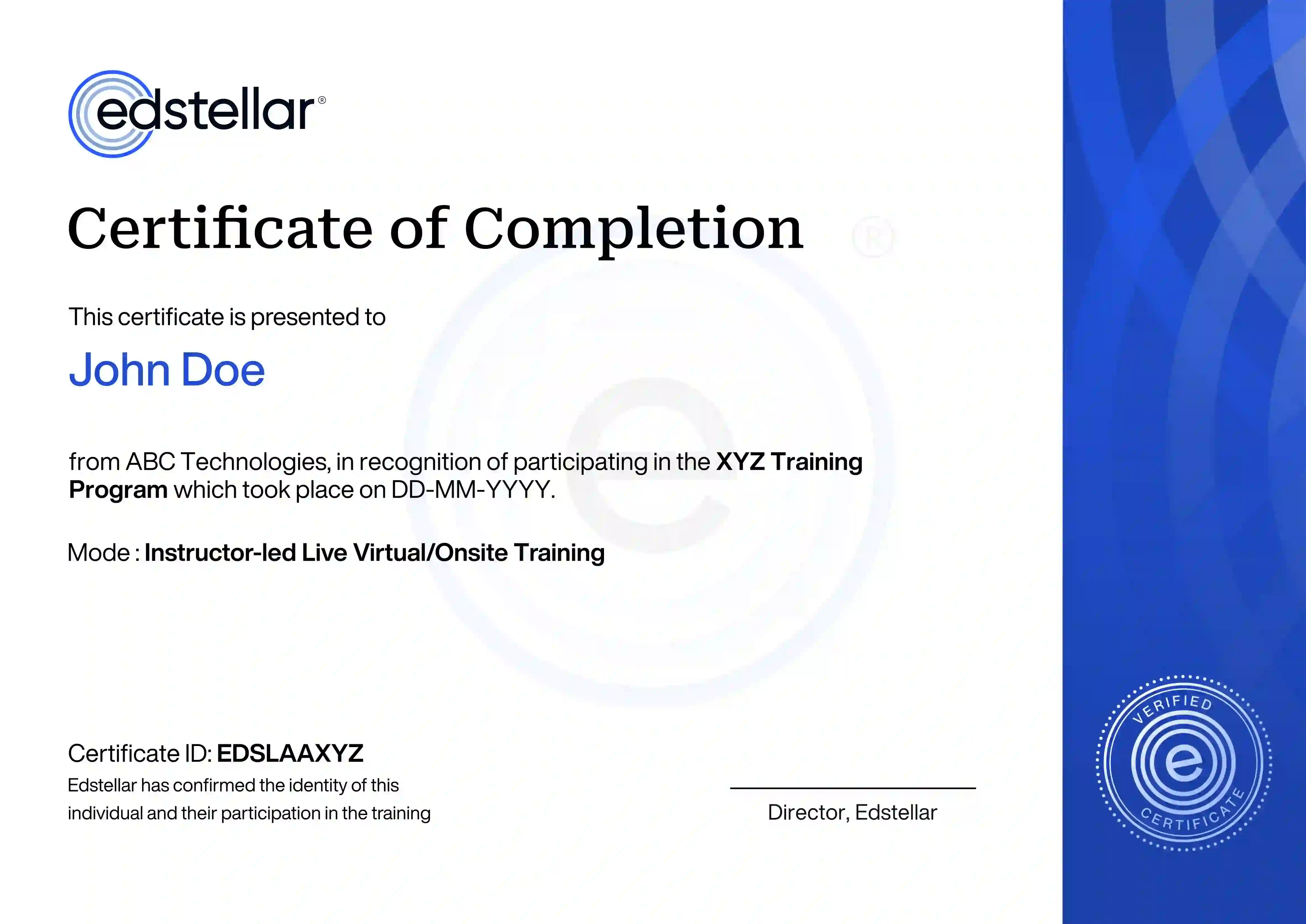
Recognition That Motivates Your Team

Explore More Courses


.svg)
.svg)
.svg)

.svg)