.svg "edstellar")

Data Governance Fundamentals Corporate Training Program
This training introduces professionals to the principles, frameworks, and practices of data governance. Participants learn how to establish governance structures, define data ownership, ensure data quality, and align data management with organizational strategy and compliance requirements.
(Virtual / On-site / Off-site)
.svg)
Drive Team Excellence with Data Governance Fundamentals Corporate Training
Data governance is the foundation of effective, trusted, and compliant data management in any organization. As data volumes grow and regulatory requirements intensify, organizations need clear governance structures to ensure their data is accurate, accessible, protected, and aligned with business goals. This training introduces the key concepts, frameworks, and practices that enable organizations to build and sustain a robust data governance program from the ground up.
Edstellar's Data Governance Fundamentals Instructor-led course offers virtual/onsite training options tailored for data professionals, IT managers, compliance teams, and business leaders new to data governance. With practical exercises, real-world case studies, and governance framework application, participants gain the foundational knowledge needed to contribute to or lead a data governance initiative within their organization.
.svg)

Skills Your Employees Will Gain
These are the core, hands-on capabilities your team builds during the program.
- Data governance framework design
- Data ownership and stewardship
- Data quality assessment
- Metadata management
- Data policy development
- Regulatory compliance alignment
- Data governance program implementation
What Your Team Will Achieve After This Training
- Master foundational data governance concepts, frameworks, and the role of governance in driving organizational data strategy.
- Develop understanding of data ownership, stewardship roles, and accountability structures within a governance program.
- Learn to assess and improve data quality using governance tools, metrics, and data quality management best practices.
- Build skills to design and implement data policies, standards, and procedures that support compliant data management.
- Gain knowledge of metadata management, data cataloging, and how they support data discoverability and governance maturity.
- Apply data governance principles to establish a structured program aligned with regulatory and business requirements.
Topics & Program Outline
The curriculum is organized into focused modules built by industry experts and delivered virtually or on-premise. Interactive sessions reflect the evolving demands of the workplace, keeping the learning both relevant and practical.
- What is Data Governance and Why It Matters
- Definition of data governance and its scope in modern organizations
- The business value of well-governed data assets
- How poor data governance leads to operational and compliance risks
- Overview of the data governance lifecycle and its core components
- Key Data Governance Concepts and Terminology
- Essential data governance terms: data domain, data asset, and data lineage
- Difference between data governance, data management, and data quality
- Key stakeholders and their terminology in a governance context
- Building a shared governance vocabulary across the organization
- Business Drivers for Data Governance
- Regulatory compliance as a primary driver for data governance adoption
- Data-driven decision-making and its dependence on governed data
- Operational efficiency gains from consistent and trusted data
- Competitive advantage through better data management and governance
- Data Governance vs. Data Management
- How data governance and data management complement each other
- The scope of data management: architecture, integration, quality, and security
- Where governance ends and management begins in organizational practice
- Integrating governance into existing data management processes
- The Role of Data Governance in Organizational Strategy
- Aligning data governance with overall business objectives and strategy
- Data governance as an enabler of digital transformation initiatives
- How governance supports mergers, acquisitions, and enterprise data integration
- Executive sponsorship and leadership support for data governance
- Common Data Governance Challenges and How to Address Them
- Cultural resistance to governance and strategies to drive adoption
- Siloed data ownership and how governance structures resolve it
- Resource constraints in launching and sustaining governance programs
- Balancing governance rigor with operational agility
- Overview of Major Data Governance Frameworks
- Introduction to industry-recognized data governance frameworks
- Comparing framework scope, maturity levels, and applicability
- How frameworks provide structure for governance program design
- Selecting the appropriate framework based on organizational needs
- DAMA-DMBOK: A Guide to Data Management
- Overview of the DAMA-DMBOK framework and its 11 knowledge areas
- Data governance as the foundational knowledge area in DAMA-DMBOK
- Applying DAMA-DMBOK principles to enterprise data governance programs
- DAMA-DMBOK v2 updates and their relevance to modern data governance
- The Data Governance Institute Framework
- Structure and components of the DGI Data Governance Framework
- How the DGI framework addresses people, processes, and technology
- Using the DGI framework to define governance rules and accountabilities
- Case examples of DGI framework application in organizations
- Comparing Data Governance Models and Approaches
- Centralized, decentralized, and federated data governance models
- Pros and cons of each governance model in different organizational contexts
- Hybrid governance models and when they are most effective
- Matching governance model choice to organizational culture and structure
- Selecting the Right Framework for Your Organization
- Criteria for evaluating and selecting a data governance framework
- Assessing organizational maturity to determine framework fit
- Engaging stakeholders in the framework selection process
- Piloting framework elements before full-scale adoption
- Adapting Frameworks to Organizational Context and Maturity
- Tailoring governance frameworks to industry-specific requirements
- Scaling governance framework complexity with program maturity
- Integrating multiple frameworks for a comprehensive governance approach
- Continuous framework review and adaptation over time
- Defining Data Ownership in an Organization
- What data ownership means in a governance context
- Identifying data owners by business domain and data asset type
- Responsibilities and authority of a data owner
- Formalizing data ownership through governance policies and structures
- Roles and Responsibilities of Data Stewards
- Distinction between data owners, data stewards, and data custodians
- Day-to-day responsibilities of a data steward in a governance program
- Technical vs. business data steward roles and their collaboration
- Setting performance expectations for data stewardship roles
- Building a Data Governance Council
- Purpose and mandate of a data governance council or committee
- Membership composition: executive sponsors, data owners, and stewards
- Governance council meeting structure, cadence, and decision-making
- Documenting and communicating governance council decisions
- Establishing Accountability for Data Assets
- Creating accountability frameworks for data quality and compliance
- Linking data accountability to performance objectives and KPIs
- Escalation paths when data accountability is not met
- Using governance tools to track and enforce data accountability
- Cross-Functional Collaboration in Data Stewardship
- Facilitating collaboration between IT, business, and compliance stakeholders
- Managing competing priorities across data stewardship stakeholders
- Building a governance community of practice across departments
- Communication strategies for effective cross-functional stewardship
- Managing Data Ownership Conflicts and Disputes
- Common sources of data ownership conflicts in organizations
- Dispute resolution processes for conflicting data ownership claims
- The role of the governance council in mediating ownership disputes
- Preventing ownership conflicts through clear governance documentation
- Dimensions of Data Quality
- The six core dimensions of data quality: accuracy, completeness, consistency, timeliness, validity, and uniqueness
- How each dimension impacts business operations and decision-making
- Prioritizing data quality dimensions based on business use cases
- Industry frameworks for measuring and reporting on data quality dimensions
- Assessing Current Data Quality State
- Data profiling techniques for evaluating existing data quality
- Defining data quality metrics and baselines for assessment
- Tools and methods for conducting a data quality audit
- Communicating assessment findings to business and technical stakeholders
- Root Cause Analysis for Data Quality Issues
- Identifying root causes of data quality problems at source systems
- Process and system factors that contribute to data quality degradation
- Using root cause analysis techniques to resolve data quality issues
- Documenting quality issues and root causes in a governance register
- Data Quality Rules and Monitoring
- Defining and documenting data quality rules for critical data assets
- Implementing automated data quality monitoring and alerting
- Setting data quality thresholds and escalation triggers
- Reporting data quality metrics to governance and business stakeholders
- Data Quality Tools and Automation
- Overview of leading data quality tools and platforms
- Using automation to detect and flag data quality violations
- Integrating data quality tools into data pipelines and workflows
- Evaluating tool fit for organizational data quality governance needs
- Continuous Data Quality Improvement
- Establishing a continuous data quality improvement cycle
- Engaging data stewards in ongoing quality monitoring and remediation
- Tracking quality improvement progress against governance KPIs
- Building a data quality culture across the organization
- What is Metadata and Why It Matters
- Definition of metadata and its role in data governance programs
- How metadata enables data discoverability and trust across the organization
- Business vs. technical perspectives on metadata importance
- Common metadata management gaps and their governance impact
- Types of Metadata: Technical, Business, and Operational
- Technical metadata: data structure, formats, and system information
- Business metadata: definitions, ownership, and business context
- Operational metadata: process execution, transformation, and usage logs
- Integrating all metadata types for a complete data asset picture
- Building and Managing a Data Catalog
- Purpose and components of an enterprise data catalog
- Steps for building and populating a data catalog from scratch
- Maintaining catalog accuracy and completeness over time
- Driving user adoption of the data catalog across business teams
- Data Lineage Tracking and Its Governance Value
- What data lineage is and how it maps data flow across systems
- Using data lineage for impact analysis and compliance audits
- Tools and techniques for capturing and visualizing data lineage
- Integrating lineage tracking into governance and data quality processes
- Metadata Standards and Classification Schemes
- Industry standards for metadata: Dublin Core, ISO 11179, and others
- Data classification frameworks for sensitivity and regulatory labeling
- Applying classification schemes to support data protection governance
- Enforcing metadata standards through governance policies and stewardship
- Tools for Metadata Management
- Overview of leading metadata management and data catalog platforms
- Comparing on-premise vs. cloud-native metadata management solutions
- Integrating metadata tools with existing data infrastructure
- Evaluating tools based on governance, scalability, and usability criteria
- Developing Organizational Data Policies
- What a data policy is and how it differs from a standard or procedure
- Identifying the data policies an organization needs at a foundational level
- Steps for drafting, reviewing, and approving data policies
- Common data policy categories: access, quality, retention, and privacy
- Data Standards: Definitions, Formats, and Naming Conventions
- The role of data standards in ensuring consistency across the organization
- Defining data element standards including formats, types, and valid values
- Establishing naming conventions for data assets, fields, and systems
- Governing and enforcing data standards through stewardship roles
- Data Procedures and Operational Guidelines
- Translating policies into actionable operational procedures
- Writing clear and practical data procedures for operational teams
- Documenting procedures for data entry, transfer, archiving, and deletion
- Embedding data procedures into standard operational workflows
- Communicating and Enforcing Data Policies
- Strategies for communicating new data policies across the organization
- Training employees on their data policy responsibilities
- Monitoring compliance with data policies and standards
- Escalation and enforcement mechanisms for policy violations
- Policy Review and Update Processes
- Establishing a regular review cycle for data governance policies
- Triggers for unscheduled policy reviews: regulatory changes and incidents
- Involving stakeholders in policy revision and approval processes
- Version control and change management for governance documentation
- Aligning Data Policies with Regulatory Requirements
- Mapping organizational data policies to GDPR, CCPA, and DPDP Act requirements
- Using governance policies to demonstrate regulatory compliance to auditors
- Updating policies in response to new or amended regulations
- Maintaining a regulatory alignment register for data governance policies
- What is Master Data and Why It Matters
- Definition of master data and its role in enterprise data consistency
- Common master data domains: customer, product, supplier, and employee
- Business impact of inconsistent or duplicated master data
- Relationship between master data and transactional data
- MDM Architectures and Implementation Styles
- Registry, consolidation, coexistence, and centralized MDM architectures
- Choosing the right MDM architecture for organizational needs
- Trade-offs between MDM implementation styles and their governance implications
- MDM architecture evolution as organizational maturity increases
- Identifying and Managing Critical Master Data Domains
- Criteria for identifying and prioritizing master data domains
- Defining master data attributes and their governance requirements
- Establishing golden records and managing master data deduplication
- Lifecycle management of master data across creation, update, and retirement
- Master Data Governance and Stewardship
- Assigning stewardship roles for each master data domain
- Defining governance rules for master data creation and updates
- Resolving master data conflicts and duplicate records through governance
- Monitoring master data quality using domain-specific governance metrics
- MDM Tools and Technology Overview
- Overview of leading MDM platforms and their governance capabilities
- Cloud vs. on-premise MDM solutions and their governance trade-offs
- Integrating MDM tools with data catalogs and quality management platforms
- Evaluating MDM tools for scalability, flexibility, and governance support
- MDM and Its Relationship to Data Governance
- How MDM and data governance programs reinforce each other
- Embedding governance policies within the MDM lifecycle
- Coordinating MDM stewardship with broader governance council activities
- Using MDM as a foundation for enterprise data quality and compliance
- How Data Governance Supports GDPR Compliance
- GDPR requirements that data governance programs directly address
- Using data inventories and catalogs to support GDPR data mapping obligations
- Governing consent, data subject rights, and lawful processing through governance
- Demonstrating GDPR accountability through governance documentation and audit trails
- CCPA and Data Governance Requirements
- CCPA data rights and how governance structures support their fulfillment
- Mapping personal information flows to support CCPA compliance
- Governance policies for data sale opt-out and deletion request management
- Preparing governance documentation for CCPA audit and enforcement scenarios
- DPDP Act and Data Governance Obligations
- DPDP Act requirements relevant to data governance program design
- Governing consent management and data principal rights under the DPDP Act
- Data fiduciary obligations that governance structures must support
- Integrating DPDP Act compliance into the data governance operating model
- Data Retention and Disposal Governance
- Defining data retention schedules aligned with regulatory requirements
- Governing secure data disposal and deletion processes
- Automating retention and disposal workflows through governance tools
- Maintaining retention and disposal records for compliance evidence
- Privacy by Design within a Data Governance Framework
- Integrating Privacy by Design principles into data governance policies
- Governing privacy requirements in data system and process design
- Using governance structures to enforce privacy-by-default settings
- Linking data governance to DPIA requirements and outcomes
- Audit Readiness and Evidence Through Data Governance
- Building a governance evidence repository for regulatory audit readiness
- Mapping governance controls to regulatory requirements for audit response
- Preparing data stewards and owners for regulatory examination
- Continuous governance monitoring to maintain ongoing audit readiness
- Assessing Data Governance Readiness and Maturity
- Using a data governance maturity model to assess current state
- Identifying gaps between current practice and target governance state
- Conducting a governance readiness assessment across key dimensions
- Prioritizing gaps to focus initial governance program investment
- Building the Business Case for Data Governance
- Quantifying the cost of ungoverned data to the business
- Articulating the ROI of a data governance program to executive stakeholders
- Identifying quick wins to demonstrate early governance program value
- Structuring a governance business case presentation for leadership approval
- Designing the Data Governance Operating Model
- Defining governance operating model components: people, process, and technology
- Selecting a governance model: centralized, federated, or hybrid
- Designing governance roles, councils, and decision-making structures
- Documenting the governance operating model in a governance charter
- Stakeholder Engagement and Change Management
- Identifying and engaging key stakeholders across business and IT
- Managing resistance to governance adoption through change management
- Building awareness and governance literacy across the organization
- Sustaining stakeholder engagement throughout the governance program lifecycle
- Launching a Pilot Data Governance Initiative
- Selecting the right data domain or use case for a governance pilot
- Designing a pilot governance structure with measurable success criteria
- Running the pilot: governance activities, tools, and stakeholder roles
- Evaluating pilot outcomes and building lessons into the full program
- Scaling Governance from Pilot to Enterprise
- Transition strategies from pilot governance to enterprise-wide program
- Scaling governance structures, roles, and tools across additional domains
- Managing complexity as governance scope expands across the organization
- Communication and change management during enterprise governance scaling
- Key Performance Indicators for Data Governance
- Defining meaningful KPIs for data governance program performance
- Measuring data quality, policy compliance, and stewardship activity
- Linking governance KPIs to business outcomes and strategic objectives
- Building governance dashboards to track and communicate KPIs
- Data Governance Maturity Models
- Overview of leading data governance maturity models and frameworks
- Using maturity assessments to track program progress over time
- Setting maturity targets aligned with organizational goals
- Communicating maturity progress to executive sponsors and stakeholders
- Reporting on Governance Progress to Stakeholders
- Designing governance status reports for different stakeholder audiences
- Communicating governance wins and challenges with transparency
- Using data storytelling to make governance metrics meaningful to business leaders
- Establishing a regular governance reporting cadence and format
- Common Governance Program Failures and How to Avoid Them
- Top reasons data governance programs fail and warning signs to watch
- Avoiding over-engineering governance structures that create friction
- Maintaining executive sponsorship and funding for long-term program health
- Keeping governance relevant and valued by focusing on business outcomes
- Sustaining Governance Culture Across the Organization
- Building governance into everyday business and data processes
- Recognizing and rewarding data stewardship contributions
- Embedding governance awareness into onboarding and ongoing training
- Creating a self-sustaining governance community of practice
- Building a Continuous Improvement Roadmap
- Using governance assessment outcomes to build a prioritized roadmap
- Planning governance improvements in iterative, achievable phases
- Linking the roadmap to technology investments and organizational changes
- Reviewing and refreshing the roadmap annually to reflect evolving needs
Who Should Attend?
This program suits professionals at many levels across the organization, including:
- Data Analysts
- Business Intelligence Professionals
- Data Engineers
- IT Managers
- Compliance Officers
- Chief Data Officers
What are the Prerequisites?
Professionals should have basic familiarity with organizational data management practices and a general understanding of business processes to take the Data Governance Fundamentals training course.
Choose the Format That Fits Your Team
We design training your teams actually engage with, and deliver it the way that suits you best. Through a vetted global trainer network, Edstellar runs sessions in 10+ languages with consistent quality anywhere.


.webp "Virtual Data Governance Fundamentals Training")
Virtual / online: expert-led live sessions delivered anywhere, with consistency and easy scheduling.
.webp "On-site Data Governance Fundamentals Training")
On-site (in-house): immersive, instructor-led learning at your office.
.webp "Off-site Data Governance Fundamentals Training")
Off-site: focused, instructor-led group learning away from everyday workplace distractions.
Get a Proposal Shaped to Your Needs
Need pricing for onsite, offsite, or virtual delivery? Get a proposal tailored to your team's needs.
64 hours of group training (includes VILT/In-person On-site)
Tailored for SMBs
Tailor-Made Trainee Licenses with Our Exclusive Training Packages!
160 hours of group training (includes VILT/In-person On-site)
Ideal for growing SMBs
Tailor-Made Trainee Licenses with Our Exclusive Training Packages!
400 hours of group training (includes VILT/In-person On-site)
Designed for large corporations
Tailor-Made Trainee Licenses with Our Exclusive Training Packages!
Unlimited duration
Designed for large corporations
What Sets Edstellar Apart
Experienced Trainers
Our trainers are drawn from a vetted global network and bring years of industry expertise, keeping every session practical and impactful.
Proven Quality
With a strong global track record, Edstellar is known for quality and engaging delivery.
Industry-Relevant Curriculum
Our programs are built by experts to match the demands of today's industry.
Fully Customizable
Every program can be tailored to your organization's goals.
Comprehensive Support
We provide pre- and post-session support for a complete learning experience.
Global Multi-Location & Multilingual Training Delivery
We deliver in multiple languages to support diverse global teams.
Recognition That Motivates Your Team
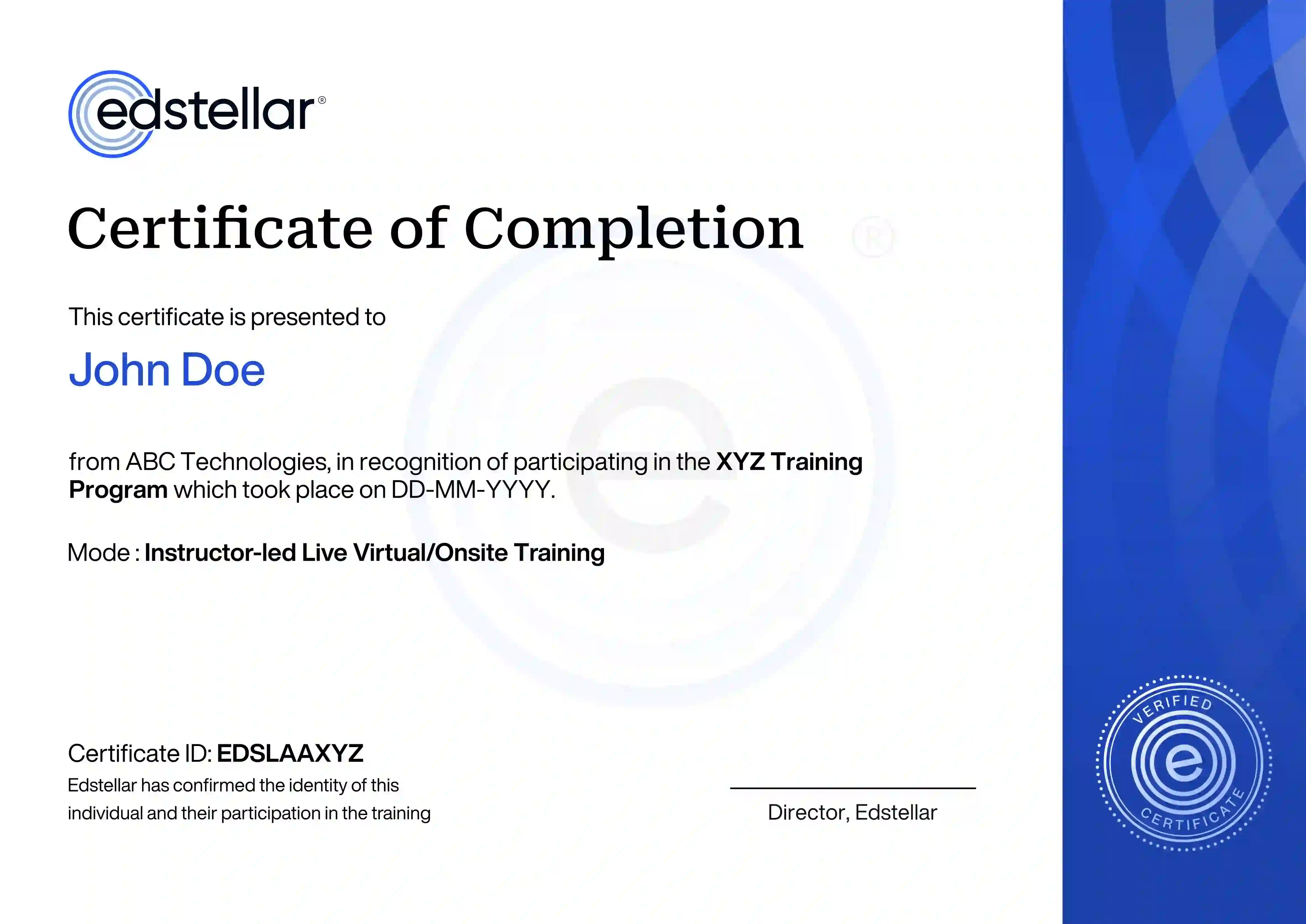
Upon successful completion of the Data Governance Fundamentals training course offered by Edstellar, employees receive a course completion certificate, symbolizing their dedication to ongoing learning and professional development.
This certificate validates the employee's acquired skills and is a powerful motivator, inspiring them to enhance their expertise further and contribute effectively to organizational success.

Other Related Corporate Training Courses


Explore More Courses


Edstellar is a one-stop instructor-led corporate training and coaching solution that addresses organizational upskilling and talent transformation needs globally.
.svg)
.svg)
.svg)

.svg)
Learning Technology
Learning Content Design and Development
Learning Governance, Analytics & ROI
Digital Learning Ecosystem
Training Simulations, AR/VR & Case Studies
Employee Performance Support
Leadership Pipeline & Succession PlanningStrategic Workforce Planning for EnterprisesTransformation & Risk Advisory for EnterprisesDEI Consulting for EnterprisesEmployee Engagement Consulting for Enterprises
Cultural Transformation