.svg "edstellar")

Data Protection Impact Assessments (DPIA) Corporate Training Program
This training equips professionals with practical skills to conduct Data Protection Impact Assessments, identify privacy risks, implement mitigation strategies, and comply with GDPR Article 35 and global DPIA requirements.
(Virtual / On-site / Off-site)
.svg)
Drive Team Excellence with Data Protection Impact Assessments (DPIA) Corporate Training
Data Protection Impact Assessments (DPIAs) are a mandatory requirement under GDPR Article 35 for high-risk data processing activities, and are increasingly required or recommended under privacy laws worldwide. A well-executed DPIA enables organizations to identify and address privacy risks before they materialize, demonstrating accountability and reducing regulatory and reputational exposure. This training covers every stage of the DPIA process, from necessity determination and risk identification to mitigation planning, consultation, documentation, and ongoing review.
Edstellar's Data Protection Impact Assessments (DPIA) Instructor-led course offers virtual/onsite training options so teams can learn in the format that suits them best. The curriculum combines regulatory analysis with structured DPIA methodology exercises, real-world case studies, and practical templates, enabling DPOs, privacy officers, legal, IT, and product teams to confidently scope, conduct, document, and maintain DPIAs that meet regulatory expectations.
.svg)

Skills Your Employees Will Gain
These are the core, hands-on capabilities your team builds during the program.
- DPIA Scoping and Necessity Assessment
- Privacy Risk Identification and Analysis
- Risk Mitigation and Privacy Controls Planning
- GDPR Article 35 Compliance
- Stakeholder Consultation Management
- DPIA Documentation and Reporting
- Post-DPIA Monitoring and Review
What Your Team Will Achieve After This Training
- Master the DPIA necessity assessment process to determine when a DPIA is required under GDPR Article 35 and applicable national law.
- Gain hands-on skills to identify and analyze privacy risks using structured risk matrices and assessment frameworks.
- Develop effective risk mitigation plans applying technical and organizational measures to reduce privacy risks to an acceptable level.
- Learn to conduct stakeholder consultations, engage Data Protection Officers, and manage supervisory authority pre-consultation processes.
- Build compliant DPIA documentation and reports that satisfy regulatory requirements and withstand supervisory authority scrutiny.
- Apply a continuous DPIA review and monitoring framework to maintain ongoing compliance as processing activities and risks evolve.
Topics & Program Outline
The curriculum is organized into focused modules built by industry experts and delivered virtually or on-premise. Interactive sessions reflect the evolving demands of the workplace, keeping the learning both relevant and practical.
- What Constitutes a Data Breach: Definitions and Scope
- GDPR Article 4(12) definition: breach of security leading to unauthorized access, destruction, or loss of personal data
- Broader data breach definitions under CCPA, HIPAA, and other key regulatory frameworks globally
- The spectrum of breach types: confidentiality, integrity, and availability breaches explained
- Why scope matters for breach response: how the definition shapes notification obligations and legal exposure
- The Data Breach Threat Landscape: Actors, Motives, and Methods
- External threat actors: cybercriminals, nation-state actors, hacktivists, and their common breach methods
- Internal threat actors: malicious employees, negligent staff, and compromised accounts
- Common attack vectors: phishing, ransomware, credential stuffing, SQL injection, and supply chain attacks
- Emerging threat trends: AI-powered attacks, deepfake social engineering, and API-targeting breaches
- The Cost and Consequences of Data Breaches
- Financial costs: regulatory fines, litigation, breach response, customer notification, and remediation
- Operational costs: business interruption, system downtime, productivity loss, and staff time
- Reputational costs: customer trust erosion, media coverage, partner relationship damage, and brand devaluation
- Long-term consequences: regulatory scrutiny, increased insurance premiums, and strategic opportunity cost
- Regulatory Definitions of Data Breach Across Key Frameworks
- GDPR personal data breach definition and its three key components: security, personal data, controller obligation
- CCPA breach definition: unauthorized access to non-encrypted or non-redacted personal information
- HIPAA breach definition for covered entities and business associates and its safe harbor exceptions
- Sector-specific breach definitions in financial services, healthcare, and critical infrastructure regulations
- The Data Breach Lifecycle: How Breaches Unfold
- The breach lifecycle model: reconnaissance, initial access, persistence, lateral movement, and exfiltration
- How dwell time between initial access and discovery amplifies breach severity and impact
- The detection gap: why breaches are typically discovered weeks or months after initial compromise
- Understanding the breach lifecycle as a foundation for both prevention and effective response planning
- Why Organizations Fail to Prevent or Detect Breaches
- Common prevention failures: unpatched vulnerabilities, weak access controls, and inadequate monitoring
- Common detection failures: insufficient logging, alert fatigue, and siloed security teams
- Organizational failure factors: security underfunding, lack of leadership support, and poor security culture
- The human factor: why the majority of breaches involve a human element and how to address it
- The Prevention-First Mindset in Data Breach Management
- Shifting from reactive breach response to proactive prevention as the primary risk management strategy
- The relationship between Privacy by Design, data minimization, and breach prevention effectiveness
- Prevention as a regulatory obligation: GDPR Article 32 and equivalent requirements in other frameworks
- Building a prevention-first culture: leadership commitment, investment, and organizational alignment
- Risk-Based Data Protection Strategy
- Conducting a data protection risk assessment to identify and prioritize breach prevention priorities
- Risk-tiering personal data assets by sensitivity, volume, and regulatory exposure
- Aligning security controls with risk level: proportional investment in high-risk data and systems
- Documenting the risk-based approach for regulatory accountability under GDPR Article 5(2)
- Data Minimization and Access Control as Prevention Strategies
- Reducing breach blast radius through aggressive data minimization across collection and retention
- Role-based access control (RBAC) and least privilege principles in limiting personal data exposure
- Data classification schemes: identifying which data requires the highest level of breach prevention investment
- Access review cycles: periodic review and deprovisioning of unnecessary access rights across the organization
- Employee Training and Human Factor Prevention
- Security awareness training programs: phishing simulation, social engineering awareness, and safe data handling
- Role-specific security training for high-risk roles: finance, HR, IT, and customer service staff
- Building a security culture where all employees understand their role in breach prevention
- Measuring the effectiveness of human factor prevention programs through metrics and incident trends
- Third-Party and Supply Chain Breach Prevention
- The supply chain breach risk: how vendor access and data sharing create organizational breach exposure
- Third-party security assessments: evaluating vendor security posture before onboarding
- Contractual breach prevention obligations: data processing agreements, security requirements, and audit rights
- Ongoing vendor monitoring: continuous assessment of third-party security posture and compliance status
- Measuring Prevention Effectiveness and Key Metrics
- Key prevention metrics: vulnerability remediation time, patch coverage, phishing click rates, and access anomalies
- Using security scorecards to track and communicate prevention program effectiveness
- Security benchmarking: comparing organizational prevention capability against industry standards
- Reporting prevention metrics to leadership and boards for governance and investment decisions
- Network Security Controls: Firewalls, Segmentation, and Intrusion Prevention
- Next-generation firewalls: capabilities, placement, and rule management for breach prevention
- Network segmentation: isolating sensitive data environments to limit lateral movement after compromise
- Intrusion prevention systems (IPS): signature-based and behavioral detection of network-level attacks
- Zero trust network architecture: implementing least privilege network access for breach prevention
- Endpoint Protection and Device Management
- Endpoint detection and response (EDR): capabilities, deployment, and management for breach prevention
- Mobile device management (MDM): securing employee and corporate mobile devices against compromise
- USB and removable media controls: preventing data exfiltration through physical media
- Patch management programs: ensuring endpoints are updated to eliminate known vulnerability risks
- Identity and Access Management for Breach Prevention
- Multi-factor authentication (MFA): eliminating credential-based breach risk across critical systems
- Privileged access management (PAM): protecting high-risk administrator accounts from compromise
- Single sign-on and identity federation: centralizing identity management to improve control and visibility
- Identity threat detection: monitoring for compromised credentials, account takeover, and insider misuse
- Encryption as a Breach Prevention and Risk Reduction Control
- Encryption at rest: protecting stored personal data from unauthorized access in the event of breach
- Encryption in transit: TLS and other protocols protecting data moving between systems and users
- Key management practices: ensuring encryption keys are protected, rotated, and auditable
- How encryption affects breach notification requirements: when encrypted data breach may not require notification
- Vulnerability Management and Patch Management Programs
- Vulnerability scanning: continuous identification of security weaknesses in systems and applications
- Penetration testing: simulated attacks to identify exploitable vulnerabilities before threat actors do
- Patch management lifecycle: from vulnerability disclosure to patch deployment and validation
- Bug bounty programs and responsible disclosure as complementary vulnerability management tools
- Security Information and Event Management (SIEM) for Prevention
- What SIEM does: centralizing security logs and generating alerts for potential breach indicators
- SIEM deployment and tuning: reducing false positives while ensuring genuine threats are detected
- SOAR integration: automating response to common threat indicators identified by SIEM
- Using SIEM data for proactive threat hunting and prevention program improvement
- The Detection Gap: Why Breaches Go Undetected
- Industry statistics on dwell time: why attackers often operate for months before detection
- Organizational factors that extend dwell time: monitoring gaps, alert fatigue, and siloed teams
- How attackers maintain persistence and evade detection once inside a network
- The business case for improving detection capability: how dwell time reduction limits breach impact
- Indicators of Compromise (IoCs) and Their Detection
- What IoCs are: file hashes, IP addresses, domain names, and behavioral indicators of compromise
- Sources of IoC intelligence: threat feeds, ISACs, and law enforcement breach disclosures
- Integrating IoC intelligence into detection tools: SIEM, EDR, and network monitoring platforms
- Limitations of IoC-based detection and the shift toward behavioral threat detection approaches
- Security Monitoring and Alerting Systems
- 24/7 security monitoring: building or buying SOC capability for continuous breach detection
- Alert triage and prioritization: distinguishing genuine breach indicators from false positives
- Detection use case design: defining what monitoring rules and thresholds trigger investigation
- Monitoring coverage assessment: identifying gaps in visibility across the organization's environment
- User and Entity Behavior Analytics (UEBA) for Breach Detection
- How UEBA detects anomalous behavior that signature-based tools miss
- Building behavioral baselines for users and entities: establishing what normal looks like
- UEBA use cases for breach detection: insider threats, compromised accounts, and data exfiltration
- Integrating UEBA with SIEM and other detection tools for enhanced breach visibility
- Log Analysis and Threat Hunting
- Log management fundamentals: what to log, how long to retain, and how to protect log integrity
- Threat hunting: proactively searching for evidence of breach without pre-existing alerts
- Forensic log analysis: using log data to reconstruct breach timelines and identify impact
- Developing a log analysis program: tooling, skills, and processes for effective log-based detection
- Third-Party and Vendor Breach Detection
- How to detect when a third-party breach has exposed your organization's data
- Monitoring for vendor-related breach indicators: unusual API activity and data access anomalies
- Third-party breach notification obligations: what vendors must tell you and when
- Responding to notification that a vendor has been breached: immediate steps and investigation triggers
- Building an Incident Response Plan for Data Breaches
- The six phases of incident response: preparation, detection, containment, eradication, recovery, and review
- Tailoring the incident response plan to data breach scenarios: personal data exposure, ransomware, insider threats
- Incident response plan documentation: what to include and how to maintain currency
- Legal review of the incident response plan: engaging privacy counsel in plan development
- Incident Response Team: Roles, Responsibilities, and Structure
- Core incident response team composition: IT, legal, privacy, HR, communications, and executive leadership
- Role cards and RACI matrices for clear accountability during a breach response
- Escalation pathways: when and how to escalate a breach within the incident response team
- External response resources: forensic investigators, breach coaches, crisis PR, and cyber insurance
- Incident Classification and Severity Rating
- Incident classification frameworks: distinguishing data breach events from general security events
- Severity tiers for data breach incidents: low, medium, high, and critical classification criteria
- How severity rating drives response urgency, team activation, and notification decisions
- Reclassification triggers: when to escalate a breach response as more information becomes available
- Communication Protocols Within the Incident Response Team
- Secure communication channels for breach response teams: protecting investigation from further compromise
- Information compartmentalization: need-to-know principles during an active breach investigation
- Out-of-band communication tools when primary systems are compromised or untrusted
- Legal privilege considerations in breach response communications: protecting attorney-client privilege
- Engaging Legal Counsel and External Resources
- Why legal counsel should be engaged immediately upon discovery of a potential data breach
- The role of privacy counsel in breach response: regulatory guidance, notification decisions, and litigation risk
- Cyber insurance: understanding coverage, reporting obligations, and approved vendor panels
- Working with external forensic investigators: scope of engagement and handover protocols
- Exercising the Incident Response Plan: Tabletop Exercises
- What tabletop exercises are: scenario-based team exercises for testing breach response readiness
- Designing effective tabletop exercise scenarios for data breach response teams
- Running the exercise: facilitation, scoring, and capturing lessons for plan improvement
- Full-scale breach simulation: testing operational response capabilities beyond tabletop discussion
- Containment Strategy: Isolating and Limiting Breach Scope
- Short-term containment: immediate isolation actions to stop the active compromise
- Long-term containment: maintaining operations while preparing for full eradication
- Network isolation vs system shutdown: making the right containment decision for the breach type
- Documenting containment decisions and actions for regulatory and forensic purposes
- Short-Term vs Long-Term Containment Decisions
- Business continuity vs containment: balancing operational needs with the imperative to stop the breach
- Deciding when to disconnect systems: criteria for taking systems offline during active breach response
- Preserving evidence during containment: what forensic integrity requires before containment actions
- Communication with operational teams about containment decisions and their business impact
- Evidence Preservation During Containment
- Why evidence preservation is critical: regulatory, legal, and forensic requirements
- Forensic imaging: creating bit-for-bit copies of compromised systems before changes are made
- Log preservation: protecting log data from deletion, overwriting, or tampering during the breach
- Chain of custody documentation: maintaining the integrity of evidence for regulatory and legal purposes
- Eradication: Removing Threat Actors and Malicious Artifacts
- Eradication scope: identifying every system, account, and persistence mechanism used by the attacker
- Malware removal: ensuring all malicious software is identified and completely eliminated
- Account remediation: resetting compromised credentials and closing unauthorized accounts
- Verifying eradication completeness before moving to recovery and restoration phases
- System Recovery and Restoration
- Recovery planning: prioritizing systems and services for restoration based on criticality
- Clean restoration: ensuring recovery from known-good backups, not potentially compromised sources
- Testing before reconnection: validating that restored systems are clean before returning to production
- Post-recovery monitoring: enhanced surveillance of recovered systems for signs of re-compromise
- Documenting Containment and Eradication Actions
- The regulatory requirement to document incident response actions under GDPR and other frameworks
- Building a breach timeline: chronological documentation of breach discovery, containment, and eradication
- Evidence log maintenance: documenting every action taken during containment and eradication phases
- Using breach documentation for regulatory notification, legal response, and post-incident review
- GDPR Data Breach Notification: 72-Hour Supervisory Authority Requirement
- Article 33 requirements: when notification is mandatory, who notifies, and the 72-hour countdown
- The content of a supervisory authority notification: nature, categories, approximate number, and consequences
- Provisional notifications: how to notify within 72 hours when not all information is yet available
- Documenting the notification decision: why organizations that do not notify must record their reasoning
- GDPR Individual Notification: When and How to Notify Data Subjects
- Article 34: when notification of affected individuals is required under GDPR
- The high risk threshold: what constitutes high risk to data subject rights and freedoms
- Content requirements for individual notification: clear language, breach description, and remediation steps
- Timing, format, and channel selection for individual data subject breach notification
- Data Breach Notification Under Other Key Regulations
- CCPA breach notification: California breach notification law obligations for CCPA-covered businesses
- HIPAA breach notification: covered entity and business associate notification obligations and timelines
- NIS2 and critical infrastructure breach notification requirements in the European Union
- Sector-specific notification requirements: financial services, healthcare, and telecommunications regulators
- Multi-Jurisdiction Breach Notification Management
- The challenge of multi-jurisdiction breaches: different notification timelines, content, and authority requirements
- Developing a breach notification decision matrix for organizations operating across multiple jurisdictions
- Lead supervisory authority mechanism under GDPR for cross-border data breach notifications
- Working with legal counsel to coordinate multi-jurisdiction notification strategies
- What to Include in a Breach Notification
- Notification content for supervisory authorities: technical detail, scope, data types, and response measures
- Notification content for individuals: clear, jargon-free language describing what happened and next steps
- Notification content for regulators outside GDPR: adapting content to jurisdiction-specific requirements
- What not to include in notifications: avoiding oversharing that creates additional regulatory or legal risk
- Notification Strategy: Managing Timing, Content, and Scope
- Notification timing strategy: balancing regulatory deadlines with the need for accurate information
- Scope determination: identifying exactly which individuals must be notified and documenting the reasoning
- Phased notification: when and how to issue updated or supplementary breach notifications
- Post-notification regulatory follow-up: responding to supervisory authority questions and investigations
- Stakeholder Communication Planning for Data Breach Scenarios
- Identifying all stakeholder groups in a data breach communication plan: customers, staff, regulators, media, investors
- Developing stakeholder-specific messaging frameworks before a breach occurs
- Message hierarchy: core breach narrative adapted for different stakeholder communication channels
- Crisis communication governance: who approves messages, manages spokespeople, and controls the narrative
- Customer and Affected Individual Communication
- What affected individuals need to know: clear, empathetic communication about what happened and what to do
- Timing the customer notification: regulatory requirements vs reputational risk management considerations
- Channels for customer notification: email, SMS, in-app, and website notification approaches
- Providing remediation support: credit monitoring, helplines, and dedicated breach response resources
- Executive and Board Communication During a Breach
- Initial executive briefing: what leadership needs to know immediately upon breach discovery
- Board notification protocols: triggers, format, and frequency of board-level breach updates
- Executive decision-making during a breach: key decisions requiring C-suite or board involvement
- Maintaining executive confidence: how to keep leadership informed without creating unhelpful interference
- Partner and Third-Party Notification and Coordination
- Identifying which business partners and data processors must be notified of a breach
- Coordinating breach response with processors, sub-processors, and joint controllers
- Managing information flow to partners while protecting investigation integrity and legal privilege
- Third-party liability and indemnity considerations in breach partner communication
- Media and Public Relations Management
- Preparing a breach press statement: key elements, tone, and approval process
- Spokesperson selection and media training for data breach response scenarios
- Managing media inquiries during an active breach: protocols, holding statements, and escalation
- Press conference management when a breach attracts significant media attention
- Maintaining Trust During and After a Breach
- Trust recovery principles: transparency, accountability, and demonstrable remediation action
- Long-term customer communication: keeping affected individuals informed beyond the initial notification
- Public commitment to improvement: communicating what the organization is doing to prevent recurrence
- Monitoring trust indicators post-breach: sentiment, customer retention, and brand reputation metrics
- Digital Forensics Fundamentals for Data Breach Response Teams
- What digital forensics involves: evidence collection, preservation, analysis, and reporting
- The forensic process in a data breach: from initial detection through to root cause findings
- In-house vs outsourced forensics: when to use internal teams and when to engage external specialists
- Preparing the organization for forensic investigation: pre-incident capability building and tooling
- Evidence Collection, Chain of Custody, and Forensic Integrity
- Evidence types in a data breach: system images, logs, network traffic captures, and user activity records
- Chain of custody requirements: documenting who collected, accessed, and transferred digital evidence
- Forensic imaging standards: bit-for-bit copy requirements and hash verification for integrity
- Anti-forensic artifacts: identifying attacker attempts to destroy or manipulate evidence
- Root Cause Analysis: Identifying How the Breach Occurred
- Root cause analysis methodology for data breach incidents: five whys, fishbone, and fault tree analysis
- Identifying the initial access vector: how the attacker first gained entry to the environment
- Distinguishing root cause from contributing factors and proximate causes in the breach analysis
- Documenting root cause findings with the evidence trail required for regulatory and legal purposes
- Mapping the Attack Timeline and Blast Radius
- Reconstructing the attack timeline: using logs and forensic artifacts to establish breach chronology
- Blast radius assessment: determining which systems, data, and individuals were affected by the breach
- Data exfiltration assessment: identifying what data was accessed, copied, or transmitted externally
- Using timeline and blast radius findings to inform notification scope and regulatory reporting
- Working With External Forensic Investigators
- When to engage external forensic investigators: complexity, capacity, and independence considerations
- Scoping the forensic engagement: defining what investigators will examine and what findings are required
- Managing the forensic investigation timeline: balancing thoroughness with regulatory notification deadlines
- Receiving and using forensic report findings: integrating investigator conclusions into regulatory responses
- Documenting Forensic Findings for Regulatory and Legal Purposes
- Forensic report structure: executive summary, methodology, findings, and conclusions
- What regulators expect from forensic documentation in a breach investigation response
- Protecting forensic reports under legal privilege: engaging counsel before commissioning investigations
- Retention of forensic documentation: how long to keep breach investigation records
- Post-Incident Review and Lessons Learned Process
- The post-incident review (PIR) process: timeline, participants, and structured review methodology
- What a PIR should cover: breach timeline, response effectiveness, gaps identified, and recommendations
- Distinguishing between blame and accountability in post-incident review culture
- Turning PIR findings into actionable improvements in controls, processes, and response plans
- Updating Policies, Controls, and Response Plans After a Breach
- Prioritizing remediation actions emerging from the PIR and breach investigation findings
- Control improvement roadmap: technical, organizational, and procedural changes required
- Response plan updates: incorporating breach response lessons into the incident response plan
- Communicating improvement actions to regulators, insurers, and leadership as part of recovery
- Security Culture and Employee Awareness Programs
- Post-breach security awareness refresh: addressing the human factors that contributed to the incident
- Building a culture where employees report suspicious activity rather than ignore or conceal it
- Gamification and behavioral change techniques for sustained security culture improvement
- Measuring security culture maturity: surveys, phishing simulation rates, and incident reporting metrics
- Building a Data Breach Resilience Framework
- The breach resilience framework: prevention, detection, response, recovery, and continuous improvement
- Aligning the breach resilience framework with organizational risk management and governance
- Integrating breach resilience into business continuity planning and enterprise risk management
- Regulatory alignment: how the breach resilience framework supports GDPR Article 32 and equivalent obligations
- Measuring Resilience: Key Performance Indicators and Metrics
- Prevention metrics: patch coverage, access review completion, and vulnerability remediation time
- Detection metrics: mean time to detect (MTTD), alert triage time, and monitoring coverage
- Response metrics: mean time to respond (MTTR), notification timeliness, and containment effectiveness
- Recovery metrics: system recovery time, affected individual support quality, and trust restoration
- Continuous Improvement: From Breach Response to Breach Resilience
- Embedding continuous improvement into the breach prevention and response program lifecycle
- Using threat intelligence to anticipate emerging breach threats and update prevention strategies
- Annual breach resilience assessment: auditing the full breach prevention and response framework
- Building breach resilience as a strategic organizational capability and competitive advantage
Who Should Attend?
This program suits professionals at many levels across the organization, including:
- Data Protection Officers
- Privacy and Compliance Officers
- IT and Security Managers
- Legal Counsel
- Product Managers
- Business Analysts
What are the Prerequisites?
Professionals should have a basic understanding of data protection principles and familiarity with GDPR or applicable privacy regulations to take the Data Protection Impact Assessments (DPIA) training course.
Choose the Format That Fits Your Team
We design training your teams actually engage with, and deliver it the way that suits you best. Through a vetted global trainer network, Edstellar runs sessions in 10+ languages with consistent quality anywhere.


.webp "Virtual Data Protection Impact Assessments (DPIA) Training")
Virtual / online: expert-led live sessions delivered anywhere, with consistency and easy scheduling.
.webp "On-site Data Protection Impact Assessments (DPIA) Training")
On-site (in-house): immersive, instructor-led learning at your office.
.webp "Off-site Data Protection Impact Assessments (DPIA) Training")
Off-site: focused, instructor-led group learning away from everyday workplace distractions.
Get a Proposal Shaped to Your Needs
Need pricing for onsite, offsite, or virtual delivery? Get a proposal tailored to your team's needs.
64 hours of group training (includes VILT/In-person On-site)
Tailored for SMBs
Tailor-Made Trainee Licenses with Our Exclusive Training Packages!
160 hours of group training (includes VILT/In-person On-site)
Ideal for growing SMBs
Tailor-Made Trainee Licenses with Our Exclusive Training Packages!
400 hours of group training (includes VILT/In-person On-site)
Designed for large corporations
Tailor-Made Trainee Licenses with Our Exclusive Training Packages!
Unlimited duration
Designed for large corporations
What Sets Edstellar Apart
Experienced Trainers
Our trainers are drawn from a vetted global network and bring years of industry expertise, keeping every session practical and impactful.
Proven Quality
With a strong global track record, Edstellar is known for quality and engaging delivery.
Industry-Relevant Curriculum
Our programs are built by experts to match the demands of today's industry.
Fully Customizable
Every program can be tailored to your organization's goals.
Comprehensive Support
We provide pre- and post-session support for a complete learning experience.
Global Multi-Location & Multilingual Training Delivery
We deliver in multiple languages to support diverse global teams.
Recognition That Motivates Your Team
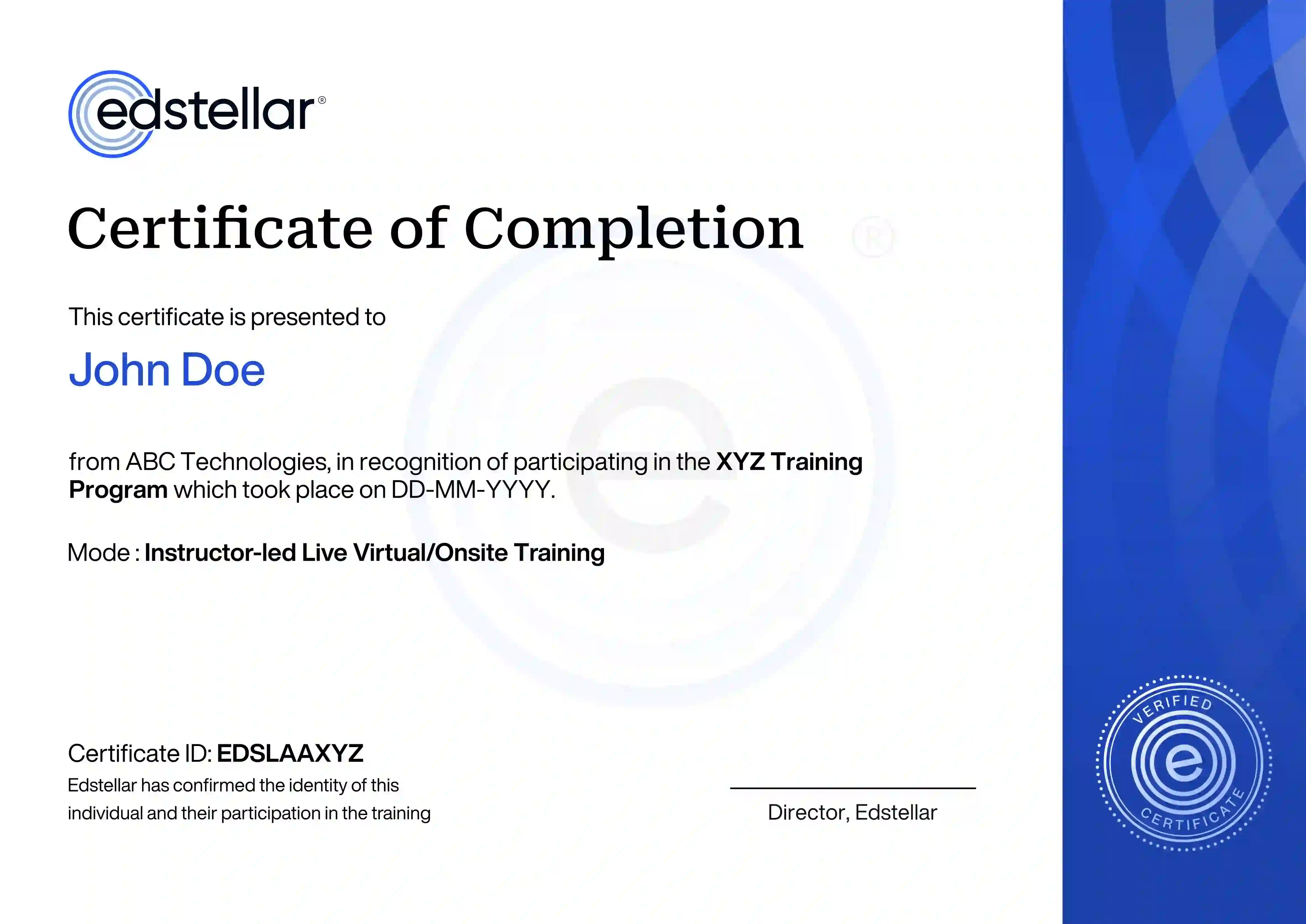
Upon successful completion of the Data Protection Impact Assessments (DPIA) training course offered by Edstellar, employees receive a course completion certificate, symbolizing their dedication to ongoing learning and professional development.
This certificate validates the employee's acquired skills and is a powerful motivator, inspiring them to enhance their expertise further and contribute effectively to organizational success.

Explore More Courses


Edstellar is a one-stop instructor-led corporate training and coaching solution that addresses organizational upskilling and talent transformation needs globally.
.svg)
.svg)
.svg)

.svg)
Learning Technology
Learning Content Design and Development
Learning Governance, Analytics & ROI
Digital Learning Ecosystem
Training Simulations, AR/VR & Case Studies
Employee Performance Support
Leadership Pipeline & Succession PlanningStrategic Workforce Planning for EnterprisesTransformation & Risk Advisory for EnterprisesDEI Consulting for EnterprisesEmployee Engagement Consulting for Enterprises
Cultural Transformation