Home
Corporate Training Courses
IT & Technical
Data Science Training
Data Science for Financial Risk Modeling Training

Drive Team Excellence with Data Science for Financial Risk Modeling Corporate Training

Empower your teams with expert-led on-site, off-site, and virtual Data Science for Financial Risk Modeling Training through Edstellar, a premier corporate training provider for organizations globally. Designed to meet your specific training needs, this group training program ensures your team is primed to drive your business goals. Help your employees build lasting capabilities that translate into real performance gains.

Data science has transformed financial risk management, enabling institutions to build more accurate and data-driven models for credit risk, market risk, and operational risk quantification. This training equips participants with the analytical skills to develop, validate, and deploy financial risk models using statistical methods and machine learning, bridging the gap between data science capabilities and the rigorous demands of risk management and regulatory compliance in financial institutions.

Edstellar's Data Science for Financial Risk Modeling Instructor-led course offers virtual/onsite training options that combine statistical theory with practical model-building workshops. Participants apply Python and R to real financial datasets, building credit scoring models, VaR frameworks, and operational risk pipelines that meet both business requirements and regulatory standards across banking, insurance, and investment management sectors.

Get Customized Expert-led Training for Your Teams
Customized Training Delivery
Scale Your Training: Small to Large Teams
In-person Onsite, Live Virtual or Hybrid Training Modes
Plan from 2000+ Industry-ready Training Programs
Experience Hands-On Learning from Industry Experts
Delivery Capability Across 100+ Countries & 10+ Languages
""""

Key Skills Employees Gain from Instructor-led Data Science for Financial Risk Modeling Training

Data Science for Financial Risk Modeling skills corporate training will enable teams to effectively apply their learnings at work.

  • Credit Risk Modeling
  • Market Risk Analysis
  • Statistical Risk Modeling
  • Machine Learning for Finance
  • Operational Risk Assessment
  • Model Validation and Backtesting
  • Risk-Adjusted Performance Measurement

Key Learning Outcomes of Data Science for Financial Risk Modeling Training Workshop

Upon completing Edstellar’s Data Science for Financial Risk Modeling workshop, employees will gain valuable, job-relevant insights and develop the confidence to apply their learning effectively in the professional environment.

  • Master data science and statistical modeling techniques applied to credit, market, and operational risk in financial institutions.
  • Gain hands-on skills to build credit scoring, PD/LGD/EAD models, and portfolio risk assessment pipelines.
  • Develop market risk models including VaR, CVaR, and stress testing frameworks for financial portfolio management.
  • Learn operational risk modeling approaches using loss distribution and Bayesian estimation for risk capital.
  • Build proficiency in model validation, backtesting, and regulatory compliance practices for financial risk models.
  • Apply risk-adjusted performance measurement frameworks to evaluate financial strategies and risk trade-offs.

Key Benefits of the Data Science for Financial Risk Modeling Group Training

Attending our Data Science for Financial Risk Modeling group training classes provides your team with a powerful opportunity to build skills, boost confidence, and develop a deeper understanding of the concepts that matter most. The collaborative learning environment fosters knowledge sharing and enables employees to translate insights into actionable work outcomes.

  • Instructor-led training covering data science applications for credit, market, and operational risk modeling.
  • Hands-on exercises building risk models using Python, R, and financial datasets from real-world scenarios.
  • Learn statistical and machine learning techniques applied to financial risk quantification and management.
  • Covers credit scoring, PD/LGD/EAD modeling, and loan portfolio risk assessment methodologies.
  • Market risk training including VaR, CVaR, stress testing, and scenario analysis for financial portfolios.
  • Operational risk modeling using data-driven approaches for loss distribution and risk capital estimation.
  • Model validation frameworks covering backtesting, benchmarking, and regulatory compliance requirements.
  • Risk-adjusted performance measurement training including Sharpe ratio, RAROC, and risk attribution.
  • Flexible virtual and onsite delivery suitable for data scientists, risk analysts, and finance professionals.
  • Certificate of completion recognizing proficiency in data science for financial risk modeling.

Topics and Outline of Data Science for Financial Risk Modeling Training

Our virtual and on-premise Data Science for Financial Risk Modeling training curriculum is structured into focused modules developed by industry experts. This training for organizations provides an interactive learning experience that addresses the evolving demands of the workplace, making it both relevant and practical.

  1. Financial Risk Categories Overview
    • Credit, market, and operational risk definitions and their significance to financial institutions
    • Liquidity risk, systemic risk, and model risk as additional dimensions of financial exposure
    • Relationships between risk categories and how they interact in financial institution portfolios
    • Regulatory capital requirements under Basel III and their relationship to risk measurement
  2. Role of Data Science in Risk Management
    • How data science improves accuracy, speed, and scalability of financial risk models
    • Traditional actuarial and statistical methods vs modern machine learning risk approaches
    • Data science applications across the risk lifecycle: identification, measurement, and monitoring
    • Skills and tools a data scientist needs to work effectively in financial risk environments
  3. Regulatory Landscape
    • Basel III/IV capital adequacy framework and its data and modeling requirements
    • IFRS 9 expected credit loss model requirements and their data science implications
    • SR 11-7 model risk management guidance and its application to financial risk models
    • FRTB, DFAST, and CCAR stress testing requirements and data science model inputs
  4. Risk Data Architecture
    • Data infrastructure requirements for financial risk modeling: sources, quality, and governance
    • Risk data aggregation principles under BCBS 239 and their practical implementation
    • Feature engineering for financial risk: transforming raw financial data into model inputs
    • Data pipelines for risk model development, validation, and production deployment
  5. Python and R for Financial Risk
    • Python libraries for financial risk: NumPy, Pandas, Scikit-learn, and Statsmodels
    • R packages for quantitative finance: PerformanceAnalytics, QuantLib, and Risk
    • Setting up reproducible financial risk analysis environments with version control
    • Jupyter and RMarkdown notebooks for transparent and auditable risk model development
  6. Risk Management Frameworks Overview
    • Enterprise risk management framework structure and its data science integration points
    • Risk appetite statements and how quantitative risk models support appetite setting
    • Three lines of defense model and the role of data science in each line
    • Risk reporting requirements and how data science outputs feed into governance frameworks
  1. Credit Risk Concepts
    • Definition of credit risk and its components: default risk, concentration risk, and migration risk
    • Credit risk measurement objectives: expected loss, unexpected loss, and economic capital
    • Retail vs corporate credit risk and the different modeling approaches each requires
    • Credit risk lifecycle from origination through monitoring, default, and recovery
  2. Probability of Default Modeling
    • PD definition under Basel IRB and IFRS 9 frameworks and their methodological differences
    • Through-the-cycle vs point-in-time PD estimation and when each approach is appropriate
    • Calibrating PD models to long-run default rates using historical credit data
    • PD model performance metrics: Gini coefficient, KS statistic, and AUC evaluation
  3. Loss Given Default Estimation
    • LGD definition and its components: recovery rate, workout costs, and time discounting
    • Collateral valuation and its role in LGD estimation for secured exposures
    • LGD modeling approaches: regression, survival analysis, and machine learning methods
    • Downturn LGD requirements under Basel IRB and regulatory adjustment methods
  4. Exposure at Default Calculation
    • EAD definition and its measurement for different product types and facilities
    • Credit conversion factors for off-balance-sheet exposures and undrawn commitments
    • EAD estimation models for revolving credit products and committed credit lines
    • Stress testing EAD assumptions under adverse economic and liquidity scenarios
  5. Expected and Unexpected Loss
    • Expected loss calculation from PD, LGD, and EAD components for portfolio management
    • Portfolio loss distribution modeling and its role in economic capital estimation
    • Credit risk contribution analysis: identifying the largest risk contributors in a portfolio
    • Provisioning requirements under IFRS 9 and how EL models feed into accounting reserves
  6. Credit Scorecard Development
    • Scorecard design process: variable selection, binning, WoE transformation, and scoring
    • Logistic regression as the foundation for traditional credit scorecard development
    • Scorecard cutoff setting balancing default minimization with acceptance rate targets
    • Scorecard monitoring: population stability index and characteristic stability index
  1. Machine Learning for Default Prediction
    • Random forest and gradient boosting classifiers applied to credit default prediction
    • Feature importance analysis for identifying key credit risk drivers in ML models
    • Handling class imbalance in credit default datasets with SMOTE and cost-sensitive methods
    • Comparing ML model accuracy vs logistic regression on credit default prediction tasks
  2. Deep Learning in Credit Risk
    • Neural network architectures for tabular credit data and their practical limitations
    • Recurrent neural networks for sequential credit behavior and payment pattern modeling
    • Autoencoders for anomaly detection in credit application and transaction data
    • Calibrating deep learning model output probabilities for regulatory compliance use
  3. Feature Engineering for Credit Models
    • Credit bureau data features: payment history, utilization, inquiries, and derogatory marks
    • Behavioral features from transaction data: spending velocity, merchant patterns, and timing
    • Macroeconomic features for forward-looking IFRS 9 expected credit loss modeling
    • Alternative data sources: telecom, utilities, and digital footprint data for thin-file borrowers
  4. Credit Portfolio Analysis
    • Portfolio segmentation strategies for credit risk model development and monitoring
    • Concentration risk measurement: single name, sector, and geographic concentration limits
    • Credit portfolio correlation modeling and its impact on unexpected loss estimates
    • Portfolio-level stress testing for credit risk under adverse macroeconomic scenarios
  5. IFRS 9 Staging and Impairment
    • IFRS 9 three-stage classification: Stage 1, Stage 2, and Stage 3 criteria and triggers
    • Significant increase in credit risk criteria and their quantitative and qualitative indicators
    • Lifetime expected credit loss calculation methodology for Stage 2 and Stage 3 exposures
    • Overlays and management adjustments to model-based ECL estimates in practice
  6. Explainable AI in Credit Decisions
    • Regulatory requirements for model explainability in credit decisioning applications
    • SHAP values for explaining individual credit model predictions to regulators and customers
    • LIME for local model interpretation in complex ensemble credit risk models
    • Building compliant adverse action reason codes from ML credit model outputs
  1. Introduction to Market Risk
    • Market risk definition and its key components: equity, interest rate, FX, and commodity
    • Trading book vs banking book market risk and their different regulatory treatments
    • Sources of market risk data: price feeds, curves, volatility surfaces, and correlations
    • Market risk management framework and its integration with trading desk operations
  2. Value at Risk Methods
    • Historical simulation VaR: methodology, advantages, and lookback period selection
    • Parametric VaR: variance-covariance method and normality assumption limitations
    • Monte Carlo VaR: simulation-based approach for complex or non-linear portfolios
    • VaR confidence levels and holding periods under Basel regulatory requirements
  3. Conditional Value at Risk
    • CVaR definition as Expected Shortfall and its superiority over VaR for tail risk
    • Computing CVaR from historical simulation and parametric distributions
    • FRTB expected shortfall requirements and the shift from VaR to CVaR reporting
    • Comparing VaR and CVaR behavior during financial market stress events
  4. Stress Testing and Scenario Analysis
    • Historical stress scenarios: applying past market crises to current portfolio positions
    • Hypothetical stress scenarios: constructing plausible adverse market shocks
    • Reverse stress testing: identifying scenarios that would cause a specific loss threshold
    • Regulatory stress testing frameworks: DFAST, CCAR, and EBA stress test methodologies
  5. Interest Rate Risk Analysis
    • Duration, modified duration, and convexity for measuring interest rate sensitivity
    • Yield curve modeling: Nelson-Siegel, Svensson, and principal component approaches
    • Interest rate risk in the banking book under IRRBB regulatory requirements
    • Interest rate scenario analysis for parallel shifts, tilts, and curve steepening events
  6. Equity and FX Risk Modeling
    • Equity risk factor models: market beta, sector factors, and style factor exposures
    • Volatility modeling with GARCH and stochastic volatility models for equity risk
    • FX risk measurement for single currency pairs and cross-currency portfolio exposures
    • Correlation and covariance estimation for multi-asset market risk portfolio models
  1. Modern Portfolio Theory
    • Markowitz mean-variance framework: expected return, variance, and covariance inputs
    • Efficient frontier construction and portfolio optimization with Python and R
    • Capital market line, Sharpe ratio, and tangency portfolio concepts applied
    • Limitations of MPT and practical extensions for real-world portfolio management
  2. Correlation and Covariance in Risk
    • Sample covariance matrix estimation challenges for large financial portfolios
    • Shrinkage estimators: Ledoit-Wolf and Oracle Approximating Shrinkage for covariance
    • Dynamic conditional correlation for modeling time-varying asset correlations
    • Correlation breakdown during market stress and its implications for risk models
  3. Factor Models for Portfolio Risk
    • CAPM and multi-factor model frameworks for portfolio risk decomposition
    • Fama-French and Carhart factors for equity portfolio risk attribution
    • Statistical factor models using PCA for dimensionality reduction in risk modeling
    • Risk factor exposure analysis and active risk monitoring for portfolio managers
  4. Portfolio VaR and Component VaR
    • Portfolio VaR aggregation from individual position VaR using correlation matrices
    • Component VaR and marginal VaR for risk contribution analysis by position
    • Incremental VaR for measuring the risk impact of adding a new position to a portfolio
    • Risk attribution by asset class, sector, and geography for portfolio risk reporting
  5. Tail Risk and Extreme Value Theory
    • Fat tails in financial returns and why normal distribution assumptions underestimate risk
    • Extreme value theory: block maxima and peaks-over-threshold approaches
    • Generalized Pareto distribution fitting for tail risk quantification in financial data
    • Copula models for capturing non-linear dependence and tail co-movement in portfolios
  6. Risk-Return Optimization
    • Maximum Sharpe ratio portfolio construction with long-only and long-short constraints
    • Risk parity and equal risk contribution portfolio optimization approaches
    • Black-Litterman model for incorporating portfolio manager views into optimization
    • Robust optimization under parameter uncertainty for financial portfolio construction
  1. Operational Risk Identification
    • Basel operational risk event categories: internal fraud, external fraud, and execution errors
    • Risk and Control Self-Assessment as a structured operational risk identification tool
    • Process mapping for identifying operational risk exposure in financial workflows
    • Emerging operational risks: cyber threats, third-party failures, and conduct risk
  2. Loss Data Collection and Analysis
    • Internal loss data collection standards and minimum thresholds for Basel compliance
    • External loss data sources: ORX, public databases, and consortium data for benchmarking
    • Data quality issues in operational loss databases and cleaning approaches
    • Loss data trend analysis to identify deteriorating risk areas or improving control environments
  3. Loss Distribution Approach
    • LDA methodology: fitting frequency and severity distributions to operational loss data
    • Common frequency distributions: Poisson and negative binomial for event count modeling
    • Severity distribution fitting: lognormal, Weibull, and generalized Pareto for loss amounts
    • Compound loss distribution estimation using Monte Carlo simulation for capital calculation
  4. Bayesian Methods in Operational Risk
    • Bayesian inference for updating operational risk parameter estimates with new loss data
    • Combining internal loss data with expert judgment using Bayesian credibility weighting
    • Bayesian networks for modeling causal relationships in operational risk scenarios
    • Scenario analysis integration with Bayesian priors for low-frequency high-severity risks
  5. Key Risk Indicators and Monitoring
    • KRI design principles: measurability, timeliness, and predictive power for risk events
    • Setting KRI thresholds and escalation triggers for operational risk monitoring
    • KRI dashboard design for operational risk managers and business line oversight
    • Testing KRI predictive performance using historical loss data and backtesting
  6. Operational Risk Capital Estimation
    • Advanced Measurement Approach for operational risk capital under Basel II/III
    • Standardized Measurement Approach under Basel IV and its data requirements
    • Business environment and internal control factor adjustments to capital estimates
    • Economic capital vs regulatory capital for operational risk and their practical differences
  1. Supervised Learning for Risk Classification
    • Decision trees, logistic regression, and SVM applied to financial risk classification
    • Hyperparameter tuning strategies for risk classification models in financial contexts
    • Model selection criteria for regulatory-constrained financial risk applications
    • Pipeline design for feature preprocessing and model training in risk workflows
  2. Ensemble Methods in Finance
    • Random forest for robust credit risk and fraud detection model development
    • Gradient boosting: XGBoost, LightGBM, and CatBoost applied to financial risk tasks
    • Stacking and blending ensemble strategies for financial risk model performance improvement
    • Feature importance and permutation importance analysis for ensemble financial models
  3. Deep Learning for Financial Risk
    • LSTM and GRU networks for time-series risk forecasting in financial markets
    • Transformer architectures for sequential financial data and risk prediction tasks
    • Convolutional neural networks for pattern recognition in financial chart and signal data
    • Training deep learning risk models on limited financial datasets with regularization
  4. Anomaly Detection for Risk
    • Isolation forest and one-class SVM for detecting unusual financial transactions
    • Autoencoder-based anomaly detection for fraud and model performance degradation
    • Statistical process control methods for detecting shifts in risk model input distributions
    • Setting detection thresholds to balance false positive and false negative rates in risk
  5. Time-Series Models for Risk Forecasting
    • GARCH models for volatility forecasting in equity, FX, and commodity risk
    • Vector autoregression for multi-variate macroeconomic risk factor forecasting
    • Machine learning regression for return and risk factor forecasting in financial models
    • Combining macroeconomic forecasts with ML models for forward-looking risk estimates
  6. Explainable AI for Risk Models
    • Regulatory expectations for model transparency and explainability in financial risk
    • SHAP global and local explanations for financial risk model output interpretation
    • LIME for explaining individual risk predictions to business users and regulators
    • Building model cards and explainability documentation for financial risk governance
  1. Model Risk Management Principles
    • SR 11-7 model risk management framework and its three core activities
    • Model definition, materiality, and inventory requirements for financial institutions
    • Roles of model owners, model developers, and independent model validators
    • Model risk appetite and tiering frameworks for risk-proportionate validation resourcing
  2. Backtesting Methodologies
    • Unconditional and conditional coverage backtests for VaR model validation
    • Basel traffic light backtesting framework and exception thresholds for market risk
    • Credit model backtesting: comparing predicted PD/LGD to realized default outcomes
    • Out-of-time and out-of-sample backtesting design for robust model performance assessment
  3. Statistical Tests for Model Adequacy
    • Kolmogorov-Smirnov test for evaluating distributional fit in risk model assumptions
    • Hosmer-Lemeshow goodness-of-fit test for credit scorecard and PD model calibration
    • Brier score and log-loss for evaluating probabilistic risk model calibration quality
    • Benchmark model comparison using Diebold-Mariano test for forecast accuracy
  4. Champion-Challenger Testing
    • Champion-challenger framework for comparing current vs proposed financial risk models
    • Statistical significance testing for performance differences in champion-challenger trials
    • Governance requirements for champion-challenger testing in regulated financial institutions
    • Rollout and monitoring plan following a successful challenger model promotion
  5. Regulatory Model Validation
    • IRB model validation requirements under Basel III for credit risk internal models
    • FRTB internal model approval process and model validation obligations
    • Supervisory model review expectations and typical examination findings in model governance
    • Preparing model validation reports that meet both business and regulatory standards
  6. Model Inventory and Documentation
    • Building and maintaining a financial risk model inventory with tiering and status tracking
    • Model documentation standards: methodology, data, assumptions, and limitations
    • Change management processes for model updates, redevelopments, and retirements
    • Audit trail requirements for model development and validation activities
  1. Risk Dashboard Design
    • Principles of effective risk dashboard design for credit, market, and operational risk
    • Selecting appropriate visualization types for risk metrics, exposures, and trends
    • Audience-specific dashboard design: front office, risk management, and board levels
    • Interactive risk dashboards with drill-down and filtering for risk investigation
  2. Regulatory Reporting Frameworks
    • COREP and FINREP templates for regulatory capital and financial reporting submissions
    • Automating regulatory report generation from risk model outputs and data pipelines
    • Data lineage and audit trail requirements for regulatory risk reporting systems
    • Managing regulatory report versioning, submission deadlines, and restatement processes
  3. Communicating Risk to Non-Technical Stakeholders
    • Translating quantitative risk model outputs into business-relevant risk language
    • Risk narrative writing for board risk committee and executive leadership reporting
    • Presenting risk model limitations and uncertainty to senior business stakeholders
    • Scenario and stress test results communication for strategic decision-making support
  4. Interactive Risk Visualization with Python
    • Plotly and Dash for building interactive financial risk dashboards in Python
    • Matplotlib and Seaborn for static risk analysis and model performance visualization
    • Visualizing loss distributions, VaR cones, and credit migration matrices
    • Heatmaps and correlation matrices for portfolio risk factor visualization
  5. Automated Report Generation
    • Scheduling automated risk reports for daily, weekly, and monthly distribution
    • Parameterized report templates that update with refreshed risk model outputs
    • Integrating Python risk analytics outputs into PDF and Excel reporting workflows
    • Report governance: review, sign-off, and version control for automated risk reports
  6. Data Governance for Risk Reporting
    • Data quality controls for risk reporting inputs: completeness, accuracy, and timeliness
    • Reconciliation processes between risk systems and financial accounting data
    • Data lineage documentation for regulatory risk reporting traceability requirements
    • Risk data governance committee roles and responsibilities in financial institutions
  1. End-to-End Credit Risk Pipeline
    • Building a full credit risk modeling pipeline from raw data to deployed scorecard
    • Data preparation, model training, calibration, and validation in an end-to-end workflow
    • Packaging credit risk models for production deployment with monitoring hooks
    • Presenting credit risk model results to a mock risk committee for approval
  2. Market Risk Monitoring System
    • Designing a daily VaR and CVaR calculation system for a multi-asset portfolio
    • Integrating market data feeds with risk calculation and reporting infrastructure
    • Automated backtesting and exception reporting for market risk regulatory compliance
    • Stress scenario application and impact reporting for a portfolio management use case
  3. Integrated Risk Model Deployment
    • Deploying financial risk models as APIs for real-time decisioning system integration
    • Containerizing risk models with Docker for consistent and reproducible deployment
    • Model monitoring in production: detecting drift, degradation, and data quality issues
    • Change management for risk model updates in regulated financial institution environments
  4. Risk Model Benchmarking
    • Defining performance benchmarks for credit, market, and operational risk models
    • Comparing model performance across development, validation, and production populations
    • Statistical significance testing for performance differences across model versions
    • Presenting model benchmarking results in a validation report format for governance
  5. Industry Case Studies
    • Retail bank credit risk model redevelopment under IFRS 9 regulatory requirements
    • Investment management market risk VaR model enhancement for FRTB compliance
    • Insurance operational risk capital model using LDA and Bayesian scenario integration
    • Fintech alternative data credit scoring for thin-file customer segment expansion
  6. Emerging Trends in Quantitative Risk
    • Generative AI and large language models emerging applications in financial risk
    • Climate risk integration into credit and market risk models under TCFD requirements
    • Quantum computing potential for portfolio optimization and risk calculation at scale
    • Real-time risk analytics and continuous monitoring replacing batch risk reporting cycles

Who Can Take the Data Science for Financial Risk Modeling Training Course

The Data Science for Financial Risk Modeling training program can also be taken by professionals at various levels in the organization.

  • Risk Analysts
  • Quantitative Analysts
  • Data Scientists
  • Financial Risk Managers
  • Credit Analysts
  • Investment Analysts

Prerequisites for Data Science for Financial Risk Modeling Training

Professionals should have foundational knowledge of statistics, data science concepts, and basic financial principles to take the Data Science for Financial Risk Modeling training course.

Request a Quote for your Corporate Training Requirements

Valid number

Delivering Training for Organizations across 100 Countries and 10+ Languages

Corporate Group Training Delivery Modes
for Data Science for Financial Risk Modeling Training

At Edstellar, we understand the importance of impactful and engaging training for employees. As a leading Data Science for Financial Risk Modeling training provider, we ensure the training is more interactive by offering Face-to-Face onsite/in-house or virtual/online sessions for companies. This approach has proven to be effective, outcome-oriented, and produces a well-rounded training experience for your teams.

Virtual Data Science for Financial Risk Modeling Training

Edstellar's Data Science for Financial Risk Modeling virtual/online training sessions bring expert-led, high-quality training to your teams anywhere, ensuring consistency and seamless integration into their schedules.

With global reach, your employees can get trained from various locations
The consistent training quality ensures uniform learning outcomes
Participants can attend training in their own space without the need for traveling
Organizations can scale learning by accommodating large groups of participants
Interactive tools can be used to enhance learning engagement
On-site Data Science for Financial Risk Modeling Training

Edstellar's Data Science for Financial Risk Modeling inhouse face to face instructor-led training delivers immersive and insightful learning experiences right in the comfort of your office.

Higher engagement and better learning experience through face-to-face interaction
Workplace environment can be tailored to learning requirements
Team collaboration and knowledge sharing improves training effectiveness
Demonstration of processes for hands-on learning and better understanding
Participants can get their doubts clarified and gain valuable insights through direct interaction
Off-site Data Science for Financial Risk Modeling Training

Edstellar's Data Science for Financial Risk Modeling offsite face-to-face instructor-led group training offer a unique opportunity for teams to immerse themselves in focused and dynamic learning environments away from their usual workplace distractions.

Distraction-free environment improves learning engagement
Team bonding can be improved through activities
Dedicated schedule for training away from office set up can improve learning effectiveness
Boosts employee morale and reflects organization's commitment to employee development

Explore Our Customized Pricing Package
for
Data Science for Financial Risk Modeling Corporate Training

Looking for pricing details for onsite, offsite, or virtual instructor-led Data Science for Financial Risk Modeling training? Get a customized proposal tailored to your team’s specific needs.

Request a Group Training Quote
""
How Many Team Members Need Training?
Please select an option or fill in the custom field.
"'

Is Your Corporate Training Requirement Only for Data Science for Financial Risk Modeling?

Please select at least one course.
""
Add the List of Training Workshops
search icon

      Please select the course

      No. of Courses selected: 0

      Clear

      Upload a CSV

      Send us your Training Requirements in 3 Easy steps

      1. 1
      2. 2
        Add the required training workshops
      3. 3
        Upload to get a quick quote or email it to contact@edstellar.com

      ""

      Looking for a Complete Package?

      Looking for a one-time pricing option for all your annual training requirements?

      View Corporate Training Packages
      ""
      Select the Option that Best Describes Your Corporate Training Requirement

      Please select an option or choose from the recurring options.
      ""
      Verify and Submit Your Request

      Review Your Corporate Training Selection Summary

      Training Program: Data Science for Financial Risk Modeling Training

      1. No of Team Members

      2. Selected Training Preference

      3. Selected Recurring Sessions

      1

      Review your Requirements

      Training Workshops Selected :


        Excel
        File has been
        successfully uploaded.
        Fill the form to submit
 your details
        Submit Your Professional Contact Information
        Valid number
        We've received your enquiry. Our team will be in touch soon.
        Oops! Something went wrong while submitting the form.
        Starter
        120 licences

        Tailor-Made Trainee Licenses with Our Exclusive Training Packages!

        View Package

        64 hours of group training (includes VILT/In-person On-site)

        Tailored for SMBs

        Growth
        320 licences

        Tailor-Made Trainee Licenses with Our Exclusive Training Packages!

        View Package

        160 hours of group training (includes VILT/In-person On-site)

        Ideal for growing SMBs

        Enterprise
        800 licences

        Tailor-Made Trainee Licenses with Our Exclusive Training Packages!

        View Package

        400 hours of group training (includes VILT/In-person On-site)

        Designed for large corporations

        Custom
        Unlimited licenses

        Tailor-Made Trainee Licenses with Our Exclusive Training Packages!

        View Package

        Unlimited duration

        Designed for large corporations

        Edstellar: Your Go-to Data Science for Financial Risk Modeling Training Company

        Experienced Trainers

        Our trainers bring years of industry expertise to ensure the training is practical and impactful.

        Quality Training

        With a strong track record of delivering training worldwide, Edstellar maintains its reputation for its quality and training engagement.

        Industry-Relevant Curriculum

        Our course is designed by experts and is tailored to meet the demands of the current industry.

        Customizable Training

        Our course can be customized to meet the unique needs and goals of your organization.

        Comprehensive Support

        We provide pre and post training support to your organization to ensure a complete learning experience.

        Multilingual Training Capabilities

        We offer training in multiple languages to cater to diverse and global teams.

        Testimonials

        What Our Clients Say

        We pride ourselves on delivering exceptional training solutions. Here's what our clients have to say about their experiences with Edstellar.

        "Edstellar's virtual Data Science for Financial Risk Modeling training transformed our risk analytics capabilities. 24 quantitative analysts and risk managers completed the program, improving credit model accuracy by 18% and reducing risk capital estimation error by 22% within two reporting cycles."

        Deepak Iyer

        Head of Risk Analytics,

        A Global Banking Institution

        "Edstellar's onsite Data Science for Financial Risk Modeling training was exactly what our risk team needed. The credit scoring and VaR modeling modules were immediately applied to our portfolio. We reduced model validation cycle time by 35% and improved regulatory compliance scores across all risk models within six months."

        Nalini Reddy

        VP of Risk Modeling and Validation,

        A Global Financial Services Group

        "We partnered with Edstellar for an intensive off-site Data Science for Financial Risk Modeling bootcamp with 28 analysts. The machine learning and model validation sessions transformed our risk infrastructure. We rebuilt our PD models with a 15% improvement in Gini coefficient and a 40% faster validation turnaround within 90 days."

        Sameer Kulkarni

        Director of Quantitative Risk,

        A Global Investment Management Firm

        "Edstellar's IT & Technical training programs have been instrumental in strengthening our engineering teams and building future-ready capabilities. The hands-on approach, practical cloud scenarios, and expert guidance helped our teams improve technical depth, problem-solving skills, and execution across multiple projects. We're excited to extend more of these impactful programs to other business units."

        Aditi Rao

        L&D Head,

        A Global Technology Company

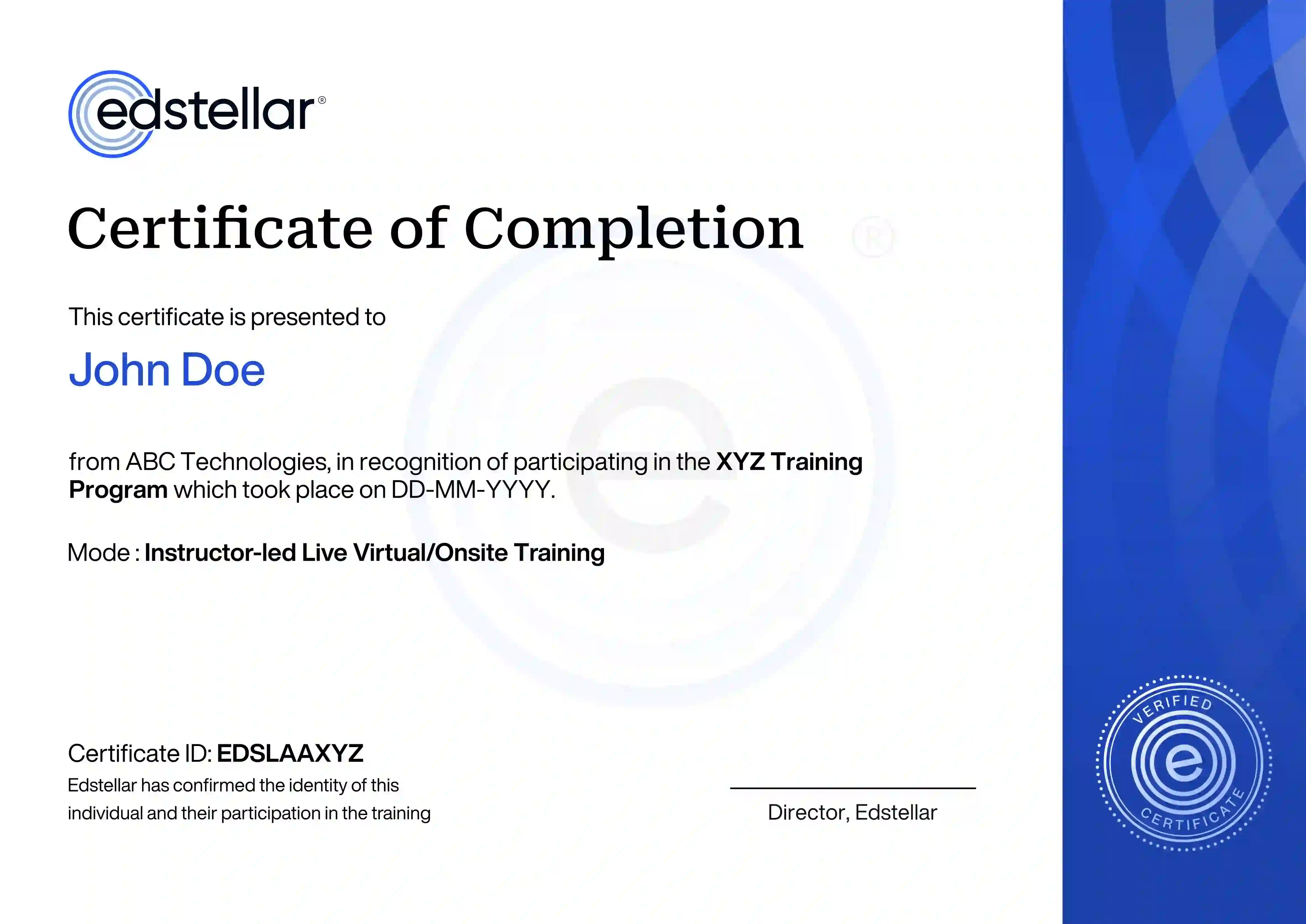
        Get Your Team Members Recognized with Edstellar’s Course Certificate

        Upon successful completion of the training course offered by Edstellar, employees receive a course completion certificate, symbolizing their dedication to ongoing learning and professional development.

        This certificate validates the employee's acquired skills and is a powerful motivator, inspiring them to enhance their expertise further and contribute effectively to organizational success.

        Certificate of Excellence