.svg "edstellar")

DeFi Fundamentals and Protocols Corporate Training Program for Employees
Edstellar's instructor-led DeFi Fundamentals and Protocols training equips professionals to navigate decentralized finance ecosystems. Participants master lending, DEX, stablecoin, derivatives, and yield protocols on Ethereum and L2s, while evaluating risks, tokenomics, and governance to support informed product, investment, and engineering decisions.
(Virtual / On-site / Off-site)
.svg)
Drive Team Excellence with DeFi Fundamentals and Protocols Corporate Training
Decentralized Finance (DeFi) is an open, programmable financial system built on public blockchains that enables trading, lending, borrowing, stablecoin issuance, derivatives, and yield generation without traditional intermediaries. It combines smart contracts, tokenization, and composable protocols to create permissionless alternatives to banks, brokerages, and exchanges. The training provides comprehensive knowledge of DeFi primitives, major protocol categories, cross-chain ecosystems, governance models, risk frameworks, and analytics tools to build, evaluate, and use DeFi products responsibly.
Edstellar's DeFi Fundamentals and Protocols Instructor-led course offers virtual/onsite training options to meet professionals' diverse needs. This flexibility ensures that professionals and teams can engage in learning experiences that best suit their logistical and learning preferences. What sets the Edstellar course apart is its emphasis on practical experience, with hands-on protocol walkthroughs, on-chain analytics exercises, and real-world case studies that bring DeFi concepts to life. Edstellar equips professionals with the skills and confidence to apply DeFi knowledge effectively in their enterprise, product, or investment roles.
.svg)

- DeFi Ecosystem Navigation
- DEX and AMM Mechanics
- Lending and Borrowing Protocols
- Stablecoin Design Analysis
- Yield Strategies and Risks
- DeFi Governance Evaluation
- Protocol Risk Assessment
- Master the foundational principles of decentralized finance by understanding smart contracts, tokenization, on-chain settlement, and composability, enabling professionals to evaluate how DeFi protocols replicate and extend traditional financial services.
- Gain expertise in DEX and AMM mechanics including constant-product, concentrated liquidity, and stable-swap curves, emphasizing their application to liquidity provision, slippage analysis, and capital efficiency across trading pairs and chains.
- Develop proficiency in lending markets, stablecoins, and derivatives, ensuring professionals can analyze collateralization, liquidation, peg stability, and leverage mechanics across major DeFi protocols and assets.
- Learn comprehensive strategies for yield generation, risk assessment, and portfolio construction in DeFi, including staking, liquidity mining, restaking, and risk-adjusted return modeling under different market regimes.
- Build practical skills in cross-chain DeFi navigation, bridge usage, and L2 ecosystem analysis, enabling informed decisions on liquidity fragmentation, gas optimization, and multi-chain deployment strategies.
- Master DeFi risk, governance, and compliance frameworks, emphasizing smart contract audits, oracle risks, MEV, DAO structures, and emerging regulations to support safe participation and product development.
- Blockchain and Smart Contract Basics
- Public blockchain properties
- EVM and smart contract execution
- Gas fees and transactions
- Wallet and key management
- What is DeFi
- Definition and core principles
- Permissionless and composable finance
- CeFi vs DeFi comparison
- DeFi growth and TVL trends
- DeFi Stack and Layers
- Settlement and asset layers
- Protocol and application layers
- Aggregator layer
- Oracles and off-chain data
- Tokens and Asset Types
- ERC-20 and ERC-721 overview
- Governance and utility tokens
- Wrapped and synthetic assets
- LP and receipt tokens
- DeFi Ecosystems and Chains
- Ethereum and L2 landscape
- Alternative L1s (Solana, Sui, Aptos)
- Cosmos and Polkadot ecosystems
- Cross-chain activity patterns
- Navigating DeFi Interfaces
- Connecting wallets
- Reading protocol dashboards
- Block explorers and transactions
- Safety and phishing awareness
- Exchange Models
- Order book vs AMM
- On-chain vs off-chain order books
- Hybrid designs
- DEX aggregators (1inch, ParaSwap)
- Constant Product AMMs
- Uniswap V2 mechanics
- x*y=k pricing curve
- Liquidity pool tokens
- Fee structures
- Concentrated Liquidity
- Uniswap V3 ranges and ticks
- Capital efficiency improvements
- Active vs passive LP strategies
- V4 hooks overview
- Stable Swap and Custom Curves
- Curve StableSwap invariant
- Balancer weighted pools
- Convex and veTokenomics
- Exotic AMM designs
- Slippage and Impermanent Loss
- Price impact calculation
- Impermanent loss math
- IL mitigation strategies
- LP profit and loss analysis
- MEV and Trading Protection
- Sandwich and front-running attacks
- Private mempools
- MEV-resistant designs
- Intent-based trading
- DeFi Lending Fundamentals
- Overcollateralized loans
- Supply and borrow APY mechanics
- Utilization and interest models
- Protocol vs P2P lending
- Aave and Compound Deep Dive
- Aave V3 architecture
- Compound III Comet design
- aTokens and cTokens
- Risk parameters and markets
- Liquidation Mechanics
- Health factor and LTV
- Liquidation bonuses
- Liquidator strategies
- Cascading liquidation risks
- Flash Loans
- Uncollateralized atomic loans
- Arbitrage and collateral swaps
- Flash loan attack vectors
- Protocol fee models
- Isolated and Permissioned Markets
- Morpho Blue markets
- Euler modular lending
- Real-world asset (RWA) markets
- KYC-gated pools
- Lending Risk Assessment
- Collateral quality
- Oracle and price risk
- Protocol governance risk
- Bad debt scenarios
- Stablecoin Design Overview
- Purpose and use cases
- Peg mechanisms
- Market size and share
- Regulatory landscape
- Fiat-Backed Stablecoins
- USDC and USDT mechanics
- Reserve transparency
- Minting and redemption
- Issuer and custody risk
- Crypto-Collateralized Stablecoins
- MakerDAO and DAI
- Liquity and LUSD
- Overcollateralization ratios
- Governance and stability fees
- Algorithmic and Hybrid Designs
- Elastic supply mechanisms
- Delta-neutral strategies (Ethena)
- Lessons from UST collapse
- Hybrid collateral models
- Yield-Bearing Stablecoins
- sDAI and savings rate
- T-bill backed tokens
- USDe and staking yield
- Risk-return trade-offs
- Peg Stability and Arbitrage
- Arbitrage mechanics
- Depeg events and recovery
- Peg stability modules
- Monitoring tools
- Perpetual Futures
- Funding rate mechanics
- dYdX and GMX architectures
- Leverage and liquidation
- Orderbook vs pool-based perps
- On-Chain Options
- Lyra and Dopex protocols
- American vs European options
- Option pricing on-chain
- Vault and structured products
- Synthetic Assets
- Synthetix architecture
- Debt pool mechanics
- Tokenized equities and commodities
- Oracle dependency
- Prediction Markets
- Polymarket and Augur
- Market making on outcomes
- Resolution mechanisms
- Use cases and liquidity
- Insurance and Risk Markets
- Nexus Mutual coverage
- Smart contract insurance
- Claims assessment
- Parametric insurance
- Structured DeFi Products
- Pendle yield tokenization
- Principal and yield separation
- Tranched risk products
- Auto-compounding vaults
- Sources of DeFi Yield
- Trading fees and LP rewards
- Lending and borrowing spreads
- Staking and validator rewards
- Incentive token emissions
- Staking and PoS Basics
- Ethereum proof-of-stake
- Validators and slashing
- Staking yield dynamics
- Delegated staking on L1s
- Liquid Staking Tokens
- Lido stETH and wstETH
- Rocket Pool rETH
- LST use across DeFi
- Depeg and withdrawal risks
- Restaking and EigenLayer
- Restaking concept
- AVS services
- LRTs (EtherFi, Renzo)
- Risks and slashing exposure
- Yield Aggregators and Vaults
- Yearn Finance strategies
- Beefy auto-compounders
- Convex and Aura boosts
- Strategy risk evaluation
- Risk-Adjusted Return Analysis
- APR vs APY vs real yield
- Tokenomics and emission sustainability
- Risk-adjusted metrics
- Portfolio construction principles
- Layer 2 Landscape
- Optimistic rollups (Optimism, Arbitrum)
- ZK rollups (zkSync, Starknet)
- Base and emerging L2s
- Gas and finality comparisons
- Bridging and Messaging
- Native vs third-party bridges
- Lock-mint vs burn-mint
- CCIP, LayerZero, Wormhole
- Bridge security tiers
- Alt-L1 DeFi Ecosystems
- Solana DeFi overview
- Cosmos IBC-enabled DeFi
- Avalanche subnets
- Sui and Aptos emerging DeFi
- Multi-Chain Strategies
- Chain-selection criteria
- Liquidity fragmentation
- Cross-chain aggregators
- Portfolio tracking across chains
- Gas and Cost Optimization
- L1 vs L2 cost trade-offs
- Batching and aggregation
- Gas estimators and tools
- Meta-transactions
- Security in Cross-Chain
- Bridge hack case studies
- Finality and reorg risks
- Message verification
- Chain-specific attack surfaces
- DAO Fundamentals
- Definition and history
- Legal and structural models
- Governance vs utility tokens
- DAO ecosystem overview
- Governance Mechanisms
- Token-weighted voting
- Snapshot off-chain voting
- On-chain execution (Governor Bravo)
- Delegation and representation
- Token Distribution Models
- Fair launches
- Airdrops and liquidity mining
- Vesting and cliff schedules
- Retroactive rewards
- veTokenomics and Incentive Design
- Vote-escrowed models (Curve)
- Gauge weights and bribes
- Lockup incentive analysis
- Sustainability considerations
- Treasury Management
- Treasury composition
- Diversification strategies
- Runway and spending policies
- Reporting and transparency
- Governance Attacks and Risks
- Whale centralization
- Flash loan governance attacks
- Low voter turnout
- Defensive mechanisms
- Smart Contract Risk
- Common vulnerability classes
- Audit reports and methodologies
- Bug bounty programs
- Formal verification
- Oracle and Market Manipulation
- Oracle design patterns
- Chainlink and Pyth
- Price manipulation attacks
- TWAP defenses
- Economic and Liquidity Risk
- Bank runs and deleveraging
- Stablecoin depeg contagion
- Liquidity crunches
- Cascading liquidations
- Operational and Key Risk
- Wallet and seed phrase security
- Multisig best practices
- Hardware wallets and MPC
- Social engineering defenses
- Regulatory Landscape
- Global regulatory approaches
- MiCA, US, APAC frameworks
- Sanctions and compliance tools
- Evolving DeFi regulation
- Tax and Reporting
- On-chain event taxation
- Yield and staking taxation
- Record-keeping tools
- Jurisdictional variations
- On-Chain Analytics Platforms
- DefiLlama TVL metrics
- Dune Analytics dashboards
- Token Terminal fundamentals
- Nansen wallet intelligence
- Protocol Due Diligence
- Reading protocol docs
- Audit and bug-bounty review
- Treasury and holder analysis
- Governance history review
- Transaction and Portfolio Tools
- Etherscan and block explorers
- Tenderly simulations
- DeBank and Zapper portfolios
- Revoke.cash safety
- Institutional DeFi
- Permissioned pools
- KYC-gated access
- Tokenized real-world assets
- Bank and fund participation
- Emerging Narratives
- Intents and solver networks
- Account abstraction
- DeFi x AI agents
- Bitcoin DeFi (BTCFi)
- Future of Decentralized Finance
- Scaling and UX improvements
- Compliance-ready architectures
- TradFi-DeFi convergence
- Long-term ecosystem outlook
- Blockchain Developer
- DeFi Analyst
- Product Manager
- Investment Analyst
- Risk and Compliance Officer
- Treasury Manager
Professionals should have a basic understanding of blockchain concepts, familiarity with cryptocurrencies and wallets, and general knowledge of traditional financial products such as lending, exchanges, and derivatives, to take the DeFi Fundamentals and Protocols training course.


.webp "Virtual DeFi Fundamentals and Protocols Training")
.webp "On-site DeFi Fundamentals and Protocols Training")
.webp "Off-site DeFi Fundamentals and Protocols Training")
64 hours of group training (includes VILT/In-person On-site)
Tailored for SMBs
160 hours of group training (includes VILT/In-person On-site)
Ideal for growing SMBs
Tailor-Made Trainee Licenses with Our Exclusive Training Packages!
400 hours of group training (includes VILT/In-person On-site)
Designed for large corporations
Tailor-Made Trainee Licenses with Our Exclusive Training Packages!
Unlimited duration
Designed for large corporations
Experienced Trainers
Our trainers are drawn from a vetted global network and bring years of industry expertise, keeping every session practical and impactful.
Proven Quality
With a strong global track record, Edstellar is known for quality and engaging delivery.
Industry-Relevant Curriculum
Our programs are built by experts to match the demands of today's industry.
Fully Customizable
Every program can be tailored to your organization's goals.
Comprehensive Support
We provide pre- and post-session support for a complete learning experience.
Global Multi-Location & Multilingual Training Delivery
We deliver in multiple languages to support diverse global teams.
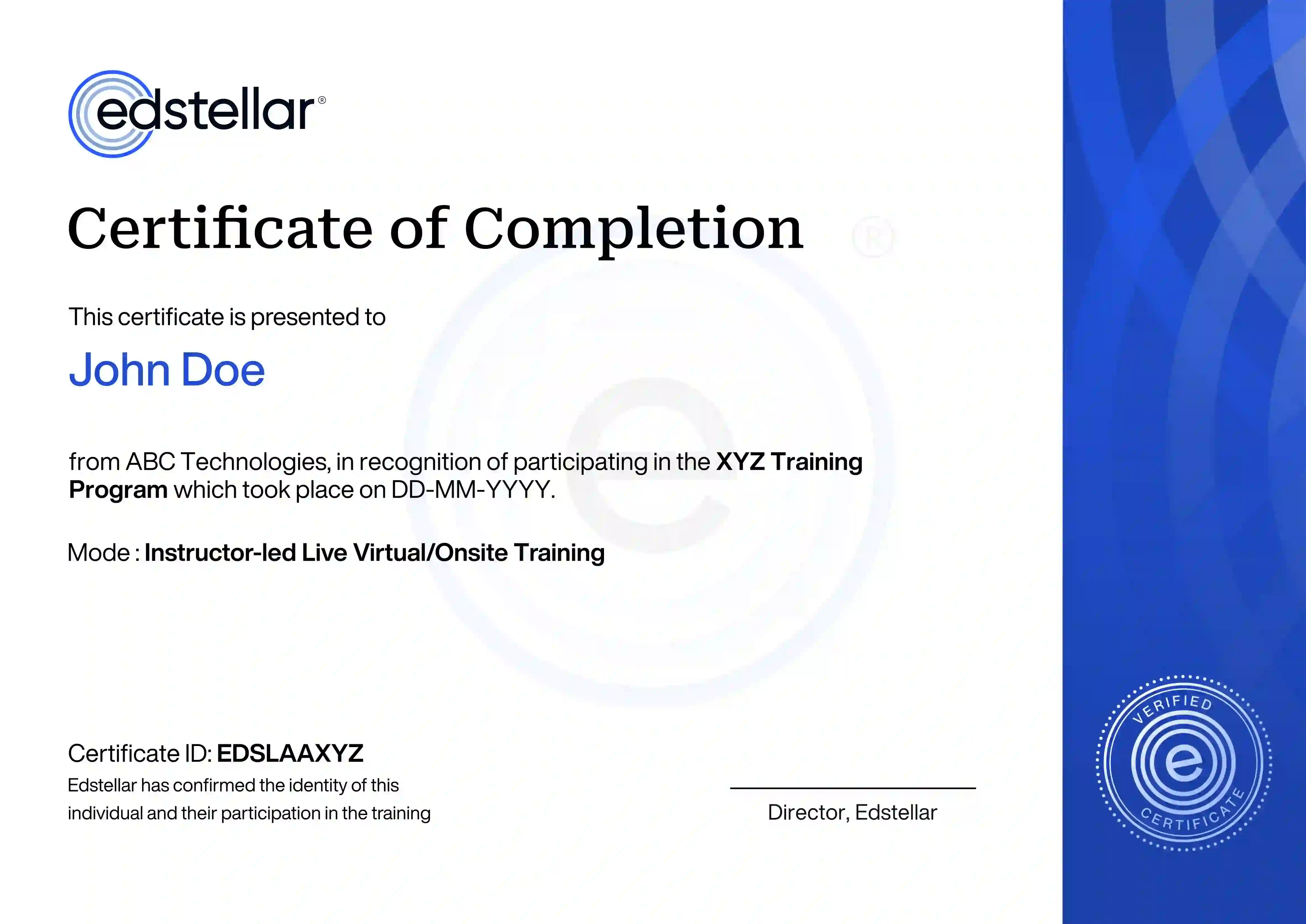
Recognition That Motivates Your Team

Explore More Courses


.svg)
.svg)
.svg)

.svg)