Drive Team Excellence with Enterprise Endpoint Security Corporate Training

Empower your teams with expert-led on-site, off-site, and virtual Enterprise Endpoint Security Training through Edstellar, a premier corporate training provider for organizations globally. Designed to meet your specific training needs, this group training program ensures your team is primed to drive your business goals. Help your employees build lasting capabilities that translate into real performance gains.

Endpoints are the most common entry point for cyberattacks, and as organizations expand their device fleets to include laptops, mobile devices, cloud workloads, and remote worker assets, securing those endpoints has become a critical priority. Modern threats including ransomware, advanced persistent threats, fileless malware, and supply chain attacks require organizations to move beyond traditional antivirus to comprehensive endpoint protection, detection, and response capabilities.

Edstellar's Enterprise Endpoint Security Instructor-led course offers virtual/onsite training options designed for IT security professionals, SOC analysts, systems administrators, and security engineers. Through hands-on configuration exercises, threat simulation scenarios, and endpoint security architecture workshops, participants gain the practical skills to deploy, manage, and continuously improve endpoint security programs that protect the organization against the full spectrum of modern endpoint threats.

Get Customized Expert-led Training for Your Teams
Customized Training Delivery
Scale Your Training: Small to Large Teams
In-person Onsite, Live Virtual or Hybrid Training Modes
Plan from 2000+ Industry-ready Training Programs
Experience Hands-On Learning from Industry Experts
Delivery Capability Across 100+ Countries & 10+ Languages
""""

Key Skills Employees Gain from Instructor-led Enterprise Endpoint Security Training

Enterprise Endpoint Security skills corporate training will enable teams to effectively apply their learnings at work.

  • Endpoint threat detection
  • EDR platform management
  • Endpoint protection configuration
  • Zero trust endpoint security
  • Mobile device and BYOD security
  • Application and privilege management
  • Endpoint incident response

Key Learning Outcomes of Enterprise Endpoint Security Training Workshop

Upon completing Edstellar’s Enterprise Endpoint Security workshop, employees will gain valuable, job-relevant insights and develop the confidence to apply their learning effectively in the professional environment.

  • Identify and analyze modern endpoint threats including malware, ransomware, APTs, and fileless attacks, and understand how attackers exploit endpoint vulnerabilities.
  • Deploy and configure endpoint protection platforms and evaluate their effectiveness against both known and emerging threats in the organizational environment.
  • Implement and manage endpoint detection and response solutions for advanced threat hunting, behavioral analysis, and rapid security incident investigation.
  • Apply mobile device management and BYOD security controls to protect organizational data on mobile endpoints across corporate and personal device programs.
  • Design and implement endpoint vulnerability management, application control, and least-privilege management programs that reduce the organizational attack surface.
  • Build a zero trust endpoint security architecture and lead endpoint security operations and incident response activities from detection through recovery.

Key Benefits of the Enterprise Endpoint Security Group Training

Attending our Enterprise Endpoint Security group training classes provides your team with a powerful opportunity to build skills, boost confidence, and develop a deeper understanding of the concepts that matter most. The collaborative learning environment fosters knowledge sharing and enables employees to translate insights into actionable work outcomes.

  • Understand the modern endpoint threat landscape including malware, ransomware, fileless attacks, APTs, and insider threats targeting enterprise endpoints.
  • Learn to deploy and configure endpoint protection platforms to detect, prevent, and respond to threats across diverse organizational endpoint environments.
  • Implement endpoint detection and response (EDR) solutions to enable advanced threat hunting, behavioral analysis, and rapid incident investigation.
  • Develop skills in mobile device management and BYOD security to govern personal and corporate devices accessing organizational systems and data.
  • Apply endpoint vulnerability management processes to identify, prioritize, and remediate vulnerabilities before attackers can exploit them at scale.
  • Build application control and privilege management capabilities to prevent unauthorized software execution and reduce the attack surface on enterprise endpoints.
  • Learn to implement endpoint encryption and data loss prevention controls to protect sensitive organizational data stored on and transmitted from endpoints.
  • Design zero trust endpoint security architectures that eliminate implicit trust, enforce continuous verification, and minimize the blast radius of endpoint breaches.
  • Develop endpoint security monitoring and alerting capabilities that integrate with the security operations center for real-time threat detection and response.
  • Build and operationalize an endpoint security incident response capability that enables rapid containment, eradication, and recovery from endpoint security incidents.

Topics and Outline of Enterprise Endpoint Security Training

Our virtual and on-premise Enterprise Endpoint Security training curriculum is structured into focused modules developed by industry experts. This training for organizations provides an interactive learning experience that addresses the evolving demands of the workplace, making it both relevant and practical.

  1. What is an Endpoint and Why Endpoints are Targeted
    • Definition of an endpoint and the range of devices covered in enterprise endpoint security
    • Why endpoints represent the most common attack surface in organizational cybersecurity
    • The business impact of endpoint security failures: data breaches, ransomware, and operational disruption
    • How the shift to remote and hybrid work has expanded the organizational endpoint attack surface
  2. The Endpoint Security Ecosystem
    • Key technologies in the endpoint security ecosystem: EPP, EDR, XDR, MDM, and DLP
    • How endpoint security integrates with network security, identity security, and cloud security
    • The role of the security operations center in endpoint security monitoring and response
    • Understanding the vendor landscape and platform consolidation trends in endpoint security
  3. Endpoint Security Frameworks and Standards
    • How the NIST Cybersecurity Framework applies to endpoint security program design
    • CIS Controls and their endpoint security benchmarks and implementation guidance
    • ISO 27001 controls relevant to endpoint security management and compliance
    • Industry-specific endpoint security standards in financial services, healthcare, and critical infrastructure
  4. The Endpoint Security Lifecycle
    • Overview of the endpoint security lifecycle: discover, protect, detect, respond, and recover
    • How to map endpoint security activities to each phase of the security lifecycle
    • The importance of continuous improvement and iterative refinement in endpoint security programs
    • Measuring endpoint security program effectiveness at each lifecycle stage
  5. Key Endpoint Security Concepts and Terminology
    • Essential endpoint security terms: attack surface, threat vector, kill chain, and lateral movement
    • Understanding indicators of compromise (IoCs) and indicators of attack (IoAs) in endpoint security
    • Key concepts: privilege escalation, persistence, command-and-control, and data exfiltration
    • Building a shared endpoint security vocabulary across IT, security, and leadership teams
  6. Building an Endpoint Security Strategy
    • How to develop an endpoint security strategy aligned with organizational risk appetite and objectives
    • Assessing the current endpoint security posture through gap analysis and maturity assessment
    • Prioritizing endpoint security investments based on threat landscape and business impact
    • Building the business case for endpoint security investment and communicating it to leadership
  1. Malware: Viruses, Trojans, and Worms
    • How traditional malware categories operate and how they have evolved in sophistication
    • Malware delivery mechanisms: phishing, drive-by downloads, and removable media
    • How modern malware evades traditional signature-based endpoint detection
    • Indicators of malware infection and initial triage approaches for endpoint analysts
  2. Ransomware and Extortion Attacks
    • How ransomware attacks operate: encryption, lateral movement, and ransom demands
    • The evolution of ransomware: double and triple extortion and ransomware-as-a-service
    • Endpoint-level controls that prevent ransomware execution and limit its spread
    • Incident response considerations unique to ransomware attacks on enterprise endpoints
  3. Advanced Persistent Threats (APTs)
    • What APTs are and how nation-state and sophisticated threat actors operate
    • APT attack lifecycle: initial access, persistence, privilege escalation, and exfiltration
    • How APTs abuse legitimate tools and credentials to avoid endpoint detection
    • Endpoint detection strategies and behavioral indicators associated with APT activity
  4. Fileless and Living-Off-the-Land (LOTL) Attacks
    • What fileless malware is and how it operates without writing files to disk
    • Living-off-the-land techniques: abuse of PowerShell, WMI, and other legitimate system tools
    • Why fileless attacks are particularly effective at evading traditional endpoint security controls
    • Detection and prevention strategies for fileless and LOTL attack techniques
  5. Insider Threats and Endpoint Risk
    • Types of insider threats: malicious insiders, negligent users, and compromised accounts
    • How insiders use endpoint access to steal data, sabotage systems, or enable external attacks
    • Endpoint monitoring controls and behavioral analytics for insider threat detection
    • Balancing insider threat monitoring with employee privacy and legal obligations
  6. Emerging Endpoint Threats and Attack Trends
    • Supply chain attacks and how compromised software updates target enterprise endpoints
    • AI-powered attacks: how threat actors are using machine learning to enhance endpoint attacks
    • IoT and OT endpoint threats and the challenge of securing non-traditional endpoints
    • How to stay current with evolving endpoint threats through threat intelligence and industry feeds
  1. Overview of Endpoint Protection Platforms
    • What an endpoint protection platform (EPP) is and its core capabilities
    • How EPP differs from standalone antivirus and from endpoint detection and response
    • Key EPP capabilities: prevention, detection, and remediation at the endpoint level
    • Evaluating EPP vendors: key criteria for enterprise endpoint protection platform selection
  2. Antivirus and Anti-Malware Technologies
    • How signature-based antivirus works and its limitations against modern malware
    • Heuristic and behavior-based detection: identifying malware without known signatures
    • Cloud-assisted threat intelligence and its role in real-time endpoint protection
    • Managing antivirus policies, exclusions, and update cycles in enterprise environments
  3. Next-Generation Endpoint Protection
    • What next-generation endpoint protection (NGEP) is and how it extends traditional EPP capabilities
    • Machine learning and AI in endpoint protection: behavioral detection and anomaly analysis
    • Memory protection and exploit prevention capabilities in next-generation EPP solutions
    • Evaluating the effectiveness of NGEP against advanced and evasive threat techniques
  4. Host-Based Firewall and Intrusion Prevention
    • The role of host-based firewalls in endpoint security and network traffic control
    • Configuring host-based firewall rules for enterprise endpoint environments
    • Host-based intrusion prevention systems (HIPS) and their detection capabilities
    • Managing host-based firewall and IPS policies at scale across diverse endpoint environments
  5. Web Filtering and Email Security at the Endpoint
    • How endpoint web filtering prevents access to malicious and policy-violating websites
    • DNS filtering as an endpoint security control for blocking malicious domains
    • Endpoint email security controls: anti-phishing, attachment scanning, and link protection
    • Integrating endpoint web and email security with cloud-delivered security platforms
  6. EPP Deployment and Configuration Best Practices
    • Planning and executing an EPP deployment across enterprise endpoint environments
    • Baseline configuration hardening for EPP policies in organizational environments
    • Managing EPP performance impact on endpoint users and business applications
    • Continuous EPP health monitoring and troubleshooting in enterprise deployments
  1. Overview of EDR and How It Differs from EPP
    • What endpoint detection and response (EDR) is and the capabilities it provides
    • How EDR complements EPP to provide post-breach detection and investigation capabilities
    • Core EDR functions: data collection, threat detection, investigation, and response automation
    • Evaluating and selecting EDR platforms: key criteria for enterprise deployment
  2. Behavioral Detection and Anomaly Analysis
    • How EDR uses behavioral telemetry to detect malicious activity without relying on signatures
    • Building behavioral baselines for users and endpoints to identify anomalous activity
    • How EDR detects attack techniques mapped to the MITRE ATT&CK framework
    • Tuning EDR behavioral detection rules to reduce false positives in enterprise environments
  3. Threat Hunting with EDR
    • What threat hunting is and how EDR data enables proactive hunting for hidden threats
    • Developing threat hunting hypotheses based on threat intelligence and MITRE ATT&CK techniques
    • Using EDR query languages and telemetry to hunt for attacker behaviors across endpoints
    • Documenting and operationalizing threat hunting findings to improve detection coverage
  4. EDR Investigation and Forensic Capabilities
    • How to use EDR to conduct endpoint investigations and reconstruct attack timelines
    • Analyzing process trees, network connections, file modifications, and registry changes in EDR
    • Using EDR forensic data to determine the scope and impact of an endpoint security incident
    • Preserving EDR evidence for incident documentation, legal proceedings, and compliance reporting
  5. Extended Detection and Response (XDR)
    • What XDR is and how it extends EDR to correlate endpoint, network, cloud, and identity data
    • How XDR improves detection accuracy and reduces investigation time through cross-domain correlation
    • Evaluating XDR platforms: native XDR vs. open XDR architectures and integration approaches
    • Planning an XDR deployment in environments with existing SIEM and security operations tools
  6. Selecting and Deploying an EDR Solution
    • Requirements gathering and evaluation criteria for enterprise EDR platform selection
    • Planning the EDR deployment: rollout phasing, agent installation, and policy configuration
    • Integrating EDR with SIEM, SOAR, and ticketing systems for automated response workflows
    • Measuring EDR value: metrics and KPIs for assessing EDR effectiveness post-deployment
  1. The BYOD Security Challenge
    • Why BYOD creates distinct security, privacy, and governance challenges for organizations
    • Security risks of personal devices accessing corporate data, email, and applications
    • Regulatory and legal considerations in BYOD security policy design
    • BYOD vs. corporate-owned personally enabled (COPE) vs. corporate-owned restricted device models
  2. Mobile Device Management (MDM) Platforms
    • What MDM is and the core capabilities it provides for enterprise mobile device control
    • MDM enrollment methods: user enrollment, device enrollment, and automated device enrollment
    • Configuring MDM policies: passcode requirements, encryption, and remote wipe capabilities
    • Evaluating enterprise MDM platforms: Microsoft Intune, Jamf, VMware Workspace ONE, and others
  3. Mobile Application Management (MAM)
    • What MAM is and how it enables secure app management without full device management control
    • App wrapping and containerization: isolating corporate apps and data on personal devices
    • Configuring MAM policies for data protection, copy-paste restrictions, and app-level VPN
    • Managing the enterprise app store and controlling application distribution to mobile endpoints
  4. BYOD Policy and Governance
    • Key elements of an effective BYOD acceptable use policy
    • Defining the acceptable use boundaries for personal devices accessing corporate resources
    • Employee privacy protections in BYOD monitoring programs and their legal implications
    • Communicating BYOD policies to employees and obtaining informed consent for device management
  5. iOS and Android Endpoint Security Controls
    • iOS security architecture and the controls available for enterprise security configuration
    • Android security architecture, fragmentation challenges, and enterprise security controls
    • Configuring platform-specific security settings for enterprise mobile endpoints
    • Jailbreaking and rooting detection: identifying compromised mobile endpoints in enterprise fleets
  6. Mobile Threat Defense (MTD) Solutions
    • What mobile threat defense (MTD) is and how it extends endpoint security to mobile platforms
    • MTD detection capabilities: network threat detection, app analysis, and device vulnerability assessment
    • Integrating MTD with MDM and enterprise security platforms for coordinated mobile response
    • Evaluating and deploying MTD solutions across iOS and Android enterprise device fleets
  1. The Vulnerability Management Lifecycle
    • Overview of the endpoint vulnerability management lifecycle: discover, assess, prioritize, remediate, verify
    • The relationship between vulnerability management and patch management in endpoint security
    • Regulatory and compliance requirements driving endpoint vulnerability management programs
    • Building a vulnerability management program that is sustainable at enterprise scale
  2. Endpoint Discovery and Asset Inventory
    • Why accurate endpoint asset inventory is foundational to vulnerability management
    • Active and passive endpoint discovery methods and their use in enterprise environments
    • Managing asset inventory for cloud instances, remote endpoints, and unmanaged devices
    • Integrating endpoint discovery with configuration management databases (CMDB)
  3. Vulnerability Scanning and Assessment
    • How endpoint vulnerability scanners work and their role in the assessment lifecycle
    • Authenticated vs. unauthenticated scanning and the trade-offs for enterprise endpoint environments
    • Configuring and scheduling vulnerability scans to minimize impact on endpoint performance
    • Interpreting vulnerability scan results and common sources of false positives
  4. Risk-Based Vulnerability Prioritization
    • Why not all vulnerabilities require the same remediation urgency and how to prioritize effectively
    • CVSS scores and their limitations as the sole basis for vulnerability prioritization
    • Risk-based prioritization frameworks: EPSS, exploit availability, and asset criticality weighting
    • Communicating vulnerability risk and prioritization decisions to business and IT stakeholders
  5. Patch Management for Endpoints
    • Building an enterprise patch management process that is consistent, measurable, and auditable
    • Patch testing strategies: balancing speed of remediation with risk of patch-induced outages
    • Patch deployment tools and automation: WSUS, SCCM, Intune, and third-party patch management platforms
    • Managing patch compliance for remote endpoints, contractor devices, and legacy systems
  6. Measuring and Reporting Endpoint Vulnerability Metrics
    • Key vulnerability management metrics: mean time to patch, patch compliance rate, and vulnerability density
    • Building vulnerability management dashboards and reports for security and leadership audiences
    • Using vulnerability metrics to demonstrate program improvement and justify security investment
    • Integrating vulnerability reporting with risk registers and enterprise security program reporting
  1. The Role of Application Control in Endpoint Security
    • Why application control is a critical endpoint security control for preventing unauthorized execution
    • How application control reduces the risk of malware, shadow IT, and unauthorized tools
    • The relationship between application control and zero trust endpoint security principles
    • Regulatory frameworks that mandate or recommend application control as an endpoint security control
  2. Allowlisting, Blocklisting, and Graylisting Approaches
    • Allowlisting: permitting only approved applications and blocking everything else by default
    • Blocklisting: denying specific known-bad applications while permitting all others
    • Graylisting: managing unknown applications with elevated scrutiny before permitting or blocking
    • Choosing the right application control approach based on environment, risk tolerance, and user impact
  3. Privileged Access Management (PAM) for Endpoints
    • What privileged access management is and why it is critical for endpoint security
    • Types of privileged accounts on endpoints: local administrator, domain admin, and service accounts
    • PAM controls for endpoints: just-in-time access, session recording, and privileged account vaulting
    • Integrating endpoint PAM with identity and access management platforms
  4. Least Privilege Principles and Implementation
    • The principle of least privilege and its application to endpoint user and account management
    • Removing local administrator rights from standard users and managing the transition
    • Endpoint privilege elevation solutions: granting temporary elevation without permanent admin rights
    • Measuring least privilege compliance across the enterprise endpoint fleet
  5. User Account Control and Privilege Escalation Prevention
    • How Windows User Account Control (UAC) works and its role in privilege escalation prevention
    • Common privilege escalation techniques used by attackers to elevate access on compromised endpoints
    • Endpoint controls that detect and prevent privilege escalation attempts
    • Auditing and alerting on privilege escalation events across the enterprise environment
  6. Monitoring and Auditing Application and Privilege Activity
    • What application and privilege activity logging should be captured on enterprise endpoints
    • Integrating endpoint application and privilege logs with SIEM for centralized analysis
    • Using behavioral analytics to detect anomalous application execution and privilege usage
    • Building audit and compliance reporting for application control and privilege management programs
  1. Why Encryption is Essential for Endpoint Security
    • How endpoint encryption protects data at rest from physical theft and unauthorized access
    • Regulatory requirements mandating endpoint encryption in healthcare, finance, and public sector
    • The encryption gap: risks of unencrypted endpoints in enterprise environments
    • Evaluating encryption solutions for performance, key management, and enterprise manageability
  2. Full-Disk Encryption (FDE) Technologies
    • How full-disk encryption protects all data on an endpoint drive at rest
    • Windows BitLocker: configuration, deployment, and management in enterprise environments
    • macOS FileVault: configuration and management for Apple endpoint environments
    • Deploying and monitoring full-disk encryption compliance across the enterprise endpoint fleet
  3. File and Folder Encryption
    • When file and folder encryption complements full-disk encryption in endpoint protection
    • Encrypting sensitive data at the file level to restrict access beyond disk-level protections
    • Managing file encryption keys and access controls in enterprise environments
    • Challenges of file encryption in collaboration environments and cloud-connected endpoints
  4. Removable Media and USB Device Control
    • Why removable media and USB devices represent a significant data exfiltration and malware risk
    • Endpoint controls for blocking, restricting, or encrypting removable media access
    • Managing USB device policies across diverse endpoint environments and user populations
    • Auditing and alerting on removable media usage to detect policy violations and insider threats
  5. Endpoint Data Loss Prevention (DLP)
    • What endpoint DLP is and how it prevents sensitive data from leaving organizational control
    • Endpoint DLP capabilities: content inspection, file transfer blocking, and clipboard control
    • Classifying sensitive data and applying DLP policies based on data classification labels
    • Balancing endpoint DLP enforcement with user productivity and legitimate business workflows
  6. Key Management and Encryption Policy
    • The role of key management in enterprise endpoint encryption programs
    • Centralized key management: escrow, recovery, and key lifecycle governance
    • Developing and enforcing an endpoint encryption policy that meets regulatory requirements
    • Auditing and reporting on endpoint encryption compliance across the organizational fleet
  1. Zero Trust Principles and Their Application to Endpoints
    • The zero trust security model: never trust, always verify, and assume breach
    • Why traditional perimeter-based security is insufficient for modern enterprise endpoint environments
    • How zero trust principles apply to endpoint security: device trust, user identity, and access control
    • Key zero trust reference architectures: NIST SP 800-207 and CISA zero trust maturity model
  2. Identity and Device Trust in Zero Trust Architectures
    • How device identity and health assessment are established in zero trust endpoint security
    • Device compliance policies: what an endpoint must prove to be trusted for access
    • Integrating endpoint management platforms with identity providers for conditional access
    • Certificate-based device authentication and its role in zero trust endpoint trust establishment
  3. Micro-Segmentation and Network Access Control
    • How micro-segmentation limits lateral movement from compromised endpoints
    • Network access control (NAC) and its role in verifying endpoint health before granting network access
    • Software-defined perimeter and ZTNA solutions for zero trust endpoint network access
    • Implementing micro-segmentation in environments with diverse endpoint types and access needs
  4. Continuous Authentication and Endpoint Verification
    • Why zero trust requires continuous verification of user identity and endpoint health
    • Risk-based authentication: dynamically adjusting access based on endpoint and user risk signals
    • Behavioral biometrics and continuous authentication technologies for enterprise endpoints
    • Managing session timeout and re-authentication policies in zero trust endpoint environments
  5. Zero Trust Implementation for Endpoint Environments
    • Building a zero trust endpoint implementation roadmap aligned with organizational maturity
    • Key technology components for zero trust endpoint deployment: IAM, MDM, ZTNA, and EDR integration
    • Phasing zero trust endpoint adoption to manage user impact and operational risk
    • Measuring zero trust endpoint maturity and tracking progress against the implementation roadmap
  6. Zero Trust Endpoint Security in Hybrid and Remote Work Environments
    • How zero trust principles address the security challenges of remote and hybrid work
    • Securing remote endpoints that access corporate resources outside the traditional network perimeter
    • ZTNA vs. VPN: why zero trust network access is better suited to modern remote work environments
    • Managing unmanaged and contractor endpoints in zero trust endpoint security architectures
  1. Endpoint Security Monitoring and SIEM Integration
    • What endpoint telemetry and log sources should be collected and forwarded to the SIEM
    • Configuring endpoint logging: Windows event logs, Sysmon, and EDR telemetry integration
    • Building SIEM correlation rules and alerts based on endpoint threat indicators
    • Reducing SIEM alert noise from endpoint sources through log filtering and tuning
  2. Security Operations Center (SOC) and Endpoint Visibility
    • The SOC's role in continuous endpoint security monitoring and threat detection
    • Building endpoint visibility across managed and unmanaged devices in the organization
    • Using dashboards and reporting to maintain real-time situational awareness of endpoint health
    • SOC workflows for endpoint security events: alert triage, escalation, and analyst handoff
  3. Endpoint Incident Detection and Triage
    • How SOC analysts detect and classify endpoint security incidents from alerts and telemetry
    • Initial triage steps for suspected endpoint compromise: scoping, severity classification, and escalation
    • Using EDR and SIEM data to determine whether an alert represents a true positive incident
    • Documenting endpoint incident triage decisions and evidence for the investigation record
  4. Endpoint Incident Containment and Eradication
    • Containment strategies for compromised endpoints: isolation, quarantine, and network blocking
    • Using EDR platform capabilities to remotely contain and investigate compromised endpoints
    • Eradication steps: removing malware, closing attack vectors, and restoring endpoint integrity
    • Coordinating endpoint containment with network, identity, and cloud security teams
  5. Post-Incident Recovery and Forensic Review
    • Endpoint recovery procedures: reimaging, credential rotation, and access restoration
    • Post-incident forensic analysis: preserving evidence, building attack timelines, and root cause analysis
    • Writing incident reports that document findings, impact, and remediation actions clearly
    • Post-incident review: translating lessons learned into endpoint security improvements
  6. Building a Mature Endpoint Security Operations Program
    • Defining endpoint security operations maturity: from reactive to proactive and optimized capabilities
    • Key metrics for endpoint security operations: MTTD, MTTR, and detection coverage across endpoints
    • Using tabletop exercises and simulated endpoint attacks to test and improve response capabilities
    • Building a continuous improvement roadmap for endpoint security operations aligned with threat evolution

Who Can Take the Enterprise Endpoint Security Training Course

The Enterprise Endpoint Security training program can also be taken by professionals at various levels in the organization.

  • IT Security Analysts
  • Systems and Network Administrators
  • Endpoint Operations Teams
  • Security Operations Center (SOC) Teams
  • IT Managers and Technology Leaders
  • Cybersecurity Engineers

Prerequisites for Enterprise Endpoint Security Training

Professionals should have foundational knowledge of IT networking and operating systems and a general understanding of cybersecurity principles to take the Enterprise Endpoint Security training course.

Request a Quote for your Corporate Training Requirements

Valid number

Delivering Training for Organizations across 100 Countries and 10+ Languages

Corporate Group Training Delivery Modes
for Enterprise Endpoint Security Training

At Edstellar, we understand the importance of impactful and engaging training for employees. As a leading Enterprise Endpoint Security training provider, we ensure the training is more interactive by offering Face-to-Face onsite/in-house or virtual/online sessions for companies. This approach has proven to be effective, outcome-oriented, and produces a well-rounded training experience for your teams.

Virtual Enterprise Endpoint Security Training

Edstellar's Enterprise Endpoint Security virtual/online training sessions bring expert-led, high-quality training to your teams anywhere, ensuring consistency and seamless integration into their schedules.

With global reach, your employees can get trained from various locations
The consistent training quality ensures uniform learning outcomes
Participants can attend training in their own space without the need for traveling
Organizations can scale learning by accommodating large groups of participants
Interactive tools can be used to enhance learning engagement
On-site Enterprise Endpoint Security Training

Edstellar's Enterprise Endpoint Security inhouse face to face instructor-led training delivers immersive and insightful learning experiences right in the comfort of your office.

Higher engagement and better learning experience through face-to-face interaction
Workplace environment can be tailored to learning requirements
Team collaboration and knowledge sharing improves training effectiveness
Demonstration of processes for hands-on learning and better understanding
Participants can get their doubts clarified and gain valuable insights through direct interaction
Off-site Enterprise Endpoint Security Training

Edstellar's Enterprise Endpoint Security offsite face-to-face instructor-led group training offer a unique opportunity for teams to immerse themselves in focused and dynamic learning environments away from their usual workplace distractions.

Distraction-free environment improves learning engagement
Team bonding can be improved through activities
Dedicated schedule for training away from office set up can improve learning effectiveness
Boosts employee morale and reflects organization's commitment to employee development

Explore Our Customized Pricing Package
for
Enterprise Endpoint Security Corporate Training

Looking for pricing details for onsite, offsite, or virtual instructor-led Enterprise Endpoint Security training? Get a customized proposal tailored to your team’s specific needs.

Request a Group Training Quote
""
How Many Team Members Need Training?
Please select an option or fill in the custom field.
"'

Is Your Corporate Training Requirement Only for Enterprise Endpoint Security?

Please select at least one course.
""
Add the List of Training Workshops
search icon

      Please select the course

      No. of Courses selected: 0

      Clear

      Upload a CSV

      Send us your Training Requirements in 3 Easy steps

      1. 1
      2. 2
        Add the required training workshops
      3. 3
        Upload to get a quick quote or email it to contact@edstellar.com

      ""

      Looking for a Complete Package?

      Looking for a one-time pricing option for all your annual training requirements?

      View Corporate Training Packages
      ""
      Select the Option that Best Describes Your Corporate Training Requirement

      Please select an option or choose from the recurring options.
      ""
      Verify and Submit Your Request

      Review Your Corporate Training Selection Summary

      Training Program: Enterprise Endpoint Security Training

      1. No of Team Members

      2. Selected Training Preference

      3. Selected Recurring Sessions

      1

      Review your Requirements

      Training Workshops Selected :


        Excel
        File has been
        successfully uploaded.
        Fill the form to submit
 your details
        Submit Your Professional Contact Information
        Valid number
        We've received your enquiry. Our team will be in touch soon.
        Oops! Something went wrong while submitting the form.
        Starter
        120 licences

        Tailor-Made Trainee Licenses with Our Exclusive Training Packages!

        View Package

        64 hours of group training (includes VILT/In-person On-site)

        Tailored for SMBs

        Growth
        320 licences

        Tailor-Made Trainee Licenses with Our Exclusive Training Packages!

        View Package

        160 hours of group training (includes VILT/In-person On-site)

        Ideal for growing SMBs

        Enterprise
        800 licences

        Tailor-Made Trainee Licenses with Our Exclusive Training Packages!

        View Package

        400 hours of group training (includes VILT/In-person On-site)

        Designed for large corporations

        Custom
        Unlimited licenses

        Tailor-Made Trainee Licenses with Our Exclusive Training Packages!

        View Package

        Unlimited duration

        Designed for large corporations

        Edstellar: Your Go-to Enterprise Endpoint Security Training Company

        Experienced Trainers

        Our trainers bring years of industry expertise to ensure the training is practical and impactful.

        Quality Training

        With a strong track record of delivering training worldwide, Edstellar maintains its reputation for its quality and training engagement.

        Industry-Relevant Curriculum

        Our course is designed by experts and is tailored to meet the demands of the current industry.

        Customizable Training

        Our course can be customized to meet the unique needs and goals of your organization.

        Comprehensive Support

        We provide pre and post training support to your organization to ensure a complete learning experience.

        Multilingual Training Capabilities

        We offer training in multiple languages to cater to diverse and global teams.

        Testimonials

        What Our Clients Say

        We pride ourselves on delivering exceptional training solutions. Here's what our clients have to say about their experiences with Edstellar.

        "Edstellar's virtual Enterprise Endpoint Security training gave our SOC and IT teams the structured knowledge and practical skills to significantly improve our endpoint detection and response capabilities. Post-training, we deployed EDR across our full endpoint fleet and reduced our mean time to contain from days to hours."

        Rajesh Nair

        Head of Cybersecurity Operations,

        A Global Financial Services Group

        "The onsite Enterprise Endpoint Security training by Edstellar transformed our security team's approach to endpoint protection. The threat hunting and zero trust architecture modules were immediately relevant, and we redesigned our endpoint security stack within two months of completing the program."

        Priya Krishnamurthy

        Chief Information Security Officer,

        A Global Technology Enterprise

        "Our off-site Enterprise Endpoint Security workshop with Edstellar equipped our security engineering team with the advanced skills needed to build a mature endpoint protection program. Post-training, our endpoint security maturity improved by 42% and we passed our first external endpoint security assessment with no critical findings."

        Anand Mehta

        Chief Technology Officer,

        A Global Industrial Group

        "Edstellar's IT and Technical training programs have significantly enhanced our team's technical expertise, problem-solving abilities, and proficiency with the latest technologies. The training combines hands-on labs with real-world applications, making complex concepts accessible and immediately usable in our operations, driving measurable improvements in both efficiency and innovation."

        Aditi Rao

        Chief Technology Officer,

        A Global Technology Enterprise

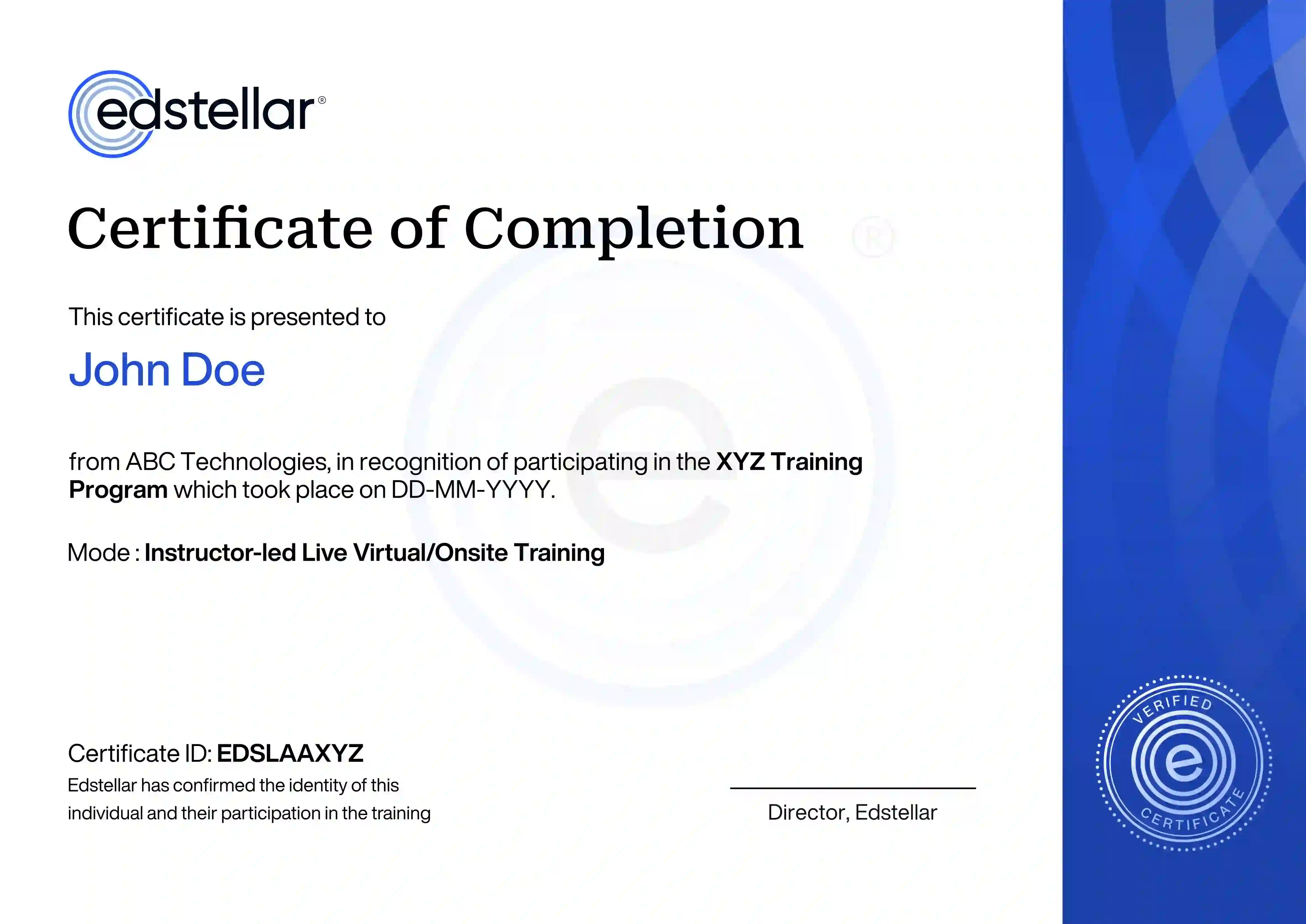
        Get Your Team Members Recognized with Edstellar’s Course Certificate

        Upon successful completion of the training course offered by Edstellar, employees receive a course completion certificate, symbolizing their dedication to ongoing learning and professional development.

        This certificate validates the employee's acquired skills and is a powerful motivator, inspiring them to enhance their expertise further and contribute effectively to organizational success.

        Certificate of Excellence