.svg "edstellar")

HIPAA Corporate Training Program for Employees
This training provides healthcare and compliance professionals with a thorough understanding of HIPAA requirements. Participants explore the Privacy Rule, Security Rule, Breach Notification Rule, patient rights, and practical steps to build and sustain a HIPAA-compliant program.
(Virtual / On-site / Off-site)
.svg)
Drive Team Excellence with HIPAA Corporate Training
The Health Insurance Portability and Accountability Act (HIPAA) sets the national standard for protecting sensitive patient health information in the United States. Healthcare organizations, their partners, and workforce members must understand and comply with HIPAA's Privacy Rule, Security Rule, and Breach Notification Rule to protect patients and avoid significant regulatory penalties. This training covers every major component of HIPAA compliance with a focus on practical application across real-world healthcare scenarios.
Edstellar's HIPAA Instructor-led course offers virtual/onsite training options for compliance officers, privacy professionals, IT and security teams, clinical staff, and business associates. With case study analysis, policy development workshops, and scenario-based exercises, participants build the knowledge and skills needed to confidently navigate HIPAA requirements and strengthen their organization's compliance posture.
.svg)

Skills Your Employees Will Gain
These are the core, hands-on capabilities your team builds during the program.
- HIPAA Privacy Rule compliance
- Security Rule implementation
- PHI and ePHI protection
- Breach notification management
- Patient rights administration
- Business associate oversight
- HIPAA audit readiness
What Your Team Will Achieve After This Training
- Master the core requirements of HIPAA including the Privacy Rule, Security Rule, and Breach Notification Rule and their application across healthcare settings.
- Develop an understanding of Protected Health Information (PHI) and electronic PHI and the obligations for protecting them under HIPAA.
- Learn patient rights under HIPAA and how covered entities must uphold and administer these rights in day-to-day operations.
- Build skills to identify and manage Business Associate relationships and ensure compliant data handling through signed agreements.
- Apply breach notification procedures and regulatory timelines to meet HIPAA requirements when a data breach involving PHI occurs.
- Gain the knowledge to design and implement a HIPAA compliance program with supporting policies, risk assessments, and workforce training.
Topics & Program Outline
The curriculum is organized into focused modules built by industry experts and delivered virtually or on-premise. Interactive sessions reflect the evolving demands of the workplace, keeping the learning both relevant and practical.
-
History and Purpose of HIPAA
- Origins of HIPAA and the legislative intent behind its enactment
- Key milestones in HIPAA rulemaking from 1996 through the HITECH Act
- How HIPAA changed the landscape of healthcare data privacy and security
- Overview of HIPAA's five titles and their organizational scope
-
Key HIPAA Rules and Their Scope
- Overview of the Privacy Rule, Security Rule, and Breach Notification Rule
- How the three rules work together to protect patient health information
- Scope of each rule: what it covers and who it applies to
- Interplay between HIPAA rules and other state and federal privacy laws
-
Who Must Comply with HIPAA
- Definition of covered entities: health plans, healthcare clearinghouses, and providers
- Definition and role of business associates in HIPAA compliance
- When workforce members are subject to HIPAA obligations
- Hybrid entities and how they manage HIPAA applicability
-
HITECH Act and Its Impact on HIPAA
- How the HITECH Act of 2009 strengthened HIPAA requirements and enforcement
- HITECH's expansion of breach notification obligations
- Increased penalties introduced by HITECH for HIPAA violations
- HITECH's influence on business associate compliance obligations
-
HIPAA and the Omnibus Rule
- What the 2013 Omnibus Rule changed in HIPAA's compliance landscape
- Omnibus Rule updates to the Privacy and Security Rules
- New breach notification standards introduced by the Omnibus Rule
- Expanded business associate liability under the Omnibus Rule
-
HIPAA Compliance Culture in Healthcare Organizations
- Building a culture of HIPAA compliance across the workforce
- Role of leadership in setting HIPAA compliance expectations
- Embedding HIPAA awareness into daily operational practices
- Consequences of a non-compliant organizational culture for HIPAA risk
-
Defining Protected Health Information
- What constitutes PHI under HIPAA's Privacy Rule definition
- The 18 HIPAA identifiers that make health information individually identifiable
- Distinction between PHI, de-identified information, and limited data sets
- Examples of PHI in common healthcare and administrative contexts
-
Electronic PHI (ePHI) and Its Unique Risks
- What qualifies as ePHI and how it differs from paper-based PHI
- Common ePHI formats: EHRs, emails, mobile data, and cloud storage
- Heightened security risks associated with electronic health information
- HIPAA Security Rule obligations specific to ePHI protection
-
De-identification of PHI
- HIPAA's two de-identification methods: expert determination and safe harbor
- Requirements and limitations of the safe harbor de-identification method
- Using de-identified data for research, analytics, and public health purposes
- Re-identification risks and how to mitigate them in data handling practices
-
Minimum Necessary Standard
- The minimum necessary principle and its application to PHI use and disclosure
- Implementing minimum necessary policies in clinical and administrative workflows
- Exceptions to the minimum necessary standard under the Privacy Rule
- Common minimum necessary violations and how to prevent them
-
PHI in Third-Party and Cloud Environments
- HIPAA obligations when PHI is stored or processed by third-party vendors
- Cloud computing and HIPAA: responsibilities of covered entities and vendors
- Ensuring Business Associate Agreements cover cloud-hosted PHI
- Auditing third-party PHI handling for HIPAA compliance
-
PHI Across the Healthcare Ecosystem
- How PHI flows between providers, payers, and clearinghouses
- PHI handling obligations at each point in the healthcare data exchange
- Managing PHI in telehealth, mobile health, and digital care environments
- Emerging PHI challenges in connected health and wearable device data
-
Core Requirements of the Privacy Rule
- Overview of the Privacy Rule's scope and key provisions
- How the Privacy Rule limits the use and disclosure of PHI
- Required vs. permitted disclosures under the Privacy Rule
- Privacy Rule compliance obligations for covered entities and workforce members
-
Permitted Uses and Disclosures of PHI
- Disclosures permitted without patient authorization: treatment, payment, operations
- Public interest disclosures: public health, law enforcement, and research exceptions
- Incidental disclosures and the reasonable safeguards standard
- Documentation requirements for permitted disclosures
-
Authorization Requirements for PHI Disclosure
- When a written patient authorization is required for PHI disclosure
- Core elements of a valid HIPAA authorization form
- Defective authorizations: common errors and how to avoid them
- Revoking authorization and managing revocation in clinical systems
-
Notice of Privacy Practices (NPP)
- What the NPP must contain under the HIPAA Privacy Rule
- When and how covered entities must provide the NPP to patients
- Electronic NPP delivery and website posting requirements
- Updating the NPP in response to policy or regulatory changes
-
Privacy Rule Safeguards and Administrative Requirements
- Designating a Privacy Officer for the organization
- Workforce training obligations under the Privacy Rule
- Implementing privacy policies, procedures, and documentation standards
- Handling and resolving patient privacy complaints
-
Special Categories of PHI Under the Privacy Rule
- Heightened protections for mental health, substance use, and HIV information
- State laws that may provide stronger protections than HIPAA
- Handling adolescent and minor patient health information under HIPAA
- Genetic information protections under GINA and HIPAA
-
Overview of the Security Rule
- Purpose and scope of the HIPAA Security Rule for ePHI protection
- The flexibility principle: scalability of Security Rule requirements
- Relationship between the Security Rule and the Privacy Rule
- Security Rule compliance documentation and policy requirements
-
Administrative Safeguards
- Security management process: risk analysis and risk management requirements
- Assigned security responsibility and the Security Officer role
- Workforce security: authorization, supervision, and termination procedures
- Security awareness and training program requirements
-
Physical Safeguards
- Facility access controls and policies for protecting ePHI environments
- Workstation use and security standards for ePHI access points
- Device and media controls: encryption, disposal, and accountability
- Physical safeguards for mobile devices and remote work environments
-
Technical Safeguards
- Access controls: unique user identification, emergency access, and auto-logoff
- Audit controls: hardware and software activity review and logging
- Integrity controls: protecting ePHI from unauthorized alteration or destruction
- Transmission security: encryption and network security for ePHI in transit
-
Organizational and Policy Requirements
- Business associate contracts and other organizational Security Rule requirements
- Policies and procedures: documentation, retention, and update obligations
- Security incident response procedures under the Security Rule
- Security Rule documentation retention requirements
-
Security Risk Analysis and Management
- HIPAA requirement to conduct and document a thorough security risk analysis
- Steps for conducting a HIPAA-compliant risk analysis
- Developing and implementing a risk management plan from analysis findings
- Frequency and triggers for repeating the risk analysis process
-
What Constitutes a HIPAA Breach
- HIPAA's definition of breach and the presumption of breach standard
- Three exceptions to the breach definition: unintentional access, good faith disclosure, and limited recipient
- Categories of PHI breaches: electronic, physical, and verbal disclosures
- How to determine whether an incident constitutes a reportable breach
-
The Four-Factor Risk Assessment
- The four factors for assessing breach probability of compromise
- Nature and extent of the PHI involved in the breach
- Who accessed or could have accessed the PHI
- Documenting the risk assessment outcome and breach determination decision
-
Notification to Affected Individuals
- Timing requirement: notifying individuals within 60 days of breach discovery
- Required content of individual breach notification letters
- Substitute notice methods when contact information is insufficient
- Media notice requirements for breaches affecting more than 500 residents in a state
-
Notification to HHS and Media
- Reporting large breaches to HHS within 60 days of discovery
- Annual reporting process for small breaches affecting fewer than 500 individuals
- HHS breach portal submission requirements and process
- Media notification obligations for large breaches in affected geographic areas
-
Business Associate Breach Notification Obligations
- When a business associate must report a breach to the covered entity
- Business associate breach notification timelines and documentation requirements
- Covered entity responsibilities following business associate breach notification
- Contractual breach notification provisions in Business Associate Agreements
-
Breach Response and Remediation
- Immediate containment steps upon discovery of a potential PHI breach
- Building an incident response plan aligned with the Breach Notification Rule
- Post-breach remediation: corrective actions and control improvements
- Documenting breach response activities for regulatory and legal purposes
-
Right of Access to PHI
- Patient right to inspect and receive copies of their PHI in a designated record set
- HIPAA access request timelines: 30-day standard and 60-day extension
- Permitted fees for providing access to PHI copies
- Grounds for denying access and patient rights to review a denial
-
Right to Amend PHI
- Patient right to request amendment of inaccurate or incomplete PHI
- Covered entity obligations when accepting or denying an amendment request
- Timelines and documentation requirements for amendment decisions
- Informing other parties of accepted amendments to PHI
-
Right to an Accounting of Disclosures
- Patient right to receive an accounting of PHI disclosures made without authorization
- What disclosures must be included in and excluded from the accounting
- Six-year lookback period for accounting of disclosures
- Documentation and record-keeping requirements for disclosure accounting
-
Right to Request Restrictions
- Patient right to request restrictions on PHI use and disclosure
- When covered entities must honor patient restriction requests
- Mandatory restriction for self-pay patients requesting out-of-pocket disclosures
- Documenting and honoring approved restriction requests in clinical systems
-
Right to Request Confidential Communications
- Patient right to receive communications by alternative means or locations
- Covered entity obligations to accommodate reasonable confidential communication requests
- Implementing confidential communication preferences in patient records
- Balancing confidential communication obligations with operational feasibility
-
Handling Patient Rights Requests in Practice
- Establishing intake and tracking procedures for patient rights requests
- Training frontline staff to receive and process rights requests correctly
- Documenting rights request decisions and maintaining required records
- Responding to patient complaints about rights request handling
-
Defining Covered Entities
- Three categories of covered entities: health plans, clearinghouses, and providers
- Criteria for determining whether an organization qualifies as a covered entity
- Hybrid entities and how they isolate HIPAA-covered components
- Affiliated covered entities and organized healthcare arrangements
-
Identifying Business Associates
- HIPAA definition of a business associate and common examples
- Functions and activities that trigger business associate status
- Subcontractors as business associates and their HIPAA obligations
- Workforce members and conduit exceptions to business associate status
-
Business Associate Agreements (BAA)
- Required elements of a HIPAA-compliant Business Associate Agreement
- When a BAA must be in place before PHI can be shared with a vendor
- BAA provisions for breach notification, termination, and return of PHI
- Managing BAA renewals and amendments as vendor relationships evolve
-
Business Associate Compliance Obligations
- Direct HIPAA obligations that apply to business associates under the Omnibus Rule
- Business associate Security Rule compliance requirements
- Subcontractor management and downstream BAA requirements
- Business associate workforce training and HIPAA awareness obligations
-
Managing Business Associate Risk
- Conducting due diligence on business associate HIPAA compliance before contracting
- Periodic audits and assessments of business associate compliance
- Responding to business associate HIPAA violations and breaches
- BAA termination procedures when a business associate cannot remediate a violation
-
Vendor Management and Third-Party Oversight
- Building a comprehensive vendor management program for HIPAA compliance
- Maintaining a current inventory of business associates and BAAs
- Integrating HIPAA vendor oversight into procurement and contracting workflows
- Technology tools for tracking and managing business associate relationships
-
Why Risk Assessment is a HIPAA Requirement
- The Security Rule mandate for a thorough and accurate risk analysis
- Consequences of failing to conduct or document a HIPAA risk assessment
- How OCR evaluates risk assessment quality during investigations and audits
- Risk assessment as the foundation of the HIPAA security compliance program
-
Conducting a HIPAA Risk Analysis
- Scoping the risk analysis: identifying all ePHI and the systems that hold it
- Identifying threats and vulnerabilities to ePHI confidentiality, integrity, and availability
- Assessing the likelihood and impact of identified threats materializing
- Documenting risk analysis findings in a format suitable for audit review
-
Developing a Risk Management Plan
- Translating risk analysis findings into prioritized risk management actions
- Selecting and implementing security measures to reduce identified risks
- Assigning responsibility and timelines for risk management action items
- Documenting the risk management plan and tracking implementation progress
-
Ongoing Risk Management and Monitoring
- Building a continuous risk monitoring program aligned with the Security Rule
- Triggers for repeating or updating the risk analysis: new systems, incidents, and changes
- Integrating risk management into security governance and oversight structures
- Reporting risk management status to leadership and compliance committees
-
Common HIPAA Risk Assessment Failures
- Scope gaps: failing to identify all ePHI repositories and data flows
- Insufficient threat and vulnerability identification in the risk analysis
- Inadequate documentation that fails to satisfy OCR audit requirements
- Failing to update the risk assessment after significant organizational changes
-
Risk Assessment Tools and Methodologies
- OCR's HIPAA Security Risk Assessment Tool and how to use it effectively
- NIST frameworks for healthcare security risk assessment methodology
- Qualitative vs. quantitative risk assessment approaches for HIPAA
- Selecting risk assessment tools appropriate for organizational size and complexity
-
Building a HIPAA Compliance Program
- Core components of a comprehensive HIPAA compliance program
- Appointing and empowering Privacy and Security Officers
- Developing and maintaining HIPAA-required policies and procedures
- Integrating HIPAA compliance into the broader organizational governance structure
-
HIPAA Policies and Procedures
- Required policies under the Privacy Rule and Security Rule
- Writing clear, actionable HIPAA policies that reflect actual operational practice
- Policy review and update cycles aligned with regulatory and operational changes
- Communicating and enforcing policies across covered entity and business associate workforces
-
HIPAA Workforce Training Requirements
- HIPAA Privacy Rule training obligations for the workforce
- Security awareness and training program requirements under the Security Rule
- Designing role-based HIPAA training for clinical, administrative, and IT staff
- Documenting training completion for compliance evidence and audit purposes
-
HIPAA Sanctions and Accountability
- Sanction policy requirements for workforce HIPAA violations
- Applying sanctions consistently and proportionately to the severity of violations
- Documenting sanctions and maintaining records for compliance purposes
- Using sanctions as part of a broader culture of HIPAA accountability
-
Internal HIPAA Auditing and Monitoring
- Designing an internal HIPAA audit program to assess compliance effectiveness
- Key audit areas: Privacy Rule, Security Rule, and workforce adherence
- Using audit findings to drive remediation and program improvement
- Frequency and scope of internal HIPAA compliance reviews
-
HIPAA Incident Response and Complaint Handling
- Establishing a HIPAA incident response and reporting process
- Receiving, investigating, and documenting patient privacy complaints
- Mitigation steps to reduce harm following identified privacy violations
- Coordinating with legal counsel during HIPAA incident response activities
-
HIPAA Enforcement by OCR
- Role of the HHS Office for Civil Rights in HIPAA enforcement
- How OCR investigates complaints and self-reported breaches
- Corrective Action Plans (CAPs) and how they resolve OCR investigations
- Criminal referrals to the Department of Justice for willful HIPAA violations
-
Civil and Criminal Penalties for HIPAA Violations
- Four tiers of civil money penalties and their fine ranges
- Factors OCR considers when calculating civil penalty amounts
- Criminal penalty categories for knowingly obtaining or disclosing PHI
- State attorney general authority to bring HIPAA civil actions
-
OCR HIPAA Audit Program
- Overview of OCR's Phase 1 and Phase 2 HIPAA audit programs
- What OCR reviews during desk audits and onsite audits
- Preparing documentation and evidence for an OCR HIPAA audit
- Common deficiencies identified in OCR audit findings
-
Preparing for a HIPAA Audit
- Building an audit-ready HIPAA compliance evidence repository
- Conducting pre-audit gap assessments and remediation
- Preparing Privacy and Security Officers for OCR audit interviews
- Maintaining ongoing audit readiness through continuous compliance monitoring
-
Landmark HIPAA Enforcement Case Studies
- Analysis of major OCR settlements and the violations that led to them
- Lessons from high-profile HIPAA breach cases in healthcare organizations
- How enforcement outcomes shaped compliance best practices across the industry
- Applying case study lessons to strengthen organizational HIPAA compliance
-
HIPAA Compliance Scenario Exercises
- Scenario 1: Responding to a workforce member's unauthorized PHI access
- Scenario 2: Evaluating a vendor request to share patient data without a BAA
- Scenario 3: Managing a lost laptop containing unencrypted ePHI
- Scenario 4: Handling a patient complaint about denied access to their records
Who Should Attend?
This program suits professionals at many levels across the organization, including:
- Healthcare Compliance Officers
- Privacy Officers
- IT and Security Managers in Healthcare
- Medical and Administrative Staff
- Business Associate Representatives
- Legal and Risk Management Professionals
What are the Prerequisites?
Professionals should have basic familiarity with healthcare operations or organizational compliance processes and a general understanding of data privacy concepts to take the HIPAA training course.
Choose the Format That Fits Your Team
We design training your teams actually engage with, and deliver it the way that suits you best. Through a vetted global trainer network, Edstellar runs sessions in 10+ languages with consistent quality anywhere.


.webp "Virtual HIPAA Training")
Virtual / online: expert-led live sessions delivered anywhere, with consistency and easy scheduling.
.webp "On-site HIPAA Training")
On-site (in-house): immersive, instructor-led learning at your office.
.webp "Off-site HIPAA Training")
Off-site: focused, instructor-led group learning away from everyday workplace distractions.
Get a Proposal Shaped to Your Needs
Need pricing for onsite, offsite, or virtual delivery? Get a proposal tailored to your team's needs.
64 hours of group training (includes VILT/In-person On-site)
Tailored for SMBs
Tailor-Made Trainee Licenses with Our Exclusive Training Packages!
160 hours of group training (includes VILT/In-person On-site)
Ideal for growing SMBs
Tailor-Made Trainee Licenses with Our Exclusive Training Packages!
400 hours of group training (includes VILT/In-person On-site)
Designed for large corporations
Tailor-Made Trainee Licenses with Our Exclusive Training Packages!
Unlimited duration
Designed for large corporations
What Sets Edstellar Apart
Experienced Trainers
Our trainers are drawn from a vetted global network and bring years of industry expertise, keeping every session practical and impactful.
Proven Quality
With a strong global track record, Edstellar is known for quality and engaging delivery.
Industry-Relevant Curriculum
Our programs are built by experts to match the demands of today's industry.
Fully Customizable
Every program can be tailored to your organization's goals.
Comprehensive Support
We provide pre- and post-session support for a complete learning experience.
Global Multi-Location & Multilingual Training Delivery
We deliver in multiple languages to support diverse global teams.
Recognition That Motivates Your Team
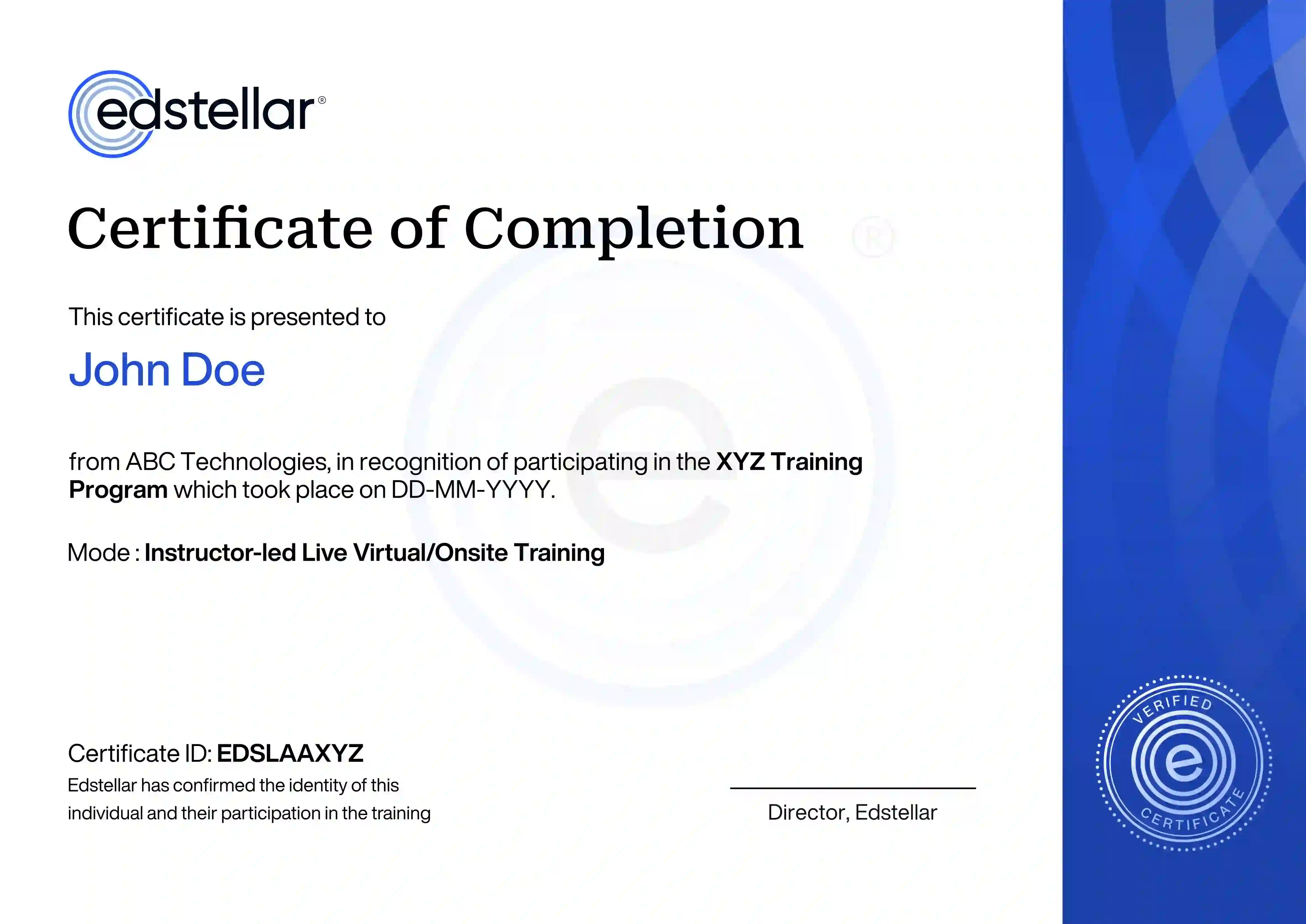
Upon successful completion of the HIPAA training course offered by Edstellar, employees receive a course completion certificate, symbolizing their dedication to ongoing learning and professional development.
This certificate validates the employee's acquired skills and is a powerful motivator, inspiring them to enhance their expertise further and contribute effectively to organizational success.

Explore More Courses


Edstellar is a one-stop instructor-led corporate training and coaching solution that addresses organizational upskilling and talent transformation needs globally.
.svg)
.svg)
.svg)

.svg)
Learning Technology
Learning Content Design and Development
Learning Governance, Analytics & ROI
Digital Learning Ecosystem
Training Simulations, AR/VR & Case Studies
Employee Performance Support
Leadership Pipeline & Succession PlanningStrategic Workforce Planning for EnterprisesTransformation & Risk Advisory for EnterprisesDEI Consulting for EnterprisesEmployee Engagement Consulting for Enterprises
Cultural Transformation