%20Training%202553x860.webp)
Corporate Introduction to Natural Language Processing (NLP) Training Course
Edstellar's Natural Language Processing (NLP) training equips teams with the skills to build and use NLP models in libraries like NLTK and spaCy. Professionals gain a foundation in linguistics to solve real-world NLP challenges and transform text data into actionable insights. Upskill your team for enhanced proficiency in NLP.
(Virtual / On-site / Off-site)
Available Languages
English, Español, 普通话, Deutsch, العربية, Português, हिंदी, Français, 日本語 and Italiano
Drive Team Excellence with Introduction to Natural Language Processing (NLP) Corporate Training
Introduction to Natural Language Processing (NLP) is the gateway to understanding how computers can process and analyze large amounts of natural language data. The importance of NLP lies in its ability to automate understanding, interpretation, and even the generation of human language, which is crucial for businesses to automate customer service and recommend content.
The course is necessary for organizations to harness the power of natural language processing, thus driving innovation, efficiency, and competitiveness. Introduction to Natural Language Processing (NLP) training course is essential for teams to keep up with technological advancements and leverage the benefits of NLP applications.
Edstellar's instructor-led Introduction to Natural Language Processing (NLP) training course offers a comprehensive curriculum delivered through virtual/onsite training modes by industry experts with domain-specific experience. The course stands out due to its emphasis on practical, hands-on learning, customizable curriculum to meet specific organizational needs, and the application of real-world examples. The training imparts knowledge and offers valuable insights and skills that professionals can directly apply daily.

Skills Your Employees Will Gain
These are the core, hands-on capabilities your team builds during the program.
- Text Analysis AutomationText Analysis Automation involves using software to process and analyze large volumes of text data efficiently. This skill is important for roles in data science, marketing, and customer insights, as it enables quick decision-making and enhances data-driven strategies.
- Intelligent Chatbot DevelopmentIntelligent Chatbot Development involves creating AI-driven conversational agents that enhance user interaction. this skill is important for roles in customer support, marketing, and tech, as it improves efficiency, engagement, and user satisfaction.
- Insightful Data ExtractionInsightful Data Extraction is the ability to analyze and interpret data to derive meaningful insights. this skill is important for roles in data analysis, marketing, and decision-making, as it drives informed strategies and enhances business outcomes.
- Content OptimizationContent Optimization is the process of enhancing digital content to improve visibility and engagement. This skill is important for roles in marketing and SEO, as it drives traffic and boosts conversions.
- User Engagement EnhancementUser Engagement Enhancement is the ability to improve interactions and satisfaction among users. This skill is important for roles in marketing, product design, and customer support, as it drives loyalty and boosts retention.
- Platform Interaction EnhancementPlatform Interaction Enhancement is the ability to optimize user engagement across digital platforms. This skill is important for roles in UX design and digital marketing, as it drives user satisfaction and retention.
What Your Team Will Achieve After This Training
- Apply NLP techniques to automate text analysis and interpretation tasks, improving efficiency in handling large volumes of data
- Utilize advanced NLP models and algorithms to develop intelligent chatbots and virtual assistants, enhancing customer service experiences
- Implement NLP solutions to extract meaningful insights from unstructured data sources, supporting informed decision-making processes
- Incorporate NLP strategies into content creation and recommendation systems, optimizing user engagement and satisfaction
- Integrate NLP capabilities into existing systems to enhance user interaction and experience across various platforms
Topics & Program Outline
The curriculum is organized into focused modules built by industry experts and delivered virtually or on-premise. Interactive sessions reflect the evolving demands of the workplace, keeping the learning both relevant and practical.
- Introduction to Natural Language Processing (NLP)
- Overview of NLP and its applications
- Importance of NLP in various industries
- Basic concepts and terminology in NLP
- Understanding deep learning
- Fundamentals of deep learning neural networks
- Deep learning architectures relevant to NLP
- The advantages of deep learning for NLP
- Benefits of deep learning over traditional NLP methods
- Examples of successful deep learning applications in NLP
- Introduction to Keras for deep learning
- Introduction to Keras and its features
- Setting up a deep learning environment with Keras
- Basics of building and training deep learning models using Keras
- Techniques for manual text cleaning
- Identifying and handling common text data issues
- Manual text cleaning methods
- Text cleaning with NLTK (Natural Language Toolkit)
- Introduction to NLTK and its functionalities
- Performing text cleaning tasks using NLTK
- Tokenization, stemming, and lemmatization with NLTK
- Text data preparation with scikit-learn
- Overview of scikit-learn library for text preprocessing
- Preprocessing text data for machine learning tasks
- Text data preparation with Keras
- Preparing text data for deep learning models in Keras
- The Bag-of-Words model
- Concept and principles of bag-of-words
- Implementing bag-of-words representation for text data
- Applications and limitations of the bag-of-words model in NLP
- Prepare movie review data for sentiment analysis
- Data collection and preprocessing for sentiment analysis
- Formatting movie review data into suitable input format
- Neural Bag-of-Words model for sentiment analysis
- Introduction to neural networks for sentiment analysis
- Designing and training a neural network using bag-of-words representation
- The word embedding model
- Introduction to word embeddings and distributed representations
- Applications and advantages of word embeddings in NLP tasks
- How to develop word embeddings with gensim
- Overview of gensim library for word embedding generation
- Fine-tuning pre-trained word embeddings for specific tasks
- How to learn and load word embeddings in Keras
- Integrating pre-trained word embeddings with Keras models
- Customizing word embedding layers in Keras for fine-tuning
- Handling out-of-vocabulary words and embedding matrix initialization in Keras
- Neural models for document classification
- Overview of neural network architectures for text classification
- Comparing different neural models for document classification tasks
- Advantages and limitations of neural approaches in text classification
- Develop an Embedding + CNN Model
- Designing a convolutional neural network (CNN) with embedding layers
- Training and fine-tuning the model for document classification
- Develop an n-gram CNN Model for Sentiment Analysis
- Introduction to n-gram models
- Implementing an n-gram CNN architecture for sentiment analysis
- Optimizing model hyperparameters and regularization techniques
- Neural language modeling
- Introduction to language modeling and its applications
- Overview of neural network approaches to language modeling
- Challenges and considerations in neural language modeling
- Develop a character-based neural language model
- Building a character-level Recurrent Neural Network (RNN) for language modeling
- Generating text samples using the trained character-based language model
- How to develop a word-based neural language model
- Designing a word-level Recurrent Neural Network (RNN) architecture for language modeling
- Preprocessing text data and tokenizing words for model input
- Training the word-based language model and evaluating its performance on test data
- Develop a neural language model for text generation
- Extending the word-based language model to generate coherent text sequences
- Fine-tuning the language model for specific text-generation tasks
- Neural image caption generation
- Overview of image captioning and its applications
- Neural network models for caption generation
- Introduction to Convolutional Neural Networks (CNNs) for image feature extraction
- Integration of CNNs with Recurrent Neural Network (RNNs) for caption generation
- Training strategies and techniques for improving caption quality
- Load and use a pre-trained object recognition model
- Introduction to pre-trained CNN models for image recognition tasks
- Loading pre-trained CNN models using popular deep learning frameworks
- Utilizing pre-trained CNN features for image captioning tasks
- How to evaluate generated text with the BLEU score
- Overview of the BLEU (Bilingual Evaluation Understudy) metric for text evaluation
- Calculating BLEU scores to measure the quality of generated captions
- Interpreting BLEU scores and their significance in evaluating image captioning models
- How to prepare a photo caption dataset for modeling
- Data collection and preprocessing for image captioning datasets
- Ensuring data quality and diversity in the photo caption dataset
- Develop a neural image caption generation model
- Building an end-to-end neural network model for image captioning
- Training the model on the prepared dataset to generate descriptive captions for images
- Neural machine translation
- Introduction to machine translation and its challenges
- Overview of neural network approaches to machine translation
- Advantages of neural machine translation over traditional statistical methods
- Encoder-decoder models for NMT
- Architecture and components of encoder-decoder models for neural machine translation
- Training strategies and techniques for encoder-decoder models
- Configure encoder-decoder models for NMT
- Configuring encoder and decoder architectures for specific language pairs
- How to develop a neural machine translation model
- Building an end-to-end neural network model for machine translation
- Evaluating translation quality and performance metrics of the developed NMT model
Who Should Attend?
This program suits professionals at many levels across the organization, including:
- Data Scientists
- Machine Learning Engineers
- AI Researchers
- Research Analysts
- Computational Linguists
- Data Analysts
- Software Developers
- Data Engineers
- Python Programmers
- Tech Leads
- Product Managers
- IT Project Managers
What are the Prerequisites?
Professionals with a basic understanding of Linux editors and Python can take the Introduction to Natural Language Processing (NLP) training course.
Choose the Format That Fits Your Team
We design training your teams actually engage with, and deliver it the way that suits you best. Through a vetted global trainer network, Edstellar runs sessions in 10+ languages with consistent quality anywhere.


.webp)
Virtual / online: expert-led live sessions delivered anywhere, with consistency and easy scheduling.
.webp)
On-site (in-house): immersive, instructor-led learning at your office.
.webp)
Off-site: focused, instructor-led group learning away from everyday workplace distractions.
Get a Proposal Shaped to Your Needs
Need pricing for onsite, offsite, or virtual delivery? Get a proposal tailored to your team's needs.
64 hours of group training (includes VILT/In-person On-site)
Tailored for SMBs
Tailor-Made Trainee Licenses with Our Exclusive Training Packages!
160 hours of group training (includes VILT/In-person On-site)
Ideal for growing SMBs
Tailor-Made Trainee Licenses with Our Exclusive Training Packages!
400 hours of group training (includes VILT/In-person On-site)
Designed for large corporations
Tailor-Made Trainee Licenses with Our Exclusive Training Packages!
Unlimited duration
Designed for large corporations
What Sets Edstellar Apart
Experienced Trainers
Our trainers are drawn from a vetted global network and bring years of industry expertise, keeping every session practical and impactful.
Proven Quality
With a strong global track record, Edstellar is known for quality and engaging delivery.
Industry-Relevant Curriculum
Our programs are built by experts to match the demands of today's industry.
Fully Customizable
Every program can be tailored to your organization's goals.
Comprehensive Support
We provide pre- and post-session support for a complete learning experience.
Global Multi-Location & Multilingual Training Delivery
We deliver in multiple languages to support diverse global teams.
Hear from Organizations We've Trained
"This Introduction to Natural Language Processing (NLP) course was exactly what I needed to advance my career. As a Research Analyst, mastering strategic frameworks has become crucial for my success. The frameworks I use daily. I've confidently led multiple high-visibility initiatives leveraging this comprehensive knowledge. The real-world examples and deep dive into hands-on exercises were particularly valuable for my professional growth.”
Sandra Dixon
Research Analyst,
Enterprise Software Development Firm
"This Introduction to Natural Language Processing (NLP) course was precisely what I needed to design robust technical mastery architectures. The hands-on approach to interactive labs and seamless integration with projects using advanced techniques from this training. We've successfully expanded our service portfolio based on these enhanced capabilities. The comprehensive curriculum has elevated my solution delivery capabilities significantly.”
Guo Hui
Python Developer,
IT Services and Solutions Provider
"The Introduction to Natural Language Processing (NLP) training transformed our team's entire approach to strategic implementation management and execution. As a Analytics Engineer, the extensive coverage of industry best proven concepts to optimized processes. Our department achieved a remarkable 50% improvement in operational efficiency metrics. Our team's productivity and solution quality have improved measurably, validating this investment.”
Nabeel Fares
Analytics Engineer,
Global Technology Solutions Provider
“Edstellar’s IT & Technical training programs have been instrumental in strengthening our engineering teams and building future-ready capabilities. The hands-on approach, practical cloud scenarios, and expert guidance helped our teams improve technical depth, problem-solving skills, and execution across multiple projects. We’re excited to extend more of these impactful programs to other business units.”
Aditi Rao
L&D Head,
A Global Technology Company
Recognition That Motivates Your Team
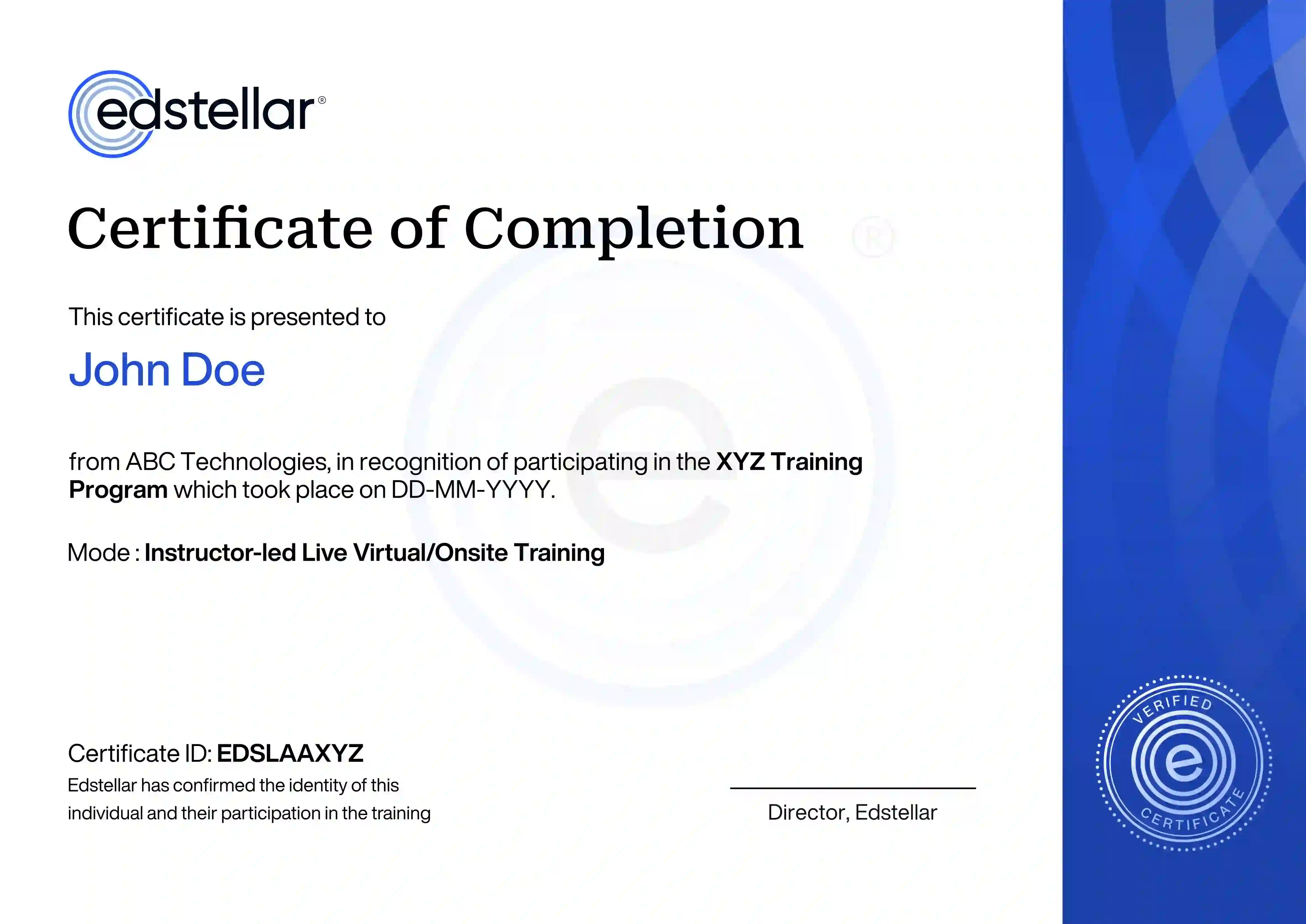
Upon successful completion of the training course offered by Edstellar, employees receive a course completion certificate, symbolizing their dedication to ongoing learning and professional development.
This certificate validates the employee's acquired skills and is a powerful motivator, inspiring them to enhance their expertise further and contribute effectively to organizational success.


Other Related Corporate Training Courses
Explore More Courses
Edstellar is a one-stop instructor-led corporate training and coaching solution that addresses organizational upskilling and talent transformation needs globally.
Learning Technology
Learning Content Design and Development
Learning Governance, Analytics & ROI
Digital Learning Ecosystem
Training Simulations, AR/VR & Case Studies
Employee Performance Support
Leadership Pipeline & Succession PlanningStrategic Workforce Planning for EnterprisesTransformation & Risk Advisory for EnterprisesDEI Consulting for EnterprisesEmployee Engagement Consulting for Enterprises
Cultural Transformation