Join 25 Global CEOs (Exclusive CEO Retreat) - Leading the Change - Mallorca, Spain · 20th–24th May 2026
Know More
X

Drive Team Excellence with Basic Linux and Docker with Kubernetes Corporate Training

Empower your teams with expert-led on-site, off-site, and virtual Basic Linux and Docker with Kubernetes Training through Edstellar, a premier corporate training provider for organizations globally. Designed to meet your specific training needs, this group training program ensures your team is primed to drive your business goals. Help your employees build lasting capabilities that translate into real performance gains.

Basic Linux and Docker with Kubernetes are key technologies for modern software development and deployment. They enable organizations to create, deploy, and manage applications efficiently, utilizing containerization and orchestration to improve scalability, reliability, and ease of maintenance. Basic Linux and Docker with Kubernetes Training in these technologies provides individuals with the essential skills needed to work effectively in contemporary IT environments.

Basic Linux and Docker with Kubernetes instructor-led training course provided by Edstellar can be customized to meet team requirements. The virtual/onsite Basic Linux and Docker with Kubernetes training course led by expert trainers ensures that employees develop the skills to manage and deploy applications efficiently in a real-world environment.

Get Customized Expert-led Training for Your Teams
Customized Training Delivery
Scale Your Training: Small to Large Teams
In-person Onsite, Live Virtual or Hybrid Training Modes
Plan from 2000+ Industry-ready Training Programs
Experience Hands-On Learning from Industry Experts
Delivery Capability Across 100+ Countries & 10+ Languages
""""

Key Skills Employees Gain from instructor-led Basic Linux and Docker with Kubernetes Training

Basic Linux and Docker with Kubernetes skills corporate training will enable teams to effectively apply their learnings at work.

  • Linux Commands
    Linux Commands refer to the set of instructions used to interact with the Linux operating system. this skill is important for system administrators and developers to manage servers, automate tasks, and troubleshoot efficiently.
  • Shell Scripting
    Shell Scripting is the process of writing scripts for command-line interfaces to automate tasks. This skill is important for system administrators and DevOps roles, enhancing efficiency and reliability.
  • File System Management
    File System Management involves organizing, storing, and retrieving data efficiently. This skill is important for IT professionals and data analysts to ensure data integrity, accessibility, and security.
  • User Management
    User Management is the process of overseeing user accounts, permissions, and access within systems. This skill is important for IT roles to ensure security, compliance, and efficient operations.
  • Docker Containerization
    Docker Containerization is the process of packaging applications and their dependencies into containers for consistent deployment. This skill is important for DevOps and software development roles, as it enhances scalability, efficiency, and collaboration across teams.
  • Dockerfile Creation
    Dockerfile Creation is the process of writing scripts to automate the building of Docker images. This skill is important for DevOps and software engineering roles, ensuring consistent environments and efficient deployment.

Key Learning Outcomes of Basic Linux and Docker with Kubernetes Training Workshop for Employees

Upon completing Edstellar’s Basic Linux and Docker with Kubernetes workshop, employees will gain valuable, job-relevant insights and develop the confidence to apply their learning effectively in the professional environment.

  • Analyze the Linux file system structure to locate files and understand access permissions
  • Monitor the health and performance of Kubernetes applications using Prometheus and Grafana
  • Manage Kubernetes objects including pods, replica sets, deployments, services and persistent volumes
  • Evaluate the benefits of containerization and use Docker commands to run, manage and build Docker containers
  • Apply knowledge of Linux commands to navigate directories, view files, manage processes and create/manipulate files and directories

Key Benefits of the Basic Linux and Docker with Kubernetes Group Training with Instructor-led Face to Face and Virtual Options

Attending our Basic Linux and Docker with Kubernetes group training classes provides your team with a powerful opportunity to build skills, boost confidence, and develop a deeper understanding of the concepts that matter most. The collaborative learning environment fosters knowledge sharing and enables employees to translate insights into actionable work outcomes.

  • Equips the team with the techniques to navigate, manage, and secure Linux systems
  • Empowers employees with the skills to build, run, and manage containerized applications using Docker
  • Develops required skills in employees to deploy and orchestrate containerized applications with Kubernetes
  • Cultivates ideas in teams for leveraging containerization for scalable and agile application development
  • Provides insights into the benefits and use cases of containerization for modern application architectures

Topics and Outline of Basic Linux and Docker with Kubernetes Training

Our virtual and on-premise Basic Linux and Docker with Kubernetes training curriculum is structured into focused modules developed by industry experts. This training for organizations provides an interactive learning experience that addresses the evolving demands of the workplace, making it both relevant and practical.

  1. What is Linux

    • History of Linux
    • Linux distributions
    • Open source philosophy
  1. Basic Linux commands

    • Navigating directories
    • Viewing files and directories
    • File operations (copy, move, delete)
    • Viewing and managing processes
  1. Understanding Linux file system structure

    • Root directory
    • Common directories (bin, etc, var, home, usr)
    • Pathnames (absolute and relative)
  1. Creating files and directories

    • Using touch command
    • Using mkdir command
    • Creating files with cat
  1. Copying files and directories

    • cp command basics
    • Recursive copying
    • Preserving file attributes
  1. Basics of VIM editor

    • Starting and exiting VIM
    • Basic navigation
    • Insert and command modes
    • Saving and quitting
  1. Managing users

    • Adding and removing users
    • Modifying user information
    • User groups
  1. Understanding Linux file system permissions

    • Viewing file permissions
    • Understanding permission types (read, write, execute)
  1. Changing permissions

    • Using chmod command
    • Numeric and symbolic modes
    • Changing ownership with chown
  1. Managing services

    • Starting and stopping services
    • Enabling and disabling services at boot
    • Checking service status
  1. Installing and updating software packages with YUM

    • Adding repositories
    • Installing packages
    • Updating packages
    • Removing packages
  1. Introduction to containers

    • Containerization vs. virtualization
    • Benefits of containers
    • Use cases for containers
  1. Introduction to Docker

    • Docker architecture
    • Components (Docker Engine, Docker CLI, Docker Hub)
  1. Downloading and installing Docker

    • System requirements
    • Installation steps on different operating systems
    • Verifying installation
  1. Docker essential commands

    • Starting and stopping containers
    • Listing running containers
    • Removing containers
    • Inspecting containers
  1. Understanding Docker images

    • Image layers
    • Base images and child images
    • Image repositories
  1. Building Docker images using Dockerfile

    • Dockerfile syntax and structure
    • Building an image with docker build
    • Tagging images
  1. Storing and retrieving Docker images from Docker Hub

    • Creating a Docker Hub account
    • Pushing images to Docker Hub
    • Pulling images from Docker Hub
    • Managing images on Docker Hub
  1. Overview of container orchestration

    • Need for orchestration
    • Comparison of orchestration tools (Kubernetes, Docker Swarm, Mesos)
  1. Introduction to Kubernetes

    • Key features of Kubernetes
    • Kubernetes use cases
  1. Kubernetes architecture

    • Master components (API server, scheduler, controller manager, etcd)
    • Node components (kubelet, kube-proxy, container runtime)
    • Cluster communication
  1. Create Kubernetes cluster using kubeadm

    • Prerequisites
    • Initializing the master node
    • Joining worker nodes to the cluster
  1. Implement network solution – Calico

    • Network policies
    • Installing Calico
    • Configuring network policies
  1. Verify installation

    • Checking node status
    • Verifying cluster components
    • Basic troubleshooting
  1. Managing pods

    • Creating pods
    • Viewing pod status
    • Deleting pods
  1. Managing labels and selectors

    • Adding labels to resources
    • Selecting resources with labels
    • Label-based queries
  1. Managing replica sets

    • Creating replica sets
    • Scaling replica sets
    • Updating replica sets
  1. Managing services

    • Service types (ClusterIP, NodePort, LoadBalancer)
    • Creating services
    • Service discovery
  1. Manual scheduling

    • Static pod definition
    • Node assignment
  1. Node selector

    • Defining node selectors
    • Using node selectors in pod specifications
  1. Overview of deployment

    • Deployment object in Kubernetes
    • Benefits of using deployments
  1. Deployment strategies

    • Rolling updates
    • Blue-green deployment
    • Canary deployment
  1. Managing deployment

    • Creating deployments
    • Updating deployments
    • Rolling back deployments
  1. Volumes

    • Volume types
    • Using volumes in pods
  1. Persistent volumes

    • Persistent Volume (PV) concepts
    • Creating persistent volumes
    • Binding PVs to pods
  1. Persistent volume claims

    • Persistent Volume Claim (PVC) concepts
    • Creating PVCs
    • Binding PVCs to PVs
  1. Understand how to monitor all cluster components

    • Monitoring Kubernetes control plane
    • Node monitoring
  1. Understand how to monitor applications

    • Application-level monitoring
    • Using probes (liveness, readiness)
  1. Monitoring with Prometheus and Grafana

    • Installing Prometheus
    • Setting up Grafana
    • Creating dashboards
  1. Kubernetes networking

    • Pod networking
    • Service networking
  1. Introduction to ingress

    • Ingress concepts
    • Ingress controllers
  1. Configure and manage ingress rules

    • Defining ingress resources
    • Managing HTTPS/TLS
  1. Namespace

    • Creating namespaces
    • Resource isolation with namespaces
  1. Load balancer service

    • External load balancers
    • Configuring load balancer services

Who Can Take the Basic Linux and Docker with Kubernetes Training Course

The Basic Linux and Docker with Kubernetes training program can also be taken by professionals at various levels in the organization.

  • Systems Administrators
  • DevOps Engineers
  • Cloud Engineers
  • IT Infrastructure Managers
  • Linux Administrators
  • Containerization Specialists
  • Kubernetes Administrators
  • Network Engineers
  • IT Operations Managers
  • Technical Support Engineers
  • Software Developers
  • Systems Engineers

Prerequisites for Basic Linux and Docker with Kubernetes Training

Employees with a basic understanding of operating systems and command-line interfaces, basic knowledge of computer networking concepts, and familiarity with programming or scripting languages such as Bash or Python.

Request a Quote for your Corporate Training Requirements

Valid number

Delivering Training for Organizations across 100 Countries and 10+ Languages

Corporate Group Training Delivery Modes
for Basic Linux and Docker with Kubernetes Training

At Edstellar, we understand the importance of impactful and engaging training for employees. As a leading Basic Linux and Docker with Kubernetes training provider, we ensure the training is more interactive by offering Face-to-Face onsite/in-house or virtual/online sessions for companies. This approach has proven to be effective, outcome-oriented, and produces a well-rounded training experience for your teams.

Virtual Basic Linux and Docker with Kubernetes Training

Edstellar's Basic Linux and Docker with Kubernetes virtual/online training sessions bring expert-led, high-quality training to your teams anywhere, ensuring consistency and seamless integration into their schedules.

With global reach, your employees can get trained from various locations
The consistent training quality ensures uniform learning outcomes
Participants can attend training in their own space without the need for traveling
Organizations can scale learning by accommodating large groups of participants
Interactive tools can be used to enhance learning engagement
On-site Basic Linux and Docker with Kubernetes Training

Edstellar's Basic Linux and Docker with Kubernetes inhouse face to face instructor-led training delivers immersive and insightful learning experiences right in the comfort of your office.

Higher engagement and better learning experience through face-to-face interaction
Workplace environment can be tailored to learning requirements
Team collaboration and knowledge sharing improves training effectiveness
Demonstration of processes for hands-on learning and better understanding
Participants can get their doubts clarified and gain valuable insights through direct interaction
Off-site Basic Linux and Docker with Kubernetes Training

Edstellar's Basic Linux and Docker with Kubernetes offsite face-to-face instructor-led group training offer a unique opportunity for teams to immerse themselves in focused and dynamic learning environments away from their usual workplace distractions.

Distraction-free environment improves learning engagement
Team bonding can be improved through activities
Dedicated schedule for training away from office set up can improve learning effectiveness
Boosts employee morale and reflects organization's commitment to employee development

Explore Our Customized Pricing Package
for
Basic Linux and Docker with Kubernetes Corporate Training

Looking for pricing details for onsite, offsite, or virtual instructor-led Basic Linux and Docker with Kubernetes training? Get a customized proposal tailored to your team’s specific needs.

Request a Group Training Quote
""
How Many Team Members Need Training?
Please select an option or fill in the custom field.
"'

Is Your Corporate Training Requirement Only for Basic Linux and Docker with Kubernetes?

Please select at least one course.
""
Add the List of Training Workshops
search icon

      Please select the course

      No. of Courses selected: 0

      Clear

      Upload a CSV

      Send us your Training Requirements in 3 Easy steps

      1. 1
      2. 2
        Add the required training workshops
      3. 3
        Upload to get a quick quote or email it to contact@edstellar.com

      ""

      Looking for a Complete Package?

      Looking for a one-time pricing option for all your annual training requirements?

      View Corporate Training Packages
      ""
      Select the Option that Best Describes Your Corporate Training Requirement

      Please select an option or choose from the recurring options.
      ""
      Verify and Submit Your Request

      Review Your Corporate Training Selection Summary

      Training Program: Basic Linux and Docker with Kubernetes Training

      1. No of Team Members

      2. Selected Training Preference

      3. Selected Recurring Sessions

      1

      Review your Requirements

      Training Workshops Selected :


        Excel
        File has been
        successfully uploaded.
        Fill the form to submit
 your details
        Submit Your Professional Contact Information
        Valid number
        We've received your enquiry. Our team will be in touch soon.
        Oops! Something went wrong while submitting the form.
        Starter
        120 licences

        Tailor-Made Trainee Licenses with Our Exclusive Training Packages!

        View Package

        64 hours of group training (includes VILT/In-person On-site)

        Tailored for SMBs

        Growth
        320 licences

        Tailor-Made Trainee Licenses with Our Exclusive Training Packages!

        View Package

        160 hours of group training (includes VILT/In-person On-site)

        Ideal for growing SMBs

        Enterprise
        800 licences

        Tailor-Made Trainee Licenses with Our Exclusive Training Packages!

        View Package

        400 hours of group training (includes VILT/In-person On-site)

        Designed for large corporations

        Custom
        Unlimited licenses

        Tailor-Made Trainee Licenses with Our Exclusive Training Packages!

        View Package

        Unlimited duration

        Designed for large corporations

        Edstellar: Your Go-to Basic Linux and Docker with Kubernetes Training Company

        Experienced Trainers

        Our trainers bring years of industry expertise to ensure the training is practical and impactful.

        Quality Training

        With a strong track record of delivering training worldwide, Edstellar maintains its reputation for its quality and training engagement.

        Industry-Relevant Curriculum

        Our course is designed by experts and is tailored to meet the demands of the current industry.

        Customizable Training

        Our course can be customized to meet the unique needs and goals of your organization.

        Comprehensive Support

        We provide pre and post training support to your organization to ensure a complete learning experience.

        Multilingual Training Capabilities

        We offer training in multiple languages to cater to diverse and global teams.

        Testimonials

        What Our Clients Say

        We pride ourselves on delivering exceptional training solutions. Here's what our clients have to say about their experiences with Edstellar.

        "Attending the Basic Linux and Docker with Kubernetes training was transformational for my professional development. As a Lead Cloud Operations Engineer, the deep dive into advanced methodologies gave me the confidence to coverage of expert-led workshops were immediately applicable to my work. I've been able to drive meaningful innovation and improvement within my department. This course has become foundational to my continued success.”

        Elias Marshall

        Lead Cloud Operations Engineer,

        Enterprise Kubernetes Solutions Provider

        "The Basic Linux and Docker with Kubernetes training enhanced my ability to architect and implement sophisticated operational excellence strategies. Understanding industry best practices through intensive interactive labs optimize strategic initiatives. Client engagement and retention metrics have improved significantly across our practice. The detailed exploration of practical simulations provided methodologies I leverage in every engagement.”

        Wilhelm Schröder

        Lead Cloud Security Engineer,

        Microservices Infrastructure Company

        "As a Lead AWS Solutions Architect leading technical mastery operations, the Basic Linux and Docker with Kubernetes training provided our team with essential strategic frameworks expertise at scale. The comprehensive our complete operational footprint. Our team has automated eighteen critical business processes, reducing manual effort by 70%. This course has proven invaluable for driving our organizational transformation and sustained excellence.”

        Ambika Prakash

        Lead AWS Solutions Architect,

        Container Orchestration Platform Provider

        “Edstellar’s IT & Technical training programs have been instrumental in strengthening our engineering teams and building future-ready capabilities. The hands-on approach, practical cloud scenarios, and expert guidance helped our teams improve technical depth, problem-solving skills, and execution across multiple projects. We’re excited to extend more of these impactful programs to other business units.”

        Aditi Rao

        L&D Head,

        A Global Technology Company

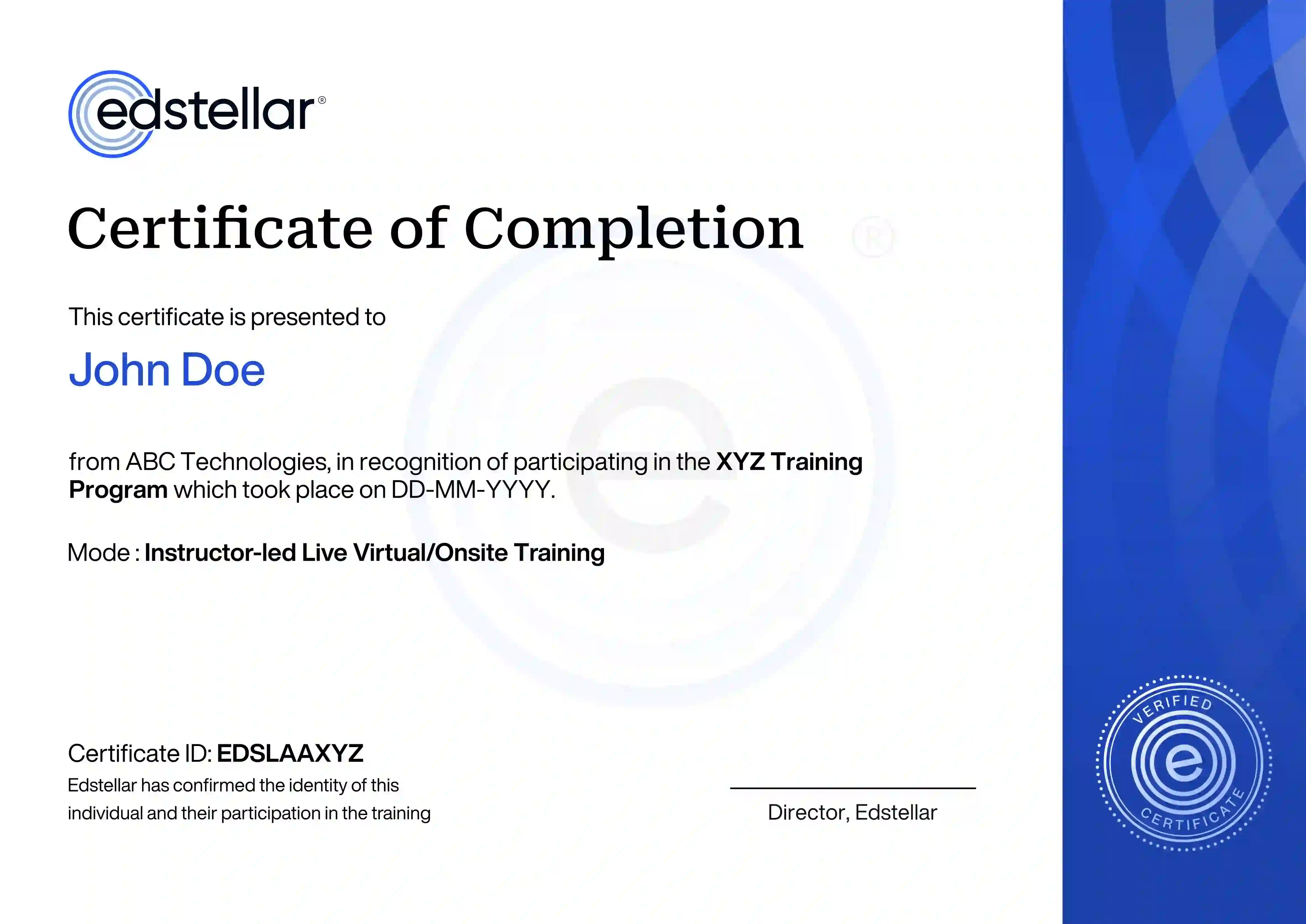
        Get Your Team Members Recognized with Edstellar’s Course Certificate

        Upon successful completion of the training course offered by Edstellar, employees receive a course completion certificate, symbolizing their dedication to ongoing learning and professional development.

        This certificate validates the employee's acquired skills and is a powerful motivator, inspiring them to enhance their expertise further and contribute effectively to organizational success.

        Certificate of Excellence

        We have Expert Trainers to Meet Your Basic Linux and Docker with Kubernetes Training Needs

        The instructor-led training is conducted by certified trainers with extensive expertise in the field. Participants will benefit from the instructor's vast knowledge, gaining valuable insights and practical skills essential for success in Access practices.

        Other Related Corporate Training Courses