.svg "edstellar")

ISO 42001 AI Management System Corporate Training Program
Equip your teams to implement, maintain, and audit an ISO 42001 Artificial Intelligence Management System. This training covers AIMS governance, AI risk assessment, lifecycle controls, ethical AI practices, and certification preparation.
(Virtual / On-site / Off-site)
.svg)
Drive Team Excellence with ISO 42001 AI Management System Corporate Training
ISO 42001 AI Management System training equips compliance, governance, and technology professionals with the skills to implement and operate an AIMS in alignment with the international standard. The course covers the full ISO 42001 framework including context setting, leadership commitment, planning, risk assessment, AI lifecycle controls, ethical AI principles, performance evaluation, internal audit, and certification preparation.
Edstellar's ISO 42001 AI Management System Instructor-led course offers virtual/onsite training options suited to organizations at any stage of their AIMS journey. Participants gain practical skills through structured exercises, documentation workshops, and audit simulation activities that translate standard requirements into real-world organizational practice.
.svg)

Skills Your Employees Will Gain
These are the core, hands-on capabilities your team builds during the program.
- ISO 42001 AIMS Implementation
- AI Risk Assessment and Context Analysis
- AI Governance Frameworks
- AI System Lifecycle Management
- Operational AI Controls
- ISO 42001 Internal Audit
- Continual Improvement for AI Systems
What Your Team Will Achieve After This Training
- Master the ISO 42001 standard requirements and implement a compliant Artificial Intelligence Management System from foundation to certification
- Gain expertise in AI risk assessment and context analysis to proactively identify and treat risks across the AI system lifecycle
- Develop and apply robust AI governance frameworks that meet ISO 42001 leadership and accountability requirements
- Build operational AI controls that ensure responsible, ethical, and continuously monitored AI system deployment
- Learn to plan and execute ISO 42001 internal audits and management reviews that drive evidence-based improvement
- Apply continual improvement methodologies to sustain AIMS effectiveness and prepare confidently for external certification
Topics & Program Outline
The curriculum is organized into focused modules built by industry experts and delivered virtually or on-premise. Interactive sessions reflect the evolving demands of the workplace, keeping the learning both relevant and practical.
-
Overview of ISO 42001 and Its Purpose
- Explain the origins, development, and global significance of the ISO 42001 standard
- Describe the structure of ISO 42001 using the Annex SL high-level framework
- Identify the key objectives of an Artificial Intelligence Management System
- Understand how ISO 42001 relates to other AI governance regulations and frameworks
-
The AI Governance Landscape
- Survey the global regulatory environment for AI governance including the EU AI Act and NIST AI RMF
- Distinguish between voluntary standards, mandatory regulations, and certification schemes for AI
- Explain how ISO 42001 complements and interacts with existing data protection and cybersecurity standards
- Identify organizational drivers for adopting ISO 42001 including risk reduction and competitive advantage
-
Key Definitions and Terminology
- Define core ISO 42001 terms including AIMS, AI system, AI provider, and AI deployer
- Distinguish between AI system developers, operators, and users within the standard's scope
- Clarify the meaning of AI risk, AI impact, and AI objective as used in the standard
- Build a shared vocabulary across compliance, IT, and governance teams for AIMS implementation
-
Benefits of ISO 42001 Certification
- Articulate the risk management benefits of structured AI governance through ISO 42001
- Explain how certification supports organizational trust, customer confidence, and market differentiation
- Review how ISO 42001 helps organizations demonstrate responsible AI to regulators and stakeholders
- Identify the internal operational benefits including improved AI accountability and decision transparency
-
ISO 42001 and Annex SL Integration
- Explain the Annex SL structure and how it enables integration with ISO 9001, ISO 27001, and other standards
- Identify common clauses shared across ISO management system standards for integrated implementation
- Develop an integration roadmap for organizations already holding other ISO certifications
- Understand the efficiency gains available through integrated AIMS and existing management systems
-
Scoping and Planning the AIMS Implementation Journey
- Identify the key phases and activities in a typical ISO 42001 implementation project
- Define roles, responsibilities, and cross-functional teams required for AIMS implementation
- Develop a high-level AIMS implementation project plan with realistic timelines and milestones
- Assess organizational readiness and identify capability gaps before beginning implementation
-
Analyzing the External and Internal Context
- Apply ISO 42001 Clause 4.1 requirements to analyze the organization's external AI environment
- Identify internal organizational factors that influence AI governance and management system design
- Use PESTLE and SWOT analysis tools adapted for AI context identification
- Document context analysis outputs in a format suitable for AIMS planning and certification evidence
-
Identifying Interested Parties and Their Requirements
- Identify all internal and external stakeholders relevant to the organization's AI systems
- Document the needs and expectations of interested parties in relation to AI governance
- Assess which stakeholder requirements are relevant and binding within the AIMS scope
- Establish mechanisms for monitoring changes in interested party requirements over time
-
Defining the AIMS Scope
- Apply ISO 42001 Clause 4.3 guidance to define the boundaries and applicability of the AIMS
- Determine which AI systems, processes, and organizational units fall within the AIMS scope
- Document scope exclusions and justify them in accordance with standard requirements
- Review scope definition against organizational strategy and AI system inventory
-
AI System Inventory and Classification
- Develop a comprehensive inventory of all AI systems in scope of the AIMS
- Classify AI systems by risk level, application domain, and organizational impact
- Identify AI systems developed internally, procured externally, and deployed in third-party contexts
- Maintain and update the AI system inventory as a living document within the AIMS
-
Mapping AI Roles and Responsibilities
- Define the roles of AI provider, AI deployer, and AI user as specified in ISO 42001
- Map organizational functions to AIMS roles and assign accountabilities for each AI system
- Establish governance structures that ensure clear ownership of AI management responsibilities
- Document role assignments in AIMS governance records for audit and certification purposes
-
Documenting the AIMS Context
- Develop context documentation templates aligned with ISO 42001 clause requirements
- Integrate context documentation into the broader AIMS document management system
- Establish a review schedule to keep context documentation current and accurate
- Use context documentation as the foundation for AIMS scope, objectives, and risk planning
-
Top Management Responsibilities Under ISO 42001
- Explain the leadership obligations defined in ISO 42001 Clause 5 for senior management
- Describe the accountability of top management for AIMS effectiveness and resource provision
- Identify how leadership commitment is demonstrated through documented policies and decisions
- Develop an executive briefing on ISO 42001 leadership requirements for C-suite engagement
-
Developing the AI Policy
- Draft an AI policy that meets ISO 42001 Clause 5.2 requirements for content and communication
- Align the AI policy with organizational values, risk appetite, and regulatory obligations
- Ensure the AI policy addresses responsible AI principles including fairness, transparency, and accountability
- Establish a policy review and approval process with appropriate senior management sign-off
-
Assigning AIMS Roles and Authorities
- Define the roles of AIMS owner, AI risk manager, and internal auditor within the governance structure
- Assign authorities and reporting lines for AIMS roles in accordance with ISO 42001 requirements
- Develop RACI matrices for core AIMS processes and AI system governance activities
- Document role assignments in the AIMS governance framework for certification evidence
-
Communicating the AIMS to the Organization
- Develop internal communication plans to build awareness of the AIMS across the organization
- Tailor AIMS communication to the needs of technical, operational, and executive audiences
- Use town halls, intranet channels, and team briefings to embed AIMS awareness at all levels
- Measure AIMS awareness and understanding across organizational functions and adjust accordingly
-
Integrating AI Governance into Organizational Strategy
- Align the AIMS with organizational strategic objectives and digital transformation priorities
- Embed AI governance considerations into business planning, product development, and procurement decisions
- Develop AI governance KPIs that are reported at leadership and board level on a regular basis
- Establish AI governance as a permanent agenda item in senior leadership and risk committee meetings
-
Building an AI-Responsible Organizational Culture
- Identify the cultural values and behaviors that support responsible AI across the organization
- Train all employees on the organization's AI policy and their individual AIMS responsibilities
- Recognize and reward teams and individuals who demonstrate strong AI governance behaviors
- Embed AI responsibility principles into onboarding, performance management, and values programs
-
AIMS Planning Requirements Under ISO 42001
- Review ISO 42001 Clause 6 planning requirements including risks, opportunities, and objectives
- Understand how planning integrates context, interested party needs, and scope outputs
- Develop a planning framework that connects AIMS objectives to operational AI activities
- Identify planning documentation requirements for ISO 42001 certification readiness
-
AI Risk Assessment Methodology
- Apply ISO 42001 and ISO 31000 risk assessment frameworks to AI system risk identification
- Identify AI-specific risk categories including bias, opacity, security vulnerabilities, and unintended impacts
- Use risk likelihood and impact matrices adapted for AI system contexts and organizational risk appetite
- Document risk assessment results in a format aligned with ISO 42001 certification requirements
-
AI Impact Assessment
- Define AI impact assessment and distinguish it from traditional IT risk assessment approaches
- Assess the potential societal, ethical, and operational impacts of each AI system in scope
- Apply impact assessment criteria from ISO 42001 Annex B to evaluate AI system risk levels
- Integrate AI impact assessment findings into the overall AIMS risk register
-
Risk Treatment Planning
- Identify and evaluate risk treatment options including avoidance, mitigation, transfer, and acceptance
- Develop risk treatment plans with assigned owners, timelines, and measurable control objectives
- Select controls from ISO 42001 Annex A to address identified AI risks and impact areas
- Document the Statement of Applicability linking selected controls to risk treatment decisions
-
Setting AIMS Objectives
- Establish measurable AIMS objectives consistent with the AI policy and organizational strategy
- Define objectives at organizational, system, and process levels within the AIMS
- Assign ownership, resources, and timelines to each AIMS objective
- Develop monitoring and reporting mechanisms to track AIMS objective achievement
-
Managing AI Opportunities
- Identify opportunities arising from AI governance maturity including innovation and market trust
- Develop plans to capture AI governance opportunities alongside risk treatment activities
- Integrate opportunity management into AIMS planning cycles and management reviews
- Report on realized AI governance opportunities in leadership and certification documentation
-
Resource Requirements for the AIMS
- Identify the human, technological, and financial resources needed to operate the AIMS effectively
- Assess current organizational resource capacity against AIMS implementation requirements
- Develop a resource plan aligned with AIMS objectives and risk treatment activities
- Secure management approval for AIMS resource allocation and ongoing operational budgets
-
Competence and Training Requirements
- Define the competencies required for all roles with AIMS responsibilities under ISO 42001
- Conduct a skills gap analysis across governance, technical, compliance, and audit functions
- Develop and deliver targeted AIMS training programs to address identified competency gaps
- Maintain competence records and evidence of training completion for certification audit purposes
-
Awareness Programs for All Employees
- Design AIMS awareness programs that communicate AI policy and employee responsibilities clearly
- Differentiate awareness content for technical teams, operational users, and leadership audiences
- Integrate AIMS awareness into existing compliance, onboarding, and annual training programs
- Measure awareness levels and adjust program delivery to address gaps in understanding
-
AIMS Communication Planning
- Develop an AIMS communication plan specifying what, when, how, and to whom information is communicated
- Define internal communication requirements for AIMS performance updates and risk alerts
- Establish external communication protocols for AI governance reporting to regulators and clients
- Document communication activities as evidence of ISO 42001 Clause 7.4 compliance
-
AIMS Documentation and Records Management
- Identify mandatory documented information required by ISO 42001 across all clauses
- Design a document control system that ensures AIMS documents are current, accessible, and protected
- Establish records retention policies for AIMS operational records and audit evidence
- Implement version control and review workflows for all AIMS documentation
-
Technology Infrastructure for the AIMS
- Identify the software tools and platforms needed to support AIMS documentation and risk management
- Evaluate GRC platforms and AI governance tools for AIMS implementation and monitoring
- Integrate AIMS technology infrastructure with existing IT governance and compliance systems
- Establish tool access controls and audit trails aligned with AIMS security and accountability requirements
-
Overview of AI System Lifecycle Under ISO 42001
- Describe the stages of the AI system lifecycle from conception through retirement
- Map ISO 42001 Clause 8 operational control requirements to each lifecycle stage
- Understand how lifecycle controls apply differently to AI providers versus AI deployers
- Integrate AI lifecycle management into existing software development and procurement processes
-
AI System Design and Development Controls
- Apply design-stage controls to ensure AI systems are built with fairness and transparency by design
- Establish data governance requirements for training data quality, provenance, and bias mitigation
- Document design decisions, model architecture choices, and risk-informed trade-offs
- Conduct design-stage risk and impact assessments before AI system development proceeds
-
AI System Testing and Validation
- Define testing requirements for AI systems including performance, bias, robustness, and security testing
- Develop test plans that address ISO 42001 validation requirements across system risk levels
- Establish acceptance criteria and sign-off procedures before AI system deployment
- Document test results and validation evidence as mandatory AIMS records
-
AI System Deployment Controls
- Define deployment authorization procedures including stakeholder sign-off and risk acceptance
- Establish controls for staged rollout, pilot testing, and phased deployment of AI systems
- Implement human oversight mechanisms for high-risk AI systems at the point of deployment
- Document deployment decisions and approvals in AIMS records for audit readiness
-
AI System Monitoring and Incident Management
- Design operational monitoring plans to detect AI system drift, degradation, and unexpected behavior
- Establish AI incident classification, reporting, and escalation procedures within the AIMS
- Define corrective action processes for AI system failures, bias incidents, and security events
- Maintain AI incident logs and corrective action records as AIMS performance evidence
-
AI System Decommissioning and Retirement
- Define criteria and triggers for AI system decommissioning within the AIMS lifecycle framework
- Establish data disposition, model archiving, and documentation retention procedures at retirement
- Conduct end-of-life risk assessments to manage residual risks from retired AI systems
- Document retirement decisions and activities in AIMS records for audit and lessons learned purposes
-
Ethical AI Principles Under ISO 42001
- Review the ethical AI principles embedded in ISO 42001 including fairness, transparency, and human oversight
- Understand how ISO 42001 Annex A controls support responsible AI development and deployment
- Map ethical AI principles to specific AIMS controls, policies, and operational procedures
- Distinguish between ethical AI requirements under ISO 42001 and broader voluntary AI ethics commitments
-
Addressing AI Bias and Fairness
- Define algorithmic bias and explain its sources in training data, model design, and deployment context
- Apply bias detection techniques across AI system development and monitoring stages
- Implement fairness metrics and establish acceptable thresholds for different AI application types
- Document bias assessment results and remediation actions as part of AIMS operational records
-
AI Transparency and Explainability
- Explain the ISO 42001 requirements for AI system transparency in documentation and communications
- Develop explainability standards appropriate for different AI system risk levels and user audiences
- Implement explainability tools and techniques including model cards and algorithmic impact statements
- Establish user communication protocols that explain AI-driven decisions to affected individuals
-
Human Oversight and Control Requirements
- Define human oversight obligations under ISO 42001 for high-risk AI system categories
- Design human-in-the-loop controls that preserve meaningful human decision authority
- Establish override and intervention mechanisms for AI systems that produce unacceptable outputs
- Document human oversight procedures and evidence in AIMS operational records
-
AI and Data Privacy Integration
- Identify data privacy risks associated with AI system data processing and model training
- Integrate Privacy by Design principles into AI system development and deployment processes
- Align AI data governance practices with GDPR, DPDP, and relevant data protection regulations
- Conduct AI-specific data protection impact assessments and document outcomes in the AIMS
-
Responsible AI Procurement and Supply Chain
- Establish due diligence requirements for third-party AI systems and model providers
- Develop AI-specific supplier assessment criteria aligned with ISO 42001 and ethical AI standards
- Include AI governance obligations in supplier contracts and service level agreements
- Monitor third-party AI system compliance on an ongoing basis within the AIMS framework
-
AIMS Performance Monitoring Requirements
- Review ISO 42001 Clause 9 performance evaluation requirements for the AIMS
- Define what, how, when, and by whom AIMS performance is monitored and measured
- Establish AIMS performance indicators aligned with objectives, risks, and policy commitments
- Design monitoring workflows that integrate AIMS performance tracking into regular operational cycles
-
Developing AIMS Key Performance Indicators
- Define quantitative and qualitative KPIs for AI risk management, control effectiveness, and incident response
- Establish baseline measurements and target thresholds for each AIMS KPI
- Assign ownership and reporting responsibility for each AIMS performance indicator
- Develop dashboards and reporting templates for AIMS KPI visualization and communication
-
Monitoring AI System Controls
- Define control monitoring plans for each operational control in the AIMS control register
- Establish evidence collection procedures to confirm controls are operating effectively
- Implement automated monitoring tools where possible to reduce manual control testing burden
- Escalate control failures to the appropriate governance level for timely remediation
-
Analyzing and Evaluating Performance Data
- Apply trend analysis to AIMS performance data to identify patterns and emerging risks
- Correlate AI incident data with control effectiveness to identify systemic weaknesses
- Benchmark AIMS performance against industry standards and peer organizations where possible
- Prepare performance analysis reports for management review and continual improvement planning
-
Compliance Evaluation Under ISO 42001
- Establish a compliance evaluation program to assess adherence to legal and regulatory AI obligations
- Develop a legal register tracking AI-relevant regulations and their AIMS control implications
- Conduct periodic compliance evaluations and document findings as AIMS mandatory records
- Report compliance evaluation results to management as input to the management review process
-
Management Review Process
- Define the inputs, outputs, and frequency of the ISO 42001 management review
- Prepare management review agenda covering AIMS performance, risks, audits, and improvement opportunities
- Document management review decisions and assigned actions as mandatory AIMS records
- Track management review action completion and integrate outcomes into AIMS planning cycles
-
ISO 42001 Internal Audit Requirements
- Review ISO 42001 Clause 9.2 requirements for the internal audit program
- Understand the purpose of internal audits in evaluating AIMS conformity and effectiveness
- Distinguish between conformity audits, effectiveness audits, and combined audit approaches
- Identify the competencies required for ISO 42001 internal auditors
-
Developing the Annual Internal Audit Program
- Design a risk-based annual audit schedule covering all AIMS clauses and significant AI systems
- Allocate audit resources including auditor time, access, and documentation support
- Define audit scope, criteria, and methodology for each planned internal audit
- Obtain management approval for the annual internal audit program
-
Conducting the Internal Audit
- Prepare audit plans, checklists, and sampling strategies aligned with ISO 42001 requirements
- Conduct opening meetings, interviews, document reviews, and observations during the audit
- Collect and evaluate objective evidence of AIMS conformity and control effectiveness
- Classify audit findings as conformities, opportunities for improvement, or nonconformities
-
Audit Reporting and Nonconformity Management
- Prepare clear, objective audit reports that communicate findings to the appropriate audience
- Raise nonconformity reports with sufficient evidence and root cause analysis requirements
- Develop corrective action plans for each nonconformity with assigned owners and deadlines
- Track corrective action completion and verify effectiveness before closing nonconformities
-
Auditor Independence and Objectivity
- Apply ISO 19011 guidance on auditor independence to ISO 42001 internal audit planning
- Manage conflicts of interest by separating auditor and auditee responsibilities
- Rotate auditors across AIMS areas to maintain objectivity and develop broader audit capability
- Document auditor independence measures in the audit program for certification evidence
-
Preparing for External Certification Audit
- Understand the two-stage certification audit process used by accredited certification bodies
- Conduct a pre-certification readiness review using internal audit findings and management review outputs
- Prepare the AIMS documentation package for Stage 1 documentation review by the certification body
- Brief key AIMS staff on their roles and responsibilities during the external certification audit
-
Continual Improvement Under ISO 42001
- Explain the continual improvement requirements of ISO 42001 Clause 10 and their practical application
- Distinguish between correction, corrective action, and continual improvement in the AIMS context
- Develop a continual improvement culture that engages all AIMS stakeholders in ongoing enhancement
- Integrate PDCA cycle principles into AIMS operational and governance processes
-
Corrective Action and Nonconformity Management
- Apply a structured approach to root cause analysis for AIMS nonconformities and incidents
- Develop corrective action plans that address root causes rather than symptoms of AIMS failures
- Track corrective action implementation and verify effectiveness using objective evidence
- Maintain corrective action records as mandatory AIMS documentation for certification purposes
-
Using Audit and Review Outputs for Improvement
- Analyze internal audit findings to identify systemic weaknesses in AIMS design and operation
- Use management review decisions to prioritize and resource continual improvement initiatives
- Translate improvement opportunities identified in audits into concrete AIMS enhancement projects
- Report improvement progress to leadership through regular AIMS performance updates
-
Lessons Learned and Knowledge Management
- Establish a lessons learned process that captures insights from AI incidents, audits, and improvement projects
- Create a knowledge base of AIMS best practices accessible to all governance and operational staff
- Share lessons learned across business units to prevent recurrence of AI governance failures
- Incorporate lessons learned into AIMS training programs and procedure updates on a regular basis
-
Certification Body Selection and Audit Preparation
- Select an IAF-accredited certification body with demonstrated ISO 42001 audit expertise
- Submit the AIMS scope, context, and policy documentation for Stage 1 review
- Address Stage 1 findings and prepare evidence packages for Stage 2 on-site certification audit
- Plan and rehearse Stage 2 audit activities including witness audits of key AIMS processes
-
Maintaining Certification and Surveillance Audits
- Understand the surveillance audit schedule and requirements for maintaining ISO 42001 certification
- Develop an ongoing AIMS maintenance calendar aligned with certification cycle obligations
- Ensure continual improvement evidence is documented and available for each surveillance audit
- Plan recertification activities and manage the three-year certification renewal process proactively
Who Should Attend?
This program suits professionals at many levels across the organization, including:
- AI Governance Managers
- Compliance Officers
- Risk Managers
- IT Managers
- Quality Managers
- AI Project Leaders
What are the Prerequisites?
Professionals should have a basic understanding of management systems, organizational risk practices, or AI project environments to take the ISO 42001 AI Management System training course.
Choose the Format That Fits Your Team
We design training your teams actually engage with, and deliver it the way that suits you best. Through a vetted global trainer network, Edstellar runs sessions in 10+ languages with consistent quality anywhere.


.webp "Virtual ISO 42001 AI Management System Training")
Virtual / online: expert-led live sessions delivered anywhere, with consistency and easy scheduling.
.webp "On-site ISO 42001 AI Management System Training")
On-site (in-house): immersive, instructor-led learning at your office.
.webp "Off-site ISO 42001 AI Management System Training")
Off-site: focused, instructor-led group learning away from everyday workplace distractions.
Get a Proposal Shaped to Your Needs
Need pricing for onsite, offsite, or virtual delivery? Get a proposal tailored to your team's needs.
64 hours of group training (includes VILT/In-person On-site)
Tailored for SMBs
Tailor-Made Trainee Licenses with Our Exclusive Training Packages!
160 hours of group training (includes VILT/In-person On-site)
Ideal for growing SMBs
Tailor-Made Trainee Licenses with Our Exclusive Training Packages!
400 hours of group training (includes VILT/In-person On-site)
Designed for large corporations
Tailor-Made Trainee Licenses with Our Exclusive Training Packages!
Unlimited duration
Designed for large corporations
What Sets Edstellar Apart
Experienced Trainers
Our trainers are drawn from a vetted global network and bring years of industry expertise, keeping every session practical and impactful.
Proven Quality
With a strong global track record, Edstellar is known for quality and engaging delivery.
Industry-Relevant Curriculum
Our programs are built by experts to match the demands of today's industry.
Fully Customizable
Every program can be tailored to your organization's goals.
Comprehensive Support
We provide pre- and post-session support for a complete learning experience.
Global Multi-Location & Multilingual Training Delivery
We deliver in multiple languages to support diverse global teams.
Recognition That Motivates Your Team
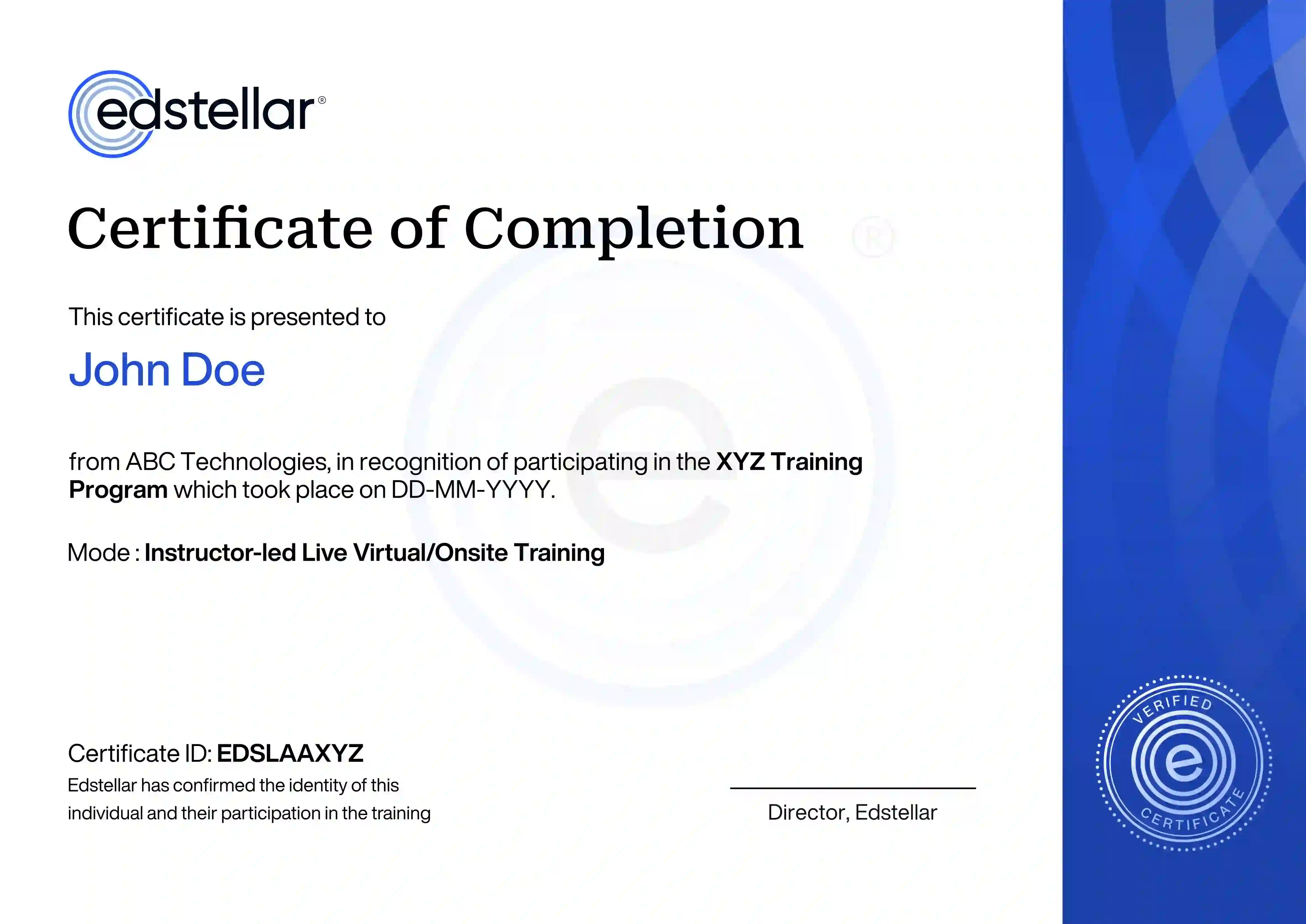
Upon successful completion of the ISO 42001 AI Management System training course offered by Edstellar, employees receive a course completion certificate, symbolizing their dedication to ongoing learning and professional development.
This certificate validates the employee's acquired skills and is a powerful motivator, inspiring them to enhance their expertise further and contribute effectively to organizational success.



Edstellar is a one-stop instructor-led corporate training and coaching solution that addresses organizational upskilling and talent transformation needs globally.
.svg)
.svg)
.svg)

.svg)
Learning Technology
Learning Content Design and Development
Learning Governance, Analytics & ROI
Digital Learning Ecosystem
Training Simulations, AR/VR & Case Studies
Employee Performance Support
Leadership Pipeline & Succession PlanningStrategic Workforce Planning for EnterprisesTransformation & Risk Advisory for EnterprisesDEI Consulting for EnterprisesEmployee Engagement Consulting for Enterprises
Cultural Transformation