Drive Team Excellence with NIST CSF Implementation Corporate Training

Empower your teams with expert-led on-site, off-site, and virtual NIST CSF Implementation Training through Edstellar, a premier corporate training provider for organizations globally. Designed to meet your specific training needs, this group training program ensures your team is primed to drive your business goals. Help your employees build lasting capabilities that translate into real performance gains.

The NIST Cybersecurity Framework (CSF) 2.0 is the most widely adopted voluntary cybersecurity framework globally, providing organizations with a common language and structured approach for managing cybersecurity risk. Updated in 2024, CSF 2.0 introduced the Govern function and expanded its scope beyond critical infrastructure to support all types of organizations. Implementing CSF enables security leaders to align cybersecurity programs with business objectives, communicate risk effectively to executive leadership, and meet an expanding range of regulatory and contractual cybersecurity requirements.

Edstellar's NIST CSF Implementation Instructor-led course offers virtual/onsite training options for cybersecurity managers, IT security analysts, CISOs, risk officers, and governance professionals. Through hands-on profile development workshops, tier selection exercises, and incident response planning scenarios, participants gain the practical skills to deploy, manage, and continuously improve a NIST CSF-aligned cybersecurity program within their organizations.

Get Customized Expert-led Training for Your Teams
Customized Training Delivery
Scale Your Training: Small to Large Teams
In-person Onsite, Live Virtual or Hybrid Training Modes
Plan from 2000+ Industry-ready Training Programs
Experience Hands-On Learning from Industry Experts
Delivery Capability Across 100+ Countries & 10+ Languages
""""

Key Skills Employees Gain from Instructor-led NIST CSF Implementation Training

NIST CSF Implementation skills corporate training will enable teams to effectively apply their learnings at work.

  • NIST CSF 2.0 Core Function Implementation
  • Cybersecurity Risk Assessment
  • CSF Profile Development
  • Implementation Tier Selection
  • Cybersecurity Governance Design
  • Incident Detection and Response Planning
  • CSF Continuous Improvement

Key Learning Outcomes of NIST CSF Implementation Training Workshop

Upon completing Edstellar’s NIST CSF Implementation workshop, employees will gain valuable, job-relevant insights and develop the confidence to apply their learning effectively in the professional environment.

  • Master the NIST CSF 2.0 framework structure and apply each of its six core functions to build a comprehensive, organization-wide cybersecurity program.
  • Gain the skills to conduct structured cybersecurity risk assessments and use findings to prioritize control implementation across CSF core function categories.
  • Develop current and target organizational CSF profiles that translate business objectives and risk appetite into actionable cybersecurity outcome priorities.
  • Learn how to select the appropriate CSF implementation tier and use it to guide cybersecurity program investment, maturity roadmaps, and governance structures.
  • Build incident detection, response, and recovery capabilities aligned to CSF Detect, Respond, and Recover function requirements and best practices.
  • Apply CSF continuous improvement processes, metrics, and audit practices to sustain and advance cybersecurity program effectiveness over time.

Key Benefits of the NIST CSF Implementation Group Training

Attending our NIST CSF Implementation group training classes provides your team with a powerful opportunity to build skills, boost confidence, and develop a deeper understanding of the concepts that matter most. The collaborative learning environment fosters knowledge sharing and enables employees to translate insights into actionable work outcomes.

  • Understand the NIST Cybersecurity Framework 2.0 structure including its six core functions, categories, subcategories, and informative references.
  • Apply the Govern function to establish cybersecurity governance structures, policies, roles, and accountability frameworks across the organization.
  • Use the Identify function to build a comprehensive asset inventory and conduct structured cybersecurity risk assessments aligned to CSF requirements.
  • Implement the Protect function by selecting and deploying safeguards and controls that reduce cybersecurity risk to acceptable organizational levels.
  • Design Detect function capabilities including continuous monitoring, anomaly detection, and cybersecurity event logging and analysis processes.
  • Build a Respond function capability with documented incident response plans, communication protocols, and containment and eradication procedures.
  • Develop a Recover function plan that enables timely restoration of services, communication with stakeholders, and post-incident learning integration.
  • Select the appropriate CSF implementation tier for your organization and use it to guide prioritization of cybersecurity investment and program maturity.
  • Create current and target organizational CSF profiles to define the cybersecurity outcomes most important to your mission and risk tolerance.
  • Integrate CSF with enterprise risk management, regulatory compliance frameworks, and existing security programs to maximize operational alignment.

Topics and Outline of NIST CSF Implementation Training

Our virtual and on-premise NIST CSF Implementation training curriculum is structured into focused modules developed by industry experts. This training for organizations provides an interactive learning experience that addresses the evolving demands of the workplace, making it both relevant and practical.

  1. History and Evolution of the NIST CSF
    • Origins of the NIST CSF in Executive Order 13636 and its initial 2014 publication
    • Key changes introduced in CSF version 1.1 and the expanded applicability of the framework
    • The 2024 CSF 2.0 update: new Govern function, broader scope, and revised structure
    • How CSF 2.0 positions itself as a universal cybersecurity framework beyond critical infrastructure
  2. CSF 2.0 Structure and Components
    • The six CSF 2.0 core functions and their role in the cybersecurity program lifecycle
    • CSF categories and subcategories as the building blocks of cybersecurity outcomes
    • Informative references: how CSF maps to NIST SP 800-53, ISO 27001, and CIS Controls
    • CSF tiers and profiles as tools for assessing maturity and prioritizing improvements
  3. Why Organizations Adopt the NIST CSF
    • CSF as a common language for communicating cybersecurity risk to executive leadership and boards
    • Regulatory and contractual drivers for CSF adoption across industries and sectors
    • How CSF supports compliance with HIPAA, SOC 2, SEC rules, and other regulatory frameworks
    • Business benefits of CSF implementation: reduced incidents, improved risk posture, and audit readiness
  4. CSF and Enterprise Risk Management
    • Positioning cybersecurity risk within the enterprise risk management framework
    • How CSF 2.0 aligns with NIST Risk Management Framework (RMF) and ISO 31000
    • Using CSF to translate technical cybersecurity risk into business risk language
    • Integrating CSF outputs into board-level risk reporting and oversight processes
  5. Scoping a CSF Implementation
    • Defining the organizational scope for CSF implementation: enterprise-wide versus business unit
    • Identifying critical assets, services, and processes to prioritize in the CSF scope
    • Engaging stakeholders from IT, legal, operations, and executive leadership in scoping
    • Documenting the CSF scope definition and obtaining leadership approval
  6. Building the CSF Implementation Team
    • Defining roles and responsibilities for the CSF implementation program
    • Establishing a cross-functional CSF steering committee with executive sponsorship
    • Selecting a CSF program lead and assigning core function ownership to subject matter experts
    • Creating a CSF implementation charter, timeline, and governance structure
  1. Overview of the Govern Function
    • Purpose of the Govern function in CSF 2.0 and its role as the governance foundation
    • Categories within the Govern function: Organizational Context, Risk Management Strategy, Roles and Responsibilities, Policy, Oversight, and Supply Chain
    • How the Govern function differs from and enables all other CSF core functions
    • Common governance gaps that the Govern function is designed to address
  2. Organizational Context and Cybersecurity Strategy
    • Identifying organizational mission, objectives, and stakeholder expectations that shape cybersecurity priorities
    • Understanding legal, regulatory, and contractual cybersecurity obligations by industry
    • Translating business strategy into cybersecurity program objectives and outcome priorities
    • Documenting the organizational context as the foundation for the CSF current profile
  3. Cybersecurity Risk Management Strategy
    • Establishing the organization's cybersecurity risk appetite and risk tolerance levels
    • Defining risk prioritization criteria used to direct cybersecurity investment decisions
    • Building a risk management strategy that integrates cybersecurity and enterprise risk processes
    • Communicating the risk management strategy to relevant stakeholders and leadership
  4. Roles, Responsibilities, and Accountability
    • Defining cybersecurity roles from the board level through operational teams
    • Assigning accountability for each CSF core function to named roles and teams
    • Establishing escalation paths for cybersecurity decisions and risk acceptance
    • Documenting cybersecurity roles in job descriptions, charters, and RACI matrices
  5. Cybersecurity Policy Development
    • Identifying the cybersecurity policies required to support CSF implementation
    • Writing effective cybersecurity policies that are actionable and enforceable across the workforce
    • Establishing policy review cycles and change management processes
    • Communicating policies to the workforce and tracking acknowledgment and compliance
  6. Cybersecurity Supply Chain Risk Management
    • Identifying third-party and supply chain cybersecurity risks within the CSF governance scope
    • Establishing supplier cybersecurity requirements and assessment processes
    • Incorporating CSF supply chain risk categories into vendor contracts and onboarding
    • Monitoring and managing cybersecurity risks from critical suppliers on an ongoing basis
  1. Asset Management Under the Identify Function
    • Building a comprehensive inventory of hardware, software, data, and network assets
    • Classifying assets by criticality, sensitivity, and business function
    • Maintaining an up-to-date asset inventory through automated discovery tools
    • Linking asset inventory to CSF risk assessment and protection prioritization processes
  2. Business Environment and Mission Analysis
    • Identifying the organization's critical business functions and their cybersecurity dependencies
    • Mapping critical assets and data flows to business processes and value chains
    • Understanding how cybersecurity risk to assets affects organizational mission and objectives
    • Engaging business unit leaders to validate critical asset and process identification
  3. Cybersecurity Risk Assessment
    • Identifying threats and threat actors relevant to the organization's industry and asset profile
    • Assessing vulnerabilities in identified assets through scanning, testing, and review
    • Estimating the likelihood and potential impact of identified threat-vulnerability pairs
    • Documenting risk assessment findings in a risk register aligned to CSF categories
  4. Risk Assessment Methodologies
    • NIST SP 800-30 risk assessment methodology and its alignment with CSF Identify requirements
    • Qualitative versus quantitative cybersecurity risk assessment approaches and their tradeoffs
    • Using CVSS scores, threat intelligence feeds, and industry data to inform risk estimates
    • Facilitating risk assessment workshops with IT, security, and business stakeholders
  5. Improvement and Gap Analysis
    • Using the Identify function outputs to assess gaps in current cybersecurity capabilities
    • Mapping identified risks to CSF categories to determine where gaps are most critical
    • Prioritizing improvement actions based on risk severity and business impact
    • Documenting the gap analysis as the basis for CSF target profile development
  6. Integrating Threat Intelligence into the Identify Function
    • Sources of actionable cyber threat intelligence relevant to the Identify function
    • Using threat intelligence to update and validate risk assessments in the CSF program
    • Sharing threat intelligence within industry information sharing communities
    • Automating threat intelligence ingestion into risk management and asset management tools
  1. Identity Management and Access Control
    • Implementing identity and access management (IAM) controls aligned to CSF Protect requirements
    • Enforcing least privilege, need-to-know, and separation of duties across systems
    • Multi-factor authentication deployment for privileged and remote access scenarios
    • Managing user lifecycle: provisioning, access reviews, and timely deprovisioning
  2. Awareness and Training Programs
    • Building a cybersecurity awareness and training program aligned to CSF Protect requirements
    • Role-based training for privileged users, developers, and general workforce members
    • Phishing simulation and social engineering awareness as core training components
    • Measuring training effectiveness and tracking completion for audit evidence
  3. Data Security and Information Protection
    • Data classification schemes and how they drive data protection control selection
    • Encryption requirements for data at rest and data in transit under the Protect function
    • Data loss prevention (DLP) controls and their alignment to CSF Protect subcategories
    • Backup and data integrity controls to support both Protect and Recover function requirements
  4. Platform Security and Configuration Management
    • Hardening operating systems, applications, and network devices to reduce attack surface
    • Patch management processes for timely vulnerability remediation across the asset estate
    • Configuration management databases (CMDB) and their role in the Protect function
    • Secure software development lifecycle (SDLC) practices aligned to CSF Protect requirements
  5. Technology Infrastructure Protection
    • Network segmentation and micro-segmentation strategies for reducing lateral movement risk
    • Endpoint protection platform (EPP) and endpoint detection and response (EDR) deployment
    • Email security controls: anti-phishing, anti-malware, and email authentication protocols
    • Cloud security controls and shared responsibility model alignment under the Protect function
  6. Resilience Planning Under the Protect Function
    • Business continuity planning and its integration with CSF Protect and Recover functions
    • Redundancy and failover design for critical systems and services
    • Physical security controls for protecting hardware assets and data center environments
    • Tabletop exercises to validate the effectiveness of resilience and protection controls
  1. Continuous Monitoring Architecture
    • Designing a continuous monitoring program aligned to CSF Detect function requirements
    • Selecting and deploying security monitoring tools: SIEM, IDS, IPS, and NDR platforms
    • Defining monitoring coverage requirements across endpoints, network, cloud, and applications
    • Building a security monitoring architecture that scales with organizational growth
  2. Security Event Logging and Management
    • Defining log sources, log types, and retention requirements for the Detect function
    • Centralizing log collection into a SIEM platform for correlation and analysis
    • Establishing log integrity controls to prevent tampering with audit records
    • Using log data to support both incident detection and forensic investigation activities
  3. Anomaly and Event Detection
    • Defining baseline behavior for users, systems, and networks to enable anomaly detection
    • Developing detection use cases and SIEM correlation rules for high-priority threat scenarios
    • User and entity behavior analytics (UEBA) for detecting insider threats and compromised accounts
    • Tuning detection rules to reduce false positives while maintaining detection sensitivity
  4. Threat Hunting Practices
    • Introduction to proactive threat hunting as a complement to automated detection capabilities
    • Hypothesis-driven threat hunting methodologies aligned to MITRE ATT&CK techniques
    • Using threat intelligence to direct threat hunting investigations within the environment
    • Documenting threat hunting findings and translating them into detection rule improvements
  5. Security Operations Center (SOC) Alignment
    • Aligning SOC processes and workflows with CSF Detect and Respond function requirements
    • Defining SOC tier structures, escalation criteria, and incident triage procedures
    • Measuring SOC effectiveness: mean time to detect (MTTD) and alert triage metrics
    • Evaluating managed detection and response (MDR) services as a Detect function capability
  6. Vulnerability Management and Continuous Assessment
    • Establishing a vulnerability management program aligned to CSF Detect requirements
    • Vulnerability scanning frequency, coverage, and remediation SLA requirements
    • Penetration testing cadence and scope aligned to the CSF Detect and Protect functions
    • Tracking vulnerability remediation progress and reporting risk reduction to leadership
  1. Incident Response Plan Development
    • Core components of a NIST CSF-aligned incident response plan
    • Defining incident categories, severity levels, and escalation thresholds
    • Assigning incident response roles: incident commander, technical lead, communications lead
    • Maintaining and testing the incident response plan through regular drills and exercises
  2. Incident Analysis and Classification
    • Triaging security events to classify confirmed incidents by type and severity
    • Gathering evidence and preserving forensic artifacts during incident analysis
    • Using threat intelligence and attack frameworks to attribute and scope incidents
    • Documenting incident analysis findings in a structured incident record
  3. Containment Strategies
    • Short-term containment actions to limit incident spread while preserving evidence
    • Network isolation, account disablement, and system quarantine as containment techniques
    • Decision criteria for choosing between containment strategies based on incident type
    • Coordinating containment actions across IT, security, and business operations teams
  4. Eradication and Root Cause Analysis
    • Removing malicious artifacts, backdoors, and attacker footholds from affected systems
    • Conducting root cause analysis to identify how the incident occurred and was sustained
    • Validating eradication completeness before initiating recovery activities
    • Documenting eradication actions and root cause findings for post-incident review
  5. Incident Communication and Notification
    • Establishing internal incident communication protocols and escalation paths
    • Regulatory and legal notification obligations for cybersecurity incidents by industry
    • Communicating with customers, partners, and the public during significant incidents
    • Managing media and social media inquiries during and after high-profile cybersecurity incidents
  6. Incident Response Testing and Improvement
    • Designing tabletop exercises to test incident response plan scenarios and team readiness
    • Running functional drills and full-scale simulations for high-priority incident categories
    • Conducting post-incident reviews and capturing lessons learned for plan updates
    • Tracking incident response improvement actions and validating effectiveness in future exercises
  1. Recovery Planning Under the CSF
    • Core components of a NIST CSF-aligned recovery plan for cybersecurity incidents
    • Defining recovery time objectives (RTO) and recovery point objectives (RPO) for critical systems
    • Aligning recovery plans with business continuity and disaster recovery programs
    • Documenting recovery procedures for each priority system and data asset category
  2. System and Data Restoration
    • Sequencing system restoration to prioritize critical business functions and dependencies
    • Validating backup integrity before initiating recovery to avoid restoring compromised data
    • Testing recovery procedures in isolated environments before returning systems to production
    • Documenting recovery steps, timelines, and outcomes for post-incident reporting
  3. Recovery Communication and Coordination
    • Establishing a recovery command structure with clear roles and decision authority
    • Communicating recovery progress to leadership, business units, and key stakeholders
    • Managing customer and partner communications during service restoration periods
    • Coordinating with external recovery partners, cloud providers, and managed service vendors
  4. Post-Incident Review and Lessons Learned
    • Conducting a structured post-incident review within 72 hours of incident closure
    • Identifying root causes, contributing factors, and gaps in detection and response
    • Documenting lessons learned and translating them into actionable improvement recommendations
    • Presenting post-incident findings to leadership with a prioritized remediation roadmap
  5. Recovery Testing and Validation
    • Designing recovery exercises to test RTO and RPO achievement for critical system categories
    • Tabletop and functional recovery exercises for ransomware, data breach, and DDoS scenarios
    • Validating backup and recovery tool effectiveness through periodic restoration tests
    • Tracking recovery exercise findings and using results to strengthen recovery plan quality
  6. Integrating Recovery with Business Resilience
    • Aligning CSF Recover outcomes with organizational business continuity management programs
    • Embedding cybersecurity recovery scenarios into enterprise-wide business continuity exercises
    • Using recovery planning to identify single points of failure and drive infrastructure resilience improvements
    • Reporting recovery capability maturity to the board and executive leadership team
  1. Understanding CSF Implementation Tiers
    • Definitions of CSF Tiers 1 through 4: Partial, Risk Informed, Repeatable, and Adaptive
    • How tiers describe cybersecurity program maturity across risk management, integration, and external participation
    • Common misconceptions about tiers as a scoring system versus a maturity context descriptor
    • Using tier descriptions to communicate cybersecurity program maturity to executive leadership
  2. Selecting the Appropriate Implementation Tier
    • Assessing current cybersecurity program practices against each tier's characteristics
    • Factors influencing target tier selection: risk appetite, regulatory requirements, and resources
    • Avoiding over-engineering: matching the target tier to the organization's actual risk context
    • Documenting tier selection rationale and communicating it to leadership and auditors
  3. Building a Current State CSF Profile
    • Defining the current profile by mapping existing cybersecurity outcomes to CSF subcategories
    • Gathering evidence of current cybersecurity practices through interviews, documentation review, and tool assessment
    • Scoring current profile coverage and identifying categories with significant gaps
    • Presenting the current profile to leadership as a snapshot of the existing cybersecurity posture
  4. Developing a Target State CSF Profile
    • Using organizational risk assessment, business objectives, and regulatory requirements to define the target profile
    • Selecting the CSF subcategories most relevant to the organization's risk context and mission
    • Prioritizing target profile outcomes based on risk severity and business impact
    • Validating the target profile with executive leadership and obtaining formal approval
  5. Gap Analysis Between Current and Target Profiles
    • Comparing current and target profiles to identify cybersecurity capability gaps
    • Prioritizing gaps by risk exposure, regulatory obligation, and implementation cost
    • Translating profile gaps into a prioritized cybersecurity improvement roadmap
    • Tracking gap closure progress through periodic profile reassessment
  6. Community Profiles and Sector Baselines
    • How NIST and industry bodies publish community profiles as starting points for sector-specific implementation
    • Using existing community profiles for financial services, healthcare, and critical infrastructure sectors
    • Adapting community profiles to fit the organization's unique risk environment and constraints
    • Contributing to community profile development through industry information sharing initiatives
  1. Aligning CSF with Enterprise Risk Management
    • Positioning the CSF within the organization's broader enterprise risk management (ERM) structure
    • Mapping CSF risk categories to ERM risk taxonomy and reporting frameworks
    • Escalating cybersecurity risks identified through CSF to enterprise risk committees
    • Using ERM investment prioritization processes to fund CSF-identified improvement actions
  2. Integrating CSF with NIST RMF
    • Understanding the relationship between the CSF and the NIST Risk Management Framework (RMF)
    • Mapping CSF core functions to RMF steps: Categorize, Select, Implement, Assess, Authorize, and Monitor
    • Using CSF profiles to define security requirements that inform the RMF Select step
    • Organizations subject to both CSF and RMF: strategies for integrated compliance
  3. Cybersecurity Risk Quantification
    • Introduction to cyber risk quantification methods: FAIR model and probabilistic loss estimation
    • Using CSF risk assessment outputs as inputs to financial risk quantification models
    • Communicating quantified cybersecurity risk to CFOs and board members
    • Using risk quantification to justify cybersecurity investment decisions and ROI
  4. Third-Party Risk Management Under CSF
    • Identifying and assessing cybersecurity risks from third-party vendors and partners
    • Building a third-party cybersecurity risk assessment program aligned to CSF Govern requirements
    • Monitoring ongoing third-party cybersecurity risk through continuous assessment tools
    • Managing incidents involving third-party access using the CSF Respond function
  5. Regulatory Compliance Mapping to CSF
    • Mapping HIPAA Security Rule requirements to CSF subcategories for healthcare organizations
    • Aligning PCI DSS requirements to CSF core functions for payment card environments
    • Using CSF implementation as evidence of due diligence in SEC cybersecurity disclosure filings
    • Building a unified compliance mapping that satisfies multiple regulatory frameworks through CSF
  6. Cybersecurity Risk Reporting to Leadership
    • Designing a cybersecurity risk dashboard for CISO, executive, and board-level audiences
    • Key cybersecurity risk metrics derived from CSF implementation activities
    • Presenting CSF profile gaps and risk reduction progress in board-ready formats
    • Using CSF risk reporting to secure executive sponsorship for cybersecurity improvement investments
  1. CSF-Aligned Cybersecurity Metrics
    • Defining cybersecurity metrics for each CSF core function to measure program effectiveness
    • Leading versus lagging indicators in cybersecurity measurement and reporting
    • MTTD, MTTR, patch compliance rate, and training completion as core CSF performance metrics
    • Automating cybersecurity metric collection and reporting through security tooling integrations
  2. Internal CSF Assessment and Audit
    • Designing a periodic internal CSF assessment program to evaluate profile implementation progress
    • Selecting assessment methods: document review, interviews, observation, and technical testing
    • Documenting assessment findings and scoring current profile achievement by subcategory
    • Reporting assessment results to leadership with a prioritized remediation action plan
  3. External CSF Assessments and Third-Party Audits
    • When to engage external assessors for independent CSF program evaluation
    • Preparing documentation, policies, and evidence packages for external CSF assessments
    • Common findings in external CSF assessments and how to address them proactively
    • Using external assessment results to strengthen leadership and board confidence in the program
  4. Cybersecurity Program Continuous Improvement
    • Establishing a formal continuous improvement process aligned to the CSF Improve category
    • Integrating lessons learned from incidents, exercises, and audits into improvement cycles
    • Setting annual improvement targets for CSF profile advancement and risk reduction
    • Tracking improvement action completion and validating effectiveness through reassessment
  5. Advancing CSF Maturity Over Time
    • Building a multi-year CSF maturity roadmap with phased improvement milestones
    • Prioritizing maturity investments based on residual risk, regulatory pressure, and business value
    • Benchmarking CSF maturity against industry peers using publicly available assessment data
    • Recognizing and celebrating cybersecurity program achievements to sustain organizational engagement
  6. CSF Case Studies and Practical Application
    • Case study: a financial services firm's journey from Tier 1 to Tier 3 CSF implementation
    • Case study: using the CSF to respond to a ransomware incident and accelerate recovery
    • Case study: building a CSF-aligned cybersecurity governance program in a healthcare organization
    • Workshop: developing a CSF current profile and improvement roadmap for a sample organization

Who Can Take the NIST CSF Implementation Training Course

The NIST CSF Implementation training program can also be taken by professionals at various levels in the organization.

  • Cybersecurity Managers
  • IT Security Analysts
  • CISOs and IT Leaders
  • Risk and Compliance Officers
  • IT Architects
  • Governance and Audit Professionals

Prerequisites for NIST CSF Implementation Training

Professionals should have a foundational understanding of cybersecurity concepts, basic IT infrastructure knowledge, and familiarity with organizational risk management processes to take the NIST CSF Implementation training course.

Request a Quote for your Corporate Training Requirements

Valid number

Delivering Training for Organizations across 100 Countries and 10+ Languages

Corporate Group Training Delivery Modes
for NIST CSF Implementation Training

At Edstellar, we understand the importance of impactful and engaging training for employees. As a leading NIST CSF Implementation training provider, we ensure the training is more interactive by offering Face-to-Face onsite/in-house or virtual/online sessions for companies. This approach has proven to be effective, outcome-oriented, and produces a well-rounded training experience for your teams.

Virtual NIST CSF Implementation Training

Edstellar's NIST CSF Implementation virtual/online training sessions bring expert-led, high-quality training to your teams anywhere, ensuring consistency and seamless integration into their schedules.

With global reach, your employees can get trained from various locations
The consistent training quality ensures uniform learning outcomes
Participants can attend training in their own space without the need for traveling
Organizations can scale learning by accommodating large groups of participants
Interactive tools can be used to enhance learning engagement
On-site NIST CSF Implementation Training

Edstellar's NIST CSF Implementation inhouse face to face instructor-led training delivers immersive and insightful learning experiences right in the comfort of your office.

Higher engagement and better learning experience through face-to-face interaction
Workplace environment can be tailored to learning requirements
Team collaboration and knowledge sharing improves training effectiveness
Demonstration of processes for hands-on learning and better understanding
Participants can get their doubts clarified and gain valuable insights through direct interaction
Off-site NIST CSF Implementation Training

Edstellar's NIST CSF Implementation offsite face-to-face instructor-led group training offer a unique opportunity for teams to immerse themselves in focused and dynamic learning environments away from their usual workplace distractions.

Distraction-free environment improves learning engagement
Team bonding can be improved through activities
Dedicated schedule for training away from office set up can improve learning effectiveness
Boosts employee morale and reflects organization's commitment to employee development

Explore Our Customized Pricing Package
for
NIST CSF Implementation Corporate Training

Looking for pricing details for onsite, offsite, or virtual instructor-led NIST CSF Implementation training? Get a customized proposal tailored to your team’s specific needs.

Request a Group Training Quote
""
How Many Team Members Need Training?
Please select an option or fill in the custom field.
"'

Is Your Corporate Training Requirement Only for NIST CSF Implementation?

Please select at least one course.
""
Add the List of Training Workshops
search icon

      Please select the course

      No. of Courses selected: 0

      Clear

      Upload a CSV

      Send us your Training Requirements in 3 Easy steps

      1. 1
      2. 2
        Add the required training workshops
      3. 3
        Upload to get a quick quote or email it to contact@edstellar.com

      ""

      Looking for a Complete Package?

      Looking for a one-time pricing option for all your annual training requirements?

      View Corporate Training Packages
      ""
      Select the Option that Best Describes Your Corporate Training Requirement

      Please select an option or choose from the recurring options.
      ""
      Verify and Submit Your Request

      Review Your Corporate Training Selection Summary

      Training Program: NIST CSF Implementation Training

      1. No of Team Members

      2. Selected Training Preference

      3. Selected Recurring Sessions

      1

      Review your Requirements

      Training Workshops Selected :


        Excel
        File has been
        successfully uploaded.
        Fill the form to submit
 your details
        Submit Your Professional Contact Information
        Valid number
        We've received your enquiry. Our team will be in touch soon.
        Oops! Something went wrong while submitting the form.
        Starter
        120 licences

        Tailor-Made Trainee Licenses with Our Exclusive Training Packages!

        View Package

        64 hours of group training (includes VILT/In-person On-site)

        Tailored for SMBs

        Growth
        320 licences

        Tailor-Made Trainee Licenses with Our Exclusive Training Packages!

        View Package

        160 hours of group training (includes VILT/In-person On-site)

        Ideal for growing SMBs

        Enterprise
        800 licences

        Tailor-Made Trainee Licenses with Our Exclusive Training Packages!

        View Package

        400 hours of group training (includes VILT/In-person On-site)

        Designed for large corporations

        Custom
        Unlimited licenses

        Tailor-Made Trainee Licenses with Our Exclusive Training Packages!

        View Package

        Unlimited duration

        Designed for large corporations

        Edstellar: Your Go-to NIST CSF Implementation Training Company

        Experienced Trainers

        Our trainers bring years of industry expertise to ensure the training is practical and impactful.

        Quality Training

        With a strong track record of delivering training worldwide, Edstellar maintains its reputation for its quality and training engagement.

        Industry-Relevant Curriculum

        Our course is designed by experts and is tailored to meet the demands of the current industry.

        Customizable Training

        Our course can be customized to meet the unique needs and goals of your organization.

        Comprehensive Support

        We provide pre and post training support to your organization to ensure a complete learning experience.

        Multilingual Training Capabilities

        We offer training in multiple languages to cater to diverse and global teams.

        Testimonials

        What Our Clients Say

        We pride ourselves on delivering exceptional training solutions. Here's what our clients have to say about their experiences with Edstellar.

        "Edstellar's virtual NIST CSF Implementation training equipped our cybersecurity and IT risk teams with a clear, structured approach to building our security program. Within six months of completing the training, we advanced from a Tier 1 to a Tier 2 implementation and reduced our mean time to detect security events by 38%."

        Karthik Balasubramanian

        CISO,

        A Global Financial Services Group

        "The onsite NIST CSF training by Edstellar transformed how our security, IT, and compliance teams collaborate on risk management. The profile development workshops gave us a shared language and a prioritized improvement roadmap that helped us pass our first external cybersecurity audit with no critical findings."

        Sneha Pillai

        VP of Information Security,

        A Regional Healthcare Network

        "Our intensive off-site NIST CSF workshop with Edstellar gave our CISO, IT architects, and governance leads the strategic alignment needed to build a mature, enterprise-wide cybersecurity program. Post-training, we launched a CSF-aligned third-party risk management process that reduced our vendor-related security incidents by over 50%."

        Rahul Desai

        Chief Risk Officer,

        A Global Technology Company

        "Edstellar's IT & Technical training programs have been instrumental in strengthening our engineering teams and building future-ready capabilities. The hands-on approach, practical cloud scenarios, and expert guidance helped our teams improve technical depth, problem-solving skills, and execution across multiple projects. We're excited to extend more of these impactful programs to other business units."

        Aditi Rao

        L&D Head,

        A Global Technology Company

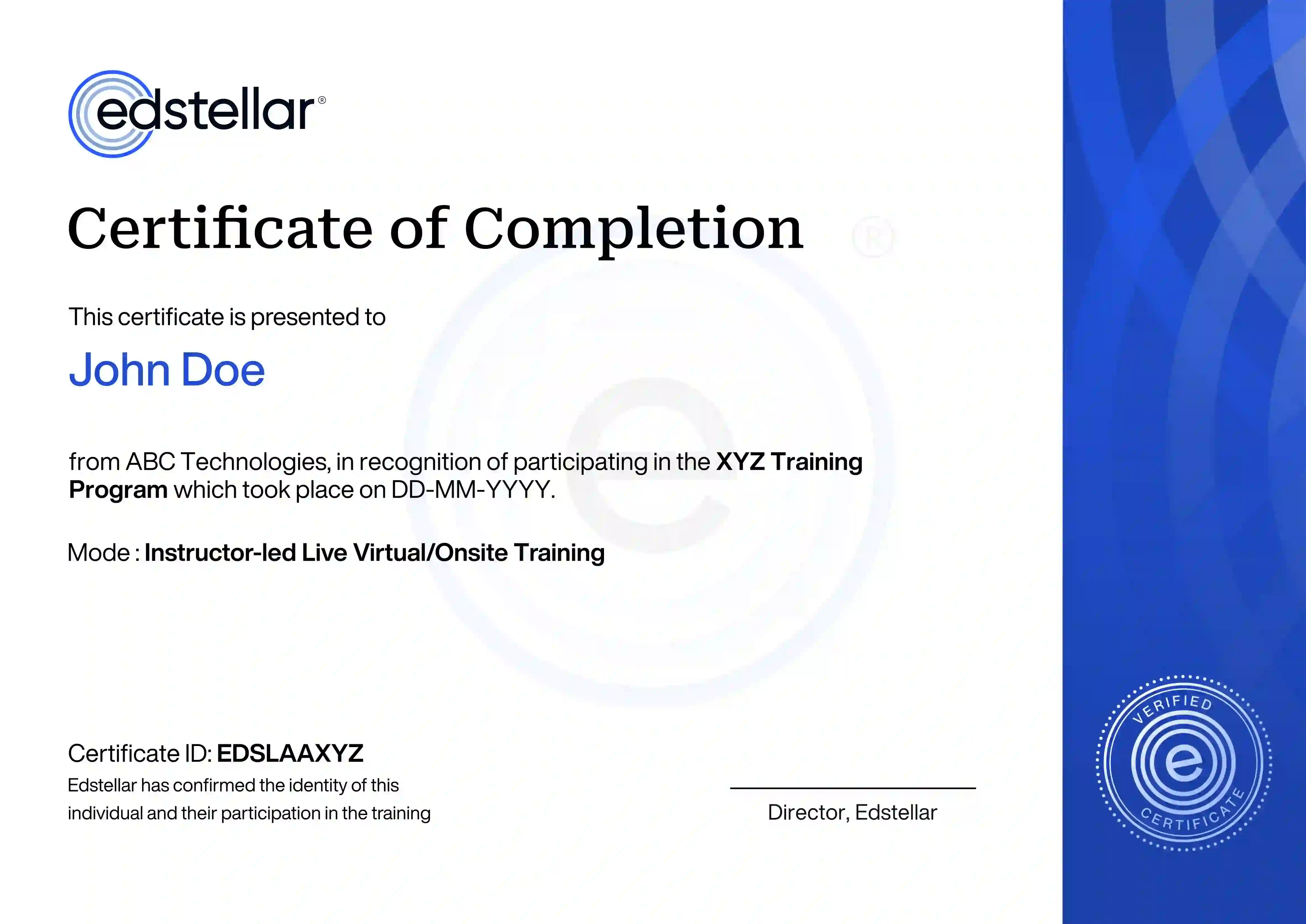
        Get Your Team Members Recognized with Edstellar’s Course Certificate

        Upon successful completion of the training course offered by Edstellar, employees receive a course completion certificate, symbolizing their dedication to ongoing learning and professional development.

        This certificate validates the employee's acquired skills and is a powerful motivator, inspiring them to enhance their expertise further and contribute effectively to organizational success.

        Certificate of Excellence

        Other Related Corporate Training Courses