%20Training.webp)
Operational Technology (OT) Corporate Training Program
Edstellar's OT training covers OT architecture, ICS/SCADA operations, industrial protocols, OT-IT convergence, cybersecurity fundamentals, and operational resilience to equip teams with practical skills for managing and securing industrial environments.
(Virtual / On-site / Off-site)
Available Languages
English, Español, 普通话, Deutsch, العربية, Português, हिंदी, Français, 日本語 and Italiano
Drive Team Excellence with Operational Technology (OT) Corporate Training
Empower your teams with expert-led on-site, off-site, and virtual Operational Technology (OT) Training through Edstellar, a premier corporate training provider for organizations globally. Designed to meet your specific training needs, this group training program ensures your team is primed to drive your business goals. Help your employees build lasting capabilities that translate into real performance gains.
Operational Technology (OT) refers to the hardware and software systems that monitor and control physical devices, processes, and infrastructure in industries such as manufacturing, energy, utilities, and transportation. OT encompasses ICS, SCADA systems, PLCs, RTUs, and industrial networks that are increasingly interconnected with corporate IT environments. This training equips professionals with in-depth knowledge of OT architecture, industrial protocols, cybersecurity practices, and compliance frameworks to manage and secure complex industrial ecosystems.
Edstellar's Operational Technology (OT) Instructor-led course offers virtual/onsite training options to meet professionals' diverse needs. This flexibility ensures teams can engage in learning experiences that best suit their logistical and operational preferences. The course emphasizes hands-on practice with real-world industrial scenarios, enabling participants to immediately apply OT design, security, and incident response skills within their organizations.

Key Skills Employees Gain from Instructor-led Operational Technology (OT) Training
Operational Technology (OT) skills corporate training will enable teams to effectively apply their learnings at work.
- OT Architecture and System Design
- ICS and SCADA System Operations
- OT Network Segmentation and Design
- OT Cybersecurity Risk Management
- Industrial Protocol Configuration
- OT Compliance and Standards Application
- OT Incident Response Planning
Key Learning Outcomes of Operational Technology (OT) Training Workshop
Upon completing Edstellar’s Operational Technology (OT) workshop, employees will gain valuable, job-relevant insights and develop the confidence to apply their learning effectively in the professional environment.
- Master OT architecture principles, including the Purdue model, field devices, PLCs, and supervisory systems that underpin industrial operational environments.
- Gain expertise in ICS and SCADA system configuration, operation, and maintenance for manufacturing, energy, utilities, and critical infrastructure sectors.
- Develop proficiency in industrial protocol configuration including Modbus, DNP3, PROFINET, and OPC-UA for reliable OT-IT data integration.
- Learn OT network segmentation and cybersecurity controls to protect industrial environments against cyber threats using defense-in-depth strategies.
- Build skills in OT risk assessment, vulnerability management, and compliance with IEC 62443 and NERC CIP regulatory frameworks.
- Apply OT incident response and recovery practices to detect, contain, and remediate disruptions while preserving operational continuity.
Key Benefits of the Operational Technology (OT) Group Training
Attending our Operational Technology (OT) group training classes provides your team with a powerful opportunity to build skills, boost confidence, and develop a deeper understanding of the concepts that matter most. The collaborative learning environment fosters knowledge sharing and enables employees to translate insights into actionable work outcomes.
- Understand OT architecture by examining purdue model layers, field devices, controllers, and supervisory systems that form industrial operational environments.
- Configure and operate ICS and SCADA systems, including PLCs, RTUs, and HMI interfaces used in manufacturing, energy, and critical infrastructure.
- Design OT network segmentation strategies using DMZs, industrial firewalls, and conduit models to isolate operational zones and reduce attack surfaces.
- Apply industrial communication protocols including Modbus, DNP3, PROFINET, and OPC-UA to connect field devices, controllers, and enterprise systems.
- Implement OT-IT convergence frameworks that bridge operational and information technology systems while managing interoperability and security risks.
- Conduct OT-specific risk assessments using asset inventory, vulnerability analysis, and threat modeling tailored to industrial control environments.
- Apply OT cybersecurity fundamentals covering access control, patch management, anomaly detection, and defense-in-depth strategies for industrial networks.
- Develop OT incident response plans covering detection, containment, recovery, and post-incident review to maintain operational continuity.
- Ensure compliance with IEC 62443, NERC CIP, and NIST SP 800-82 frameworks governing security and reliability in industrial control environments.
- Modernize OT environments by evaluating technology refresh strategies, secure remote access, and integration with cloud-based industrial analytics platforms.
Topics and Outline of Operational Technology (OT) Training
Our virtual and on-premise Operational Technology (OT) training curriculum is structured into focused modules developed by industry experts. This training for organizations provides an interactive learning experience that addresses the evolving demands of the workplace, making it both relevant and practical.
- OT Fundamentals and Scope
- Definition and role of operational technology in industry
- Differences between OT, IT, and IoT systems
- OT applications across sectors including energy, utilities, and manufacturing
- Evolution of OT from isolated systems to connected environments
- OT System Components Overview
- Field devices and sensors in industrial environments
- Programmable logic controllers and remote terminal units
- Human-machine interfaces and engineering workstations
- Supervisory and enterprise integration layers
- OT Ecosystem and Stakeholders
- Roles of OT engineers, operators, and security teams
- Vendor and integrator relationships in OT environments
- Regulatory and compliance stakeholders
- Cross-functional collaboration between OT and IT teams
- OT Operational Priorities
- Availability and uptime as primary OT objectives
- Safety and reliability considerations in industrial settings
- Balancing security with operational continuity
- Real-time response requirements in OT systems
- OT Threat Landscape Overview
- Historical OT incidents and their operational impact
- Types of threats targeting industrial environments
- Nation-state and cybercriminal actors in OT
- Consequences of OT disruption on critical infrastructure
- OT Standards and Frameworks Overview
- Introduction to IEC 62443 for industrial security
- NERC CIP requirements for energy sector OT
- NIST SP 800-82 guidance for ICS security
- ISO 27001 applicability to OT environments
- Purdue Enterprise Reference Architecture
- Purdue model levels and their functions
- Zone and conduit model based on IEC 62443
- Network boundaries between OT and IT layers
- Data flows across Purdue model levels
- Field Devices and Instrumentation
- Types of sensors and actuators in industrial plants
- Transmitters and field bus communication
- Device calibration and maintenance requirements
- Safety instrumented systems and interlocks
- Programmable Logic Controllers (PLCs)
- PLC hardware architecture and scan cycle
- Ladder logic and structured text programming
- Input/output module configuration
- PLC redundancy and failover strategies
- Remote Terminal Units (RTUs) and Outstations
- RTU role in SCADA and distributed control
- RTU communication over serial and IP networks
- Data acquisition and event logging functions
- RTU vs PLC selection criteria
- Human-Machine Interfaces (HMIs)
- HMI design principles for industrial operations
- Alarm management and annunciation standards
- Trends and historical data visualization
- HMI security hardening practices
- Distributed Control Systems (DCS)
- DCS architecture and components
- Comparison of DCS and PLC-based control
- Process control and regulatory loops
- DCS integration with enterprise systems
- ICS Architecture and Topology
- Types of industrial control systems and their applications
- Centralized vs distributed control architectures
- ICS network topology design considerations
- Redundancy and high-availability configurations
- SCADA System Design
- SCADA architecture components and communication flows
- Master station and remote site configuration
- Data acquisition polling and exception reporting
- SCADA historian and data archiving
- SCADA Communication Infrastructure
- Serial, radio, and IP-based SCADA communication links
- Wide area network design for remote SCADA sites
- Communication redundancy and failover
- Latency and reliability requirements for SCADA
- ICS Operations and Control Modes
- Manual, automatic, and cascade control modes
- Process setpoint management and tuning
- Operator procedures and control room practices
- Alarm rationalization and response protocols
- ICS Maintenance and Lifecycle Management
- Preventive and corrective maintenance strategies for ICS
- Software version management and patch windows
- Spare parts inventory and obsolescence planning
- System acceptance testing and commissioning
- ICS Cybersecurity Challenges
- Legacy system exposure and limited patch support
- Proprietary protocols and vendor lock-in risks
- Insider threat considerations in control rooms
- Remote access security for ICS environments
- Modbus Protocol
- Modbus RTU and Modbus TCP/IP specifications
- Function codes and data register mapping
- Modbus master-slave communication model
- Modbus implementation and troubleshooting
- DNP3 and IEC 60870-5
- DNP3 structure and application in SCADA systems
- Unsolicited responses and event-driven reporting
- DNP3 secure authentication features
- IEC 60870-5 variants and utility sector use
- PROFIBUS and PROFINET
- PROFIBUS DP architecture for field device communication
- PROFINET real-time and isochronous communication
- Device configuration and GSD file management
- Migration from PROFIBUS to PROFINET
- OPC-UA Standard
- OPC-UA information model and address space
- OPC-UA security mechanisms and certificates
- Publish-subscribe and client-server communication modes
- OPC-UA integration with cloud and MES platforms
- EtherNet/IP and CIP
- Common Industrial Protocol (CIP) object model
- EtherNet/IP implicit and explicit messaging
- Device profiles and conformance testing
- EtherNet/IP network design considerations
- Wireless and Emerging OT Protocols
- WirelessHART and ISA100.11a standards
- 5G and private LTE for industrial connectivity
- Time-sensitive networking (TSN) for OT
- Protocol selection criteria for industrial applications
- OT-IT Convergence Drivers
- Business drivers for connecting OT and IT systems
- Industry 4.0 and smart manufacturing initiatives
- Operational data demands from enterprise analytics
- Cost reduction through integrated asset management
- Architecture Patterns for OT-IT Integration
- Data diodes and unidirectional security gateways
- Industrial DMZ design and purpose
- Historian and data aggregation layer design
- OT data contextualization for IT consumption
- Integration Technologies and Middleware
- Industrial IoT platforms and edge computing
- Message brokers and MQTT for OT data transport
- API gateways for OT-IT data exchange
- Digital integration with ERP and MES systems
- Operational Challenges of OT-IT Convergence
- Cultural and organizational barriers between OT and IT teams
- Legacy OT system limitations for integration
- Change management in converged environments
- Governance and ownership responsibilities
- Security Challenges in OT-IT Convergence
- Expanded attack surface from OT-IT connectivity
- IT security tools incompatible with OT environments
- Secure remote access for converged environments
- Managing IT-borne threats entering OT networks
- OT-IT Convergence Governance
- Establishing shared OT-IT security policies
- Joint incident response procedures
- Asset ownership and accountability frameworks
- Performance metrics for converged environments
- OT Network Architecture Principles
- Defense-in-depth for industrial network design
- Network tiering and zone definitions
- East-west vs north-south traffic control in OT
- Physical and logical network separation strategies
- Network Segmentation and Zoning
- IEC 62443 zone and conduit model implementation
- VLAN design for OT network isolation
- Micro-segmentation in industrial networks
- Segmentation validation and testing
- Industrial Firewalls and Security Appliances
- Industrial next-generation firewall selection criteria
- Deep packet inspection for OT protocols
- Firewall rule management for OT environments
- Unidirectional gateway deployment
- Demilitarized Zone (DMZ) Design for OT
- Purpose and function of the industrial DMZ
- Services hosted in the OT DMZ layer
- Data flow controls through the DMZ
- DMZ maintenance and monitoring practices
- OT Network Monitoring
- Passive asset discovery in OT networks
- OT-aware network monitoring tools
- Baseline traffic profiling for anomaly detection
- Integrating OT monitoring with security operations
- Secure Remote Access for OT
- Jump server and privileged access workstation design
- VPN and zero-trust access for OT remote connections
- Vendor remote access management and controls
- Session recording and audit logging for remote OT access
- OT Cybersecurity Principles
- Availability, integrity, and confidentiality priorities in OT
- Safety-security integration in industrial environments
- OT security vs IT security approach differences
- Cybersecurity culture in industrial organizations
- OT Asset Identification and Inventory
- Methods for passive OT asset discovery
- Asset inventory management tools for OT
- Asset criticality classification
- Maintaining accurate OT asset registers
- Access Control in OT Environments
- Role-based access control for control system users
- Privileged account management in OT
- Multi-factor authentication for OT access
- Physical access controls for industrial assets
- OT Patch Management
- Challenges of patching legacy OT systems
- Coordinating patch windows with operational schedules
- Compensating controls when patching is not feasible
- Vendor patch coordination and testing procedures
- Malware Protection for OT
- Application whitelisting in industrial environments
- Removable media controls and USB policies
- OT-specific endpoint protection solutions
- Safe media transfer procedures for OT
- OT Security Monitoring and Detection
- Intrusion detection systems for industrial protocols
- Security information and event management for OT
- Threat intelligence applicable to OT environments
- Indicators of compromise in ICS and SCADA systems
- OT Risk Assessment Methodology
- Risk assessment frameworks adapted for OT environments
- Consequence-based risk prioritization for industrial systems
- Threat and vulnerability pairing in OT risk models
- Safety risk integration with cybersecurity risk assessments
- OT Asset Criticality Analysis
- Identifying critical control system assets
- Business impact analysis for OT disruptions
- Consequence severity classification for operational assets
- Prioritizing protection investment by asset criticality
- OT Vulnerability Assessment
- Passive vs active scanning considerations in OT
- Vendor advisories and ICS-CERT vulnerability tracking
- Common vulnerabilities in industrial protocols and firmware
- Vulnerability scoring adapted for OT impact
- OT Threat Modeling
- STRIDE and attack tree methods for OT threats
- Threat actor profiling for industrial targets
- Attack path analysis in OT environments
- Mapping threats to Purdue model layers
- Risk Treatment and Mitigation Planning
- Selecting risk treatment options for OT risks
- Compensating control design for legacy OT assets
- Risk acceptance thresholds and documentation
- Residual risk monitoring and review cycles
- OT Security Program Maturity
- Maturity model assessment for OT security programs
- Gap analysis against IEC 62443 and NIST frameworks
- Security roadmap development for OT environments
- Key performance indicators for OT security improvement
- OT Incident Response Planning
- Developing OT-specific incident response plans
- Roles and responsibilities during OT incidents
- Coordination between OT operations and cybersecurity teams
- Communication and escalation procedures
- OT Incident Detection and Triage
- Identifying indicators of compromise in OT systems
- Alert triage procedures for industrial environments
- Distinguishing cyber events from process anomalies
- Incident classification and severity scoring
- Containment Strategies for OT Incidents
- Isolating affected OT systems without halting operations
- Network segmentation as a containment tool
- Manual and fallback control mode activation
- Evidence preservation during OT incident containment
- OT Forensics and Evidence Collection
- Safe forensic data collection in industrial environments
- Log sources and data retention in OT systems
- Chain of custody procedures for OT evidence
- Forensic analysis tools compatible with OT environments
- Recovery and Restoration Procedures
- System restoration sequencing for OT environments
- Backup and recovery strategies for control system configurations
- Validation testing before returning systems to service
- Recovery time objectives for critical OT processes
- Post-Incident Review and Improvement
- Conducting post-incident analysis for OT events
- Root cause analysis techniques for industrial incidents
- Lessons learned documentation and dissemination
- Updating response plans based on incident findings
- IEC 62443 Framework Deep Dive
- IEC 62443 series structure and document hierarchy
- Security levels and security level targets
- Foundational requirements and system requirements
- IEC 62443 compliance assessment methodology
- NERC CIP Standards for Energy Sector OT
- Critical infrastructure protection standard requirements
- Bulk electric system cyber asset identification
- Electronic security perimeters and access management
- NERC CIP audit preparation and evidence collection
- NIST SP 800-82 and Cybersecurity Framework
- NIST SP 800-82 guidance for ICS security
- Applying the NIST Cybersecurity Framework to OT
- Mapping NIST functions to OT security controls
- Integrating NIST guidance with IEC 62443
- OT Compliance Program Management
- Developing an OT compliance management program
- Policy and procedure documentation for OT
- Internal audit processes for OT compliance
- Managing compliance obligations across multiple frameworks
- OT Modernization Strategies
- Technology refresh planning for aging OT infrastructure
- Secure migration paths for legacy control systems
- Cloud-enabled industrial analytics integration
- Evaluating vendor solutions for OT modernization
- OT Security Roadmap and Future Trends
- Zero trust principles applied to OT environments
- AI and machine learning for OT anomaly detection
- OT security convergence with physical security
- Emerging standards and regulatory developments in OT
Who Can Take the Operational Technology (OT) Training Course
The Operational Technology (OT) training program can also be taken by professionals at various levels in the organization.
- OT Engineers
- Industrial Control System Specialists
- SCADA Operators
- IT/OT Integration Architects
- Cybersecurity Analysts (OT)
- Plant Operations Managers
Prerequisites for Operational Technology (OT) Training
Professionals should have a basic understanding of industrial systems, networking fundamentals, and familiarity with control system concepts or plant operations environments to take the Operational Technology (OT) training course.
Corporate Group Training Delivery Modes
for Operational Technology (OT) Training
At Edstellar, we understand the importance of impactful and engaging training for employees. As a leading Operational Technology (OT) training provider, we ensure the training is more interactive by offering Face-to-Face onsite/in-house or virtual/online sessions for companies. This approach has proven to be effective, outcome-oriented, and produces a well-rounded training experience for your teams.


.webp)
Edstellar's Operational Technology (OT) virtual/online training sessions bring expert-led, high-quality training to your teams anywhere, ensuring consistency and seamless integration into their schedules.
.webp)
Edstellar's Operational Technology (OT) inhouse face to face instructor-led training delivers immersive and insightful learning experiences right in the comfort of your office.
.webp)
Edstellar's Operational Technology (OT) offsite face-to-face instructor-led group training offer a unique opportunity for teams to immerse themselves in focused and dynamic learning environments away from their usual workplace distractions.
Explore Our Customized Pricing Package
for
Operational Technology (OT) Corporate Training
Looking for pricing details for onsite, offsite, or virtual instructor-led Operational Technology (OT) training? Get a customized proposal tailored to your team’s specific needs.
64 hours of group training (includes VILT/In-person On-site)
Tailored for SMBs
Tailor-Made Trainee Licenses with Our Exclusive Training Packages!
160 hours of group training (includes VILT/In-person On-site)
Ideal for growing SMBs
Tailor-Made Trainee Licenses with Our Exclusive Training Packages!
400 hours of group training (includes VILT/In-person On-site)
Designed for large corporations
Tailor-Made Trainee Licenses with Our Exclusive Training Packages!
Unlimited duration
Designed for large corporations
Edstellar: Your Go-to Operational Technology (OT) Training Company
Experienced Trainers
Our trainers bring years of industry expertise to ensure the training is practical and impactful.
Quality Training
With a strong track record of delivering training worldwide, Edstellar maintains its reputation for its quality and training engagement.
Industry-Relevant Curriculum
Our course is designed by experts and is tailored to meet the demands of the current industry.
Customizable Training
Our course can be customized to meet the unique needs and goals of your organization.
Comprehensive Support
We provide pre and post training support to your organization to ensure a complete learning experience.
Multilingual Training Capabilities
We offer training in multiple languages to cater to diverse and global teams.
What Our Clients Say
We pride ourselves on delivering exceptional training solutions. Here's what our clients have to say about their experiences with Edstellar.
"Edstellar's virtual OT training transformed how our team manages industrial systems. Our OT engineers and IT/OT integration architects completed the program in just four weeks, gaining deep knowledge of ICS architectures and SCADA operations. We saw a 35% improvement in OT network visibility and reduced unplanned downtime by 28% within three months of completing the training. The virtual format was highly flexible and the instructors brought real-world industrial expertise."
Rajiv Mehta
OT/IT Integration Manager,
A Global Energy Infrastructure Company
"We partnered with Edstellar for onsite OT training across two of our manufacturing facilities. Twenty-two plant engineers and SCADA operators completed the five-day program, focusing on OT network segmentation and industrial protocol configuration. After implementing the recommended segmentation architecture, we reduced OT security incidents by 42% and improved our audit readiness score by 30 percentage points. Edstellar's practical approach made a measurable difference."
Sarah Lindqvist
Plant Operations Director,
A Global Industrial Manufacturing Group
"Edstellar's intensive off-site OT security training was a turning point for our organization. Our security team of eighteen completed the six-day program focused on IEC 62443 compliance and OT incident response. Within two months, we achieved IEC 62443 Level 2 readiness across all operational zones and passed our first independent compliance assessment with zero critical findings. The depth of content and expert facilitation made this the highest-value training our OT security team has received."
Marcus Tanner
Head of OT Security,
A Global Critical Infrastructure Operator
"Edstellar's IT & Technical training programs have been instrumental in strengthening our engineering teams and building future-ready capabilities. The hands-on approach, practical cloud scenarios, and expert guidance helped our teams improve technical depth, problem-solving skills, and execution across multiple projects. We're excited to extend more of these impactful programs to other business units."
Aditi Rao
L&D Head,
A Global Technology Company
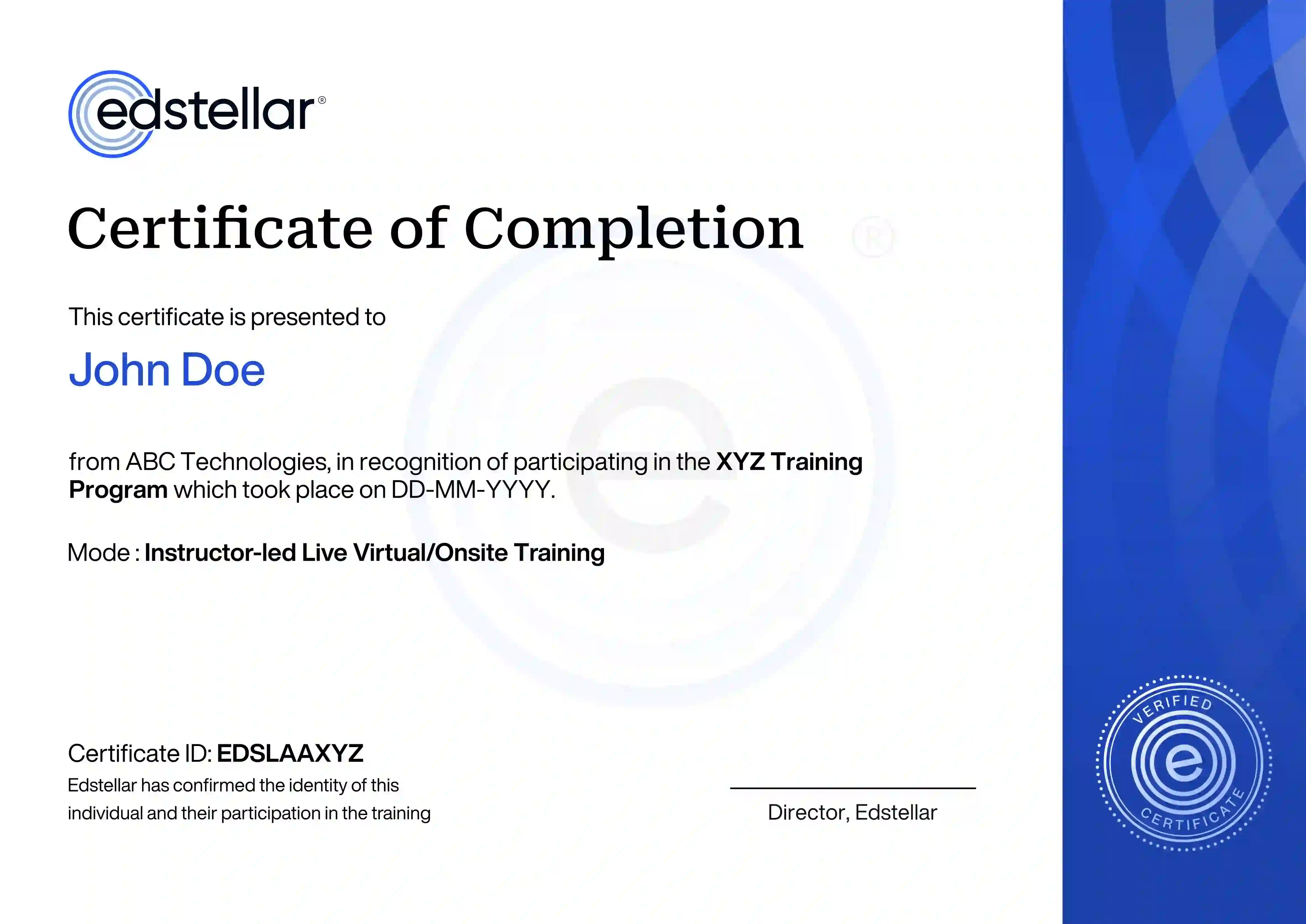
Get Your Team Members Recognized with Edstellar’s Course Certificate
Upon successful completion of the training course offered by Edstellar, employees receive a course completion certificate, symbolizing their dedication to ongoing learning and professional development.
This certificate validates the employee's acquired skills and is a powerful motivator, inspiring them to enhance their expertise further and contribute effectively to organizational success.


Edstellar is a one-stop instructor-led corporate training and coaching solution that addresses organizational upskilling and talent transformation needs globally.
Marketing Excellence
Operational Excellence
Finance Excellence
HR Excellence
IT Excellence
Customer Service
Leadership Excellence
Quality Management
Software
How it WorksFAQ'sCorporate Training
CatalogStellar AI
Skill MatrixHRMS Integration
Who we ServeCEO RetreatsPricingTraining DeliveryPartner with Edstellar
CareersContact us