.svg "edstellar")

Phishing Awareness Corporate Training Program for Employees
This training equips employees at all levels with the knowledge and skills to recognize, avoid, and report phishing attacks. Participants learn to identify phishing indicators across email, phone, and messaging channels and respond correctly to protect organizational security.
(Virtual / On-site / Off-site)
.svg)
Drive Team Excellence with Phishing Awareness Corporate Training
Phishing remains the single most common entry point for cyberattacks, with attackers constantly refining their techniques to deceive even security-aware employees. A single click on a malicious link can compromise an entire organization's systems, data, and reputation. Phishing Awareness training equips every employee, regardless of technical background, with the knowledge to recognize suspicious communications, understand attacker tactics, and take the right actions before a phishing attempt escalates into a breach.
Edstellar's Phishing Awareness Instructor-led course offers virtual/onsite training options designed for all employees, from frontline staff to executive leadership. Through realistic phishing simulations, case study analysis, and scenario-based exercises, participants develop the vigilance and practical skills needed to act as a strong first line of defense against social engineering attacks in any organizational environment.
.svg)

Skills Your Employees Will Gain
These are the core, hands-on capabilities your team builds during the program.
- Phishing email identification
- Social engineering awareness
- Spear phishing recognition
- Phishing incident reporting
- Multi-channel attack detection
- Secure communication practices
- Security culture contribution
What Your Team Will Achieve After This Training
- Master the characteristics of phishing attacks and social engineering tactics used to manipulate individuals into revealing sensitive information.
- Develop skills to identify phishing emails, smishing messages, and vishing calls by recognizing common indicators of compromise.
- Learn how to respond correctly to suspected phishing attempts, including reporting procedures and immediate containment actions.
- Build awareness of spear phishing, whaling, and BEC techniques that pose elevated and targeted risk to organizations.
- Apply knowledge of organizational phishing defense strategies to support a stronger security culture and faster incident response.
- Gain confidence to identify multi-channel phishing attempts and protect personal and organizational information from social engineering.
Topics & Program Outline
The curriculum is organized into focused modules built by industry experts and delivered virtually or on-premise. Interactive sessions reflect the evolving demands of the workplace, keeping the learning both relevant and practical.
-
What is Phishing and Why It Matters
- Definition of phishing and how it fits within the broader category of social engineering
- Why phishing is the leading initial attack vector in organizational cyber incidents
- The evolution of phishing tactics from mass spam to highly targeted attacks
- Real-world phishing statistics and the scale of the global phishing threat
-
The Psychology of Social Engineering
- How attackers exploit human psychology to bypass technical defenses
- Key psychological triggers: urgency, authority, fear, curiosity, and trust
- Why awareness of cognitive biases makes employees more resistant to manipulation
- Examples of social engineering principles used in real phishing campaigns
-
How Phishing Attacks Work
- The typical lifecycle of a phishing attack from reconnaissance to exploitation
- How attackers gather target information for personalized phishing campaigns
- Tools and infrastructure used by attackers to launch phishing campaigns at scale
- What attackers seek to gain: credentials, data, financial access, and system access
-
The Business Impact of Phishing
- Financial losses from phishing-enabled fraud and ransomware incidents
- Reputational damage caused by data breaches originating from phishing attacks
- Regulatory and legal consequences of breaches initiated through phishing
- Case studies of major organizational breaches initiated by phishing attacks
-
Why Technical Defenses Alone Are Not Enough
- The limitations of email filters, spam blockers, and endpoint security against phishing
- How sophisticated phishing campaigns evade technical detection mechanisms
- The critical role of human vigilance as a last line of defense
- How security awareness training reduces phishing click rates in organizations
-
The Role of Every Employee in Phishing Defense
- Why all employees, not just IT staff, are targets and defenders
- High-risk employee groups: finance, HR, executives, and remote workers
- Building individual accountability for organizational phishing defense
- How reporting culture reduces dwell time and limits breach impact
-
Email Phishing
- Characteristics of mass-distributed email phishing campaigns
- Common themes used in email phishing: account alerts, invoices, and delivery notifications
- How attackers use spoofed sender addresses to impersonate trusted organizations
- Examples of email phishing lures used against corporate targets
-
Spear Phishing
- How spear phishing targets specific individuals using personalized information
- Sources attackers use to research targets: social media, company websites, and LinkedIn
- Why spear phishing is significantly more effective than generic phishing campaigns
- Real-world spear phishing scenarios targeting finance, HR, and IT professionals
-
Whaling
- What whaling is and why executives and senior leaders are prime targets
- How whaling attacks impersonate boards, regulators, and law enforcement
- High-value targets of whaling: wire transfers, credentials, and sensitive corporate data
- Protecting executive communication channels from whaling attacks
-
Clone Phishing
- How clone phishing duplicates legitimate emails with malicious modifications
- Why clone phishing is difficult to detect without careful scrutiny
- Common triggers for clone phishing: resend requests and document updates
- Identifying the subtle differences that distinguish a cloned email from the original
-
Pharming and Credential Harvesting Sites
- How pharming redirects users to fake websites without their knowledge
- DNS poisoning and how it enables large-scale pharming attacks
- Recognizing fake login pages used to harvest credentials
- Browser and device indicators that signal a credential harvesting attempt
-
Seasonal and Event-Based Phishing Campaigns
- How attackers exploit major events: tax season, holidays, and global crises
- COVID-19 and crisis-themed phishing campaigns as a case study
- Recognizing increased phishing risk during high-pressure organizational periods
- Heightening vigilance and communication during known high-risk phishing seasons
-
Sender Address and Domain Spoofing
- How attackers spoof sender addresses to impersonate trusted organizations
- Techniques for inspecting the actual sender domain vs. the display name
- Lookalike domains: subtle character substitutions and homograph attacks
- How to verify sender authenticity using email headers and domain checks
-
Subject Lines and Urgency Tactics
- Common subject line patterns used in phishing campaigns to drive clicks
- How urgency and fear-based subject lines bypass critical thinking
- Red flags in subject lines: account suspension, urgent action, and expiry warnings
- How to pause and assess before reacting to urgent-sounding email subject lines
-
Email Body and Lure Content
- Common phishing email body structures and persuasion techniques
- Brand impersonation in email design: logos, colors, and formatting
- Grammar and formatting errors as phishing indicators, and why they are decreasing
- How AI-generated phishing emails are making lure content more convincing
-
Malicious Links and URL Inspection
- How attackers disguise malicious URLs using shortened links and hyperlink text
- Techniques for hovering over links to inspect the actual destination URL
- URL red flags: misspellings, unexpected subdomains, and non-HTTPS links
- Safe URL verification tools and browser extensions for link inspection
-
Malicious Attachments
- Common attachment types used in phishing: Office documents, PDFs, and ZIP files
- How macro-enabled Office documents deliver malware when opened
- Safe handling procedures for unexpected or unsolicited email attachments
- Organizational controls to restrict dangerous attachment types at the email gateway
-
Requests for Sensitive Information
- Why legitimate organizations never request credentials or payment via email
- Common information targets in phishing: passwords, MFA codes, and financial data
- How to verify information requests through out-of-band confirmation channels
- Recognizing pretexting stories used to justify sensitive information requests
-
How Attackers Profile Their Targets
- Open-source intelligence (OSINT) techniques used by attackers to research targets
- Information exposed on LinkedIn, company websites, and social media
- How organizational charts and press releases reveal high-value target relationships
- Reducing your personal attack surface through careful social media management
-
Personalizing Spear Phishing Lures
- How attackers use target-specific details to create highly convincing lures
- Impersonating colleagues, managers, and trusted business contacts
- Using recent events, project names, and organizational context in phishing lures
- Why personalized attacks are harder to identify than generic phishing campaigns
-
Recognizing Spear Phishing Indicators
- Subtle red flags in personalized phishing emails that differ from mass phishing
- Unusual requests that seem to come from known and trusted individuals
- Verifying the identity of senders through secondary communication channels
- Why even familiar-looking senders require scrutiny before taking action
-
High-Risk Spear Phishing Scenarios
- Finance team spear phishing: fake wire transfer and payment change requests
- HR spear phishing: W-2 requests, payroll redirection, and employee data harvesting
- IT spear phishing: credential reset, VPN access, and system update impersonation
- Executive spear phishing: board communications and urgent decision requests
-
Third-Party and Supply Chain Spear Phishing
- How attackers use compromised vendor accounts to target their customers
- Recognizing phishing attempts that impersonate trusted suppliers and partners
- Verifying vendor communication authenticity through established contact channels
- Organizational controls to limit supply chain phishing risk
-
Responding to a Suspected Spear Phishing Attack
- Immediate actions when a spear phishing email is received or clicked
- How to escalate a suspected spear phishing incident to the security team
- Preserving phishing email evidence for security investigation purposes
- Post-incident review and lessons learned from spear phishing encounters
-
Vishing: Voice-Based Phishing Attacks
- What vishing is and how attackers use phone calls to social engineer targets
- Common vishing scenarios: IT helpdesk impersonation, bank fraud alerts, and tax authority calls
- How caller ID spoofing makes vishing calls appear to come from trusted numbers
- Best practices for verifying caller identity before sharing information by phone
-
Smishing: SMS and Messaging-Based Phishing
- What smishing is and how it uses text messages to deliver phishing lures
- Common smishing lures: delivery notifications, bank alerts, and prize claims
- How smishing links bypass email security tools by reaching mobile devices directly
- Safe handling practices for suspicious text messages and mobile notifications
-
Social Media Phishing
- How attackers use social media platforms to deliver phishing lures and links
- Fake profiles, sponsored ads, and direct messages used in social media phishing
- Phishing risks in professional networking platforms like LinkedIn
- Recognizing and avoiding social media-based phishing attempts
-
Collaboration Tool Phishing
- Phishing attacks delivered through Slack, Microsoft Teams, and similar platforms
- How attackers use file sharing and collaboration tools to deliver malicious content
- Recognizing phishing indicators in collaboration tool messages and file requests
- Organizational policies for safe use of collaboration and messaging platforms
-
Multi-Channel Phishing Campaigns
- How attackers combine email, phone, and SMS in coordinated multi-channel attacks
- Why multi-channel attacks are more convincing and harder to identify in isolation
- Recognizing when multiple communications may be part of a single phishing campaign
- Escalating multi-channel social engineering attempts to the security team
-
QR Code Phishing
- How attackers use malicious QR codes to bypass email link scanning tools
- Common QR phishing delivery methods: emails, printed materials, and physical environments
- How to verify QR code destinations before scanning in professional settings
- Organizational guidance for safe QR code use in workplace communication
-
The STOP-THINK-ACT Framework
- Why pausing before acting is the single most effective phishing defense
- Applying the STOP-THINK-ACT framework to suspicious communications
- Overcoming urgency-driven impulses that phishing attackers deliberately create
- Building the habit of applying the framework in everyday email processing
-
Phishing Recognition Checklist
- Evaluating sender address authenticity and domain legitimacy
- Assessing subject line urgency and emotional pressure indicators
- Reviewing email body for impersonation, grammar errors, and inconsistencies
- Inspecting links and attachments before clicking or opening
-
Simulated Phishing Exercises
- How phishing simulations work as a training and awareness tool
- Reviewing real simulated phishing examples used in corporate training programs
- Analyzing what makes simulated phishing successful and how to catch it
- Using simulation results to identify personal vulnerability patterns
-
Real-World Phishing Case Analysis
- Dissecting real phishing emails used in documented corporate breach incidents
- Identifying the specific indicators that should have triggered suspicion
- Understanding why experienced employees fell for well-crafted phishing lures
- Lessons from real-world cases applied to personal vigilance improvement
-
Context-Based Phishing Assessment
- Using context to evaluate whether a communication is expected and legitimate
- Recognizing when an email is out of character for the apparent sender
- Verifying unexpected requests through separate communication channels
- When to trust and when to question: building sound communication judgment
-
Difficult-to-Detect Phishing Scenarios
- Phishing emails that pass all standard technical checks and look legitimate
- Account takeover phishing where the attacker uses a real compromised account
- AI-generated phishing content that mimics writing style with high accuracy
- Strategies for maintaining vigilance even when technical red flags are absent
-
What To Do When You Suspect a Phishing Email
- The correct immediate response when a suspicious email is received
- Why forwarding, replying to, or sharing suspicious emails increases risk
- How to use the organization's phishing report button or designated reporting process
- What information to include when reporting a suspected phishing email
-
What To Do If You Clicked a Phishing Link
- Immediate steps to take after clicking a suspicious link or opening an attachment
- Disconnecting from the network to limit potential malware spread
- Reporting the click to IT security immediately without delay
- What the security team will do after receiving a phishing click report
-
What To Do If You Entered Credentials on a Phishing Site
- Immediate password change procedures for potentially compromised accounts
- Reporting credential exposure to IT security and the compliance team
- Enabling MFA on affected accounts to reduce further compromise risk
- Monitoring affected accounts for unauthorized activity following credential theft
-
Incident Reporting Procedures
- How to report a phishing attempt using organizational reporting tools and processes
- Importance of reporting even when unsure whether the email is genuinely malicious
- What happens to reported phishing emails in the security operations process
- Building a no-blame reporting culture that encourages early incident disclosure
-
Supporting the Security Team During Response
- How to preserve phishing email evidence without compromising the investigation
- Responding to security team requests for information during an investigation
- Cooperating with the incident response team during a confirmed phishing breach
- Communicating cautiously with colleagues during an active phishing investigation
-
Learning from a Phishing Incident
- Post-incident review process for individuals involved in a phishing event
- Identifying personal vulnerability patterns exposed by the incident
- Using the incident as a learning opportunity rather than a source of blame
- Applying lessons learned to strengthen personal phishing vigilance
-
What is Business Email Compromise
- Definition of BEC and its classification as a targeted phishing-based fraud
- BEC vs. standard phishing: targeting, sophistication, and financial impact
- FBI IC3 BEC statistics and the scale of global BEC financial losses
- Why BEC is considered one of the most financially damaging cybercrimes
-
Common BEC Attack Types
- CEO fraud: impersonating executives to request urgent wire transfers
- Vendor impersonation: changing payment details to redirect funds
- Attorney impersonation: exploiting legal authority to pressure urgent payments
- Data theft BEC: using fake executive requests to obtain W-2s and employee data
-
How BEC Attackers Operate
- Account compromise as the starting point for authentic-looking BEC campaigns
- Long-term email monitoring before launching a BEC attack
- Timing BEC attacks during key business events: mergers, audits, and leadership changes
- How BEC attackers create urgency and bypass normal approval processes
-
Recognizing BEC Indicators
- Unusual payment requests that do not follow standard business processes
- Last-minute changes to bank account or wire transfer details
- Requests to bypass normal approval procedures due to urgency or confidentiality
- Subtle email address changes in reply-to fields that differ from the sender's domain
-
BEC Prevention Best Practices
- Two-factor verification for all payment, transfer, and vendor change requests
- Verification callbacks using independently sourced phone numbers, not email replies
- Implementing payment approval workflows that require multiple authorizations
- Finance team training on recognizing and verifying suspicious payment requests
-
Responding to a BEC Incident
- Immediate steps when a BEC fraud is discovered or suspected
- Contacting the bank to recall wire transfers within the critical time window
- Reporting BEC incidents to the FBI IC3 and relevant law enforcement
- Post-incident controls to prevent BEC recurrence within the organization
-
Email Security Technologies
- How email authentication protocols SPF, DKIM, and DMARC reduce phishing risk
- Anti-phishing filters and how they scan emails for malicious content
- Advanced email threat protection platforms and their detection capabilities
- Limitations of technical email defenses against sophisticated phishing campaigns
-
Multi-Factor Authentication (MFA)
- How MFA protects accounts even when credentials are stolen via phishing
- Types of MFA: authenticator apps, hardware tokens, and SMS codes
- MFA fatigue attacks and how employees can recognize and resist them
- Organizational MFA implementation strategies to maximize adoption and protection
-
Endpoint and Browser Security Controls
- Browser-based phishing protection: safe browsing filters and URL reputation checks
- Endpoint detection and response tools that identify phishing-related malware
- DNS filtering to block access to known phishing and malicious domains
- Keeping browsers, operating systems, and security tools updated to reduce vulnerability
-
Phishing Simulation Programs
- How organizations use phishing simulations to test and improve employee awareness
- Designing effective phishing simulation campaigns for different employee groups
- Using simulation results to identify training needs and high-risk individuals
- Building a positive, blame-free simulation culture that encourages learning
-
Incident Reporting Infrastructure
- Deploying phishing report buttons in email clients to simplify employee reporting
- Building a security operations process to triage and act on phishing reports quickly
- Using aggregated reporting data to identify targeted phishing campaigns early
- Closing the feedback loop with employees who report suspected phishing emails
-
Governance and Policy Controls
- Acceptable use policies that reduce employee behavior-based phishing risk
- Data handling and payment authorization policies that limit BEC exposure
- Third-party communication verification policies for vendor and supplier interactions
- Regular policy review to address new phishing techniques and attack vectors
-
Security Awareness Culture
- What a phishing-resistant security culture looks like in practice
- Leadership behaviors that model and reinforce good phishing vigilance
- Creating psychological safety that encourages reporting without blame
- Sustaining security awareness culture through recognition and positive reinforcement
-
Ongoing Security Awareness Training
- Why one-time phishing training is insufficient and how to build a continuous program
- Microlearning, newsletters, and just-in-time training for sustained awareness
- Role-based training to address the specific phishing risks facing different teams
- Measuring training effectiveness through simulation performance and incident trends
-
High-Risk Group Targeted Programs
- Designing enhanced phishing training for finance, HR, and executive teams
- Tailoring training content to the specific phishing scenarios each group faces
- Frequency and depth of training for high-risk employee populations
- Monitoring high-risk group simulation performance to assess program effectiveness
-
Measuring Phishing Resilience
- Key metrics for measuring organizational phishing awareness and resilience
- Tracking phishing simulation click rates over time to assess program impact
- Using reporting rates as a positive indicator of security culture strength
- Reporting phishing resilience metrics to leadership and security committees
-
Phishing Threat Intelligence and Updates
- Using threat intelligence to stay current on emerging phishing techniques
- Communicating new phishing threats to employees through timely awareness updates
- Incorporating real phishing campaign examples from threat feeds into training
- Collaborating with industry peers on phishing threat intelligence sharing
-
Continuous Improvement of the Phishing Awareness Program
- Using incident data, simulation results, and employee feedback to improve the program
- Benchmarking phishing resilience against industry peers and standards
- Planning annual program reviews to refresh content and simulation scenarios
- Building a roadmap for advancing from awareness to a fully phishing-resistant organization
Who Should Attend?
This program suits professionals at many levels across the organization, including:
- All Employees and Staff
- Finance and Accounts Payable Teams
- HR and Recruitment Professionals
- IT and Security Teams
- Executive and Senior Leadership
- Customer-Facing and Remote Workers
What are the Prerequisites?
No prior technical knowledge is required. Professionals should have basic familiarity with using email and internet-based communication tools to take the Phishing Awareness training course.
Choose the Format That Fits Your Team
We design training your teams actually engage with, and deliver it the way that suits you best. Through a vetted global trainer network, Edstellar runs sessions in 10+ languages with consistent quality anywhere.


.webp "Virtual Phishing Awareness Training")
Virtual / online: expert-led live sessions delivered anywhere, with consistency and easy scheduling.
.webp "On-site Phishing Awareness Training")
On-site (in-house): immersive, instructor-led learning at your office.
.webp "Off-site Phishing Awareness Training")
Off-site: focused, instructor-led group learning away from everyday workplace distractions.
Get a Proposal Shaped to Your Needs
Need pricing for onsite, offsite, or virtual delivery? Get a proposal tailored to your team's needs.
64 hours of group training (includes VILT/In-person On-site)
Tailored for SMBs
Tailor-Made Trainee Licenses with Our Exclusive Training Packages!
160 hours of group training (includes VILT/In-person On-site)
Ideal for growing SMBs
Tailor-Made Trainee Licenses with Our Exclusive Training Packages!
400 hours of group training (includes VILT/In-person On-site)
Designed for large corporations
Tailor-Made Trainee Licenses with Our Exclusive Training Packages!
Unlimited duration
Designed for large corporations
What Sets Edstellar Apart
Experienced Trainers
Our trainers are drawn from a vetted global network and bring years of industry expertise, keeping every session practical and impactful.
Proven Quality
With a strong global track record, Edstellar is known for quality and engaging delivery.
Industry-Relevant Curriculum
Our programs are built by experts to match the demands of today's industry.
Fully Customizable
Every program can be tailored to your organization's goals.
Comprehensive Support
We provide pre- and post-session support for a complete learning experience.
Global Multi-Location & Multilingual Training Delivery
We deliver in multiple languages to support diverse global teams.
Recognition That Motivates Your Team
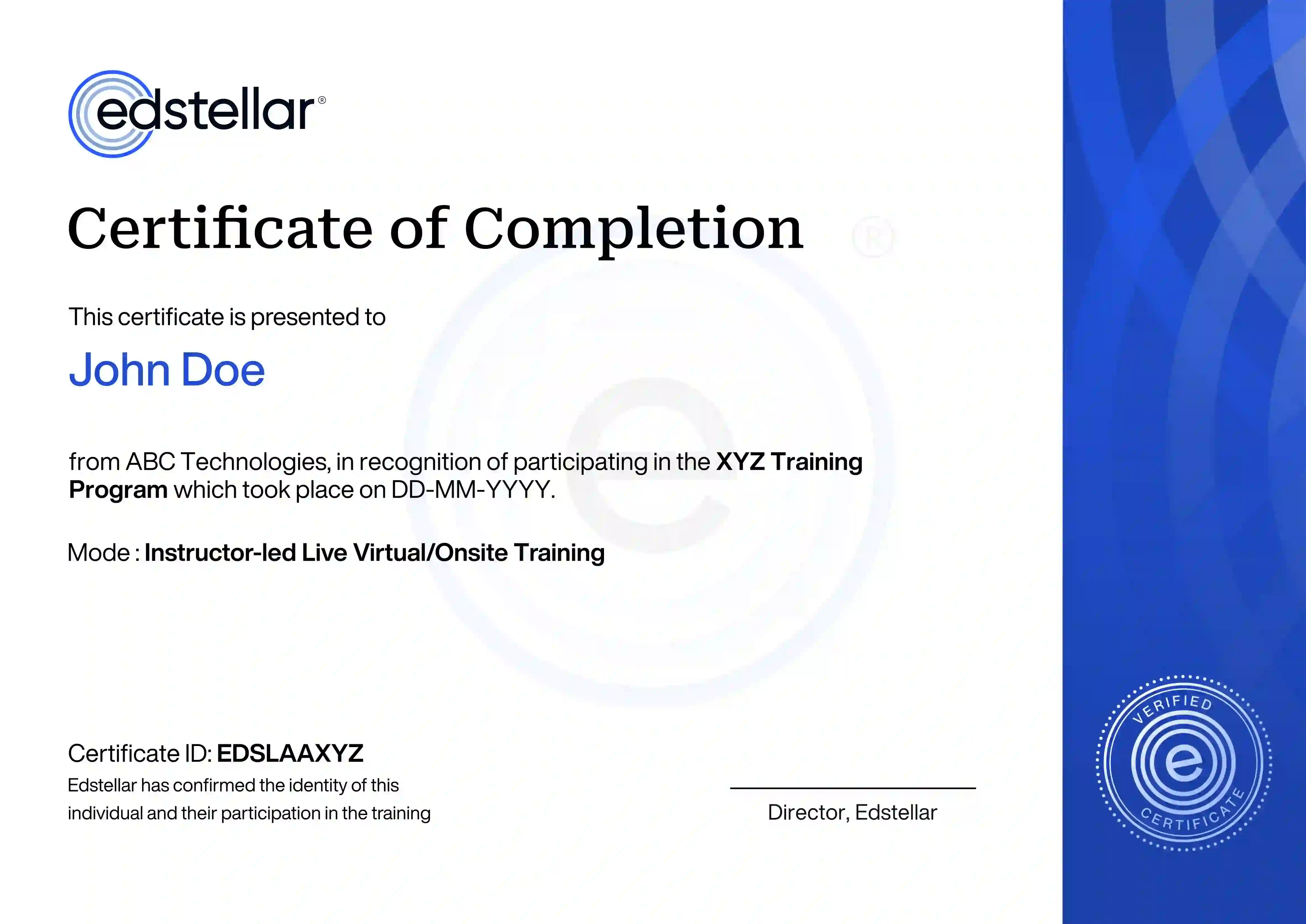
Upon successful completion of the Phishing Awareness training course offered by Edstellar, employees receive a course completion certificate, symbolizing their dedication to ongoing learning and professional development.
This certificate validates the employee's acquired skills and is a powerful motivator, inspiring them to enhance their expertise further and contribute effectively to organizational success.

Other Related Corporate Training Courses


Edstellar is a one-stop instructor-led corporate training and coaching solution that addresses organizational upskilling and talent transformation needs globally.
.svg)
.svg)
.svg)

.svg)
Learning Technology
Learning Content Design and Development
Learning Governance, Analytics & ROI
Digital Learning Ecosystem
Training Simulations, AR/VR & Case Studies
Employee Performance Support
Leadership Pipeline & Succession PlanningStrategic Workforce Planning for EnterprisesTransformation & Risk Advisory for EnterprisesDEI Consulting for EnterprisesEmployee Engagement Consulting for Enterprises
Cultural Transformation