.svg "edstellar")

Privacy by Design (PbD) Corporate Training Program
This training covers the seven Privacy by Design foundational principles, enabling professionals to embed privacy into products, systems, and business processes to achieve proactive compliance and minimize data protection risks.
(Virtual / On-site / Off-site)
.svg)
Drive Team Excellence with Privacy by Design (PbD) Corporate Training
Privacy by Design (PbD) is the globally recognized framework for embedding privacy into products, systems, and business processes from the very start - not as a compliance afterthought, but as a core design value. Anchored in seven foundational principles and directly mandated by GDPR Article 25 Data Protection by Design and by Default, Privacy by Design enables organizations to proactively address privacy risks, reduce regulatory exposure, and build consumer trust. This training covers every dimension of Privacy by Design, from foundational principles and data minimization to privacy-enhancing technologies, cross-functional integration, and program maturity.
Edstellar's Privacy by Design (PbD) Instructor-led course offers virtual/onsite training options so teams can learn in the format that suits them best. The curriculum combines regulatory grounding with practical design exercises, real-world case studies, and actionable frameworks, enabling privacy officers, product managers, architects, legal, and IT professionals to embed Privacy by Design effectively across their organizations and demonstrate compliance with GDPR Article 25 and global privacy requirements.
.svg)

Skills Your Employees Will Gain
These are the core, hands-on capabilities your team builds during the program.
- Privacy by Design Principle Application
- Data Minimization and Purpose Limitation
- Privacy-Preserving Architecture Design
- Privacy Impact Assessment Conduct
- GDPR Article 25 Compliance
- Cross-Functional Privacy Integration
- Privacy Risk Identification and Mitigation
What Your Team Will Achieve After This Training
- Master the seven foundational Privacy by Design principles and how to apply them across organizational systems and processes.
- Gain practical skills to embed privacy requirements into product and system design before and during development.
- Develop data minimization, purpose limitation, and privacy-preserving architecture strategies for data-intensive environments.
- Learn to evaluate and apply privacy-enhancing technologies to reduce personal data processing risks in organizational systems.
- Build cross-functional privacy integration capabilities enabling collaboration between legal, IT, product, and business teams.
- Apply a Privacy by Design maturity framework to assess, improve, and sustain organizational privacy-by-design capabilities.
Topics & Program Outline
The curriculum is organized into focused modules built by industry experts and delivered virtually or on-premise. Interactive sessions reflect the evolving demands of the workplace, keeping the learning both relevant and practical.
-
The Origins and Philosophy of Privacy by Design
- How Ann Cavoukian developed the Privacy by Design framework at the Ontario Privacy Commissioner's office
- The seven foundational principles: an overview of the complete Privacy by Design framework
- Why Privacy by Design emerged in response to the limitations of compliance-only approaches to privacy
- How Privacy by Design has been adopted into law, regulation, and global privacy frameworks worldwide
-
Why Privacy by Design Matters: The Business and Regulatory Case
- The cost of privacy incidents: fines, litigation, reputational damage, and consumer trust erosion
- How Privacy by Design reduces regulatory risk by addressing privacy proactively at the design stage
- The competitive advantage of privacy: consumer trust, market differentiation, and brand equity
- GDPR enforcement trends showing that privacy-by-design gaps attract significant regulatory penalty
-
Privacy by Design vs Privacy by Compliance: Key Distinctions
- The compliance mindset: meeting minimum standards after the fact vs preventing harm from the start
- How Privacy by Design shifts privacy from a legal obligation to an organizational design value
- The risk of treating privacy as a checklist item: compliance gaps and architectural debt
- Integrating Privacy by Design alongside compliance frameworks for comprehensive privacy governance
-
The Privacy by Design Framework: Overview and Structure
- The three areas of application: IT systems, business practices, and physical design and infrastructure
- How the seven principles work together as an integrated framework rather than independent rules
- Applying the framework at different stages: new designs, existing systems, and legacy infrastructure
- Privacy by Design maturity levels: from awareness to fully embedded organizational capability
-
Regulatory Roots: GDPR Article 25 and Privacy by Design Globally
- GDPR Article 25 Data Protection by Design and by Default: the direct regulatory mandate for PbD
- How GDPR Article 25 translates Privacy by Design principles into binding legal obligations
- Privacy by Design requirements under UK GDPR, LGPD, POPIA, and other global privacy frameworks
- Supervisory authority guidance on Article 25 compliance: EDPB guidelines and national DPA recommendations
-
Key Terminology and Concepts in Privacy by Design
- Privacy by Default: what it means for data subjects and how it differs from Privacy by Design
- Data minimization, purpose limitation, and storage limitation as core Privacy by Design concepts
- Privacy-enhancing technologies (PETs): the technical toolkit for implementing Privacy by Design
- Accountability in Privacy by Design: documentation, evidence, and demonstrating compliance
-
Principle 1: Proactive Not Reactive - Preventive Not Remedial
- Anticipating privacy risks before they occur rather than responding to incidents after the fact
- Conducting privacy risk assessments before systems, products, and processes are designed
- How proactive privacy design reduces the cost and complexity of regulatory compliance
- Applying the principle to product roadmaps, project governance, and procurement decisions
-
Principle 2: Privacy as the Default Setting
- Ensuring that personal data is automatically protected without requiring consumer action
- Designing data collection defaults to collect only what is strictly necessary for the purpose
- Opt-in vs opt-out: how privacy-as-default changes the burden and the baseline
- Practical examples of privacy-by-default in data collection, storage, and processing systems
-
Principle 3: Privacy Embedded into Design
- Integrating privacy as a core system requirement, not an add-on after design is complete
- Working with engineers and architects to embed privacy controls in system design decisions
- Privacy requirements in functional specifications, system design documents, and architecture reviews
- Refactoring existing systems to embed privacy controls without full system rebuilds
-
Principle 4: Full Functionality - Positive Sum, Not Zero Sum
- Rejecting the false trade-off between privacy and business functionality or user experience
- Designing privacy-preserving solutions that maintain full product utility and performance
- Case studies of products achieving privacy and functionality simultaneously at scale
- Using creative design thinking to resolve apparent conflicts between privacy and business goals
-
Principle 5: End-to-End Security - Full Lifecycle Protection
- Protecting personal data through its entire lifecycle from collection to secure destruction
- Security controls at every stage: collection, storage, processing, transmission, and deletion
- Secure destruction standards and data retention management as Privacy by Design obligations
- Aligning end-to-end security design with GDPR Article 32 appropriate technical measures
-
Principles 6 and 7: Visibility, Transparency, and Respect for User Privacy
- Principle 6: visibility and transparency - ensuring privacy practices are open and verifiable by all
- Principle 7: respect for user privacy - keeping systems user-centric, not just operator-centric
- Translating principles 6 and 7 into user interface design, notice design, and consent mechanisms
- Combining all seven principles into a holistic Privacy by Design approach for new initiatives
-
Understanding Privacy by Default Under GDPR Article 25
- GDPR Article 25(2): the legal requirement for data protection by default in processing design
- What privacy by default means for data minimization, access restriction, and retention limits
- The supervisory authority enforcement focus on privacy by default in product and app design
- Common examples of GDPR Article 25(2) violations and their regulatory consequences
-
Technical Implementation of Privacy by Default in Products and Services
- Setting default collection parameters to the minimum necessary for the stated processing purpose
- Designing user interfaces that make privacy-protective choices the easiest and most natural option
- Access restriction defaults: ensuring personal data is inaccessible to unauthorized users by default
- Retention limit defaults: auto-deletion and archiving schedules built into product design from launch
-
Default Data Minimization: Collecting Only What Is Necessary
- Defining necessity for the purpose: how to determine what data is truly required vs merely useful
- Designing data capture forms, APIs, and data pipelines to collect only necessary data fields
- Reviewing existing data collection practices for unnecessary data capture and remediation options
- Building data minimization checkpoints into new feature development and product release processes
-
Consent and Transparency as Privacy-by-Default Requirements
- Designing consent mechanisms where the default state is no consent for non-essential processing
- Pre-ticked boxes and auto-consent: why they violate privacy by default and GDPR consent rules
- Layered and just-in-time consent design that meets transparency and granularity requirements
- Privacy notices and user controls that make privacy settings visible, accessible, and changeable
-
Auditing Existing Products and Services for Privacy-by-Default Compliance
- Conducting a privacy-by-default audit: assessing current defaults across collection, access, and retention
- Identifying privacy-by-default gaps and prioritizing remediation by risk and regulatory focus
- Documenting audit findings and building a privacy-by-default remediation roadmap
- Retesting and re-auditing after remediation to validate privacy-by-default improvements
-
Common Privacy-by-Default Failures and How to Avoid Them
- Over-collection failures: capturing data fields not required for the stated processing purpose
- Broad access defaults: granting data access to all staff rather than limiting to those with a need
- Missing retention defaults: no deletion schedule, resulting in indefinite storage of personal data
- User interface dark patterns that subvert privacy-by-default by making privacy-invasive options easier
-
Data Minimization: The Core Privacy by Design Principle in Practice
- Defining data minimization under GDPR Article 5(1)(c) and its application to system design
- The adequate, relevant, and limited to what is necessary standard in practical design decisions
- Conducting a data necessity review for existing and new processing activities
- Eliminating shadow data: unintended data collection through logs, analytics, and API responses
-
Defining and Enforcing Purpose Limitation Across Processing Activities
- GDPR Article 5(1)(b) purpose limitation: specifying purposes before collection and not exceeding them
- Documenting lawful processing purposes in privacy notices, records of processing, and system design
- Technical controls for purpose limitation: data tagging, access segregation, and use case restriction
- Managing purpose creep: governance processes to prevent unauthorized secondary use of personal data
-
Retention Minimization: Designing Deletion Into Systems and Processes
- Establishing data retention schedules based on processing purpose and applicable legal obligations
- Designing automated deletion workflows into systems from the initial architecture phase
- Retention by data category: different retention periods for different personal data types and purposes
- Auditing retention compliance: verifying that data is deleted on schedule and documenting outcomes
-
Anonymization and Pseudonymization as Data Minimization Tools
- Anonymization vs pseudonymization: understanding the legal and technical distinction
- When anonymized data falls outside GDPR scope and the standards required for genuine anonymization
- Implementing pseudonymization as a Privacy by Design measure reducing breach risk
- Privacy-preserving analytics: using aggregated and anonymized data sets for analytics at scale
-
Applying Data Minimization to Analytics, Marketing, and AI Systems
- Analytics platform design: limiting data collection to metrics necessary for stated analytical purposes
- Marketing data minimization: list hygiene, consent-based segmentation, and purpose-limited profiling
- AI and machine learning training data minimization: selecting only data necessary for model objectives
- Evaluating third-party analytics, advertising, and AI tools against data minimization requirements
-
Implementing Purpose Limitation Controls in Data Architecture and Governance
- Database schema design for purpose limitation: separating data by purpose and access profile
- Data governance policies enforcing purpose limitation across business units and processing systems
- Access control architecture ensuring data is available only for its specified processing purpose
- Audit log design for purpose limitation: detecting and investigating unauthorized secondary data use
-
Introduction to Privacy-Enhancing Technologies and Their Role in PbD
- What PETs are: technologies that minimize personal data processing while achieving functional goals
- The GDPR mandate for appropriate technical measures and how PETs satisfy Article 25 and Article 32
- Categories of PETs: data-minimizing, data-masking, data-splitting, and noise-adding technologies
- Evaluating PETs for fit: balancing privacy protection, utility, performance, and implementation cost
-
Encryption: Symmetric, Asymmetric, and End-to-End Encryption for Privacy
- Symmetric encryption: use cases, key management, and performance considerations
- Asymmetric encryption: how public-key infrastructure protects data in transit and at rest
- End-to-end encryption: protecting communications and stored data from provider-level access
- GDPR and encryption: how encryption affects breach notification obligations and risk assessment
-
Pseudonymization and Tokenization as Privacy-Preserving Data Techniques
- How pseudonymization replaces direct identifiers to reduce re-identification risk
- Implementing pseudonymization in databases, analytics pipelines, and data sharing arrangements
- Tokenization: replacing sensitive data with non-sensitive tokens in payment and identity contexts
- Re-identification risk assessment: when pseudonymized data may still be linkable to individuals
-
Differential Privacy: Enabling Analytics Without Exposing Individual Data
- The mathematical foundation of differential privacy and how it protects individual data in aggregates
- Real-world applications of differential privacy in analytics, machine learning, and data publishing
- Calibrating the privacy budget: balancing privacy protection with analytical accuracy and utility
- Implementing differential privacy in organizational analytics platforms and data science workflows
-
Federated Learning and Secure Multi-Party Computation in Privacy Design
- Federated learning: training AI models on distributed data without centralizing personal data
- Secure multi-party computation: enabling joint analysis of sensitive data without data sharing
- Homomorphic encryption: processing encrypted data without decrypting it first
- Evaluating federated and distributed computing approaches for data-intensive organizational use cases
-
Evaluating and Selecting PETs for Specific Privacy by Design Requirements
- Matching PET selection to the privacy risk profile of the processing activity
- PET evaluation criteria: privacy protection strength, implementation complexity, and performance impact
- Building a PET toolkit for the organization: approved technologies, implementation guidance, and support
- Staying current with PET developments: emerging privacy-preserving technologies and regulatory guidance
-
The Privacy Design Sprint: Embedding Privacy into Product Development Cycles
- Integrating privacy requirements into design sprints from day one of product development
- Privacy-focused kickoff workshops: establishing privacy goals before design work begins
- Running privacy design reviews at sprint gates to catch and address issues before they embed
- Tools and templates for managing privacy requirements within agile and scrum methodologies
-
Privacy Requirements Gathering: Working With Stakeholders to Define Privacy Goals
- Eliciting privacy requirements from legal, compliance, product, and user research stakeholders
- Translating regulatory obligations into functional privacy requirements for engineering teams
- Writing privacy requirements in user story format for integration into product backlogs
- Prioritizing privacy requirements alongside functional requirements in the product planning process
-
Privacy Architecture Patterns: Design Patterns That Embed Privacy by Default
- The data vault pattern: centralizing personal data with strict access controls and audit logging
- The privacy proxy pattern: intercepting and filtering data flows to enforce minimization rules
- The consent management pattern: designing consent capture, storage, and enforcement into architecture
- The data lineage pattern: tracking personal data from source through processing to deletion
-
Designing for Data Subject Rights: Access, Erasure, Portability, and Correction
- Building technical capabilities to fulfill data subject access requests at scale
- Erasure by design: architecting systems to support complete and verifiable deletion
- Portability by design: producing machine-readable personal data exports from system design onward
- Correction by design: enabling data subjects to update their data across all relevant systems
-
User Interface Design for Privacy: Transparent Controls and Informed Consent
- Privacy-first UX: designing interfaces that help users understand and control their privacy
- Consent UI design principles: granularity, clarity, ease of withdrawal, and no dark patterns
- Privacy dashboard design: centralized user controls for data access, correction, and deletion requests
- Accessibility in privacy UI design: ensuring privacy controls are usable by all users
-
Privacy Review Gates in Product Design: Checkpoints Before Launch and Release
- Establishing mandatory privacy review gates at concept, design, build, and pre-launch stages
- DPIA integration as a privacy gate: when a design review must trigger a formal DPIA process
- Privacy sign-off criteria: what must be completed before a product or feature can go live
- Post-launch privacy reviews: monitoring deployed products for privacy-by-design compliance
-
Privacy-Secure Coding Practices for Developers
- Input validation and sanitization to prevent injection attacks that expose personal data
- Secure session management: token expiry, re-authentication, and session fixation prevention
- Error handling and logging: avoiding the capture and exposure of personal data in error logs
- Code review practices for privacy: including privacy-specific checks in peer review workflows
-
Integrating Privacy Requirements Into User Stories and Technical Specifications
- Writing acceptance criteria that include privacy conditions for user stories involving personal data
- Translating privacy requirements into testable technical specifications for developers
- Privacy-as-a-non-functional-requirement: integrating privacy alongside performance and scalability
- Sprint retrospective reviews of privacy requirement implementation and lessons learned
-
Threat Modeling for Privacy: Identifying Risks in Software Architecture
- Privacy threat modeling: adapting STRIDE and LINDDUN frameworks for privacy risk identification
- Identifying data flow threats: where personal data is at risk of exposure in system architecture
- Trust boundary analysis: identifying points where data crosses between trust zones in the system
- Using threat modeling outputs to drive Privacy by Design improvements in system architecture
-
Secure Software Development Lifecycle and Its Privacy Dimensions
- The SSDLC model and where privacy requirements integrate at each stage
- Security and privacy requirements review at project initiation and design stages
- Static and dynamic code analysis tools for identifying privacy risks in software code
- Penetration testing with a privacy focus: identifying data exposure risks in deployed applications
-
API Design for Privacy: Limiting Data Exposure in Integration Points
- API data minimization: returning only the data fields necessary for the integration purpose
- API authentication and authorization: ensuring only authorized parties can access personal data
- API rate limiting and logging: detecting and preventing data scraping and unauthorized bulk access
- Documenting API privacy properties: data types returned, retention, and access control design
-
Testing and Validating Privacy Controls in Software Development
- Privacy test case design: writing test cases that validate privacy controls in software builds
- Automated privacy testing: integrating privacy checks into CI/CD pipeline test suites
- Penetration and vulnerability testing for privacy: data exposure and access control validation
- Privacy regression testing: ensuring privacy controls are not degraded by subsequent code changes
-
Building a Cross-Functional Privacy Team: Roles, Responsibilities, and Collaboration
- The cross-functional privacy team model: legal, IT, product, marketing, HR, and operations representation
- Defining privacy responsibilities across functions and preventing ownership gaps
- Privacy governance structures that enable effective cross-functional decision-making
- Managing cross-functional privacy priorities and resolving competing stakeholder interests
-
Privacy Champions: Embedding Privacy Advocates Across Business Functions
- The privacy champion model: embedding privacy advocates in product, engineering, and business teams
- Selecting, training, and supporting privacy champions across the organization
- The privacy champion's role: raising privacy issues, facilitating reviews, and promoting PbD culture
- Metrics for privacy champion program effectiveness: awareness, issue identification, and PbD adoption
-
Privacy by Design in Marketing and Advertising Technology
- Consent management for marketing: building lawful consent capture and enforcement into marketing tech
- Advertising technology privacy: data flows in DSPs, SSPs, and DMPs and their GDPR implications
- Cookie and tracking technology design: compliant analytics and personalization with privacy by default
- Marketing data minimization: reducing personal data exposure in campaign measurement and attribution
-
Privacy Integration in HR Systems: Employee Data and Workforce Analytics
- Employee data privacy by design: limiting access, minimizing collection, and enforcing retention
- HR analytics privacy: building privacy controls into workforce analytics platforms and dashboards
- Recruitment and applicant tracking system privacy: data minimization and retention for candidate data
- Performance management system design: limiting sensitive data access to authorized roles
-
Third-Party and Vendor Privacy by Design Requirements and Assessments
- Embedding Privacy by Design requirements in vendor contracts and procurement documentation
- Conducting Privacy by Design assessments of third-party platforms before procurement decisions
- Vendor Privacy by Design certifications: ISO 27701, GDPR Article 25 alignment, and independent audits
- Managing vendor Privacy by Design compliance through ongoing monitoring and periodic reassessment
-
Privacy Governance Structures That Enable Effective Cross-Functional Integration
- Privacy governance committee design: membership, authority, agenda, and decision-making process
- Privacy policies and standards as cross-functional governance instruments
- Privacy risk escalation pathways from project teams to privacy governance and senior management
- Annual privacy governance review: assessing cross-functional Privacy by Design maturity and progress
-
GDPR Article 25: Data Protection by Design and by Default Requirements
- Article 25(1): implementing data protection principles by design for all processing activities
- Article 25(2): ensuring only necessary personal data is processed by default
- The state of the art and implementation cost provisions in Article 25 compliance assessment
- How supervisory authorities have interpreted and enforced Article 25 in investigations and sanctions
-
Demonstrating GDPR Article 25 Compliance Through Privacy by Design Evidence
- Documentation requirements: recording Privacy by Design decisions, assessments, and controls
- Using DPIAs, privacy audits, and records of processing as Article 25 compliance evidence
- Privacy by Design certifications and codes of conduct as compliance demonstration tools
- Responding to supervisory authority inquiries about Article 25 compliance with evidence
-
Privacy by Design in DPIAs: How PbD Supports Risk Assessment and Mitigation
- How Privacy by Design controls reduce the residual risk score in a GDPR DPIA assessment
- Using DPIA findings to drive additional Privacy by Design improvements in system design
- Documenting Privacy by Design measures as mitigation actions in the DPIA report
- The cycle of Privacy by Design and DPIA: iterative improvement of privacy across the system lifecycle
-
Regulatory Expectations for Privacy by Design Across Global Frameworks
- EDPB guidelines on data protection by design and by default: key requirements and practical guidance
- UK ICO Privacy by Design guidance and its alignment with GDPR Article 25 obligations
- Privacy by Design requirements under LGPD, POPIA, PIPEDA, and other global privacy laws
- Building a globally harmonized Privacy by Design program for multinational organizations
-
Privacy by Design in Certification and Codes of Conduct Under GDPR
- GDPR Article 42 certification: how Privacy by Design certifications demonstrate compliance
- ISO 27701 Privacy Information Management System and its alignment with Privacy by Design
- GDPR Article 40 codes of conduct: how sector-specific codes embed Privacy by Design obligations
- Evaluating Privacy by Design certification options and their value for organizational compliance
-
Enforcement Case Studies: Privacy by Design Failures and Regulatory Consequences
- Case study analysis of GDPR Article 25 enforcement actions and Privacy by Design failure patterns
- Fines and sanctions where supervisory authorities cited Privacy by Design deficiencies
- Lessons from enforcement: common Privacy by Design gaps that attract regulatory scrutiny
- Applying enforcement case study lessons to proactive Privacy by Design program improvement
-
Privacy by Design Maturity Models: Assessing Your Organization's Current State
- Overview of Privacy by Design maturity models: levels from ad hoc to fully optimized
- Conducting a Privacy by Design maturity assessment across IT, product, legal, and business functions
- Scoring maturity by domain: data minimization, consent, access controls, and privacy governance
- Using maturity assessment results to define the organizational Privacy by Design improvement roadmap
-
Key Metrics for Privacy by Design Program Effectiveness
- Privacy review completion rate: percentage of new projects completing privacy reviews on schedule
- DPIA completion and quality metrics: timeliness, depth, and DPO satisfaction with DPIA outputs
- Privacy incident metrics: tracking incidents attributable to Privacy by Design gaps
- Privacy training metrics: completion rates, knowledge assessment scores, and champion program coverage
-
Privacy by Design Roadmap: Building a Phased Implementation Plan
- Assessing the gap between current state and target Privacy by Design maturity
- Defining Privacy by Design roadmap phases: quick wins, foundational capability, and optimization
- Prioritizing roadmap initiatives by risk reduction impact, regulatory urgency, and implementation effort
- Aligning the Privacy by Design roadmap with organizational strategy, technology, and compliance plans
-
Embedding Privacy by Design Into Organizational Culture and Training
- Building a privacy-aware culture: leadership commitment, communication, and role modeling
- Privacy by Design training programs: awareness for all staff and deep-dive for privacy-critical roles
- Recognizing and rewarding Privacy by Design contributions across teams and functions
- Sustaining Privacy by Design culture through onboarding, annual refresh, and privacy champions
-
Continuous Improvement for Privacy by Design: Review, Update, and Enhance
- Annual Privacy by Design program review: assessing maturity progress against the roadmap
- Integrating Privacy by Design improvements triggered by incidents, audits, and regulatory changes
- Benchmarking Privacy by Design maturity against industry peers and regulatory guidance
- Using lessons learned from privacy incidents to drive targeted Privacy by Design enhancements
-
The Future of Privacy by Design: Emerging Technologies and Evolving Expectations
- AI and Privacy by Design: embedding privacy protections in AI model development and deployment
- Internet of Things and Privacy by Design: privacy challenges in connected device ecosystems
- Synthetic data and Privacy by Design: using AI-generated data to reduce personal data processing
- Evolving regulatory expectations for Privacy by Design: emerging standards and supervisory authority guidance
Who Should Attend?
This program suits professionals at many levels across the organization, including:
- Privacy and Data Protection Officers
- Product Managers and Designers
- Software Architects and Developers
- Legal and Compliance Officers
- IT Security Managers
- Business Process Owners
What are the Prerequisites?
Professionals should have a basic understanding of data protection principles and familiarity with organizational data handling practices to take the Privacy by Design (PbD) training course.
Choose the Format That Fits Your Team
We design training your teams actually engage with, and deliver it the way that suits you best. Through a vetted global trainer network, Edstellar runs sessions in 10+ languages with consistent quality anywhere.


.webp "Virtual Privacy by Design (PbD) Training")
Virtual / online: expert-led live sessions delivered anywhere, with consistency and easy scheduling.
.webp "On-site Privacy by Design (PbD) Training")
On-site (in-house): immersive, instructor-led learning at your office.
.webp "Off-site Privacy by Design (PbD) Training")
Off-site: focused, instructor-led group learning away from everyday workplace distractions.
Get a Proposal Shaped to Your Needs
Need pricing for onsite, offsite, or virtual delivery? Get a proposal tailored to your team's needs.
64 hours of group training (includes VILT/In-person On-site)
Tailored for SMBs
Tailor-Made Trainee Licenses with Our Exclusive Training Packages!
160 hours of group training (includes VILT/In-person On-site)
Ideal for growing SMBs
Tailor-Made Trainee Licenses with Our Exclusive Training Packages!
400 hours of group training (includes VILT/In-person On-site)
Designed for large corporations
Tailor-Made Trainee Licenses with Our Exclusive Training Packages!
Unlimited duration
Designed for large corporations
What Sets Edstellar Apart
Experienced Trainers
Our trainers are drawn from a vetted global network and bring years of industry expertise, keeping every session practical and impactful.
Proven Quality
With a strong global track record, Edstellar is known for quality and engaging delivery.
Industry-Relevant Curriculum
Our programs are built by experts to match the demands of today's industry.
Fully Customizable
Every program can be tailored to your organization's goals.
Comprehensive Support
We provide pre- and post-session support for a complete learning experience.
Global Multi-Location & Multilingual Training Delivery
We deliver in multiple languages to support diverse global teams.
Recognition That Motivates Your Team
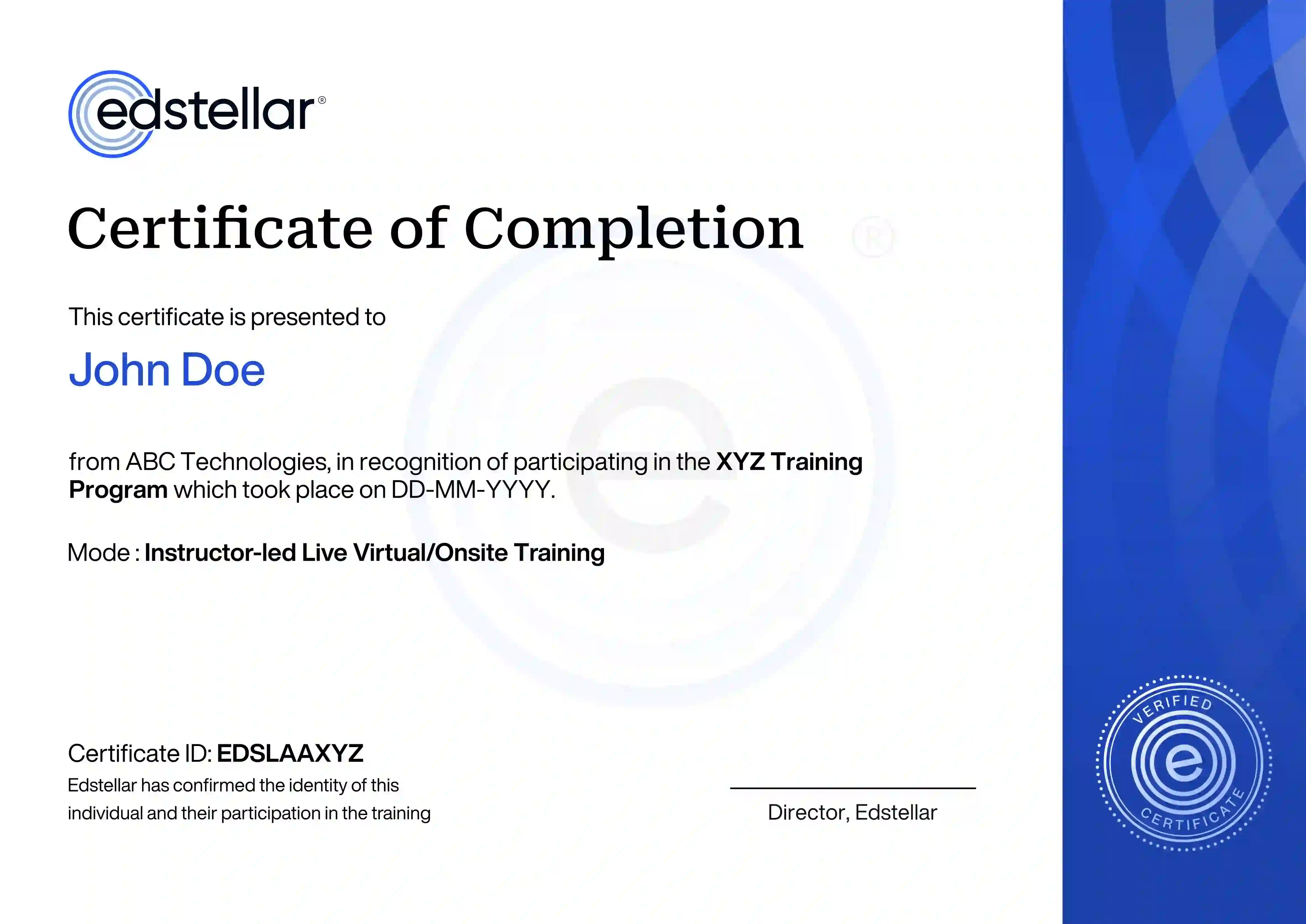
Upon successful completion of the Privacy by Design (PbD) training course offered by Edstellar, employees receive a course completion certificate, symbolizing their dedication to ongoing learning and professional development.
This certificate validates the employee's acquired skills and is a powerful motivator, inspiring them to enhance their expertise further and contribute effectively to organizational success.

Explore More Courses


Edstellar is a one-stop instructor-led corporate training and coaching solution that addresses organizational upskilling and talent transformation needs globally.
.svg)
.svg)
.svg)

.svg)
Learning Technology
Learning Content Design and Development
Learning Governance, Analytics & ROI
Digital Learning Ecosystem
Training Simulations, AR/VR & Case Studies
Employee Performance Support
Leadership Pipeline & Succession PlanningStrategic Workforce Planning for EnterprisesTransformation & Risk Advisory for EnterprisesDEI Consulting for EnterprisesEmployee Engagement Consulting for Enterprises
Cultural Transformation