.svg "edstellar")
.webp)
Product-Led Growth (PLG) Corporate Training Program
This training equips teams with strategies and frameworks to implement Product-Led Growth, using the product itself as the primary driver for user acquisition, activation, engagement, and revenue expansion.
(Virtual / On-site / Off-site)
.svg)
Drive Team Excellence with Product-Led Growth (PLG) Corporate Training
Product-Led Growth (PLG) represents a shift in how modern software companies acquire, retain, and expand revenue - placing the product itself at the center of the growth engine. This training covers the full PLG playbook: from designing onboarding flows and freemium models to building viral loops, measuring activation, and aligning cross-functional teams around product-driven growth signals.
Edstellar's Product-Led Growth (PLG) Instructor-led course offers virtual/onsite training options so participants can learn in the format that fits their schedule and team. The curriculum blends PLG strategy with practical frameworks drawn from leading PLG companies, enabling product managers, growth teams, and business leaders to implement product-led motions that scale acquisition and revenue efficiently.
.svg)

Skills Your Employees Will Gain
These are the core, hands-on capabilities your team builds during the program.
- PLG Strategy Design
- User Onboarding Optimization
- Product Activation Frameworks
- Freemium and Trial Conversion
- Product Analytics and Growth Metrics
- Viral Loop and Referral Design
- PLG Go-to-Market Execution
What Your Team Will Achieve After This Training
- Master the core principles of Product-Led Growth and design PLG strategies that drive acquisition and retention through product value.
- Gain skills to design and optimize user onboarding flows that accelerate time-to-value and improve product activation rates.
- Develop viral loop, referral program, and in-product sharing mechanisms that drive organic product-led growth.
- Learn PLG analytics frameworks to track activation, retention, and expansion metrics for data-driven growth decisions.
- Build pricing and packaging strategies for freemium, trial, and usage-based models that convert users to paying customers.
- Apply PLG go-to-market playbooks to align product, sales, and marketing teams for scalable revenue growth.
Topics & Program Outline
The curriculum is organized into focused modules built by industry experts and delivered virtually or on-premise. Interactive sessions reflect the evolving demands of the workplace, keeping the learning both relevant and practical.
-
What is Product-Led Growth
- Definition of PLG and how it differs from Sales-Led and Marketing-Led growth models
- The three PLG pillars: acquisition, engagement, and monetization through the product experience
- How SaaS companies like Slack, Dropbox, and Notion pioneered the product-led growth model
- The PLG spectrum: from pure PLG companies to hybrid PLG plus sales-led (SLG) organizations
-
PLG Business Model Fundamentals
- Freemium, free trial, and usage-based pricing as the foundational PLG go-to-market models
- How PLG changes unit economics: lower CAC, viral coefficients, and product-qualified leads
- Revenue metrics in PLG: ARR, NRR, product-qualified pipeline, and expansion revenue drivers
- When PLG is and is not the right growth strategy for a product or company stage
-
PLG Organizational Design
- How PLG shifts roles and responsibilities across product, sales, marketing, and CS teams
- The Growth team structure in PLG organizations: cross-functional squads and growth charters
- Product-Led Sales (PLS) motion: how sales teams leverage product usage data to close deals
- Executive alignment and cultural shifts required to build a product-led-first organization
-
PLG Readiness Assessment
- Evaluating product-market fit as the foundational prerequisite for a successful PLG strategy
- Assessing your product's PLG readiness across virality, self-serve, and time-to-value criteria
- Identifying PLG blockers: complex onboarding, sales-gated features, and poor analytics coverage
- PLG readiness scorecard for prioritizing investments before launching a product-led growth motion
-
PLG Metrics and North Star Framework
- Defining the North Star Metric for PLG products and connecting it to core business outcomes
- PLG metric hierarchy: input metrics, engagement metrics, and business outcome metrics
- Setting growth targets and OKRs aligned to the PLG North Star and activation funnel stages
- Common PLG metric pitfalls: vanity metrics that obscure real product-led growth signal
-
PLG Case Studies and Benchmarks
- Slack's bottom-up growth: viral sharing, freemium, and team adoption as primary growth levers
- Figma's PLG playbook: collaborative design driving organic sharing and enterprise expansion
- Dropbox's viral referral loop: storage rewards that fueled exponential free user acquisition
- Calendly and Notion: how network effects and sharing drive PLG flywheel acceleration
-
Organic and Viral Acquisition Strategies
- How PLG products acquire users without traditional paid marketing through word-of-mouth and sharing
- Viral coefficient calculation and the mechanics of exponential product-led user growth
- Types of virality: inherent, word-of-mouth, incentivized, and collaboration-driven viral loops
- Designing product experiences that generate natural sharing and referral behaviors
-
Freemium Model Design for Acquisition
- Freemium gate design: what features to give away vs lock behind a paid tier for conversion
- Balancing free value delivery with clear upgrade triggers that motivate conversion to paid
- Free tier abuse prevention: rate limits, usage caps, and anti-gaming protection strategies
- Freemium benchmarks: average free-to-paid conversion rates across SaaS product categories
-
Product-Led SEO and Content Strategies
- How PLG companies use their product to generate scalable, high-intent SEO content assets
- Programmatic SEO strategies using product data and user-generated content for acquisition
- Integration marketplaces and app stores as distribution channels for PLG product growth
- Community-led growth: building user communities that become organic acquisition engines
-
Referral Program Design
- Designing in-product referral programs with compelling incentives and low friction sharing
- Referral loop mechanics: invite flows, sharing triggers, and referral reward structures
- Measuring referral program effectiveness: referral rate, referred user quality, and CAC impact
- Case studies of successful referral programs in PLG products across SaaS verticals
-
Product-Led Acquisition Funnels
- Top-of-funnel PLG acquisition: awareness channels that feed self-serve sign-up flows
- Sign-up flow optimization: reducing friction, social login, and progressive user profiling
- First session design principles for maximizing early engagement from newly acquired users
- Attribution models for PLG acquisition: tracking channels that drive high-LTV user cohorts
-
Community and Ecosystem-Led Growth
- Building developer ecosystems and integration networks as PLG distribution channels
- Partner integrations and marketplace listings as organic acquisition sources for PLG products
- Open-source and free tools as top-of-funnel acquisition channels for PLG companies
- Template libraries and user-generated content as organic acquisition levers in PLG
-
Onboarding Strategy Fundamentals
- The goal of onboarding: guiding new users to core product value as quickly as possible
- Onboarding design principles: progressive disclosure, contextual guidance, and quick wins
- Types of onboarding flows: product tours, checklists, interactive walkthroughs, and tooltips
- Segmented onboarding: adapting the new user experience to different roles and stated goals
-
Time-to-Value (TTV) Optimization
- Defining the "Aha Moment" and its role in driving activation and long-term user retention
- Identifying TTV bottlenecks through funnel analysis and user session recording review
- Reducing time-to-value through onboarding simplification and instant value delivery techniques
- TTV measurement methodology and industry benchmarks across SaaS product categories
-
Activation Metrics and Analysis
- Defining activation as a behavioral milestone that predicts long-term retention and revenue
- Setting activation criteria based on behavioral signals correlated with long-term engagement
- Activation funnel analysis: identifying drop-off steps that most impair user activation rates
- Cohort-based activation tracking to measure onboarding improvement impact over time
-
Behavioral Nudges and In-App Guidance
- In-app messaging strategies: tooltips, modals, banners, and empty-state guidance for activation
- Behavioral nudge design using progressive onboarding checklists and completion incentives
- Email and notification sequences triggered by user behavior gaps during the onboarding phase
- A/B testing onboarding flows to identify the highest-impact activation improvements
-
Onboarding for Teams and Collaborative Products
- Team onboarding challenges in collaborative PLG products: inviting colleagues and sharing content
- Designing onboarding flows that accelerate team adoption and reduce time-to-collaboration
- Champion and admin onboarding: separate flows for decision makers vs individual end users
- Measuring team activation: multi-user milestones and collaborative engagement signals
-
Onboarding Measurement and Iteration
- Building an onboarding analytics dashboard to track activation funnel performance over time
- Session recording and heatmap analysis for qualitative onboarding flow improvement insights
- User interview techniques for diagnosing onboarding failure points and user confusion
- Iterative onboarding improvement cadence: weekly experiments and monthly activation reviews
-
Product Engagement Fundamentals
- The engagement-retention-revenue flywheel in PLG: how engagement drives sustainable growth
- Measuring product engagement: DAU/MAU ratios, feature adoption rates, and engagement depth
- Engagement segmentation: power users, casual users, and at-risk users and their distinct behaviors
- Habit loop design: cue, routine, and reward mechanics for driving daily product engagement
-
Feature Adoption Strategies
- Feature discovery: surfacing underused features through contextual in-app prompts and tooltips
- Feature adoption campaigns using in-app messaging, email sequences, and video tutorial nudges
- Breadcrumb strategies guiding users from core features to advanced value-driving capabilities
- Measuring feature adoption rates and correlating feature usage to long-term retention outcomes
-
Retention Metrics and Analysis
- Retention curve analysis: D1, D7, D30 retention benchmarks and interpretation for PLG products
- Cohort retention analysis for comparing onboarding vintages and feature release impact over time
- Identifying leading indicators of churn through behavioral signal analysis and predictive modeling
- Net Promoter Score (NPS) as a leading indicator of retention risk in Product-Led Growth products
-
Re-Engagement and Win-Back Strategies
- Designing re-engagement email sequences for users who go dormant after initial product activation
- In-app win-back prompts targeting users who have not returned within defined dormancy windows
- Win-back campaign A/B testing: subject lines, offers, and timing optimization for re-engagement
- Distinguishing fixable churn (product gaps) from natural churn (wrong ICP fit) in PLG
-
Personalization for Engagement
- Behavioral personalization in PLG: adapting product experience based on individual usage patterns
- Role-based feature recommendations surfacing relevant capabilities to different user segments
- Dynamic onboarding continuation: resuming onboarding sequences based on where users left off
- Personalization data strategy: collecting and activating behavioral signals in the product
-
Engagement Analytics and Tooling
- PLG engagement analytics platforms: Amplitude, Mixpanel, Heap, and PostHog comparison
- Building product engagement dashboards for monitoring activation, retention, and feature adoption
- Funnel analysis, user path analysis, and behavioral segmentation for engagement optimization
- Data warehouse integration for combining product analytics with CRM and revenue data sources
-
PLG Pricing Strategy Fundamentals
- Usage-based pricing models: per-seat, per-unit, and hybrid pricing for PLG product monetization
- Freemium to paid conversion: designing upgrade triggers and paywall experiences that convert
- Value metric selection: choosing the pricing axis that best aligns price with customer value
- Pricing page design and conversion optimization for PLG self-serve purchasing flows
-
Conversion Rate Optimization in PLG
- Identifying conversion moments: behavioral triggers that indicate user upgrade readiness
- Product-Qualified Account (PQA) and Product-Qualified Lead (PQL) definition and scoring
- In-product upgrade prompts: contextual upgrade triggers at value-maximizing user moments
- Self-serve checkout optimization: reducing friction in the PLG upgrade and payment flow
-
Freemium Gate Strategy
- Feature gating frameworks: deciding which features drive upgrades vs which reduce activation
- Soft gates vs hard gates: experience design for converting free users without causing frustration
- Usage limit design: setting free tier caps that prompt upgrades without killing early activation
- Testing freemium gate configurations and measuring conversion impact of gate placement changes
-
Trial Design and Conversion Optimization
- Time-limited vs feature-limited trial design: trade-offs for different product and market types
- Trial activation and success milestone design for maximizing trial-to-paid conversion rates
- Trial conversion email sequences: timing, messaging, and CTA optimization for SaaS products
- Measuring trial cohort conversion rates and diagnosing trial abandonment root causes
-
Expansion Revenue in PLG
- Expansion revenue strategies: seat expansion, usage growth, and upsell to higher pricing tiers
- Net Revenue Retention (NRR) as the key PLG expansion health metric and its primary drivers
- In-product expansion triggers: prompts that encourage teams to add seats or upgrade plans
- Customer success-led expansion in PLG: CSM engagement triggered by product usage signals
-
PLG Revenue Metrics and Reporting
- PLG revenue funnel: from free signups through activation, conversion, and expansion stages
- ARR attribution in PLG: tracking which growth motions drive the highest value customer cohorts
- Payback period and LTV modeling for PLG cohorts across freemium, trial, and usage-based models
- Executive revenue reporting for PLG organizations combining product and financial metrics
-
PLG Analytics Foundations
- Event tracking design for PLG: defining the event taxonomy that powers growth analytics
- Instrumentation strategy: frontend and backend event tracking for complete behavioral coverage
- Identity resolution in PLG analytics: connecting anonymous, free, and paid user behaviors
- Analytics governance: event naming conventions, documentation, and data quality standards
-
Funnel Analysis in PLG
- Top-down funnel analysis: from acquisition through activation, retention, and revenue stages
- Micro-funnel analysis within onboarding and activation sequences for precise optimization focus
- Drop-off identification and root cause analysis for PLG growth funnel bottlenecks
- Multi-path funnel analysis for products with multiple onboarding routes and user journeys
-
Cohort Analysis for Growth
- Cohort analysis fundamentals: defining, grouping, and tracking user cohorts over time
- Acquisition cohort retention comparison for evaluating channel and campaign quality
- Feature cohort analysis: measuring retention impact of specific feature adoption events
- Segmenting cohorts by company size, industry, and persona for PLG ICP refinement
-
Product-Qualified Lead Scoring
- PQL definition framework: behavioral signals and usage thresholds that indicate purchase intent
- PQL scoring model design using engagement depth, feature adoption, and team size signals
- Routing PQLs to sales teams with product usage context for product-led sales conversations
- Measuring PQL conversion rates and optimizing scoring models with closed-won data feedback
-
Growth Experimentation and A/B Testing
- Experiment design for PLG: hypothesis formulation, metric selection, and sample size planning
- A/B testing platforms for PLG: LaunchDarkly, Statsig, and Optimizely feature flag integration
- Running onboarding experiments: testing flows, messaging, and feature gate placement changes
- Analyzing experiment results and applying learnings to iterative PLG optimization cycles
-
Data Infrastructure for PLG Analytics
- Data stack for PLG: product analytics tools, CDP, data warehouse, and visualization layers
- Customer Data Platform (CDP) role in unifying product, CRM, and marketing data for PLG
- Reverse ETL for activating warehouse insights back into product and sales engagement tools
- Data team collaboration in PLG: analytics engineers, product analysts, and growth roles
-
PLG GTM Fundamentals
- How PLG changes the go-to-market motion compared to traditional enterprise sales approaches
- Bottom-up vs top-down GTM: individual user adoption driving team and enterprise expansion
- PLG GTM stages: individual user, team adoption, department expansion, and enterprise procurement
- Hybrid PLG plus SLG GTM design: when and how to layer sales onto a product-led motion
-
Ideal Customer Profile (ICP) for PLG
- Defining ICP for PLG products: firmographic, technographic, and behavioral dimensions
- Product usage data as an ICP refinement tool for identifying high-retention customer profiles
- ICP expansion playbook: moving from an early adopter ICP to broader market segments
- Anti-ICP identification: excluding user segments that consume resources without converting
-
Product-Led Sales (PLS) Design
- Product-Led Sales fundamentals: enabling sales teams with product usage intelligence and signals
- PLS workflow design: identifying expansion-ready accounts and routing them to sales teams
- Sales rep enablement for PLG: training teams to lead with product data in sales conversations
- CRM integration for PLG: surfacing product usage signals inside Salesforce and HubSpot
-
Community and Partner GTM Strategies
- Community-led growth as a PLG GTM amplifier: building engaged user and developer communities
- Integration partner strategy: building an app marketplace ecosystem to expand PLG distribution
- Champion programs: identifying power users and enabling them as product advocates
- Open-source GTM strategy for developer-focused PLG products and infrastructure tools
-
PLG Pricing and Packaging GTM Execution
- Packaging design for PLG GTM: starter, professional, and enterprise tier configuration
- Add-on and modular pricing for PLG products targeting diverse buyer personas and budgets
- Pricing page A/B testing and conversion optimization for self-serve PLG purchasing flows
- Transitioning enterprise prospects from PLG self-serve to negotiated commercial contracts
-
PLG Launch Playbook
- PLG product launch strategy: driving initial sign-ups, activation, and organic sharing velocity
- Launch channels for PLG: Product Hunt, community platforms, and developer ecosystems
- First-30-day PLG launch metrics: sign-up volume, activation rate, and referral performance
- Post-launch PLG iteration playbook: learning from early cohorts and optimizing the funnel
-
Viral Loop Design Fundamentals
- Types of viral loops in PLG products: inherent, word-of-mouth, and collaboration-driven virality
- Viral coefficient (K-factor) calculation and its relationship to PLG growth velocity
- Designing viral loops that create genuine product value rather than manipulative mechanics
- Examples of strong viral loops in collaboration, communication, and productivity tools
-
Network Effects in PLG Products
- Direct vs indirect network effects and their impact on PLG product defensibility and moat
- Building network effects into PLG product architecture from early product design stages
- Same-side and cross-side network effects in marketplace and platform PLG products
- Measuring network effect strength and its correlation to retention and expansion revenue
-
Sharing and Collaboration Mechanics
- In-product sharing features that expose the product to new potential users organically
- Collaborative workflows that create organic product invitations within user networks
- Designing shared outputs and artifacts that serve as marketing assets for the product
- Attribution of new sign-ups to sharing events for measuring collaboration-driven growth
-
Referral Program Design and Optimization
- Referral incentive models: give-get, milestone, and one-sided referral reward structures
- Referral program placement: in-app prompts, email triggers, and onboarding referral asks
- Referral flow optimization: reducing share friction and maximizing referral link click-through
- Measuring referral program ROI: cost per referred user vs organic and paid acquisition CAC
-
Incentive Systems and Gamification
- Gamification mechanics for PLG: progress bars, badges, streaks, and milestone celebrations
- Incentive design for driving key activation behaviors and feature adoption milestones
- Social proof mechanics: activity feeds, usage counters, and community leaderboards in PLG
- Balancing gamification with genuine value delivery to avoid superficial engagement patterns
-
Measuring and Scaling Viral Growth
- Tracking viral loop performance: viral coefficient, cycle time, and referral conversion rate
- Identifying viral loop leaks: diagnosing where sharing and referral loops break down
- Improving viral velocity by reducing cycle time and increasing sharing trigger frequency
- Scaling viral growth programs from product-led experiments to systematic growth initiatives
-
Cross-Functional PLG Team Structure
- PLG team composition: product, growth, data, marketing, and sales in a PLG organization
- PLG pod model: cross-functional squads organized around growth funnel stages and metrics
- OKR design for PLG teams: connecting team goals to activation, retention, and expansion metrics
- Avoiding silos: maintaining alignment between PLG pods and the broader organization
-
PLG Roadmap Planning
- PLG growth roadmap: balancing acquisition, activation, retention, and monetization bets
- Prioritization frameworks for PLG: ICE scoring, RICE, and impact vs effort for growth experiments
- Communicating the PLG roadmap to leadership, board, and cross-functional stakeholders
- Growth backlog management: maintaining a pipeline of tested and untested PLG hypotheses
-
PLG and Sales Team Collaboration
- Aligning PLG and sales teams around shared revenue goals and ICP definitions
- Sales handoff playbook: when and how to route product-qualified accounts to sales reps
- Avoiding PLG-sales conflict: incentive structures that reward collaborative growth behavior
- Sales feedback loops informing PLG product priorities and onboarding flow improvements
-
PLG and Marketing Alignment
- Content and SEO strategy aligned to PLG acquisition and self-serve conversion goals
- Demand generation in PLG: performance marketing supporting self-serve sign-up funnels
- Brand and community marketing as long-term organic acquisition channels for PLG products
- Marketing attribution in PLG: multi-touch models for connecting campaigns to product sign-ups
-
PLG Operational Cadences
- Weekly growth review: analyzing PLG metrics and prioritizing the highest-impact experiments
- Monthly PLG retrospective: reviewing cohort performance and funnel health against OKRs
- Quarterly PLG planning: setting activation and retention targets for the next growth cycle
- PLG dashboard design for operational transparency across product, sales, and leadership teams
-
PLG Culture and Mindset
- Data-driven decision making as a core cultural pillar of high-performing PLG organizations
- Experimentation culture: psychological safety for testing bold ideas and learning from failure
- Customer obsession in PLG: deeply understanding user needs before optimizing growth levers
- Building PLG capability: hiring, training, and developing growth talent in the organization
-
Enterprise PLG and Product-Led Enterprise Expansion
- Enterprise PLG motion: how individual user adoption drives enterprise procurement deals
- Enterprise onboarding and admin experience design for PLG products in large organizations
- Enterprise feature set design for PLG: admin controls, SSO, compliance, and security needs
- Negotiating enterprise contracts with companies that arrived through bottom-up PLG adoption
-
Multi-Product PLG Strategy
- Expanding a PLG motion across a product portfolio: cross-sell and bundling strategies
- Platform PLG: building an ecosystem of integrated products that reinforce each other
- New product launches within existing PLG user bases: warm launch vs cold launch strategies
- Managing multiple PLG motions across different product lines and customer segments
-
AI-Powered PLG Personalization
- Using machine learning to personalize onboarding paths based on user behavioral signals
- AI-driven PQL scoring models that adapt to evolving product usage patterns dynamically
- Predictive churn models for identifying at-risk users before they disengage from the product
- Generative AI in PLG: personalized in-product guidance and AI-assisted onboarding experiences
-
International PLG Expansion
- Localization requirements for PLG products expanding into international markets and regions
- Adapting freemium and pricing strategies for different market purchasing power and buying norms
- Community-led and partner-led PLG expansion strategies in markets with low brand awareness
- Measuring PLG performance across international cohorts with region-specific growth benchmarks
-
Measuring PLG Program ROI
- Building a PLG ROI framework that connects growth investments to measurable revenue outcomes
- LTV:CAC ratio optimization in PLG: measuring the efficiency of product-led user acquisition
- Attributing ARR growth to PLG vs sales-led motions for accurate growth model crediting
- Board-level PLG reporting: communicating PLG program health and efficiency to investors
-
Future of Product-Led Growth
- AI agents as the next frontier in PLG: autonomous product discovery and onboarding assistance
- Community-led growth as a complement to product-led motion in the next era of SaaS
- Vertical SaaS PLG: adapting product-led strategies for industry-specific software products
- The convergence of PLG, developer experience, and API-first growth in modern software companies
Who Should Attend?
This program suits professionals at many levels across the organization, including:
- Product Managers
- Growth Managers
- Marketing Managers
- Sales Managers
- Customer Success Managers
- Product Leaders
What are the Prerequisites?
Professionals should have a foundational understanding of product management or marketing principles and basic familiarity with SaaS business models to take the Product-Led Growth (PLG) training course.
Choose the Format That Fits Your Team
We design training your teams actually engage with, and deliver it the way that suits you best. Through a vetted global trainer network, Edstellar runs sessions in 10+ languages with consistent quality anywhere.


.webp "Virtual Product-Led Growth (PLG) Training")
Virtual / online: expert-led live sessions delivered anywhere, with consistency and easy scheduling.
.webp "On-site Product-Led Growth (PLG) Training")
On-site (in-house): immersive, instructor-led learning at your office.
.webp "Off-site Product-Led Growth (PLG) Training")
Off-site: focused, instructor-led group learning away from everyday workplace distractions.
Get a Proposal Shaped to Your Needs
Need pricing for onsite, offsite, or virtual delivery? Get a proposal tailored to your team's needs.
64 hours of group training (includes VILT/In-person On-site)
Tailored for SMBs
Tailor-Made Trainee Licenses with Our Exclusive Training Packages!
160 hours of group training (includes VILT/In-person On-site)
Ideal for growing SMBs
Tailor-Made Trainee Licenses with Our Exclusive Training Packages!
400 hours of group training (includes VILT/In-person On-site)
Designed for large corporations
Tailor-Made Trainee Licenses with Our Exclusive Training Packages!
Unlimited duration
Designed for large corporations
What Sets Edstellar Apart
Experienced Trainers
Our trainers are drawn from a vetted global network and bring years of industry expertise, keeping every session practical and impactful.
Proven Quality
With a strong global track record, Edstellar is known for quality and engaging delivery.
Industry-Relevant Curriculum
Our programs are built by experts to match the demands of today's industry.
Fully Customizable
Every program can be tailored to your organization's goals.
Comprehensive Support
We provide pre- and post-session support for a complete learning experience.
Global Multi-Location & Multilingual Training Delivery
We deliver in multiple languages to support diverse global teams.
Recognition That Motivates Your Team
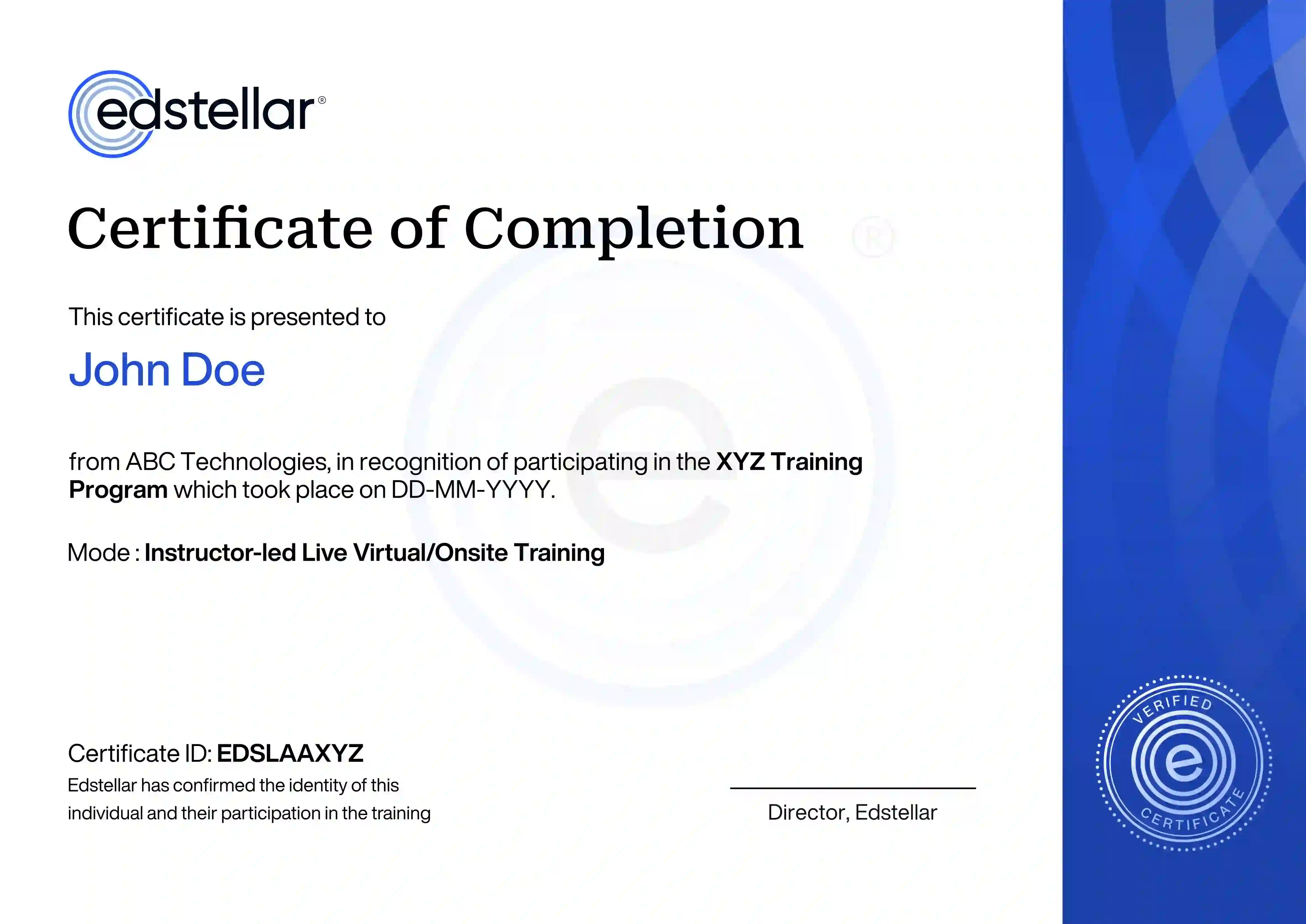
Upon successful completion of the Product-Led Growth (PLG) training course offered by Edstellar, employees receive a course completion certificate, symbolizing their dedication to ongoing learning and professional development.
This certificate validates the employee's acquired skills and is a powerful motivator, inspiring them to enhance their expertise further and contribute effectively to organizational success.



Edstellar is a one-stop instructor-led corporate training and coaching solution that addresses organizational upskilling and talent transformation needs globally.
.svg)
.svg)
.svg)

.svg)
Learning Technology
Learning Content Design and Development
Learning Governance, Analytics & ROI
Digital Learning Ecosystem
Training Simulations, AR/VR & Case Studies
Employee Performance Support
Leadership Pipeline & Succession PlanningStrategic Workforce Planning for EnterprisesTransformation & Risk Advisory for EnterprisesDEI Consulting for EnterprisesEmployee Engagement Consulting for Enterprises
Cultural Transformation