.svg "edstellar")
.webp)
Third-Party & Vendor Risk Management Essentials Corporate Training Program
This training equips risk, compliance, and procurement professionals with the skills to identify, assess, and manage third-party and vendor risks. Participants learn due diligence processes, vendor risk frameworks, contractual controls, monitoring practices, and regulatory compliance obligations.
(Virtual / On-site / Off-site)
.svg)
Drive Team Excellence with Third-Party & Vendor Risk Management Essentials Corporate Training
Third-party and vendor relationships are one of the most significant and rapidly growing sources of organizational risk. From data breaches and supply chain disruptions to regulatory violations and reputational damage, the risks associated with external partners demand structured, rigorous management. This training equips professionals with the frameworks, tools, and processes needed to assess, manage, monitor, and exit vendor relationships in a way that protects the organization and meets increasingly demanding regulatory expectations.
Edstellar's Third-Party & Vendor Risk Management Essentials Instructor-led course offers virtual/onsite training options for risk, compliance, procurement, and IT professionals responsible for managing vendor relationships. With practical risk assessment exercises, contract review workshops, and regulatory alignment scenarios, participants build the end-to-end TPRM skills needed to establish or strengthen their organization's vendor risk management program.
.svg)

Skills Your Employees Will Gain
These are the core, hands-on capabilities your team builds during the program.
- Vendor risk assessment design
- Third-party due diligence
- Vendor contract risk management
- Monitoring and SLA oversight
- Regulatory compliance alignment
- Concentration risk management
- Vendor offboarding and exit management
What Your Team Will Achieve After This Training
- Master third-party risk management frameworks and understand how TPRM programs protect organizations from vendor-related threats and compliance failures.
- Develop skills to design and conduct vendor risk assessments and due diligence processes aligned with organizational risk appetite and policy.
- Learn to structure vendor contracts and service agreements with risk controls, compliance clauses, and data protection obligations.
- Build expertise in ongoing vendor performance monitoring, SLA management, and escalation processes for vendor non-compliance.
- Apply regulatory compliance requirements for third-party risk across GDPR, DPDP Act, financial services, and other applicable frameworks.
- Gain the skills to design and implement a scalable TPRM program from vendor assessment through continuous monitoring and governance.
Topics & Program Outline
The curriculum is organized into focused modules built by industry experts and delivered virtually or on-premise. Interactive sessions reflect the evolving demands of the workplace, keeping the learning both relevant and practical.
-
What is Third-Party Risk Management
- Definition of third-party risk and its scope in modern organizational ecosystems
- Categories of third-party risk: operational, financial, cyber, compliance, and reputational
- Why third-party risk is one of the fastest-growing areas of organizational risk management
- Overview of the TPRM lifecycle: identification, assessment, onboarding, monitoring, and exit
-
The Business Case for TPRM
- Quantifying the cost of third-party risk failures: breaches, fines, and operational disruptions
- High-profile supply chain and vendor breach case studies and their organizational impact
- Regulatory pressure as a driver for structured TPRM programs across industries
- Building executive sponsorship and investment for the TPRM function
-
TPRM vs. Vendor Management
- Distinguishing between procurement, vendor management, and third-party risk management
- How TPRM complements and extends traditional vendor management programs
- Integrating TPRM into procurement, IT, legal, and compliance functions
- Building cross-functional collaboration for effective TPRM program delivery
-
TPRM Frameworks and Standards
- Overview of leading TPRM frameworks: NIST CSF, ISO 27036, FFIEC, and others
- How industry-specific standards shape TPRM requirements in financial services, healthcare, and technology
- Using TPRM frameworks to design governance structures and assessment methodologies
- Selecting and adapting frameworks to organizational size and risk appetite
-
TPRM Program Governance
- Defining TPRM program ownership and accountability across the organization
- Establishing a TPRM governance committee and decision-making structure
- Developing TPRM policies, standards, and procedures for organizational compliance
- Reporting TPRM program status and risk posture to executive and board stakeholders
-
The Third-Party Risk Landscape
- Types of third parties: suppliers, service providers, contractors, and subcontractors
- Fourth-party risk: managing the risk introduced by your vendors' vendors
- The expanding vendor ecosystem and its implications for organizational risk exposure
- Emerging third-party risk trends: cloud vendors, AI providers, and gig economy platforms
-
Pre-Assessment Scoping and Vendor Inventory
- Building a comprehensive inventory of all organizational third-party relationships
- Identifying new vendors and triggering the risk assessment process
- Defining assessment scope based on vendor type, access, and criticality
- Maintaining and updating the vendor inventory as relationships evolve
-
Risk Assessment Methodologies
- Inherent risk vs. residual risk in vendor risk assessment
- Qualitative and quantitative vendor risk assessment approaches
- Scoring models for evaluating vendor risk across multiple risk domains
- Calibrating risk scoring models to reflect organizational risk appetite
-
Security and Cyber Risk Due Diligence
- Security questionnaires: SIG, CAIQ, and custom questionnaire approaches
- Using security ratings services to assess vendor cyber posture at scale
- Reviewing vendor penetration test reports, SOC 2 reports, and ISO 27001 certifications
- On-site and remote security assessments for critical high-risk vendors
-
Financial and Operational Due Diligence
- Assessing vendor financial stability to evaluate business continuity risk
- Reviewing vendor operational resilience: BCP, DRP, and redundancy measures
- Evaluating vendor organizational governance, leadership, and management quality
- Identifying early warning signs of vendor financial or operational distress
-
Compliance and Legal Due Diligence
- Assessing vendor compliance with applicable regulations and industry standards
- Reviewing vendor legal history: litigation, sanctions, and regulatory actions
- Checking vendor certifications and compliance attestations for validity
- Reputational due diligence: adverse media screening and background checks
-
Documenting and Communicating Assessment Findings
- Structuring vendor risk assessment reports for stakeholder review
- Escalating critical assessment findings for risk acceptance or remediation
- Maintaining assessment records for audit and regulatory evidence purposes
- Communicating assessment outcomes to procurement, legal, and business owners
-
Why Vendor Risk Tiering Matters
- The rationale for tiering vendors based on risk rather than applying uniform controls
- How risk tiering enables efficient allocation of TPRM resources
- Regulatory expectations for risk-based vendor classification and tiering
- Common tiering models: two-tier, three-tier, and four-tier approaches
-
Tiering Criteria and Classification Factors
- Factors that determine vendor risk tier: data access, criticality, and spend level
- Assessing the impact of vendor failure on organizational operations
- Evaluating the sensitivity of data and systems vendors can access
- Scoring and weighting criteria to produce consistent risk tier assignments
-
Applying Tiering to Due Diligence and Monitoring
- Scaling assessment depth and frequency based on vendor risk tier
- Streamlined due diligence for low-risk vendors without compromising oversight
- Enhanced due diligence requirements for critical or high-tier vendors
- Adjusting monitoring intensity and reporting based on assigned risk tier
-
Managing Critical Vendors
- Defining what makes a vendor critical to organizational operations
- Maintaining a critical vendor register with enhanced oversight processes
- Dedicated relationship management for critical vendors and key contacts
- Succession planning and alternative vendor identification for critical relationships
-
Tier Changes and Reclassification
- Triggers for re-tiering vendors: contract changes, incidents, and scope expansions
- Periodic tiering review cycles to ensure classification remains current
- Managing vendor communication around reclassification and increased requirements
- Documenting tier change decisions and maintaining classification audit trails
-
Vendor Tiering in Practice: Exercises
- Applying tiering criteria to a sample vendor portfolio in a practical exercise
- Debating edge cases where vendor classification is ambiguous or contested
- Peer review of tiering decisions and calibration to organizational risk appetite
- Building a tiering framework template for immediate organizational use
-
Risk-Informed Contract Structuring
- How TPRM findings should inform contract negotiation and risk allocation
- Using risk assessment outcomes to prioritize contractual protections
- Aligning contract terms to vendor risk tier and organizational risk appetite
- Coordinating between procurement, legal, and risk teams during contract negotiation
-
Key TPRM Contract Clauses
- Data protection and confidentiality clauses: obligations, scope, and breach consequences
- Right-to-audit provisions: scope, frequency, and vendor cooperation requirements
- Subcontracting and fourth-party control requirements in vendor contracts
- Business continuity and disaster recovery obligations for critical vendors
-
Security and Compliance Contract Requirements
- Mandating vendor security controls: certifications, standards, and minimum requirements
- Compliance attestation and regulatory evidence obligations in contracts
- Incident notification obligations: timelines, scope, and communication requirements
- Liability, indemnification, and insurance provisions for data and security breaches
-
Service Level Agreements (SLAs) and Performance Standards
- Defining meaningful SLAs aligned to business criticality and risk requirements
- Structuring SLA metrics, measurement methods, and reporting cadence
- Remedies and consequences for SLA breaches: credits, termination, and escalation
- Balancing vendor commercial interests with organizational performance standards
-
Termination and Exit Rights
- Structuring termination rights for cause, convenience, and regulatory requirement
- Data return, deletion, and transition assistance obligations at contract end
- Exit planning requirements embedded in vendor contracts for business continuity
- Managing contract termination disputes and protecting organizational interests
-
Contract Lifecycle Management for TPRM
- Building a contract repository that supports TPRM monitoring and compliance
- Contract renewal reviews as a trigger for updated risk assessments
- Tracking contract obligations and compliance milestones across the vendor portfolio
- Technology tools for contract lifecycle management in TPRM programs
-
Data Shared with Third Parties
- Mapping all categories of data shared with vendors across the organization
- Classifying shared data by sensitivity and regulatory protection requirements
- Principles for minimizing data shared with vendors to reduce exposure
- Maintaining a data sharing register for TPRM and regulatory compliance purposes
-
Vendor Access Management
- Principles of least privilege access for third-party system access
- Governing vendor access through privileged access management (PAM) solutions
- Monitoring and auditing vendor access activity in organizational systems
- Revoking vendor access promptly upon contract end or termination of relationship
-
Data Privacy Obligations in Vendor Relationships
- GDPR data processor requirements and how they apply to vendor relationships
- Data Processing Agreements (DPAs): required elements and negotiation considerations
- DPDP Act data processor obligations and cross-border data transfer restrictions
- Managing data subject rights requests that involve data held by vendors
-
Vendor Security Requirements
- Minimum security control requirements for vendors accessing organizational data
- Requiring vendor security certifications: ISO 27001, SOC 2, and PCI DSS
- Vendor patch management and vulnerability disclosure obligations
- Embedding security requirements into vendor RFPs and procurement processes
-
Cloud Vendor Security Considerations
- Shared responsibility model and its implications for cloud vendor TPRM
- Reviewing cloud provider security documentation: SOC 2 reports and penetration tests
- Managing data sovereignty and residency requirements with cloud vendors
- Cloud exit planning and data portability obligations in cloud vendor contracts
-
Third-Party Security Incident Notification
- Contractual requirements for vendors to notify of security incidents promptly
- What vendors must include in security incident notification communications
- Organizational response protocols when a vendor notifies of a security incident
- Managing regulatory breach notification obligations triggered by vendor incidents
-
Continuous Vendor Monitoring Framework
- What continuous vendor monitoring means and why periodic assessments are insufficient
- Key monitoring activities: security ratings, news monitoring, and questionnaire updates
- Automating continuous monitoring using TPRM technology platforms
- Tiering monitoring intensity based on vendor criticality and risk level
-
Performance Metrics and KPI Tracking
- Defining operational performance KPIs for different vendor and service types
- Collecting and validating performance data from vendors and internal stakeholders
- Building performance scorecards for regular vendor review meetings
- Tracking performance trends over time to identify deteriorating vendor relationships
-
SLA Measurement and Reporting
- Establishing SLA measurement baselines and data collection processes
- Verifying vendor-provided SLA data with independent monitoring tools
- Producing SLA compliance reports for business and governance stakeholders
- Handling disputes over SLA measurement methodology and reported outcomes
-
Vendor Review Meetings and Governance Cadence
- Structuring vendor review meetings: operational, strategic, and executive levels
- Agenda design and documentation standards for vendor governance meetings
- Escalation procedures for persistent performance issues or contractual breaches
- Using governance meetings to drive continuous improvement in vendor delivery
-
Corrective Action Management
- Identifying when corrective action is required for vendor underperformance or non-compliance
- Structuring formal corrective action plans with measurable improvement targets
- Tracking corrective action progress and verifying remediation outcomes
- Escalating corrective actions to contract remedies or termination when unresolved
-
Risk-Based Monitoring Triggers
- External signals that should trigger an unscheduled vendor risk review
- Financial stress indicators: credit downgrades, layoffs, and restructuring announcements
- Security events: public breaches, CVE disclosures, and regulatory sanctions
- Building automated alert systems for real-time monitoring trigger detection
-
GDPR Third-Party Obligations
- GDPR controller-processor requirements and their impact on vendor relationships
- Mandatory Data Processing Agreement elements under GDPR Article 28
- Managing cross-border data transfers with vendors under GDPR SCCs and adequacy decisions
- GDPR accountability requirements for demonstrating third-party compliance oversight
-
DPDP Act Third-Party Requirements
- DPDP Act obligations for data fiduciaries engaging data processors
- Cross-border data transfer restrictions under the DPDP Act and their impact on global vendors
- Contractual obligations for data processors under the DPDP Act framework
- Building DPDP Act compliance into vendor onboarding and contract processes
-
Financial Services TPRM Regulations
- EBA Guidelines on ICT and security risk management and outsourcing requirements
- RBI outsourcing guidelines for Indian financial institutions and third-party risk
- FFIEC guidance on third-party relationship management in US financial services
- DORA and its operational resilience requirements for ICT third-party providers
-
Sector-Specific TPRM Compliance
- HIPAA Business Associate requirements in healthcare vendor management
- PCI DSS third-party service provider requirements for payment card data
- ISO 27001 Annex A controls for supplier relationships
- SOC 2 reporting as a vendor compliance assurance mechanism
-
Building Regulatory Evidence for TPRM
- Documentation requirements for demonstrating TPRM regulatory compliance
- Maintaining TPRM audit trails for regulatory examination and investigation
- Preparing TPRM documentation for regulatory audits and inspections
- Continuous compliance monitoring to maintain ongoing regulatory readiness
-
Evolving TPRM Regulatory Landscape
- Trends in global TPRM regulation and the direction of regulatory expectations
- Anticipating new regulatory requirements and building adaptive TPRM processes
- Engaging with regulators on TPRM guidance and best practice development
- Benchmarking TPRM compliance against industry peers and regulatory expectations
-
Understanding Concentration Risk
- What concentration risk is and how it manifests in vendor and supply chain relationships
- Types of concentration: single vendor, geographic, technology, and sector concentration
- Regulatory and industry expectations for managing third-party concentration risk
- Quantifying concentration risk exposure across the organizational vendor portfolio
-
Mapping Vendor Dependencies
- Techniques for mapping critical vendor dependencies across business processes
- Identifying single points of failure in the organizational vendor ecosystem
- Assessing cascading failure risk when a critical vendor experiences an outage
- Maintaining an up-to-date vendor dependency map for TPRM governance
-
Managing and Mitigating Concentration Risk
- Vendor diversification strategies to reduce dependence on single providers
- Geographic diversification to limit exposure to regional disruptions
- Multi-sourcing arrangements and their implications for contract and cost management
- Tolerance thresholds for concentration risk and escalation to leadership
-
Vendor Business Continuity Planning
- Contractual requirements for vendor BCP and DRP aligned to organizational needs
- Reviewing and testing vendor business continuity plans for adequacy
- Coordinating joint BCP exercises with critical vendor partners
- Vendor recovery time objectives (RTOs) and their alignment to business continuity requirements
-
Exit and Substitution Planning
- Maintaining exit plans for all critical vendors as a standard TPRM requirement
- Identifying and pre-qualifying alternative vendors for critical service categories
- Practicing exit scenarios through tabletop exercises and simulation
- Managing vendor transition costs, timelines, and knowledge transfer obligations
-
Supply Chain Resilience
- Extending TPRM beyond direct vendors to fourth-party and supply chain risk
- Using supply chain mapping to identify hidden concentration and resilience risks
- Engaging critical vendors on their own supply chain resilience and TPRM practices
- Building organizational supply chain resilience as a competitive advantage
-
Third-Party Incident Scenarios
- Categories of third-party incidents: data breaches, service outages, and compliance failures
- Why third-party incidents require a distinct response process from internal incidents
- High-profile third-party breach scenarios and lessons for organizational response
- Pre-planning response procedures for likely third-party incident types
-
Receiving and Assessing Vendor Incident Notifications
- Establishing a clear intake process for vendor security and service incident notifications
- Assessing the organizational impact of a vendor-reported incident
- Determining whether a vendor incident triggers regulatory notification obligations
- Escalating vendor incident assessments to the appropriate internal response teams
-
Coordinating the Organizational Response
- Activating the internal incident response process in response to a vendor incident
- Coordinating communication between IT, legal, compliance, and business teams
- Managing simultaneous vendor incidents affecting multiple business functions
- Documenting all organizational response activities for regulatory and legal purposes
-
Managing Vendor Communication During an Incident
- Establishing a dedicated communication channel with the affected vendor during an incident
- Requiring frequent status updates from the vendor throughout the incident lifecycle
- Managing information gaps when vendor disclosure is limited or delayed
- Asserting contractual rights during a vendor incident for access and cooperation
-
Regulatory Notification Triggered by Vendor Incidents
- Determining organizational regulatory notification obligations arising from vendor incidents
- GDPR, CCPA, and DPDP Act breach notification requirements in vendor breach scenarios
- Coordinating regulatory notifications when the vendor and client share notification duties
- Documenting notification decisions and maintaining records for regulatory defense
-
Post-Incident Review and TPRM Remediation
- Conducting a post-incident review with the vendor to assess root cause and response
- Evaluating whether vendor controls and contractual obligations were adequate
- Requiring vendor remediation plans and verifying their implementation
- Updating TPRM controls, contracts, and monitoring practices based on incident lessons
-
TPRM Maturity Assessment
- Using a TPRM maturity model to assess current program state across key dimensions
- Key maturity dimensions: governance, assessment, monitoring, and technology
- Identifying priority gaps to focus initial TPRM program investment
- Setting maturity targets aligned to regulatory requirements and organizational risk appetite
-
TPRM Operating Model Design
- Defining the TPRM operating model: centralized, decentralized, or hybrid approach
- Staffing the TPRM function: roles, responsibilities, and reporting lines
- Integrating the TPRM operating model into existing risk and compliance functions
- Documenting the TPRM operating model in a program charter
-
TPRM Technology and Tooling
- Overview of TPRM technology platforms and their core capabilities
- Key platform features: vendor portals, questionnaire automation, and risk scoring
- Integrating TPRM platforms with procurement, GRC, and security operations systems
- Evaluating and selecting a TPRM platform aligned to organizational requirements
-
Stakeholder Engagement and Change Management
- Mapping and engaging key stakeholders across risk, procurement, IT, legal, and business
- Managing organizational resistance to TPRM adoption and increased vendor oversight
- Building TPRM awareness and capability across the first and second lines of defense
- Sustaining TPRM stakeholder support through demonstrated program value
-
Measuring TPRM Program Performance
- Defining meaningful KPIs for TPRM program effectiveness and risk reduction
- Tracking assessment coverage, monitoring timeliness, and incident response metrics
- Reporting TPRM program performance to board, risk committee, and executive stakeholders
- Using performance data to build the case for continued TPRM investment and resourcing
-
Continuous Improvement of the TPRM Program
- Building a continuous improvement cycle into the TPRM operating model
- Incorporating regulatory developments, incident lessons, and audit findings into program updates
- Benchmarking TPRM practices against industry standards and peer organizations
- Planning long-term TPRM program evolution aligned to organizational growth and risk strategy
Who Should Attend?
This program suits professionals at many levels across the organization, including:
- Risk and Compliance Officers
- Procurement and Supply Chain Managers
- IT and Information Security Professionals
- Legal and Contract Management Teams
- Third-Party Relationship Managers
- Chief Risk Officers
What are the Prerequisites?
Professionals should have basic familiarity with organizational risk management principles and an understanding of vendor or supplier management processes to take the Third-Party & Vendor Risk Management Essentials training course.
Choose the Format That Fits Your Team
We design training your teams actually engage with, and deliver it the way that suits you best. Through a vetted global trainer network, Edstellar runs sessions in 10+ languages with consistent quality anywhere.


.webp "Virtual Third-Party & Vendor Risk Management Essentials Training")
Virtual / online: expert-led live sessions delivered anywhere, with consistency and easy scheduling.
.webp "On-site Third-Party & Vendor Risk Management Essentials Training")
On-site (in-house): immersive, instructor-led learning at your office.
.webp "Off-site Third-Party & Vendor Risk Management Essentials Training")
Off-site: focused, instructor-led group learning away from everyday workplace distractions.
Get a Proposal Shaped to Your Needs
Need pricing for onsite, offsite, or virtual delivery? Get a proposal tailored to your team's needs.
64 hours of group training (includes VILT/In-person On-site)
Tailored for SMBs
Tailor-Made Trainee Licenses with Our Exclusive Training Packages!
160 hours of group training (includes VILT/In-person On-site)
Ideal for growing SMBs
Tailor-Made Trainee Licenses with Our Exclusive Training Packages!
400 hours of group training (includes VILT/In-person On-site)
Designed for large corporations
Tailor-Made Trainee Licenses with Our Exclusive Training Packages!
Unlimited duration
Designed for large corporations
What Sets Edstellar Apart
Experienced Trainers
Our trainers are drawn from a vetted global network and bring years of industry expertise, keeping every session practical and impactful.
Proven Quality
With a strong global track record, Edstellar is known for quality and engaging delivery.
Industry-Relevant Curriculum
Our programs are built by experts to match the demands of today's industry.
Fully Customizable
Every program can be tailored to your organization's goals.
Comprehensive Support
We provide pre- and post-session support for a complete learning experience.
Global Multi-Location & Multilingual Training Delivery
We deliver in multiple languages to support diverse global teams.
Recognition That Motivates Your Team
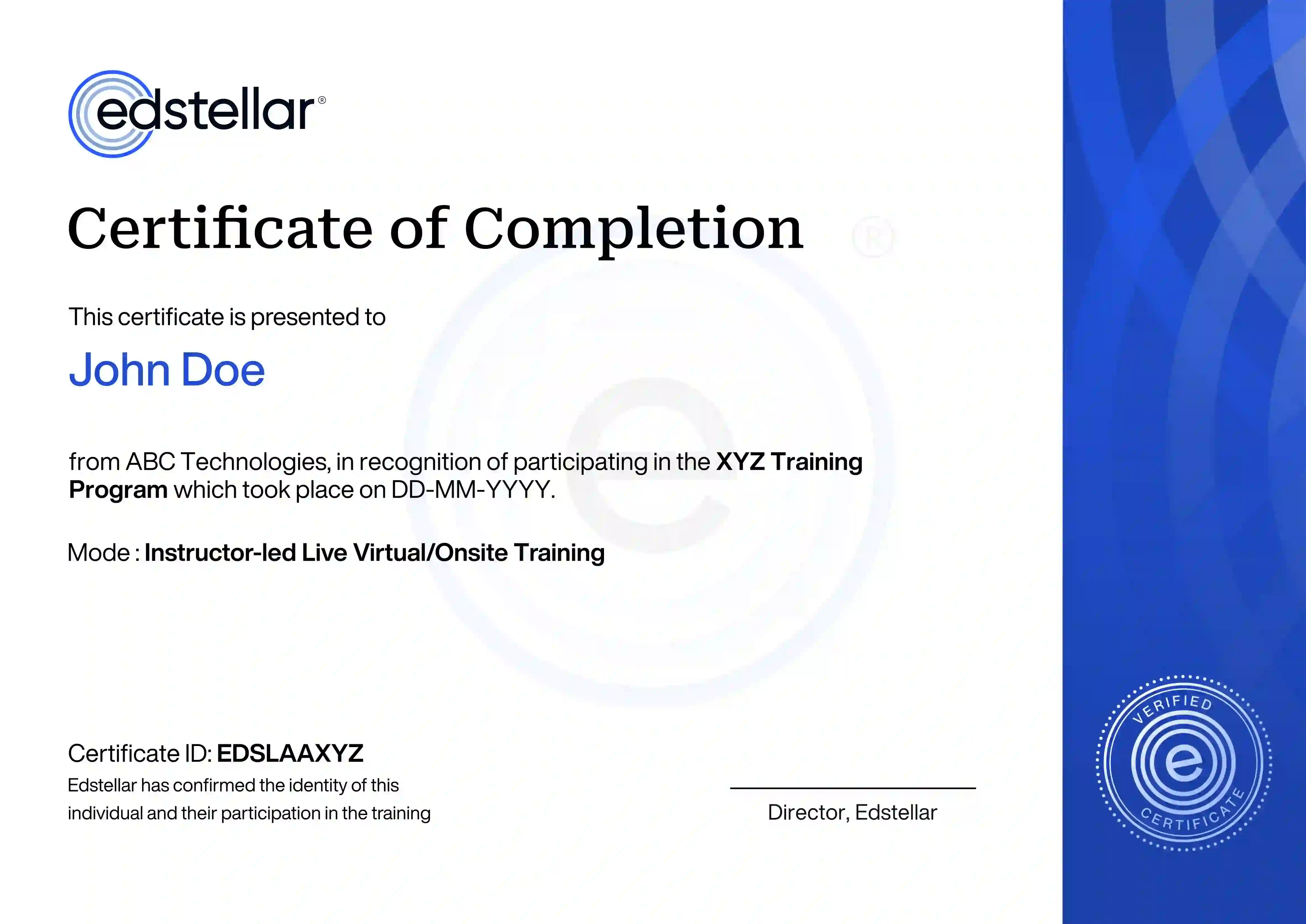
Upon successful completion of the Third-Party & Vendor Risk Management Essentials training course offered by Edstellar, employees receive a course completion certificate, symbolizing their dedication to ongoing learning and professional development.
This certificate validates the employee's acquired skills and is a powerful motivator, inspiring them to enhance their expertise further and contribute effectively to organizational success.



Edstellar is a one-stop instructor-led corporate training and coaching solution that addresses organizational upskilling and talent transformation needs globally.
.svg)
.svg)
.svg)

.svg)
Learning Technology
Learning Content Design and Development
Learning Governance, Analytics & ROI
Digital Learning Ecosystem
Training Simulations, AR/VR & Case Studies
Employee Performance Support
Leadership Pipeline & Succession PlanningStrategic Workforce Planning for EnterprisesTransformation & Risk Advisory for EnterprisesDEI Consulting for EnterprisesEmployee Engagement Consulting for Enterprises
Cultural Transformation