.svg "edstellar")

Contractor Safety Management Corporate Training Program
This training equips professionals with contractor safety management skills, covering contractor risk assessment, permit-to-work systems, safety inductions, compliance frameworks, and incident management.
(Virtual / On-site / Off-site)
.svg)
Drive Team Excellence with Contractor Safety Management Corporate Training
Contractor safety management is a critical discipline for organizations that rely on external workers for projects, maintenance, and operational activities. Effective programs reduce the risk of workplace incidents, ensure regulatory compliance, protect organizational liability, and maintain consistent safety standards across all operations involving third-party contractors. This training covers the full lifecycle of contractor safety management from pre-qualification and induction through permit-to-work systems, safety monitoring, incident investigation, and continuous performance improvement.
Edstellar's Contractor Safety Management Instructor-led course offers virtual/onsite training options tailored to the needs of HSE managers, project managers, and safety professionals. The curriculum integrates compliance frameworks with practical safety management tools, enabling learners to design, implement, and audit robust contractor safety programs that meet regulatory requirements and protect both people and organizational reputation.
.svg)

Skills Your Employees Will Gain
These are the core, hands-on capabilities your team builds during the program.
- Contractor Risk Assessment
- Permit-to-Work Systems
- Safety Induction Design
- Compliance Monitoring
- Contractor Pre-Qualification
- Incident Investigation
- Safety Performance Auditing
What Your Team Will Achieve After This Training
- Master contractor pre-qualification, selection, and risk assessment processes to ensure safe contractor engagement.
- Gain skills to design and implement effective permit-to-work systems that control high-risk contractor activities.
- Develop comprehensive contractor induction and onboarding programs aligned with regulatory safety requirements.
- Learn to monitor, audit, and enforce contractor safety compliance throughout project and operational lifecycles.
- Build proficiency in contractor incident investigation techniques and corrective action management processes.
- Apply contractor safety performance measurement frameworks to drive continuous improvement in safety outcomes.
Topics & Program Outline
The curriculum is organized into focused modules built by industry experts and delivered virtually or on-premise. Interactive sessions reflect the evolving demands of the workplace, keeping the learning both relevant and practical.
-
The Contractor Safety Landscape
- Why contractor safety is a critical risk management priority for organizations
- Common causes of contractor incidents and fatalities across industries
- Business, legal, and reputational consequences of poor contractor safety management
- Overview of contractor safety management systems and their core components
-
Roles and Responsibilities
- Duty holder responsibilities for clients, principal contractors, and subcontractors
- HSE manager, project manager, and site supervisor roles in contractor safety
- Contractor worker rights, obligations, and reporting responsibilities on site
- Accountability frameworks for shared safety responsibility across contracting parties
-
Legal and Regulatory Framework
- Key occupational health and safety legislation governing contractor engagement
- Duty of care obligations and how they apply to contractor relationships
- Regulatory inspection regimes and enforcement actions for contractor safety failures
- International safety standards and their application to contractor management programs
-
Cost of Contractor Incidents
- Direct and indirect costs of contractor workplace injuries and fatalities
- Reputational and commercial impact of contractor safety failures on organizations
- Insurance, liability, and financial exposure from inadequate contractor controls
- Business case for investing in robust contractor safety management programs
-
Building a Contractor Safety Culture
- Characteristics of a positive contractor safety culture and leadership behaviours
- Integrating contractors into the site safety culture and shared safety values
- Visible safety leadership and management commitment in contractor safety programs
- Measuring and improving contractor safety culture over time through targeted actions
-
Contractor Safety Management System Overview
- Key elements of a contractor safety management system lifecycle
- Aligning contractor safety management with organizational ISO 45001 frameworks
- Continuous improvement cycle for contractor safety program maturity development
- Integrating contractor safety data into enterprise risk management reporting
-
Pre-Qualification Criteria Development
- Defining safety pre-qualification criteria aligned to scope of work and risk level
- Safety management system requirements for contractor approval applications
- Incident rate benchmarks and safety performance thresholds for contractor eligibility
- Tiered pre-qualification requirements based on contractor risk classification
-
Safety Record Review and Verification
- Reviewing contractor incident statistics, RIDDOR records, and enforcement history
- Verifying safety management certifications: ISO 45001, CHAS, Achilles, and SafeContractor
- Reference checks and site visit assessments as part of contractor safety evaluation
- Red flag indicators in contractor safety records that require escalation or rejection
-
Insurance and Financial Requirements
- Minimum insurance coverage requirements for different contractor risk categories
- Public liability, employers liability, and professional indemnity insurance standards
- Financial stability checks and their relevance to contractor safety capacity
- Insurance certificate verification and expiry monitoring throughout the engagement
-
Competency and Certification Verification
- Checking individual worker competencies, trade licenses, and safety cards
- CSCS, IPAF, PASMA, and role-specific certification requirements by work type
- Supervisor and management competency verification for high-risk contractor activities
- Tracking certification expiry dates and managing renewal compliance for all contractors
-
Approved Contractor Register Management
- Designing and maintaining an approved contractor register with clear status indicators
- Approval categories and tiering based on contractor risk and complexity level
- Processes for suspending or removing contractors from the approved register
- Digital contractor management platforms for pre-qualification and approval workflows
-
Periodic Re-Qualification and Review
- Setting review frequencies for contractor safety pre-qualification renewal
- Triggers for unscheduled contractor re-qualification: incidents, audits, or complaints
- Communicating re-qualification requirements and deadlines to contractor organizations
- Continuous monitoring of contractor safety performance between formal re-qualification reviews
-
Embedding Safety in Contracts
- Why safety obligations must be clearly defined in the contract from the outset
- Standard safety clauses and their enforceability in contractor agreements
- Cascading safety requirements from principal contractor to subcontractor levels
- Legal review process for ensuring safety obligations are adequately captured
-
Scope of Work and Safety Specifications
- Defining scope of work in a way that informs safety planning and risk assessment
- Safety specifications as a contractual document for hazardous or complex activities
- Method statement and risk assessment requirements embedded in contract scope
- Handling scope changes and their impact on safety requirements and controls
-
Insurance and Indemnification Clauses
- Standard indemnification clause structures for contractor safety liability allocation
- Cross-indemnification provisions and their implications for safety incident liability
- Insurance adequacy reviews at contract award and renewal stages
- Ensuring sub-contractor insurance flows down consistently through the supply chain
-
Safety Performance Incentives and Penalties
- Designing safety performance incentive schemes that motivate contractor compliance
- KPI-linked payment structures and safety milestone bonuses in contractor contracts
- Financial penalties and contractual remedies for safety non-compliance events
- Balancing incentives and penalties to drive genuine safety culture improvement
-
Contract Review and Sign-Off
- Safety review gates in the contract award process before mobilization approval
- Pre-start meetings to confirm contractor understanding of contractual safety obligations
- Contractor safety plan review and approval as a condition of contract commencement
- Documenting contract safety sign-off and maintaining records for audit purposes
-
Managing Contract Amendments
- Change control processes that capture safety implications of contract amendments
- Re-assessing risk and updating safety plans when scope or conditions change
- Communicating contract changes to site supervisors and safety teams promptly
- Version control and record-keeping for contract safety documentation amendments
-
Site-Specific Safety Induction Design
- Components of an effective site safety induction for contractor workers
- Tailoring induction content to site hazards, access zones, and emergency arrangements
- Language and literacy considerations for diverse contractor workforces
- Legal minimum induction requirements vs best practice induction program standards
-
Induction Delivery Methods
- Face-to-face, video-based, and e-learning induction delivery options compared
- Using QR codes, mobile apps, and kiosks for scalable contractor induction delivery
- Practical site walk-arounds as a complement to formal induction training
- Induction delivery frequency for repeat contractors and long-term project workers
-
Competency Assessment During Induction
- Testing contractor worker understanding of safety rules and emergency procedures
- Minimum pass marks and retesting protocols for failed induction assessments
- Practical demonstrations of PPE use and emergency equipment operation
- Documenting induction assessment results and linking to site access permissions
-
Site Rules, Hazards, and Emergency Procedures
- Communicating site-specific rules: speed limits, PPE zones, and prohibited areas
- Hazard briefings for known site risks: overhead lines, confined spaces, and traffic
- Emergency assembly points, evacuation procedures, and first aid arrangements
- Muster point familiarization and emergency contact communication for contractors
-
Visitor vs Worker Induction Requirements
- Distinguishing induction requirements for site visitors, short-term, and long-term contractors
- Escorted visitor protocols vs unsupervised contractor worker access requirements
- Simplified visitor induction content and its minimum safety coverage standards
- Managing access permissions and induction status for mixed contractor and visitor groups
-
Induction Record-Keeping and Compliance
- Maintaining accurate induction records for all contractors and site visitors
- Linking induction completion to gate access control and site badge issuance
- Auditing induction records for completeness and accuracy during safety inspections
- Retention periods and legal requirements for contractor induction documentation
-
Purpose and Principles of Permit-to-Work
- What permit-to-work systems are and the hazards they are designed to control
- Legal and industry requirements for permit-to-work in high-risk activities
- How permits create a structured authorization and communication mechanism
- Limitations of permit-to-work systems and common failure modes to avoid
-
Types of Work Permits
- Hot work permits for welding, cutting, and grinding in fire-risk environments
- Confined space entry permits and their minimum safety requirements
- Electrical isolation permits and lockout/tagout integration with permit systems
- Excavation, working at height, and cold work permit types and their controls
-
Permit Issuance and Authorization
- Roles of permit issuers, receivers, and authorizing authorities in the system
- Pre-permit site assessment and hazard identification steps before issuance
- Preconditions and isolations that must be confirmed before permit sign-off
- Digital permit-to-work platforms and their advantages over paper-based systems
-
Concurrent Permits and Conflict Management
- Managing multiple simultaneous permits across shared site areas or systems
- Conflict assessment process for identifying unsafe combinations of concurrent work
- Permit suspension and cancellation procedures when conflicts or hazards emerge
- Communication protocols between contractors with overlapping permit activities
-
Permit Closure and Handover
- Permit closure checklist: confirming work completion, area clearance, and reinstatement
- De-isolation and equipment handover procedures following permitted work completion
- Partial completion and permit extension processes for multi-day activities
- Shift handover requirements when permitted work continues across shift boundaries
-
Permit System Auditing and Improvement
- Auditing permit documentation completeness, accuracy, and compliance rates
- Near-miss and incident review to identify weaknesses in the permit system
- Benchmarking permit-to-work systems against industry best practice standards
- Training and refresher programs for permit issuers, receivers, and authorizers
-
Contractor-Specific Hazard Identification
- Identifying hazards introduced by contractors that may not exist in normal operations
- Interface hazards where contractor and operational activities overlap or interact
- Techniques for hazard identification: HAZID, SWIFT, and toolbox talk approaches
- Engaging contractor workers in hazard identification and risk assessment processes
-
Risk Matrix Development
- Building a risk matrix suitable for evaluating contractor activity risk levels
- Likelihood and severity scoring conventions for contractor safety risk assessment
- Residual risk evaluation after control measures have been identified and applied
- Risk tolerance thresholds and escalation requirements for high-residual-risk activities
-
Method Statement Review and Approval
- Structure and required content of a compliant contractor method statement
- Reviewing method statements for completeness, accuracy, and risk control adequacy
- Approval workflows and authority levels for method statement sign-off
- Managing method statement revisions when site conditions or scope changes
-
Dynamic Risk Assessment
- When and how to apply dynamic risk assessment during contractor activities
- Stop-work authority and conditions that require a dynamic risk assessment stop
- Documenting dynamic risk assessment decisions and communicating changes to teams
- Integrating dynamic risk assessment into toolbox talks and pre-task briefings
-
Safe System of Work Development
- Components of a safe system of work: hazard elimination, controls, and procedures
- Hierarchy of controls application in contractor safe system of work design
- Writing clear and actionable safe work procedures for contractor field use
- Reviewing and updating safe systems of work following incidents or near misses
-
Communicating Risk to Contractor Teams
- Pre-task briefings and toolbox talks as vehicles for risk communication
- Visual risk communication: hazard boards, signage, and exclusion zone markers
- Overcoming language and literacy barriers in contractor risk communication
- Confirming contractor worker understanding of risk controls before work begins
-
Active vs Reactive Monitoring
- Difference between proactive safety monitoring and reactive incident-based monitoring
- Developing a contractor monitoring plan proportionate to risk level and activity type
- Frequency and intensity of monitoring for different contractor risk categories
- Integrating contractor monitoring into the broader site safety management program
-
Safety Inspections and Walk-Arounds
- Structured safety inspection techniques for contractor work areas and activities
- Behavioral safety observations and their role in contractor safety monitoring
- Inspection checklists tailored to contractor activity type and risk profile
- Recording and following up inspection findings in a structured corrective action process
-
Third-Party and Independent Audits
- When to commission independent audits of contractor safety management programs
- Audit scope, methodology, and reporting standards for contractor safety audits
- Managing contractor relationships during and after independent safety audits
- Integrating audit findings into contractor performance reviews and improvement plans
-
Escalation and Stop-Work Authority
- Defining clear stop-work authority roles and conditions for contractor activities
- Escalation pathways for safety concerns raised by site supervisors or workers
- Immobilizing contractor operations safely and communicating stop-work decisions
- Reinstatement process after a stop-work order and conditions for resumption
-
Corrective Action Tracking
- Logging contractor safety observations and non-conformances in a tracking register
- Assigning corrective actions with clear ownership, deadlines, and verification steps
- Grading corrective actions by severity and setting proportionate resolution timelines
- Reporting corrective action close-out rates as a contractor safety performance metric
-
Documentation and Reporting
- Minimum documentation requirements for contractor safety monitoring activities
- Reporting contractor monitoring results to project managers and HSE leadership
- Digital tools for real-time contractor safety monitoring documentation and reporting
- Retention periods and evidence standards for contractor safety monitoring records
-
Contractor Incident Reporting
- Mandatory reporting requirements for contractor injuries, illnesses, and near misses
- Contractor reporting obligations vs client reporting obligations for the same incident
- Setting up contractor incident reporting channels that are accessible and trusted
- Under-reporting risks in contractor workforces and strategies to encourage reporting
-
Incident Classification and Severity
- Incident classification systems: fatality, lost time, medical treatment, and near miss
- Severity assessment matrices for determining investigation level and resource allocation
- RIDDOR reporting obligations for contractor incidents under UK regulations
- High-potential incidents: identifying and investigating near misses with severe consequences
-
Root Cause Analysis Methods
- 5-Why analysis for identifying underlying causes of contractor safety incidents
- Fishbone diagrams and cause-and-effect mapping for contractor incident analysis
- ICAM and Bow-Tie analysis methods for complex contractor incident investigations
- Distinguishing immediate causes, underlying causes, and root causes in investigations
-
Corrective and Preventive Action Plans
- Developing CAPA plans that address root causes rather than just immediate symptoms
- Assigning CAPA ownership to the correct contractor or client organizational level
- Verifying corrective action effectiveness before closing out investigation findings
- Tracking CAPA completion rates as a contractor safety performance indicator
-
Communicating Investigation Findings
- Investigation report structure and content standards for contractor incidents
- Sharing investigation learnings across the contractor workforce to prevent recurrence
- Briefing senior leadership on significant contractor incidents and corrective actions
- Managing contractor and worker confidentiality in incident investigation reporting
-
Lessons Learned and Knowledge Sharing
- Building a contractor incident lessons learned database for ongoing reference
- Incorporating incident learnings into contractor induction and safety training updates
- Cross-site and industry sharing of contractor safety lessons and best practices
- Measuring the effectiveness of lessons learned programs in reducing repeat incidents
-
Leading and Lagging Safety KPIs
- Defining lagging indicators: TRIR, LTIR, and severity rate for contractor safety
- Leading indicators: inspection completion, near-miss reporting, and training compliance
- Balancing leading and lagging KPIs for a comprehensive contractor safety performance view
- Setting realistic contractor safety KPI targets aligned to industry benchmarks
-
Contractor Safety Scorecards
- Designing contractor safety scorecards that capture performance across KPI categories
- Weighting KPIs based on relative importance and risk significance
- Using scorecards to rank contractors and inform re-engagement or improvement decisions
- Sharing scorecards with contractors to drive transparency and accountability
-
Data Analysis for Safety Trends
- Analyzing contractor incident data to identify recurring hazard types and patterns
- Statistical process control charts for monitoring contractor safety performance over time
- Correlation analysis between leading and lagging indicators for predictive insight
- Segmenting safety performance data by contractor type, site, and activity category
-
Benchmarking Against Industry Standards
- Industry safety benchmarking databases and how to use them for contractor comparison
- Sector-specific contractor safety performance norms and best practice targets
- Internal benchmarking across multiple sites and project types for performance context
- Using benchmarking results to set stretch targets for contractor safety improvement
-
Reporting to Leadership
- Executive contractor safety dashboards: content, frequency, and audience considerations
- Presenting contractor safety data in business-relevant terms for senior leadership
- Board-level contractor safety reporting and governance oversight requirements
- Connecting contractor safety performance to organizational risk and ESG reporting
-
Continuous Improvement Programs
- Structured contractor safety improvement programs: goals, plans, and review cycles
- Collaborative improvement initiatives between client and contractor safety teams
- Recognition and reward programs that incentivize contractor safety improvement
- Measuring and communicating the ROI of contractor safety improvement investments
-
Multi-Contractor and Interface Management
- Principal contractor responsibilities when managing multiple subcontractors simultaneously
- Interface hazard assessments for work areas where contractors interact or overlap
- Multi-contractor coordination meetings: frequency, agenda, and safety outcomes
- Managing safety accountability gaps at contractor and subcontractor interfaces
-
High-Risk Activities and Specialist Contractors
- Additional safety requirements for demolition, confined space, and lifting operations
- Specialist contractor competency verification for high-risk activity categories
- Independent safety reviews and assurance for critical or complex contractor scopes
- Managing specialist contractor safety in regulated or high-hazard facility environments
-
Safety in Turnaround and Shutdown Projects
- Unique safety management challenges during plant turnarounds and shutdowns
- Managing large, time-pressured contractor workforces safely during shutdowns
- Permit-to-work and isolation management at scale during turnaround activities
- Post-turnaround safety reviews and lessons learned for future improvement
-
Digital Tools for Contractor Safety
- Contractor safety management software: features, selection, and implementation
- Mobile safety apps for permit-to-work, induction, and inspection in the field
- QR code-based site access control linked to induction and competency records
- Data analytics and AI tools for contractor safety performance monitoring
-
Contractor Safety Management System Integration
- Aligning contractor safety management with client ISO 45001 safety systems
- Integration of contractor safety data into enterprise risk management platforms
- Contractor safety management as part of ESG and sustainability reporting frameworks
- Preparing for external audits of contractor safety management program maturity
-
Future Trends in Contractor Safety
- Wearable technology and IoT for real-time contractor worker health and safety monitoring
- Drone and remote inspection technology reducing contractor exposure to hazardous areas
- Predictive analytics for identifying high-risk contractor behaviors before incidents occur
- Evolving contractor safety regulations and their anticipated impact on industry practice
Who Should Attend?
This program suits professionals at many levels across the organization, including:
- HSE Managers
- Safety Officers
- Project Managers
- Operations Managers
- Facility Managers
- Construction Supervisors
What are the Prerequisites?
Professionals should have a basic understanding of workplace safety principles and experience working with contractors or subcontractors to take the Contractor Safety Management training course.
Choose the Format That Fits Your Team
We design training your teams actually engage with, and deliver it the way that suits you best. Through a vetted global trainer network, Edstellar runs sessions in 10+ languages with consistent quality anywhere.


.webp "Virtual Contractor Safety Management Training")
Virtual / online: expert-led live sessions delivered anywhere, with consistency and easy scheduling.
.webp "On-site Contractor Safety Management Training")
On-site (in-house): immersive, instructor-led learning at your office.
.webp "Off-site Contractor Safety Management Training")
Off-site: focused, instructor-led group learning away from everyday workplace distractions.
Get a Proposal Shaped to Your Needs
Need pricing for onsite, offsite, or virtual delivery? Get a proposal tailored to your team's needs.
64 hours of group training (includes VILT/In-person On-site)
Tailored for SMBs
Tailor-Made Trainee Licenses with Our Exclusive Training Packages!
160 hours of group training (includes VILT/In-person On-site)
Ideal for growing SMBs
Tailor-Made Trainee Licenses with Our Exclusive Training Packages!
400 hours of group training (includes VILT/In-person On-site)
Designed for large corporations
Tailor-Made Trainee Licenses with Our Exclusive Training Packages!
Unlimited duration
Designed for large corporations
What Sets Edstellar Apart
Experienced Trainers
Our trainers are drawn from a vetted global network and bring years of industry expertise, keeping every session practical and impactful.
Proven Quality
With a strong global track record, Edstellar is known for quality and engaging delivery.
Industry-Relevant Curriculum
Our programs are built by experts to match the demands of today's industry.
Fully Customizable
Every program can be tailored to your organization's goals.
Comprehensive Support
We provide pre- and post-session support for a complete learning experience.
Global Multi-Location & Multilingual Training Delivery
We deliver in multiple languages to support diverse global teams.
Recognition That Motivates Your Team
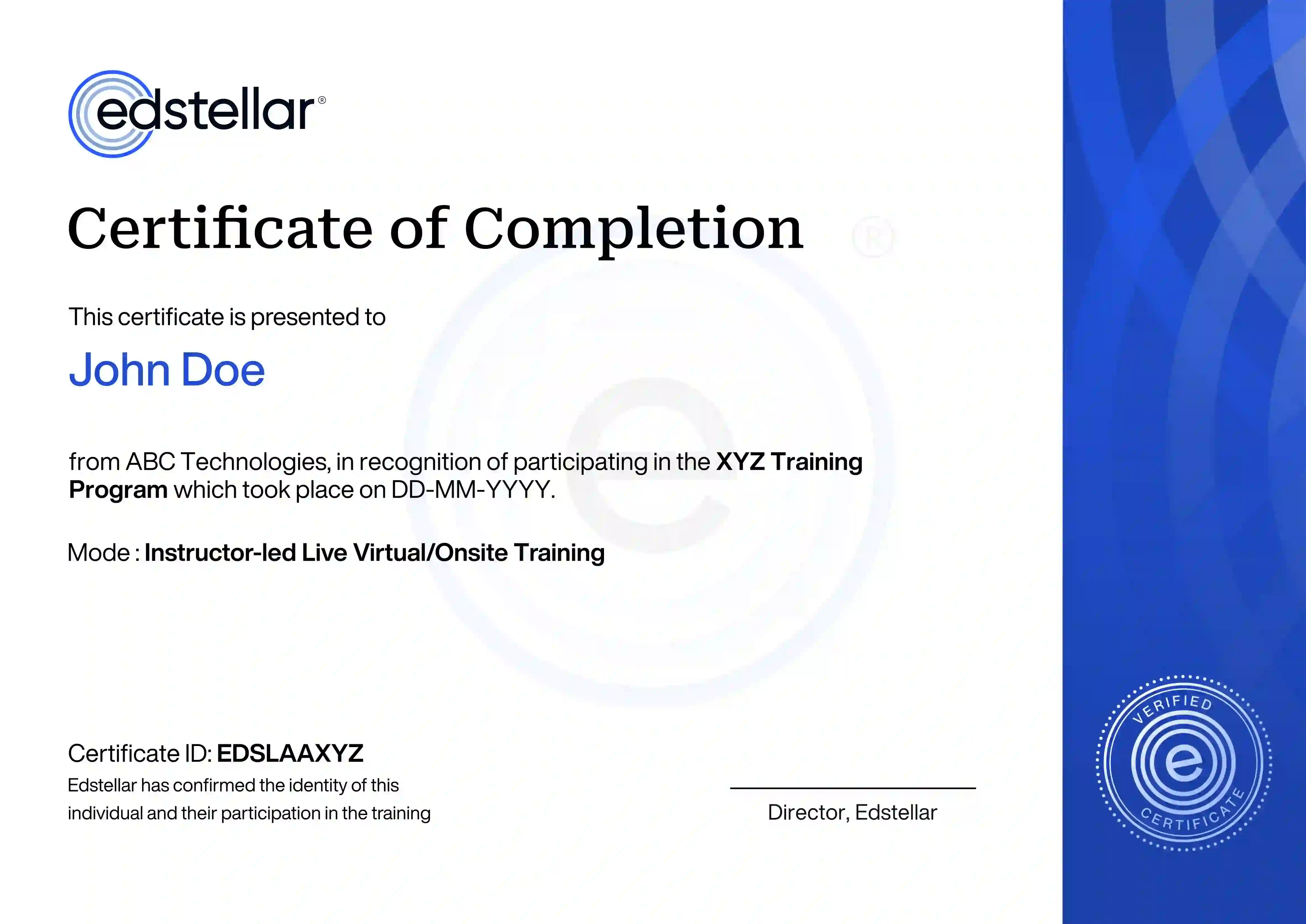
Upon successful completion of the Contractor Safety Management training course offered by Edstellar, employees receive a course completion certificate, symbolizing their dedication to ongoing learning and professional development.
This certificate validates the employee's acquired skills and is a powerful motivator, inspiring them to enhance their expertise further and contribute effectively to organizational success.



Edstellar is a one-stop instructor-led corporate training and coaching solution that addresses organizational upskilling and talent transformation needs globally.
.svg)
.svg)
.svg)

.svg)
Learning Technology
Learning Content Design and Development
Learning Governance, Analytics & ROI
Digital Learning Ecosystem
Training Simulations, AR/VR & Case Studies
Employee Performance Support
Leadership Pipeline & Succession PlanningStrategic Workforce Planning for EnterprisesTransformation & Risk Advisory for EnterprisesDEI Consulting for EnterprisesEmployee Engagement Consulting for Enterprises
Cultural Transformation