Drive Team Excellence with Human Factors Engineering Corporate Training

Empower your teams with expert-led on-site, off-site, and virtual Human Factors Engineering Training through Edstellar, a premier corporate training provider for organizations globally. Designed to meet your specific training needs, this group training program ensures your team is primed to drive your business goals. Help your employees build lasting capabilities that translate into real performance gains.

Human Factors Engineering (HFE) is a discipline focused on understanding the interactions between people, tasks, tools, and organisational systems to design safer, more reliable, and more efficient workplaces. Drawing on cognitive psychology, ergonomics, and systems thinking, HFE addresses how human performance is shaped by individual capabilities, task demands, environmental conditions, and organisational culture. The training covers human performance models, task and workload analysis, human-system interface design, error taxonomy and prevention strategies, situational awareness, safety-critical systems analysis, incident investigation, and safety culture development.

Edstellar's Human Factors Engineering Instructor-led course offers virtual/onsite training options to meet professionals' diverse needs. This flexibility ensures that teams can engage in learning experiences that best suit their logistical and operational preferences. What sets the Edstellar course apart is its emphasis on practical application, with hands-on workshops, real-world case studies from high-reliability industries, and structured exercises that translate HFE concepts into actionable workplace improvements. Edstellar equips professionals with the skills and confidence to design safer systems and build resilient safety cultures.

Get Customized Expert-led Training for Your Teams
Customized Training Delivery
Scale Your Training: Small to Large Teams
In-person Onsite, Live Virtual or Hybrid Training Modes
Plan from 2000+ Industry-ready Training Programs
Experience Hands-On Learning from Industry Experts
Delivery Capability Across 100+ Countries & 10+ Languages
""""

Key Skills Employees Gain from Instructor-led Human Factors Engineering Training

Human Factors Engineering skills corporate training will enable teams to effectively apply their learnings at work.

  • Human Performance Analysis
  • Task Analysis and Workload Assessment
  • Human-System Interface Design
  • Error Identification and Prevention
  • Situational Awareness Enhancement
  • Human Factors Investigation and RCA
  • Safety Culture Integration

Key Learning Outcomes of Human Factors Engineering Training Workshop

Upon completing Edstellar’s Human Factors Engineering workshop, employees will gain valuable, job-relevant insights and develop the confidence to apply their learning effectively in the professional environment.

  • Master human performance models and cognitive ergonomics principles to analyse how individual, task, and organisational factors drive errors in safety-critical systems.
  • Gain practical expertise in task analysis and workload assessment methods to identify error-prone activities and redesign tasks for safer, more reliable performance.
  • Develop proficiency in human-system interface design, applying HFE standards to improve display usability, alarm management, and operator situational awareness.
  • Learn systematic error identification and prevention techniques using HFACS, HRA, and defence-in-depth approaches to reduce incident likelihood and severity.
  • Build capability in human factors investigation and root cause analysis to uncover systemic contributory factors behind incidents and near misses.
  • Apply HFE principles to strengthen safety culture, embed proactive reporting behaviours, and sustain long-term human performance improvement across the organisation.

Key Benefits of the Human Factors Engineering Group Training

Attending our Human Factors Engineering group training classes provides your team with a powerful opportunity to build skills, boost confidence, and develop a deeper understanding of the concepts that matter most. The collaborative learning environment fosters knowledge sharing and enables employees to translate insights into actionable work outcomes.

  • Understand human performance models by exploring cognitive, physical, and organisational factors that influence human behaviour and reliability in safety-critical environments.
  • Apply task analysis methods including hierarchical task analysis and SHERPA to assess workload, identify error-prone steps, and optimise task sequences.
  • Design human-system interfaces using HFE principles to improve display clarity, control layout, alarm management, and operator situational awareness.
  • Identify and classify human errors using taxonomies such as HFACS and the Swiss Cheese Model to understand latent and active failure pathways.
  • Implement error prevention strategies including defence-in-depth, procedural controls, and human reliability analysis techniques across operational contexts.
  • Enhance situational awareness using SA theory and decision-making frameworks to improve performance under time pressure and high-consequence conditions.
  • Investigate human factors incidents using structured RCA methods to identify contributory organisational, task, and individual factors.
  • Evaluate safety culture maturity using validated tools and develop targeted interventions to shift organisational norms toward proactive safety behaviours.
  • Apply HFE principles to safety-critical systems including aviation, healthcare, energy, and manufacturing through structured case study analysis.
  • Build practical HFE implementation plans that align human performance improvement goals with organisational safety management systems.

Topics and Outline of Human Factors Engineering Training

Our virtual and on-premise Human Factors Engineering training curriculum is structured into focused modules developed by industry experts. This training for organizations provides an interactive learning experience that addresses the evolving demands of the workplace, making it both relevant and practical.

  1. Foundations and Scope of Human Factors Engineering
    • Definition and history of HFE as a discipline
    • Key domains: cognitive, physical, and organisational ergonomics
    • HFE applications in aviation, healthcare, energy, and manufacturing
    • Relationship between HFE and safety management systems
  2. Human Error Concepts and Terminology
    • Distinguishing slips, lapses, mistakes, and violations
    • Active versus latent failures in complex systems
    • The Swiss Cheese Model and its practical implications
    • Normalisation of deviance and high-reliability principles
  3. Systems Thinking and Sociotechnical Systems
    • Sociotechnical systems theory and its relevance to HFE
    • Understanding system boundaries and interdependencies
    • Emergent properties and unforeseen system interactions
    • Work-as-imagined versus work-as-done gaps
  4. Regulatory and Standards Landscape
    • Key HFE standards and guidelines (ISO 9241, IEC 62508)
    • Regulatory expectations for human factors in high-risk industries
    • Integrating HFE requirements into compliance frameworks
    • Case studies of regulatory HFE requirements in practice
  5. The Business Case for Human Factors Engineering
    • Quantifying the cost of human error and preventable incidents
    • Return on investment from HFE interventions
    • Linking HFE performance to organisational safety metrics
    • Building leadership support for HFE programmes
  6. Overview of HFE Methods and Tools
    • Survey of core HFE analytical methods and when to apply them
    • Introduction to task analysis, HRA, and interface evaluation tools
    • Selecting appropriate methods for different operational contexts
    • Integrating HFE tools into safety management workflows
  1. Information Processing Models
    • Stages of human information processing: perception, cognition, response
    • Attention and its limitations in complex operational environments
    • Memory systems: working memory, long-term memory, and prospective memory
    • Processing bottlenecks and their impact on performance under load
  2. Mental Models and Schema Theory
    • How operators form and use mental models of systems
    • Schema activation and errors from model mismatch
    • Strategies to support accurate mental model formation
    • Training implications for mental model alignment
  3. Skill, Rule, and Knowledge-Based Performance (Rasmussen's SRK)
    • Skill-based automaticity and associated slip and lapse errors
    • Rule-based behaviour and misapplication of stored rules
    • Knowledge-based problem solving under novel conditions
    • Designing interventions tailored to each performance level
  4. Cognitive Biases and Decision-Making Heuristics
    • Common cognitive biases affecting operational decisions
    • Confirmation bias, anchoring, and plan continuation errors
    • Recognition-primed decision making in time-critical scenarios
    • Strategies to mitigate bias-induced errors in safety contexts
  5. Stress, Fatigue, and Performance Degradation
    • Physiological and psychological effects of occupational stress on performance
    • Fatigue mechanisms and cumulative performance degradation
    • Shift work, circadian rhythms, and operational risk implications
    • Organisational controls to manage fatigue and stress risk
  6. Applying Performance Models to Workplace Design
    • Translating cognitive ergonomics insights into operational design recommendations
    • Matching task demands to human cognitive capabilities and limits
    • Using performance models to guide training and procedure development
    • Case studies linking cognitive ergonomics analysis to incident prevention
  1. Hierarchical Task Analysis (HTA)
    • HTA methodology: goals, sub-goals, operations, and plans
    • Conducting HTA interviews and observations in operational settings
    • Representing and documenting HTA outputs effectively
    • Using HTA to identify critical task steps and decision points
  2. Cognitive Task Analysis (CTA) Methods
    • Critical decision method (CDM) and think-aloud protocols
    • Applied cognitive task analysis (ACTA) framework
    • Capturing tacit knowledge from experienced operators
    • Translating CTA findings into training and procedure improvements
  3. Workload Measurement Techniques
    • NASA-TLX subjective workload assessment tool and administration
    • Bedford Scale and SWAT for operational workload rating
    • Physiological and performance-based workload indicators
    • Interpreting workload data to inform task redesign decisions
  4. Identifying Error-Prone Task Steps
    • Systematic human error reduction and prediction approach (SHERPA)
    • Predictive human error analysis from HTA outputs
    • Classifying error types at each task step using taxonomies
    • Prioritising high-risk steps for procedural or design intervention
  5. Task Allocation Between Humans and Automation
    • Principles of function allocation and human-automation teaming
    • Fitts' List and contemporary allocation frameworks
    • Identifying over-automation risks and skill degradation effects
    • Designing adaptive automation to maintain operator engagement
  6. Procedure Design and Validation
    • Principles of effective written procedure design for high-risk tasks
    • Common procedure deficiencies that contribute to human error
    • Procedure verification and validation methods including walkthrough
    • Continuous procedure review cycles tied to incident learning
  1. HFE Principles for Interface Design
    • Compatibility, consistency, and feedback principles in display design
    • Population stereotypes and expectancy in control and display layout
    • Applying ISO 9241 usability standards to operational interfaces
    • Differentiating between good and poor interface design examples
  2. Control Room and Workstation Ergonomics
    • Physical layout and anthropometric design of control rooms
    • Optimising reach zones and sight lines for operator efficiency
    • Lighting, noise, and environmental factor control for cognitive performance
    • Multi-screen display arrangement and information hierarchy principles
  3. Alarm Management
    • Alarm philosophy development aligned with EEMUA 191 and ISA 18.2
    • Alarm rationalisation to eliminate nuisance and chattering alarms
    • Prioritisation schemes and operator response time requirements
    • Managing alarm floods during abnormal and emergency situations
  4. Information Visualisation and Data Display
    • Principles of effective graphical data representation for operators
    • Using trend displays, overviews, and detail views effectively
    • Colour coding, symbology, and standardisation for quick recognition
    • Avoiding information overload and display clutter in dense systems
  5. Digital and Touchscreen Interface Considerations
    • HFE challenges specific to touchscreen and tablet-based interfaces
    • Gesture design, latency tolerance, and glove-compatible control
    • Voice and multimodal interface design for safety-critical applications
    • Evaluating digital interface prototypes using HFE review methods
  6. Interface Evaluation Methods
    • Heuristic evaluation using Nielsen's usability heuristics in safety contexts
    • Walkthrough and talk-through evaluation of control room interfaces
    • Usability testing with representative operators in simulated environments
    • Documenting and prioritising interface deficiencies for remediation
  1. Human Error Taxonomies
    • Reason's Generic Error Modelling System (GEMS) and error types
    • HFACS framework: organisational influences, supervision, preconditions, acts
    • TRACEr taxonomy for transport and safety-critical domain analysis
    • Selecting and applying the appropriate taxonomy for context
  2. Human Reliability Analysis (HRA) Methods
    • Technique for Human Error Rate Prediction (THERP) methodology
    • Human Error Assessment and Reduction Technique (HEART)
    • ATHEANA and CREAM for complex system reliability assessment
    • Quantifying human error probability for risk analysis integration
  3. Performance Shaping Factors (PSFs)
    • Identifying PSFs that increase or decrease human error likelihood
    • Time pressure, workload, procedure quality, and team communication as PSFs
    • Environmental and equipment-related PSFs in operational contexts
    • Applying PSF analysis to prioritise error reduction interventions
  4. Error Prevention Strategies
    • Defence-in-depth approach to layering error barriers and recovery mechanisms
    • Designing error-tolerant systems and forcing functions
    • Procedure and checklist optimisation to reduce execution errors
    • Positive reinforcement and just culture principles for error reporting
  5. Near-Miss and Incident Reporting Systems
    • Designing psychologically safe near-miss reporting environments
    • Classifying and coding near-miss events for trend analysis
    • Extracting learning signals from near-miss data at scale
    • Communicating near-miss insights to frontline and leadership audiences
  6. Error Proofing and Poka-Yoke in Safety Contexts
    • Applying error-proofing principles adapted from manufacturing to safety-critical tasks
    • Designing physical and digital constraints to prevent incorrect actions
    • Warning systems, interlocks, and forcing functions as error barriers
    • Evaluating error-proofing effectiveness through validation and testing
  1. Endsley's Model of Situational Awareness
    • Three levels of SA: perception, comprehension, and projection
    • Factors that degrade SA in complex and dynamic environments
    • SA requirements analysis for roles in safety-critical operations
    • Designing systems and interfaces to support higher-level SA
  2. Team Situational Awareness
    • Shared mental models and distributed cognition in operational teams
    • Communication breakdowns that lead to SA loss in team settings
    • Crew Resource Management (CRM) techniques for SA maintenance
    • Cross-checking and closed-loop communication as SA safeguards
  3. Naturalistic Decision Making (NDM)
    • Recognition-primed decision (RPD) model for expert operators
    • How experienced practitioners make decisions under time pressure
    • Sources of decision error in naturalistic operational contexts
    • Training strategies to accelerate expert pattern recognition
  4. Complacency and Automation Bias
    • Mechanisms of complacency in highly automated work environments
    • Automation bias and over-reliance on automated system outputs
    • Out-of-the-loop performance degradation and skill fade risks
    • Countermeasures to maintain active monitoring and operator readiness
  5. Stress and Decision Performance
    • Effects of acute and chronic stress on decision-making quality
    • Perceptual narrowing, tunnel vision, and anchoring under stress
    • Decision-making frameworks for emergency and abnormal situations
    • Resilience training approaches to improve performance under pressure
  6. SA Measurement and Training Methods
    • SAGAT and SART tools for measuring situational awareness in context
    • Simulation-based SA training and scenario design principles
    • Debriefing techniques to reinforce SA lessons from training exercises
    • Embedding SA assessments into operational competency frameworks
  1. HFE in Aviation and Air Traffic Management
    • Human factors contributions to aviation accidents and near misses
    • Cockpit design and flight deck human factors standards
    • CRM evolution and its cross-industry application
    • Air traffic control human factors challenges and mitigations
  2. HFE in Healthcare and Patient Safety
    • Human factors in medication errors and clinical adverse events
    • Operating theatre and ICU human factors challenges
    • Healthcare system design using HFE principles (SEIPS model)
    • Handover protocols and communication failure in clinical settings
  3. HFE in Oil, Gas, and Energy
    • Lessons from major process industry accidents (Deepwater Horizon, Texas City)
    • Operator tasks in abnormal situation management for process plants
    • HFE requirements in HAZOP, LOPA, and safety case development
    • Human factors in permit-to-work and maintenance task management
  4. HFE in Rail and Transportation
    • Human factors in rail signal passing at danger (SPAD) incidents
    • Driver vigilance, attention management, and fatigue in rail operations
    • Cab ergonomics and interface design in transportation systems
    • Applying HFE to road vehicle driver-assistance system design
  5. HFE in Nuclear and High-Reliability Organisations
    • Human factors in nuclear safety and defence-in-depth philosophy
    • Control room human factors in nuclear power plant operations
    • High-reliability organisation (HRO) principles and their HFE basis
    • Human performance improvement (HPI) programmes in nuclear utilities
  6. Cross-Industry HFE Lessons and Transfer
    • Common human factors themes across safety-critical industries
    • Transferring HFE lessons and best practices between sectors
    • Adapting HFE methods developed in one industry for another context
    • Building an industry-relevant HFE case study library for organisational learning
  1. Organisational Influences on Human Performance
    • How organisational structure, goals, and pressures shape frontline behaviour
    • Production-safety trade-off dynamics and their incident contribution
    • Leadership behaviour as a driver of safety climate and performance
    • Resource allocation decisions and their downstream human factors impact
  2. Safety Culture Models and Frameworks
    • Reason's safety culture model: informed, reporting, just, flexible, and learning
    • INSAG safety culture definition and its application to assessments
    • Hearts and Minds safety culture framework and maturity ladder
    • Differentiating safety culture from safety climate in practice
  3. Assessing Safety Culture Maturity
    • Validated safety culture survey tools and their administration
    • Qualitative methods: observations, focus groups, and document analysis
    • Interpreting assessment findings and identifying priority culture gaps
    • Benchmarking safety culture scores against industry norms
  4. Just Culture and Psychological Safety
    • Just culture principles: accountability without blame for systemic errors
    • Designing just culture decision frameworks for incident classification
    • Psychological safety as a foundation for near-miss reporting effectiveness
    • Leadership behaviours that reinforce or undermine just culture norms
  5. Team Factors: Communication and Coordination
    • Team communication failure patterns in safety-critical operations
    • Briefing and debriefing practices for hazardous task management
    • Handover and shift turnover as high-risk communication events
    • Assertiveness training and speaking-up culture in hierarchical teams
  6. Developing Safety Culture Interventions
    • Designing targeted interventions based on safety culture assessment gaps
    • Leadership development programmes to shift safety culture norms
    • Frontline engagement strategies for sustainable behavioural change
    • Measuring safety culture improvement over time using lagging and leading indicators
  1. Principles of Human Factors Incident Investigation
    • Shifting from blame to system-oriented investigation thinking
    • Investigator biases and hindsight bias in post-incident analysis
    • Preserving and collecting human factors evidence at incident scenes
    • Interviewing witnesses and operators using cognitive interview techniques
  2. Applying HFACS to Incident Investigation
    • Using HFACS taxonomy to code causal and contributory factors
    • Mapping investigation findings to HFACS layers systematically
    • Identifying organisational and supervisory factors behind unsafe acts
    • Communicating HFACS-based findings to technical and non-technical audiences
  3. Root Cause Analysis (RCA) Methods for Human Factors
    • 5 Whys analysis with human factors lens for causal chain development
    • Fishbone (Ishikawa) diagram applied to human and organisational factors
    • Barrier analysis and change analysis in human factors investigations
    • TapRoot and MORT methods for systematic root cause identification
  4. Common Cause Analysis and Trend Identification
    • Aggregating individual incident findings to identify systemic patterns
    • Using HFACS and near-miss data for common cause analysis
    • Statistical approaches to incident trend detection and prioritisation
    • Presenting systemic trend findings to drive strategic safety investment
  5. Corrective Action Development and Tracking
    • Developing targeted corrective actions mapped to root causes
    • Hierarchy of controls applied to human factors corrective actions
    • Verifying corrective action effectiveness through follow-up evaluation
    • Managing and tracking open corrective actions to closure
  6. Lessons Learned Communication and Organisational Learning
    • Designing effective lessons learned communication for operational teams
    • Avoiding alert fatigue when disseminating incident learning
    • Embedding incident lessons into training and procedure updates
    • Building a learning organisation culture through continuous incident review
  1. Integrating HFE into Safety Management Systems
    • Mapping HFE activities to SMS elements and bow-tie risk models
    • Embedding HFE requirements into management of change processes
    • HFE input into HAZOP, HAZID, and risk assessment workshops
    • Aligning HFE programmes with ISO 45001 and industry safety standards
  2. HFE in Design and Engineering Projects
    • Incorporating HFE into early design stages to reduce costly late changes
    • Task-based design review and human factors design verification
    • Conducting desktop and simulation-based human factors assessments
    • HFE deliverables in capital project gating and safety case development
  3. Training Design Using HFE Principles
    • Applying cognitive load theory to training content and delivery design
    • Simulation fidelity requirements for safety-critical skills training
    • Scenario-based training for error recognition and recovery skills
    • Competency validation approaches aligned with HFE task requirements
  4. Human Performance Improvement (HPI) Programmes
    • HPI framework elements: tools, observations, and corrective actions
    • Pre-job briefings, self-checking (STAR), and peer-checking techniques
    • Stop-work authority and questioning attitude as HPI culture enablers
    • Measuring HPI programme effectiveness using leading indicators
  5. Measuring and Reporting Human Factors Performance
    • Developing an HFE KPI dashboard using leading and lagging indicators
    • Near-miss rate, human error frequency, and barrier effectiveness metrics
    • Reporting HFE performance to senior leadership and safety committees
    • Using HFE data to drive continuous improvement in safety strategy
  6. Building an Organisational HFE Capability
    • Defining HFE roles, responsibilities, and competency requirements
    • Developing an internal HFE centre of excellence and community of practice
    • Engaging external HFE expertise and academic partnerships strategically
    • Creating a multi-year HFE roadmap linked to organisational safety goals

Who Can Take the Human Factors Engineering Training Course

The Human Factors Engineering training program can also be taken by professionals at various levels in the organization.

  • Safety Engineers
  • Operations Managers
  • Process Engineers
  • Human Factors Specialists
  • Risk and Compliance Officers
  • Industrial Designers

Prerequisites for Human Factors Engineering Training

Professionals should have a basic understanding of workplace safety principles and operational processes, along with familiarity with risk management concepts and safety management systems, to take the Human Factors Engineering training course.

Request a Quote for your Corporate Training Requirements

Valid number

Delivering Training for Organizations across 100 Countries and 10+ Languages

Corporate Group Training Delivery Modes
for Human Factors Engineering Training

At Edstellar, we understand the importance of impactful and engaging training for employees. As a leading Human Factors Engineering training provider, we ensure the training is more interactive by offering Face-to-Face onsite/in-house or virtual/online sessions for companies. This approach has proven to be effective, outcome-oriented, and produces a well-rounded training experience for your teams.

Virtual Human Factors Engineering Training

Edstellar's Human Factors Engineering virtual/online training sessions bring expert-led, high-quality training to your teams anywhere, ensuring consistency and seamless integration into their schedules.

With global reach, your employees can get trained from various locations
The consistent training quality ensures uniform learning outcomes
Participants can attend training in their own space without the need for traveling
Organizations can scale learning by accommodating large groups of participants
Interactive tools can be used to enhance learning engagement
On-site Human Factors Engineering Training

Edstellar's Human Factors Engineering inhouse face to face instructor-led training delivers immersive and insightful learning experiences right in the comfort of your office.

Higher engagement and better learning experience through face-to-face interaction
Workplace environment can be tailored to learning requirements
Team collaboration and knowledge sharing improves training effectiveness
Demonstration of processes for hands-on learning and better understanding
Participants can get their doubts clarified and gain valuable insights through direct interaction
Off-site Human Factors Engineering Training

Edstellar's Human Factors Engineering offsite face-to-face instructor-led group training offer a unique opportunity for teams to immerse themselves in focused and dynamic learning environments away from their usual workplace distractions.

Distraction-free environment improves learning engagement
Team bonding can be improved through activities
Dedicated schedule for training away from office set up can improve learning effectiveness
Boosts employee morale and reflects organization's commitment to employee development

Explore Our Customized Pricing Package
for
Human Factors Engineering Corporate Training

Looking for pricing details for onsite, offsite, or virtual instructor-led Human Factors Engineering training? Get a customized proposal tailored to your team’s specific needs.

Request a Group Training Quote
""
How Many Team Members Need Training?
Please select an option or fill in the custom field.
"'

Is Your Corporate Training Requirement Only for Human Factors Engineering?

Please select at least one course.
""
Add the List of Training Workshops
search icon

      Please select the course

      No. of Courses selected: 0

      Clear

      Upload a CSV

      Send us your Training Requirements in 3 Easy steps

      1. 1
      2. 2
        Add the required training workshops
      3. 3
        Upload to get a quick quote or email it to contact@edstellar.com

      ""

      Looking for a Complete Package?

      Looking for a one-time pricing option for all your annual training requirements?

      View Corporate Training Packages
      ""
      Select the Option that Best Describes Your Corporate Training Requirement

      Please select an option or choose from the recurring options.
      ""
      Verify and Submit Your Request

      Review Your Corporate Training Selection Summary

      Training Program: Human Factors Engineering Training

      1. No of Team Members

      2. Selected Training Preference

      3. Selected Recurring Sessions

      1

      Review your Requirements

      Training Workshops Selected :


        Excel
        File has been
        successfully uploaded.
        Fill the form to submit
 your details
        Submit Your Professional Contact Information
        Valid number
        We've received your enquiry. Our team will be in touch soon.
        Oops! Something went wrong while submitting the form.
        Starter
        120 licences

        Tailor-Made Trainee Licenses with Our Exclusive Training Packages!

        View Package

        64 hours of group training (includes VILT/In-person On-site)

        Tailored for SMBs

        Growth
        320 licences

        Tailor-Made Trainee Licenses with Our Exclusive Training Packages!

        View Package

        160 hours of group training (includes VILT/In-person On-site)

        Ideal for growing SMBs

        Enterprise
        800 licences

        Tailor-Made Trainee Licenses with Our Exclusive Training Packages!

        View Package

        400 hours of group training (includes VILT/In-person On-site)

        Designed for large corporations

        Custom
        Unlimited licenses

        Tailor-Made Trainee Licenses with Our Exclusive Training Packages!

        View Package

        Unlimited duration

        Designed for large corporations

        Edstellar: Your Go-to Human Factors Engineering Training Company

        Experienced Trainers

        Our trainers bring years of industry expertise to ensure the training is practical and impactful.

        Quality Training

        With a strong track record of delivering training worldwide, Edstellar maintains its reputation for its quality and training engagement.

        Industry-Relevant Curriculum

        Our course is designed by experts and is tailored to meet the demands of the current industry.

        Customizable Training

        Our course can be customized to meet the unique needs and goals of your organization.

        Comprehensive Support

        We provide pre and post training support to your organization to ensure a complete learning experience.

        Multilingual Training Capabilities

        We offer training in multiple languages to cater to diverse and global teams.

        Testimonials

        What Our Clients Say

        We pride ourselves on delivering exceptional training solutions. Here's what our clients have to say about their experiences with Edstellar.

        "Edstellar's virtual Human Factors Engineering training transformed the way our safety engineers and operations teams think about error prevention. Within six months of completing the programme, we recorded a 34% reduction in human error-related incidents and a 52% improvement in near-miss reporting rates across our facilities. The structured modules on cognitive ergonomics and HRA gave our team practical tools they could apply immediately."

        Dr. Sarah Mitchell

        Head of Safety Engineering,

        A Global Energy and Resources Company

        "The onsite Human Factors Engineering training delivered by Edstellar had a measurable impact across our operations. Our safety culture scores improved by 28 percentage points in our post-training pulse survey, and we achieved a 41% reduction in ergonomic-related injuries over the following two quarters. The facilitators brought deep industry knowledge and the workshop exercises were directly applicable to our plant environment."

        James Okafor

        Plant Operations Director,

        A Large-Scale Process Manufacturing Group

        "Edstellar's intensive off-site Human Factors Engineering programme enabled us to deploy a comprehensive HFE framework across our organisation within four months. We reduced average incident investigation time by 38% through the adoption of HFACS-based RCA methods, and our near-miss capture rate increased by 60% following the just culture and reporting system overhaul. An outstanding investment in our long-term safety performance."

        Caroline Firth

        Chief Safety Officer,

        A Critical Infrastructure and Utilities Enterprise

        "Edstellar's Compliance training programs have greatly strengthened our organization's ability to manage regulatory risks with confidence and consistency. The sessions combine practical compliance frameworks, real-case scenarios, and expert insights, enabling our teams to interpret regulations accurately, strengthen governance practices, enhance data protection measures, and maintain compliance across evolving regulatory landscapes."

        Sonia D'Souza

        Head of Compliance,

        A Global Financial Services Company

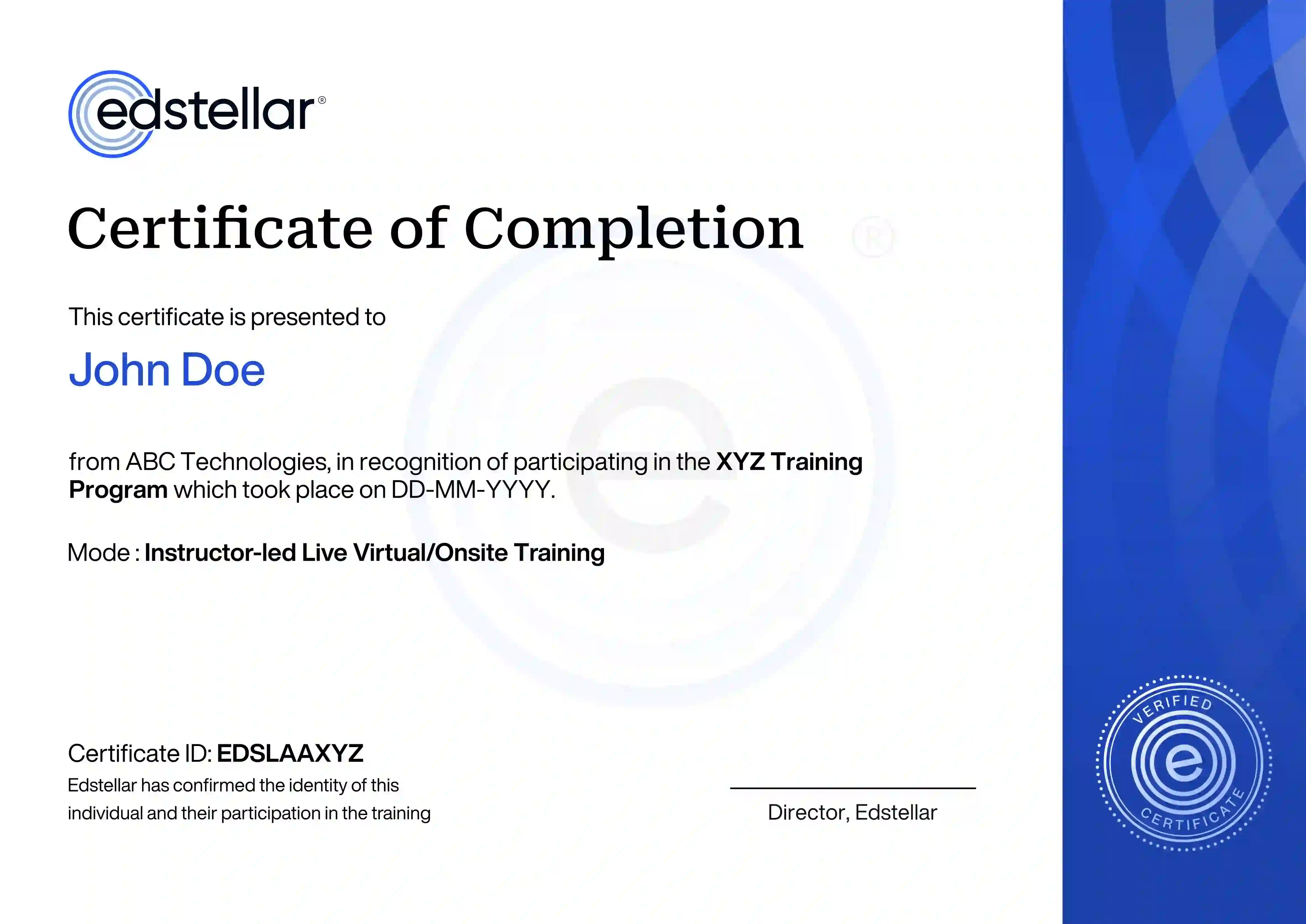
        Get Your Team Members Recognized with Edstellar’s Course Certificate

        Upon successful completion of the training course offered by Edstellar, employees receive a course completion certificate, symbolizing their dedication to ongoing learning and professional development.

        This certificate validates the employee's acquired skills and is a powerful motivator, inspiring them to enhance their expertise further and contribute effectively to organizational success.

        Certificate of Excellence