Home
Corporate Training Courses
Compliance
Workplace Safety Training
Human & Organizational Performance (HOP) Training

Drive Team Excellence with Human and Organizational Performance (HOP) Implementation Corporate Training

Empower your teams with expert-led on-site, off-site, and virtual Human and Organizational Performance (HOP) Implementation Training through Edstellar, a premier corporate training provider for organizations globally. Designed to meet your specific training needs, this group training program ensures your team is primed to drive your business goals. Help your employees build lasting capabilities that translate into real performance gains.

Human and Organizational Performance (HOP) Implementation is a transformative approach to workplace safety that shifts organizations from blame-based responses to system-focused learning. Grounded in decades of research in high-reliability industries, HOP recognizes that human error is an inevitable part of complex work and that organizations must design systems capable of preventing, detecting, and recovering from failures before they cause harm.

Edstellar's Human and Organizational Performance (HOP) Implementation Instructor-led course offers virtual/onsite training options, equipping safety leaders, operations managers, and HSE professionals with the tools, frameworks, and facilitation skills needed to embed HOP principles into daily operations, transform safety culture, and build lasting organizational resilience.

Get Customized Expert-led Training for Your Teams
Customized Training Delivery
Scale Your Training: Small to Large Teams
In-person Onsite, Live Virtual or Hybrid Training Modes
Plan from 2000+ Industry-ready Training Programs
Experience Hands-On Learning from Industry Experts
Delivery Capability Across 100+ Countries & 10+ Languages
""""

Key Skills Employees Gain from Instructor-led Human and Organizational Performance (HOP) Implementation Training

Human and Organizational Performance (HOP) Implementation skills corporate training will enable teams to effectively apply their learnings at work.

  • HOP Principles Application
  • Human Error Analysis
  • Learning Team Facilitation
  • Safety Culture Transformation
  • Event Learning and Investigation
  • Pre-Job Briefing Design
  • HOP Implementation Planning

Key Learning Outcomes of Human and Organizational Performance (HOP) Implementation Training Workshop

Upon completing Edstellar’s Human and Organizational Performance (HOP) Implementation workshop, employees will gain valuable, job-relevant insights and develop the confidence to apply their learning effectively in the professional environment.

  • Master the five HOP principles and apply them to diagnose systemic vulnerabilities in workplace safety environments
  • Gain proficiency in facilitating learning teams and conducting event investigations that drive system improvement
  • Develop and deploy operational observation techniques and pre-job briefing frameworks used in HOP practice
  • Learn to design and execute a comprehensive HOP implementation strategy tailored to your organization
  • Build leadership capabilities that reinforce HOP culture and sustain behavioral change across the organization
  • Apply HOP measurement frameworks to track cultural progress and continuously improve organizational safety performance

Key Benefits of the Human and Organizational Performance (HOP) Implementation Group Training

Attending our Human and Organizational Performance (HOP) Implementation group training classes provides your team with a powerful opportunity to build skills, boost confidence, and develop a deeper understanding of the concepts that matter most. The collaborative learning environment fosters knowledge sharing and enables employees to translate insights into actionable work outcomes.

  • Learn the five core HOP principles and how they apply to real-world safety and operations contexts
  • Understand why human error is normal and how system design prevents, catches, and recovers from failures
  • Facilitate learning teams that extract meaningful insights from events without blame or punishment
  • Apply HOP tools including pre-job briefs, job observations, and story-based learning techniques
  • Analyze the context and organizational factors that drive human behavior in high-risk environments
  • Design and execute a structured HOP implementation roadmap aligned to your organizational culture
  • Develop leadership behaviors that model and reinforce HOP principles across all levels of the organization
  • Transform reactive safety cultures into proactive, learning-oriented systems using HOP methodology
  • Measure HOP effectiveness using leading and lagging indicators and continuous improvement loops
  • Build organizational resilience by embedding HOP thinking into daily operations and management practices

Topics and Outline of Human and Organizational Performance (HOP) Implementation Training

Our virtual and on-premise Human and Organizational Performance (HOP) Implementation training curriculum is structured into focused modules developed by industry experts. This training for organizations provides an interactive learning experience that addresses the evolving demands of the workplace, making it both relevant and practical.

  1. Origins and Evolution of HOP
    • Historical context of human factors in safety science
    • Shift from person-focused to system-focused safety models
    • Key contributors and milestones in HOP development
    • HOP adoption across high-reliability industries globally
  2. HOP vs. Traditional Safety Approaches
    • Limitations of blame-based incident response models
    • Comparing compliance-driven versus learning-driven safety cultures
    • How HOP reframes error as a symptom of system conditions
    • Business and cultural benefits of adopting HOP
  3. Core Concepts in HOP
    • Defining human error, violation, and system failure
    • Understanding latent conditions and active failures
    • The role of context in shaping human behavior at work
    • Introduction to organizational resilience and adaptive capacity
  4. HOP in Practice
    • Real-world case studies from high-hazard industries
    • How HOP organizations respond differently to incidents
    • Common misconceptions about HOP and how to address them
    • Setting expectations for HOP implementation journeys
  5. Stakeholder Alignment for HOP
    • Identifying key internal champions and sponsors for HOP
    • Communicating HOP value to senior leadership and frontline workers
    • Building a shared language around error and learning
    • Mapping organizational readiness for HOP transition
  6. Introduction to HOP Tools and Methods
    • Overview of learning teams and their role in HOP
    • Pre-job briefs and operational observations as HOP practices
    • Story-based learning as a HOP communication tool
    • Introduction to HOP implementation frameworks and roadmaps
  1. Principle 1 - Error Is Normal
    • Why all humans make errors regardless of experience or motivation
    • Cognitive and physiological factors that contribute to error
    • Normalizing error as the starting point for system improvement
    • Organizational responses that reduce error frequency and impact
  2. Principle 2 - Blame Fixes Nothing
    • How blame suppresses reporting and learning after incidents
    • The psychology of accountability without punishment
    • Building psychological safety through just culture frameworks
    • Transitioning from punitive to corrective response models
  3. Principle 3 - Context Drives Behavior
    • How work environment shapes worker decisions and actions
    • Identifying organizational and situational factors behind errors
    • Work-as-imagined versus work-as-done analysis techniques
    • Redesigning work contexts to reduce error-likely situations
  4. Principle 4 - Learning and Improving
    • Creating feedback loops that convert events into system improvements
    • Learning from successes as well as failures in HOP
    • Building organizational memory through structured event reviews
    • Sharing lessons learned across teams and sites effectively
  5. Principle 5 - How You Respond to Failure Matters
    • Crafting incident responses that reinforce HOP values
    • Leadership communication after events that builds trust
    • Avoiding common failure response traps that undermine culture
    • Designing response protocols consistent with HOP principles
  6. Integrating the Five Principles into Daily Work
    • Embedding HOP principles in toolbox talks and safety meetings
    • Using principles to guide management decisions and priorities
    • Assessing organizational alignment with each HOP principle
    • Action planning to close gaps between current and desired state
  1. Types of Human Error
    • Classifying errors as slips, lapses, mistakes, and violations
    • Understanding skill-based, rule-based, and knowledge-based errors
    • Distinguishing between intentional and unintentional unsafe acts
    • Error likelihood assessment in complex operational tasks
  2. Cognitive Factors in Human Performance
    • Attention, memory, and perception limitations in the workplace
    • How stress, fatigue, and distraction degrade performance
    • Decision-making under time pressure and uncertainty
    • Cognitive biases that influence safety-critical judgments
  3. System Factors and Latent Conditions
    • Identifying organizational preconditions that set up workers to fail
    • Analyzing production pressure as a latent system condition
    • How equipment design and procedures contribute to error
    • Mapping latent conditions using barrier analysis techniques
  4. Error-Likely Situations
    • Recognizing task and environmental characteristics that increase error risk
    • SAFER and HEFT tools for error likelihood assessment
    • Mitigating error traps through task redesign and controls
    • Engaging workers to identify error-likely situations in their own tasks
  5. Organizational Factors in Human Performance
    • How management systems influence frontline worker behavior
    • The role of scheduling, staffing, and workload in human error
    • Communication breakdowns as a systemic contributor to incidents
    • Addressing organizational drift and normalization of deviance
  6. Human Performance Data and Analysis
    • Collecting qualitative and quantitative human performance data
    • Trend analysis of near misses and human error events
    • Using performance data to prioritize system improvement efforts
    • Building dashboards to track human performance indicators over time
  1. Overview of HOP Tool Categories
    • Categorizing HOP tools by purpose: learning, preventing, and communicating
    • Selecting the right tools for different organizational contexts
    • Integrating HOP tools into existing safety management systems
    • Sequencing tool deployment for maximum cultural impact
  2. Story-Based Learning
    • Designing compelling safety stories that illustrate HOP principles
    • Structuring narratives to highlight system factors over individual blame
    • Delivering story-based learning in team meetings and toolbox talks
    • Measuring audience engagement and learning transfer from stories
  3. Job Observations as a HOP Tool
    • Purpose and principles of HOP-aligned job observations
    • Conducting non-judgmental observations focused on work-as-done
    • Identifying gaps between written procedures and actual practice
    • Feeding observation insights back into system and procedure improvement
  4. Pre-Job Briefings
    • Designing pre-job briefs that anticipate error traps and critical steps
    • Engaging workers in identifying risks before task execution begins
    • Using pre-job briefs to reinforce HOP language and mindset
    • Evaluating pre-job brief quality and effectiveness over time
  5. Post-Job Reviews
    • Structuring post-job reviews to capture learning from completed tasks
    • Identifying what went well and what could be improved systematically
    • Documenting and sharing insights from post-job reviews across teams
    • Building a continuous improvement loop from pre-job to post-job review
  6. Peer Checks and Error Prevention Techniques
    • Using STAR (Stop, Think, Act, Review) for critical task verification
    • Three-way communication for high-stakes operational instructions
    • Concurrent and independent verification techniques in practice
    • Building peer check cultures without creating bureaucratic overhead
  1. What Is a Learning Team
    • Defining learning teams and their role in HOP-based organizations
    • Differences between learning teams and traditional incident investigations
    • When to convene a learning team versus other review methods
    • Composition and size guidelines for effective learning teams
  2. Facilitating Learning Teams
    • Core facilitation skills for HOP-aligned learning team sessions
    • Creating psychological safety for open and honest worker participation
    • Using curiosity-based questioning to explore work-as-done
    • Managing group dynamics and dominant voices in learning teams
  3. Learning Team Process and Structure
    • Step-by-step structure for conducting a learning team session
    • Gathering worker perspectives before and during the session
    • Synthesizing learning team findings into actionable system improvements
    • Documenting and communicating learning team outcomes organization-wide
  4. Event Learning Beyond Incidents
    • Learning from near misses, good catches, and successful adaptations
    • Proactive learning teams triggered by operational changes or close calls
    • Benchmarking event learning practices from high-reliability organizations
    • Building a culture where workers volunteer events for learning review
  5. Avoiding Common Learning Team Pitfalls
    • Preventing root cause analysis habits from contaminating learning teams
    • Avoiding premature conclusions and confirmation bias in sessions
    • Keeping learning teams focused on system factors, not individual fault
    • Sustaining learning team quality as the program matures over time
  6. Scaling Learning Teams Across the Organization
    • Training internal facilitators to lead learning teams independently
    • Standardizing learning team templates without losing flexibility
    • Integrating learning teams into regular operational review cycles
    • Measuring learning team impact on safety culture and incident rates
  1. The Leader's Role in HOP
    • How leadership behavior shapes safety culture and worker trust
    • Visible leadership commitment as a driver of HOP adoption
    • Aligning leadership style with HOP values and principles
    • Common leadership behaviors that undermine HOP progress
  2. Curiosity-Based Leadership
    • Asking questions to understand work rather than to assign fault
    • Building curiosity habits through leader standard work practices
    • Modeling intellectual humility in safety conversations and reviews
    • Using curiosity to uncover systemic gaps before incidents occur
  3. Just Culture and Leadership Accountability
    • Defining just culture within a HOP framework for leaders
    • Balancing individual accountability with systemic improvement focus
    • Making consistent, fair decisions about worker conduct and discipline
    • Communicating just culture principles credibly across the organization
  4. Leadership Communication After Failure
    • Crafting post-incident messaging that reflects HOP values
    • Avoiding language that assigns blame while maintaining transparency
    • Engaging frontline workers with empathy after high-severity events
    • Reinforcing learning focus through visible leadership actions post-event
  5. Coaching Frontline Supervisors in HOP
    • Equipping supervisors to conduct HOP-aligned conversations with workers
    • Coaching supervisors to recognize and remove error traps in real time
    • Developing supervisor facilitation skills for toolbox talks and briefs
    • Building supervisor confidence to challenge unsafe conditions openly
  6. Sustaining Leadership Commitment to HOP
    • Linking HOP leadership behaviors to performance review criteria
    • Creating peer accountability networks among senior leaders for HOP
    • Refreshing leadership HOP skills through annual training and coaching
    • Recognizing and celebrating leadership behaviors that exemplify HOP
  1. Assessing Current Safety Culture
    • Using safety culture surveys and diagnostic tools to baseline culture
    • Identifying cultural attributes that support or hinder HOP adoption
    • Engaging frontline and management perspectives in culture assessment
    • Translating assessment data into prioritized improvement opportunities
  2. Culture Change Theory and HOP
    • Applying change management principles to safety culture transformation
    • Understanding resistance to HOP and strategies to address it
    • Building coalitions of early adopters to accelerate cultural shift
    • Setting realistic timelines for observable culture change outcomes
  3. Moving from Reactive to Proactive Safety
    • Shifting organizational focus from lagging to leading safety indicators
    • Building proactive reporting systems that reward near-miss disclosure
    • Designing feedback loops that demonstrate value of proactive reporting
    • Benchmarking proactive safety metrics against industry leading practice
  4. Psychological Safety and HOP Culture
    • Defining psychological safety and its link to HOP cultural outcomes
    • Building environments where workers speak up without fear of reprisal
    • Measuring psychological safety levels across teams and departments
    • Interventions to improve psychological safety in high-pressure settings
  5. Embedding HOP in Organizational Systems
    • Revising incident investigation procedures to align with HOP principles
    • Updating onboarding and training programs to incorporate HOP language
    • Aligning performance management systems with HOP cultural values
    • Integrating HOP into management operating systems and routine reviews
  6. Communicating the HOP Culture Journey
    • Building internal HOP communication campaigns for sustained awareness
    • Using visual management tools to keep HOP principles visible daily
    • Sharing progress stories and wins to maintain organizational momentum
    • Engaging external stakeholders and regulators in the HOP culture narrative
  1. Purpose of Operational Observations in HOP
    • How observations shift from compliance checking to learning discovery
    • Distinguishing HOP observations from traditional safety audits
    • Building observer skills aligned with curiosity and HOP values
    • Selecting observation targets based on risk and operational variability
  2. Planning and Conducting Observations
    • Structuring observation sessions to minimize disruption to workers
    • Using observation guides that focus on error traps and context
    • Engaging workers in conversation during and after observations
    • Recording observation data in formats suited to HOP analysis
  3. Analyzing and Acting on Observation Data
    • Identifying patterns in observation data across teams and tasks
    • Translating observation findings into procedure and design improvements
    • Closing the loop with workers on changes made from their observations
    • Building a database of observation insights for trend analysis
  4. Designing Effective Pre-Job Briefs
    • Identifying critical steps and error traps specific to each task type
    • Structuring pre-job briefs to be concise, focused, and worker-led
    • Incorporating HOP language and principles into brief templates
    • Adapting pre-job brief formats for different task complexities
  5. Facilitating Pre-Job Brief Sessions
    • Engaging all team members in identifying risks before work begins
    • Encouraging workers to raise concerns and propose control measures
    • Documenting and acting on pre-job brief inputs in real time
    • Evaluating the quality and consistency of pre-job briefs over time
  6. Connecting Observations and Briefs to Systemic Learning
    • Using observation and brief data to trigger proactive learning teams
    • Integrating pre-job brief insights into procedure revision cycles
    • Sharing cross-site learning from observation and brief programs
    • Tracking improvements in error rates linked to observation and brief quality
  1. Building the HOP Business Case
    • Quantifying the cost of incidents, errors, and reactive safety models
    • Presenting HOP ROI through reduced incident rates and improved culture
    • Aligning HOP implementation with organizational strategy and values
    • Gaining executive sponsorship and resource commitment for HOP
  2. Organizational Readiness Assessment
    • Diagnosing current safety culture maturity using readiness tools
    • Identifying structural and cultural barriers to HOP implementation
    • Mapping stakeholder support and resistance across the organization
    • Setting a realistic starting point based on readiness assessment results
  3. Designing the HOP Implementation Roadmap
    • Defining phased implementation milestones for HOP over 12 to 36 months
    • Sequencing HOP tool deployment to build momentum progressively
    • Assigning roles and responsibilities across the implementation team
    • Building contingency plans for common implementation setbacks
  4. Training and Capability Building for HOP
    • Designing tiered HOP training programs for leaders, supervisors, and workers
    • Developing internal HOP facilitators and champions for sustainability
    • Selecting and deploying HOP tools appropriate to each audience group
    • Evaluating training effectiveness and adjusting delivery based on feedback
  5. Pilot Programs and Scaled Rollout
    • Selecting pilot sites or teams for initial HOP implementation testing
    • Defining success metrics for the pilot to inform organization-wide rollout
    • Capturing and sharing pilot learnings before scaling HOP broadly
    • Managing the pace of rollout to avoid change fatigue across teams
  6. Governance and Accountability Structures
    • Establishing a HOP steering committee with clear terms of reference
    • Defining governance checkpoints to review implementation progress
    • Linking HOP implementation KPIs to leadership performance agreements
    • Reporting HOP progress to the board and external stakeholders regularly
  1. HOP Measurement Framework
    • Selecting leading and lagging indicators that reflect HOP cultural progress
    • Balancing quantitative metrics with qualitative culture assessments
    • Designing HOP dashboards for operational and executive audiences
    • Avoiding measurement traps that incentivize underreporting of events
  2. Leading Indicators for HOP
    • Tracking near-miss reporting rates as a HOP health indicator
    • Measuring quality and frequency of learning team sessions over time
    • Monitoring pre-job brief completion and quality scores across sites
    • Assessing psychological safety trends through periodic pulse surveys
  3. Lagging Indicators and HOP Outcomes
    • Correlating HOP adoption milestones with incident rate improvements
    • Tracking severity of incidents over time as HOP matures
    • Analyzing repeat incident patterns to identify unresolved system factors
    • Benchmarking lagging indicators against industry peers and standards
  4. Continuous Improvement in HOP Programs
    • Conducting annual HOP program reviews to assess progress and gaps
    • Incorporating emerging HOP research and tools into ongoing programs
    • Running refresher training cycles to prevent HOP skill decay
    • Using measurement data to reprioritize HOP improvement efforts
  5. Sustaining HOP Through Leadership Transitions
    • Embedding HOP into onboarding for all new leaders and managers
    • Documenting HOP history and milestones to preserve organizational memory
    • Building HOP into succession planning and leadership development programs
    • Maintaining external HOP networks to sustain momentum through change
  6. Demonstrating HOP Value to Stakeholders
    • Reporting HOP progress to regulators and industry bodies with confidence
    • Publishing HOP case studies to build organizational reputation
    • Connecting HOP outcomes to ESG, sustainability, and governance reporting
    • Celebrating HOP milestones visibly to reinforce cultural commitment

Who Can Take the Human and Organizational Performance (HOP) Implementation Training Course

The Human and Organizational Performance (HOP) Implementation training program can also be taken by professionals at various levels in the organization.

  • Safety Managers and Officers
  • Operations Managers
  • HSE Leaders
  • HR and Organizational Development Managers
  • Plant and Site Managers
  • Quality and Risk Professionals

Prerequisites for Human and Organizational Performance (HOP) Implementation Training

Professionals should have a foundational understanding of workplace safety concepts and some exposure to incident investigation or safety management systems to take the Human and Organizational Performance (HOP) Implementation training course.

Request a Quote for your Corporate Training Requirements

Valid number

Delivering Training for Organizations across 100 Countries and 10+ Languages

Corporate Group Training Delivery Modes
for Human and Organizational Performance (HOP) Implementation Training

At Edstellar, we understand the importance of impactful and engaging training for employees. As a leading Human and Organizational Performance (HOP) Implementation training provider, we ensure the training is more interactive by offering Face-to-Face onsite/in-house or virtual/online sessions for companies. This approach has proven to be effective, outcome-oriented, and produces a well-rounded training experience for your teams.

Virtual Human & Organizational Performance (HOP) Training

Edstellar's Human and Organizational Performance (HOP) Implementation virtual/online training sessions bring expert-led, high-quality training to your teams anywhere, ensuring consistency and seamless integration into their schedules.

With global reach, your employees can get trained from various locations
The consistent training quality ensures uniform learning outcomes
Participants can attend training in their own space without the need for traveling
Organizations can scale learning by accommodating large groups of participants
Interactive tools can be used to enhance learning engagement
On-site Human & Organizational Performance (HOP) Training

Edstellar's Human and Organizational Performance (HOP) Implementation inhouse face to face instructor-led training delivers immersive and insightful learning experiences right in the comfort of your office.

Higher engagement and better learning experience through face-to-face interaction
Workplace environment can be tailored to learning requirements
Team collaboration and knowledge sharing improves training effectiveness
Demonstration of processes for hands-on learning and better understanding
Participants can get their doubts clarified and gain valuable insights through direct interaction
Off-site Human & Organizational Performance (HOP) Training

Edstellar's Human and Organizational Performance (HOP) Implementation offsite face-to-face instructor-led group training offer a unique opportunity for teams to immerse themselves in focused and dynamic learning environments away from their usual workplace distractions.

Distraction-free environment improves learning engagement
Team bonding can be improved through activities
Dedicated schedule for training away from office set up can improve learning effectiveness
Boosts employee morale and reflects organization's commitment to employee development

Explore Our Customized Pricing Package
for
Human and Organizational Performance (HOP) Implementation Corporate Training

Looking for pricing details for onsite, offsite, or virtual instructor-led Human and Organizational Performance (HOP) Implementation training? Get a customized proposal tailored to your team’s specific needs.

Request a Group Training Quote
""
How Many Team Members Need Training?
Please select an option or fill in the custom field.
"'

Is Your Corporate Training Requirement Only for Human and Organizational Performance (HOP) Implementation?

Please select at least one course.
""
Add the List of Training Workshops
search icon

      Please select the course

      No. of Courses selected: 0

      Clear

      Upload a CSV

      Send us your Training Requirements in 3 Easy steps

      1. 1
      2. 2
        Add the required training workshops
      3. 3
        Upload to get a quick quote or email it to contact@edstellar.com

      ""

      Looking for a Complete Package?

      Looking for a one-time pricing option for all your annual training requirements?

      View Corporate Training Packages
      ""
      Select the Option that Best Describes Your Corporate Training Requirement

      Please select an option or choose from the recurring options.
      ""
      Verify and Submit Your Request

      Review Your Corporate Training Selection Summary

      Training Program: Human & Organizational Performance (HOP) Training

      1. No of Team Members

      2. Selected Training Preference

      3. Selected Recurring Sessions

      1

      Review your Requirements

      Training Workshops Selected :


        Excel
        File has been
        successfully uploaded.
        Fill the form to submit
 your details
        Submit Your Professional Contact Information
        Valid number
        We've received your enquiry. Our team will be in touch soon.
        Oops! Something went wrong while submitting the form.
        Starter
        120 licences

        Tailor-Made Trainee Licenses with Our Exclusive Training Packages!

        View Package

        64 hours of group training (includes VILT/In-person On-site)

        Tailored for SMBs

        Growth
        320 licences

        Tailor-Made Trainee Licenses with Our Exclusive Training Packages!

        View Package

        160 hours of group training (includes VILT/In-person On-site)

        Ideal for growing SMBs

        Enterprise
        800 licences

        Tailor-Made Trainee Licenses with Our Exclusive Training Packages!

        View Package

        400 hours of group training (includes VILT/In-person On-site)

        Designed for large corporations

        Custom
        Unlimited licenses

        Tailor-Made Trainee Licenses with Our Exclusive Training Packages!

        View Package

        Unlimited duration

        Designed for large corporations

        Edstellar: Your Go-to Human and Organizational Performance (HOP) Implementation Training Company

        Experienced Trainers

        Our trainers bring years of industry expertise to ensure the training is practical and impactful.

        Quality Training

        With a strong track record of delivering training worldwide, Edstellar maintains its reputation for its quality and training engagement.

        Industry-Relevant Curriculum

        Our course is designed by experts and is tailored to meet the demands of the current industry.

        Customizable Training

        Our course can be customized to meet the unique needs and goals of your organization.

        Comprehensive Support

        We provide pre and post training support to your organization to ensure a complete learning experience.

        Multilingual Training Capabilities

        We offer training in multiple languages to cater to diverse and global teams.

        Testimonials

        What Our Clients Say

        We pride ourselves on delivering exceptional training solutions. Here's what our clients have to say about their experiences with Edstellar.

        "Edstellar's virtual HOP Implementation training transformed how our safety team approaches incidents. Within six months, our near-miss reporting increased by 40% and our total recordable incident rate dropped by 28%. The learning team facilitation module gave our leaders practical skills they applied immediately on return."

        Rajesh Menon

        Head of HSE,

        A Global Energy Company

        "The onsite HOP training delivered by Edstellar was exactly what our plant operations team needed. Facilitators brought real-world examples that resonated with our supervisors. We have since embedded pre-job briefs and job observations across all three sites, and our safety culture survey scores improved by 22 points in the following review cycle."

        Sandra Kowalski

        Plant Safety Manager,

        A Leading Chemical Manufacturer

        "We ran an intensive off-site HOP Implementation program for our senior operations leaders through Edstellar. The immersive format accelerated our leadership team's understanding of human error and system design in ways classroom training never had. Three months later, our event investigation quality scores improved by 35% as assessed by our external auditors."

        Femi Adeyemi

        VP Operations and Safety,

        A Multinational Utilities Group

        "Edstellar's Compliance training programs have greatly strengthened our organization's ability to manage regulatory risks with confidence and consistency. The sessions combine practical compliance frameworks, real-case scenarios, and expert insights, enabling our teams to interpret regulations accurately, strengthen governance practices, enhance data protection measures, and maintain compliance across evolving regulatory landscapes."

        Sonia D'Souza

        Head of Compliance,

        A Global Financial Services Company

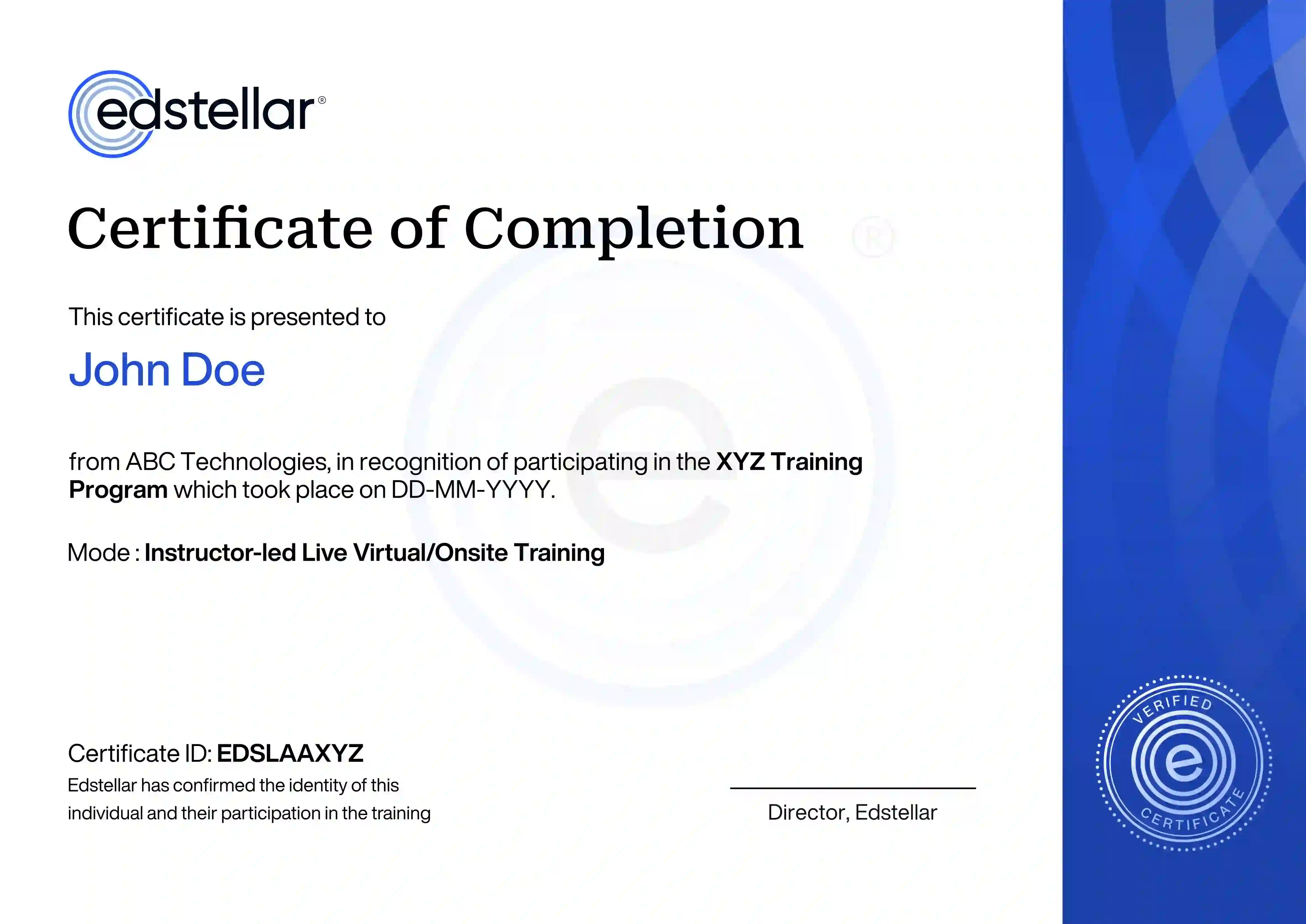
        Get Your Team Members Recognized with Edstellar’s Course Certificate

        Upon successful completion of the training course offered by Edstellar, employees receive a course completion certificate, symbolizing their dedication to ongoing learning and professional development.

        This certificate validates the employee's acquired skills and is a powerful motivator, inspiring them to enhance their expertise further and contribute effectively to organizational success.

        Certificate of Excellence