Drive Team Excellence with Quantitative Investment Decision Corporate Training

Empower your teams with expert-led on-site, off-site, and virtual Quantitative Investment Decision Training through Edstellar, a premier corporate training provider for organizations globally. Designed to meet your specific training needs, this group training program ensures your team is primed to drive your business goals. Help your employees build lasting capabilities that translate into real performance gains.

Quantitative Investment Decision encompasses the systematic application of mathematical, statistical, and computational methods to financial markets, enabling investment professionals to make data-driven portfolio decisions with measurable precision. It spans factor modeling, algorithmic strategy development, risk quantification, and machine learning-driven signal generation to identify and exploit persistent market inefficiencies. This training provides comprehensive knowledge of quantitative frameworks, portfolio optimization techniques, derivatives pricing, alternative data analysis, and performance attribution to build disciplined, evidence-based investment processes.

Edstellar's Quantitative Investment Decision Instructor-led course offers virtual/onsite training options to meet professionals' diverse needs. This flexibility ensures that investment teams and individual practitioners can engage in learning experiences that best suit their logistical and learning preferences. What sets the Edstellar course apart is its emphasis on practical application, with hands-on projects, real market datasets, and strategy simulations that bring quantitative investment concepts to life, equipping professionals with the confidence to deploy live quantitative strategies.

Get Customized Expert-led Training for Your Teams
Customized Training Delivery
Scale Your Training: Small to Large Teams
In-person Onsite, Live Virtual or Hybrid Training Modes
Plan from 2000+ Industry-ready Training Programs
Experience Hands-On Learning from Industry Experts
Delivery Capability Across 100+ Countries & 10+ Languages
""""

Key Skills Employees Gain from Instructor-led Quantitative Investment Decision Training

Quantitative Investment Decision skills corporate training will enable teams to effectively apply their learnings at work.

  • Quantitative Investment Analysis
  • Statistical Modeling for Finance
  • Factor-Based Portfolio Construction
  • Algorithmic Trading Strategy Design
  • Investment Risk Quantification
  • Machine Learning for Financial Signals
  • Backtesting and Performance Attribution

Key Learning Outcomes of Quantitative Investment Decision Training Workshop

Upon completing Edstellar’s Quantitative Investment Decision workshop, employees will gain valuable, job-relevant insights and develop the confidence to apply their learning effectively in the professional environment.

  • Master quantitative investment analysis by applying statistical modeling, factor decomposition, and data-driven frameworks to evaluate and construct high-performing portfolios.
  • Gain expertise in factor-based portfolio construction, optimizing multi-factor models for risk-adjusted returns while controlling for factor crowding and turnover costs.
  • Develop algorithmic trading strategies using systematic signal generation, execution modeling, and walk-forward backtesting to validate profitability across market regimes.
  • Build machine learning pipelines for financial signal generation, applying supervised, unsupervised, and reinforcement learning to derive alpha from complex datasets.
  • Apply quantitative risk management techniques including scenario analysis, stress testing, and CVaR optimization to protect portfolios from tail risk and drawdowns.
  • Master backtesting and performance attribution methodologies, decomposing returns into factor, sector, and security selection effects to drive continuous strategy improvement.

Key Benefits of the Quantitative Investment Decision Group Training

Attending our Quantitative Investment Decision group training classes provides your team with a powerful opportunity to build skills, boost confidence, and develop a deeper understanding of the concepts that matter most. The collaborative learning environment fosters knowledge sharing and enables employees to translate insights into actionable work outcomes.

  • Apply statistical modeling techniques to analyze financial data and identify alpha-generating factors across equity, fixed income, and alternative asset classes.
  • Construct factor-based portfolios using quantitative methods, optimizing for risk-adjusted returns while managing factor exposures and correlation constraints.
  • Design and implement algorithmic trading strategies, including mean reversion, momentum, and statistical arbitrage, with systematic signal generation.
  • Quantify investment risk using Value-at-Risk, Expected Shortfall, and stress testing methodologies to build resilient, drawdown-managed portfolios.
  • Leverage machine learning models including gradient boosting, neural networks, and NLP to generate predictive financial signals from structured and unstructured data.
  • Backtest quantitative strategies using walk-forward analysis, survivorship-bias correction, and transaction-cost modeling to validate performance robustness.
  • Implement options pricing models including Black-Scholes, binomial trees, and Monte Carlo simulation to value derivatives and manage options portfolios.
  • Generate investment signals from alternative data sources including satellite imagery, web-scraped data, and earnings call transcripts for informational edge.
  • Perform attribution analysis to decompose portfolio returns into factor contributions, security selection, and timing effects for performance accountability.
  • Apply regulatory frameworks including MiFID II, SEC rules, and Basel III requirements to ensure compliant and ethical quantitative finance practices.

Topics and Outline of Quantitative Investment Decision Training

Our virtual and on-premise Quantitative Investment Decision training curriculum is structured into focused modules developed by industry experts. This training for organizations provides an interactive learning experience that addresses the evolving demands of the workplace, making it both relevant and practical.

  1. Introduction to Quantitative Finance
    • History and evolution of quantitative investing
    • Quantitative vs. fundamental investing approaches
    • Key mathematical tools and notation
    • Overview of asset classes and market microstructure
  2. Financial Mathematics Essentials
    • Probability theory and stochastic processes
    • Linear algebra for portfolio analysis
    • Calculus applications in finance
    • Time value of money and compounding
  3. Data Structures in Finance
    • Time-series data and panel data concepts
    • Equity, bond, and derivatives market data
    • Data sourcing and vendor platforms
    • Data cleaning and quality control
  4. Return and Risk Measurement
    • Arithmetic vs. geometric returns
    • Volatility and standard deviation calculations
    • Drawdown metrics and maximum drawdown
    • Risk-adjusted performance ratios (Sharpe, Sortino)
  5. Correlation and Covariance Analysis
    • Correlation matrix construction and interpretation
    • Covariance estimation techniques
    • Shrinkage estimators for stability
    • Rolling correlation and regime changes
  6. Python and R for Quantitative Finance
    • Setting up the quant development environment
    • Key libraries: NumPy, pandas, scipy, quantlib
    • Data manipulation and visualization workflows
    • Reproducible research and version control
  1. Descriptive and Inferential Statistics
    • Moments of financial return distributions
    • Hypothesis testing frameworks
    • Confidence intervals and p-values
    • Non-parametric statistical tests
  2. Regression Analysis for Finance
    • Ordinary least squares (OLS) regression
    • Multiple regression and multicollinearity
    • Robust regression techniques
    • Regression diagnostics and assumption testing
  3. Time-Series Modeling
    • Autoregressive (AR) and moving average (MA) models
    • ARIMA and GARCH frameworks
    • Cointegration and error correction models
    • Stationarity testing (ADF, KPSS)
  4. Factor Analysis and PCA
    • Principal component analysis for return decomposition
    • Factor extraction and rotation methods
    • Interpreting latent factors in returns
    • Dimensionality reduction for large datasets
  5. Bayesian Methods in Finance
    • Bayesian inference fundamentals
    • Prior and posterior distribution construction
    • Black-Litterman model as Bayesian framework
    • Bayesian updating for return expectations
  6. Statistical Significance and Multiple Testing
    • Multiple comparison problem in finance
    • Bonferroni and Benjamini-Hochberg corrections
    • t-statistic thresholds for strategy validation
    • Avoiding false discoveries in signal research
  1. Introduction to Factor Investing
    • CAPM and single-factor model foundations
    • Fama-French three and five-factor models
    • Carhart momentum factor
    • Factor premium persistence and cyclicality
  2. Multi-Factor Model Construction
    • Factor selection and validation methodology
    • Cross-sectional factor scoring and ranking
    • Factor combination and composite scoring
    • Factor crowding and capacity constraints
  3. Common Style Factors
    • Value factors: P/E, P/B, EV/EBITDA
    • Momentum factors: price and earnings momentum
    • Quality factors: ROE, earnings stability
    • Low-volatility and size factors
  4. Portfolio Optimization Techniques
    • Mean-variance optimization (Markowitz framework)
    • Black-Litterman model for view integration
    • Risk parity and equal-risk-contribution portfolios
    • Robust optimization under uncertainty
  5. Constraints and Practical Implementation
    • Long-only and long-short portfolio construction
    • Turnover and transaction cost constraints
    • Sector, country, and factor exposure limits
    • Rebalancing frequency and drift management
  6. Portfolio Evaluation Metrics
    • Information ratio and tracking error
    • Alpha generation and benchmark attribution
    • Factor tilt analysis and exposure reporting
    • Comparing realized vs. expected portfolio metrics
  1. Risk Measurement Fundamentals
    • Types of financial risk: market, credit, liquidity
    • Volatility estimation methods (historical, EWMA)
    • Correlation risk and diversification limits
    • Tail risk and fat-tailed distributions
  2. Value-at-Risk and Expected Shortfall
    • Parametric VaR calculation
    • Historical simulation VaR
    • Monte Carlo simulation VaR
    • Expected Shortfall (CVaR) and coherent risk measures
  3. Stress Testing and Scenario Analysis
    • Historical scenario construction (2008, 2020)
    • Hypothetical scenario design and calibration
    • Reverse stress testing methodology
    • Regulatory stress test frameworks
  4. Drawdown Management
    • Maximum drawdown and calmar ratio
    • Drawdown duration and recovery analysis
    • Dynamic position sizing under drawdown
    • Stop-loss and risk limit frameworks
  5. Liquidity Risk Measurement
    • Bid-ask spread and market impact modeling
    • Liquidity-adjusted VaR
    • Asset liquidity scoring and bucketing
    • Funding liquidity and portfolio resilience
  6. Risk Reporting and Governance
    • Risk dashboard design and KRI selection
    • Limit breach escalation procedures
    • Risk attribution by factor and sector
    • Board-level risk reporting standards
  1. Algorithmic Trading Fundamentals
    • Market microstructure and order types
    • Execution algorithms: TWAP, VWAP, implementation shortfall
    • High-frequency vs. low-frequency strategies
    • Regulatory landscape for algorithmic trading
  2. Momentum and Trend-Following Strategies
    • Price momentum signal construction
    • Moving average crossover systems
    • Time-series vs. cross-sectional momentum
    • Trend filter and regime detection
  3. Mean Reversion Strategies
    • Statistical arbitrage and pairs trading
    • Cointegration-based entry and exit rules
    • Bollinger band and z-score signals
    • Half-life of mean reversion estimation
  4. Event-Driven Strategies
    • Earnings announcement alpha capture
    • Merger arbitrage frameworks
    • Earnings surprise and revision signals
    • Short-term catalysts and news-driven signals
  5. Strategy Signal Construction
    • Alpha signal design and normalization
    • Signal decay and half-life analysis
    • Combining signals through IC-weighted composites
    • Signal turnover and transaction cost management
  6. Transaction Cost Modeling
    • Market impact estimation models
    • Bid-ask spread cost modeling
    • Slippage and opportunity cost analysis
    • Net alpha estimation after costs
  1. Derivatives Fundamentals
    • Forward and futures contracts mechanics
    • Swap structures and valuation
    • Options payoff profiles and terminology
    • Put-call parity and no-arbitrage conditions
  2. Black-Scholes-Merton Model
    • Assumptions and derivation overview
    • Closed-form pricing for European options
    • Implied volatility and volatility surface
    • Model limitations and volatility smile
  3. Binomial Tree Models
    • One-period and multi-period binomial models
    • Pricing American options with early exercise
    • Risk-neutral probability calculation
    • Convergence to Black-Scholes
  4. Monte Carlo Methods for Derivatives
    • Simulating asset price paths
    • Pricing path-dependent options (Asian, barrier)
    • Variance reduction techniques
    • Quasi-Monte Carlo and low-discrepancy sequences
  5. Greeks and Risk Management
    • Delta, gamma, vega, theta, and rho
    • Dynamic delta-hedging strategies
    • Portfolio Greeks aggregation
    • Hedging exotic exposures
  6. Volatility Modeling
    • GARCH models for volatility forecasting
    • Stochastic volatility models (Heston)
    • Realized and implied volatility comparison
    • VIX and variance risk premium
  1. Supervised Learning for Return Prediction
    • Linear and logistic regression for signals
    • Decision trees and random forests
    • Gradient boosting (XGBoost, LightGBM)
    • Cross-validation for financial time series
  2. Deep Learning for Financial Data
    • Feedforward neural network architecture
    • Recurrent neural networks and LSTMs for sequences
    • Convolutional networks for pattern recognition
    • Transformer models for financial text
  3. Unsupervised Learning Applications
    • K-means and hierarchical clustering of assets
    • Regime detection with hidden Markov models
    • Autoencoders for anomaly detection
    • Graph-based portfolio clustering
  4. Natural Language Processing for Finance
    • Sentiment analysis on earnings calls and news
    • Topic modeling for thematic signal extraction
    • Named entity recognition in financial documents
    • Large language model applications in research
  5. Reinforcement Learning for Portfolio Management
    • Markov decision process for trading
    • Q-learning and policy gradient methods
    • Reward function design for investment objectives
    • Simulation environments for strategy training
  6. Model Risk and Overfitting Prevention
    • Bias-variance tradeoff in finance
    • Regularization techniques (L1, L2, dropout)
    • Out-of-sample testing and embargo periods
    • Model interpretability and SHAP values
  1. Introduction to Alternative Data
    • Definition and taxonomy of alternative data
    • Data acquisition and licensing considerations
    • Evaluating data vendors and quality
    • MNPI and regulatory compliance for alt data
  2. Web and Social Media Data
    • Web scraping and API data collection
    • Social media sentiment signal construction
    • Google Trends and search volume indicators
    • Online review and rating signals
  3. Satellite and Geospatial Data
    • Satellite imagery for economic activity monitoring
    • Foot traffic and mobility data signals
    • Geospatial feature engineering
    • Night-light data for GDP estimation
  4. Credit Card and Transaction Data
    • Consumer spending signal extraction
    • Revenue nowcasting from card data
    • Same-store sales and category-level trends
    • Data normalization and seasonal adjustment
  5. Earnings Call and Document Analysis
    • Earnings call transcript sentiment scoring
    • Management tone and language change detection
    • 10-K and 10-Q textual analysis
    • Patent and research publication signals
  6. Signal Validation and Alpha Testing
    • Information coefficient (IC) calculation
    • Quantile portfolio analysis for signal testing
    • Signal decay and persistence analysis
    • Correlation with existing factor signals
  1. Backtesting Framework Design
    • Event-driven vs. vectorized backtesting
    • Data pipeline and universe construction
    • Point-in-time data integrity requirements
    • Corporate action adjustments (splits, dividends)
  2. Avoiding Backtesting Biases
    • Survivorship bias identification and correction
    • Look-ahead bias prevention techniques
    • Selection bias and sample construction risks
    • Overfitting and in-sample data mining
  3. Walk-Forward and Out-of-Sample Testing
    • Rolling window walk-forward methodology
    • Train-validation-test split for time series
    • Embargo and purge periods for leakage prevention
    • Robustness checks across market regimes
  4. Strategy Performance Metrics
    • Annualized return, volatility, and Sharpe ratio
    • Calmar ratio and maximum drawdown analysis
    • Win rate, average win/loss, and profit factor
    • Turnover, capacity, and cost-adjusted return
  5. Brinson Performance Attribution
    • Allocation, selection, and interaction effects
    • Sector and country-level attribution
    • Security selection contribution analysis
    • Benchmark-relative attribution reporting
  6. Factor-Based Attribution
    • Factor return decomposition (style, sector, macro)
    • Residual alpha identification
    • Multi-period attribution aggregation methods
    • Attribution reporting for investor communication
  1. Financial Regulation Overview
    • MiFID II requirements for algorithmic trading
    • SEC and FINRA rules for quantitative strategies
    • Basel III capital requirements impact on risk models
    • EMIR and Dodd-Frank derivatives reporting
  2. Market Manipulation and Compliance
    • Prohibited trading practices (spoofing, layering)
    • Surveillance and monitoring requirements
    • Pre-trade risk controls and circuit breakers
    • Compliance documentation for algorithms
  3. Data Privacy and MNPI Compliance
    • Material non-public information rules
    • GDPR and data handling for financial firms
    • Alternative data legal review processes
    • Information barriers and Chinese walls
  4. Model Governance and Validation
    • Model risk management frameworks (SR 11-7)
    • Independent model validation processes
    • Documentation standards for quant models
    • Model change management and approval workflows
  5. Ethical Considerations in Quantitative Finance
    • Fairness and bias in algorithmic decisions
    • Systemic risk and market stability concerns
    • Responsible use of AI in investment management
    • ESG integration in quantitative frameworks
  6. Emerging Regulatory Trends
    • AI governance regulations for financial services
    • Crypto asset regulation and DeFi compliance
    • Climate risk disclosure requirements
    • Cross-border regulatory coordination challenges

Who Can Take the Quantitative Investment Decision Training Course

The Quantitative Investment Decision training program can also be taken by professionals at various levels in the organization.

  • Portfolio Managers
  • Quantitative Analysts
  • Risk Managers
  • Investment Strategists
  • Financial Data Scientists
  • Hedge Fund Professionals

Prerequisites for Quantitative Investment Decision Training

Professionals should have a foundational understanding of financial markets, basic statistics, and familiarity with spreadsheet or programming tools to take the Quantitative Investment Decision training course.

Request a Quote for your Corporate Training Requirements

Valid number

Delivering Training for Organizations across 100 Countries and 10+ Languages

Corporate Group Training Delivery Modes
for Quantitative Investment Decision Training

At Edstellar, we understand the importance of impactful and engaging training for employees. As a leading Quantitative Investment Decision training provider, we ensure the training is more interactive by offering Face-to-Face onsite/in-house or virtual/online sessions for companies. This approach has proven to be effective, outcome-oriented, and produces a well-rounded training experience for your teams.

Virtual Quantitative Investment Decision Training

Edstellar's Quantitative Investment Decision virtual/online training sessions bring expert-led, high-quality training to your teams anywhere, ensuring consistency and seamless integration into their schedules.

With global reach, your employees can get trained from various locations
The consistent training quality ensures uniform learning outcomes
Participants can attend training in their own space without the need for traveling
Organizations can scale learning by accommodating large groups of participants
Interactive tools can be used to enhance learning engagement
On-site Quantitative Investment Decision Training

Edstellar's Quantitative Investment Decision inhouse face to face instructor-led training delivers immersive and insightful learning experiences right in the comfort of your office.

Higher engagement and better learning experience through face-to-face interaction
Workplace environment can be tailored to learning requirements
Team collaboration and knowledge sharing improves training effectiveness
Demonstration of processes for hands-on learning and better understanding
Participants can get their doubts clarified and gain valuable insights through direct interaction
Off-site Quantitative Investment Decision Training

Edstellar's Quantitative Investment Decision offsite face-to-face instructor-led group training offer a unique opportunity for teams to immerse themselves in focused and dynamic learning environments away from their usual workplace distractions.

Distraction-free environment improves learning engagement
Team bonding can be improved through activities
Dedicated schedule for training away from office set up can improve learning effectiveness
Boosts employee morale and reflects organization's commitment to employee development

Explore Our Customized Pricing Package
for
Quantitative Investment Decision Corporate Training

Looking for pricing details for onsite, offsite, or virtual instructor-led Quantitative Investment Decision training? Get a customized proposal tailored to your team’s specific needs.

Request a Group Training Quote
""
How Many Team Members Need Training?
Please select an option or fill in the custom field.
"'

Is Your Corporate Training Requirement Only for Quantitative Investment Decision?

Please select at least one course.
""
Add the List of Training Workshops
search icon

      Please select the course

      No. of Courses selected: 0

      Clear

      Upload a CSV

      Send us your Training Requirements in 3 Easy steps

      1. 1
      2. 2
        Add the required training workshops
      3. 3
        Upload to get a quick quote or email it to contact@edstellar.com

      ""

      Looking for a Complete Package?

      Looking for a one-time pricing option for all your annual training requirements?

      View Corporate Training Packages
      ""
      Select the Option that Best Describes Your Corporate Training Requirement

      Please select an option or choose from the recurring options.
      ""
      Verify and Submit Your Request

      Review Your Corporate Training Selection Summary

      Training Program: Quantitative Investment Decision Training

      1. No of Team Members

      2. Selected Training Preference

      3. Selected Recurring Sessions

      1

      Review your Requirements

      Training Workshops Selected :


        Excel
        File has been
        successfully uploaded.
        Fill the form to submit
 your details
        Submit Your Professional Contact Information
        Valid number
        We've received your enquiry. Our team will be in touch soon.
        Oops! Something went wrong while submitting the form.
        Starter
        120 licences

        Tailor-Made Trainee Licenses with Our Exclusive Training Packages!

        View Package

        64 hours of group training (includes VILT/In-person On-site)

        Tailored for SMBs

        Growth
        320 licences

        Tailor-Made Trainee Licenses with Our Exclusive Training Packages!

        View Package

        160 hours of group training (includes VILT/In-person On-site)

        Ideal for growing SMBs

        Enterprise
        800 licences

        Tailor-Made Trainee Licenses with Our Exclusive Training Packages!

        View Package

        400 hours of group training (includes VILT/In-person On-site)

        Designed for large corporations

        Custom
        Unlimited licenses

        Tailor-Made Trainee Licenses with Our Exclusive Training Packages!

        View Package

        Unlimited duration

        Designed for large corporations

        Edstellar: Your Go-to Quantitative Investment Decision Training Company

        Experienced Trainers

        Our trainers bring years of industry expertise to ensure the training is practical and impactful.

        Quality Training

        With a strong track record of delivering training worldwide, Edstellar maintains its reputation for its quality and training engagement.

        Industry-Relevant Curriculum

        Our course is designed by experts and is tailored to meet the demands of the current industry.

        Customizable Training

        Our course can be customized to meet the unique needs and goals of your organization.

        Comprehensive Support

        We provide pre and post training support to your organization to ensure a complete learning experience.

        Multilingual Training Capabilities

        We offer training in multiple languages to cater to diverse and global teams.

        Testimonials

        What Our Clients Say

        We pride ourselves on delivering exceptional training solutions. Here's what our clients have to say about their experiences with Edstellar.

        "Edstellar's virtual Quantitative Investment Decision training transformed how our research team approaches portfolio construction. Fourteen analysts and portfolio managers completed the program over four weeks, and we saw a 32% improvement in risk-adjusted returns and a 25% reduction in maximum drawdown within the first two quarters of applying the new factor models and backtesting frameworks."

        Ananya Krishnan

        Head of Quantitative Research,

        A Leading Asset Management Firm

        "The onsite Quantitative Investment Decision training from Edstellar enabled our investment team to adopt systematic, evidence-based frameworks at scale. Twenty investment professionals completed the five-day program, resulting in the successful rollout of three quantitative strategies across our equity and multi-asset funds, contributing to a 19% increase in alpha generation over the following six months."

        James Okafor

        Chief Investment Officer,

        A Global Multi-Asset Investment House

        "Edstellar's intensive off-site Quantitative Investment Decision program gave our team the depth and practical tools to move from concept to live deployment in under 90 days. Our risk and portfolio teams designed, backtested, and launched their first live quantitative strategy, achieving a Sharpe ratio of 1.4 and reducing portfolio drawdowns by 28% within the first quarter of operation."

        Sofia Marchetti

        Risk Director,

        A European Institutional Investment Manager

        "Edstellar's Management training programs have greatly improved our teams' ability to lead with clarity, confidence, and operational efficiency. The sessions combine practical leadership frameworks, real-world case studies, and hands-on exercises that strengthen decision-making, cross-functional collaboration, and execution excellence across departments, driving measurable improvements in overall business performance."

        Meera Rao

        HR & L&D Head,

        A Global Services Company

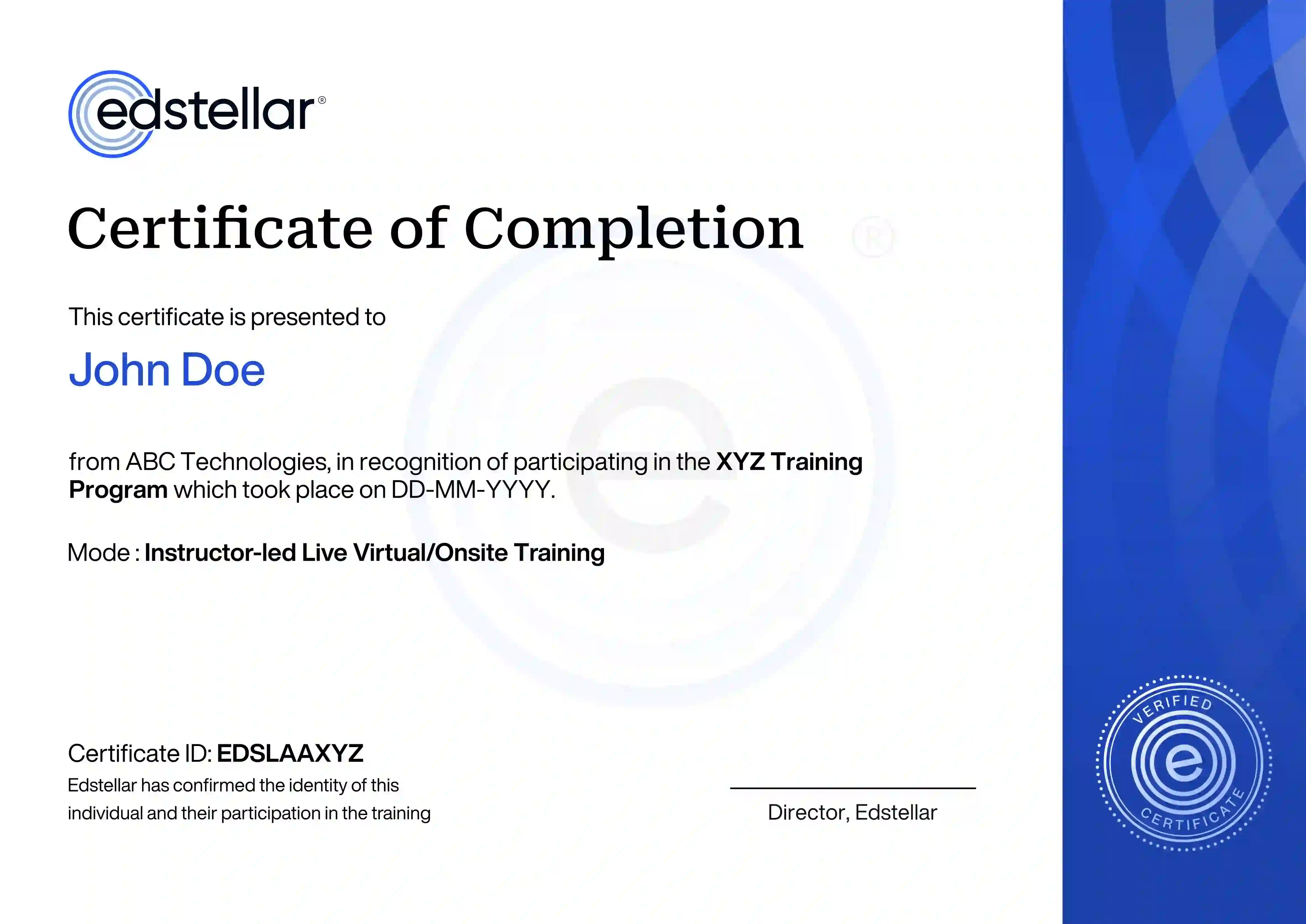
        Get Your Team Members Recognized with Edstellar’s Course Certificate

        Upon successful completion of the training course offered by Edstellar, employees receive a course completion certificate, symbolizing their dedication to ongoing learning and professional development.

        This certificate validates the employee's acquired skills and is a powerful motivator, inspiring them to enhance their expertise further and contribute effectively to organizational success.

        Certificate of Excellence

        Other Related Corporate Training Courses