A curated list of the most in-demand skills in Bahrain, compiled by a leadership trainer and certified coach with 25+ years of experience in technology, leadership, and organizational transformation across the banking sector.
Bahrain's economy is diversifying at pace under Economic Vision 2030, yet the Kingdom records 35,000–45,000 job openings annually across key private-sector industries while expatriates still comprise approximately 80% of the employed population. The ICT market is growing at 6.7% annually with over 15,000 new technology positions expected, Cloud Engineer and AI/ML Engineer were the two fastest-growing job titles in Bahrain in 2025 (78% and 64% year-over-year growth respectively according to LinkedIn's MENA Workforce Report), and the financial services sector positions Bahrain as the GCC's leading fintech hub.
The National Plan for Labour Market Regulation 2023–2026 targets employment of 20,000 Bahrainis and training of 10,000 job seekers annually, yet skills gaps in IT, digital transformation, finance, and engineering continue to limit the pace at which the economy can absorb national talent. For corporate L&D leaders and HR managers operating in the Gulf's most diversified small economy, these numbers translate directly into urgent training priorities.
Several structural forces are intensifying this demand. Tamkeen, the national Labour Fund, supported 23,000 Bahrainis in 2023 alone, with over 12,000 receiving employment support, and the government is building a future-ready workforce through three strategic approaches: accelerating female participation, investing in digital skills, and aligning education with employer needs. Bahrain's fintech ecosystem, anchored by the Central Bank of Bahrain's FinHub 973 (the region's first cross-border digital innovation platform), is attracting digital payment companies and blockchain startups.
The healthcare sector is expanding to meet chronic disease demand, tourism is adding roles as visitor numbers rise, and the Sitra and Hidd Industrial Zones drive engineering and manufacturing employment. With Bahrainisation quotas varying by sector and all salaries tax-free, organisations face the dual challenge of developing local talent while recruiting international specialists for shortage occupations.
So which skills are truly driving Bahrain's economy, and where should organisations invest their training budgets? This guide breaks down the top 10 skills in demand in Bahrain, spanning fintech, cybersecurity, AI, healthcare, and industrial engineering. Drawing on LMRA labour data, CBB fintech reports, Tamkeen workforce analysis, and industry salary benchmarks, it provides an evidence-based picture of what jobs are in demand in Bahrain, whether you are planning corporate upskilling programmes, supporting Bahrainisation compliance, or building workforce strategies for the GCC's most fintech-forward economy.
Sources Behind This Research
Every ranking in this guide is backed by data from Bahraini government bodies, industry associations, and established hiring platforms.
Government
Labour Market Regulatory Authority (LMRA)
National Plan for Labour Market Regulation 2023–2026
Set targets of 20,000 Bahraini employments and 10,000 trained job seekers annually. Manages Bahrainisation quotas, work permit issuance, and labour market data including the 80% expatriate share of employment.
Outlined three strategic approaches to tackling the global talent shortage: accelerating female workforce participation, investing in digital skills, and aligning education with employer needs. Drives investment attraction across technology, fintech, and healthcare sectors.
Established the region's first cross-border digital innovation platform connecting financial institutions with fintechs. Operates the regulatory sandbox enabling product testing under real-world conditions with CBB supervision.
Supported 23,000 Bahrainis in 2023 with 12,000+ receiving employment support. Funds skills development, enterprise support, and career development programmes aligned with Economic Vision 2030 diversification priorities.
3 Ways Bahrain is Building a Future-Ready Workforce (Jan 2026)
Profiled Bahrain's workforce development strategy including female participation acceleration (women now comprise 40%+ of the national workforce), digital skills investment, and education-employer alignment as a model for small economies.
Documented the GCC's leading fintech hub status, CBB's regulatory sandbox operations, FinHub 973 cross-border platform, and the ecosystem of digital payment, blockchain, and insurtech companies establishing Bahrain operations.
Reported 35,000–45,000 annual job openings, 6.1% unemployment trending to 5.8%, and sector-level demand across IT, healthcare, engineering, finance, logistics, and education. Confirmed Business Intelligence Analysts among fastest-growing occupations.
Bahrain Tech Jobs & Cybersecurity Salary Guides 2025–2026
Provided salary benchmarks: AI engineers up to BHD 10,000 monthly, cybersecurity specialists BHD 1,500–3,000, software developers BHD 1,200–2,200. Confirmed Cloud Engineer and AI/ML Engineer as fastest-growing job titles (78% and 64% YoY).
"As technology and AI continue to reshape the workplace, technical expertise alone is no longer enough. The professionals who will thrive are those who can think critically, adapt quickly, communicate effectively, and lead themselves as well as others. In my experience, self-awareness, emotional intelligence, and continuous learning are no longer soft skills; they are essential skills for navigating an increasingly complex and fast-changing world."
Reem Marhoon
✓ Leadership trainer, certified leadership coach, and former banking executive with 25+ years of experience in technology, leadership, and organizational transformation, helping professionals build self-awareness, emotional intelligence, and leadership effectiveness.
10 Key Skills in Demand Across Bahrain's Job Market
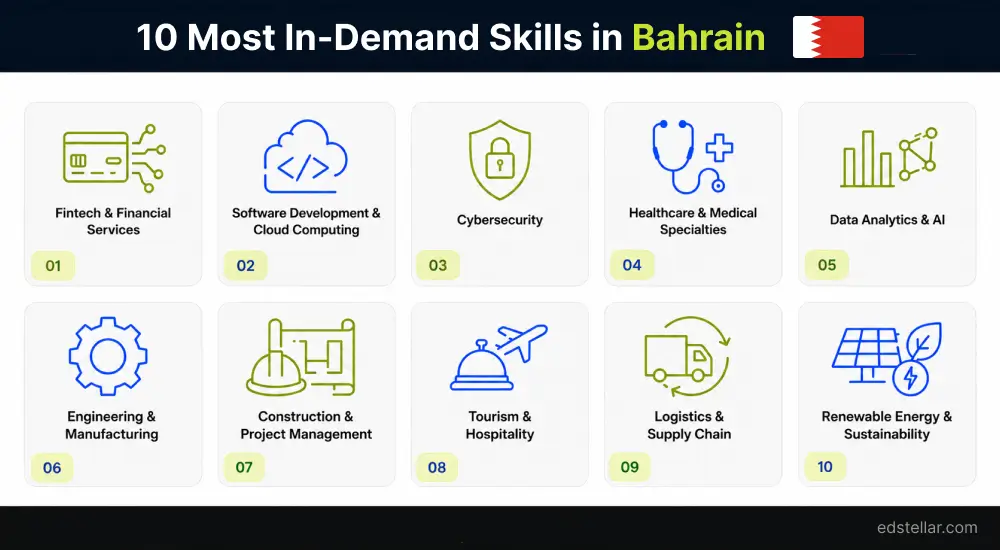
Bahrain's skills landscape in 2026 reflects a compact Gulf economy that has diversified further than most of its neighbours, with financial services, technology, manufacturing, and tourism all contributing meaningfully alongside the traditional hydrocarbon sector. The 10 skills below span fintech, cybersecurity, healthcare, industrial engineering, and hospitality, mirroring the sectors where government investment, employer demand, and Bahrainisation pressure are highest.
1
Fintech & Financial Services
Research Score: 9.15/10
Bahrain positions itself as the GCC's leading fintech hub, anchored by the Central Bank of Bahrain's FinHub 973, the region's first cross-border digital innovation platform connecting financial institutions with fintechs under central bank supervision. The CBB's dedicated Fintech and Innovation Unit operates a regulatory sandbox enabling startups to test products under real-world conditions, and the framework has attracted digital payment companies, blockchain startups, and insurtech firms from across the Gulf and beyond. Bahrain's expanding healthcare system, its fintech leadership, and ongoing infrastructure projects are the major factors driving demand for skilled international workers.
Financial services remain a cornerstone of Bahrain's economy, with the banking sector including both conventional and Islamic finance institutions. Bahrain Islamic Bank, Ahli United Bank, National Bank of Bahrain, and the regional operations of HSBC, Standard Chartered, and Citibank all hire compliance officers, risk analysts, relationship managers, and digital banking specialists. The convergence of traditional banking with fintech is creating hybrid roles in open banking, digital payments, and regulatory technology that require both financial regulation knowledge and technology architecture expertise.
Bahrainisation in financial services is among the more advanced sectors, creating strong demand for Bahraini nationals with combined finance and technology skills. Tamkeen funds training programmes specifically designed to prepare Bahrainis for careers in banking, compliance, and fintech. For finance professionals, Bahrain's compact ecosystem offers broad exposure across multiple financial disciplines, with tax-free salaries and the CBB's progressive regulatory framework providing career advantages unique to the Kingdom.
Key Sub-skills
Digital Payments & Open BankingRegulatory Compliance & AMLIslamic Finance & Shariah ComplianceBlockchain & Digital Asset ManagementRisk Management & Financial Analysis
Cloud Engineer and AI/ML Engineer were the two fastest-growing job titles in Bahrain at 78% and 64% year-over-year growth respectively, and the ICT market is growing at 6.7% annually with over 15,000 new positions expected. Software developers earn BHD 1,200–2,200 monthly, and cloud engineers with AWS, Azure, or GCP expertise command premiums that reflect the severe supply-demand imbalance in the compact Bahraini market. The average IT salary ranges from BHD 18,000–24,000 annually, with experienced professionals earning up to BHD 29,000 and CTO-level roles exceeding BHD 4,000 monthly.
Bahrain's digital transformation spans government e-services (the government was an early adopter of e-governance in the GCC), banking digitisation, fintech platform development, and smart city initiatives. The demand for DevOps, software development, and data analytics professionals is driven by automation, efficiency, and scalability requirements across every sector. Bahrain's compact size means that developers often work across fintech, government, and industrial clients simultaneously, gaining breadth of experience unusual for a single market.
Major employers include Bahrain's banking sector (technology divisions), telecommunications companies (Batelco, STC Bahrain, Zain), government digital agencies, and the growing number of international tech firms attracted by Bahrain's business-friendly environment. For international developers, Bahrain offers tax-free salaries, English as the primary business language, and a cost of living below Dubai and Qatar. All IT salaries are tax-free, with additional benefits typically including housing and transport allowances.
Key Sub-skills
Full-Stack Development (React, Node.js, Python)AWS / Azure / Google Cloud ArchitectureDevOps & CI/CD AutomationMobile App DevelopmentAI & Machine Learning Engineering
Cybersecurity specialists earn BHD 1,500–3,000 monthly in Bahrain, with over 120 cybersecurity positions currently listed and the market growing at 9.21% through 2029. Bahrain's concentration of banking operations, fintech platforms, and government digital services creates a cybersecurity demand profile that exceeds what its small population can supply domestically. The Kingdom's position as a GCC financial hub means that cyber threats targeting banking infrastructure, digital payment systems, and customer data are constant and growing in sophistication.
Entry-level cybersecurity salaries of BHD 6,000–14,400 annually are significantly above average for new graduates, reflecting the premium the market places on security skills at every experience level. Cybersecurity skills in cloud security, threat intelligence, and GRC are in particular demand as the CBB tightens compliance requirements and the government implements its National Cybersecurity Strategy. CISSP, CISM, and CEH certifications carry salary premiums that can significantly exceed the cost of obtaining them.
Key employers include the banking sector (NBB, Ahli United, BisB), Batelco, the National Centre for Cyber Security, and the growing number of managed security service providers operating in Bahrain. For IT professionals considering a career transition, cybersecurity offers one of the highest-return pathways in the Bahraini market, with structured training available through international certification programmes and Tamkeen-funded skills development initiatives.
"Having a future-ready workforce that can handle growing production demands and the shift in technological requirements requires a strategy that includes upskilling and reskilling employees to adapt to new technologies. We are strengthening our talent pool through cross-training initiatives and enhancing our internship programmes to bridge the gap between academia and the industry."
Bahrain's healthcare sector is expanding with high demand for doctors, nurses, and pharmacists to meet rising healthcare needs driven by an aging population and increasing chronic disease prevalence. Medical specialties in particular demand include internal medicine, cardiology, oncology, orthopaedics, paediatrics, emergency medicine, radiology, and anaesthesia. Allied health professionals including physiotherapists, laboratory technicians, pharmacists, and radiographers are also needed. Due to the rising prevalence of diabetes, mental health conditions, and rehabilitation needs, specialists in these areas see strong and growing job opportunities.
Bahrain's healthcare system serves both the national population and the growing expatriate community, with Salmaniya Medical Complex, King Hamad University Hospital, and Bahrain Defence Force Hospital anchoring the public system alongside private providers including Royal Bahrain Hospital, American Mission Hospital, and Gulf Dental Specialty Hospital. The government's healthcare expansion includes new facilities and digital health investments that require professionals with both clinical expertise and technology skills.
For international healthcare professionals, Bahrain offers structured licensing through the National Health Regulatory Authority (NHRA), tax-free salaries, and comprehensive benefits packages including housing and annual flights. The Kingdom's compact geography means that all healthcare facilities are within easy reach, and the English-speaking clinical environment removes language barriers common in other Gulf states. Healthcare Bahrainisation is progressing, with Tamkeen funding nursing and allied health training for Bahraini nationals.
Key Sub-skills
Specialist Medicine (Cardiology, Oncology, Diabetes)Critical Care & Emergency NursingAllied Health (Physiotherapy, Radiology, Pharmacy)Healthcare Informatics & Digital HealthMental Health & Rehabilitation
Top Industries
Government Hospitals (Salmaniya, King Hamad), Private Healthcare Groups, Primary Health Centres, Pharmaceutical
Business Intelligence Analysts are among the fastest-growing occupations in Bahrain, and AI engineers command salaries reaching up to BHD 10,000 monthly for experienced professionals. The demand for AI talent has surged across finance, healthcare, and logistics, with 43% of companies reporting increased need for AI-related abilities. Bahrain's banking sector needs analytics professionals for credit risk modelling, fraud detection, and customer segmentation, while the government's digital transformation creates demand for data analysts who can turn public service data into policy insights and operational improvements.
The intersection of data analytics with Bahrain's fintech leadership is particularly significant. Every digital payment transaction, mobile banking interaction, and open banking API call generates data that requires skilled professionals to analyse, protect, and monetise. The CBB's FinHub 973 platform creates regulatory technology demand that combines data analytics with compliance expertise, and the growing insurtech sector needs actuaries and data scientists who can build pricing models and risk assessment algorithms.
Python, SQL, R, Tableau, Power BI, and cloud-based analytics platforms are the core technical requirements. For mid-career professionals transitioning from business or finance roles, data analytics represents one of the strongest reskilling pathways in the Bahraini market, with Tamkeen providing funding for qualifying training programmes. The compact market means that data professionals gain cross-sector experience that builds rapidly, with financial services, government, healthcare, and logistics analytics all accessible within a single career.
Key Sub-skills
Machine Learning EngineeringData Visualisation (Tableau, Power BI)SQL & Python for Data AnalysisBusiness Intelligence & ReportingPredictive Analytics & Financial Modelling
Top Industries
Banking & Financial Services, Government Digital, Fintech & Insurtech, Healthcare
Get a custom training plan from Edstellar's 5,000+ expert trainers. Virtual or onsite delivery across Manama, Riffa, Muharraq, Isa Town, and beyond.
Request a Free Consultation →
6
Engineering & Manufacturing
Research Score: 7.90/10
Bahrain's industrial base spans oil refining (BAPCO), aluminium smelting (Alba, one of the world's largest smelters), steel fabrication, and petrochemicals, creating sustained demand for mechanical, electrical, chemical, and process engineers. The Sitra Industrial Zone offers oil and gas support services and manufacturing opportunities, while the Hidd Industrial Area has high demand for engineering, manufacturing, logistics, and technical jobs. Structural steel fabrication capacity is expected to exceed 500,000 tonnes annually, boosting infrastructure and industrial employment.
Alba (Aluminium Bahrain) is one of the Kingdom's largest employers and a global top-five aluminium smelter, requiring metallurgists, process engineers, maintenance specialists, and quality assurance professionals. BAPCO's refinery operations and the downstream petrochemical sector add energy engineering demand. The gradual integration of Industry 4.0 technologies, including automation, IoT sensors, and predictive maintenance systems, is creating hybrid roles where traditional industrial engineering intersects with digital technology.
For engineering graduates, Bahrain's industrial sector offers stable careers in one of the Gulf's most established manufacturing economies. Bahrainisation targets in manufacturing and industrial sectors are creating pathways for national engineers, with Tamkeen and the Bahrain Polytechnic providing technical training. The combination of oil and gas, aluminium, and fabrication within a compact geography gives engineers broad industrial exposure that builds versatile careers.
Bahrain's ongoing infrastructure development, including road networks, housing projects, and commercial real estate, creates sustained demand for civil engineers, project managers, quantity surveyors, and skilled tradespeople. The Kingdom's diversification strategy includes tourism infrastructure (new hotels and entertainment venues), industrial zone expansion, and renewable energy installations that all require construction professionals. The structural steel fabrication sector's growth to 500,000+ tonnes annually drives both industrial construction and the supporting trades.
Bahrain's compact geography and established regulatory framework mean that construction projects operate under well-defined building codes and safety standards, with the Works Affairs Ministry overseeing infrastructure quality. Project managers who can deliver across residential, commercial, and industrial projects while managing Bahrainisation requirements and multinational contractor coordination are consistently among the hardest roles to fill.
For international construction professionals, Bahrain offers tax-free compensation, a central Gulf location, and year-round construction activity. The market is smaller than Dubai or Saudi Arabia but offers more accessible project scales and less competition for senior positions. Electricians, plumbers, welders, and HVAC technicians face persistent demand, with wages reflecting the competition for skilled tradespeople across the broader GCC region.
Tourism and hospitality are adding new roles in Bahrain as visitor numbers rise, driven by the Kingdom's positioning as the Gulf's most accessible leisure destination with its proximity to Saudi Arabia (connected by the King Fahd Causeway), Formula 1 Grand Prix, and growing entertainment and cultural offerings. Hotels, restaurants, event venues, and the emerging MICE segment all require trained hospitality professionals who can deliver international-standard service to a diverse visitor base spanning Saudi weekend visitors, European tourists, and regional business travellers.
Bahrain's hotel sector includes international brands (Four Seasons, Ritz-Carlton, Hilton, Marriott) alongside local operators, and the growing restaurant and nightlife scene creates food and beverage management demand. The combination of cultural tourism (Bahrain Fort UNESCO site, Muharraq heritage quarter), sporting events (F1, football), and entertainment creates a diversified hospitality market that offers year-round employment rather than purely seasonal patterns.
For young Bahrainis, tourism offers accessible career entry points with structured progression, and Tamkeen funds hospitality training programmes aligned with Bahrainisation targets. The bilingual Arabic-English market requires hospitality professionals who can serve both regional and international guests with cultural sensitivity and service excellence. The compact island means that all tourism venues are within easy commuting distance, making the sector particularly accessible for local workers.
Key Sub-skills
Hotel Operations ManagementFood & Beverage ManagementEvent Management & MICEGuest Experience & Service ExcellenceRevenue Management & Tourism Marketing
Logistics and supply chain roles are growing in Bahrain due to the Kingdom's strong transport infrastructure, strategic location in the Gulf, and positioning as a trade gateway connecting the GCC markets. The procurement and supply chain sector is experiencing steady growth driven by economic diversification and expanding construction, retail, logistics, and energy sectors. Khalifa Bin Salman Port and Bahrain International Airport serve as the Kingdom's trade infrastructure backbone, requiring port operations, freight management, and customs compliance professionals.
The aluminium export supply chain (Alba is one of the world's largest smelters), oil and gas logistics, and the distribution networks serving Bahrain's retail and hospitality sectors all require supply chain professionals. The growing e-commerce market, while smaller than in larger Gulf states, is driving last-mile delivery and warehouse management demand. The connection to Saudi Arabia via the King Fahd Causeway creates unique cross-border logistics requirements that distinguish Bahrain's supply chain market from isolated island economies.
For supply chain professionals, Bahrain offers tax-free compensation, a compact and manageable logistics network, and cross-sector experience across manufacturing, financial services, retail, and energy. The Kingdom's role as a regional hub for aluminium trading and financial services creates niche logistics specialisations in precious metals, financial documents, and high-value cargo management.
Bahrain is gradually expanding its renewable energy footprint, with solar energy, environmental engineering, energy auditing, green building design, and sustainability consulting identified as growth areas under Economic Vision 2030. While the Kingdom's hydrocarbon sector remains dominant, the government recognises that long-term economic sustainability requires clean energy investment and workforce development. Technicians skilled in installing and maintaining renewable energy systems are beginning to see employment opportunities as solar projects scale.
ESG reporting, carbon accounting, and sustainability strategy are emerging demand areas as Bahrain's financial services sector and listed companies face growing international disclosure expectations. The Bahrain Bourse's ESG guidelines and the growing focus on sustainable finance across the GCC create compliance and advisory demand. Alba's sustainability initiatives and BAPCO's energy efficiency programmes add industrial sustainability roles to the skill requirements.
For professionals in energy, engineering, or environmental science, the renewable energy sector in Bahrain is at an earlier stage than in the UAE or Saudi Arabia, meaning early movers can establish themselves in a growing market before competition intensifies. The combination of traditional energy expertise with emerging clean technology creates career pathways that leverage existing industrial knowledge while positioning professionals for the long-term energy transition.
Key Sub-skills
Solar PV System Design & InstallationESG Reporting & Carbon AccountingEnergy Auditing & EfficiencyGreen Building Design & LEEDSustainability Consulting & Strategy
Top Industries
Energy (BAPCO Sustainability), Industrial (Alba ESG), Financial Services (Green Finance), Government & Policy
"Skill development is not a destination, it is an endless road. Every mistake gives you an opportunity to learn, and every time you practice, you become more confident and capable. Progress does not come from being perfect; it comes from continuing to move forward."
Ossama Jabri
Founder & Corporate Trainer, Jabri Training · Al-Hidd, Bahrain
Top 10 high-demand job occupations in Bahrain covering the most sought-after roles and career opportunities in Manama.
Skills Demand Across Bahrain's Key Economic Sectors
Bahrain's compact geography (780 km²) means skills demand is best understood by sector rather than region, though Manama's financial district, the industrial zones in Sitra and Hidd, and the tourism belt across Seef and Amwaj each have distinct employment profiles.
Financial services and technology dominate high-value employment in Manama, with the CBB's progressive regulatory framework and FinHub 973 creating a fintech ecosystem unique in the GCC. Industrial employment concentrates in Sitra and Hidd, where Alba and BAPCO anchor manufacturing, while tourism and hospitality roles distribute across Seef, Amwaj, and the Bahrain Bay waterfront. For organisations operating across sectors, the key insight is that Bahrain's compact market creates talent competition between sectors: a cybersecurity professional is equally valuable to a bank, a fintech, and an industrial company, making retention strategies as important as recruitment.
How to Develop These Skills in Demand in Bahrain
Bahrain's skills challenge is defined by an economy that has diversified more successfully than most Gulf neighbours, creating demand across fintech, manufacturing, healthcare, and tourism that a population of 1.5 million cannot supply without structured workforce development. With 35,000–45,000 annual job openings, 80% expatriate employment, and Bahrainisation targets requiring 20,000 national hires annually, organisations need a systematic approach to build both local and international talent. Here is how to approach it.
Start with a skills audit. Use a structured training needs analysis to map your current team capabilities against the skills your business needs over the next 12 to 24 months. Focus on the gaps that directly affect Bahrainisation compliance, fintech delivery, and industrial operations. With 35,000 to 45,000 job openings annually and the National Plan for Labour Market Regulation mandating 20,000 national hires per year, identifying your organisation's specific mismatches is essential before committing training budgets.
Build individual development plans. Generic training programmes produce generic results. Use individual development plan templates to tailor learning pathways to each employee's current skills and career trajectory. A Bahraini national entering the fintech compliance pipeline at a CBB-licensed institution has different development needs than a process engineer at ALBA or BAPCO, even though both are central to Bahrain's diversification priorities under Economic Vision 2030.
Combine certifications with applied learning. International certifications (ACAMS, CFA, AWS, PMP, CISSP) carry significant weight in the Bahrain market, particularly with financial regulators and GCC employers, and command strong salary premiums in an economy where Cloud Engineer and AI/ML Engineer roles grew 78% and 64% year-over-year. However, applied projects and instructor-led workshops build the practical capability that certifications alone cannot provide. The most effective programmes pair certification preparation with hands-on exercises drawn from Bahrain-specific scenarios, particularly in Islamic fintech, CBB open banking compliance, and industrial process engineering where local regulatory context matters.
Address performance gaps systematically. A guide to understanding performance gaps can help managers distinguish between skill deficits, inadequate tooling, and process failures before investing in training. A fintech compliance team missing CBB reporting deadlines may need RegTech tooling and process redesign rather than another compliance workshop, while an industrial engineering team at ALBA or BAPCO with rising defect rates may need Lean Six Sigma training rather than general quality awareness programmes.
Leverage Tamkeen co-funding and Bahrain's national training institutions. Tamkeen subsidises training costs and provides wage support for Bahraini employees across fintech, ICT, manufacturing, and healthcare. Companies that build structured, multi-module training programmes gain more from Tamkeen's funding cycles while creating the compliance evidence trail regulators expect when assessing Bahrainisation performance. The Bahrain Institute of Banking and Finance (BIBF) and Bahrain Polytechnic offer additional certified pathways that integrate directly into employer-funded development plans across the Kingdom's priority sectors.
Bahrain's economic trajectory, driven by the GCC's leading fintech ecosystem, ICT growth at 6.7% annually, healthcare expansion, and industrial diversification around aluminium and petrochemicals, signals that demand for skilled professionals will only intensify. Organisations that build their training strategies around these national priorities, supported by a catalogue of over 2,000 instructor-led courses, will be better positioned to attract and retain talent in the Gulf's most diversified small economy.
Frequently Asked Questions
What skills are in high demand in Bahrain?
The most in-demand skills in Bahrain for 2026 include fintech and financial services, software development and cloud computing, cybersecurity, healthcare and medical specialties, data analytics and AI, engineering and manufacturing, construction and project management, tourism and hospitality, logistics and supply chain, and renewable energy and sustainability. Fintech leads due to Bahrain's position as the GCC's leading fintech hub with CBB's FinHub 973, while Cloud Engineer and AI/ML Engineer were the two fastest-growing job titles at 78% and 64% year-over-year growth.
What jobs are in demand in Bahrain in 2026?
The highest-demand jobs in Bahrain for 2026 include fintech developers, compliance officers, cloud engineers, AI/ML engineers, cybersecurity specialists, software developers, doctors (cardiology, oncology, diabetes), registered nurses, data analysts, process engineers, project managers, hotel managers, and supply chain coordinators. Bahrain records 35,000 to 45,000 annual job openings, with over 15,000 new technology positions expected and the ICT market growing at 6.7% annually.
What are the highest paying jobs in Bahrain?
AI engineers earn up to BHD 10,000 monthly, cybersecurity specialists earn BHD 1,500 to 3,000, software developers earn BHD 1,200 to 2,200, and CTO-level roles exceed BHD 4,000 monthly. IT professionals earn BHD 18,000 to 29,000 annually. Financial services, senior healthcare, and engineering roles also offer strong compensation. All salaries in Bahrain are tax-free, with additional benefits typically including housing allowances, transport, health insurance, and annual flights.
How do I get a job in Bahrain as a foreigner?
Foreign professionals access Bahrain's job market through employer-sponsored work permits managed by the LMRA. Technology, healthcare, engineering, financial services, and hospitality are the sectors most actively hiring expatriates. Bahrain has a more relaxed business environment than some Gulf neighbours, with English widely used in business. The Flexi Permit allows certain categories of workers to sponsor themselves. Bahrainisation quotas vary by sector, so some industries have more expatriate openings than others. International certifications (AWS, CISSP, CFA, PMP) strengthen applications, and GCC experience is valued but not always required.
What is Bahrainisation and how does it affect hiring?
Bahrainisation is the policy requiring private sector companies to employ Bahraini nationals at specified quotas. The National Plan for Labour Market Regulation 2023 to 2026 targets employment of 20,000 Bahrainis and training of 10,000 job seekers annually. Tamkeen supports employers through training subsidies, wage support, and career development funding. Quotas vary by sector, with financial services and telecommunications having higher requirements while technology and healthcare offer more flexibility. Companies meeting Bahrainisation targets receive benefits including reduced work permit fees, while non-compliance incurs penalties.
Are salaries in Bahrain tax-free?
Yes, Bahrain does not impose personal income tax on employment income, making gross salary equal to net salary. A 5% VAT applies to goods and services but not to wages. In addition to tax-free base pay, many employers provide housing allowances, transport allowances, health insurance, annual return flights, and end-of-service benefits. The cost of living is generally lower than in Dubai, Abu Dhabi, or Qatar, making the combination of tax-free income and moderate living costs attractive for international professionals.
Why is Bahrain a GCC fintech leader?
Bahrain's fintech leadership rests on three pillars: the CBB's progressive regulatory framework including the first central bank regulatory sandbox in the Middle East, FinHub 973 as the region's first cross-border digital innovation platform, and the Kingdom's established banking sector (conventional and Islamic) providing a foundation for fintech partnerships. The combination of regulatory clarity, open banking infrastructure, and a well-educated bilingual workforce makes Bahrain attractive for fintech companies seeking a GCC base. Major banks actively collaborate with fintechs through the CBB's innovation unit, creating a cooperative rather than competitive ecosystem.
What kind of jobs are available in Bahrain for foreigners?
Foreign professionals make up approximately 80% of employed workers in Bahrain and are recruited across virtually every sector. The most common roles include technology and fintech development (at banks, CBB-licensed fintechs, and telecoms), engineering (at Alba aluminium, BAPCO refinery, and fabrication companies), healthcare (doctors, nurses, and pharmacists at government and private hospitals), financial services (at banks, fund administrators, and insurance companies), construction (at infrastructure and real estate projects), and hospitality (at international hotel brands). Expatriate employment is the norm in the private sector, though Bahrainisation quotas determine the national-to-expatriate ratio requirements by sector.
Conclusion
Bahrain's skills landscape in 2026 is defined by a compact Gulf economy that has diversified more successfully than most of its neighbours, creating demand across fintech, technology, healthcare, manufacturing, and tourism that its 1.5 million population cannot satisfy without structured workforce development. With Cloud Engineer job titles growing 78% year-over-year, AI engineers earning up to BHD 10,000 monthly, the CBB operating the region's most progressive fintech regulatory framework, and 35,000–45,000 job openings recorded annually, the gap between what the economy demands and what the domestic talent pool delivers remains the central challenge for every HR leader in the Kingdom.
The ten skills in demand in Bahrain covered in this guide represent the intersection of Economic Vision 2030's diversification agenda and acute market need. From fintech and cybersecurity driving the GCC's most innovative financial ecosystem, through healthcare serving a growing population, manufacturing anchored by one of the world's largest aluminium smelters, and tourism leveraging the Kingdom's accessibility and entertainment offerings, each skill area offers clear returns on training investment. The organisations that close their skills gaps fastest will be the ones that attract talent, meet Bahrainisation targets, and lead their industries in the Gulf's most diversified small economy.
Ready to Upskill Your Bahrain Team?
Join 500+ organisations that trust Edstellar's Training Needs Analysis to find the gaps, pick the right skills, and build a training plan that works.
Reem Marhoon is a leadership trainer, certified leadership coach, and former banking executive with over 25 years of experience in technology, leadership, and organizational transformation.
Explore High-impact instructor-led training for your teams.
Unlock premium resources, tools, and frameworks designed for HR and learning professionals. Our L&D Hub gives you everything needed to elevate your organization's training approach.
.svg "edstellar")


















.svg "Click Here to Follow on Medium")
.svg)



.svg)


.svg)
.svg)
.svg)

.svg)