Join 25 Global CEOs (Exclusive CEO Retreat) - Leading the Change - Mallorca, Spain · 20th–24th May 2026
Know More
X

Drive Team Excellence with Fundamentals of Remote Sensing Corporate Training

Empower your teams with expert-led on-site, off-site, and virtual Fundamentals of Remote Sensing Training through Edstellar, a premier corporate training provider for organizations globally. Designed to meet your specific training needs, this group training program ensures your team is primed to drive your business goals. Help your employees build lasting capabilities that translate into real performance gains.

Remote sensing is the process of collecting data about the Earth's surface or atmosphere from a distance, typically using satellites, aircraft, drones, or other remote platforms. Remote sensing enables organizations to monitor environmental changes, enabling informed decisions for sustainable resource management. Additionally, it enhances disaster preparedness and response by detecting natural hazards early and facilitating proactive measures. The Fundamentals of Remote Sensing training enables employees to navigate remote sensing platforms, interpret satellite and aerial imagery, and understand image processing and analysis techniques.

The Fundamentals of Remote Sensing instructor-led training course provided by Edstellar can be customized to meet the teams’ requirements. The virtual/onsite Fundamentals of Remote Sensing training course led by expert trainers ensures that employees understand the basics of remote sensing, enabling them to collect, interpret, and analyze data accurately.

Get Customized Expert-led Training for Your Teams
Customized Training Delivery
Scale Your Training: Small to Large Teams
In-person Onsite, Live Virtual or Hybrid Training Modes
Plan from 2000+ Industry-ready Training Programs
Experience Hands-On Learning from Industry Experts
Delivery Capability Across 100+ Countries & 10+ Languages
""""

Key Skills Employees Gain from instructor-led Fundamentals of Remote Sensing Training

Fundamentals of Remote Sensing skills corporate training will enable teams to effectively apply their learnings at work.

  • Image Interpretation
    Image Interpretation is the ability to analyze and understand visual data, such as medical images or satellite photos. This skill is important for roles in healthcare, remote sensing, and research, as it enables accurate diagnosis, effective decision-making, and informed analysis.
  • Data Analysis
    Data Analysis is the process of inspecting, cleansing, and modeling data to discover useful information. This skill is important for roles like data scientist and business analyst, as it drives informed decision-making and strategy development.
  • Remote Sensing Platforms
    Remote Sensing Platforms involve using satellite or aerial technology to collect data about the Earth's surface. This skill is important for roles in environmental monitoring, urban planning, and disaster management, as it enables informed decision-making and effective resource management.
  • Geographic Information Systems (GIS)
    Geographic Information Systems (GIS) is the technology for capturing, analyzing, and managing spatial data. This skill is important for urban planners, environmental scientists, and geographers, as it enables informed decision-making and effective resource management.
  • Environmental Monitoring
    Environmental Monitoring is the systematic collection and analysis of data regarding environmental conditions. This skill is important for roles in environmental science, conservation, and public health, as it ensures compliance, protects ecosystems, and informs policy decisions.
  • Spatial Analysis
    Spatial Analysis is the technique of examining locations, attributes, and relationships in geographic data. This skill is important for urban planners, geographers, and data analysts to make informed decisions and optimize resource allocation.

Key Learning Outcomes of Fundamentals of Remote Sensing Training Workshop for Employees

Upon completing Edstellar’s Fundamentals of Remote Sensing workshop, employees will gain valuable, job-relevant insights and develop the confidence to apply their learning effectively in the professional environment.

  • Analyze the electromagnetic spectrum to understand how different wavelengths interact with Earth's surface
  • Compare and contrast capabilities of various remote sensing platforms (satellites, drones) to choose the right platform for a project
  • Interpret spectral response curves to understand how different materials reflect light
  • Evaluate different image resolutions (spatial, spectral) and their impact on data quality
  • Apply basic image enhancement techniques (contrast adjustment, noise reduction) to improve data usability
  • Perform georeferencing to accurately position remote sensing data on a map
  • Classify land cover features using supervised image classification techniques
  • Analyze LiDAR data to create topographic maps and assess vegetation

Key Benefits of the Fundamentals of Remote Sensing Group Training with Instructor-led Face to Face and Virtual Options

Attending our Fundamentals of Remote Sensing group training classes provides your team with a powerful opportunity to build skills, boost confidence, and develop a deeper understanding of the concepts that matter most. The collaborative learning environment fosters knowledge sharing and enables employees to translate insights into actionable work outcomes.

  • Equips the team with the techniques to understand the electromagnetic spectrum and how it interacts with Earth's surface
  • Develops required skills in employees to compare and choose appropriate remote sensing platforms (satellites, drones) based on project needs
  • Empowers employees to interpret spectral response curves to extract information about different materials
  • Provides insights into the impact of image resolution (spatial, spectral) on data quality and analysis
  • Cultivates ideas in teams for applying basic image enhancement techniques (contrast, noise reduction) to improve data usability
  • Develops the skills required to perform georeferencing and accurately position remote sensing data
  • Empowers employees with the techniques to classify land cover features using supervised image classification methods
  • Provides a foundation for analyzing LiDAR data for topographic mapping and vegetation assessment

Topics and Outline of Fundamentals of Remote Sensing Training

Our virtual and on-premise Fundamentals of Remote Sensing training curriculum is structured into focused modules developed by industry experts. This training for organizations provides an interactive learning experience that addresses the evolving demands of the workplace, making it both relevant and practical.

  1. Rudiments of remote sensing and advantages
    • Introduction to remote sensing
    • Key benefits and applications
  2. Historical perspective of development of remote sensing technology
    • Timeline of key developments
    • Milestones in remote sensing advancements
  3. EM spectrum, solar reflection, and thermal emission
    • Understanding the electromagnetic spectrum
    • Solar reflective vs. thermal remote sensing
  4. Interaction of EM radiation with the atmosphere
    • Atmospheric scattering
    • Absorption and emission
  5. Interaction mechanisms of EM radiation with ground
    • Surface properties affecting reflection
    • Spectral response curves and their interpretation
  1. Laws of Radiation and their relevance in Remote Sensing
    • Basic laws of radiation
    • Application of these laws in remote sensing
  2. Basis of remote sensing image representation
    • Data formats and image types
    • Color models and their use in imagery
  3. Various Remote Sensing platforms
    • Satellite, aerial, and terrestrial platforms
    • Comparative analysis of platform capabilities
  4. Multispectral scanners and imaging devices
    • Types and functionalities
    • Use cases in remote sensing
  5. Significant characteristics of LANDSAT, SPOT, Sentinel sensors
    • Sensor specifications and capabilities
    • Operational uses and data products
  1. Prominent characteristics of IRS, Cartosat, ResourceSat sensors
    • Sensor specifications and applications
    • Comparative strengths and limitations
  2. Unmanned Aerial Vehicle/Drone
    • Drone technology in remote sensing
    • Applications and regulations
  3. Passive Microwave Remote Sensing
    • Principles and applications
    • Advantages over other sensing methods
  4. Image characteristics and different resolutions in Remote Sensing
    • Spatial, spectral, radiometric, and temporal resolutions
    • Impact on data quality and application
  5. Different techniques of Image acquisition
    • Direct, indirect, and derived data acquisition methods
    • Selection criteria based on project needs
  1. Importance of digital image processing
    • Enhancing data usability
    • Examples of processing needs
  2. Digital Image Processing Software
    • Common software options
    • Features and selection criteria
  3. Basic image enhancement techniques
    • Contrast adjustment
    • Noise reduction
  4. Color representations and transforms
    • RGB, HIS, and other color models
    • Transform algorithms and their uses
  5. Image histograms and statistics
    • Understanding histograms
    • Statistical analysis for image enhancement
  1. Atmospheric errors and corrections
    • Types of atmospheric distortions
    • Correction techniques
  2. Georeferencing Technique
    • Methods and importance of georeferencing
    • Tools and software used
  3. Digital Image Processing software – Basic tools
    • Demonstration of basic tools
    • Uses
  4. Image enhancement techniques – Visual quality
    • Techniques for improving visual quality
    • Application-specific enhancements
  1. Digital Image Processing software – Intermediate tools
    • Intermediate tools
    • Uses
  2. Spatial Filtering Techniques, Band rationing, and PCA
    • Filter design and applications
    • Band rationing for multispectral analysis
    • Principal Component Analysis for image classification
  3. Frequency Domain Fourier Transformation
    • Theory and application in image processing
    • Example uses in filtering and pattern recognition
  4. Digital Image Processing software – Advanced tools
    • Advanced tools and techniques
    • Integrating various functions for complex projects
  5. Unsupervised image classification and density slicing techniques
    • Classification algorithms
    • Density slicing for thematic mapping
  1. Supervised image classification techniques and limitations
    • Overview of supervised classification
    • Challenges and limitations in practical scenarios
  2. Digital Image Processing software – Supervised classification tools
    • Demonstration of supervised classification tools
    • Applications
  3. LiDAR technique and applications
    • Basics of LiDAR technology
    • Use cases in topographic and vegetation mapping
  4. Mosaicking, subsets, sub-sampling techniques, and applications
    • Techniques for image assembly and detail extraction
    • Practical uses in large-area surveys
  5. False topographic phenomena and correction techniques
    • Identifying and correcting topographic distortions
    • Tools and methods for effective correction
  1. High spatial resolution satellite images and limitations
    • Characteristics of high-resolution imagery
    • Limitations and considerations for use
  2. Basic image compression techniques and different image file formats
    • Compression methods to reduce file size without losing quality
    • Overview of various image formats used in remote sensing
  3. Hyperspectral remote sensing
    • Fundamentals of hyperspectral imaging
    • Applications and data analysis techniques
  4. Digital image vs digital photograph
    • Differences between digital images and photographs in GIS
    • Implications for data analysis and usage
  1. NDVI and other indices
    • Explanation of Normalized Difference Vegetation Index (NDVI) and others
    • Practical applications in environmental monitoring
  2. Active Microwave Remote Sensing
    • Introduction to microwave sensing technologies
    • Applications in agriculture and forestry
  3. Radar Images interpretation and applications
    • Techniques for interpreting radar imagery
    • Use cases in meteorology and geology
  4. SAR Interferometry (InSAR) Technique
    • Basics of Synthetic Aperture Radar Interferometry
  1. Principles of image interpretation
    • Key concepts in visual interpretation of remote sensing data
    • Tools and techniques for effective analysis
  2. Image interpretation of different geological landforms, rock types, and structures
    • Strategies for identifying geological features
    • Techniques for detailed structural analysis
  3. Remote Sensing of moon and mars
    • Overview of extraterrestrial remote sensing applications
    • Techniques and challenges in planetary exploration
  4. Google Earth and its applications
    • Using Google Earth for educational and research purposes
    • Integration with other remote sensing data for enhanced visualizations
  1. Different sources of free satellite images
    • Overview of platforms and services offering free remote sensing data
    • Tips for accessing and utilizing these resources effectively
  2. Limitations of Remote Sensing techniques
    • Discussion on the inherent limitations of remote sensing technologies
    • Strategies to mitigate these limitations and improve data accuracy

Who Can Take the Fundamentals of Remote Sensing Training Course

The Fundamentals of Remote Sensing training program can also be taken by professionals at various levels in the organization.

  • Remote Sensing Analysts
  • GIS Analysts
  • Environmental Scientists
  • System Engineers
  • IT Specialists
  • Environmental Engineers
  • Geospatial Analysts
  • Research Scientists
  • Spatial Data Analysts
  • Surveyors
  • GIS Specialists
  • Managers

Prerequisites for Fundamentals of Remote Sensing Training

Professionals with a basic understanding of geographical concepts and familiarity with interpreting aerial photographs or satellite images can take up the Fundamentals of Remote Sensing training course.

Request a Quote for your Corporate Training Requirements

Valid number

Delivering Training for Organizations across 100 Countries and 10+ Languages

Corporate Group Training Delivery Modes
for Fundamentals of Remote Sensing Training

At Edstellar, we understand the importance of impactful and engaging training for employees. As a leading Fundamentals of Remote Sensing training provider, we ensure the training is more interactive by offering Face-to-Face onsite/in-house or virtual/online sessions for companies. This approach has proven to be effective, outcome-oriented, and produces a well-rounded training experience for your teams.

Virtual Fundamentals of Remote Sensing Training

Edstellar's Fundamentals of Remote Sensing virtual/online training sessions bring expert-led, high-quality training to your teams anywhere, ensuring consistency and seamless integration into their schedules.

With global reach, your employees can get trained from various locations
The consistent training quality ensures uniform learning outcomes
Participants can attend training in their own space without the need for traveling
Organizations can scale learning by accommodating large groups of participants
Interactive tools can be used to enhance learning engagement
On-site Fundamentals of Remote Sensing Training

Edstellar's Fundamentals of Remote Sensing inhouse face to face instructor-led training delivers immersive and insightful learning experiences right in the comfort of your office.

Higher engagement and better learning experience through face-to-face interaction
Workplace environment can be tailored to learning requirements
Team collaboration and knowledge sharing improves training effectiveness
Demonstration of processes for hands-on learning and better understanding
Participants can get their doubts clarified and gain valuable insights through direct interaction
Off-site Fundamentals of Remote Sensing Training

Edstellar's Fundamentals of Remote Sensing offsite face-to-face instructor-led group training offer a unique opportunity for teams to immerse themselves in focused and dynamic learning environments away from their usual workplace distractions.

Distraction-free environment improves learning engagement
Team bonding can be improved through activities
Dedicated schedule for training away from office set up can improve learning effectiveness
Boosts employee morale and reflects organization's commitment to employee development

Explore Our Customized Pricing Package
for
Fundamentals of Remote Sensing Corporate Training

Looking for pricing details for onsite, offsite, or virtual instructor-led Fundamentals of Remote Sensing training? Get a customized proposal tailored to your team’s specific needs.

Request a Group Training Quote
""
How Many Team Members Need Training?
Please select an option or fill in the custom field.
"'

Is Your Corporate Training Requirement Only for Fundamentals of Remote Sensing?

Please select at least one course.
""
Add the List of Training Workshops
search icon

      Please select the course

      No. of Courses selected: 0

      Clear

      Upload a CSV

      Send us your Training Requirements in 3 Easy steps

      1. 1
      2. 2
        Add the required training workshops
      3. 3
        Upload to get a quick quote or email it to contact@edstellar.com

      ""

      Looking for a Complete Package?

      Looking for a one-time pricing option for all your annual training requirements?

      View Corporate Training Packages
      ""
      Select the Option that Best Describes Your Corporate Training Requirement

      Please select an option or choose from the recurring options.
      ""
      Verify and Submit Your Request

      Review Your Corporate Training Selection Summary

      Training Program: Fundamentals of Remote Sensing Training

      1. No of Team Members

      2. Selected Training Preference

      3. Selected Recurring Sessions

      1

      Review your Requirements

      Training Workshops Selected :


        Excel
        File has been
        successfully uploaded.
        Fill the form to submit
 your details
        Submit Your Professional Contact Information
        Valid number
        We've received your enquiry. Our team will be in touch soon.
        Oops! Something went wrong while submitting the form.
        Starter
        120 licences

        Tailor-Made Trainee Licenses with Our Exclusive Training Packages!

        View Package

        64 hours of group training (includes VILT/In-person On-site)

        Tailored for SMBs

        Growth
        320 licences

        Tailor-Made Trainee Licenses with Our Exclusive Training Packages!

        View Package

        160 hours of group training (includes VILT/In-person On-site)

        Ideal for growing SMBs

        Enterprise
        800 licences

        Tailor-Made Trainee Licenses with Our Exclusive Training Packages!

        View Package

        400 hours of group training (includes VILT/In-person On-site)

        Designed for large corporations

        Custom
        Unlimited licenses

        Tailor-Made Trainee Licenses with Our Exclusive Training Packages!

        View Package

        Unlimited duration

        Designed for large corporations

        Edstellar: Your Go-to Fundamentals of Remote Sensing Training Company

        Experienced Trainers

        Our trainers bring years of industry expertise to ensure the training is practical and impactful.

        Quality Training

        With a strong track record of delivering training worldwide, Edstellar maintains its reputation for its quality and training engagement.

        Industry-Relevant Curriculum

        Our course is designed by experts and is tailored to meet the demands of the current industry.

        Customizable Training

        Our course can be customized to meet the unique needs and goals of your organization.

        Comprehensive Support

        We provide pre and post training support to your organization to ensure a complete learning experience.

        Multilingual Training Capabilities

        We offer training in multiple languages to cater to diverse and global teams.

        Testimonials

        What Our Clients Say

        We pride ourselves on delivering exceptional training solutions. Here's what our clients have to say about their experiences with Edstellar.

        "Attending the Fundamentals of Remote Sensing training was transformational for my professional development. As a Senior Software Engineer, the deep dive into industry best practices gave me the confidence to tackle of expert-led workshops were immediately applicable to my work. I've successfully implemented these advanced techniques in production environments with measurable impact. This course has become foundational to my continued success.”

        Damien Cunningham

        Senior Software Engineer,

        Technology Consulting Services Company

        "This Fundamentals of Remote Sensing course transformed my approach to professional expertise solutions. The comprehensive modules on interactive labs were invaluable for our professional services projects. I can now confidently implement client requirements. The deep coverage of practical simulations gave me advanced skills I immediately applied to This expertise enabled us to secure a transformative contract with a Fortune 100 organization.”

        Cui Ning

        Senior Software Engineer,

        IT Services and Solutions Provider

        "The Fundamentals of Remote Sensing training transformed our team's entire approach to operational excellence management and execution. As a Senior Software Engineer, the extensive coverage of advanced methodologies, real-world case concepts to optimized processes. Our team's capability maturity level increased by three full stages within six months. Our team's productivity and solution quality have improved measurably, validating this investment.”

        Sudha Roy

        Senior Software Engineer,

        Digital Innovation Platform

        “Edstellar’s IT & Technical training programs have been instrumental in strengthening our engineering teams and building future-ready capabilities. The hands-on approach, practical cloud scenarios, and expert guidance helped our teams improve technical depth, problem-solving skills, and execution across multiple projects. We’re excited to extend more of these impactful programs to other business units.”

        Aditi Rao

        L&D Head,

        A Global Technology Company

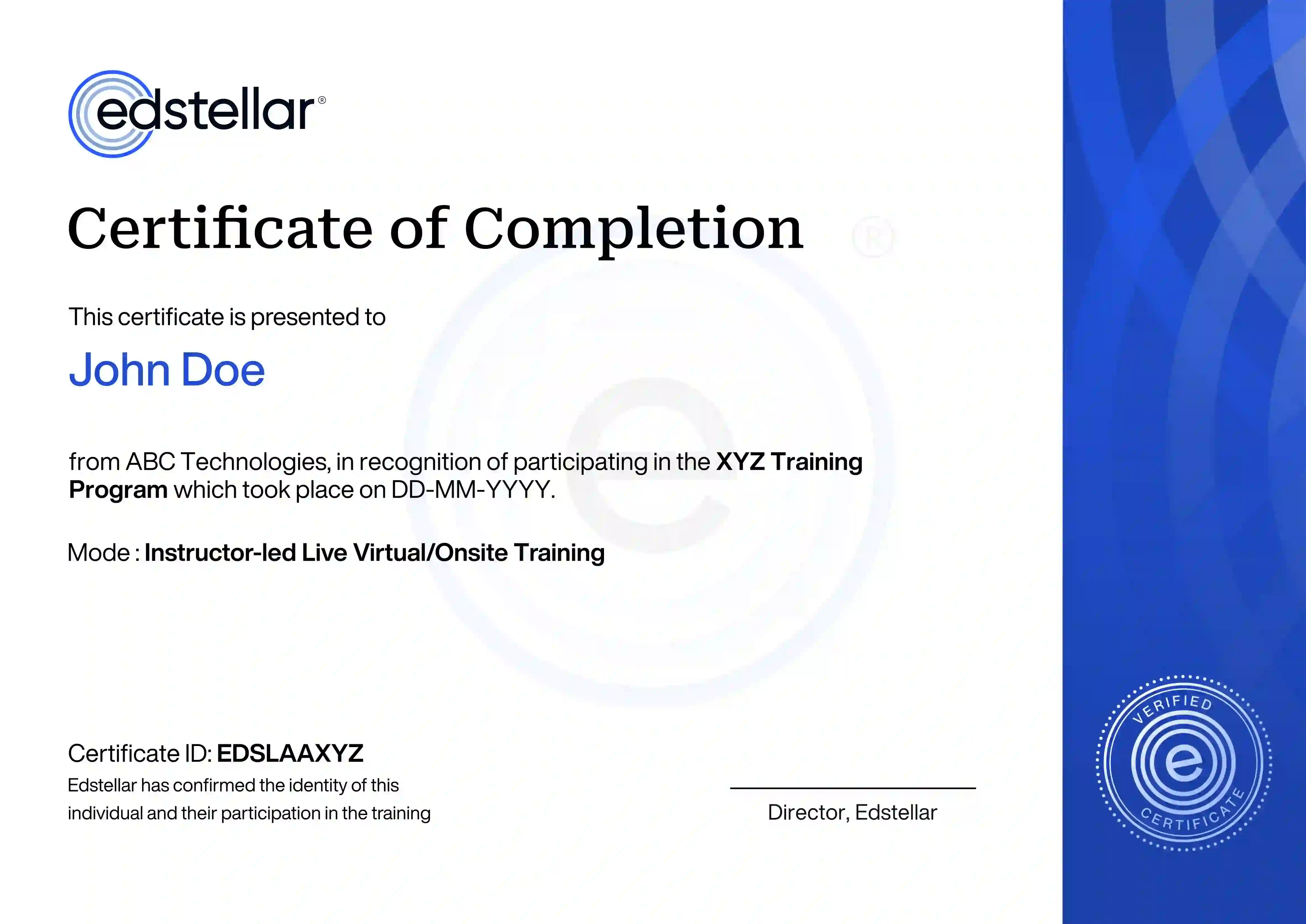
        Get Your Team Members Recognized with Edstellar’s Course Certificate

        Upon successful completion of the training course offered by Edstellar, employees receive a course completion certificate, symbolizing their dedication to ongoing learning and professional development.

        This certificate validates the employee's acquired skills and is a powerful motivator, inspiring them to enhance their expertise further and contribute effectively to organizational success.

        Certificate of Excellence

        We have Expert Trainers to Meet Your Fundamentals of Remote Sensing Training Needs

        The instructor-led training is conducted by certified trainers with extensive expertise in the field. Participants will benefit from the instructor's vast knowledge, gaining valuable insights and practical skills essential for success in Access practices.

        Other Related Corporate Training Courses