Drive Team Excellence with Space - Based Radar Engineering Corporate Training

Space-Based Radar Engineering involves designing, developing, and operating radar systems deployed on satellites orbiting Earth, facilitating vital functions such as surveillance, reconnaissance, and environmental monitoring. It is essential for organizations to invest in Space-Based Radar Engineering training course to equip teams with the expertise needed to harness satellite-based radar technology effectively, ensuring enhanced capabilities in areas such as defense, disaster management, and navigation. The course is vital for continuous skill development and adaptation to evolving technologies and industry standards.

Edstellar's instructor-led Space-Based Radar Engineering training course offers virtual/onsite sessions facilitated by industry experts with extensive experience in the domain. Employees benefit from a tailored curriculum, practical insights, and personalized guidance, empowering them to excel in Space-Based Radar Engineering.

Get Customized Expert-led Training for Your Teams
Customized Training Delivery
Scale Your Training: Small to Large Teams
In-person Onsite, Live Virtual or Hybrid Training Modes
Plan from 2000+ Industry-ready Training Programs
Experience Hands-On Learning from Industry Experts
Delivery Capability Across 100+ Countries & 10+ Languages
""""

Skills Your Employees Will Gain

These are the core, hands-on capabilities your team builds during the program.

  • Space Systems
    Space Systems involves designing, developing, and managing spacecraft and satellites. This skill is important for aerospace engineers and mission planners to ensure successful space missions.
  • Radar Engineering
    Radar Engineering involves designing, developing, and maintaining radar systems for detecting and tracking objects. This skill is important for roles in defense, aviation, and meteorology, ensuring safety and precision in operations.
  • Remote Sensing
    Remote Sensing is the acquisition of data about Earth's surface via satellite or aerial sensors. This skill is important for roles in environmental monitoring, urban planning, and agriculture, as it enables precise analysis and informed decision-making.
  • Spacecraft Operations
    Spacecraft Operations involves managing and controlling spacecraft systems during missions. This skill is important for ensuring mission success, safety, and efficient resource use.
  • Data Analysis
    Data Analysis is the process of inspecting, cleansing, and modeling data to discover useful information. This skill is important for roles like data scientist and business analyst, as it drives informed decision-making and strategy development.
  • Mission Planning
    Mission Planning is the process of strategizing and organizing tasks to achieve specific objectives. This skill is important for roles in military, aerospace, and project management, ensuring efficient resource allocation and risk mitigation.

What Your Team Will Achieve After This Training

  • Apply advanced radar signal processing techniques to optimize radar performance in real-world scenarios
  • Optimize radar system architecture and components to enhance performance and reliability in space environments
  • Analyze radar data using sophisticated algorithms to extract actionable insights and improve situational awareness
  • Design and implement adaptive strategies to mitigate the impact of dynamic space environments on radar operations
  • Develop innovative solutions to overcome challenges in space-based radar engineering, such as limited power and bandwidth constraints

Topics & Program Outline

The curriculum is organized into focused modules built by industry experts and delivered virtually or on-premise. Interactive sessions reflect the evolving demands of the workplace, keeping the learning both relevant and practical.

  1. Overview of radar technology
    • Historical development and fundamental principles
    • Evolution from ground-based to space-based systems
  2. Differences between ground-based and space-based radar systems
    • Design, deployment, and operational characteristics comparison
    • Advantages and limitations of each system type
  3. Applications of space-based radar in various industries
    • Surveillance and reconnaissance in defense and security sectors
    • Environmental monitoring and disaster management applications
  4. Regulatory considerations for space-based radar deployment
    • Compliance with international treaties and agreements
    • Licensing and authorization processes for satellite deployment
  5. Recent advancements in space-based radar technology
    • Introduction of new sensor technologies and signal processing techniques
    • Emerging trends in data fusion and multi-sensor integration
  1. Basics of radar signal processing
    • Time-domain vs. frequency-domain signal processing
    • Analog vs. digital signal processing methodologies
  2. Pulse compression and range resolution
    • Principles of pulse compression and its impact on radar performance
    • Techniques for achieving high-range resolution in radar systems
  3. Doppler processing for moving target indication
    • Doppler effect and its significance in radar applications
    • Strategies for detecting and tracking moving targets using Doppler processing
  4. Clutter mitigation strategies
    • Types of clutter and methods to mitigate their effects in radar systems
    • Implementation of clutter rejection techniques in signal processing algorithms
  5. Adaptive beamforming in space-based radar
    • Principles and advantages of adaptive beamforming techniques
    • Applications of adaptive beamforming in space-based radar systems
  6. Digital beamforming and array processing
    • Introduction to digital beamforming technology
    • Advantages of array processing for space-based radar applications
  1. System architecture and components
    • Overview of the architecture and key components of space-based radar systems
    • Integration of radar systems with satellite platforms
  2. Antenna design considerations for space-based platforms
    • Factors influencing antenna design for satellite-based radar systems
    • Techniques for optimizing antenna performance in space environments
  3. Transmitter and receiver design challenges
    • Challenges associated with designing radar transmitters and receivers for space environments
    • Strategies for minimizing power consumption and maximizing sensitivity
  4. Power and thermal considerations in space environments
    • Importance of power and thermal management in space-based radar system design
    • Techniques for managing heat dissipation and power distribution
  5. Integration of radar systems with satellite platforms
    • Strategies for integrating radar systems with satellite platforms for seamless operation
    • Challenges and solutions for ensuring compatibility and reliability
  1. Introduction to radar simulation tools
    • Overview of software tools used for simulating radar systems
    • Selection criteria and features of radar simulation software
  2. Simulation of radar waveforms and signal processing algorithms
    • Process of simulating radar waveforms and signal processing algorithms for analysis
    • Techniques for modeling radar propagation and environmental effects
  3. Performance analysis of simulated radar systems
    • Methods for evaluating the performance of simulated radar systems
    • Comparison of simulated results with real-world data for validation
  4. Troubleshooting and optimization in simulation environments
    • Techniques for identifying and resolving issues in radar system simulations
    • Optimization strategies for improving simulation efficiency and accuracy
  1. Mitigating space environment effects on radar performance
    • Strategies for mitigating the impact of space environment on radar performance
    • Use of shielding and protective measures to safeguard radar systems
  2. Dealing with limited power and bandwidth in space-based systems
    • Optimization techniques for minimizing power consumption in space-based radar systems
    • Strategies for maximizing data transmission efficiency within limited bandwidth
  3. Overcoming communication challenges in remote sensing applications
    • Techniques for establishing reliable communication links between satellites and ground stations
    • Implementation of error correction and data compression algorithms for efficient data transfer
  4. Strategies for enhancing radar resolution and sensitivity
    • Development of advanced signal processing algorithms for improving radar performance
    • Utilization of multi-sensor fusion techniques to enhance situational awareness
  5. Adaptive techniques for dynamic space environments
    • Implementation of adaptive control algorithms to dynamically adjust radar parameters
    • Integration of real-time data processing capabilities to respond to changing environmental conditions
  1. Techniques for optimizing radar performance in space
    • Utilization of advanced signal processing algorithms for enhanced target detection
    • Optimization of antenna configurations and beamforming techniques for improved coverage
  2. Common issues and challenges in space-based radar operations
    • Identification and mitigation of interference sources affecting radar performance
    • Strategies for minimizing the impact of space debris and orbital debris on radar operations
  3. Diagnostic tools and methodologies for troubleshooting
    • Utilization of diagnostic software tools for analyzing radar system performance
    • Implementation of remote monitoring and diagnostic capabilities for proactive maintenance
  4. System maintenance and updates in space environments
    • Procedures for conducting routine maintenance and software updates in space-based radar systems
    • Challenges and solutions for ensuring reliability and longevity of space-based radar systems
  5. Continuous improvement strategies for space-based radar systems
    • Implementation of feedback mechanisms for gathering user input and performance data

Who Should Attend?

This program suits professionals at many levels across the organization, including:

  • Radar Engineers
  • Aerospace Engineers
  • System Engineers
  • IT Specialists
  • Signal Processing Engineers
  • Defense Analysts
  • Research Scientists
  • Satellite Engineers
  • Electromagnetic Engineers
  • Space Systems Engineers
  • Technical Analysts
  • Managers

What are the Prerequisites?

Employees with a basic understanding of radar principles and familiarity with satellite technology can take the Space-Based Radar Engineering training course.

Request a Quote for your Corporate Training Requirements

Valid number

Delivering Training for Organizations across 100 Countries and 10+ Languages

Choose the Format That Fits Your Team

We design training your teams actually engage with, and deliver it the way that suits you best. Through a vetted global trainer network, Edstellar runs sessions in 10+ languages with consistent quality anywhere.

Virtual Space - Based Radar Engineering Training

Virtual / online: expert-led live sessions delivered anywhere, with consistency and easy scheduling.

We deliver anywhere worldwide
Standardized content for consistent outcomes
Join from own workspace, no travel
We scale to large groups across sites
Interactive tools keep remote learners engaged
On-site Space - Based Radar Engineering Training

On-site (in-house): immersive, instructor-led learning at your office.

Our trainers run face-to-face at your office
We tailor setup/content to your workplace and tools
Group exercises drive collaboration
Live demos +  hands-on practice
Direct trainer access to clarify doubts
Off-site Space - Based Radar Engineering Training

Off-site: focused, instructor-led group learning away from everyday workplace distractions.

We host your teams at a venue of your preferred choice
Built-in group activities for bonding
Full uninterrupted schedule for focus/retention
Boosts morale and signals commitment

Get a Proposal Shaped to Your Needs

Need pricing for onsite, offsite, or virtual delivery? Get a proposal tailored to your team's needs.

Request a Group Training Quote
""
How Many Team Members Need Training?
Please select an option or fill in the custom field.
"'

Is Your Corporate Training Requirement Only for Space - Based Radar Engineering ?

Please select at least one course.
""
Add the List of Training Workshops
search icon

      Please select the course

      No. of Courses selected: 0

      Clear

      Upload a CSV

      Send us your Training Requirements in 3 Easy steps

      1. 1
      2. 2
        Add the required training workshops
      3. 3
        Upload to get a quick quote or email it to contact@edstellar.com

      ""

      Looking for a Complete Package?

      Looking for a one-time pricing option for all your annual training requirements?

      View Corporate Training Packages
      ""
      Select the Option that Best Describes Your Corporate Training Requirement

      Please select an option or choose from the recurring options.
      ""
      Verify and Submit Your Request

      Review Your Corporate Training Selection Summary

      Training Program: Space - Based Radar Engineering Training

      1. No of Team Members

      2. Selected Training Preference

      3. Selected Recurring Sessions

      1

      Review your Requirements

      Training Workshops Selected :


        Excel
        File has been
        successfully uploaded.
        Fill the form to submit
 your details
        Submit Your Professional Contact Information
        Valid number
        We've received your enquiry. Our team will be in touch soon.
        Oops! Something went wrong while submitting the form.
        Starter
        120 licences

        Tailor-Made Trainee Licenses with Our Exclusive Training Packages!

        View Package

        64 hours of group training (includes VILT/In-person On-site)

        Tailored for SMBs

        Growth
        320 licences

        Tailor-Made Trainee Licenses with Our Exclusive Training Packages!

        View Package

        160 hours of group training (includes VILT/In-person On-site)

        Ideal for growing SMBs

        Enterprise
        800 licences

        Tailor-Made Trainee Licenses with Our Exclusive Training Packages!

        View Package

        400 hours of group training (includes VILT/In-person On-site)

        Designed for large corporations

        Custom
        Unlimited licenses

        Tailor-Made Trainee Licenses with Our Exclusive Training Packages!

        View Package

        Unlimited duration

        Designed for large corporations

        What Sets Edstellar Apart

        Experienced Trainers

        Our trainers are drawn from a vetted global network and bring years of industry expertise, keeping every session practical and impactful.

        Proven Quality

        With a strong global track record, Edstellar is known for quality and engaging delivery.

        Industry-Relevant Curriculum

        Our programs are built by experts to match the demands of today's industry.

        Fully Customizable

        Every program can be tailored to your organization's goals.

        Comprehensive Support

        We provide pre- and post-session support for a complete learning experience.

        Global Multi-Location & Multilingual Training Delivery

        We deliver in multiple languages to support diverse global teams.

        Hear from Organizations We've Trained

        "The Space - Based Radar Engineering course revolutionized how I approach my daily responsibilities. As a Senior Software Engineer, understanding strategic frameworks was essential, and this training delivered real-world experience. I've successfully implemented these advanced techniques in production environments with measurable impact. The instructor's insights on interactive labs have proven instrumental in my professional advancement.”

        Alden Marshall

        Senior Software Engineer,

        Digital Innovation Platform

        "The Space - Based Radar Engineering training provided critical insights into industry best practices that enhanced my consulting capabilities. As a Senior Software Engineer, I now leverage expert-led workshops practical exercises on practical simulations prepared me perfectly for real-world client scenarios. Client engagement and retention metrics have improved significantly across our practice, demonstrating immediate value from this investment.”

        Wu Jie

        Senior Software Engineer,

        Global Technology Solutions Provider

        "The Space - Based Radar Engineering training transformed our team's entire approach to operational excellence management and execution. As a Senior Software Engineer, the extensive coverage of practical proven concepts to enhanced capabilities. We completed our comprehensive digital transformation initiative significantly ahead of schedule. Our team's productivity and solution quality have improved measurably, validating this investment.”

        Adel Mahmoud

        Senior Software Engineer,

        IT Services and Solutions Provider

        “Edstellar’s IT & Technical training programs have been instrumental in strengthening our engineering teams and building future-ready capabilities. The hands-on approach, practical cloud scenarios, and expert guidance helped our teams improve technical depth, problem-solving skills, and execution across multiple projects. We’re excited to extend more of these impactful programs to other business units.”

        Aditi Rao

        L&D Head,

        A Global Technology Company

        Recognition That Motivates Your Team

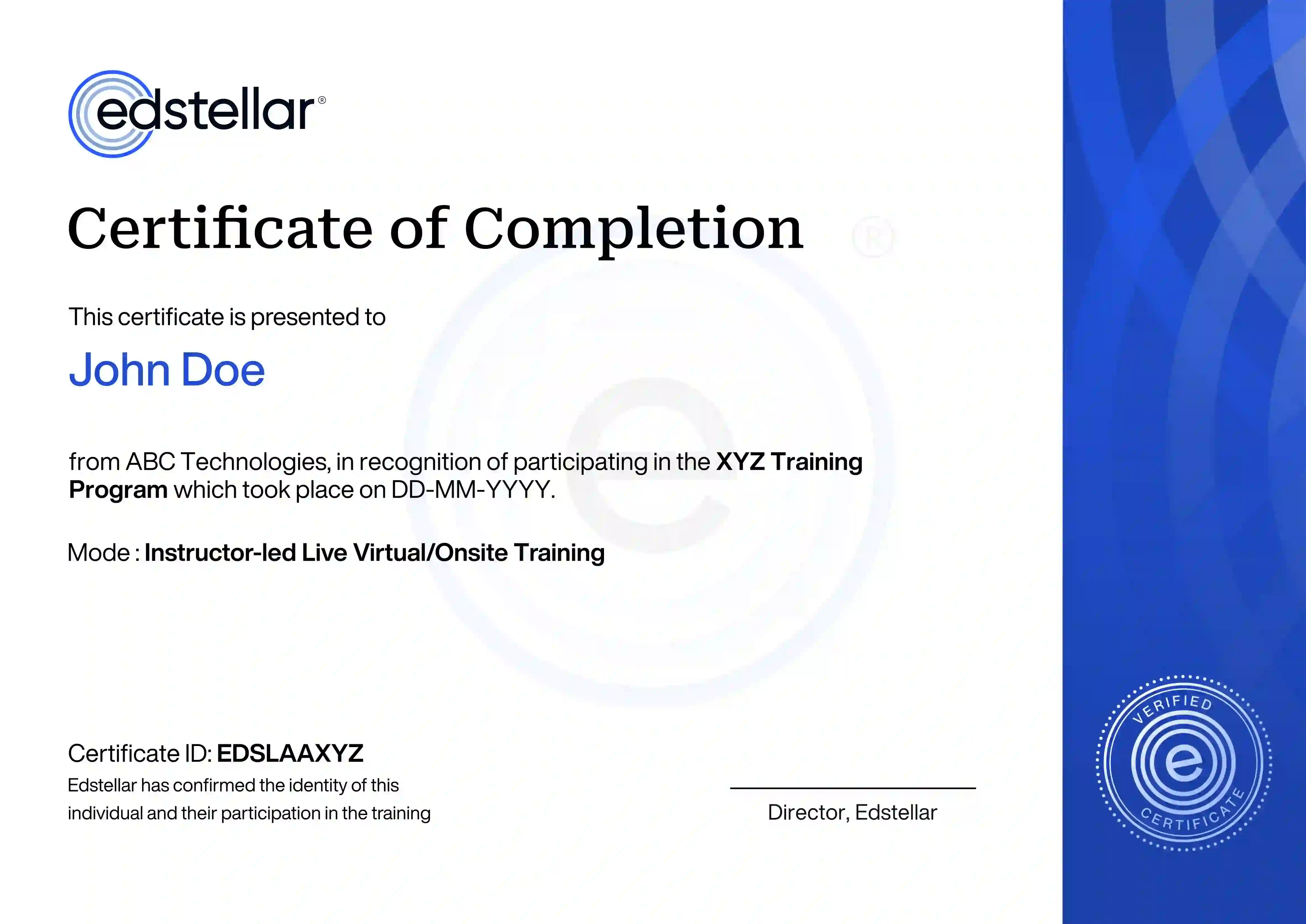
        Upon successful completion of the training course offered by Edstellar, employees receive a course completion certificate, symbolizing their dedication to ongoing learning and professional development.

        This certificate validates the employee's acquired skills and is a powerful motivator, inspiring them to enhance their expertise further and contribute effectively to organizational success.

        Recognition That Motivates Your Team