Drive Team Excellence with Oracle Exadata Corporate Training

Empower your teams with expert-led on-site, off-site, and virtual Oracle Exadata Training through Edstellar, a premier corporate training provider for organizations globally. Designed to meet your specific training needs, this group training program ensures your team is primed to drive your business goals. Help your employees build lasting capabilities that translate into real performance gains.

Oracle Exadata database machine is a computing platform optimized for running Oracle databases. Exadata offers cost efficiency by consolidating multiple databases onto a single machine, reducing hardware costs, and simplifying management. It ensures high availability and reliability with robust data protection, disaster recovery, and fault tolerance features, minimizing downtime. Oracle Exadata training course ensures that employees can configure storage servers, implement advanced Exadata features, and perform critical maintenance tasks, leading to enhanced database performance and reliability.

Oracle Exadata instructor-led training course provided by Edstellar can be customized to meet team requirements. The virtual/onsite Oracle Exadata training course led by expert trainers ensures employees acquire essential skills to implement, maintain, and enhance Exadata environments.

Get Customized Expert-led Training for Your Teams
Customized Training Delivery
Scale Your Training: Small to Large Teams
In-person Onsite, Live Virtual or Hybrid Training Modes
Plan from 2000+ Industry-ready Training Programs
Experience Hands-On Learning from Industry Experts
Delivery Capability Across 100+ Countries & 10+ Languages
""""

Key Skills Employees Gain from instructor-led Oracle Exadata Training

Oracle Exadata skills corporate training will enable teams to effectively apply their learnings at work.

  • Configuration
    Configuration is the process of setting up systems or software to meet specific requirements. This Skill is important for IT roles, ensuring optimal performance and functionality.
  • Maintenance
    Maintenance is the process of preserving equipment and systems to ensure optimal performance and longevity. This skill is important for roles in engineering, facilities management, and manufacturing, as it minimizes downtime, reduces costs, and enhances safety.
  • Performance Tuning
    Performance Tuning is the process of optimizing systems to enhance efficiency and speed. This skill is important for roles like database administrators and software developers, ensuring applications run smoothly and effectively.
  • Smart Scan
    Smart Scan is the ability to quickly analyze and interpret data using advanced scanning technologies. This skill is important for roles in data analysis, cybersecurity, and quality control, as it enhances efficiency and accuracy in decision-making.
  • Flash Cache
    Flash Cache is a technology that accelerates data access by using flash memory to store frequently accessed data. This skill is important for IT roles, enhancing system performance and efficiency.
  • I/O Resource Management (IORM)
    I/O Resource Management (IORM) optimizes input/output operations in systems, ensuring efficient resource allocation. This skill is important for system administrators and cloud engineers to enhance performance and reliability.

Key Learning Outcomes of Oracle Exadata Training Workshop for Employees

Upon completing Edstellar’s Oracle Exadata workshop, employees will gain valuable, job-relevant insights and develop the confidence to apply their learning effectively in the professional environment.

  • Implement Oracle Exadata configurations for optimal database performance
  • Configure Exadata storage servers and InfiniBand networks to enhance data throughput
  • Perform backup and recovery operations using RMAN tailored for Exadata environments
  • Optimize database performance through advanced compression and indexing techniques
  • Utilize Exadata Smart Scan and Smart Flash Cache features to improve query performance
  • Deploy Oracle Enterprise Manager Grid Control to monitor and manage Exadata environments effectively
  • Execute maintenance tasks and patching procedures to ensure the Exadata system's reliability and security
  • Administer Exadata storage security and I/O resource management to maintain data integrity and efficient resource usage

Key Benefits of the Oracle Exadata Group Training

Attending our Oracle Exadata group training classes provides your team with a powerful opportunity to build skills, boost confidence, and develop a deeper understanding of the concepts that matter most. The collaborative learning environment fosters knowledge sharing and enables employees to translate insights into actionable work outcomes.

  • Develops required skills to perform database migrations to Exadata database machine
  • Develops required skills to configure and manage storage on Exadata database machine
  • Empowers employees with the skills to use Oracle DBFS for high-speed bulk data loading
  • Equips the team with the techniques for backing up and recovering data using RMAN on Exadata
  • Cultivates ideas in teams for implementing data consolidation strategies to leverage Exadata efficiently
  • Empowers employees with the skills to monitor Exadata performance using metrics, alerts, and grid control
  • Provides insights into optimizing database performance using Exadata features like smart scan and flash memory
  • Equips the team with the techniques for administering and managing Exadata database machine hardware and software

Topics and Outline of Oracle Exadata Training

Our virtual and on-premise Oracle Exadata training curriculum is structured into focused modules developed by industry experts. This training for organizations provides an interactive learning experience that addresses the evolving demands of the workplace, making it both relevant and practical.

  1. Overview of Oracle Exadata
    • Introduction to Exadata
    • Key features and benefits
  1. Introducing database machine 
    • Overview of Exadata
    • Key components
  2. Introducing Exadata storage server
    • Storage server functions
    • Benefits of Exadata storage
  3. Exadata storage server architecture: overview
    • Hardware architecture
    • Software architecture
  4. Exadata storage server features: overview
    • Unique features
    • Performance enhancements
  5. Database machine capacity
    • Storage capacity
    • Performance capacity
  6. Exadata storage expansion racks
    • Expansion options
    • Adding storage capacity
  7. InfiniBand network 
    • Network architecture
    • Configuration and management
  8. Database machine support: overview
    • Support structure
    • Maintenance and updates
  1. Database machine architecture: overview
    • Overall architecture
    • Key components
  2. Database machine network architecture
    • Network design
    • Key elements
  3. InfiniBand network architecture
    • Detailed network setup
    • Configuration best practices
  4. X2-2 full rack leaf switch topology
    • Switch topology
    • Configuration guidelines
  5. Spine and leaf topology
    • Network design principles
    • Scalability considerations
  6. Scale performance and capacity
    • Scaling strategies
    • Performance considerations
  7. Database machine software architecture: overview
    • Software components
    • Integration with hardware
  8. Disk storage entities and relationships
    • Disk architecture
    • Data storage relationships
  1. Classic database I/O and SQL processing model
    • Traditional I/O processing
    • SQL processing overview
  2. Exadata smart scan model
    • Smart scan technology
    • Benefits and implementation
  3. Exadata smart storage capabilities
    • Storage optimization
    • Performance enhancements
  4. Exadata hybrid columnar compression data organization 
    • Compression techniques
    • Benefits and use cases
  5. Exadata smart flash cache intelligent caching 
    • Flash cache technology
    • Cache management
  6. Storage index with partitions
    • Indexing strategies
    • Partition management
  7. Database file system 
    • File system overview
    • Integration with Exadata
  8. I/O resource management: overview 
    • Resource management principles
    • Configuration steps
  1. Database machine implementation: overview
    • Implementation steps
    • Key considerations
  2. General configuration
    • Initial setup
    • Configuration options
  3. Choosing the right protection level 
    • Data protection strategies
    • Implementation steps
  4. Oracle enterprise manager grid control configuration 
    • Grid control overview
    • Configuration steps
  5. Database machine hardware installation: overview
    • Hardware setup
    • Installation guidelines
  6. Configuring Oracle Exadata database machine: overview 
    • Configuration steps
  7. Selecting the database server operating system
    • OS options
    • Selection criteria
  8. Deploying Solaris on the database servers 
    • Solaris installation
    • Configuration guidelines
  1. Exadata storage server administration: overview
    • Administration principles
  2. Testing storage server performance using CALIBRATE 
    • Performance testing
    • Using CALIBRATE tool
  3. Configuring the Exadata cell server software 
    • Software configuration
  4. Creating flash-based grid disks
    • Flash disk setup
    • Configuration steps
  5. Creating smart flash log
    • Flash log creation
    • Configuration steps
  6. Configuring ASM and database instances to access Exadata cells 
    • ASM setup
    • Database instance configuration
  7. Exadata storage security: overview
    • Security principles
  8. Exadata storage security implementation
    • Security configuration
  1. I/O resource management: overview
    • Introduction to IORM
  2. IORM architecture
    • Architecture overview
    • Components
  3. Getting started with IORM
    • Initial setup
    • Configuration steps
  4. Enabling intradatabase resource management 
    • Resource management within databases
    • Configuration steps
  5. Setting database I/O utilization limits 
    • Utilization limits setup
    • Key settings
  6. Interdatabase plans and database roles
    • Creating interdatabase plans
    • Assigning database roles
  7. Using database I/O metrics
    • Monitoring I/O metrics
    • Analysis and reporting
  8. IORM and Exadata storage server flash memory
    • Flash memory integration
    • Performance optimization
  1. Optimizing performance
    • Performance tuning principles
    • Key techniques
  2. Flash memory usage
    • Utilizing flash memory
    • Configuration steps
  3. Compression usage
    • Implementing compression
    • Benefits and considerations
  4. Index usage
    • Effective indexing strategies
    • Performance impact
  5. ASM allocation unit size 
    • Setting allocation unit size
  6. Minimum extent size
    • Configuring extent size
    • Performance considerations
  7. Optimizing database performance with Exadata
    • Comprehensive optimization
  1. Exadata smart scan: overview 
    • Introduction to smart scan
    • Key benefits
  2. Smart scan requirements 
    • Prerequisites for smart scan
    • Setup steps
  3. Monitoring smart scan in SQL execution plans 
    • Monitoring techniques
    • Analysis steps
  4. Smart scan join processing with bloom filters
    • Bloom filter usage
    • Configuration steps
  5. Other situations affecting smart scan
    • Common issues
    • Troubleshooting tips
  6. Exadata storage server statistics: overview 
    • Key statistics
    • Monitoring tools
  7. Exadata storage server wait events: overview
    • Identifying wait events
    • Analysis steps
  8. Using smart scan
    • Implementation
  1. Consolidation: overview
    • Introduction to consolidation
  2. Different consolidation types
    • Types of consolidation
    • Selection criteria
  3. Recommended storage configuration for consolidation 
    • Storage configuration guidelines
  4. Alternative storage configurations
    • Other configuration options
    • Pros and cons
  5. Cluster configuration options 
    • Cluster setup
    • Configuration steps
  6. Isolating management roles
    • Role isolation principles
    • Implementation steps
  7. Schema consolidation recommendations
    • Schema consolidation strategies
  8. Maintenance considerations
    • Maintenance planning
    • Scheduling steps
  1. Migration best practices: overview
    • Introduction to migration
    • Key principles
  2. Performing capacity planning
    • Capacity planning steps
    • Tools and techniques
  3. Database machine migration considerations 
    • Key considerations for migration
    • Planning steps
  4. Choosing the right migration path
    • Migration path options
    • Selection criteria
  5. Logical migration approaches
    • Logical migration methods
    • Implementation steps
  6. Physical migration approaches
    • Physical migration methods
    • Implementation steps
  7. Post-migration best practices
    • Post-migration activities
  8. Migrating to database machine using transportable
    • Transportable migration method
    • Steps and Considerations
  1. Bulk data loading using Oracle DBFS: overview 
    • Introduction to bulk data loading
    • Benefits
  2. Preparing the data files
    • Data file preparation steps
  3. Staging the data files
    • Staging process
    • Tools and techniques
  4. Configuring the staging area 
    • Staging area setup
    • Configuration steps
  5. Configuring the target database 
    • Target database setup
    • Configuration guidelines
  6. Loading the target database
    • Data loading steps
  7. Bulk data loading using Oracle DBFS 
    • Practical implementation
  1. Monitoring technologies and standards
    • Overview of monitoring technologies
    • Key standards
  2. Simple Network Management Protocol (SNMP)
    • Introduction to SNMP
  3. Intelligent Platform Management Interface (IPMI)
    • Overview of IPMI
  4. Integrated Lights Out Manager (ILOM) 
    • Introduction to ILOM
  5. Exadata storage server metrics, thresholds, and alerts
    • Key metrics
    • Setting thresholds and alerts
  6. Automatic Diagnostic Repository (ADR)
    • Overview of ADR
  7. Enterprise Manager Grid Control
    • Introduction to Grid Control
    • Monitoring capabilities
  8. Enterprise Manager Database Control
    • Overview of Database Control
  1. Enterprise Manager Grid Control architecture: overview 
    • Grid Control architecture
  2. Grid Control monitoring architecture for Exadata database machine
    • Monitoring setup
    • Configuration steps
  3. Configuring Grid Control to monitor Exadata database machine
    • Configuration guidelines
  4. Deploying the Oracle Management Agent 
    • Agent deployment steps
  5. Configuring ASM and Oracle database targets
    • ASM setup
    • Database target configuration
  6. Deployment overview for system monitoring plug-ins
    • Plug-in deployment steps
  7. Recommended plug-in deployment strategy
    • Deployment strategies
  1. Exadata metrics and alerts architecture
    • Overview of metrics and alerts
  2. Monitoring Exadata storage server with metrics 
    • Metrics monitoring steps
    • Tools and techniques
  3. Monitoring Exadata storage server with alerts 
    • Setting up alerts
    • Monitoring steps
  4. Monitoring Exadata with active requests
    • Monitoring active requests
    • Analysis steps
  5. Monitoring Exadata storage server with Grid Control: overview
    • Grid Control monitoring capabilities
    • Configuration steps
  6. Monitoring hardware failure and sensor state
    • Hardware monitoring
    • Sensor state analysis
  7. Monitoring Exadata storage server availability
    • Availability monitoring steps
  8. Comparing metrics across multiple storage servers
    • Metrics comparison techniques
    • Analysis steps
  1. Monitoring database servers: overview
    • Introduction to database server monitoring
  2. Monitoring hardware
    • Hardware monitoring steps
  3. Monitoring the operating system
    • OS monitoring steps
    • Tools and techniques
  4. Monitoring Oracle Grid infrastructure
    • Grid infrastructure monitoring
  5. Monitoring Oracle database
    • Database monitoring steps
    • Tools and techniques
  6. Monitoring Oracle Management Agent
    • Management Agent monitoring
  1. InfiniBand network monitoring: overview
    • Introduction to InfiniBand monitoring
  2. Manually monitoring the InfiniBand switches
    • Manual monitoring steps
  3. Monitoring the InfiniBand switches with Grid Control
    • Grid Control monitoring
    • Configuration steps
  4. Monitoring the InfiniBand switch ports
    • Port monitoring steps
    • Tools and techniques
  5. Monitoring the InfiniBand ports on database machine servers
    • Port monitoring on servers
  6. Monitoring the InfiniBand fabric: subnet manager master location 
    • Subnet manager monitoring
  7. Monitoring the InfiniBand fabric: network topology and link status 
    • Topology monitoring
    • Link status analysis
  1. Monitoring the Cisco Catalyst Ethernet switch 
    • Ethernet switch monitoring
  2. Monitoring the Sun power distribution units
    • PDU monitoring
  3. Monitoring the Avocent MergePoint Unity KVM switch
    • KVM switch monitoring
    • Tools and techniques
  4. Exachk: overview
    • Introduction to Exachk
  5. Running Exachk
    • Running Exachk steps
  6. Exachk output
    • Analyzing Exachk output
    • Reporting steps
  7. DiagTools: overview 
    • Introduction to DiagTools
  8. Using ADRCI on Exadata storage servers
    • ADRCI usage steps
  9. Imageinfo: overview
    • Introduction to Imageinfo
  10. Imagehistory: overview
    • Introduction to Imagehistory
  11. OSWatcher: overview
    • Introduction to OSWatcher
  1. Using RMAN with database machine
    • Introduction to RMAN
  2. General recommendations for RMAN
    • RMAN best practices
  3. Disk-based backup strategy
    • Disk backup steps
  4. Disk-based backup recommendations
    • Best practices for disk backups
  5. Tape-based backup strategy
    • Tape backup steps
  6. Tape-based backup architecture
    • Tape backup architecture overview
    • Components
  7. Connecting the media server using Ethernet
    • Media server connection steps
  8. Backup and recovery of database machine software
    • Software backup steps
    • Recovery steps
  1. Database machine maintenance: overview 
    • Introduction to maintenance
  2. Powering database machine off and on
    • Power management steps
  3. Safely shutting down a single Exadata storage server 
    • Shutdown steps
  4. Replacing a damaged physical disk
    • Disk replacement steps
  5. Replacing a damaged flash card
    • Flash card replacement steps
  6. Moving all disks from one cell to another
    • Disk migration steps
  7. Using the Exadata cell software rescue procedure
    • Rescue procedure steps
  1. Patching and updating: overview
    • Introduction to patching
  2. Maintaining Exadata storage server software
    • Software maintenance steps
  3. Maintaining database server software
    • Database server maintenance steps
  4. Assisted patching using OPlan
    • OPlan patching steps
  5. Maintaining other software
    • Additional software maintenance
  6. Recommended patching process
    • Patching steps
  7. Test system recommendations 
    • Test system setup

Who Can Take the Oracle Exadata Training Course

The Oracle Exadata training program can also be taken by professionals at various levels in the organization.

  • Database Administrators
  • System Engineers
  • IT Specialists
  • Oracle Developers
  • Application Developers
  • Data Architects
  • Database Engineers
  • IT Analysts
  • System Analysts
  • IT Specialists
  • Oracle Engineers
  • Managers

Prerequisites for Oracle Exadata Training

Employees with a basic understanding of Oracle database can take up the Oracle Exadata training course.

Request a Quote for your Corporate Training Requirements

Valid number

Delivering Training for Organizations across 100 Countries and 10+ Languages

Corporate Group Training Delivery Modes
for Oracle Exadata Training

At Edstellar, we understand the importance of impactful and engaging training for employees. As a leading Oracle Exadata training provider, we ensure the training is more interactive by offering Face-to-Face onsite/in-house or virtual/online sessions for companies. This approach has proven to be effective, outcome-oriented, and produces a well-rounded training experience for your teams.

 Virtual trainig

Edstellar's Oracle Exadata virtual/online training sessions bring expert-led, high-quality training to your teams anywhere, ensuring consistency and seamless integration into their schedules.

With global reach, your employees can get trained from various locations
The consistent training quality ensures uniform learning outcomes
Participants can attend training in their own space without the need for traveling
Organizations can scale learning by accommodating large groups of participants
Interactive tools can be used to enhance learning engagement
 On-site trainig

Edstellar's Oracle Exadata inhouse training delivers immersive and insightful learning experiences right in the comfort of your office.

Higher engagement and better learning experience through face-to-face interaction
Workplace environment can be tailored to learning requirements
Team collaboration and knowledge sharing improves training effectiveness
Demonstration of processes for hands-on learning and better understanding
Participants can get their doubts clarified and gain valuable insights through direct interaction
 Off-site trainig

Edstellar's Oracle Exadata offsite group training offer a unique opportunity for teams to immerse themselves in focused and dynamic learning environments away from their usual workplace distractions.

Distraction-free environment improves learning engagement
Team bonding can be improved through activities
Dedicated schedule for training away from office set up can improve learning effectiveness
Boosts employee morale and reflects organization's commitment to employee development

Explore Our Customized Pricing Package
for
Oracle Exadata Corporate Training

Looking for pricing details for onsite, offsite, or virtual instructor-led Oracle Exadata training? Get a customized proposal tailored to your team’s specific needs.

Request a Group Training Quote
""
How Many Team Members Need Training?
Please select an option or fill in the custom field.
"'

Is Your Corporate Training Requirement Only for Oracle Exadata?

Please select at least one course.
""
Add the List of Training Workshops
search icon

      Please select the course

      No. of Courses selected: 0

      Clear

      Upload a CSV

      Send us your Training Requirements in 3 Easy steps

      1. 1
      2. 2
        Add the required training workshops
      3. 3
        Upload to get a quick quote or email it to contact@edstellar.com

      ""

      Looking for a Complete Package?

      Looking for a one-time pricing option for all your annual training requirements?

      View Corporate Training Packages
      ""
      Select the Option that Best Describes Your Corporate Training Requirement

      Please select an option or choose from the recurring options.
      ""
      Verify and Submit Your Request

      Review Your Corporate Training Selection Summary

      Training Program: Oracle Exadata Training

      1. No of Team Members

      2. Selected Training Preference

      3. Selected Recurring Sessions

      1

      Review your Requirements

      Training Workshops Selected :


        Excel
        File has been
        successfully uploaded.
        Fill the form to submit
 your details
        Submit Your Professional Contact Information
        Valid number
        We've received your enquiry. Our team will be in touch soon.
        Oops! Something went wrong while submitting the form.
        Starter
        120 licences

        Tailor-Made Trainee Licenses with Our Exclusive Training Packages!

        View Package

        64 hours of group training (includes VILT/In-person On-site)

        Tailored for SMBs

        Growth
        320 licences

        Tailor-Made Trainee Licenses with Our Exclusive Training Packages!

        View Package

        160 hours of group training (includes VILT/In-person On-site)

        Ideal for growing SMBs

        Enterprise
        800 licences

        Tailor-Made Trainee Licenses with Our Exclusive Training Packages!

        View Package

        400 hours of group training (includes VILT/In-person On-site)

        Designed for large corporations

        Custom
        Unlimited licenses

        Tailor-Made Trainee Licenses with Our Exclusive Training Packages!

        View Package

        Unlimited duration

        Designed for large corporations

        Edstellar: Your Go-to Oracle Exadata Training Company

        Experienced Trainers

        Our trainers bring years of industry expertise to ensure the training is practical and impactful.

        Quality Training

        With a strong track record of delivering training worldwide, Edstellar maintains its reputation for its quality and training engagement.

        Industry-Relevant Curriculum

        Our course is designed by experts and is tailored to meet the demands of the current industry.

        Customizable Training

        Our course can be customized to meet the unique needs and goals of your organization.

        Comprehensive Support

        We provide pre and post training support to your organization to ensure a complete learning experience.

        Multilingual Training Capabilities

        We offer training in multiple languages to cater to diverse and global teams.

        Testimonials

        What Our Clients Say

        We pride ourselves on delivering exceptional training solutions. Here's what our clients have to say about their experiences with Edstellar.

        "This Oracle Exadata course was exactly what I needed to advance my career. As a Technical Consultant, mastering industry best practices has become crucial for my success. The in-depth coverage of hands-on frameworks I use daily. The knowledge gained has been immediately applicable to mission-critical projects and initiatives. The real-world examples and deep dive into interactive labs were particularly valuable for my professional growth.”

        Bertha Crawford

        Technical Consultant,

        Enterprise Database Solutions Provider

        "This Oracle Exadata course equipped me with comprehensive strategic frameworks expertise that I've seamlessly integrated into our enterprise practice. The hands-on modules covering real-world case studies and practical confidently design solutions that consistently deliver measurable business results. Client engagement and retention metrics have improved significantly across our practice, validating the immediate impact of this training program.”

        Zhao Hao

        Database Engineer,

        Database Management Platform

        "The Oracle Exadata training transformed our team's entire approach to operational excellence management and execution. As a Cloud DBA, the extensive coverage of practical applications, hands-on exercises, and interactive concepts to enhanced capabilities. Our team has automated eighteen critical business processes, reducing manual effort by 70%. Our team's productivity and solution quality have improved measurably, validating this investment.”

        Venkat Babu

        Cloud DBA,

        Oracle Technology Consulting Firm

        “Edstellar’s IT & Technical training programs have been instrumental in strengthening our engineering teams and building future-ready capabilities. The hands-on approach, practical cloud scenarios, and expert guidance helped our teams improve technical depth, problem-solving skills, and execution across multiple projects. We’re excited to extend more of these impactful programs to other business units.”

        Aditi Rao

        L&D Head,

        A Global Technology Company

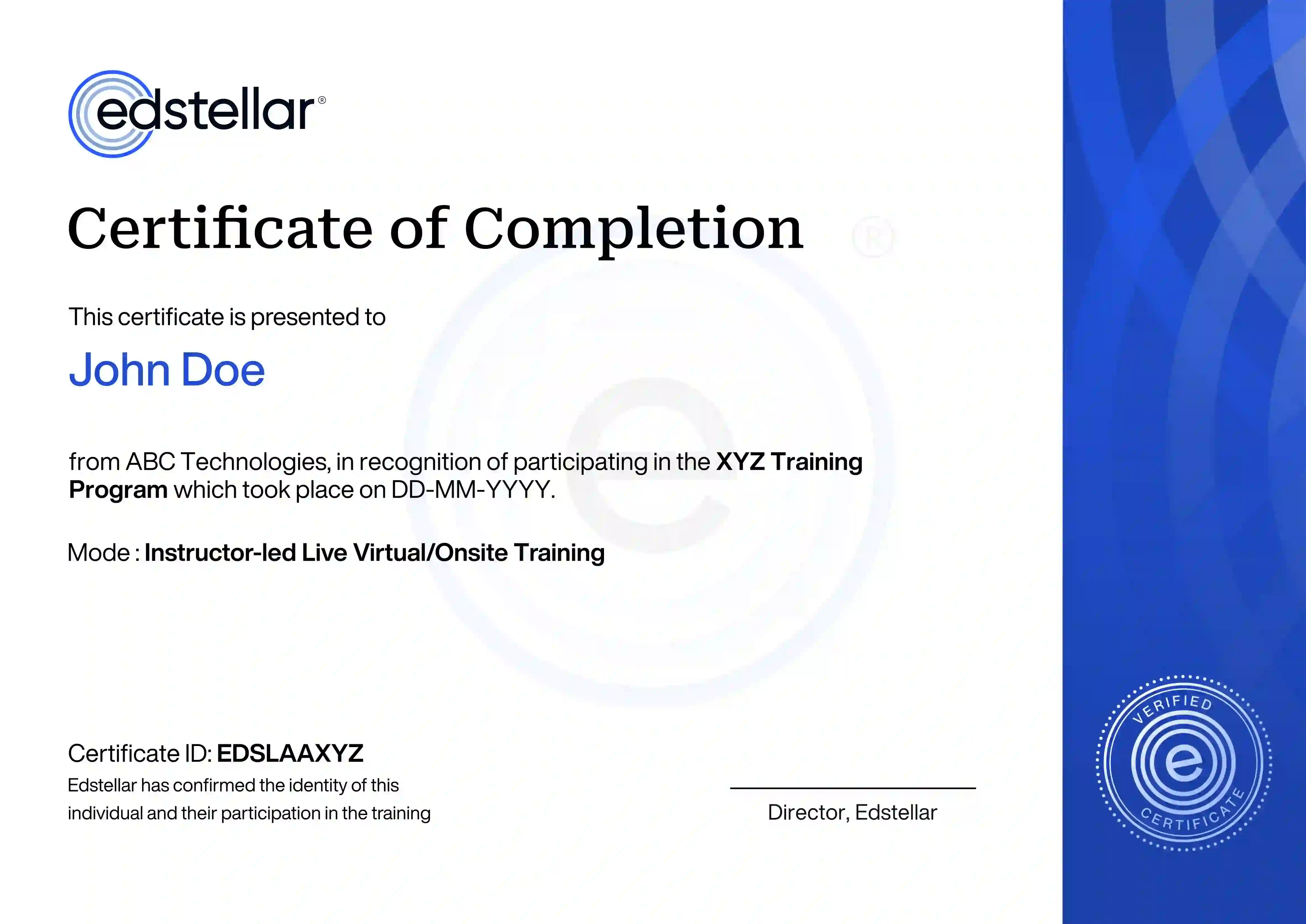
        Get Your Team Members Recognized with Edstellar’s Course Certificate

        Upon successful completion of the training course offered by Edstellar, employees receive a course completion certificate, symbolizing their dedication to ongoing learning and professional development.

        This certificate validates the employee's acquired skills and is a powerful motivator, inspiring them to enhance their expertise further and contribute effectively to organizational success.

        Certificate of Excellence

        We have Expert Trainers to Meet Your Oracle Exadata Training Needs

        The instructor-led training is conducted by certified trainers with extensive expertise in the field. Participants will benefit from the instructor's vast knowledge, gaining valuable insights and practical skills essential for success in Access practices.

        Other Related Corporate Training Courses