Implementing an AI Management System Corporate Training Program
Edstellar's instructor-led AI Management System training equips professionals to design, govern, and monitor enterprise AI systems. Participants build governance frameworks, assess AI risks, manage model lifecycles, and apply ethical practices for compliant AI deployments.
(Virtual / On-site / Off-site)
Available Languages
English, Español, 普通话, Deutsch, العربية, Português, हिंदी, Français, 日本語 and Italiano
Drive Team Excellence with Implementing an AI Management System Corporate Training
Empower your teams with expert-led on-site, off-site, and virtual Implementing an Artificial Intelligence Management System Training through Edstellar, a premier corporate training provider for organizations globally. Designed to meet your specific training needs, this group training program ensures your team is primed to drive your business goals. Help your employees build lasting capabilities that translate into real performance gains.
An Artificial Intelligence Management System (AIMS) provides the governance, processes, and operational controls needed to design, deploy, monitor, and maintain AI solutions at enterprise scale. It encompasses AI project management, lifecycle governance, risk management, ethical oversight, and performance monitoring to ensure AI initiatives deliver measurable business value while meeting regulatory and compliance requirements. This training equips professionals with the skills to build and operate robust AI management systems across diverse organizational environments.
Edstellar's Implementing an Artificial Intelligence Management System Instructor-led course offers virtual/onsite training options to meet professionals' diverse needs. This flexibility ensures that professionals and teams can engage in learning experiences that best suit their logistical and learning preferences. What sets the Edstellar course apart is its emphasis on practical experience, with hands-on workshops and real-world case studies that bring AI management concepts to life and equip participants to govern AI initiatives with confidence.

Key Skills Employees Gain from Instructor-led Implementing an Artificial Intelligence Management System Training
Implementing an Artificial Intelligence Management System skills corporate training will enable teams to effectively apply their learnings at work.
- AI Governance Framework Design
- AI Risk Assessment and Mitigation
- AI Model Lifecycle Management
- AI Performance Monitoring
- AI Ethics and Compliance
- AI Vendor Management
- AI Change Management
Key Learning Outcomes of Implementing an Artificial Intelligence Management System Training Workshop
Upon completing Edstellar’s Implementing an Artificial Intelligence Management System workshop, employees will gain valuable, job-relevant insights and develop the confidence to apply their learning effectively in the professional environment.
- Master core AI management system principles, including governance frameworks, lifecycle management strategies, and organizational structures for responsible enterprise-scale AI deployment.
- Gain expertise in AI risk assessment and mitigation by identifying technical, ethical, and operational risks and applying structured frameworks to ensure compliant and resilient AI operations.
- Develop proficiency in AI model lifecycle management, emphasizing version control, performance monitoring, model retraining, and deprecation processes to sustain high-quality AI outputs.
- Learn comprehensive AI governance implementation strategies, focusing on policy design, audit mechanisms, accountability structures, and regulatory alignment for enterprise AI programs.
- Build practical skills in AI performance monitoring by configuring dashboards, tracking key metrics, detecting model drift, and implementing proactive maintenance workflows for AI systems.
- Apply AI ethics and compliance frameworks by evaluating fairness, transparency, and bias in AI models and embedding responsible AI practices across organizational initiatives.
Key Benefits of the Implementing an Artificial Intelligence Management System Group Training
Attending our Implementing an Artificial Intelligence Management System group training classes provides your team with a powerful opportunity to build skills, boost confidence, and develop a deeper understanding of the concepts that matter most. The collaborative learning environment fosters knowledge sharing and enables employees to translate insights into actionable work outcomes.
- Understand AI management system fundamentals by learning how to design governance frameworks that align AI initiatives with business objectives and regulatory requirements.
- Develop comprehensive AI project management skills using structured methodologies to plan, execute, and monitor AI implementation projects from inception to deployment.
- Build AI risk assessment capabilities by identifying technical, ethical, and operational risks in AI systems and applying mitigation strategies across the AI lifecycle.
- Master AI model lifecycle management by applying version control, monitoring, retraining, and deprecation practices to maintain high-performing AI systems in production.
- Implement AI governance structures using policy frameworks, audit trails, and accountability mechanisms to ensure transparent and compliant AI operations.
- Apply AI ethics principles by evaluating fairness, explainability, and bias in AI systems and implementing corrective measures aligned with organizational values.
- Configure AI performance monitoring dashboards using key metrics such as accuracy, drift, latency, and throughput to enable proactive system management.
- Establish AI vendor management practices including evaluation criteria, contract governance, and performance benchmarking for third-party AI solutions.
- Design AI change management programs that build organizational readiness, foster adoption, and enable teams to integrate AI tools into existing workflows effectively.
- Develop AI incident response procedures covering detection, root cause analysis, remediation, and post-incident learning to maintain operational resilience.
Topics and Outline of Implementing an Artificial Intelligence Management System Training
Our virtual and on-premise Implementing an Artificial Intelligence Management System training curriculum is structured into focused modules developed by industry experts. This training for organizations provides an interactive learning experience that addresses the evolving demands of the workplace, making it both relevant and practical.
-
Defining AI Management Systems
- What is an AI management system
- Key components and architecture
- Difference from traditional IT management
- Business value of structured AI management
-
AI Ecosystem Overview
- Types of AI technologies in enterprise
- AI maturity models and adoption stages
- Organizational roles in AI programs
- AI landscape and vendor ecosystem
-
AI Governance Fundamentals
- Governance principles and objectives
- Policy and standards frameworks
- Accountability and responsibility models
- Governance body structures
-
Regulatory and Compliance Landscape
- Global AI regulations and standards
- Industry-specific compliance requirements
- Regulatory risk assessment basics
- Staying current with evolving regulations
-
Strategic Alignment of AI
- Linking AI initiatives to business goals
- AI investment prioritization
- Stakeholder mapping for AI programs
- Measuring AI business impact
-
AI Management System Design Principles
- Core design principles for AIMS
- Scalability and flexibility considerations
- Integration with enterprise architecture
- Change management foundations
-
AI Project Lifecycle Overview
- Phases of AI project delivery
- Key milestones and deliverables
- Resource planning for AI projects
- Timeline and dependency management
-
Business Case Development for AI
- Value proposition articulation
- ROI estimation techniques
- Cost-benefit analysis frameworks
- Executive presentation strategies
-
AI Governance Framework Design
- Framework components and structure
- Policy development and approval
- Roles and responsibilities matrix
- Governance cadence and review cycles
-
Stakeholder Engagement
- Identifying AI stakeholders
- Communication planning
- Managing expectations and concerns
- Building AI champion networks
-
Resource and Budget Management
- AI project resourcing strategies
- Budget allocation and tracking
- Managing data and infrastructure costs
- Vendor and contractor management
-
Agile Approaches for AI Projects
- Agile methodologies in AI context
- Sprint planning for AI workstreams
- Iterative development and feedback loops
- Adapting agile for data-driven projects
-
AI Risk Categories and Classification
- Technical and algorithmic risks
- Operational and process risks
- Ethical and reputational risks
- Regulatory and compliance risks
-
Risk Identification Techniques
- Risk mapping and taxonomy
- Workshop-based risk discovery
- Data-driven risk indicators
- Lessons from AI failure case studies
-
Risk Assessment Methodologies
- Qualitative risk assessment
- Quantitative risk modeling
- Risk scoring and prioritization
- Risk tolerance and appetite setting
-
Risk Mitigation Strategies
- Technical controls for AI risk
- Process-based mitigation measures
- Human oversight mechanisms
- Monitoring and early warning systems
-
Risk Monitoring and Reporting
- Risk register maintenance
- Key risk indicators (KRIs)
- Escalation procedures
- Risk reporting to leadership
-
AI Incident Management
- Incident classification and severity
- Response and remediation workflows
- Root cause analysis techniques
- Post-incident review and learning
-
AI Model Development Phase
- Data requirements and sourcing
- Feature engineering foundations
- Model selection and architecture
- Training and validation workflows
-
Model Deployment and Integration
- Deployment strategies and patterns
- Integration with enterprise systems
- API and service layer design
- Rollout and canary deployment
-
Model Performance Monitoring
- Key performance metrics for models
- Drift detection techniques
- Anomaly detection and alerting
- Performance benchmarking
-
Model Retraining and Updates
- Triggers for model retraining
- Incremental vs full retraining
- Data pipeline management
- Version management for models
-
Model Documentation and Transparency
- Model cards and documentation standards
- Audit trail requirements
- Explainability documentation
- Compliance documentation practices
-
Model Retirement and Transition
- Criteria for model deprecation
- Transition planning and communication
- Data retention and archival policies
- Knowledge transfer procedures
-
Foundations of Ethical AI
- Core ethical principles for AI
- International AI ethics frameworks
- The ethics-compliance distinction
- Building an ethical AI culture
-
Fairness and Bias in AI
- Types and sources of AI bias
- Bias detection methods
- Fairness metrics and definitions
- Debiasing techniques and trade-offs
-
Explainability and Transparency
- Explainability requirements
- XAI tools and techniques
- Communicating AI decisions to users
- Transparency in model documentation
-
Privacy and Data Ethics
- Data minimization principles
- Consent and data subject rights
- Anonymization and pseudonymization
- Privacy-preserving AI techniques
-
Human Oversight and Control
- Human-in-the-loop frameworks
- Meaningful human control mechanisms
- Override and intervention capabilities
- Escalation to human decision-makers
-
Ethical Review Processes
- AI ethics board structures
- Ethics impact assessments
- Review checklists and criteria
- Continuous ethical monitoring
-
AI Monitoring Architecture
- Monitoring component design
- Data collection and logging
- Real-time vs batch monitoring
- Integration with observability tools
-
Key Performance Indicators for AI
- Accuracy and precision metrics
- Latency and throughput measures
- Business outcome KPIs
- Model health indicators
-
Model Drift Detection
- Data drift vs concept drift
- Statistical drift detection methods
- Threshold setting and alerting
- Automated drift response strategies
-
Performance Dashboards and Reporting
- Dashboard design for AI monitoring
- Visualization of AI metrics
- Automated reporting workflows
- Stakeholder-specific reporting formats
-
Optimization Strategies
- Model optimization techniques
- Infrastructure resource optimization
- Cost-performance trade-off analysis
- Continuous improvement cycles
-
A/B Testing and Experimentation
- Experimental design for AI systems
- A/B testing methodology
- Statistical significance analysis
- Experiment logging and governance
-
AI Vendor Landscape and Selection
- Evaluating AI vendors and solutions
- Vendor comparison frameworks
- RFP and procurement processes
- Due diligence requirements
-
Contract and SLA Management
- Key clauses in AI vendor contracts
- SLA definition and enforcement
- Penalty and incentive structures
- Contract renewal and renegotiation
-
Third-Party Risk Management
- Vendor risk assessment methodology
- Data security and access controls
- Third-party audit procedures
- Vendor concentration risk
-
Integration and Onboarding
- Technical integration planning
- Data sharing agreements
- Onboarding timelines and milestones
- Acceptance testing for AI solutions
-
Ongoing Vendor Performance Monitoring
- KPI tracking for vendor performance
- Regular performance reviews
- Issue escalation with vendors
- Remediation and improvement plans
-
Vendor Exit Planning
- Exit criteria and triggers
- Data portability and migration
- Knowledge retention strategies
- Transition to alternative solutions
-
Change Management Fundamentals for AI
- Change management models applied to AI
- Stakeholder impact assessment
- Change readiness evaluation
- Resistance identification and management
-
Building AI Literacy in Organizations
- AI literacy programs and curricula
- Role-based training design
- Executive AI awareness programs
- Measuring AI knowledge gaps
-
Cultural Transformation for AI
- Fostering a data-driven culture
- Psychological safety and innovation
- Encouraging experimentation
- Celebrating AI-driven successes
-
Communication Strategy for AI Programs
- Internal communication planning
- Managing AI anxiety and concerns
- Narrative framing for AI initiatives
- Feedback collection mechanisms
-
AI Capability Development
- Skills assessment frameworks
- Learning pathways for AI roles
- External training and certification
- AI competency frameworks
-
Sustaining AI Adoption
- Adoption measurement techniques
- Feedback and continuous improvement
- Recognizing and rewarding AI adoption
- Long-term capability building plans
-
Global AI Regulatory Frameworks
- EU AI Act requirements overview
- US AI governance guidelines
- ISO AI standards overview
- Sector-specific AI regulations
-
Compliance Program Design
- Compliance management structures
- Policy and procedure development
- Compliance officer roles
- Compliance technology tools
-
AI Audit and Assurance
- Internal audit methodologies for AI
- External audit coordination
- Audit evidence and documentation
- Audit findings and remediation
-
Data Governance and Compliance
- Data quality requirements
- Data lineage and traceability
- Retention and deletion policies
- Cross-border data transfer rules
-
Documentation and Record-Keeping
- Required documentation for AI systems
- Records management systems
- Evidence preservation practices
- Compliance reporting formats
-
Continuous Compliance Monitoring
- Compliance monitoring frameworks
- Automated compliance checks
- Regulatory change management
- Escalation and reporting procedures
-
Enterprise AI Strategy Development
- AI vision and roadmap creation
- Aligning AI strategy with business goals
- Competitive intelligence in AI
- AI investment portfolio management
-
Federated and Distributed AI Governance
- Governance across business units
- Federated learning governance
- Cross-functional AI councils
- Global vs local governance models
-
AI Center of Excellence
- CoE purpose and structure
- CoE operating model
- Knowledge sharing mechanisms
- Measuring CoE impact and value
-
Emerging AI Technologies and Management
- Generative AI management challenges
- Autonomous AI systems governance
- Edge AI deployment governance
- Quantum AI considerations
-
AI Metrics and Business Value Measurement
- Value realization frameworks
- ROI measurement for AI programs
- Non-financial AI value metrics
- Communicating AI value to leadership
-
Building Future-Ready AI Organizations
- Adaptive governance frameworks
- Anticipating regulatory changes
- Building resilient AI teams
- Long-term AI sustainability practices
Who Can Take the Implementing an Artificial Intelligence Management System Training Course
The Implementing an Artificial Intelligence Management System training program can also be taken by professionals at various levels in the organization.
- AI Project Manager
- IT Manager
- Data Scientist
- Business Analyst
- Chief Technology Officer
- AI Governance Officer
Prerequisites for Implementing an Artificial Intelligence Management System Training
Professionals should have a foundational understanding of artificial intelligence concepts, basic project management experience, and familiarity with data analytics and enterprise technology environments to take the Implementing an Artificial Intelligence Management System training course.
Corporate Group Training Delivery Modes
for Implementing an Artificial Intelligence Management System Training
At Edstellar, we understand the importance of impactful and engaging training for employees. As a leading Implementing an Artificial Intelligence Management System training provider, we ensure the training is more interactive by offering Face-to-Face onsite/in-house or virtual/online sessions for companies. This approach has proven to be effective, outcome-oriented, and produces a well-rounded training experience for your teams.


.webp)
Edstellar's Implementing an Artificial Intelligence Management System virtual/online training sessions bring expert-led, high-quality training to your teams anywhere, ensuring consistency and seamless integration into their schedules.
.webp)
Edstellar's Implementing an Artificial Intelligence Management System inhouse face to face instructor-led training delivers immersive and insightful learning experiences right in the comfort of your office.
.webp)
Edstellar's Implementing an Artificial Intelligence Management System offsite face-to-face instructor-led group training offer a unique opportunity for teams to immerse themselves in focused and dynamic learning environments away from their usual workplace distractions.
Explore Our Customized Pricing Package
for
Implementing an Artificial Intelligence Management System Corporate Training
Looking for pricing details for onsite, offsite, or virtual instructor-led Implementing an Artificial Intelligence Management System training? Get a customized proposal tailored to your team’s specific needs.
64 hours of group training (includes VILT/In-person On-site)
Tailored for SMBs
Tailor-Made Trainee Licenses with Our Exclusive Training Packages!
160 hours of group training (includes VILT/In-person On-site)
Ideal for growing SMBs
Tailor-Made Trainee Licenses with Our Exclusive Training Packages!
400 hours of group training (includes VILT/In-person On-site)
Designed for large corporations
Tailor-Made Trainee Licenses with Our Exclusive Training Packages!
Unlimited duration
Designed for large corporations
Edstellar: Your Go-to Implementing an Artificial Intelligence Management System Training Company
Experienced Trainers
Our trainers bring years of industry expertise to ensure the training is practical and impactful.
Quality Training
With a strong track record of delivering training worldwide, Edstellar maintains its reputation for its quality and training engagement.
Industry-Relevant Curriculum
Our course is designed by experts and is tailored to meet the demands of the current industry.
Customizable Training
Our course can be customized to meet the unique needs and goals of your organization.
Comprehensive Support
We provide pre and post training support to your organization to ensure a complete learning experience.
Multilingual Training Capabilities
We offer training in multiple languages to cater to diverse and global teams.
What Our Clients Say
We pride ourselves on delivering exceptional training solutions. Here's what our clients have to say about their experiences with Edstellar.
"Edstellar's virtual AI Management System training transformed our approach to governing AI initiatives. Fourteen AI project managers and data leads completed the three-week program, gaining practical skills in governance frameworks, risk assessment, and model lifecycle management. We deployed a unified AI governance structure that reduced compliance incidents by 45% and improved project delivery timelines significantly."
David Kim
Director of AI Transformation,
A Global Technology Enterprise
"The onsite AI Management System training by Edstellar was exactly what our team needed. Eighteen IT managers, AI architects, and governance officers completed a four-day intensive workshop. We implemented a comprehensive AIMS framework covering risk controls, ethical guidelines, and performance dashboards, improving our AI operational compliance score by 50% within the first quarter after training."
Sarah Mitchell
VP of Technology Operations,
A Global Financial Services Company
"Edstellar's off-site AI Management System training gave our AI leadership team the structured framework needed to scale AI responsibly. Over five intensive days, AI architects, compliance officers, and product managers built governance policies, risk registers, and model monitoring workflows. We launched three enterprise AI programs with full lifecycle management in place, reducing model failure incidents by 40%."
James Okafor
Chief AI Officer,
A Global Manufacturing Enterprise
"Edstellar's IT & Technical training programs have been instrumental in strengthening our engineering teams and building future-ready capabilities. The hands-on approach, practical cloud scenarios, and expert guidance helped our teams improve technical depth, problem-solving skills, and execution across multiple projects. We're excited to extend more of these impactful programs to other business units."
Aditi Rao
L&D Head,
A Global Technology Company
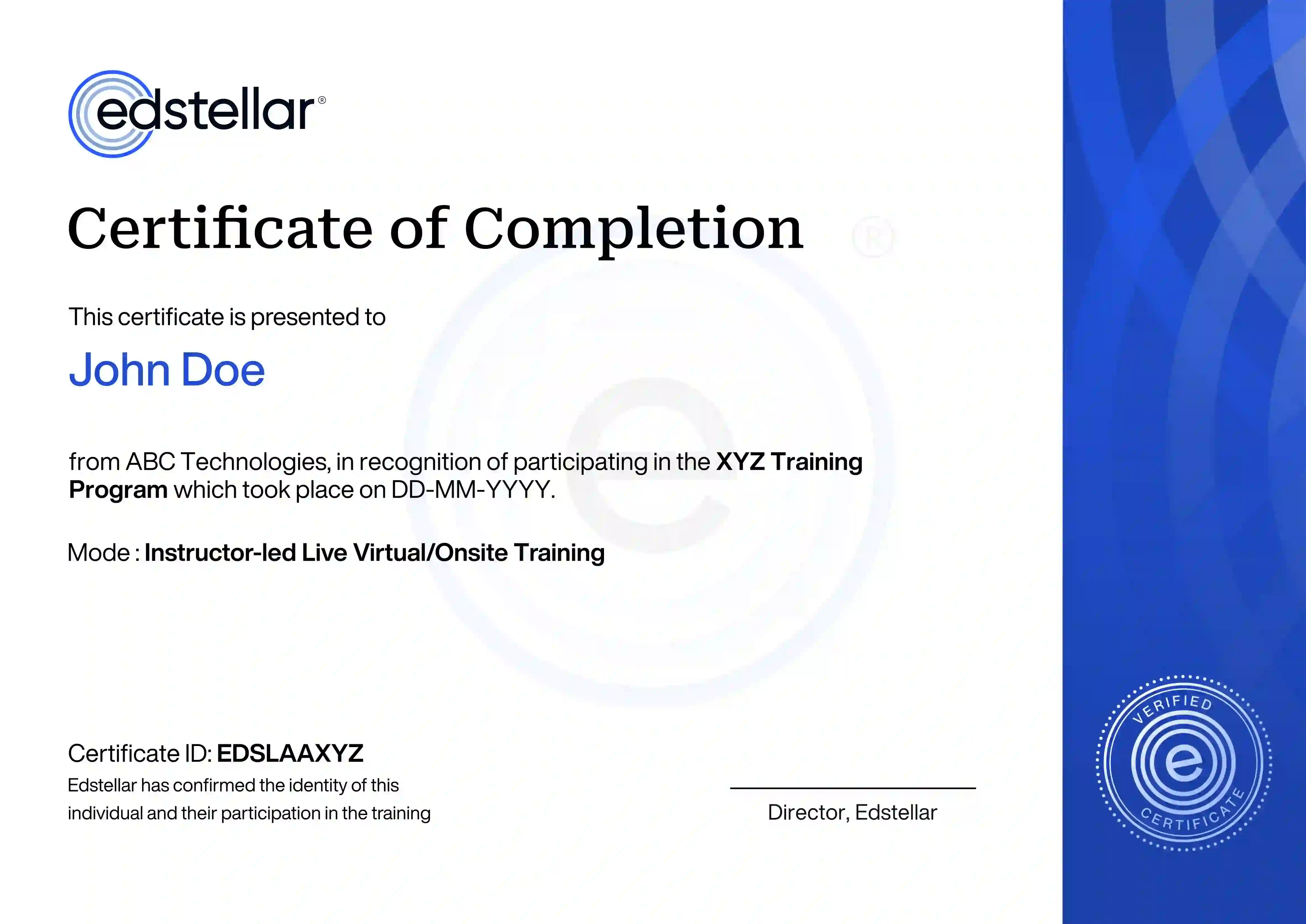
Get Your Team Members Recognized with Edstellar’s Course Certificate
Upon successful completion of the training course offered by Edstellar, employees receive a course completion certificate, symbolizing their dedication to ongoing learning and professional development.
This certificate validates the employee's acquired skills and is a powerful motivator, inspiring them to enhance their expertise further and contribute effectively to organizational success.


Other Related Corporate Training Courses
Edstellar is a one-stop instructor-led corporate training and coaching solution that addresses organizational upskilling and talent transformation needs globally.
Marketing Excellence
Operational Excellence
Finance Excellence
HR Excellence
IT Excellence
Customer Service
Leadership Excellence
Quality Management
Software
How it WorksFAQ'sCorporate Training
CatalogStellar AI
Skill MatrixHRMS Integration
Who we ServeCEO RetreatsPricingTraining DeliveryPartner with Edstellar
CareersContact us