.svg "edstellar")
%20Training%203.webp)
Information Lifecycle Management (ILM) Corporate Training Program
This training equips professionals with the knowledge and skills to manage information assets across their full lifecycle. Participants learn to design ILM frameworks, implement data retention and archiving strategies, ensure regulatory compliance, and oversee secure data disposal.
(Virtual / On-site / Off-site)
.svg)
Drive Team Excellence with Information Lifecycle Management (ILM) Corporate Training
Information Lifecycle Management (ILM) is the systematic approach to managing organizational information assets from creation to disposal. As data volumes grow exponentially and regulatory requirements become more demanding, organizations need structured ILM frameworks to ensure data is retained, archived, and destroyed appropriately, reducing compliance risk, storage costs, and operational complexity throughout the information lifecycle.
Edstellar's Information Lifecycle Management (ILM) Instructor-led course offers virtual/onsite training options for data managers, IT administrators, compliance professionals, and governance teams. With hands-on framework exercises, real-world policy development workshops, and tool evaluation activities, participants build practical ILM skills they can immediately apply to strengthen their organization's information management capabilities.
.svg)

Skills Your Employees Will Gain
These are the core, hands-on capabilities your team builds during the program.
- Information classification and taxonomy
- Data retention policy design
- Archiving strategy development
- Regulatory compliance alignment
- Secure data disposal management
- ILM framework implementation
- Storage optimization planning
What Your Team Will Achieve After This Training
- Master core ILM principles and frameworks that enable organizations to manage information assets effectively across their full lifecycle.
- Develop skills to design and implement information classification taxonomies that support governance, compliance, and data discoverability.
- Learn to create and enforce data retention policies aligned with regulatory requirements and organizational data management objectives.
- Build expertise in archiving strategies, technologies, and governance controls that preserve data integrity while optimizing storage costs.
- Apply secure data disposal and destruction methods that protect sensitive information and fulfill regulatory and legal obligations.
- Gain the knowledge to design and launch a structured ILM program integrated with data governance and compliance frameworks.
Topics & Program Outline
The curriculum is organized into focused modules built by industry experts and delivered virtually or on-premise. Interactive sessions reflect the evolving demands of the workplace, keeping the learning both relevant and practical.
- What is Information Lifecycle Management
- Definition and scope of ILM in modern organizational data management
- The business value of managing information across its full lifecycle
- How ungoverned information lifecycles create compliance and operational risk
- Overview of ILM as a strategic organizational capability
- The ILM Lifecycle: Stages and Transitions
- The five stages of the information lifecycle: creation, active use, archiving, retention, and disposal
- Triggers and criteria for transitioning data between lifecycle stages
- How lifecycle stage affects storage, access, and governance requirements
- Mapping information flows across the lifecycle in real organizational contexts
- Business Drivers for Adopting ILM
- Regulatory compliance as a primary driver for structured ILM adoption
- Storage cost reduction through effective lifecycle tiering and disposal
- Operational efficiency gains from well-organized information management
- Risk reduction through systematic retention and disposal governance
- ILM and Its Relationship to Data Governance
- How ILM supports and extends the data governance operating model
- Shared principles between ILM and data governance: accountability and control
- Coordinating ILM policies with data governance councils and stewards
- Integrating ILM into enterprise data governance frameworks
- Key Stakeholders in an ILM Program
- Identifying stakeholders across IT, legal, compliance, and business functions
- Roles and responsibilities of ILM program leaders and administrators
- Engaging records managers and data stewards in ILM governance
- Executive sponsorship and its importance for ILM program success
- Common ILM Challenges and How to Address Them
- Managing unstructured data growth that outpaces ILM policies
- Lack of cross-functional alignment on retention and disposal decisions
- Technical complexity of enforcing ILM policies across hybrid environments
- Overcoming organizational resistance to systematic data disposal
- What is Information Classification and Why It Matters
- Definition of information classification in ILM and governance contexts
- How classification drives retention, access control, and disposal decisions
- Regulatory requirements that mandate information classification
- Business benefits of a well-structured classification program
- Building an Information Classification Taxonomy
- Principles for designing a practical and scalable classification taxonomy
- Aligning taxonomy structure with regulatory and business requirements
- Engaging stakeholders in taxonomy design to ensure broad applicability
- Documenting and publishing the classification taxonomy for organizational use
- Classification Levels: Public, Internal, Confidential, and Restricted
- Defining and scoping each classification level with clear criteria
- Governance controls and handling requirements for each classification tier
- Mapping classification levels to regulatory sensitivity categories
- Training employees to correctly identify and apply classification labels
- Applying Classification to Structured and Unstructured Data
- Differences in classifying structured databases vs. unstructured documents and emails
- Classification challenges posed by unstructured data volumes
- Using data discovery tools to identify and classify unstructured data
- Ensuring classification consistency across all data types and sources
- Governing and Enforcing Information Classification
- Embedding classification governance into data stewardship responsibilities
- Monitoring classification compliance through audits and automated checks
- Handling misclassified or unclassified data through governance escalation
- Updating classification policies in response to regulatory and business changes
- Tools and Automation for Information Classification
- Overview of data classification and labeling tools for enterprise environments
- Using machine learning to automate classification of large data volumes
- Integrating classification tools with DLP, SIEM, and governance platforms
- Evaluating classification tools for accuracy, scalability, and compliance support
- Governing Data at the Point of Creation
- Why ILM governance must begin at the data creation stage
- Defining governance rules for acceptable data creation and capture practices
- Assigning ownership and accountability at the point of data creation
- Embedding creation-stage governance into business process workflows
- Data Capture Standards and Quality Controls
- Setting data capture standards for formats, completeness, and accuracy
- Implementing validation controls at data entry and ingestion points
- Managing data capture from multiple sources while maintaining consistency
- Monitoring data capture quality metrics and escalating quality failures
- Managing Data Duplication at Source
- Identifying causes of duplicate data creation across systems and processes
- Governance controls to prevent duplicate creation at source
- Deduplication strategies for data captured from multiple channels
- Impact of data duplication on storage costs and ILM program effectiveness
- Metadata Capture at Data Creation
- Why capturing metadata at creation is critical for ILM governance
- Required metadata fields for effective lifecycle management and compliance
- Automating metadata capture at data entry and system ingestion points
- Validating metadata completeness and accuracy at point of capture
- Data Provenance and Source Tracking
- Definition and importance of data provenance in ILM governance
- Tracking data origins to support regulatory compliance and audit requirements
- Tools and techniques for capturing and visualizing data provenance
- Using provenance data to support breach investigations and compliance reporting
- Embedding Governance into Data Creation Workflows
- Designing ILM governance checkpoints into data creation workflows
- Training data creators on ILM policies and classification obligations
- Using workflow automation to enforce creation-stage governance controls
- Monitoring workflow compliance with governance controls through auditing
- Managing Data During Its Active Use Period
- Defining the active data stage and its governance requirements
- Access management and permission controls for active data assets
- Data quality monitoring and remediation during the active use period
- Identifying when data transitions from active use to archiving eligibility
- Storage Architecture for Active Data
- Overview of storage tiers for active data: hot, warm, and cold storage
- Selecting appropriate storage architecture based on data access frequency
- On-premise vs. cloud storage considerations for active data management
- Storage performance requirements for different active data use cases
- Data Access Controls and Permission Management
- Principles of least privilege access for active data assets
- Role-based access control frameworks for data governance programs
- Auditing and monitoring data access during the active lifecycle stage
- Managing access changes triggered by personnel moves and role changes
- Version Control and Change Management for Active Data
- Version control principles for managing changes to active data assets
- Documenting data change history for audit and governance purposes
- Managing data conflicts and rollback scenarios in active data systems
- Integrating version control with ILM governance and compliance requirements
- Monitoring Active Data Usage and Quality
- Metrics for monitoring active data usage patterns and access trends
- Detecting and remediating data quality degradation in active data assets
- Alerting mechanisms for governance policy violations during active use
- Using usage monitoring data to inform archiving and retention decisions
- Storage Optimization Strategies for Active Data
- Data deduplication and compression techniques for active data storage
- Intelligent tiering strategies to optimize storage costs for active data
- Automated storage management policies for active data environments
- Balancing performance requirements with storage cost reduction targets
- When and Why to Archive Information
- Criteria for determining when data should transition from active to archived state
- Business and regulatory drivers for maintaining archived data
- Risks of premature or delayed archiving decisions
- Aligning archiving decisions with retention policy requirements
- Archiving Models: Near-Line, Off-Line, and Cloud Archiving
- Characteristics and use cases for near-line archiving solutions
- Off-line archiving: tape, optical media, and long-term preservation
- Cloud archiving: tiered storage, object storage, and compliance archive services
- Selecting the right archiving model based on data volume, cost, and access needs
- Designing an Archiving Policy and Schedule
- Components of an effective organizational archiving policy
- Setting archiving schedules aligned with regulatory retention requirements
- Defining archiving rules by data classification and business domain
- Communicating and enforcing archiving policies across the organization
- Maintaining Data Accessibility in Archives
- Balancing data access requirements with archive cost and performance
- Metadata indexing strategies to support searchability in large archives
- Managing archive retrieval SLAs for compliance and business purposes
- Preventing format obsolescence in long-term data archives
- Archive Integrity Verification and Monitoring
- Techniques for verifying data integrity in long-term archives
- Automated integrity checks and alerting for archive corruption events
- Periodic archive audits to ensure completeness and governance compliance
- Recovery strategies for corrupted or inaccessible archive data
- Legal Hold and Litigation Hold Management in Archives
- What a legal hold is and when it overrides standard retention and disposal
- Implementing legal holds in archive systems to prevent premature disposal
- Coordinating legal hold management between legal, IT, and governance teams
- Releasing legal holds and resuming normal lifecycle management after litigation
- Designing Effective Data Retention Policies
- Core components of a data retention policy document
- Steps for drafting, reviewing, and approving retention policies
- Balancing regulatory minimums with business data needs
- Common data retention policy pitfalls and how to avoid them
- Regulatory Requirements Driving Retention Obligations
- Retention obligations under GDPR, CCPA, and the DPDP Act
- Industry-specific retention requirements: HIPAA, SOX, PCI DSS, and others
- Mapping regulatory retention requirements to organizational data categories
- Managing conflicting retention obligations across multiple jurisdictions
- Retention Schedules for Different Data Categories
- Building a retention schedule matrix by data type and regulatory requirement
- Defining retention periods for financial, HR, customer, and operational data
- Managing data categories with no explicit regulatory retention mandate
- Documenting and publishing the retention schedule for organizational use
- Balancing Retention with Storage Cost and Performance
- Impact of extended retention periods on storage cost and complexity
- Using tiered storage to manage retention obligations cost-effectively
- Applying intelligent retention policies to minimize unnecessary data accumulation
- Reporting storage cost impact of retention decisions to business stakeholders
- Managing Retention Exceptions and Legal Holds
- Types of retention exceptions and when they are justified
- Process for requesting and approving retention period exceptions
- Coordinating legal holds as retention exceptions in governance systems
- Documenting and auditing retention exceptions for compliance purposes
- Communicating and Enforcing Retention Policies
- Strategies for communicating retention policies to business and IT teams
- Training employees on their retention responsibilities by data category
- Using automated systems to enforce retention schedules across data stores
- Auditing retention policy compliance and remediating non-compliance findings
- When and Why Data Must Be Destroyed
- Regulatory and business triggers for mandatory data destruction
- Risks of retaining data beyond its authorized retention period
- Balancing data minimization obligations with operational data needs
- Building a disposal-ready culture supported by governance and policy
- Data Disposal Methods: Deletion, Overwriting, and Physical Destruction
- Logical deletion vs. secure erasure: differences and when each is appropriate
- Overwriting standards: DoD 5220.22-M and NIST 800-88 guidelines
- Physical destruction methods: shredding, degaussing, and incineration
- Selecting the right disposal method based on data sensitivity and media type
- Certificate of Destruction and Disposal Documentation
- Purpose and content of a certificate of destruction
- Maintaining disposal records for regulatory audit and compliance evidence
- Chain of custody documentation for physical data destruction processes
- Storing disposal documentation securely for long-term audit access
- Secure Disposal of Cloud-Stored Data
- Challenges of securely deleting data from cloud storage environments
- Cloud provider responsibilities for data deletion and residual data risks
- Using encryption as a disposal mechanism for cloud-stored data
- Verifying cloud data deletion through contractual assurances and audits
- Managing Third-Party Data Disposal and Vendor Compliance
- Contractual requirements for third-party data disposal and return
- Auditing vendor data disposal practices against organizational standards
- Managing disposal obligations at the end of vendor contracts
- Incorporating disposal requirements into procurement and vendor management
- Auditing Data Disposal Activities for Compliance
- Designing a disposal audit program for governance and regulatory compliance
- Key audit evidence requirements for demonstrating secure disposal
- Remediating disposal compliance failures identified through audits
- Reporting disposal compliance status to governance and legal stakeholders
- ILM Requirements Under GDPR
- GDPR storage limitation principle and how ILM operationalizes it
- Mapping GDPR data minimization requirements to ILM retention and disposal
- ILM controls that support GDPR data subject rights fulfillment
- Demonstrating GDPR accountability through ILM documentation and audit trails
- CCPA Data Retention and Deletion Obligations
- CCPA requirements for retention disclosure and consumer deletion rights
- Using ILM programs to fulfill CCPA deletion and opt-out obligations
- Documenting retention practices for CCPA compliance reporting
- Managing CCPA deletion requests within the ILM governance framework
- DPDP Act Storage Limitation and Disposal Requirements
- DPDP Act obligations for limiting data retention to specified purposes
- Governing data principal erasure requests under the DPDP Act
- Aligning ILM policies with DPDP Act data fiduciary obligations
- Maintaining compliance evidence for DPDP Act regulatory submissions
- Industry-Specific Retention Regulations: HIPAA, SOX, and Others
- HIPAA medical record retention requirements and ILM governance implications
- SOX financial record retention obligations and audit trail management
- PCI DSS cardholder data retention and disposal requirements
- Building multi-regulation ILM policies for complex compliance environments
- Mapping ILM Controls to Regulatory Requirements
- Creating a regulatory-to-ILM control mapping document
- Using control mapping to identify gaps in ILM program coverage
- Maintaining and updating the control mapping as regulations evolve
- Using control maps to guide regulatory audit preparation and response
- Preparing ILM Documentation for Regulatory Audits
- Building an ILM compliance evidence repository for audit readiness
- Key documentation categories: policies, schedules, disposal records, and logs
- Preparing data stewards and owners for regulatory examination
- Continuous ILM monitoring to maintain ongoing audit readiness
- Overview of ILM Software and Platforms
- Categories of ILM tools: classification, archiving, retention, and disposal platforms
- Leading ILM software vendors and their key capability areas
- On-premise vs. cloud-native ILM platform trade-offs
- Evaluating ILM tools against organizational governance and compliance requirements
- Enterprise Content Management and ILM
- Role of enterprise content management systems in ILM governance
- Integrating ECM platforms with ILM retention and archiving workflows
- Managing unstructured content through ECM-driven ILM policies
- ECM platform selection considerations for ILM program support
- Cloud Storage and ILM Policy Enforcement
- Challenges of enforcing ILM policies across multi-cloud environments
- Native cloud ILM capabilities: lifecycle rules, tiering, and expiration policies
- Governing cloud data across AWS, Azure, and GCP using ILM frameworks
- Monitoring cloud ILM policy compliance through cloud governance tools
- Automated Tiering and Lifecycle Policies in Cloud Platforms
- How automated tiering transitions data between storage classes based on age and access
- Configuring lifecycle policies in AWS S3, Azure Blob, and GCP Cloud Storage
- Cost impact of automated tiering and lifecycle management in cloud environments
- Validating automated lifecycle policy behavior against ILM governance requirements
- Integrating ILM Tools with Data Governance and Compliance Systems
- Connecting ILM platforms with data catalogs and metadata management systems
- Integrating ILM tools with compliance management and audit platforms
- Enabling end-to-end lifecycle visibility through integrated tool ecosystems
- API and connector strategies for ILM tool integration in complex environments
- Evaluating and Selecting ILM Technology
- Key evaluation criteria: functionality, scalability, compliance support, and cost
- Building an ILM technology evaluation framework and scoring matrix
- Conducting vendor demonstrations and proof-of-concept evaluations
- Making the technology selection business case to executive stakeholders
- Assessing Current ILM Maturity and Readiness
- Using an ILM maturity model to assess current state across key dimensions
- Identifying gaps between current practice and target ILM program state
- Conducting stakeholder interviews and data audits as part of readiness assessment
- Prioritizing maturity gaps to focus initial ILM program investment
- Designing the ILM Program Operating Model
- Defining ILM program governance structures: roles, councils, and decision rights
- Aligning the ILM operating model with the data governance framework
- Documenting the ILM program charter and governance accountabilities
- Selecting program management approaches: agile, phased, or hybrid
- Stakeholder Engagement and Change Management
- Mapping and engaging key ILM program stakeholders across the organization
- Managing resistance to ILM adoption through structured change management
- Building ILM awareness and literacy across business and IT teams
- Sustaining stakeholder engagement through program milestones and wins
- Implementing an ILM Pilot and Scaling to Enterprise
- Selecting the right data domain or use case for the ILM program pilot
- Designing pilot governance structures with measurable success criteria
- Running the pilot: policies, tools, stewardship roles, and monitoring
- Scaling ILM governance from pilot results to enterprise-wide program
- Measuring ILM Program Performance and Maturity
- Defining KPIs for ILM program performance: compliance, cost, and quality
- Tracking ILM maturity progress against defined target states
- Reporting ILM program outcomes to governance councils and executive sponsors
- Using performance data to prioritize ILM program improvements
- Continuous Improvement of the ILM Program
- Building a continuous improvement cycle into ILM program governance
- Incorporating regulatory changes and audit findings into program updates
- Engaging stewards and business teams in ongoing ILM improvement initiatives
- Planning long-term ILM roadmap evolution aligned with organizational strategy
Who Should Attend?
This program suits professionals at many levels across the organization, including:
- Data Managers
- IT and Storage Administrators
- Compliance and Legal Officers
- Records Management Professionals
- Chief Data Officers
- Data Governance Analysts
What are the Prerequisites?
Professionals should have basic familiarity with organizational data management practices and a general understanding of data storage and compliance concepts to take the Information Lifecycle Management (ILM) training course.
Choose the Format That Fits Your Team
We design training your teams actually engage with, and deliver it the way that suits you best. Through a vetted global trainer network, Edstellar runs sessions in 10+ languages with consistent quality anywhere.


.webp "Virtual Information Lifecycle Management (ILM) Training")
Virtual / online: expert-led live sessions delivered anywhere, with consistency and easy scheduling.
.webp "On-site Information Lifecycle Management (ILM) Training")
On-site (in-house): immersive, instructor-led learning at your office.
.webp "Off-site Information Lifecycle Management (ILM) Training")
Off-site: focused, instructor-led group learning away from everyday workplace distractions.
Get a Proposal Shaped to Your Needs
Need pricing for onsite, offsite, or virtual delivery? Get a proposal tailored to your team's needs.
64 hours of group training (includes VILT/In-person On-site)
Tailored for SMBs
Tailor-Made Trainee Licenses with Our Exclusive Training Packages!
160 hours of group training (includes VILT/In-person On-site)
Ideal for growing SMBs
Tailor-Made Trainee Licenses with Our Exclusive Training Packages!
400 hours of group training (includes VILT/In-person On-site)
Designed for large corporations
Tailor-Made Trainee Licenses with Our Exclusive Training Packages!
Unlimited duration
Designed for large corporations
What Sets Edstellar Apart
Experienced Trainers
Our trainers are drawn from a vetted global network and bring years of industry expertise, keeping every session practical and impactful.
Proven Quality
With a strong global track record, Edstellar is known for quality and engaging delivery.
Industry-Relevant Curriculum
Our programs are built by experts to match the demands of today's industry.
Fully Customizable
Every program can be tailored to your organization's goals.
Comprehensive Support
We provide pre- and post-session support for a complete learning experience.
Global Multi-Location & Multilingual Training Delivery
We deliver in multiple languages to support diverse global teams.
Recognition That Motivates Your Team
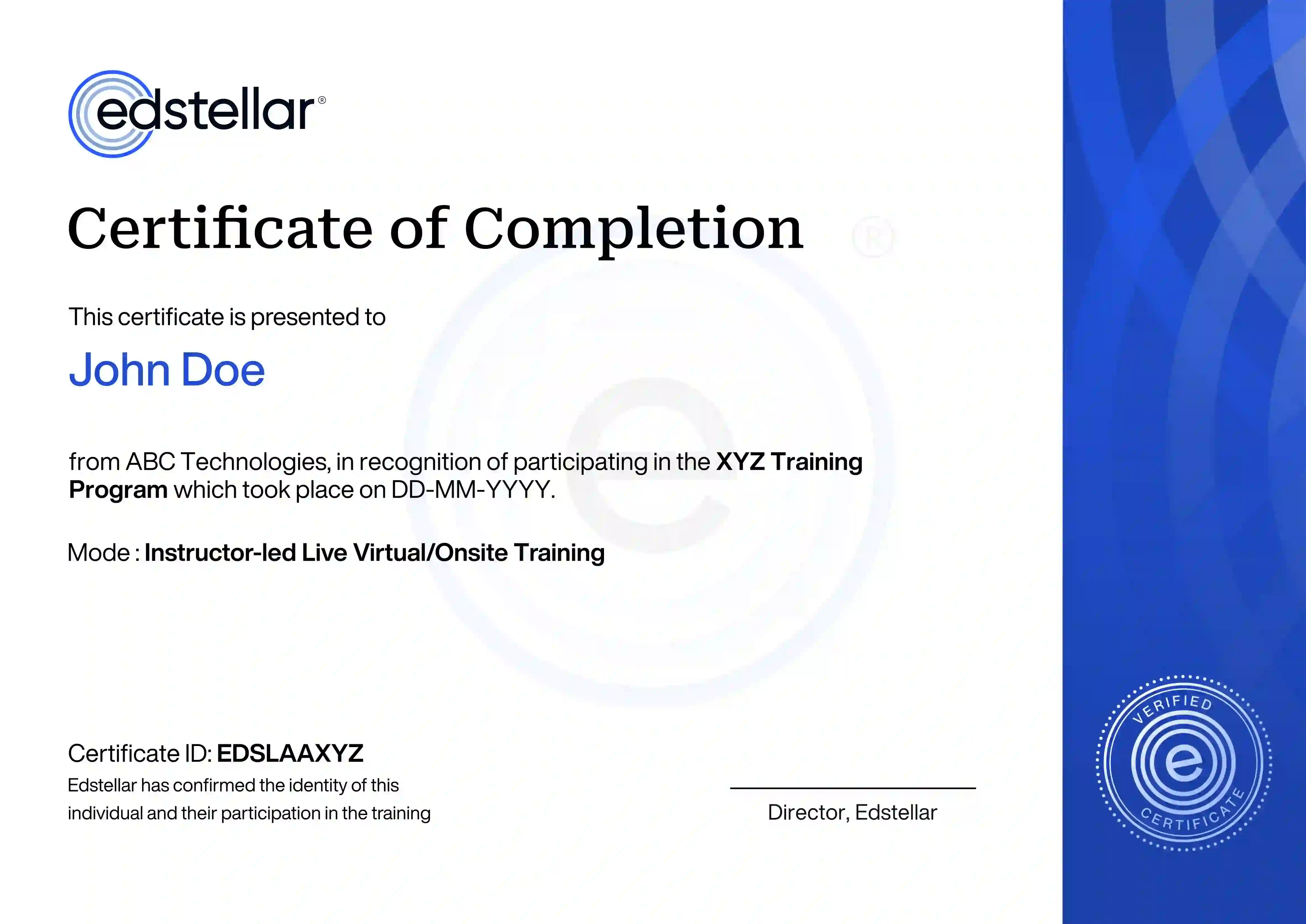
Upon successful completion of the Information Lifecycle Management (ILM) training course offered by Edstellar, employees receive a course completion certificate, symbolizing their dedication to ongoing learning and professional development.
This certificate validates the employee's acquired skills and is a powerful motivator, inspiring them to enhance their expertise further and contribute effectively to organizational success.

Other Related Corporate Training Courses


Explore More Courses


Edstellar is a one-stop instructor-led corporate training and coaching solution that addresses organizational upskilling and talent transformation needs globally.
.svg)
.svg)
.svg)

.svg)
Learning Technology
Learning Content Design and Development
Learning Governance, Analytics & ROI
Digital Learning Ecosystem
Training Simulations, AR/VR & Case Studies
Employee Performance Support
Leadership Pipeline & Succession PlanningStrategic Workforce Planning for EnterprisesTransformation & Risk Advisory for EnterprisesDEI Consulting for EnterprisesEmployee Engagement Consulting for Enterprises
Cultural Transformation