Home
Corporate Training Courses
IT & Technical
Data Analytics Training
Business Intelligence Training
Oracle Business Intelligence Enterprise Edition (OBIEE) Training

Drive Team Excellence with Oracle Business Intelligence Enterprise Edition (OBIEE) Corporate Training

OBIEE is a business intelligence system that allows professionals to gather, store, and visualize enterprise data. OBIEE helps professionals to optimize performance, ensure data accuracy, and enhance security measures. Professionals need training in OBIEE to understand data modeling concepts and leverage its advanced reporting and visualization tools efficiently.

Edstellar's virtual/onsite Oracle Business Intelligence Enterprise Edition (OBIEE) training course offers customization and employs cutting-edge methodologies for better outcomes. Our trainers are renowned for their expertise in the OBIEE instructor-led training course and have vast experience guiding teams through the complexities of OBIEE.

Get Customized Expert-led Training for Your Teams
Customized Training Delivery
Scale Your Training: Small to Large Teams
In-person Onsite, Live Virtual or Hybrid Training Modes
Plan from 2000+ Industry-ready Training Programs
Experience Hands-On Learning from Industry Experts
Delivery Capability Across 100+ Countries & 10+ Languages
""""

Skills Your Employees Will Gain

These are the core, hands-on capabilities your team builds during the program.

  • Data Analysis
    Data Analysis is the process of inspecting, cleansing, and modeling data to discover useful information. This skill is important for roles like data scientist and business analyst, as it drives informed decision-making and strategy development.
  • Report Development
    Report Development is the process of creating structured documents that present data analysis and insights. this skill is important for roles in data analysis, management, and decision-making, as it enables clear communication of findings and supports informed business strategies.
  • Dashboard Design
    Dashboard Design is the skill of creating visual representations of data to facilitate decision-making. this skill is important for data analysts and business intelligence roles, as it enhances data comprehension and drives strategic insights.
  • Data Modeling
    Data Modeling is the process of creating visual representations of data structures and relationships. This skill is important for data analysts and database developers to ensure accurate data management and analysis.
  • Data Visualization
    Data Visualization is the ability to represent data graphically, making complex information accessible and understandable. this skill is important for analysts and decision-makers to identify trends, insights, and patterns effectively.
  • Security Implementation
    Security Implementation involves deploying measures to protect systems and data from threats. This skill is important for IT roles to ensure data integrity and compliance.

What Your Team Will Achieve After This Training

  • Design and develop customized reports and dashboards tailored to specific business requirements
  • Implement effective data modeling strategies to optimize performance and enhance data integrity
  • Utilize advanced data visualization techniques to present findings in a clear and compelling manner
  • Evaluate security measures and implement best practices to safeguard sensitive data within OBIEE environments
  • Apply ad-hoc query capabilities to perform real-time data analysis and answer ad-hoc business questions
  • Collaborate with team members to leverage OBIEE's collaborative features and share knowledge effectively
  • Optimize OBIEE workflows and processes to streamline data analysis and reporting tasks for improved efficiency

Topics & Program Outline

The curriculum is organized into focused modules built by industry experts and delivered virtually or on-premise. Interactive sessions reflect the evolving demands of the workplace, keeping the learning both relevant and practical.

  1. Understanding repository components
    • Types of repositories
    • Version control systems
    • Metadata management
  2. Repository architecture overview
    • Layered architecture 
    • Data flow through the repository
    • Integration with surrounding systems
  3. Repository file structure
    • Naming conventions
    • File types
  1. Creating physical tables and columns
    • Data modeling techniques 
    • Data type selection
    • Normalization considerations
  2. Defining physical joins and foreign keys
    • Types of joins 
    • Optimizing join performance
  3. Importing metadata from data sources
    • Reverse engineering techniques
    • Data transformation considerations
    • Error handling during import
  1. Creating logical tables and columns
    • Business-oriented representation of data
    • Aggregations and calculations
    • Dimension tables and hierarchies
  2. Defining logical joins and hierarchies
    • Relationships between logical tables
    • Multi-level hierarchies for dimensions
    • Handling parent-child relationships
  3. Mapping physical to logical columns
    • Ensuring data consistency
    • Defining transformation logic
  1. Creating presentation tables and columns
    • User-friendly views of data
    • Derived metrics and KPIs
  2. Organizing presentation hierarchies
    • Defining how users navigate data
    • Drill-down and roll-up capabilities
    • Presenting data in a consumable way
  3. Defining presentation privileges
    • Controlling user access to data
    • Row-level and column-level security
  1. Implementing testing strategies
    • Unit testing for transformations
    • Integration testing for data flow
    • Data quality checks
  2. Validating repository integrity
    • Identifying and correcting errors
    • Maintaining data lineage
  3. Troubleshooting common issues
    • Performance bottlenecks
    • Data integrity problems
  1. Understanding logical table source properties
    • Data source connection settings
    • Refresh schedules and dependencies
    • Incremental load strategies
  2. Managing complex logical joins
    • Optimizing performance for complex joins
    • Handling multiple join conditions
  3. Optimizing logical table sources
    • Caching strategies for frequently used sources
    • Partitioning for improved query performance
    • Identifying and eliminating redundant data
  1. Implementing aggregate functions
    • Common aggregation functions
    • Grouping data for calculations
    • Using nested aggregations
  2. Creating custom calculations
    • Defining custom formulas and expressions
    • Leveraging scripting languages for complex logic
    • Ensuring calculation validity and accuracy
  3. Utilizing expression builder
    • Simplifying complex calculation definition
    • Validating expression syntax
  1. Creating dimension hierarchies
    • Defining parent-child relationships between levels
    • Managing attribute hierarchies for roll-up capabilities
    • Designing user-friendly navigation through dimensions
  2. Managing level-based measures
    • Assigning measures to specific levels of a hierarchy
    • Aggregating measures at different levels
  3. Handling Slowly Changing Dimensions (SCDs)
    • Strategies for handling updates to dimension tables
    • Implementing SCD types 
    • Maintaining historical data integrity
  1. Configuring usage tracking settings
    • Defining events to track
    • Specifying user and session identification
    • Setting data retention periods
  2. Analyzing usage tracking reports
    • Identifying popular reports and data sources
    • Understanding user access patterns
    • Optimizing repository based on usage data
  3. Optimizing usage tracking performance
    • Minimizing overhead on data access queries
  1. Configuring model checker settings
    • Defining data quality checks 
    • Scheduling automated model validation
    • Setting alert thresholds for data issues
  2. Optimizing aggregate navigation
    • Pre-calculating and storing aggregates
    • Designing efficient aggregate hierarchies
  3. Troubleshooting aggregate issues
    • Identifying incorrect or missing aggregates
    • Diagnosing errors in aggregate calculations
  1. Implementing partitioning strategies
    • Dividing data tables based on specific criteria
    • Managing partition lifecycle
  2. Managing fragmented tables
    • Balancing data distribution
    • Maintaining data consistency across fragments
  1. Defining repository variables
    • Setting default values and data types
    • Utilizing variables for dynamic configurations
  2. Implementing session variables
    • Storing user preferences and filter selections
    • Enhancing user experience with personalized settings
  3. Leveraging variable prompts
    • Capturing user input during data access
    • Dynamically modifying queries
    • Providing flexibility for ad-hoc analysis
  1. Understanding time series modeling concepts
    • Representing data points over time
    • Defining time attributes and granularities 
    • Selecting appropriate data aggregation methods
  2. Implementing time series functions:
    • Functions for date/time manipulation
    • Calculations specific to time series data
    • Leveraging built-in functions
  3. Optimizing time-series performance
    • Utilizing appropriate data compression techniques
    • Implementing efficient indexing strategies for time-based queries
  1. Defining bridge tables
    • Establishing foreign key relationships to reference primary keys
    • Maintaining data integrity across linked tables
  2. Implementing many-to-many relationships
    • Designing efficient data structures
    • Handling data retrieval and manipulation
    • Ensuring data consistency in all linked tables
  3. Optimizing relationship performance
    • Denormalization techniques 
    • Utilizing materialized views
  1. Understanding implicit fact column concepts
    • Simplifying data model design for certain scenarios
    • Potential drawbacks and limitations of implicit facts
  2. Configuring implicit fact columns
    • Specifying the measure to be implicitly applied
    • Ensuring data accuracy and consistency with implicit facts
  3. Optimizing implicit fact column performance
    • Evaluating the impact on query performance
    • Considering alternative data modeling approaches
    • Balancing simplicity with efficiency
  1. Implementing object-level security
    • Controlling access to specific repository objects 
    • Granting permissions to users and groups
    • Defining granular access control rules
  2. Configuring data-level security
    • Restricting data visibility based on user attributes or roles
    • Implementing row-level and column-level security filters
  3. Managing security privileges
    • Assigning and revoking user permissions
    • Auditing user activity and data access
    • Maintaining a secure repository environment
  1. Understanding cache management concepts
    • Storing frequently accessed data for faster retrieval
    • Configuring cache invalidation strategies
  2. Configuring cache settings
    • Defining objects to be cached 
    • Specifying cache expiration times
  3. Optimizing cache performance
    • Monitoring cache hit rates and utilization
    • Identifying and removing outdated cached data
    • Tuning cache settings for specific workloads

Who Should Attend?

This program suits professionals at many levels across the organization, including:

  • Business Intelligence Developers
  • Data Analysts
  • BI Engineers
  • Data Scientists
  • Database Administrators
  • Reporting Analysts
  • ETL Developers
  • Analytics Specialists
  • Data Architects
  • Information Analysts
  • BI Specialists
  • Managers

What are the Prerequisites?

Professionals with a basic understanding of SQL queries and familiarity with database concepts can take up the Oracle Business Intelligence Enterprise Edition (OBIEE) training course.

Request a Quote for your Corporate Training Requirements

Valid number

Delivering Training for Organizations across 100 Countries and 10+ Languages

Choose the Format That Fits Your Team

We design training your teams actually engage with, and deliver it the way that suits you best. Through a vetted global trainer network, Edstellar runs sessions in 10+ languages with consistent quality anywhere.

Virtual Oracle Business Intelligence Enterprise Edition (OBIEE) Training

Virtual / online: expert-led live sessions delivered anywhere, with consistency and easy scheduling.

We deliver anywhere worldwide
Standardized content for consistent outcomes
Join from own workspace, no travel
We scale to large groups across sites
Interactive tools keep remote learners engaged
On-site Oracle Business Intelligence Enterprise Edition (OBIEE) Training

On-site (in-house): immersive, instructor-led learning at your office.

Our trainers run face-to-face at your office
We tailor setup/content to your workplace and tools
Group exercises drive collaboration
Live demos +  hands-on practice
Direct trainer access to clarify doubts
Off-site Oracle Business Intelligence Enterprise Edition (OBIEE) Training

Off-site: focused, instructor-led group learning away from everyday workplace distractions.

We host your teams at a venue of your preferred choice
Built-in group activities for bonding
Full uninterrupted schedule for focus/retention
Boosts morale and signals commitment

Get a Proposal Shaped to Your Needs

Need pricing for onsite, offsite, or virtual delivery? Get a proposal tailored to your team's needs.

Request a Group Training Quote
""
How Many Team Members Need Training?
Please select an option or fill in the custom field.
"'

Is Your Corporate Training Requirement Only for Oracle Business Intelligence Enterprise Edition (OBIEE)?

Please select at least one course.
""
Add the List of Training Workshops
search icon

      Please select the course

      No. of Courses selected: 0

      Clear

      Upload a CSV

      Send us your Training Requirements in 3 Easy steps

      1. 1
      2. 2
        Add the required training workshops
      3. 3
        Upload to get a quick quote or email it to contact@edstellar.com

      ""

      Looking for a Complete Package?

      Looking for a one-time pricing option for all your annual training requirements?

      View Corporate Training Packages
      ""
      Select the Option that Best Describes Your Corporate Training Requirement

      Please select an option or choose from the recurring options.
      ""
      Verify and Submit Your Request

      Review Your Corporate Training Selection Summary

      Training Program: Oracle Business Intelligence Enterprise Edition (OBIEE) Training

      1. No of Team Members

      2. Selected Training Preference

      3. Selected Recurring Sessions

      1

      Review your Requirements

      Training Workshops Selected :


        Excel
        File has been
        successfully uploaded.
        Fill the form to submit
 your details
        Submit Your Professional Contact Information
        Valid number
        We've received your enquiry. Our team will be in touch soon.
        Oops! Something went wrong while submitting the form.
        Starter
        120 licences

        Tailor-Made Trainee Licenses with Our Exclusive Training Packages!

        View Package

        64 hours of group training (includes VILT/In-person On-site)

        Tailored for SMBs

        Growth
        320 licences

        Tailor-Made Trainee Licenses with Our Exclusive Training Packages!

        View Package

        160 hours of group training (includes VILT/In-person On-site)

        Ideal for growing SMBs

        Enterprise
        800 licences

        Tailor-Made Trainee Licenses with Our Exclusive Training Packages!

        View Package

        400 hours of group training (includes VILT/In-person On-site)

        Designed for large corporations

        Custom
        Unlimited licenses

        Tailor-Made Trainee Licenses with Our Exclusive Training Packages!

        View Package

        Unlimited duration

        Designed for large corporations

        What Sets Edstellar Apart

        Experienced Trainers

        Our trainers are drawn from a vetted global network and bring years of industry expertise, keeping every session practical and impactful.

        Proven Quality

        With a strong global track record, Edstellar is known for quality and engaging delivery.

        Industry-Relevant Curriculum

        Our programs are built by experts to match the demands of today's industry.

        Fully Customizable

        Every program can be tailored to your organization's goals.

        Comprehensive Support

        We provide pre- and post-session support for a complete learning experience.

        Global Multi-Location & Multilingual Training Delivery

        We deliver in multiple languages to support diverse global teams.

        Hear from Organizations We've Trained

        "The Oracle Business Intelligence Enterprise Edition (OBIEE) training provided me with comprehensive capabilities that elevated my expertise. As a Senior Software Engineer, I needed to understand industry best practices deeply, workshops gave me hands-on experience with industry best practices. I now handle complex technical scenarios with enhanced confidence and systematic efficiency. Highly recommend for anyone serious about this field.”

        Lisa Gilbert

        Senior Software Engineer,

        Enterprise Consulting Services

        "This Oracle Business Intelligence Enterprise Edition (OBIEE) course transformed my approach to technical mastery solutions. The comprehensive modules on interactive labs were invaluable for our strategic projects. I can now confidently diverse client requirements. The deep coverage of hands-on exercises gave me advanced skills I immediately applied to This expertise enabled us to secure a transformative contract with a Fortune 100 organization.”

        Lucas Dubois

        Senior Software Engineer,

        Business Development Company

        "The Oracle Business Intelligence Enterprise Edition (OBIEE) training gave our team advanced advanced methodologies expertise that revolutionized our technical mastery approach. As a Senior Software Engineer, understanding practical our entire portfolio. We reduced operational costs by 40% while simultaneously improving service quality standards. This training has become foundational to our team's strategic capabilities and continued growth.”

        Ramesh Antony

        Senior Software Engineer,

        Business Operations Platform

        “Edstellar’s IT & Technical training programs have been instrumental in strengthening our engineering teams and building future-ready capabilities. The hands-on approach, practical cloud scenarios, and expert guidance helped our teams improve technical depth, problem-solving skills, and execution across multiple projects. We’re excited to extend more of these impactful programs to other business units.”

        Aditi Rao

        L&D Head,

        A Global Technology Company

        Recognition That Motivates Your Team

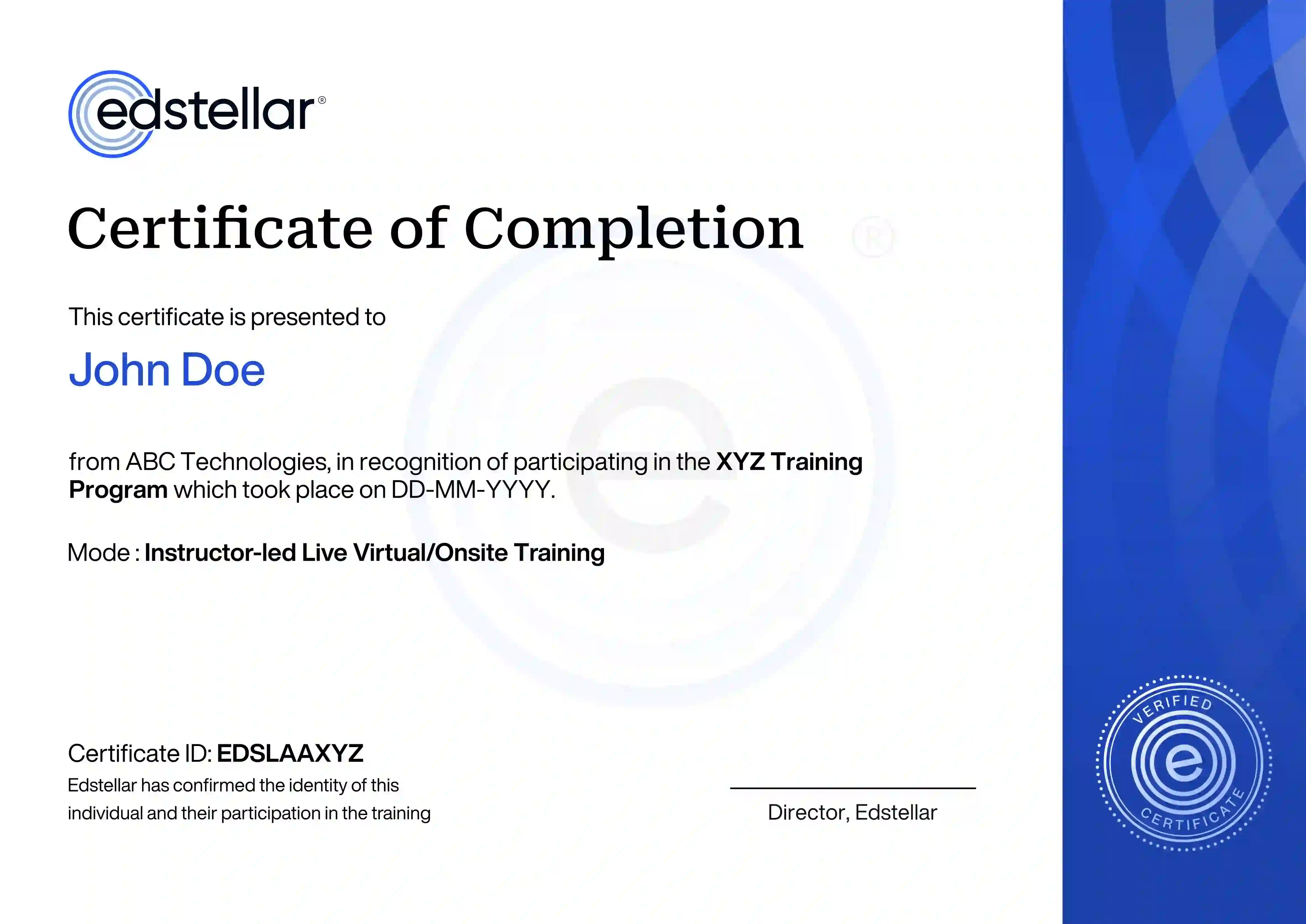
        Upon successful completion of the training course offered by Edstellar, employees receive a course completion certificate, symbolizing their dedication to ongoing learning and professional development.

        This certificate validates the employee's acquired skills and is a powerful motivator, inspiring them to enhance their expertise further and contribute effectively to organizational success.

        Recognition That Motivates Your Team
        ""

        Other Related Corporate Training Courses