Drive Team Excellence with Test Automation with HP UFT Corporate Training

Test Automation with HP UFT involves using the Unified Functional Testing (UFT) tool by Hewlett Packard Enterprise (HPE) to automate the testing of software applications. Organizations must automate repetitive tasks and execute tests across multiple platforms and environments to streamline testing processes, increase efficiency, and ensure software quality. Test Automation with HP UFT training course in test automation with HP UFT equips employees with the skills to effectively utilize this tool to automate testing procedures, thereby enhancing productivity and quality assurance efforts within the organization.

Test automation with HP UFT instructor-led training course provided by Edstellar can be customized to meet team requirements. The virtual/onsite Test automation with HP UFT training course led by expert trainers ensures employees gain practical skills in automating test cases, improving test efficiency, and ensuring software quality.

Get Customized Expert-led Training for Your Teams
Customized Training Delivery
Scale Your Training: Small to Large Teams
In-person Onsite, Live Virtual or Hybrid Training Modes
Plan from 2000+ Industry-ready Training Programs
Experience Hands-On Learning from Industry Experts
Delivery Capability Across 100+ Countries & 10+ Languages
""""

Skills Your Employees Will Gain

These are the core, hands-on capabilities your team builds during the program.

  • Test Execution
    Test Execution is the process of running test cases to validate software functionality. This skill is important for QA engineers and testers to ensure product quality and reliability.
  • Object Identification
    Object Identification is the ability to recognize and categorize objects within images or environments. This skill is important for roles in AI development, robotics, and security, enhancing accuracy and efficiency in tasks like surveillance and automated systems.
  • Error Handling
    Error Handling is the process of anticipating, detecting, and resolving errors in software or systems. This skill is important for developers and IT professionals to ensure reliability, enhance user experience, and maintain system integrity.
  • Parameterization
    Parameterization is the process of defining variables in models or systems to enhance flexibility and adaptability. This skill is important for data analysts and software developers, as it allows for efficient adjustments and optimizations in code and data analysis, leading to more robust and scalable solutions.
  • Data-Driven Testing
    Data-Driven Testing is the practice of using data sets to drive test cases, enhancing efficiency and coverage. This skill is important for QA roles, ensuring robust software quality and faster releases.
  • Checkpoints
    Checkpoints refer to critical evaluation points in a process where progress is assessed. This Skill is important for project managers to ensure timely delivery and quality control.

What Your Team Will Achieve After This Training

  • Recognize key features of the HP UFT start page and navigate the UFT interface effectively
  • Prioritize business processes for automation based on defined criteria and gather sufficient test data for scripting
  • Translate manual test cases into automated tests using UFT's recording and editing functionalities
  • Utilize the object repository to manage test objects, including adding, organizing, and sharing them effectively
  • Implement synchronization points within tests to ensure application stability and reliable test execution

Topics & Program Outline

The curriculum is organized into focused modules built by industry experts and delivered virtually or on-premise. Interactive sessions reflect the evolving demands of the workplace, keeping the learning both relevant and practical.

  1. UFT start page
    • Introduction to UFT
    • Navigating the UFT interface
    • Key features of the UFT start page
  1. Navigate the typical GUI testing workflow
    • Overview of GUI testing
    • Steps involved in GUI testing
  2. Document the steps of a business process
    • Identifying business processes
    • Creating process documentation
    • Tools for documenting business processes
  3. Prioritize business processes using effective criteria
    • Criteria for prioritizing business processes
    • Techniques for prioritization
  4. Gather sufficient test data
    • Identifying required test data
    • Sources of test data
    • Data preparation techniques
  5. Prepare the test environment for automated testing
    • Setting up the test environment
    • Configuring test tools and software
    • Ensuring environment stability
  1. Run a test and check for errors
    • Executing a test in UFT
    • Monitoring test execution
    • Identifying and resolving errors
  2. Save a test
    • Steps to save a test in UFT
    • Organizing saved tests
  3. View test results
    • Accessing test results in UFT
    • Interpreting test result data
    • Reporting test outcomes
  1. Identify objects in UFT for GUI testing
    • Understanding objects in GUI testing
    • Techniques for object identification
    • Common challenges and solutions
  2. Use the object repository to manage test objects in UFT for GUI testing
    • Introduction to the Object Repository
    • Adding objects to the repository
    • Managing and organizing repository items
  1. Identify the types of Object Repositories
    • Local Object Repository
    • Shared Object Repository
    • Differences and use cases
  2. Manage shared Object Repositories using the Object Repository Manager
    • Introduction to the Object Repository Manager
    • Creating and sharing repositories
  3. Use visual relation identifiers
    • Understanding visual relation identifiers
    • Setting up visual relation identifiers
  1. Define synchronization in UFT for GUI testing
    • What is synchronization?
    • Importance of synchronization in testing
    • Synchronization challenges
  2. Identify the uses of synchronization in UFT for GUI testing
    • Common scenarios requiring synchronization
    • Benefits of proper synchronization
  3. Add a synchronization step for a specified object
    • Steps to add synchronization in UFT
    • Configuring synchronization settings
    • Testing synchronization effectiveness
  1. Define standard checkpoints
    • What are standard checkpoints?
    • Types of checkpoints in UFT
  2. Add standard checkpoints to a test
    • Steps to add checkpoints in UFT
    • Configuring checkpoint properties
  3. Use a regular expression to add flexibility to a standard checkpoint
    • Introduction to regular expressions
    • Applying regular expressions in checkpoints
  1. Insert an input or output parameter
    • Understanding input and output parameters
    • Steps to insert parameters in UFT
    • Managing parameter values
  2. Insert an output parameter
    • Defining output parameters
    • Steps to insert output parameters
    • Practical applications
  3. Parameterize a checkpoint
    • What is checkpoint parameterization?
    • Steps to parameterize checkpoints
  4. Evaluate test results for iterative tests
    • Conducting iterative tests
    • Evaluating results of parameterized tests
    • Reporting and analysis
  1. Identify actions in GUI testing
    • Definition and importance of actions
    • Types of actions in UFT
  2. Identify action types
    • Reusable actions
    • Non-reusable actions
  3. Identify action and test iterations
    • Understanding iterations
    • Setting up action iterations in UFT
  4. Identify calls to existing actions and copies of actions
    • Calling existing actions
    • Copying actions for reuse
  5. Share values using the global data table
    • Introduction to the global data table
    • Sharing and managing data values
    • Practical applications
  6. Call actions with parameters
    • Steps to call actions with parameters
    • Configuring parameter values
  7. Store action return values
    • Understanding action return values
    • Steps to store and manage return values
  8. Create multiple actions from a single action
    • Steps to create multiple actions
    • Managing and organizing actions
  9. Create a new action
    • Steps to create new actions in UFT
    • Configuring action properties
    • Practical applications
  10. Call a reusable action from another test
    • Understanding reusable actions
    • Steps to call reusable actions
  11. Use local and global data sheets
    • Differences between local and global data sheets
    • Managing data in UFT
    • Practical applications
  12. Resolve missing actions
    • Common issues with missing actions
    • Steps to resolve missing actions
  1. List the types of steps that can be added to a test without using the record feature
    • Manual steps
    • Conditional statements
    • Custom steps
  2. Use conditional statements in a test
    • Introduction to conditional statements
    • Examples of conditional statements
  3. Use the step generator
    • Introduction to the step generator
    • Steps to use the step generator
    • Practical applications
  4. Use the reporter object to report events in the test results
    • Understanding the reporter object
    • Steps to use the reporter object
  1. Record and run a test on a web application
    • Steps to record a test
    • Configuring and running the test
  2. Insert standard checkpoints on web objects
    • Identifying web objects
    • Steps to insert checkpoints
    • Practical applications
  3. Insert a text checkpoint in a test for a web application
    • Understanding text checkpoints
    • Steps to insert text checkpoints
  1. Define Service-Oriented Architecture (SOA)
    • What is SOA?
    • Key components of SOA
    • Importance of SOA in testing
  2. Identify components of SOA
    • Services
    • Service providers
    • Service consumers
  3. Define the terminology and principles surrounding component testing
    • Key terms in component testing
    • Principles of component testing
  4. Navigate the UFT UI for API testing
    • Overview of the UFT UI
    • Key features for API testing
  5. Create a basic service test (API test) in UFT
    • Steps to create a service test
    • Configuring and running the test

Who Should Attend?

This program suits professionals at many levels across the organization, including:

  • QA Engineers
  • Test Analysts
  • Automation Testers
  • Software Developers
  • Test Managers
  • IT Analysts
  • Development Managers
  • QA Managers
  • Technical Leads
  • Software Testers
  • System Analysts
  • Test Architects

What are the Prerequisites?

Employees with a basic understanding of software testing, proficiency in programming (especially VBScript), familiarity with SDLC processes, and experience in manual testing methodologies can take up the Test Automation with HP UFT training course.

Request a Quote for your Corporate Training Requirements

Valid number

Delivering Training for Organizations across 100 Countries and 10+ Languages

Choose the Format That Fits Your Team

We design training your teams actually engage with, and deliver it the way that suits you best. Through a vetted global trainer network, Edstellar runs sessions in 10+ languages with consistent quality anywhere.

Virtual Test Automation with HP UFT Training

Virtual / online: expert-led live sessions delivered anywhere, with consistency and easy scheduling.

We deliver anywhere worldwide
Standardized content for consistent outcomes
Join from own workspace, no travel
We scale to large groups across sites
Interactive tools keep remote learners engaged
On-site Test Automation with HP UFT Training

On-site (in-house): immersive, instructor-led learning at your office.

Our trainers run face-to-face at your office
We tailor setup/content to your workplace and tools
Group exercises drive collaboration
Live demos +  hands-on practice
Direct trainer access to clarify doubts
Off-site Test Automation with HP UFT Training

Off-site: focused, instructor-led group learning away from everyday workplace distractions.

We host your teams at a venue of your preferred choice
Built-in group activities for bonding
Full uninterrupted schedule for focus/retention
Boosts morale and signals commitment

Get a Proposal Shaped to Your Needs

Need pricing for onsite, offsite, or virtual delivery? Get a proposal tailored to your team's needs.

Request a Group Training Quote
""
How Many Team Members Need Training?
Please select an option or fill in the custom field.
"'

Is Your Corporate Training Requirement Only for Test Automation with HP UFT?

Please select at least one course.
""
Add the List of Training Workshops
search icon

      Please select the course

      No. of Courses selected: 0

      Clear

      Upload a CSV

      Send us your Training Requirements in 3 Easy steps

      1. 1
      2. 2
        Add the required training workshops
      3. 3
        Upload to get a quick quote or email it to contact@edstellar.com

      ""

      Looking for a Complete Package?

      Looking for a one-time pricing option for all your annual training requirements?

      View Corporate Training Packages
      ""
      Select the Option that Best Describes Your Corporate Training Requirement

      Please select an option or choose from the recurring options.
      ""
      Verify and Submit Your Request

      Review Your Corporate Training Selection Summary

      Training Program: Test Automation with HP UFT Training

      1. No of Team Members

      2. Selected Training Preference

      3. Selected Recurring Sessions

      1

      Review your Requirements

      Training Workshops Selected :


        Excel
        File has been
        successfully uploaded.
        Fill the form to submit
 your details
        Submit Your Professional Contact Information
        Valid number
        We've received your enquiry. Our team will be in touch soon.
        Oops! Something went wrong while submitting the form.
        Starter
        120 licences

        Tailor-Made Trainee Licenses with Our Exclusive Training Packages!

        View Package

        64 hours of group training (includes VILT/In-person On-site)

        Tailored for SMBs

        Growth
        320 licences

        Tailor-Made Trainee Licenses with Our Exclusive Training Packages!

        View Package

        160 hours of group training (includes VILT/In-person On-site)

        Ideal for growing SMBs

        Enterprise
        800 licences

        Tailor-Made Trainee Licenses with Our Exclusive Training Packages!

        View Package

        400 hours of group training (includes VILT/In-person On-site)

        Designed for large corporations

        Custom
        Unlimited licenses

        Tailor-Made Trainee Licenses with Our Exclusive Training Packages!

        View Package

        Unlimited duration

        Designed for large corporations

        What Sets Edstellar Apart

        Experienced Trainers

        Our trainers are drawn from a vetted global network and bring years of industry expertise, keeping every session practical and impactful.

        Proven Quality

        With a strong global track record, Edstellar is known for quality and engaging delivery.

        Industry-Relevant Curriculum

        Our programs are built by experts to match the demands of today's industry.

        Fully Customizable

        Every program can be tailored to your organization's goals.

        Comprehensive Support

        We provide pre- and post-session support for a complete learning experience.

        Global Multi-Location & Multilingual Training Delivery

        We deliver in multiple languages to support diverse global teams.

        Hear from Organizations We've Trained

        "Attending the Test Automation with HP UFT training was transformational for my professional development. As a Senior Test Engineer, the deep dive into practical applications gave me the confidence to tackle complex coverage of interactive labs were immediately applicable to my work. The knowledge gained has been immediately applicable to mission-critical projects and initiatives. This course has become foundational to my continued success.”

        Colby Chandler

        Senior Test Engineer,

        RPA Technology Provider

        "The Test Automation with HP UFT training provided critical insights into strategic frameworks that enhanced my consulting capabilities. As a Principal QA Architect, I now leverage practical simulations with expertise exercises on real-world case studies prepared me perfectly for real-world client scenarios. Our project success rate and profitability increased dramatically within the quarter, demonstrating immediate value from this investment.”

        Ye Bao

        Principal QA Architect,

        Intelligent Automation Company

        "As a Lead Test Automation Engineer overseeing operational excellence initiatives, the Test Automation with HP UFT training significantly elevated our team's capabilities. The course expertly covered industry that transformed our operational effectiveness. Our stakeholder satisfaction and NPS scores reached unprecedented all-time highs. Our department has achieved remarkable improvements, demonstrating this course's lasting organizational impact.”

        Janaki Gopalan

        Lead Test Automation Engineer,

        Workflow Automation Solutions Firm

        “Edstellar’s IT & Technical training programs have been instrumental in strengthening our engineering teams and building future-ready capabilities. The hands-on approach, practical cloud scenarios, and expert guidance helped our teams improve technical depth, problem-solving skills, and execution across multiple projects. We’re excited to extend more of these impactful programs to other business units.”

        Aditi Rao

        L&D Head,

        A Global Technology Company

        Recognition That Motivates Your Team

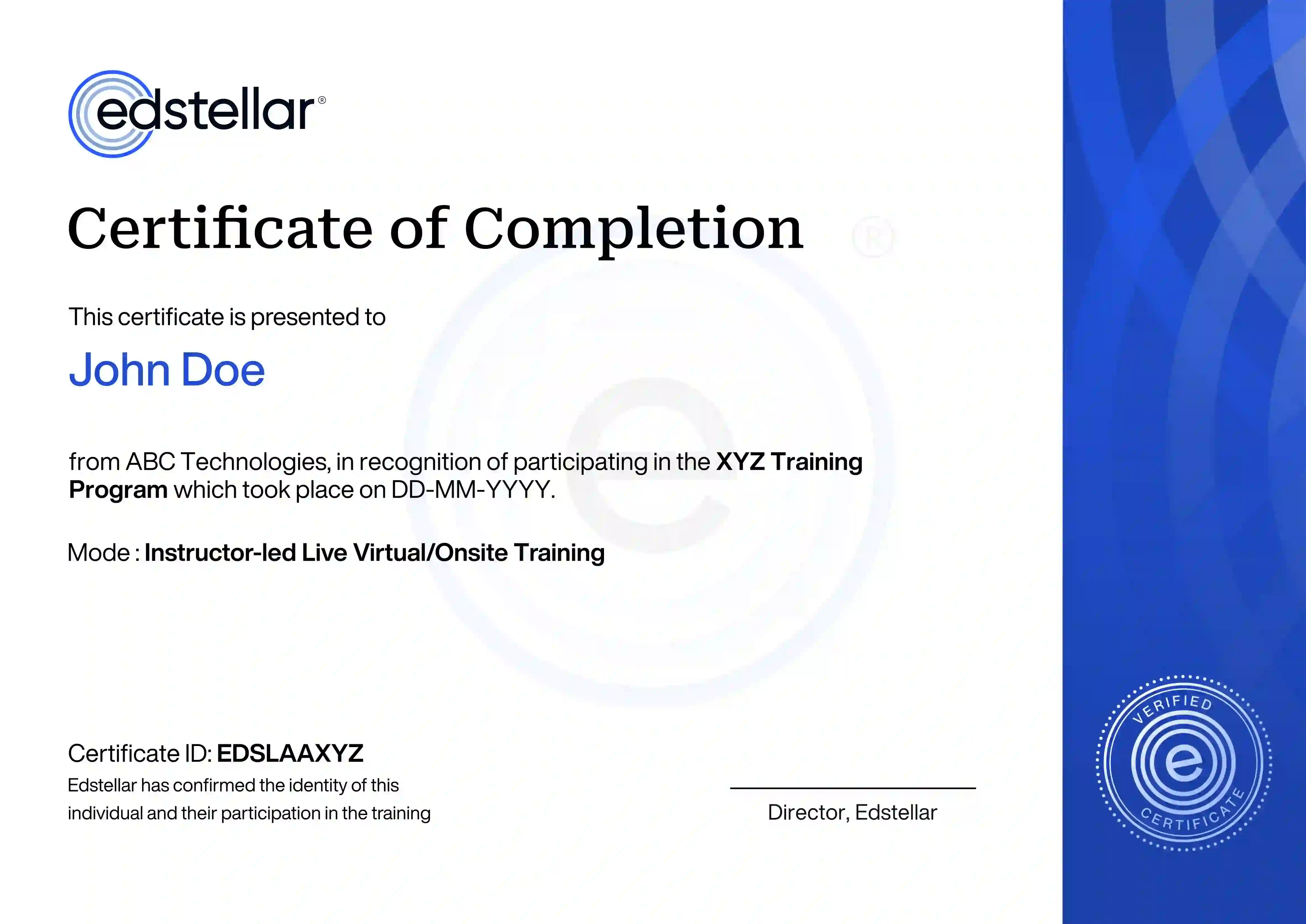
        Upon successful completion of the training course offered by Edstellar, employees receive a course completion certificate, symbolizing their dedication to ongoing learning and professional development.

        This certificate validates the employee's acquired skills and is a powerful motivator, inspiring them to enhance their expertise further and contribute effectively to organizational success.

        Recognition That Motivates Your Team
        Other Related Corporate Training Courses