.svg "edstellar")

Air Cargo Revenue Optimization Corporate Training Program for Employees
Give your revenue, pricing, and cargo sales teams the skills to forecast demand, segment markets, set profitable pricing, and optimize capacity, with training shaped around your network and your routes.
(Virtual / On-site / Off-site)
.svg)
Equip Your Air Cargo Teams to Maximize Revenue and Profitability
Air Cargo Revenue Optimization is the practice of applying revenue management principles, demand forecasting, market segmentation, pricing, cost control, overbooking, and capacity allocation, to maximize the revenue and profit an airline or freight operator earns from its available cargo capacity. It covers the full revenue cycle your teams work through: reading market drivers and constraints, forecasting demand, segmenting customers and products, setting profitable prices, managing fixed and variable costs, controlling overbooking and spoilage, and measuring performance. Air Cargo Revenue Optimization training gives your team the practical skills to turn capacity, demand, and cost data into pricing and allocation decisions that lift yield on every flight.
As air cargo markets face volatile demand, fluctuating fuel costs, shifting trade routes, and intense competition, this program helps your teams forecast demand and optimize pricing, capacity, and overbooking decisions confidently inside real cargo revenue workflows. Empower your people with expert-led on-site, off-site, and virtual sessions delivered by Edstellar, a premier corporate training provider serving organizations worldwide in-person and virtually across popular languages. Built around your goals, the program turns Air Cargo Revenue Optimization skills into lasting capabilities that lift performance across your revenue management, pricing, and cargo sales teams.
By the end of the program, your team can move from raw capacity and demand data to profitable, optimized revenue decisions: forecast demand, segment markets, price for yield, control costs and overbooking, and track results through a performance management system. The result is higher cargo revenue and margins, fewer offloads and spoilage, and a commercial function that optimizes capacity in-house rather than leaving revenue on the table.
.svg)

- Apply core revenue management principles, segmentation, allocation, and optimization, to maximize revenue from available cargo capacity.
- Forecast cargo demand with qualitative and quantitative methods and translate forecasts into capacity and pricing decisions.
- Segment markets and set differentiated, profitable pricing using supply, demand, and price elasticity.
- Manage fixed and variable costs and optimize cost structures across cargo operations.
- Apply overbooking and capacity forecasting techniques to cut spoilage and offloads while protecting service levels.
- Build and run a performance management system that tracks revenue, margins, and the roles accountable for results.
- Drivers in air cargo and logistics industry
- Technological advancements and automation
- Growth of global e-commerce
- Expansion of trade routes and hubs
- Demand for expedited shipping
- Constraints in cost, fuel, world trade, competition
- Fluctuating fuel prices and their impact on costs
- Trade tariffs and international trade barriers
- Competitive pressures and market saturation
- Environmental regulations and sustainability challenges
- Pandemics, world trade blocs, e-commerce, regulatory environments, integrators, freight forwarders
- Impact of global pandemics on air cargo
- Influence of world trade blocs on logistics
- Growth and challenges of e-commerce in air cargo
- Navigating regulatory environments in different regions
- Role of integrators in the air cargo industry
- Contribution of freight forwarders to supply chain efficiency
- Trends in competition, capacity, profit, and supply chain management
- Competitive landscape and market dynamics
- Capacity management strategies and challenges
- Profit optimization techniques in air cargo
- Innovations in supply chain management
- Segmentation, allocation, optimization
- Importance of market segmentation in revenue management
- Effective allocation of resources and capacity
- Optimization techniques for maximizing revenue
- Contribution methods and margin calculation
- Different contribution methods in revenue management
- Calculating and analyzing profit margins
- Different ways and approaches to forecasting
- Qualitative vs. quantitative forecasting methods
- Short-term and long-term forecasting techniques
- Scenario planning and its applications in air cargo
- Influences and managing demand
- Key factors influencing demand in air cargo
- Techniques for managing and predicting demand fluctuations
- The importance of market segmentation and its benefits
- Benefits of identifying and targeting specific market segments
- Product differentiation and respective pricing
- Strategies for differentiating products in the air cargo market
- Setting competitive and profitable pricing
- Pricing as a management tool and strategy, supply, demand, and price elasticity
- Using pricing strategies to manage supply and demand
- Understanding and applying price elasticity in revenue management
- What are fixed and variable costs?
- Definitions and examples of fixed and variable costs
- Optimizing costs
- Techniques for cost optimization in air cargo operations
- Factors to be considered and factors to increase risk
- Key considerations in overbooking practices
- Risk factors associated with overbooking
- Avoiding spoilage
- Strategies to minimize spoilage and ensure optimal capacity usage
- What is fixed capacity, and what is "rest" capacity based on?
- Understanding fixed and variable capacity in air cargo
- Different objectives in capacity forecasting
- Goals and objectives of effective capacity forecasting
- Increased revenue and profits
- How revenue management contributes to financial performance
- Operational benefits in decreasing offloads and service failures
- Operational improvements from effective revenue management
- The characteristics and structure of performance management systems
- Key features of effective performance management systems
- The different roles within the system
- Roles and responsibilities in a performance management system
- Revenue Analysts
- Airline Network Planners
- Financial Analysts
- Pricing Analysts
- Cargo Sales Representatives
- Air Freight Managers
- Operations Managers
- Cargo Analysts
- Sales Managers
- Air Cargo Analysts
- Financial Planners
- Route Planners
No advanced background in revenue management is required. The program suits revenue analysts, pricing analysts, cargo sales representatives, air freight managers, network planners, and operations and financial analysts who influence cargo revenue. A working familiarity with air cargo operations and comfort reading basic data and reports help participants move faster, and Edstellar tailors the depth, examples, and datasets to your network, your routes, and the revenue outcomes your organization is working toward.


.webp "Virtual Air Cargo Revenue Optimization Training")
.webp "On-site Air Cargo Revenue Optimization Training")
.webp "Off-site Air Cargo Revenue Optimization Training")
64 hours of group training (includes VILT/In-person On-site)
Tailored for SMBs
160 hours of group training (includes VILT/In-person On-site)
Ideal for growing SMBs
Tailor-Made Trainee Licenses with Our Exclusive Training Packages!
400 hours of group training (includes VILT/In-person On-site)
Designed for large corporations
Tailor-Made Trainee Licenses with Our Exclusive Training Packages!
Unlimited duration
Designed for large corporations
Experienced Trainers
Our trainers are drawn from a vetted global network and bring years of industry expertise, keeping every session practical and impactful.
Proven Quality
With a strong global track record, Edstellar is known for quality and engaging delivery.
Industry-Relevant Curriculum
Our programs are built by experts to match the demands of today's industry.
Fully Customizable
Every program can be tailored to your organization's goals.
Comprehensive Support
We provide pre- and post-session support for a complete learning experience.
Global Multi-Location & Multilingual Training Delivery
We deliver in multiple languages to support diverse global teams.
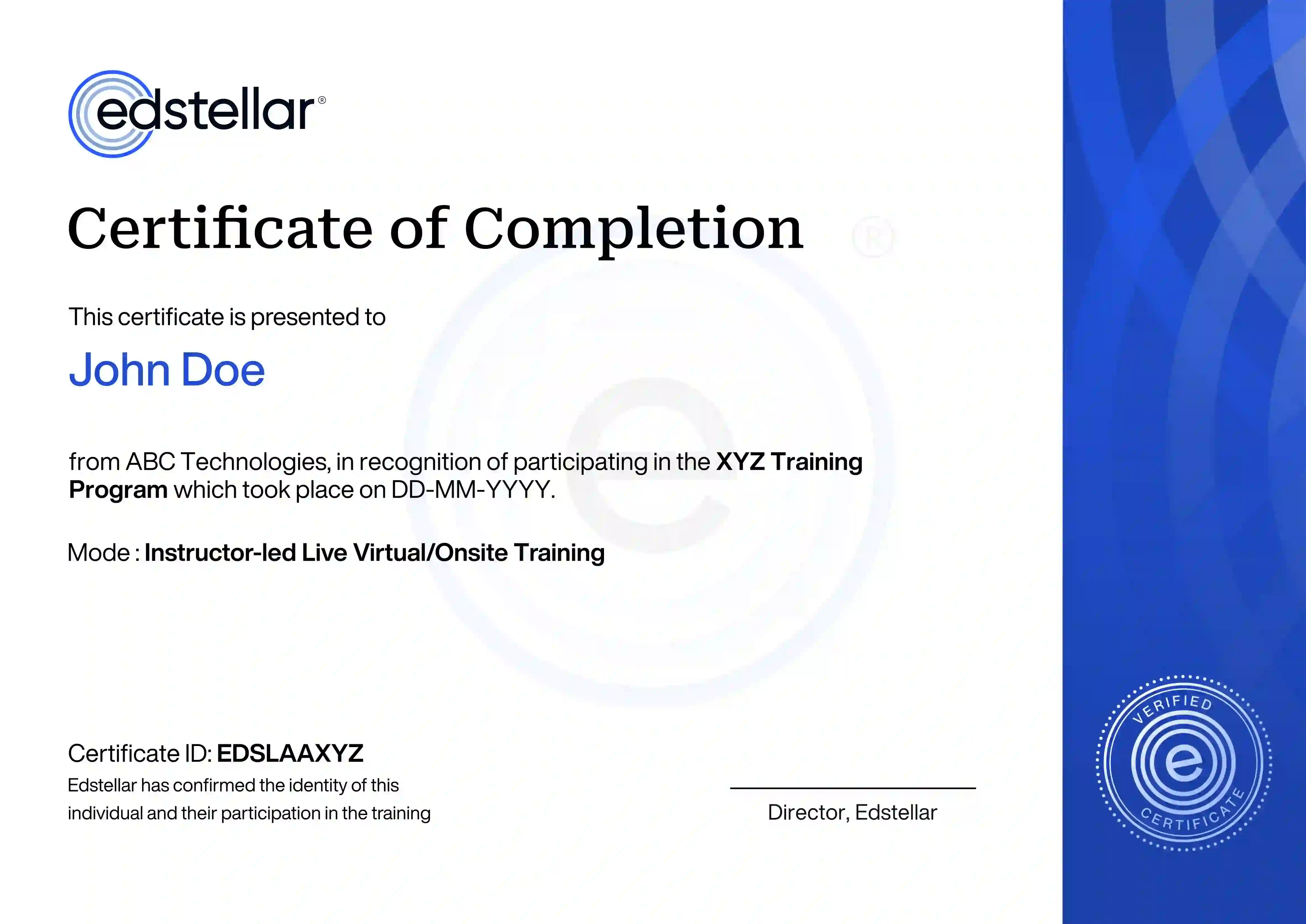
Recognition That Motivates Your Team

Frequently Asked Questions
Other Related Corporate Training Courses


Explore More Courses


.svg)
.svg)
.svg)

.svg)