Drive Team Excellence with Change Management for Generative AI Adoption Corporate Training

Empower your teams with expert-led on-site, off-site, and virtual Change Management for Generative AI Adoption Training through Edstellar, a premier corporate training provider for organizations globally. Designed to meet your specific training needs, this group training program ensures your team is primed to drive your business goals. Help your employees build lasting capabilities that translate into real performance gains.

Change Management for Generative AI Adoption addresses the organisational, cultural, and human dimensions of deploying GenAI tools and workflows at enterprise scale. As generative AI reshapes roles, processes, and decision-making, organisations face significant challenges in managing employee resistance, building new capabilities, and sustaining adoption beyond initial pilots. The training covers AI readiness assessment, stakeholder engagement, change sponsorship, workforce reskilling, communication planning, process redesign, resistance management, pilot measurement, culture embedding, and responsible AI governance to equip professionals with the full change management toolkit for AI-era transformation.

Edstellar's Change Management for Generative AI Adoption Instructor-led course offers virtual/onsite training options to meet professionals' diverse needs. This flexibility ensures that change leaders and cross-functional teams can engage in learning experiences that best suit their organisational context and schedules. What sets the Edstellar course apart is its emphasis on practical application, using real-world GenAI adoption case studies, structured workshop exercises, and immediately deployable change management tools. Edstellar equips professionals with the skills and confidence to lead human-centred AI transformation that delivers lasting business impact.

Get Customized Expert-led Training for Your Teams
Customized Training Delivery
Scale Your Training: Small to Large Teams
In-person Onsite, Live Virtual or Hybrid Training Modes
Plan from 2000+ Industry-ready Training Programs
Experience Hands-On Learning from Industry Experts
Delivery Capability Across 100+ Countries & 10+ Languages
""""

Key Skills Employees Gain from Instructor-led Change Management for Generative AI Adoption Training

Change Management for Generative AI Adoption skills corporate training will enable teams to effectively apply their learnings at work.

  • Organisational AI Readiness Assessment
  • Stakeholder Engagement for AI Change
  • AI Adoption Communication Planning
  • Workforce Reskilling Strategy Design
  • Resistance Management for AI Initiatives
  • GenAI Process Integration and Redesign
  • AI Adoption Metrics and Measurement

Key Learning Outcomes of Change Management for Generative AI Adoption Training Workshop

Upon completing Edstellar’s Change Management for Generative AI Adoption workshop, employees will gain valuable, job-relevant insights and develop the confidence to apply their learning effectively in the professional environment.

  • Master AI readiness assessment frameworks to evaluate organisational culture, infrastructure, and leadership alignment and identify the critical enablers for successful GenAI adoption.
  • Gain expertise in stakeholder analysis and change sponsorship to build cross-functional commitment, navigate political dynamics, and secure resources for AI transformation initiatives.
  • Develop proficiency in designing communication and reskilling strategies that address employee concerns, accelerate GenAI capability building, and reduce adoption resistance.
  • Learn process redesign and GenAI workflow integration techniques to optimise human-AI collaboration and deliver measurable productivity and quality improvements.
  • Build practical skills in piloting GenAI initiatives, measuring adoption success using structured KPIs, and iterating based on data-driven feedback before organisation-wide scaling.
  • Apply ethics and responsible AI governance principles to ensure GenAI adoption is transparent, equitable, and aligned with regulatory requirements and organisational values.

Key Benefits of the Change Management for Generative AI Adoption Group Training

Attending our Change Management for Generative AI Adoption group training classes provides your team with a powerful opportunity to build skills, boost confidence, and develop a deeper understanding of the concepts that matter most. The collaborative learning environment fosters knowledge sharing and enables employees to translate insights into actionable work outcomes.

  • Assess organisational AI readiness by evaluating culture, infrastructure, data maturity, and leadership alignment to define a realistic GenAI adoption baseline.
  • Apply established change management frameworks including ADKAR, Kotter's 8-Step, and Prosci to structure and sequence GenAI transformation initiatives.
  • Conduct stakeholder analysis and build change sponsorship networks to secure executive commitment and cross-functional alignment for AI adoption programmes.
  • Design targeted communication strategies that address employee concerns, build AI literacy, and create transparent narratives around GenAI deployment.
  • Develop workforce reskilling and upskilling plans that identify skill gaps, design learning pathways, and accelerate GenAI capability development across roles.
  • Apply resistance management techniques to identify sources of employee pushback against AI tools and implement tailored engagement and co-creation approaches.
  • Redesign business processes and workflows to integrate GenAI tools effectively, removing friction points and optimising human-AI collaboration models.
  • Design and execute GenAI pilot programmes using structured experimentation, feedback loops, and adoption metrics to validate change readiness before scaling.
  • Embed AI adoption culture by aligning leadership behaviours, reward systems, and governance structures to sustain long-term GenAI integration across the organisation.
  • Apply ethics and responsible AI governance principles to ensure equitable, transparent, and compliant GenAI adoption across diverse workforce and business contexts.

Topics and Outline of Change Management for Generative AI Adoption Training

Our virtual and on-premise Change Management for Generative AI Adoption training curriculum is structured into focused modules developed by industry experts. This training for organizations provides an interactive learning experience that addresses the evolving demands of the workplace, making it both relevant and practical.

  1. The GenAI Transformation Landscape
    • Understanding what generative AI is and how it differs from previous technology waves
    • Key enterprise GenAI use cases driving organisational transformation today
    • The pace and scale of AI adoption across industries and business functions
    • Why most GenAI initiatives fail to scale beyond pilots and initial deployments
  2. Why Change Management Is Critical for AI Adoption
    • The human and cultural barriers that derail GenAI implementation programmes
    • Differences between technology deployment and human-centred change management
    • The cost of unmanaged resistance: productivity loss, adoption failure, and attrition
    • Evidence linking structured change management to higher AI adoption ROI
  3. Established Change Management Frameworks Applied to AI
    • ADKAR model applied to the individual journey from awareness to GenAI proficiency
    • Kotter's 8-Step model adapted for enterprise GenAI transformation sequencing
    • Prosci change management methodology and its structured assessment tools
    • Selecting and combining frameworks for hybrid GenAI change programmes
  4. Roles in a GenAI Change Management Programme
    • Change sponsor accountabilities and executive leadership behaviours for AI adoption
    • Change manager and change agent roles in a distributed GenAI rollout
    • HR, L&D, IT, and legal responsibilities in cross-functional AI change teams
    • Building a change network to cascade AI adoption across business units
  5. The AI Adoption Lifecycle
    • Phases of GenAI adoption: awareness, exploration, piloting, scaling, and embedding
    • Typical adoption curves and plateau risks in enterprise AI deployments
    • Transition management between pilot and full organisational rollout
    • Planning for sustained adoption beyond the initial change programme timeline
  6. Aligning GenAI Change Strategy with Business Objectives
    • Linking AI adoption goals to organisational strategy and measurable business outcomes
    • Defining success criteria and value realisation milestones for GenAI change
    • Securing executive alignment on AI adoption priorities and resource commitment
    • Creating a GenAI change charter that unifies vision, scope, and governance
  1. AI Readiness Assessment Dimensions
    • Evaluating strategic alignment: leadership vision and AI ambition clarity
    • Assessing cultural readiness: openness to experimentation and tolerance for change
    • Data and infrastructure maturity as a foundational readiness factor
    • Workforce capability and digital literacy as readiness indicators
  2. Readiness Assessment Tools and Methods
    • Designing AI readiness surveys for leadership, managers, and frontline employees
    • Conducting structured readiness interviews and focus group diagnostics
    • Benchmarking readiness scores against industry and maturity models
    • Translating readiness assessment outputs into prioritised action plans
  3. Identifying AI Adoption Barriers
    • Cultural barriers: risk aversion, hierarchy, and change fatigue diagnosis
    • Skills barriers: gap analysis between current capability and GenAI demands
    • Process barriers: legacy workflows and systems that obstruct GenAI integration
    • Governance barriers: unclear ownership, ethics concerns, and compliance gaps
  4. Change Impact Assessment for GenAI
    • Mapping GenAI tool deployment to role-level impacts across the organisation
    • Assessing task displacement, augmentation, and new work creation implications
    • Identifying high-impact and high-resistance populations for prioritised engagement
    • Quantifying workload and behavioural change magnitude for transition planning
  5. Building the AI Readiness Baseline Report
    • Structuring a readiness baseline report for executive and board communication
    • Visualising readiness heat maps by function, geography, and leadership tier
    • Using readiness data to sequence GenAI rollout by highest adoption probability
    • Setting measurable readiness improvement targets for the change programme
  6. Continuous Readiness Monitoring During Adoption
    • Designing pulse checks and readiness re-assessments at programme milestones
    • Using adoption analytics and usage data as proxy readiness indicators
    • Responding to emerging readiness gaps with agile programme adjustments
    • Reporting readiness progress to steering committees and change sponsors
  1. Stakeholder Identification and Mapping
    • Identifying all stakeholder groups affected by GenAI adoption across the organisation
    • Power-interest grid mapping for AI stakeholders: sponsors, blockers, and champions
    • Analysing stakeholder influence, concern levels, and adoption risk contributions
    • Maintaining a dynamic stakeholder register throughout the change programme
  2. Understanding Stakeholder Concerns About GenAI
    • Common executive concerns: ROI uncertainty, governance risk, and strategic alignment
    • Manager concerns: team productivity, workload redistribution, and role redefinition
    • Employee concerns: job security, skill obsolescence, and fairness of AI deployment
    • Techniques for surfacing latent concerns through safe dialogue and listening sessions
  3. Building Effective Change Sponsorship
    • Defining active sponsorship behaviours that visibly model AI adoption commitment
    • Coaching executives to serve as effective and credible AI change champions
    • Cascading sponsorship through the management hierarchy to business unit level
    • Addressing sponsor disengagement and re-mobilising lagging leadership commitment
  4. Stakeholder Engagement Planning
    • Designing tailored engagement approaches for each stakeholder segment
    • Co-design workshops that engage key stakeholders in shaping GenAI adoption plans
    • One-to-one briefings, town halls, and advisory councils as engagement mechanisms
    • Tracking engagement quality and adjusting plans based on stakeholder feedback
  5. Coalition Building and Change Networks
    • Identifying and activating informal influencers and GenAI early adopters as champions
    • Structuring a change agent network with clear roles, training, and support
    • Using peer influence to accelerate GenAI adoption among hesitant employee groups
    • Sustaining the change network through recognition and ongoing community of practice
  6. Managing Political Dynamics in AI Transformation
    • Recognising and navigating organisational politics that slow AI change momentum
    • Strategies for converting resistant stakeholders into conditional supporters
    • Managing competing priorities and resource conflicts across business units
    • Using data and pilot results to shift sceptical stakeholder positions
  1. Developing a GenAI Change Communication Plan
    • Core components of a structured AI change communication plan
    • Defining communication objectives, audiences, channels, and frequency
    • Sequencing communication across the adoption lifecycle phases
    • Aligning communication with programme milestones and readiness checkpoints
  2. Crafting Compelling AI Adoption Narratives
    • Building a clear and honest case for GenAI change that resonates with employees
    • Addressing the WIIFM question: communicating individual benefits of AI adoption
    • Avoiding hype-driven messaging that creates unrealistic expectations
    • Using storytelling and early adopter testimonials to humanise AI change
  3. Audience-Specific Communication Design
    • Tailoring AI adoption messages for executives, managers, and frontline employees
    • Communication approaches for technically confident versus AI-anxious audiences
    • Cross-cultural and multilingual communication considerations in global rollouts
    • Differentiating communication for early adopters, late majority, and resistant groups
  4. Communication Channels and Cadence
    • Selecting optimal channels: town halls, intranet, email, team meetings, and demos
    • Designing two-way communication mechanisms that surface employee questions
    • Managing information overload and communication fatigue during large-scale rollouts
    • Leveraging internal influencers and manager cascade to extend communication reach
  5. Transparency and Trust-Building Communication
    • Communicating openly about AI limitations, data use, and decision-making boundaries
    • Addressing job impact concerns with honest and empathetic messaging
    • Building psychological safety for employees to ask difficult GenAI questions
    • Communicating governance commitments and ethical AI principles to build confidence
  6. Measuring Communication Effectiveness
    • Designing communication feedback loops: surveys, Q&A logs, and sentiment analysis
    • Tracking AI awareness, understanding, and acceptance metrics across stakeholder groups
    • Using communication analytics to identify gaps and refine messaging approaches
    • Reporting communication effectiveness to change sponsors and steering committees
  1. AI Skills Gap Analysis
    • Mapping current workforce competencies against GenAI role requirements
    • Differentiating AI literacy, AI fluency, and AI expertise skill tiers across roles
    • Using job task analysis to identify tasks displaced, augmented, or created by GenAI
    • Prioritising skill gap closure by business impact and adoption timeline
  2. Designing Reskilling and Upskilling Learning Pathways
    • Developing role-specific GenAI learning journeys from awareness to applied proficiency
    • Blending formal training, on-the-job practice, and peer learning in reskilling programmes
    • Selecting GenAI learning content: vendor training, curated platforms, and custom modules
    • Sequencing reskilling with GenAI tool deployment to maximise learning transfer
  3. Building AI Literacy Across the Organisation
    • Designing foundational AI literacy programmes for non-technical employee populations
    • Executive AI literacy: enabling leaders to ask the right questions about GenAI
    • Creating accessible GenAI learning resources that demystify AI without jargon
    • Gamification and peer challenge approaches to accelerate AI literacy uptake
  4. Learning Experience Design for AI Skill Development
    • Applying adult learning principles to GenAI reskilling programme design
    • Hands-on GenAI tool practice as the primary driver of skill retention
    • Scenario-based learning to build confidence in applying GenAI in real work contexts
    • Coaching and mentoring models to accelerate GenAI skill development in teams
  5. Talent Strategy and Workforce Planning for the AI Era
    • Identifying roles most exposed to GenAI disruption and designing transition pathways
    • Building internal talent pipelines for emerging AI-adjacent roles and functions
    • Partnering with universities, vendors, and certification bodies for reskilling at scale
    • Balancing reskill, redeploy, recruit, and release workforce strategy decisions
  6. Measuring Reskilling Effectiveness and ROI
    • Defining GenAI reskilling KPIs: completion rates, proficiency gains, and application rates
    • Linking reskilling outcomes to GenAI adoption metrics and business performance data
    • Using manager observations and performance data to validate skill transfer
    • Calculating reskilling ROI and communicating value to senior stakeholders
  1. Understanding Resistance to GenAI Adoption
    • Root causes of employee resistance: fear, uncertainty, loss of control, and mistrust
    • Distinguishing productive scepticism from counterproductive resistance
    • How previous change failures amplify resistance to new AI initiatives
    • Identifying resistance signals in adoption data, behaviour, and informal feedback
  2. Diagnosing Resistance Patterns
    • Mapping resistance by employee segment, seniority level, and function
    • Using surveys, interviews, and observation to surface resistance drivers
    • Analysing GenAI tool usage data as a proxy for active resistance
    • Distinguishing between resistance to AI and resistance to poor change management
  3. Resistance Management Strategies
    • Participation and co-design approaches to convert resistors into co-owners
    • Addressing job security concerns through transparent workforce transition planning
    • One-to-one engagement plans for high-influence resistant stakeholders
    • Using pilot success stories and peer proof points to shift resistant attitudes
  4. Psychological Safety and AI Acceptance Culture
    • Creating environments where employees feel safe experimenting with GenAI tools
    • Normalising mistakes and learning during GenAI skill development phases
    • Manager behaviours that enable or suppress AI experimentation and adoption
    • Recognising and rewarding AI adoption effort to reinforce acceptance culture
  5. Addressing Ethics and Trust Concerns
    • Responding to employee concerns about AI bias, privacy, and surveillance
    • Communicating data governance and AI usage policies to build informed trust
    • Engaging trade unions and works councils in responsible AI adoption dialogue
    • Demonstrating ethical AI commitments through visible governance actions
  6. Sustaining Momentum Beyond Initial Resistance
    • Tracking resistance levels over time using pulse surveys and adoption metrics
    • Recognising and celebrating adoption milestones to maintain positive momentum
    • Re-engaging wavering adopters after initial enthusiasm plateaus
    • Adjusting resistance management approaches based on evolving adoption data
  1. Current State Process Mapping for AI Integration
    • Process discovery methods to document current workflows before GenAI integration
    • Identifying inefficiencies, bottlenecks, and manual tasks suitable for GenAI augmentation
    • Stakeholder workshops to map end-to-end process flows and decision points
    • Documenting process baselines as the benchmark for measuring GenAI-driven improvement
  2. Identifying GenAI Integration Opportunities
    • Evaluating tasks for GenAI suitability: volume, pattern recognition, and content generation
    • Prioritisation matrix for GenAI integration: business value versus implementation complexity
    • Human-AI task allocation principles: what AI does, what humans do, and how they hand off
    • Common GenAI integration patterns: drafting, summarisation, analysis, and decision support
  3. Redesigning Workflows for Human-AI Collaboration
    • Future state process design principles for effective human-AI teaming
    • Designing review, validation, and override steps to maintain human accountability
    • Removing friction points that prevent employees from using GenAI tools in daily work
    • Prototyping and testing redesigned workflows with end users before broad rollout
  4. Change Management for Process Transitions
    • Managing the transition from old to new AI-integrated workflows without productivity dips
    • Training employees on redesigned processes alongside GenAI tool proficiency
    • Handling exceptions and edge cases in AI-integrated processes during transition
    • Updating standard operating procedures and work instructions for AI-augmented tasks
  5. Cross-Functional Coordination for GenAI Integration
    • Aligning IT, operations, HR, legal, and compliance in GenAI workflow redesign projects
    • Managing dependencies between GenAI integration and legacy system constraints
    • Governance structures for approving and controlling AI-integrated process changes
    • Cross-functional steering to resolve integration conflicts and competing priorities
  6. Measuring Process Improvement from GenAI Integration
    • Defining process performance KPIs before and after GenAI workflow integration
    • Measuring time savings, quality improvements, and error reduction from AI augmentation
    • Capturing employee experience and workload impact data post-integration
    • Reporting GenAI process improvement outcomes to business sponsors and leadership
  1. Designing an Effective GenAI Pilot Programme
    • Selecting the right scope, team, and use case for a representative GenAI pilot
    • Defining pilot success criteria and minimum viable adoption thresholds
    • Structuring pilot timelines with clear checkpoints, reviews, and go/no-go decisions
    • Balancing speed of learning with rigour of evidence in GenAI pilot design
  2. Executing and Supporting the Pilot
    • Onboarding pilot participants with targeted training and just-in-time support
    • Providing in-flight coaching and help desk support during the pilot period
    • Capturing real-time usage data, barriers, and workarounds during the pilot
    • Creating a pilot community for peer support, sharing, and rapid problem resolution
  3. Measuring GenAI Adoption Metrics
    • Adoption funnel metrics: awareness, trial, regular use, and sustained integration
    • Usage analytics: active users, frequency, feature utilisation, and task completion rates
    • Quality metrics: accuracy of AI outputs, rework rates, and error reduction data
    • Employee experience metrics: confidence, satisfaction, and perceived productivity gain
  4. Analysing Pilot Results and Extracting Insights
    • Synthesising quantitative usage data with qualitative participant feedback
    • Identifying adoption barriers, friction points, and high-value use patterns
    • Separating tool limitations from change management failures in pilot analysis
    • Preparing a pilot debrief report for sponsor decision-making on scaling
  5. Scaling from Pilot to Full Deployment
    • Using pilot findings to refine the change approach before organisation-wide rollout
    • Sequencing phased rollout by readiness, business unit, and adoption risk profile
    • Scaling support infrastructure: training capacity, help resources, and change agents
    • Managing the psychology of scale: sustaining motivation across a much larger population
  6. Building a GenAI Adoption Dashboard
    • Designing a real-time adoption dashboard for programme leads and sponsors
    • Combining usage analytics, survey data, and business impact metrics in one view
    • Defining RAG status thresholds for adoption KPIs to trigger intervention
    • Using the adoption dashboard to drive data-based programme adjustments
  1. Why AI Adoption Programmes Stall After Launch
    • Common causes of post-launch adoption decay and GenAI tool abandonment
    • The sustainability gap between initial enthusiasm and embedded daily use
    • Organisational factors that undermine long-term AI adoption culture
    • Warning signals that indicate adoption is not becoming embedded practice
  2. Embedding GenAI Use in Daily Work Habits
    • Designing workflow triggers that make GenAI tool use the path of least resistance
    • Manager reinforcement behaviours that normalise GenAI use in team routines
    • Integrating GenAI use into performance expectations and role competency frameworks
    • Habit formation principles applied to building consistent GenAI work behaviours
  3. Aligning Reward and Recognition Systems
    • Recognising and rewarding GenAI adoption behaviours through formal incentives
    • Incorporating AI adoption contributions into performance reviews and career growth
    • Peer recognition programmes that celebrate GenAI innovation and sharing
    • Avoiding perverse incentives that inadvertently discourage AI experimentation
  4. Building a Continuous AI Learning Culture
    • Creating communities of practice for ongoing GenAI skill sharing and development
    • Establishing GenAI centres of excellence to drive internal capability growth
    • Curating regular AI learning touchpoints: showcases, lunch-and-learns, and challenges
    • Keeping the workforce current as GenAI capabilities and tools evolve rapidly
  5. Leadership Behaviours That Sustain AI Culture
    • Modelling visible and authentic AI adoption behaviours at executive level
    • Leaders sharing personal GenAI learning journeys to normalise capability development
    • Allocating ongoing resource and time for AI experimentation and upskilling
    • Protecting psychological safety for GenAI experimentation in performance conversations
  6. Long-Term AI Change Governance
    • Establishing an AI change governance forum for ongoing programme oversight
    • Defining roles for sustained GenAI adoption management post-programme handover
    • Regular adoption reviews to identify emerging barriers and update the change plan
    • Integrating AI adoption KPIs into business unit scorecards and leadership accountability
  1. Ethical Dimensions of GenAI Deployment
    • Key ethical risks in GenAI adoption: bias, hallucination, privacy, and misuse
    • Ethical frameworks for evaluating GenAI tool deployment decisions
    • Balancing innovation speed with ethical risk assessment in AI adoption
    • Engaging employees in ethical AI dialogue to build shared responsibility norms
  2. AI Governance Structures for Enterprise Adoption
    • Designing an AI governance framework: policies, roles, and decision rights
    • AI use case approval processes and acceptable use policy development
    • Cross-functional AI ethics committees and their mandate in governance
    • Embedding governance checkpoints into the GenAI adoption lifecycle
  3. Data Privacy and Security in GenAI Adoption
    • Employee and customer data risks in enterprise GenAI tool deployment
    • Establishing data governance rules for GenAI input, output, and retention
    • Communicating data usage boundaries to employees to prevent unintended exposure
    • Aligning GenAI adoption with GDPR, DPDP, and relevant data protection regulations
  4. Fairness and Inclusion in AI Adoption
    • Ensuring equitable access to GenAI tools and reskilling across all employee groups
    • Identifying and mitigating AI adoption gaps linked to digital literacy and demographics
    • Designing inclusive communication and training for diverse workforce populations
    • Monitoring AI adoption equity metrics and addressing systemic access barriers
  5. Regulatory Landscape for Generative AI
    • Overview of the EU AI Act and its implications for enterprise GenAI adoption
    • Sector-specific AI regulations in financial services, healthcare, and critical infrastructure
    • Developing a regulatory compliance checklist for GenAI tool deployment decisions
    • Staying current with rapidly evolving AI regulation and updating governance accordingly
  6. Building a Responsible AI Adoption Culture
    • Embedding responsible AI principles into GenAI onboarding and training content
    • Creating channels for employees to report ethical concerns about AI use safely
    • Recognising responsible AI behaviours and decision-making through leadership example
    • Conducting regular responsible AI audits and communicating findings transparently

Who Can Take the Change Management for Generative AI Adoption Training Course

The Change Management for Generative AI Adoption training program can also be taken by professionals at various levels in the organization.

  • Change Management Professionals
  • HR and L&D Leaders
  • Chief AI Officers
  • Digital Transformation Managers
  • Operations Leaders
  • Project and Program Managers

Prerequisites for Change Management for Generative AI Adoption Training

Professionals should have a foundational understanding of organisational change management principles and business operations, along with familiarity with digital transformation concepts and basic awareness of artificial intelligence applications in the workplace, to take the Change Management for Generative AI Adoption training course.

Request a Quote for your Corporate Training Requirements

Valid number

Delivering Training for Organizations across 100 Countries and 10+ Languages

Corporate Group Training Delivery Modes
for Change Management for Generative AI Adoption Training

At Edstellar, we understand the importance of impactful and engaging training for employees. As a leading Change Management for Generative AI Adoption training provider, we ensure the training is more interactive by offering Face-to-Face onsite/in-house or virtual/online sessions for companies. This approach has proven to be effective, outcome-oriented, and produces a well-rounded training experience for your teams.

Virtual Change Management for Generative AI Adoption Training

Edstellar's Change Management for Generative AI Adoption virtual/online training sessions bring expert-led, high-quality training to your teams anywhere, ensuring consistency and seamless integration into their schedules.

With global reach, your employees can get trained from various locations
The consistent training quality ensures uniform learning outcomes
Participants can attend training in their own space without the need for traveling
Organizations can scale learning by accommodating large groups of participants
Interactive tools can be used to enhance learning engagement
On-site Change Management for Generative AI Adoption Training

Edstellar's Change Management for Generative AI Adoption inhouse face to face instructor-led training delivers immersive and insightful learning experiences right in the comfort of your office.

Higher engagement and better learning experience through face-to-face interaction
Workplace environment can be tailored to learning requirements
Team collaboration and knowledge sharing improves training effectiveness
Demonstration of processes for hands-on learning and better understanding
Participants can get their doubts clarified and gain valuable insights through direct interaction
Off-site Change Management for Generative AI Adoption Training

Edstellar's Change Management for Generative AI Adoption offsite face-to-face instructor-led group training offer a unique opportunity for teams to immerse themselves in focused and dynamic learning environments away from their usual workplace distractions.

Distraction-free environment improves learning engagement
Team bonding can be improved through activities
Dedicated schedule for training away from office set up can improve learning effectiveness
Boosts employee morale and reflects organization's commitment to employee development

Explore Our Customized Pricing Package
for
Change Management for Generative AI Adoption Corporate Training

Looking for pricing details for onsite, offsite, or virtual instructor-led Change Management for Generative AI Adoption training? Get a customized proposal tailored to your team’s specific needs.

Request a Group Training Quote
""
How Many Team Members Need Training?
Please select an option or fill in the custom field.
"'

Is Your Corporate Training Requirement Only for Change Management for Generative AI Adoption?

Please select at least one course.
""
Add the List of Training Workshops
search icon

      Please select the course

      No. of Courses selected: 0

      Clear

      Upload a CSV

      Send us your Training Requirements in 3 Easy steps

      1. 1
      2. 2
        Add the required training workshops
      3. 3
        Upload to get a quick quote or email it to contact@edstellar.com

      ""

      Looking for a Complete Package?

      Looking for a one-time pricing option for all your annual training requirements?

      View Corporate Training Packages
      ""
      Select the Option that Best Describes Your Corporate Training Requirement

      Please select an option or choose from the recurring options.
      ""
      Verify and Submit Your Request

      Review Your Corporate Training Selection Summary

      Training Program: Change Management for Generative AI Adoption Training

      1. No of Team Members

      2. Selected Training Preference

      3. Selected Recurring Sessions

      1

      Review your Requirements

      Training Workshops Selected :


        Excel
        File has been
        successfully uploaded.
        Fill the form to submit
 your details
        Submit Your Professional Contact Information
        Valid number
        We've received your enquiry. Our team will be in touch soon.
        Oops! Something went wrong while submitting the form.
        Starter
        120 licences

        Tailor-Made Trainee Licenses with Our Exclusive Training Packages!

        View Package

        64 hours of group training (includes VILT/In-person On-site)

        Tailored for SMBs

        Growth
        320 licences

        Tailor-Made Trainee Licenses with Our Exclusive Training Packages!

        View Package

        160 hours of group training (includes VILT/In-person On-site)

        Ideal for growing SMBs

        Enterprise
        800 licences

        Tailor-Made Trainee Licenses with Our Exclusive Training Packages!

        View Package

        400 hours of group training (includes VILT/In-person On-site)

        Designed for large corporations

        Custom
        Unlimited licenses

        Tailor-Made Trainee Licenses with Our Exclusive Training Packages!

        View Package

        Unlimited duration

        Designed for large corporations

        Edstellar: Your Go-to Change Management for Generative AI Adoption Training Company

        Experienced Trainers

        Our trainers bring years of industry expertise to ensure the training is practical and impactful.

        Quality Training

        With a strong track record of delivering training worldwide, Edstellar maintains its reputation for its quality and training engagement.

        Industry-Relevant Curriculum

        Our course is designed by experts and is tailored to meet the demands of the current industry.

        Customizable Training

        Our course can be customized to meet the unique needs and goals of your organization.

        Comprehensive Support

        We provide pre and post training support to your organization to ensure a complete learning experience.

        Multilingual Training Capabilities

        We offer training in multiple languages to cater to diverse and global teams.

        Testimonials

        What Our Clients Say

        We pride ourselves on delivering exceptional training solutions. Here's what our clients have to say about their experiences with Edstellar.

        "Edstellar's virtual Change Management for Generative AI Adoption training delivered results we could measure within weeks. Our AI tool adoption rate improved by 47% among trained cohorts compared to untrained teams, and we saw a 39% reduction in employee resistance scores on our monthly pulse survey. The modules on stakeholder engagement and ADKAR application were particularly powerful for our change leads."

        Natasha Patel

        Change Management Director,

        A Global Professional Services and Consulting Firm

        "The onsite GenAI Change Management training from Edstellar gave our digital transformation team the practical playbook we needed. Within three months of the programme, we successfully rolled out GenAI tools across four business units covering over 800 employees, achieving a 31% measurable productivity improvement in our content and analysis workflows. The process redesign workshops were especially valuable in aligning our teams on human-AI collaboration models."

        Marcus Webb

        Head of Digital Transformation,

        A Large Financial Services Group

        "Edstellar's intensive off-site programme enabled us to complete our enterprise GenAI adoption roadmap in just five months - a timeline we had originally estimated at over a year. The structured change approach cut our average onboarding time for new GenAI tools by 44%, and our quarterly employee survey showed a 58% improvement in AI confidence scores across the organisation. An exceptional programme that gave us both the strategy and the execution discipline to succeed."

        Priya Krishnamurthy

        Chief Human Resources Officer,

        A Global Technology and Services Enterprise

        "Edstellar's Management training programs have greatly improved our teams' ability to lead with clarity, confidence, and operational efficiency. The sessions combine practical leadership frameworks, real-world case studies, and hands-on exercises that strengthen decision-making, cross-functional collaboration, and execution excellence across departments, driving measurable improvements in overall business performance."

        Meera Rao

        HR & L&D Head,

        A Global Services Company

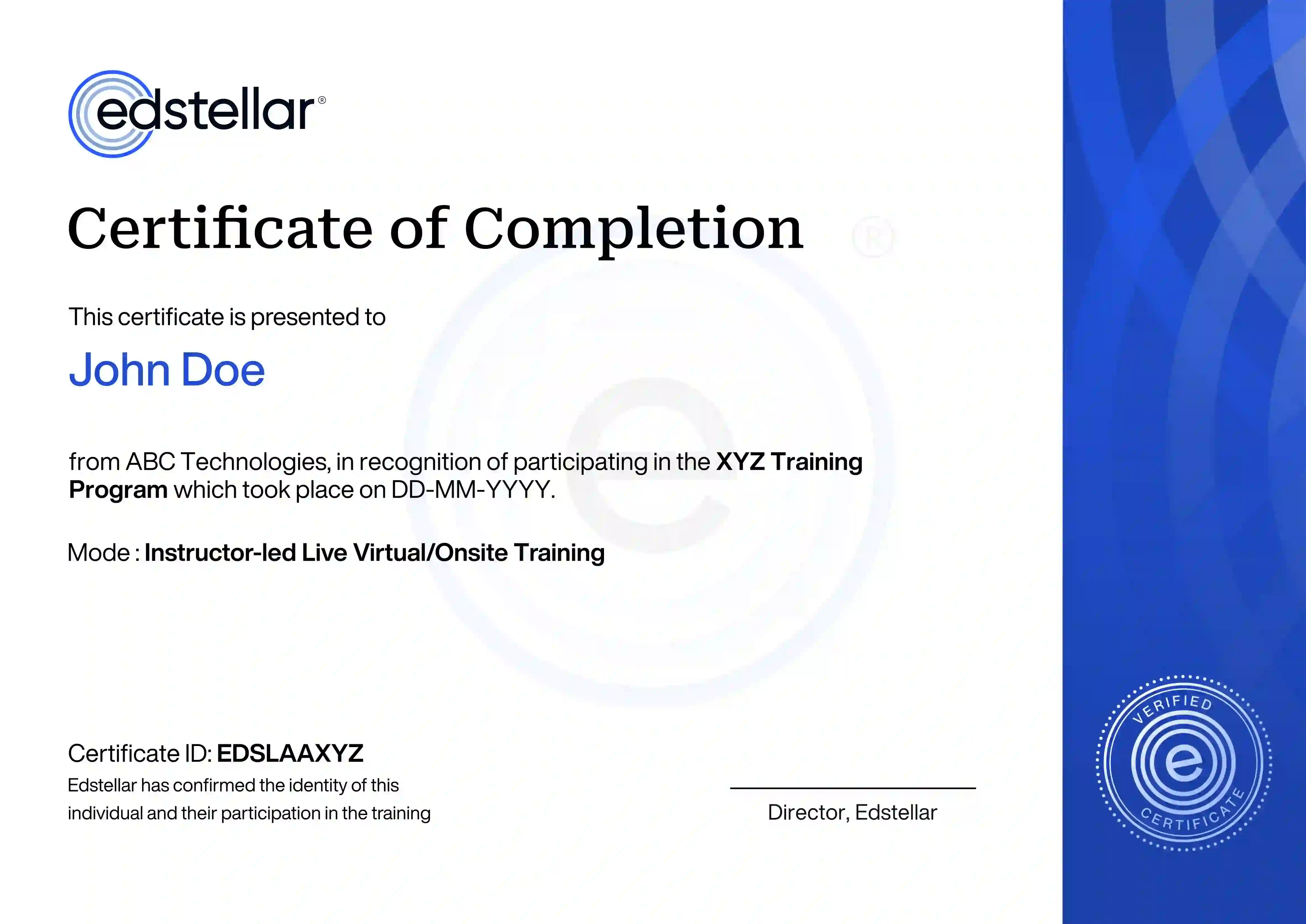
        Get Your Team Members Recognized with Edstellar’s Course Certificate

        Upon successful completion of the training course offered by Edstellar, employees receive a course completion certificate, symbolizing their dedication to ongoing learning and professional development.

        This certificate validates the employee's acquired skills and is a powerful motivator, inspiring them to enhance their expertise further and contribute effectively to organizational success.

        Certificate of Excellence

        Other Related Corporate Training Courses