.webp)
Corporate Organizational Business Analysis Training Course
Edstellar's Organizational Business Analysis instructor-led training course equips employees with the skills to analyze business environments, manage stakeholders, and develop strategic solutions. Teams will learn to apply analysis techniques, create comprehensive business cases, and align projects with organizational goals.
(Virtual / On-site / Off-site)
Available Languages
English, Español, 普通话, Deutsch, العربية, Português, हिंदी, Français, 日本語 and Italiano
Drive Team Excellence with Organizational Business Analysis Corporate Training
Empower your teams with expert-led on-site, off-site, and virtual Organizational Business Analysis Training through Edstellar, a premier corporate training provider for organizations globally. Designed to meet your specific training needs, this group training program ensures your team is primed to drive your business goals. Help your employees build lasting capabilities that translate into real performance gains.
Organizational Business Analysis involves assessing and improving an organization's processes, systems, and strategies to enhance overall efficiency, effectiveness, and alignment with business goals through data-driven insights and stakeholder engagement. Organizations require organizational business analysis to identify areas for improvement, optimize processes, and align strategies with business objectives, ultimately leading to increased operational efficiency, reduced costs, and better decision-making. Organizational Business Analysis training course enables employees to nurture a culture of ongoing improvement and well-informed decision-making. This, in turn, leads to increased efficiency, minimized risks, and sustainable business expansion.
Organizational Business Analysis instructor-led training course provided by Edstellar can be customized to meet team requirements. The virtual/onsite Organizational Business Analysis training course led by expert trainers ensures employees gain comprehensive skills in analyzing business environments, managing stakeholders, and developing strategic solutions.

Key Skills Employees Gain from instructor-led Organizational Business Analysis Training
Organizational Business Analysis skills corporate training will enable teams to effectively apply their learnings at work.
- Decision-makingDecision-Making is the ability to choose the best course of action among alternatives. this skill is important for leadership roles, as it drives effective strategies and outcomes.
- Stakeholder ManagementStakeholder Management is the ability to identify, engage, and communicate with individuals or groups affected by a project. this skill is important for project managers and business analysts to ensure alignment, foster collaboration, and achieve project success.
- Process AnalysisProcess Analysis is the skill of examining workflows to identify inefficiencies and areas for improvement. this skill is important for roles in operations, management, and quality assurance, as it enhances productivity and optimizes resources.
- Decision-making SupportDecision-Making Support involves providing data-driven insights and analysis to guide choices. This skill is important for roles in management and strategy, ensuring informed, effective decisions.
- Teamwork and CollaborationTeamwork and Collaboration involve working effectively with others to achieve common goals. This skill is important for roles in project management and healthcare, enhancing productivity and innovation.
- Project ManagementProject Management is the process of planning, executing, and closing projects efficiently. This skill is important for roles like project manager, ensuring timely delivery and resource optimization.
Key Learning Outcomes of Organizational Business Analysis Training Workshop for Employees
Upon completing Edstellar’s Organizational Business Analysis workshop, employees will gain valuable, job-relevant insights and develop the confidence to apply their learning effectively in the professional environment.
- Analyze the business change lifecycle and the role of business analysis within the process
- Create customer journey maps and rich pictures to visualize and analyze customer experiences
- Evaluate different techniques for stakeholder engagement and select appropriate methods to manage stakeholder expectations
- Apply various investigative techniques to gather information for business analysis, including interviews, workshops, and document analysis
- Develop required skills in building a conceptual business activity model (BAM) to understand key business activities and their relationships
Key Benefits of the Organizational Business Analysis Group Training with Instructor-led Face to Face and Virtual Options
Attending our Organizational Business Analysis group training classes provides your team with a powerful opportunity to build skills, boost confidence, and develop a deeper understanding of the concepts that matter most. The collaborative learning environment fosters knowledge sharing and enables employees to translate insights into actionable work outcomes.
- Empower employees with the skills to conduct gap analysis to identify the difference between the current and target state
- Provides insights into using tools like customer journey maps and rich pictures to visualize and analyze customer experiences
- Develops required skills in employees for building conceptual business activity models (BAM) to understand key business activities
- Equips the team with the techniques to analyze the business change lifecycle and align business analysis efforts with strategic goals
- Develops required skills in employees for identifying stakeholders, assessing their influence, and developing a stakeholder engagement strategy
Topics and Outline of Organizational Business Analysis Training
Our virtual and on-premise Organizational Business Analysis training curriculum is structured into focused modules developed by industry experts. This training for organizations provides an interactive learning experience that addresses the evolving demands of the workplace, making it both relevant and practical.
- Business change lifecycle
- Stages of business change
- Role of business analysis in change
- Understanding the strategic context
- Aligning analysis with strategic goals
- Strategic frameworks
- VMOST
- Vision, mission, objectives, strategy, tactics
- Performance measurement
- Importance of measuring performance
- Tools for performance measurement
- Resource audit
- Identifying and assessing resources
- Resource capabilities
- Porter’s 5 forces
- Industry analysis
- Competitive forces
- PESTLE analysis and SWOT analysis
- External environment analysis
- Internal strengths and weaknesses
- Balanced Business Scorecard (BBS)
- Components of BBS
- Implementing BBS in organizations
- Generic BBS strategy map
- Creating a strategy map
- Aligning strategies with objectives
- BBS perspectives
- Financial, customer, internal processes, learning and growth
- CSFs, KPIs, and performance targets
- Defining and measuring success
- Setting and tracking performance targets
- Critical Success Factors (CSF) and Key Performance Indicators (KPI’s)
- Identifying CSFs and KPIs
- Monitoring and improving performance
- What is a stakeholder?
- Defining stakeholders
- Stakeholder roles and influence
- Business analysis service framework
- Components of the framework
- Delivering business analysis services
- Stakeholder engagement
- Techniques for engaging stakeholders
- Managing stakeholder expectations
- Recipients of business analysis services
- Internal and external stakeholders
- Understanding stakeholder needs
- Categories of stakeholder
- Primary, secondary, and tertiary stakeholders
- Mapping stakeholder relationships
- Components of a Business Perspective
- Understanding business viewpoints
- Aligning perspectives with goals
- Approach
- Developing a stakeholder engagement strategy
- Tools for Stakeholder Analysis
- Root definition
- Defining the root problem
- Techniques for root cause analysis
- Identifying conflicts
- Recognizing stakeholder conflicts
- Resolving stakeholder issues
- Analyzing stakeholders
- Tools for Stakeholder Analysis
- Assessing stakeholder influence and interest
- Stakeholder responsibilities
- Defining stakeholder roles
- Ensuring stakeholder accountability
- Investigative techniques
- Methods for gathering information
- Selecting appropriate techniques
- Interviews and interview lifecycle
- Planning and conducting interviews
- Analyzing interview data
- Workshops and workshop lifecycle
- Organizing and facilitating workshops
- Capturing workshop outcomes
- Observation
- Techniques for effective observation
- Documenting observations
- Scenario analysis
- Developing and analyzing scenarios
- Using scenarios for decision-making
- Document analysis
- Reviewing and analyzing documents
- Extracting useful information
- Surveys/Questionnaires
- Designing effective surveys
- Analyzing survey results
- Identify an appropriate technique
- Selecting the right technique for the situation
- Combining multiple techniques
- Customer journey map
- Creating customer journey maps
- Analyzing customer experiences
- Rich pictures
- Drawing rich pictures
- Using rich pictures for analysis
- Elements of a rich picture
- Components of rich pictures
- Interpreting rich pictures
- Empathy mapping and mind maps
- Creating empathy maps
- Developing mind maps for analysis
- Conceptual business activity model
- Understanding business activity modeling
- Benefits of using BAM
- Approach to business activity modeling
- Steps for creating a BAM
- Best practices
- Benefits of BAM
- Advantages of using BAM in analysis
- Case studies
- Corner shop
- Applying BAM to a corner shop scenario
- Identifying key activities
- Identifying activities
- Defining business activities
- Prioritizing activities
- Public lending library
- Applying BAM to a public lending library
- Identifying key activities
- Building the Business Activity Model
- Constructing a BAM
- Tools for BAM development
- Library Business Activity Model
- Creating a BAM for a library
- Analyzing the model
- Some common errors in BAM
- Identifying and avoiding common mistakes
- Ensuring accuracy in BAM
- Building consensus by resolving conflicts
- Techniques for building consensus
- Resolving conflicts in BAM
- Consensus BAM rationale
- Rationale for achieving consensus
- Benefits of consensus in BAM
- When – Business events
- Identifying business events
- Integrating events into BAM
- Improvements to the business system
- Identifying areas for improvement
- Implementing changes based on BAM
- Identifying areas of concern (BAM)
- Recognizing issues in BAM
- Addressing areas of concern
- TOM and POPIT
- Understanding Target Operating Model (TOM)
- Using POPIT for analysis
- Target operating model
- Developing a TOM
- Aligning TOM with business goals
- Design thinking
- Principles of design thinking
- Applying design thinking to business analysis
- Divergent and convergent thinking
- Understanding divergent thinking
- Understanding convergent thinking
- Applying both thinking styles
- Gap analysis process
- Conducting a gap analysis
- Identifying gaps and opportunities
- POPIT and gap analysis
- Using POPIT for gap analysis
- Case studies and examples
- Identify the areas of feasibility assessment
- Assessing feasibility of solutions
- Techniques for feasibility analysis
- Structure of a business case
- Key components of a business case
- Organizing and presenting a business case
- Categories of costs and benefits
- Identifying costs and benefits
- Categorizing and prioritizing costs and benefits
- Analysis of costs and benefits
- Techniques for cost-benefit analysis
- Tools for analyzing costs and benefits
- Risk assessment
- Identifying risks
- Assessing risk impact and likelihood
- Risk management process
- Developing a risk management plan
- Implementing risk mitigation strategies
- Risk areas
- Common areas of risk
- Strategies for addressing risks
- Risk Analysis
- Conducting a risk analysis
- Tools for risk assessment
- Investment appraisal
- Methods for appraising investments
- Tools for investment analysis
- Investment and Appraisal Techniques
- Techniques for evaluating investments
- Selecting the right appraisal method
- Payback
- Understanding payback period
- Calculating payback
- Payback and risk
- Relationship between payback and risk
- Analyzing payback in risk context
- Discounted cash flow and Net Present Value
- Calculating discounted cash flow
- Understanding net present value (NPV)
- Impact assessment
- Assessing impact of business changes
- Techniques for impact assessment
- Business case within the business change lifecycle
- Role of business case in change lifecycle
- Integrating business case with change processes
Who Can Take the Organizational Business Analysis Training Course
The Organizational Business Analysis training program can also be taken by professionals at various levels in the organization.
- Business Analysts
- Project Managers
- Strategic Planners
- Change Management Leaders
- Process Analysts
- IT Professionals
- Product Owners
- Systems Analysts
- Solution Architects
- Business Process Managers
- Requirements Analysts
- Risk Analysts
Prerequisites for Organizational Business Analysis Training
There are no specific prerequisites for Organizational Business Analysis training. However, it is beneficial to have a basic understanding of business concepts and terminology.
Corporate Group Training Delivery Modes
for Organizational Business Analysis Training
At Edstellar, we understand the importance of impactful and engaging training for employees. As a leading Organizational Business Analysis training provider, we ensure the training is more interactive by offering Face-to-Face onsite/in-house or virtual/online sessions for companies. This approach has proven to be effective, outcome-oriented, and produces a well-rounded training experience for your teams.


.webp)
Edstellar's Organizational Business Analysis virtual/online training sessions bring expert-led, high-quality training to your teams anywhere, ensuring consistency and seamless integration into their schedules.
.webp)
Edstellar's Organizational Business Analysis inhouse face to face instructor-led training delivers immersive and insightful learning experiences right in the comfort of your office.
.webp)
Edstellar's Organizational Business Analysis offsite face-to-face instructor-led group training offer a unique opportunity for teams to immerse themselves in focused and dynamic learning environments away from their usual workplace distractions.
Explore Our Customized Pricing Package
for
Organizational Business Analysis Corporate Training
Looking for pricing details for onsite, offsite, or virtual instructor-led Organizational Business Analysis training? Get a customized proposal tailored to your team’s specific needs.
64 hours of group training (includes VILT/In-person On-site)
Tailored for SMBs
Tailor-Made Trainee Licenses with Our Exclusive Training Packages!
160 hours of group training (includes VILT/In-person On-site)
Ideal for growing SMBs
Tailor-Made Trainee Licenses with Our Exclusive Training Packages!
400 hours of group training (includes VILT/In-person On-site)
Designed for large corporations
Tailor-Made Trainee Licenses with Our Exclusive Training Packages!
Unlimited duration
Designed for large corporations
Edstellar: Your Go-to Organizational Business Analysis Training Company
Experienced Trainers
Our trainers bring years of industry expertise to ensure the training is practical and impactful.
Quality Training
With a strong track record of delivering training worldwide, Edstellar maintains its reputation for its quality and training engagement.
Industry-Relevant Curriculum
Our course is designed by experts and is tailored to meet the demands of the current industry.
Customizable Training
Our course can be customized to meet the unique needs and goals of your organization.
Comprehensive Support
We provide pre and post training support to your organization to ensure a complete learning experience.
Multilingual Training Capabilities
We offer training in multiple languages to cater to diverse and global teams.
What Our Clients Say
We pride ourselves on delivering exceptional training solutions. Here's what our clients have to say about their experiences with Edstellar.
"The Organizational Business Analysis training provided me with comprehensive capabilities that elevated my expertise. As a Senior Software Engineer, I needed to understand strategic frameworks deeply, and this course delivered case studies gave me hands-on experience with industry best practices. The knowledge gained has been immediately applicable to mission-critical projects and initiatives. Highly recommend for anyone serious about this field.”
Carol Dixon
Senior Software Engineer,
Business Operations Platform
"The Organizational Business Analysis training enhanced my ability to architect and implement sophisticated strategic implementation strategies. Understanding practical applications through intensive practical simulations exercises proved invaluable Our solution delivery efficiency and quality have increased substantially across the board. The detailed exploration of hands-on exercises provided methodologies I leverage in every engagement.”
Lukas Van Der Berg
Senior Software Engineer,
Corporate Strategy Firm
"This Organizational Business Analysis course provided our team with comprehensive industry best practices capabilities we immediately put into practice. As a Senior Software Engineer managing complex professional expertise significantly enhanced our delivery capacity. Our department achieved a remarkable 50% improvement in operational efficiency metrics. The training fundamentally improved our team's performance metrics and overall efficiency.”
Lutfi Wajid
Senior Software Engineer,
Enterprise Consulting Services
“Edstellar’s Management training programs have greatly improved our teams’ ability to lead with clarity, confidence, and operational efficiency. The sessions combine practical leadership frameworks, real-world case studies, and hands-on exercises that strengthen decision-making, cross-functional collaboration, and execution excellence across departments, driving measurable improvements in overall business performance.”
Meera Rao
HR & L&D Head,
A Global Services Company
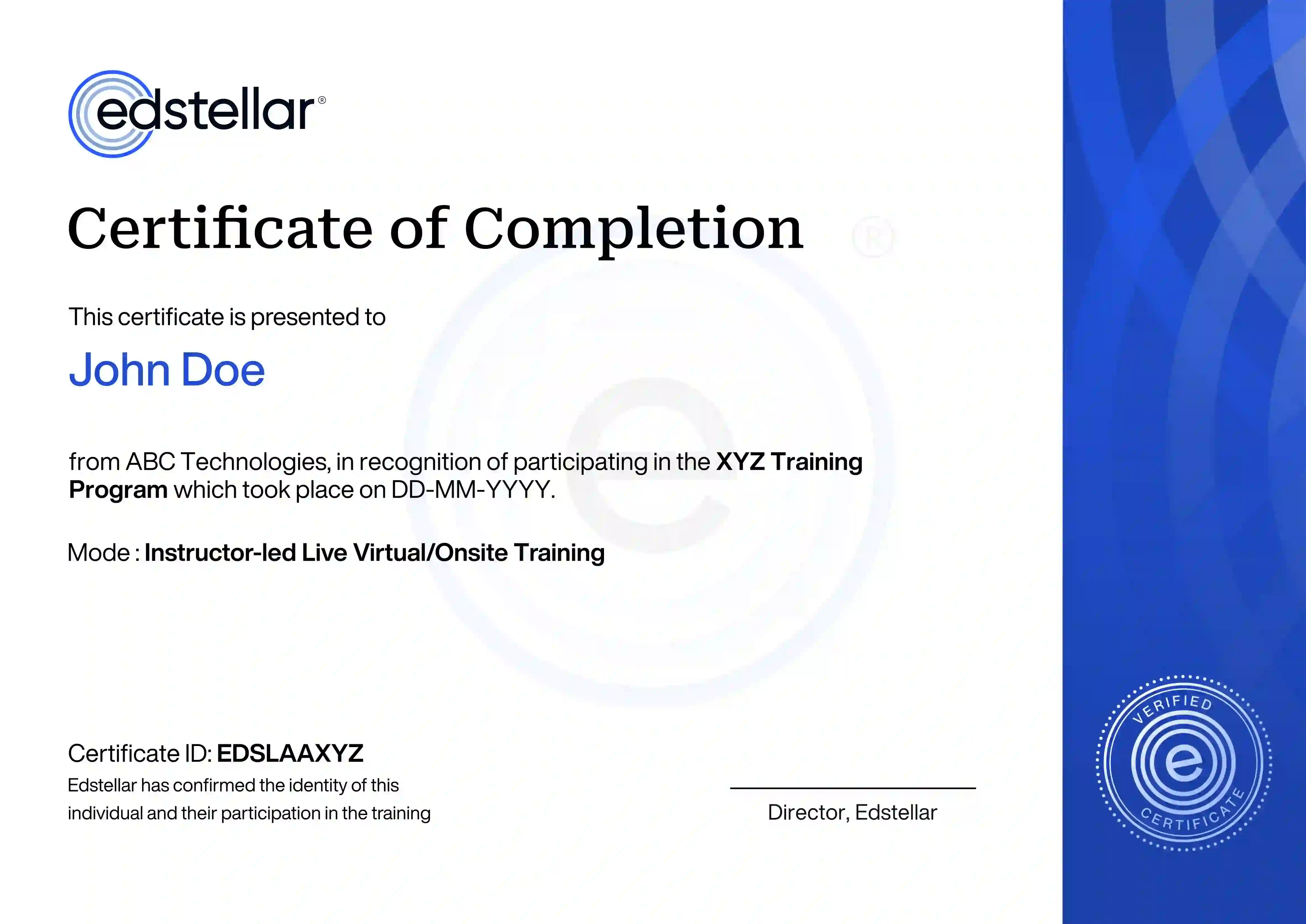
Get Your Team Members Recognized with Edstellar’s Course Certificate
Upon successful completion of the training course offered by Edstellar, employees receive a course completion certificate, symbolizing their dedication to ongoing learning and professional development.
This certificate validates the employee's acquired skills and is a powerful motivator, inspiring them to enhance their expertise further and contribute effectively to organizational success.


We have Expert Trainers to Meet Your Organizational Business Analysis Training Needs
The instructor-led training is conducted by certified trainers with extensive expertise in the field. Participants will benefit from the instructor's vast knowledge, gaining valuable insights and practical skills essential for success in Access practices.
Other Related Corporate Training Courses
Explore More Courses
Edstellar is a one-stop instructor-led corporate training and coaching solution that addresses organizational upskilling and talent transformation needs globally. Edstellar offers 2000+ tailored programs across disciplines that include Technical, Behavioral, Management, Compliance, Leadership and Social Impact.
FAQs
BlogSitemap